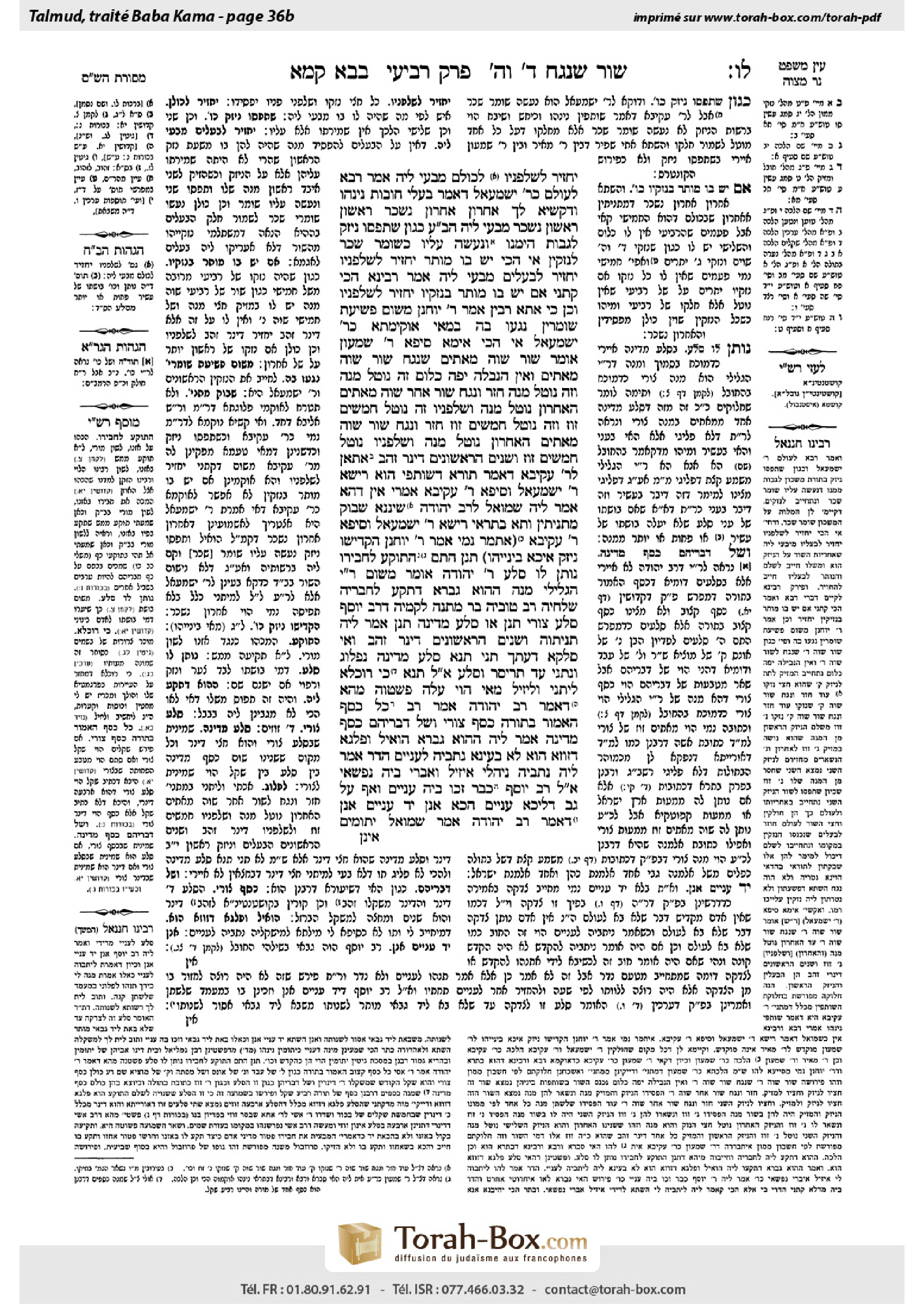
Bava Kamma 36b: Talmud study for Daf Yomi
Study the Talmud for Daf Yomi with scanned pages, Hebrew text, English translations from Sefaria and AI-generated French translations.
Passage selection and English or AI-generated French translation are available where the scan has annotations. Daf Study is independent of Torah-Box and Sefaria.
Browse Bava Kamma · בבא קמא · All tractatesBava Kamma 36b text and translations
This page of Bava Kamma includes the Aramaic text, an English translation and an AI-generated French translation, alongside the scan above.
בבא קמא ל״ו ב · Aramaic and Hebrew text
יַחֲזִיר לְשֶׁלְּפָנָיו״?! ״לְכוּלָּם״ מִבְּעֵי לֵיהּ!
אָמַר רָבָא: לְעוֹלָם כְּרַבִּי יִשְׁמָעֵאל – דְּאָמַר בַּעֲלֵי חוֹבוֹת נִינְהוּ; וּדְקַשְׁיָא לָךְ: ״אַחֲרוֹן אַחֲרוֹן נִשְׂכָּר״?! ״רִאשׁוֹן רִאשׁוֹן נִשְׂכָּר״ מִבְּעֵי לֵיהּ! הָכָא בְּמַאי עָסְקִינַן – כְּגוֹן שֶׁתְּפָסוֹ נִיזָּק לִגְבּוֹת הֵימֶנּוּ, וְנַעֲשָׂה עָלָיו כְּשׁוֹמֵר שָׂכָר לִנְזָקִין.
אִי הָכִי, ״יֵשׁ בּוֹ מוֹתָר – יַחֲזִיר לְשֶׁלְּפָנָיו״?! ״יַחֲזִיר לַבְּעָלִים״ מִבְּעֵי לֵיהּ!
אָמַר רָבִינָא, הָכִי קָתָנֵי: אִם יֵשׁ בּוֹ מוֹתָר בִּנְזָקָיו – יַחֲזִיר לְשֶׁלְּפָנָיו.
וְכֵן כִּי אֲתָא רָבִין, אָמַר רַבִּי יוֹחָנָן: מִשּׁוּם פְּשִׁיעַת שׁוֹמְרִין נָגְעוּ בָּהּ.
בְּמַאי אוֹקֵימְתַּהּ – כְּרַבִּי יִשְׁמָעֵאל; אִי הָכִי, אֵימָא סֵיפָא, רַבִּי שִׁמְעוֹן אוֹמֵר: שׁוֹר שָׁוֶה מָאתַיִם שֶׁנָּגַח שׁוֹר שָׁוֶה מָאתַיִם, וְאֵין הַנְּבֵלָה יָפָה כְּלוּם – זֶה נוֹטֵל מָנֶה וְזֶה נוֹטֵל מָנֶה.
חָזַר וְנָגַח שׁוֹר אַחֵר שָׁוֶה מָאתַיִם – הָאַחֲרוֹן נוֹטֵל מָנֶה, וְשֶׁלְּפָנָיו – זֶה נוֹטֵל חֲמִשִּׁים זוּז, וְזֶה נוֹטֵל חֲמִשִּׁים זוּז. חָזַר וְנָגַח שׁוֹר שָׁוֶה מָאתַיִם – הָאַחֲרוֹן נוֹטֵל מָנֶה, וְשֶׁלְּפָנָיו נוֹטֵל חֲמִשִּׁים זוּז, וּשְׁנַיִם הָרִאשׁוֹנִים דִּינַר זָהָב.
אֲתָאן לְרַבִּי עֲקִיבָא, דְּאָמַר: תּוֹרָא דְשׁוּתָּפֵי הוּא; רֵישָׁא רַבִּי יִשְׁמָעֵאל וְסֵיפָא רַבִּי עֲקִיבָא?
אָמְרִי: אִין, דְּהָא אֲמַר לֵיהּ שְׁמוּאֵל לְרַב יְהוּדָה: שִׁינָּנָא, שְׁבוֹק מַתְנִיתִין וְתָא בָּתְרַאי – רֵישָׁא רַבִּי יִשְׁמָעֵאל וְסֵיפָא רַבִּי עֲקִיבָא.
אִתְּמַר נָמֵי, אָמַר רַבִּי יוֹחָנָן: הִקְדִּישׁוֹ נִיזָּק אִיכָּא בֵּינַיְיהוּ.
תְּנַן הָתָם: הַתּוֹקֵעַ לַחֲבֵירוֹ – נוֹתֵן לוֹ סֶלַע. רַבִּי יְהוּדָה אוֹמֵר מִשּׁוּם רַבִּי יוֹסֵי הַגְּלִילִי: מָנֶה.
הָהוּא גַּבְרָא דִּתְקַע לְחַבְרֵיהּ. שַׁלְּחֵיהּ רַב טוֹבִיָּה בַּר מַתְנָה לְקַמֵּיהּ דְּרַב יוֹסֵף: סֶלַע צוֹרִי תְּנַן, אוֹ סֶלַע מְדִינָה תְּנַן?
אֲמַר לֵיהּ, תְּנֵיתוּהָ: וּשְׁנַיִם הָרִאשׁוֹנִים דִּינַר זָהָב. וְאִי סָלְקָא דַעְתָּךְ תָּנֵי תַּנָּא סֶלַע מְדִינָה, נִפְלוֹג וְנִתְנֵי עַד תְּרֵיסַר וְסֶלַע!
אֲמַר לֵיהּ: תַּנָּא כִּי רוֹכְלָא לִיתְנֵי וְלֵיזִיל?!
מַאי הָוֵי עֲלַהּ? פַּשְׁטוּהָ מֵהָא דְּאָמַר רַב יְהוּדָה אָמַר רַב: כׇּל כֶּסֶף הָאָמוּר בַּתּוֹרָה – כֶּסֶף צוֹרִי, וְשֶׁל דִּבְרֵיהֶם – כֶּסֶף מְדִינָה.
אֲמַר לֵיהּ הַהוּא גַּבְרָא: הוֹאִיל וּפַלְגָא דְזוּזָא הוּא – לָא בָּעֵינָא, נִתְּבֵיהּ לַעֲנִיִּים. הֲדַר אֲמַר לֵיהּ: נִתְּבֵיהּ נִיהֲלִי, אֵיזִיל וְאַבְרֵי בֵּיהּ נַפְשַׁאי.
אֲמַר לֵיהּ רַב יוֹסֵף: כְּבָר זְכוֹ בֵּיהּ עֲנִיִּים. וְאַף עַל גַּב דְּלֵיכָּא עֲנִיִּים הָכָא, אֲנַן יַד עֲנִיִּים אֲנַן. דְּאָמַר רַב יְהוּדָה אָמַר שְׁמוּאֵל: יְתוֹמִים
Bava Kamma 36b · English translation
he shall return it to the owner of the previous ox, the mishna should have ruled that the surplus shall be returned to all of them, i.e., all the prior injured parties, since they all share joint ownership of the belligerent ox.
Rava said: Actually, the mishna is in accordance with the opinion of Rabbi Yishmael, who says that all the injured parties are creditors. And as for the difficulty you pose, that instead of stating that the owner of the latest of the oxen gored in succession gains, the mishna should have stated that the owner of the earliest of the oxen gored in succession gains, that can be answered. With what are we dealing here? We are dealing with a case where the first injured party seized the ox to collect payment from it, and consequently became like a paid bailee with regard to damage it causes. Therefore, he is responsible for any subsequent attacks by the ox. Similarly, if the next injured party seizes the ox from the first as compensation, he becomes responsible for any subsequent attacks.
The Gemara asks: If so, instead of the mishna stating that if there is surplus value left in his ox after he pays that owner, he shall return it to the owner of the previous ox that was gored, it should have stated that he shall return it to its owner, since half the value of the belligerent ox belongs to its owner, who is not responsible for any later damage it causes.
Ravina said that this is what the mishna is teaching: If there is surplus value with regard to its damages, i.e., the latter injured party sustained less of a loss than the previous one, that injured party shall return this surplus value to the previous injured party.
Similarly, when Ravin came from Eretz Yisrael, he related that Rabbi Yoḥanan said: The mishna touched on this topic with regard to a bailee’s negligence.
The Gemara asks: In accordance with which opinion did you interpret the ruling in the mishna? Was it in accordance with the opinion of Rabbi Yishmael? If so, say the latter clause of the mishna: Rabbi Shimon says that the division of the compensation is as follows: With regard to an innocuous ox worth two hundred dinars that gored an ox worth two hundred dinars, thereby killing it, and the carcass is worthless, the injured party takes one hundred dinars from the proceeds of the sale of the belligerent ox, and the owner of the belligerent ox takes the remaining one hundred dinars.
If the ox, after goring the first ox but before compensation had been paid, again gored another ox worth two hundred dinars, and the carcass is worthless, the owner of the last ox that was gored takes one hundred dinars; and with regard to payment for the previous goring, the owner of this ox that was gored takes fifty dinars, which is half the remaining value of the belligerent ox after one hundred dinars were paid to the last injured party, and the owner of that belligerent ox takes the remaining fifty dinars. If the ox, after goring the first two oxen but before compensation had been paid, again gored another ox worth two hundred dinars, and the carcass is worthless, the last injured party takes one hundred dinars, the previous one takes fifty dinars, and the first two divide the remainder, each receiving one gold dinar, which is worth twenty-five silver dinars.
The Gemara continues: In the ruling of Rabbi Shimon, we arrive at the opinion of Rabbi Akiva, who says that the ox belongs to its owner and to the injured party, who are considered partners in the ownership of the ox. Is it possible that the first clause is in accordance with the opinion of Rabbi Yishmael and the latter clause is in accordance with the opinion of Rabbi Akiva?
The Sages said that yes, this is the case, as Shmuel said to Rav Yehuda: Shinnana, leave the presumption that the entire mishna follows one opinion and follow my interpretation: The first clause is in accordance with the opinion of Rabbi Yishmael and the latter clause is in accordance with the opinion of Rabbi Akiva.
It was also stated that Rabbi Yoḥanan says: The practical difference between the opinions of Rabbi Meir and Rabbi Shimon in the mishna is with regard to a case where the injured party consecrated the ox. If he is a partner in the ownership of the ox, his consecration takes effect; if he is considered merely a creditor, the consecration is ineffective. Evidently, Rabbi Yoḥanan also holds that the dispute in the mishna corresponds to the dispute between Rabbi Yishmael and Rabbi Akiva.
§ With regard to the gold dinar mentioned in the mishna, we learned in another mishna there (90a): One who slaps [hatokea] another is liable to give him a sela as a compensatory fine. Rabbi Yehuda says in the name of Rabbi Yosei HaGelili: He is liable to give him one hundred dinars.
The Gemara relates: There was a certain man who slapped another. Rav Toviya bar Mattana sent an enquiry before Rav Yosef, asking him whether the sela we learned about in the mishna is referring to a Tyrian sela, which is worth four dinars, or whether the sela we learned about in the mishna is referring to a provincial sela, worth only half of a dinar, or one-eighth of a Tyrian sela.
Rav Yosef said to him: You learned this in a mishna: And the first two divide the remainder, each receiving one gold dinar, worth twenty-five silver dinars. And if it enters your mind that the tanna teaches monetary sums using a provincial sela in order to calculate compensation, let him further divide the value that the first two litigants receive and teach a case where the belligerent ox gored an additional ox, so that their shares decrease until they reach twelve dinars and one sela apiece, which are twelve and a half dinars. The fact that he does not do so indicates that the mishna does not use a provincial sela, whose value is less than one dinar, and therefore a gold dinar cannot be divided in a manner that leaves each party with whole coins.
Rav Toviya bar Mattana said to him: This is not proof; should the tanna have continued teaching additional cases, exhausting all possibilities, like a peddler selling his wares, who advertises every item of his merchandise? The cases cited in the mishna suffice to illustrate the point.
What halakhic conclusion was reached about this matter? The Sages resolved it based on that which Rav Yehuda says that Rav says: All references to coinage mentioned in the Torah refer to Tyrian coinage, whereas all mentions of coinage in the statements of the Sages refer to provincial coinage. Therefore, a person who slaps another is fined a provincial sela, worth half of a dinar.
Following the verdict, that man who was slapped said to Rav Yosef: Since the fine is only half a dinar, I do not want it, as it is beneath me to collect such an amount. Instead, let him give it to the poor. Then he retracted his decision, and said to Rav Yosef: Let him give it to me, and I will go and sustain [ve’avri] myself with it.
Rav Yosef said to him: Since you already committed to give it to charity, the poor have already acquired it and it now belongs to them. And although there are no poor people here to acquire it, we, the court, are the hand, i.e., the legal extension, of the poor. We represent them, as Rav Yehuda says that Shmuel says: Orphans
Bava Kamma 36b · Traduction française (IA)
il doit le rendre à l'propriétaire de l'âne précédent, la Michna aurait dû déclarer que le surplus doit être rendu à tous ceux-ci, c'est-à-dire à tous les parties précédemment blessées, puisqu'ils partagent la propriété conjointe de l'âne belliqueux.
Rava dit : En réalité, la Michna suit l'opinion de Rabbi Yishmael, qui affirme que toutes les parties blessées sont des créanciers. Et concernant la difficulté que vous évoquez, à savoir que la Michna ne mentionne pas que l'propriétaire de l'âne gorgé en dernier gagne, mais qu'elle aurait dû mentionner que l'propriétaire de l'âne gorgé en premier gagne, cela peut être répondu. Avec quoi sommes-nous en train de traiter ? Nous traitons d'un cas où la première partie blessée a saisi l'âne pour obtenir un paiement, et est ainsi devenue un dépositaire payé concernant les dommages qu'il cause. Par conséquent, il est responsable de tout attaques ultérieures de l'âne. De même, si la prochaine partie blessée saisit l'âne du premier comme compensation, il devient responsable de tout attaques ultérieures.
La Guemara pose la question : Si c'est ainsi, au lieu de la Michna indiquant que si il reste une valeur excédentaire dans son âne après avoir payé cet propriétaire, il doit le rendre à l'propriétaire de l'âne précédent qui a été gorgé, elle aurait dû indiquer qu'il doit le rendre à son propriétaire, puisque la moitié de la valeur de l'âne belliqueux appartient à son propriétaire, qui n'est pas responsable des dommages ultérieurs qu'il cause.
Ravina dit que c'est ce que la Michna enseigne : Si la valeur excédentaire existe concernant les dommages, c'est-à-dire que la partie blessée ultérieure a subi moins de perte que la précédente, cette partie blessée doit rendre cette valeur excédentaire à la partie blessée précédente.
De même, lorsque Ravin est venu d'Eretz Yisrael, il rapporta que Rabbi Yoḥanan dit : La Michna a abordé ce sujet concernant la négligence d'un dépositaire.
La Guemara pose la question : Selon quel avis avez-vous interprété la décision de la Michna ? Selon l'avis de Rabbi Yishmael ? Si c'est le cas, dites la dernière clause de la Michna : Rabbi Shimon dit que la division de la compensation est comme suit : Concernant un taureau belliqueux valant deux cents dinars qui a taillé un taureau valant deux cents dinars, le tuant, et le cadavre étant inutile, la partie blessée prend cent dinars des recettes de la vente du taureau belliqueux, et l'propriétaire du taureau belliqueux prend les cent dinars restants.
Si l'ox, après avoir tenu le premier ox mais avant que la compensation n'ait été payée, a à nouveau tenu un autre ox valant deux cents dinars, et le cadavre étant inutile, l'propriétaire de l'ox tenu en dernier prend cent dinars ; et concernant la compensation pour la tenue précédente, l'propriétaire de cet ox tenu prend cinquante dinars, qui est la moitié de la valeur restante de l'ox belliqueux après que cent dinars aient été payés à la dernière partie blessée, et l'propriétaire de cet ox belliqueux prend les cinquante dinars restants. Si l'ox, après avoir tenu les deux premiers ox mais avant que la compensation n'ait été payée, a à nouveau tenu un autre ox valant deux cents dinars, et le cadavre étant inutile, la dernière partie blessée prend cent dinars, la précédente prend cinquante dinars, et les deux premiers partagent le reste, chacun recevant un dinar d'or, qui vaut vingt-cinq dinars d'argent.
La Guemara continue : Dans la décision de Rabbi Shimon, nous arrivons à l'opinion de Rabbi Akiva, qui dit que l'ox appartient à son propriétaire et à la partie blessée, qui sont considérés comme partenaires dans la propriété de l'ox. Est-il possible que la première clause soit selon l'opinion de Rabbi Yishmael et la dernière clause selon l'opinion de Rabbi Akiva ?
Les Sages dirent que oui, c'est le cas, comme Shmuel dit à Rav Yehuda : Shinnana, laissez tomber l'idée que toute la Michna suit un seul avis et suivez mon interprétation : La première clause suit l'opinion de Rabbi Yishmael et la dernière clause suit l'opinion de Rabbi Akiva.
Il a également été dit que Rabbi Yoḥanan dit : La différence pratique entre les opinions de Rabbi Meir et Rabbi Shimon dans la Michna est relative à un cas où la partie blessée a consacré l'âne. Si c'est un partenaire dans la propriété de l'âne, sa consécration est efficace ; si c'est considéré comme un simple créancier, la consécration est inefficace. Évidemment, Rabbi Yoḥanan tient également que le débat dans la Michna correspond au débat entre Rabbi Yishmael et Rabbi Akiva.
§ Concernant le dinar d'or mentionné dans la Michna, nous avons appris dans une autre Michna là (90a) : Celui qui frappe un autre est tenu de lui donner un sela comme amendement. Rabbi Yehuda dit en nom de Rabbi Yosei HaGelili : Il est tenu de lui donner cent dinars.
La Guemara rapporte : Il y avait un certain homme qui a frappé un autre. Rav Toviya bar Mattana envoya une question à Rav Yosef, lui demandant s'il s'agissait d'un sela tyrien, qui vaut quatre dinars, ou s'il s'agissait d'un sela provincial, valant seulement la moitié d'un dinar, ou un huitième d'un sela tyrien.
Rav Yosef dit à lui : Vous avez appris cela dans une Michna : Et les deux premiers partagent le reste, chacun recevant un dinar d'or, valant vingt-cinq dinars d'argent. Et si cela entre dans votre esprit que le tanna enseigne les montants monétaires en utilisant un sela provincial pour calculer la compensation, faites-le diviser la valeur que les deux premiers litigants reçoivent et enseignez un cas où un taureau belliqueux a blessé un autre taureau, de sorte que leurs parts diminuent jusqu'à ce qu'ils atteignent douze dinars et un sela chacun, soit douze et demi dinars. Le fait qu'il ne le fasse pas indique que la Michna ne utilise pas un sela provincial, dont la valeur est inférieure à un dinar, et par conséquent un dinar d'or ne peut pas être divisé de manière à ce que chaque partie reçoive des pièces entières.
Rav Toviya bar Mattana dit à celui-ci : Cela n'est pas une preuve ; aurait-on dû que le tanna ait continué à enseigner d'autres cas, épuisant toutes les possibilités, comme un marchand qui vend ses marchandises, qui présente chaque article de ses biens ? Les cas cités dans la mishna suffisent à illustrer le point.
Quelle conclusion halakhique a-t-on tirée concernant cette affaire ? Les Sages l'ont résolu sur la base de ce que Rav Yehuda dit que Rav dit : Toutes les mentions de monnaie dans la Torah font référence à la monnaie tyrienne, tandis que toutes les mentions de monnaie dans les déclarations des Sages font référence à la monnaie provinciale. Ainsi, une personne qui frappe un autre est condamnée à une amende de sela provincial, valant la moitié d'un dinar.
Après le verdict, celui qui avait été frappé dit à Rav Yosef : Puisque l'amende est seulement la moitié d'un dinar, je ne veux pas la prendre, car cela me semble trop bas pour me l'attacher. Au lieu de cela, laissez-le donner à l'indigent. Puis il rétracta sa décision et dit à Rav Yosef : Laissez-le me le donner, et je m'en servirai pour me sustenter.
Rav Yosef dit à lui : Puisque vous avez déjà engagé de le donner en charité, les pauvres l'ont déjà acquis et il leur appartient désormais. Et même si aucun pauvre n'est ici pour l'acquérir, nous, la cour, sommes la main, c'est-à-dire l'extension juridique, des pauvres. Nous représentons les pauvres, comme Rav Yehuda dit que Shmuel dit : Les orphelins
Traduction française générée par IA à partir de l’édition anglaise de Sefaria. Vérifie toujours un passage avec le texte source.
Text from Sefaria: William Davidson Edition - Vocalized Aramaic (CC BY NC); William Davidson Edition - English (CC BY NC).