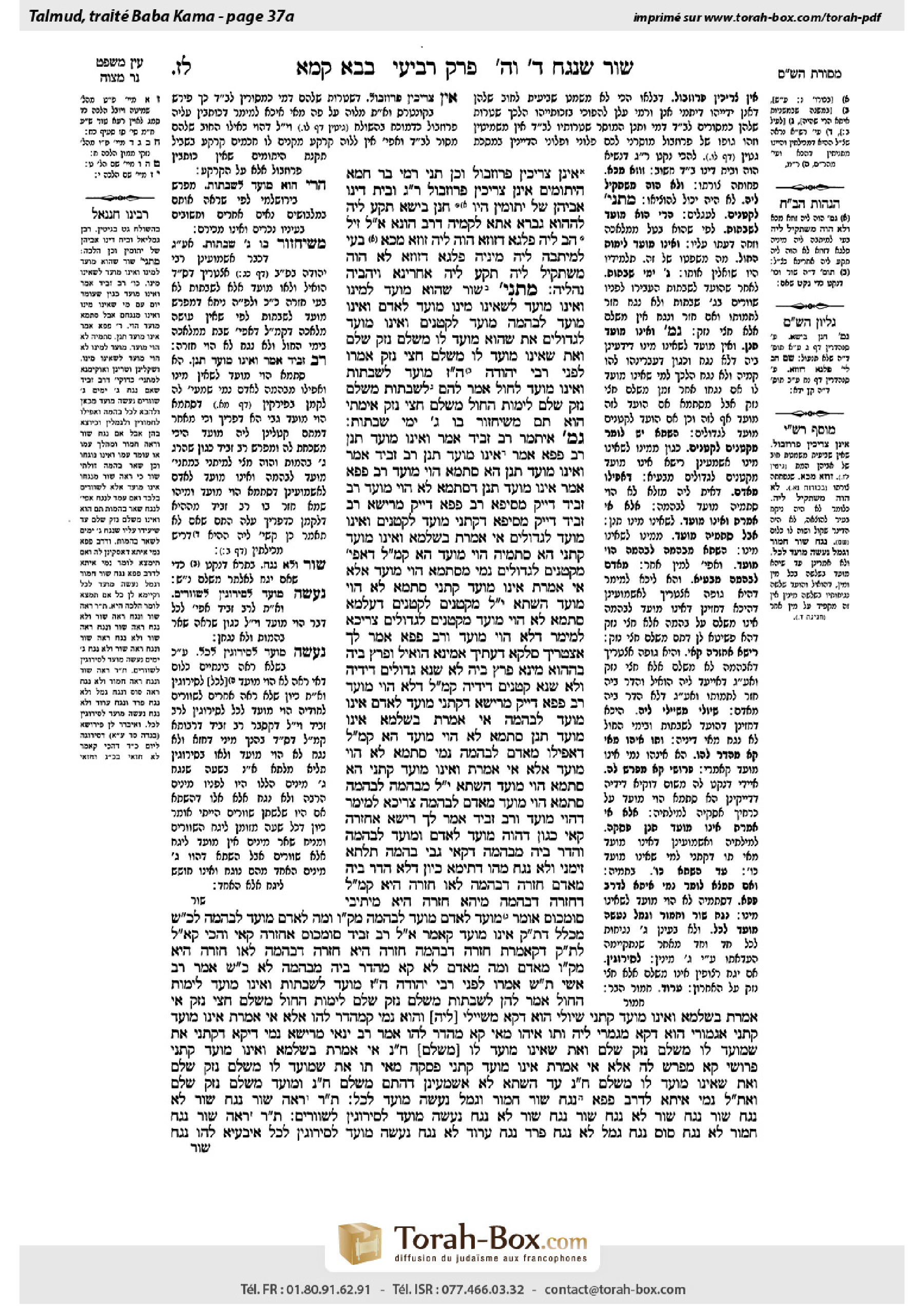
Bava Kamma 37a: Talmud study for Daf Yomi
Study the Talmud for Daf Yomi with scanned pages, Hebrew text, English translations from Sefaria and AI-generated French translations.
Passage selection and English or AI-generated French translation are available where the scan has annotations. Daf Study is independent of Torah-Box and Sefaria.
Browse Bava Kamma · בבא קמא · All tractatesBava Kamma 37a text and translations
This page of Bava Kamma includes the Aramaic text, an English translation and an AI-generated French translation, alongside the scan above.
בבא קמא ל״ז א · Aramaic and Hebrew text
אֵינָן צְרִיכִין פְּרוֹזְבּוּל.
וְכֵן תָּנֵי רָמֵי בַּר חָמָא: הַיְּתוֹמִים אֵינָן צְרִיכִין פְּרוֹזְבּוּל – רַבָּן גַּמְלִיאֵל וּבֵית דִּינוֹ אֲבִיהֶן שֶׁל יְתוֹמִין הָיוּ.
חָנָן בִּישָׁא תְּקַע לֵיהּ לְהָהוּא גַּבְרָא. אֲתָא לְקַמֵּיהּ דְּרַב הוּנָא, אֲמַר לֵיהּ: זִיל הַב לֵיהּ פַּלְגָא דְזוּזָא. הֲוָה לֵיהּ זוּזָא מָכָא, בָּעֵי לְמִיתְּבֵהּ לֵיהּ מִינֵּיהּ פַּלְגָא דְּזוּזָא, לָא הֲוָה מִשְׁתְּקִיל לֵיהּ. תְּקַע לֵיהּ אַחֲרִינָא, וְיַהֲבֵיהּ נִהֲלֵיהּ.
מַתְנִי׳ שׁוֹר שֶׁהוּא מוּעָד לְמִינוֹ, וְאֵינוֹ מוּעָד לְשֶׁאֵינוֹ מִינוֹ; מוּעָד לְאָדָם וְאֵינוֹ מוּעָד לִבְהֵמָה; מוּעָד לִקְטַנִּים וְאֵינוֹ מוּעָד לִגְדוֹלִים; אֶת שֶׁהוּא מוּעָד לוֹ – מְשַׁלֵּם נֶזֶק שָׁלֵם, וְאֶת שֶׁאֵינוֹ מוּעָד לוֹ – מְשַׁלֵּם חֲצִי נֶזֶק.
אָמְרוּ לִפְנֵי רַבִּי יְהוּדָה: הֲרֵי זֶה מוּעָד לַשַּׁבָּתוֹת וְאֵינוֹ מוּעָד לַחוֹל? אָמַר לָהֶם: לַשַּׁבָּתוֹת – מְשַׁלֵּם נֶזֶק שָׁלֵם, לִימוֹת הַחוֹל – מְשַׁלֵּם חֲצִי נֶזֶק.
אֵימָתַי הוּא תָּם? מִשֶּׁיַּחְזוֹר בּוֹ שְׁלֹשָׁה יְמֵי שַׁבָּתוֹת.
גְּמָ׳ אִיתְּמַר, רַב זְבִיד אָמַר: ״וְאֵינוֹ מוּעָד״ תְּנַן. רַב פָּפָּא אָמַר: ״אֵינוֹ מוּעָד״ תְּנַן.
רַב זְבִיד אָמַר ״וְאֵינוֹ מוּעָד״ תְּנַן – הָא סְתָמָא הָוֵי מוּעָד. רַב פָּפָּא אָמַר ״אֵינוֹ מוּעָד״ תְּנַן – דִּסְתָמָא לָא הָוֵי מוּעָד.
רַב זְבִיד דָּיֵיק מִסֵּיפָא, רַב פָּפָּא דָּיֵיק מֵרֵישָׁא.
רַב זְבִיד דָּיֵיק מִסֵּיפָא – דְּקָתָנֵי: מוּעָד לִקְטַנִּים וְאֵינוֹ מוּעָד לִגְדוֹלִים. אִי אָמְרַתְּ בִּשְׁלָמָא ״וְאֵינוֹ מוּעָד״ קָתָנֵי – הָא סְתָמֵיהּ הָוֵי מוּעָד; הָא קָא מַשְׁמַע לַן – דַּאֲפִילּוּ מִקְּטַנִּים לִגְדוֹלִים נָמֵי, מִסְּתָמָא הָוֵי מוּעָד.
אֶלָּא אִי אָמְרַתְּ ״אֵינוֹ מוּעָד״ קָתָנֵי – סְתָמָא לָא הָוֵי מוּעָד,
הַשְׁתָּא יֵשׁ לוֹמַר מִקְּטַנִּים לִקְטַנִּים דְּעָלְמָא, סְתָמָא לָא הָוֵי מוּעָד; מִקְּטַנִּים לִגְדוֹלִים צְרִיכָא לְמֵימַר דְּלָא הָוֵי מוּעָד?
וְרַב פָּפָּא אָמַר לָךְ: אִצְטְרִיךְ, סָלְקָא דַּעְתָּיךְ אָמֵינָא: הוֹאִיל וּפְרַץ בֵּיהּ בְּהָהוּא מִינָא – פְּרַץ בֵּיהּ, לָא שְׁנָא גְּדוֹלִים דִּידֵיהּ וְלָא שְׁנָא קְטַנִּים דִּידֵיהּ; קָא מַשְׁמַע לַן דְּלָא הָוֵי מוּעָד.
רַב פָּפָּא דָּיֵיק מֵרֵישָׁא, דְּקָתָנֵי: מוּעָד לְאָדָם אֵינוֹ מוּעָד לִבְהֵמָה. אִי אָמְרַתְּ בִּשְׁלָמָא ״אֵינוֹ מוּעָד״ תְּנַן – סְתָמָא לָא הָוֵי מוּעָד; הָא קָא מַשְׁמַע לַן – דַּאֲפִילּוּ מֵאָדָם לִבְהֵמָה נָמֵי, סְתָמָא לָא הָוֵי מוּעָד.
אֶלָּא אִי אָמְרַתְּ ״וְאֵינוֹ מוּעָד״ קָתָנֵי – הָא סְתָמָא הָוֵי מוּעָד; הַשְׁתָּא יֵשׁ לוֹמַר: מִבְּהֵמָה לִבְהֵמָה סְתָמָא הָוֵי מוּעָד, מֵאָדָם לִבְהֵמָה צְרִיכָא לְמֵימַר דְּהָוֵי מוּעָד?!
וְרַב זְבִיד אָמַר לָךְ: רֵישָׁא אַחֲזָרָה קָאֵי – כְּגוֹן דַּהֲוָה מוּעָד לְאָדָם וּמוּעָד לִבְהֵמָה, וַהֲדַר בֵּיהּ מִבְּהֵמָה – דְּקָאֵי גַּבֵּי בְהֵמָה תְּלָתָא זִימְנֵי וְלָא נָגַח. מַהוּ דְּתֵימָא, כֵּיוָן דְּלָא הֲדַר בֵּיהּ מֵאָדָם – חֲזָרָה דִבְהֵמָה לָאו חֲזָרָה הִיא; קָא מַשְׁמַע לַן, דַּחֲזָרָה דִבְהֵמָה מִיהָא חֲזָרָה הִיא.
מֵיתִיבִי, סוֹמְכוֹס אוֹמֵר: מוּעָד לָאָדָם מוּעָד לִבְהֵמָה, מִקַּל וְחוֹמֶר – וּמָה לְאָדָם מוּעָד, לִבְהֵמָה לֹא כׇּל שֶׁכֵּן? מִכְּלָל דְּתַנָּא קַמָּא ״אֵינוֹ מוּעָד״ קָאָמַר!
אָמַר לְךָ רַב זְבִיד: סוֹמְכוֹס – אַחֲזָרָה קָאֵי, וְהָכִי קָאָמַר לֵיהּ לְתַנָּא קַמָּא: דְּקָאָמְרַתְּ חֲזָרָה דִבְהֵמָה חֲזָרָה הִיא – חֲזָרָה דִבְהֵמָה לָאו חֲזָרָה הִיא, מִקַּל וָחוֹמֶר מֵאָדָם: וּמָה מֵאָדָם לָא קָא (מ)הָדַר בֵּיהּ, מִבְּהֵמָה לֹא כׇּל שֶׁכֵּן?
אָמַר רַב אָשֵׁי: תָּא שְׁמַע, אָמְרוּ לִפְנֵי רַבִּי יְהוּדָה: הֲרֵי זֶה מוּעָד לְשַׁבָּתוֹת וְאֵינוֹ מוּעָד לִימוֹת הַחוֹל? אָמַר לָהֶן: לְשַׁבָּתוֹת – מְשַׁלֵּם נֶזֶק שָׁלֵם, לִימוֹת הַחוֹל – מְשַׁלֵּם חֲצִי נֶזֶק.
אִי אָמְרַתְּ בִּשְׁלָמָא ״וְאֵינוֹ מוּעָד״ קָתָנֵי – שַׁיּוֹלֵי הוּא דְּקָא מְשַׁיְּילִי [לֵיהּ], וְהוּא נָמֵי קָמַהְדַּר לְהוּ. אֶלָּא אִי אָמְרַתְּ ״אֵינוֹ מוּעָד״ קָתָנֵי – אַגְמוֹרֵי הוּא דְּקָא מַגְמְרִי לֵיהּ?! וְתוּ, אִיהוּ מַאי קָא מַהְדַּר לְהוּ?
אָמַר רַב יַנַּאי: מֵרֵישָׁא נָמֵי דַּיְקָא, דְּקָתָנֵי: אֶת שֶׁמּוּעָד לוֹ – מְשַׁלֵּם נֶזֶק שָׁלֵם, וְאֶת שֶׁאֵינוֹ מוּעָד לוֹ – [מְשַׁלֵּם] חֲצִי נֶזֶק.
אִי אָמְרַתְּ בִּשְׁלָמָא ״וְאֵינוֹ מוּעָד״ קָתָנֵי – פָּרוֹשֵׁי קָא מְפָרֵשׁ לַהּ.
אֶלָּא אִי אָמְרַתְּ ״אֵינוֹ מוּעָד״ קָתָנֵי, פַּסְקַהּ; מַאי תּוּ ״אֶת שֶׁמּוּעָד לוֹ – מְשַׁלֵּם נֶזֶק שָׁלֵם, וְאֶת שֶׁאֵינוֹ מוּעָד לוֹ – מְשַׁלֵּם חֲצִי נֶזֶק״? עַד הַשְׁתָּא – לָא אַשְׁמְעִינַן דְּהָתָם מְשַׁלֵּם חֲצִי נֶזֶק, וּמוּעָד מְשַׁלֵּם נֶזֶק שָׁלֵם?
וְאִי תִּימְצֵי לוֹמַר נָמֵי אִיתָא לִדְרַב פָּפָּא; נָגַח שׁוֹר חֲמוֹר וְגָמָל – נַעֲשָׂה מוּעָד לַכֹּל.
תָּנוּ רַבָּנַן: רָאָה שׁוֹר – נָגַח, שׁוֹר – לֹא נָגַח, שׁוֹר – נָגַח, שׁוֹר – לֹא נָגַח, שׁוֹר – נָגַח, שׁוֹר – לֹא נָגַח; נַעֲשָׂה מוּעָד לְסֵירוּגִין לִשְׁווֹרִים.
תָּנוּ רַבָּנַן: רָאָה שׁוֹר – נָגַח, חֲמוֹר – לֹא נָגַח, סוּס – נָגַח, גָּמָל – לֹא נָגַח, פֶּרֶד – נָגַח, עָרוֹד – לֹא נָגַח; נַעֲשָׂה מוּעָד לְסֵירוּגִין לַכֹּל.
אִיבַּעְיָא לְהוּ: נָגַח
Bava Kamma 37a · English translation
do not require a document that prevents the Sabbatical Year from abrogating an outstanding debt [prosbol] by transferring the right of collection to the court. The reason that orphans do not require this document is because the court is legally considered to be their steward, and their debts are therefore transferred to the court automatically, even without a prosbol.
Similarly, Rami bar Ḥama taught: Orphans do not require a prosbol, as Rabban Gamliel and his court were tantamount to the fathers of orphans, as they were vigilant to collect all of the debts owed to orphans. Subsequently, the courts in every generation have this status.
The Gemara relates: Ḥanan the wicked slapped a certain man. He then came before Rav Huna for judgment. Rav Huna said to him: Go give him a half-dinar, which is the fine imposed for such an act. Ḥanan the wicked had a clipped dinar, and wanted to give him a half-dinar from it, but there was no one who wanted to take it from him to give him smaller coins for it. Ḥanan the wicked then gave him another slap, rendering himself liable to pay an additional fine of half a dinar, and gave him the clipped dinar as payment.
MISHNA: With regard to an ox that is forewarned with regard to its own species, as it already gored other oxen three times, but is not forewarned with regard to other species; or an ox that is forewarned with regard to people, but is not forewarned with regard to animals; or one that is forewarned with regard to small specimens of a species, but is not forewarned with regard to large specimens of that species; in all these cases, if the ox gores the type of animal or person with regard to which it is forewarned, its owner pays the full cost of the damage, and if it gores an animal or person with regard to which it is not forewarned, he pays half the cost of the damage.
The Sages said before Rabbi Yehuda: What would be the halakha if this ox is forewarned with regard to Shabbatot but is not forewarned with regard to weekdays? He said to them: For damage it causes on Shabbatot its owner pays the full cost of the damage, and for damage it causes on weekdays, he pays half the cost of the damage.
When is it rendered innocuous again after being forewarned with regard to Shabbat? It reverts to its innocuous status when its behavior reverts to normal, i.e., when it refrains from goring for three days of Shabbat, i.e., Shabbat in three successive weeks.
GEMARA: It was stated that Rav Zevid said: The version of the mishna that we learned states: With regard to an ox that is forewarned with regard to its own species but is not forewarned with regard to other species, referring to an ox that is proven to be innocuous with regard to other species, if it gores another species, its owner pays only half the cost of the damage. Rav Pappa said: The version of the mishna that we learned states: An ox that is forewarned with regard to its own species is not forewarned with regard to other species. Accordingly, the mishna is teaching that the fact that it is forewarned with regard to goring one species does not render it forewarned with regard to goring other species, until it is proven otherwise.
The Gemara explains: Rav Zevid said that the version of the mishna that we learned states: With regard to an ox that is forewarned with regard to its own species but is not forewarned with regard to other species, indicating that it is referring specifically to an ox that is proven to be innocuous with regard to other species. This implies that in an ordinary case, where there is no such proof, the ox is considered forewarned with regard to all species. Rav Pappa, by contrast, said that the version of the mishna that we learned states: An ox that is forewarned with regard to its own species is not forewarned with regard to other species, meaning that in an ordinary case, the ox is not considered forewarned with regard to other species.
Rav Zevid inferred his opinion from the latter clause of the mishna, whereas Rav Pappa inferred his opinion from the former clause.
Rav Zevid inferred his opinion from the latter clause, as it teaches: An ox that is forewarned with regard to small specimens of a species, but is not forewarned with regard to large specimens of that species. Granted, if you say that the mishna teaches in the first clause: With regard to an ox that is forewarned with regard to its own species but is not forewarned with regard to other species, indicating that in an ordinary case the ox is considered forewarned with regard to all animals, this clause of the mishna teaches us that even from being forewarned with regard to small specimens of a species, in an ordinary case the ox is thereby considered forewarned with regard to large specimens of that species, which is a more far-reaching statement, as an ox is less likely to gore large animals.
But if you say that the mishna teaches: An ox that is forewarned with regard to its own species is not forewarned with regard to other species, meaning that in an ordinary case, where there is no proof to the contrary, the ox is not considered forewarned with regard to other species, there is a difficulty with the latter clause of the mishna.
The Gemara explains: Now that it can be said that from being forewarned with regard to small oxen, in an ordinary case, the ox is not thereby considered forewarned with regard to small animals in general, need it be said that from being forewarned with regard to small specimens of a species it is not thereby considered forewarned with regard to large specimens of that species? It must be that the mishna reads: But is not forewarned, indicating that only when the ox is proven to be innocuous with regard to other species and then it gores another species is its owner liable to pay only half the cost of the damage. Otherwise, he must pay the full cost of the damage.
And Rav Pappa could have said to you in response that even if the mishna reads: An ox that is forewarned with regard to its own species is not forewarned with regard to other species, the latter clause is necessary, as otherwise it might enter your mind to say that since it breached the norm by attacking one of that species, it is considered to have breached the norm entirely with regard to that species, and there is no difference with regard to large members of the species and there is no difference with regard to small members of it, as the ox is now likely to gore any of them. Therefore, this clause of the mishna teaches us that it is not considered forewarned with regard to the large animals of that species.
As stated previously, Rav Pappa inferred his opinion from the former clause of the mishna. As the mishna teaches: An ox that is forewarned with regard to people is not forewarned with regard to animals. Granted, if you say that we learned that the mishna states: An ox that is forewarned with regard to its own species is not forewarned with regard to other species, which would indicate that in an ordinary case, where there is no proof to the contrary, it is not considered forewarned with regard to other species, then the mishna, in the next clause, teaches us this, that even from being forewarned with regard to people, in an ordinary case, the ox is not considered forewarned with regard to animals. The ox is considered innocuous with regard to animals, although it is more common for an ox to gore an animal than a person.
But if you say that the mishna teaches in the first clause: With regard to an ox that is forewarned with regard to its own species but is not forewarned with regard to other species, indicating that in an ordinary case it is considered forewarned with regard to other species, then there is a difficulty with the following clause of the mishna. Now that it can be said that even from being forewarned with regard to one species of animal, in an ordinary case, it is thereby considered forewarned with regard to other species of animals, need it be said that from its being forewarned with regard to people it is also considered forewarned with regard to animals?
And Rav Zevid could have said to you in response: The former clause in the mishna relates to the ox reverting to its innocuous status, i.e., a case where the ox was forewarned with regard to man and forewarned with regard to animals, and reverted to its innocuous status with regard to animals, as it stood in close proximity to an animal three times and did not gore. Lest you say that since it did not demonstratively revert to its innocuous behavior toward people, as it did not refrain from goring people, its reversal with regard to animals is not considered a reversal, the mishna teaches us that its reversal with regard to animals is nevertheless considered a reversal, and it no longer has the status of a forewarned ox with regard to goring animals.
The Gemara raises an objection to Rav Zevid’s opinion from a baraita: Sumakhos says: An ox that is forewarned with regard to people is considered forewarned with regard to animals, due to an a fortiori inference: If it is forewarned with regard to people, is it not clear all the more so that it is forewarned with regard to animals? The Gemara elaborates: By inference, the first tanna, i.e., the tanna of the mishna, is saying that the ox is not considered forewarned with regard to animals, in accordance with the opinion of Rav Pappa.
The Gemara answers: Rav Zevid could have said to you that Sumakhos’s statement can be interpreted as relating to the ox reverting to its innocuous status, and this is what he is saying to the first tanna: Contrary to what you are saying, that the ox’s reversal with regard to animals is considered a reversal although it has not yet reversed its behavior toward people, I maintain that its reversal with regard to animals is not considered a reversal, due to an a fortiori inference from the halakha of an animal forewarned with regard to people: If the ox has not reverted to its innocuous behavior toward people, is it not clear all the more so that it has not truly reverted to its innocuous behavior toward animals?
Rav Ashi said: Come and hear a proof for Rav Zevid’s opinion from the mishna: The Sages said before Rabbi Yehuda: What would be the halakha if this ox is forewarned with regard to Shabbatot but is not forewarned with regard to weekdays? He said to them: For damage it causes on Shabbatot its owner pays the full cost of the damage, and for damage it causes on weekdays, he pays half the cost of the damage.
Granted, if you say that the mishna teaches: But was not forewarned with regard to weekdays, they were asking him about the halakha in that case, and likewise, he was answering them with a ruling. But if you say that it teaches: This ox that is forewarned with regard to Shabbatot is not forewarned with regard to weekdays, the mishna would be understood as saying that an ox that is forewarned with regard to Shabbat is not considered forewarned with regard to weekdays. Is it possible that the Sages were teaching him this halakha? And furthermore, what was he responding to them? They had already stated themselves that the ox is not considered forewarned with regard to weekdays.
Rav Yannai said: Rav Zevid’s opinion can be inferred from the former clause of the mishna as well, as it teaches: If the ox gores an animal or person with regard to which it is forewarned, its owner pays the full cost of the damage, and if it gores an animal or person with regard to which it is not forewarned, he pays half the cost of the damage.
Granted, if you say that the mishna teaches in the first clause: With regard to an ox that is forewarned with regard to its own species but is not forewarned with regard to other species, this clause is explaining the halakha in that case, i.e., if the ox is forewarned only with regard to its species, its owner is liable to pay the full cost of the damage only if it gores another ox.
But if you say that the mishna teaches: An ox that is forewarned with regard to its own species is not forewarned with regard to other species, and the halakha was already determined at the beginning of the mishna, namely, that the ox is not considered forewarned with regard to other species, then what need is there for the mishna to further state: If the ox gores an animal or person with regard to which it is forewarned, its owner pays the full cost of the damage, and if it gores an animal or person with regard to which it is not forewarned, he pays half the cost of the damage? Has the mishna not taught us until now that for an innocuous ox its owner pays half the cost of the damage and for a forewarned ox he pays the full cost of the damage?
The Gemara comments: And even if you say that Rav Pappa’s opinion, which says that an ox that is forewarned with regard to its own species is not considered forewarned with regard to other species, is accepted, nevertheless, if an ox gored an ox, a donkey, and a camel, it is thereby rendered forewarned with regard to all of them. The ox is rendered forewarned with regard to all three species, regardless of the fact that it did not gore each individual species three times.
§ The Sages taught: If an ox saw an ox and gored it, and subsequently saw another ox but did not gore it, again saw an ox and gored it and then saw an ox but did not gore it, and a third time saw an ox and gored it and saw an ox and did not gore it, in this case it is rendered forewarned with regard to alternate oxen. The ox is considered forewarned with regard to goring every other ox that it sees and is considered innocuous with regard to the oxen in between. If it then gores two oxen in a row, the owner of the ox is liable for only half the cost of the damage for the second ox.
The Sages taught: If an ox saw an ox and gored it, and then saw a donkey but did not gore it, and saw a horse and gored it, then saw a camel and did not gore it, and saw a mule and gored it, and then saw a wild donkey [arod] and did not gore it, in this case it is rendered forewarned with regard to alternate animals of all species.
A dilemma was raised before the Sages: If an ox gored
Bava Kamma 37a · Traduction française (IA)
On ne requiert pas de document qui empêche l'année sabbatique de révoquer une dette en suspens [prosbol] en transférant le droit de recouvrement au tribunal. La raison pour laquelle les orphelins n'ont pas besoin de ce document est que le tribunal est juridiquement considéré comme leur tuteur, et leurs dettes sont donc automatiquement transférées au tribunal, même sans prosbol.
De même, Rami bar Ḥama enseigna : Les orphelins n'ont pas besoin de prosbol, car Rabban Gamliel et son tribunal étaient considérés comme les pères des orphelins, car ils étaient vigilants pour recouvrer toutes les dettes dues aux orphelins. Par la suite, les tribunaux de chaque génération ont ce statut.
La Guemara rapporte : Ḥanan le méchant a frappé un certain homme. Il est ensuite venu devant Rav Huna pour être jugé. Rav Huna lui a dit : Va lui donner un demi-dinar, qui est la sanction imposée pour un tel acte. Ḥanan le méchant avait un dinar éraflé et voulait lui donner un demi-dinar à partir de celui-ci, mais personne ne voulait le prendre pour lui donner des monnaies plus petites. Ḥanan le méchant a alors donné un autre coup de poing, ce qui le rendait responsable d'une sanction supplémentaire de demi-dinar, et lui a donné le dinar éraflé comme paiement.
MICHNA : Concernant un bœuf averti concernant sa propre espèce, car il a déjà blessé d'autres bœufs trois fois, mais n'est pas averti concernant d'autres espèces ; ou un bœuf averti concernant les humains, mais pas concernant les animaux ; ou un bœuf averti concernant les spécimens petits d'une espèce, mais pas concernant les spécimens grands de cette espèce ; dans tous ces cas, si le bœuf blessait l'espèce ou la personne concernée par son avertissement, son propriétaire paie le coût complet des dommages, et si le bœuf blessait un animal ou une personne concernée par laquelle il n'est pas averti, il paie la moitié du coût des dommages.
Les Sages dirent à Rabbi Yehuda : Quel serait le halakha si ce bœuf était averti concernant les sabbats mais pas concernant les jours ordinaires ? Il leur dit : Pour les dommages causés un sabbat, son propriétaire paie le coût complet des dommages, et pour les dommages causés un jour ordinaire, il paie la moitié du coût des dommages.
Quand est-ce qu'il redevient inoffensif après avoir été averti concernant les sabbats ? Il reprend son statut inoffensif lorsque son comportement reprend son cours normal, c'est-à-dire lorsque il s'abstient de blesser pendant trois jours de sabbat, c'est-à-dire les sabbats de trois semaines consécutives.
GUEMARA : Il a été dit que Rav Zevid a dit : La version de la mishna que nous avons apprise dit : Concernant un bœuf averti concernant sa propre espèce mais pas concernant d'autres espèces, faisant référence à un bœuf prouvé d'être inoffensif concernant d'autres espèces, si ce bœuf blessait une autre espèce, son propriétaire paie seulement la moitié du coût des dommages. Rav Pappa a dit : La version de la mishna que nous avons apprise dit : Un bœuf averti concernant sa propre espèce n'est pas averti concernant d'autres espèces. Ainsi, la mishna enseigne que le fait d'être averti concernant la blessure d'une espèce ne rend pas le bœuf averti concernant la blessure d'autres espèces, jusqu'à ce qu'il soit prouvé autrement.
La Guemara explique : Rav Zevid a dit que la version de la mishna que nous avons apprise dit : Concernant un bœuf averti concernant sa propre espèce mais pas concernant d'autres espèces, indiquant qu'il s'agit spécifiquement d'un bœuf prouvé d'être inoffensif concernant d'autres espèces. Cela implique que dans un cas ordinaire, où il n'y a pas de telle preuve, le bœuf est considéré comme averti concernant toutes les espèces. Rav Pappa, en revanche, a dit que la version de la mishna que nous avons apprise dit : Un bœuf averti concernant sa propre espèce n'est pas averti concernant d'autres espèces, signifiant que dans un cas ordinaire, le bœuf n'est pas considéré comme averti concernant d'autres espèces.
Rav Zevid a tiré son opinion de la clause finale de la mishna, tandis que Rav Pappa a tiré son opinion de la clause initiale.
Rav Zevid a tiré son opinion de la clause finale, car elle enseigne : Un bœuf averti concernant les spécimens petits d'une espèce, mais pas concernant les spécimens grands de cette espèce. Admettons que vous disiez que la mishna enseigne dans la clause initiale : Concernant un bœuf averti concernant sa propre espèce mais pas concernant d'autres espèces, indiquant que dans un cas ordinaire le bœuf est considéré comme averti concernant tous les animaux, cette clause de la mishna nous apprend que même à partir d'être averti concernant les spécimens petits d'une espèce, dans un cas ordinaire, le bœuf est considéré comme averti concernant les spécimens grands de cette espèce, ce qui est une déclaration plus étendue, car un bœuf est moins susceptible de blesser des grands animaux.
Mais si vous disiez que la mishna enseigne : Un bœuf averti concernant sa propre espèce n'est pas averti concernant d'autres espèces, signifiant que dans un cas ordinaire, où il n'y a pas de preuve contraire, le bœuf n'est pas considéré comme averti concernant d'autres espèces, il y a une difficulté avec la clause finale de la mishna.
La Guemara explique : Maintenant qu'il peut être dit que d'être averti concernant les petits bœufs, dans un cas ordinaire, le bœuf n'est pas considéré comme averti concernant les animaux en général, pourquoi dire qu'il n'est pas considéré comme averti concernant les grands spécimens de cette espèce ? Il doit être que la mishna lit : Mais n'est pas averti, indiquant que seulement lorsque le bœuf est prouvé d'être inoffensif concernant d'autres espèces et qu'il blesse une autre espèce, son propriétaire est tenu de payer seulement la moitié du coût des dommages. Sinon, il doit payer le coût complet des dommages.
Et Rav Pappa aurait pu vous répondre en disant que même si la michna dit : Un bœuf qui est averti concernant sa propre espèce n'est pas averti concernant d'autres espèces, la dernière partie est nécessaire, car autrement on pourrait penser que puisque le bœuf a violé la norme en attaquant un individu de cette espèce, on le considère comme ayant violé la norme entièrement concernant cette espèce, et il n'y a pas de différence entre les membres plus grands de l'espèce et les membres plus petits, car le bœuf est susceptible de tuer n'importe lequel d'entre eux. Ainsi, cette clause de la michna nous apprend que le bœuf n'est pas considéré comme averti concernant les grands animaux de cette espèce.
Comme mentionné précédemment, Rav Pappa a tiré son opinion de la première clause de la michna. La michna enseigne : Un bœuf qui est averti concernant les humains n'est pas averti concernant les animaux. Admettons que vous disiez que nous avons appris que la michna dit : Un bœuf qui est averti concernant sa propre espèce n'est pas averti concernant d'autres espèces, ce qui indiquerait que dans un cas ordinaire, sans preuve contraire, il n'est pas considéré comme averti concernant d'autres espèces, alors la michna, dans la clause suivante, nous apprend cela, à savoir que même à partir d'être averti concernant les humains, dans un cas ordinaire, le bœuf n'est pas considéré comme averti concernant les animaux. Le bœuf est considéré comme inoffensif concernant les animaux, bien qu'il soit plus courant qu'un bœuf attaque un animal qu'un humain.
Mais si vous disiez que la Michna enseigne dans la première clause : Concernant un bœuf qui est averti concernant sa propre espèce mais pas concernant d'autres espèces, indiquant que dans un cas ordinaire il est considéré comme averti concernant d'autres espèces, alors il y a un problème avec la clause suivante de la Michna. Maintenant que l'on peut dire que même à partir d'être averti concernant une espèce animale, dans un cas ordinaire, il est considéré comme averti concernant d'autres espèces animales, aurait-il besoin de dire que d'être averti concernant les humains implique aussi qu'il est considéré comme averti concernant les animaux ?
Et Rav Zevid aurait pu vous répondre en disant : La première clause de la Michna concerne le bœuf revenant à son statut inoffensif, c'est-à-dire un cas où le bœuf était averti concernant les humains et averti concernant les animaux, et a réverti à son statut inoffensif concernant les animaux, car il s'était trouvé en proximité d'un animal trois fois et n'avait pas attaqué. Lorsque l'on dit que puisque le bœuf n'avait pas démonstrativement réverti à son comportement inoffensif envers les humains, car il n'avait pas évité d'attaquer les humains, son rétablissement concernant les animaux n'est pas considéré comme un rétablissement, la Michna nous apprend que son rétablissement concernant les animaux est néanmoins considéré comme un rétablissement, et il ne possède plus le statut de bœuf averti concernant l'attaque d'animaux.
La Guemara soulève une objection contre l'opinion de Rav Zevid à partir d'une baraïta : Sumakhos dit : Un bœuf qui est averti concernant les humains est considéré comme averti concernant les animaux, en vertu d'une inférence a fortiori : Si il est averti concernant les humains, n'est-ce pas clair qu'il l'est encore plus concernant les animaux ? La Guemara explique : Par l'inférence, le premier tanna, c'est-à-dire le tanna de la michna, dit que le bœuf n'est pas considéré comme averti concernant les animaux, conformément à l'opinion de Rav Pappa.
La Guemara répond : Rav Zevid aurait pu vous dire que l'affirmation de Sumakhos peut être interprétée comme concernant le bœuf revenant à son statut inoffensif, et c'est ce qu'il dit au premier tanna : Contre ce que vous dites, que le rétablissement concernant les animaux est considéré comme un rétablissement même s'il n'a pas encore réverti son comportement envers les humains, je maintiens que son rétablissement concernant les animaux n'est pas considéré comme un rétablissement, en vertu d'une inférence a fortiori à partir de la halakha d'un bœuf averti concernant les humains : Si le bœuf n'a pas réverti à son comportement inoffensif envers les humains, n'est-ce pas clair qu'il n'a pas réellement réverti à son comportement inoffensif envers les animaux ?
Rav Ashi dit : Venez entendre une preuve pour l'opinion de Rav Zevid à partir de la michna : Les Sages dirent à Rabbi Yehuda : Quelle serait la halakha si ce bœuf est averti concernant les sabbats mais pas concernant les jours ordinaires ? Il dit à eux : Pour les dommages qu'il cause aux sabbats, son propriétaire paie le coût complet des dommages, et pour les dommages qu'il cause aux jours ordinaires, il paie la moitié du coût des dommages.
Admettons que vous disiez que la michna enseigne : Mais n'était pas averti concernant les jours ordinaires, ils lui posaient une question sur cette situation, et de même, il répondait à leur question avec un jugement. Mais si vous disiez que la michna enseigne : Ce bœuf qui est averti concernant les sabbats n'est pas averti concernant les jours ordinaires, la michna serait interprétée comme disant qu'un bœuf averti concernant les sabbats n'est pas considéré comme averti concernant les jours ordinaires. Est-ce possible que les Sages aient enseigné à lui cette halakha ? Et de plus, à quoi répondait-il à leur question ? Ils avaient déjà eux-mêmes dit qu'il n'était pas considéré comme averti concernant les jours ordinaires.
Rav Yannai dit : L'opinion de Rav Zevid peut être inférée à partir de la première clause de la michna également, car elle enseigne : Si le bœuf attaque un animal ou une personne concernant lesquels il est averti, son propriétaire paie le coût complet des dommages, et si le bœuf attaque un animal ou une personne concernant lesquels il n'est pas averti, il paie la moitié du coût des dommages.
Admettons que vous disiez que la michna enseigne dans la première clause : Concernant un bœuf qui est averti concernant sa propre espèce mais pas concernant d'autres espèces, cette clause explique la halakha dans ce cas, c'est-à-dire si le bœuf est averti uniquement concernant sa propre espèce, son propriétaire est tenu de payer le coût complet des dommages uniquement s'il attaque un autre bœuf.
Mais si vous dites que la Michna enseigne : un bœuf averti concernant sa propre espèce n'est pas averti concernant d'autres espèces, et que la halakha avait déjà été déterminée au début de la Michna, à savoir que le bœuf n'est pas considéré comme averti concernant d'autres espèces, alors quelle nécessité y a-t-il pour que la Michna précise encore : si le bœuf charge un animal ou une personne concernant lesquels il est averti, son propriétaire paie le coût complet des dommages, et si le bœuf charge un animal ou une personne concernant lesquels il n'est pas averti, il paie la moitié du coût des dommages ? La Michna n'a-t-elle pas déjà enseigné que pour un bœuf inoffensif, son propriétaire paie la moitié du coût des dommages, et pour un bœuf averti, il paie le coût complet des dommages ?
Le Guemara commente : Et même si vous dites que l'opinion de Rav Pappa, qui affirme qu'un bœuf averti concernant sa propre espèce n'est pas considéré comme averti concernant d'autres espèces, est acceptée, néanmoins, si un bœuf charge un bœuf, un âne et un chameau, il est ainsi rendu averti concernant tous les trois. Le bœuf est rendu averti concernant les trois espèces, indépendamment du fait qu'il n'ait pas charge chaque espèce trois fois.
§ Les Sages enseignent : Si un bœuf a vu un bœuf et l'a chargé, et ensuite a vu un autre bœuf mais ne l'a pas chargé, à nouveau a vu un bœuf et l'a chargé, puis a vu un bœuf mais ne l'a pas chargé, et une troisième fois a vu un bœuf et l'a chargé, et a vu un bœuf mais ne l'a pas chargé, dans ce cas il est rendu averti concernant les bœufs alternatifs. Le bœuf est considéré comme averti concernant le chargeement de chaque bœuf qu'il voit alternativement et comme inoffensif concernant les bœufs entre eux. Si ensuite il charge deux bœufs d'affilée, le propriétaire du bœuf est responsable uniquement de la moitié du coût des dommages pour le deuxième bœuf.
Les Sages enseignent : Si un bœuf a vu un bœuf et l'a taillé en pièces, et ensuite a vu un âne mais ne l'a pas taillé en pièces, et a vu un cheval et l'a taillé en pièces, puis a vu un chameau et ne l'a pas taillé en pièces, et a vu un mulet et l'a taillé en pièces, et ensuite a vu un âne sauvage [arod] et ne l'a pas taillé en pièces, dans ce cas il est rendu averti concernant les animaux alternatifs de toutes les espèces.
Un dilemme a été soulevé devant les Sages : Si un bœuf a taillé en pièces
Traduction française générée par IA à partir de l’édition anglaise de Sefaria. Vérifie toujours un passage avec le texte source.
Text from Sefaria: William Davidson Edition - Vocalized Aramaic (CC BY NC); William Davidson Edition - English (CC BY NC).