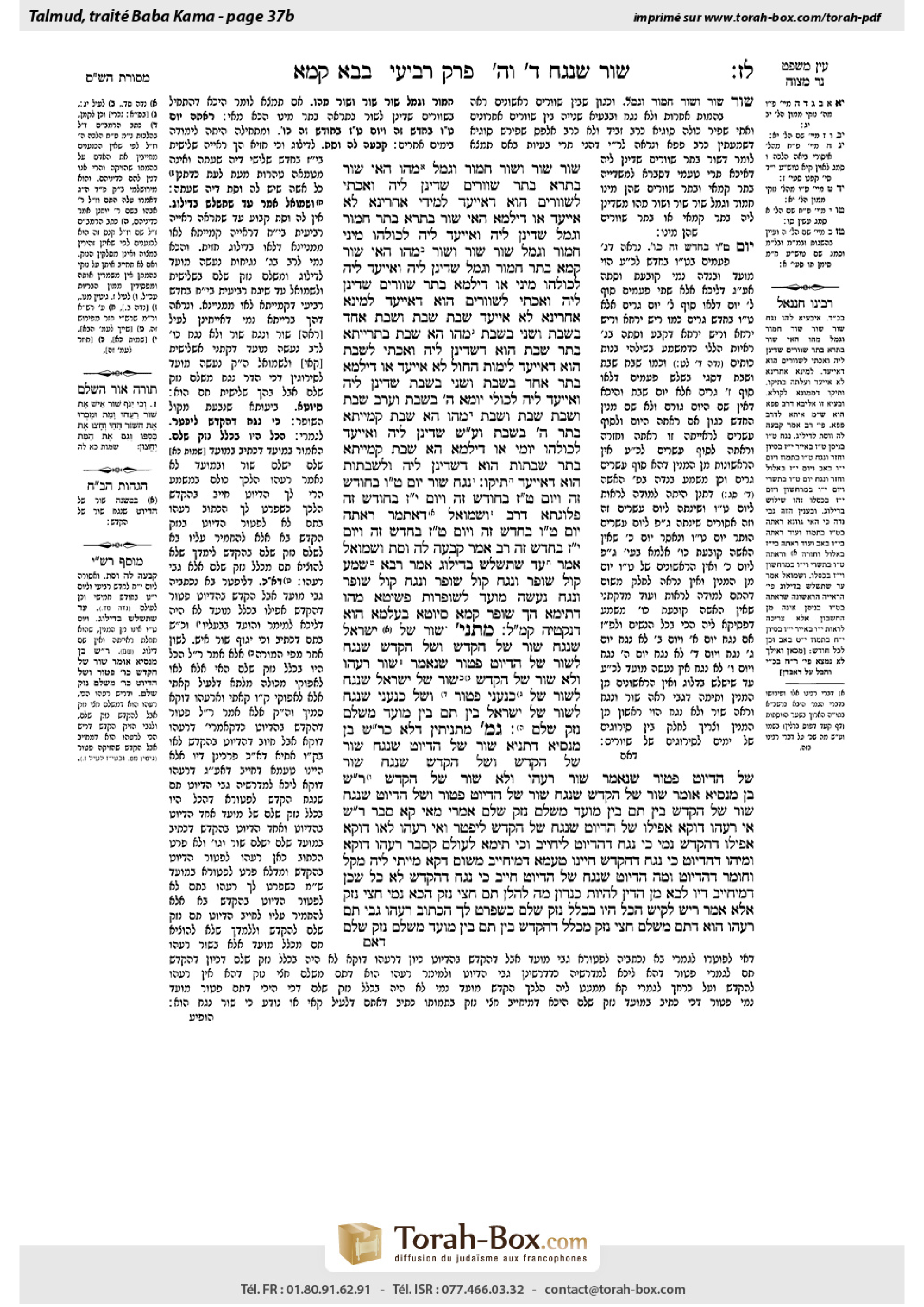
Bava Kamma 37b: Talmud study for Daf Yomi
Study the Talmud for Daf Yomi with scanned pages, Hebrew text, English translations from Sefaria and AI-generated French translations.
Passage selection and English or AI-generated French translation are available where the scan has annotations. Daf Study is independent of Torah-Box and Sefaria.
Browse Bava Kamma · בבא קמא · All tractatesBava Kamma 37b text and translations
This page of Bava Kamma includes the Aramaic text, an English translation and an AI-generated French translation, alongside the scan above.
בבא קמא ל״ז ב · Aramaic and Hebrew text
שׁוֹר, שׁוֹר וָשׁוֹר, חֲמוֹר וְגָמָל, מַהוּ?
הַאי שׁוֹר בָּתְרָא – בָּתַר שְׁווֹרִים שָׁדֵינַן לֵיהּ, וְאַכַּתִּי לִשְׁווֹרִים הוּא דְּאִיַּיעַד – לְמִידֵּי אַחֲרִינָא לָא אִיַּיעַד; אוֹ דִילְמָא, הַאי שׁוֹר בָּתְרָא – בָּתַר חֲמוֹר וְגָמָל שָׁדֵינַן לֵיהּ, וְאִיַּיעַד לֵיהּ לְכוּלְּהוּ מִינֵי?
חֲמוֹר וְגָמָל, שׁוֹר, שׁוֹר וָשׁוֹר, מַהוּ? הַאי שׁוֹר קַמָּא – בָּתַר חֲמוֹר וְגָמָל שָׁדֵינַן לֵיהּ, וְאִיַּיעַד לֵיהּ לְכוּלְּהוּ מִינֵי; אוֹ דִילְמָא בָּתַר שְׁווֹרִים שָׁדֵינַן לֵיהּ, וְאַכַּתִּי לִשְׁווֹרִים הוּא דְּאִיַּיעַד – לְמִינָא אַחֲרִינָא לָא אִיַּיעַד?
שַׁבָּת, שַׁבָּת וְשַׁבָּת, אֶחָד בְּשַׁבָּת וְשֵׁנִי בְּשַׁבָּת, מַהוּ? הָא שַׁבָּת בָּתְרָיְיתָא – בָּתַר שַׁבָּת הוּא דְּשָׁדֵינַן לֵיהּ, וְאַכַּתִּי לְשַׁבָּת הוּא דְּאִיַּיעַד – לִימוֹת הַחוֹל לָא אִיַּיעַד; אוֹ דִילְמָא בָּתַר אֶחָד בְּשַׁבָּת וְשֵׁנִי בְּשַׁבָּת שָׁדֵינַן לֵיהּ, וְאִיַּיעַד לֵיהּ לְכוּלֵּי יוֹמָא?
חֲמִישִׁי בְּשַׁבָּת וְעֶרֶב שַׁבָּת וְשַׁבָּת, שַׁבָּת וְשַׁבָּת, מַהוּ? הָא שַׁבָּת קַמַּיְיתָא – בָּתַר חֲמִישִׁי בְּשַׁבָּת וְעֶרֶב שַׁבָּת שָׁדֵינַן לֵיהּ, וְאִיַּיעַד לְכוּלְּהוּ יוֹמֵי; אוֹ דִילְמָא הָא שַׁבָּת קַמַּיְיתָא – בָּתַר שַׁבָּתוֹת הוּא דְּשָׁדֵינַן לֵיהּ, וּלְשֶׁבָּתוֹת הוּא דְּאִיַּיעַד?
תֵּיקוּ.
נָגַח שׁוֹר יוֹם חֲמִשָּׁה עָשָׂר בְּחוֹדֶשׁ זֶה, וְיוֹם שִׁשָּׁה עָשָׂר בְּחוֹדֶשׁ זֶה, וְיוֹם שִׁבְעָה עָשָׂר בְּחוֹדֶשׁ זֶה – פְּלוּגְתָּא דְּרַב וּשְׁמוּאֵל,
דְּאִתְּמַר: רָאֲתָה יוֹם חֲמִשָּׁה עָשָׂר בְּחֹדֶשׁ זֶה, וְיוֹם שִׁשָּׁה עָשָׂר בְּחֹדֶשׁ זֶה, וְיוֹם שִׁבְעָה עָשָׂר בְּחֹדֶשׁ זֶה – רַב אָמַר: קָבְעָה לָהּ וֶסֶת, וּשְׁמוּאֵל אָמַר: עַד שֶׁתְּשַׁלֵּשׁ בְּדִילּוּג.
אָמַר רָבָא: שָׁמַע קוֹל שׁוֹפָר וְנָגַח, קוֹל שׁוֹפָר וְנָגַח, קוֹל שׁוֹפָר וְנָגַח – נַעֲשָׂה מוּעָד לְשׁוֹפָרוֹת.
פְּשִׁיטָא! מַהוּ דְּתֵימָא: הָךְ שׁוֹפָר קַמָּא – סְיוּטָא בְּעָלְמָא הוּא דְּנַקְטֵיהּ; קָא מַשְׁמַע לַן.
מַתְנִי׳ שׁוֹר שֶׁל יִשְׂרָאֵל שֶׁנָּגַח שׁוֹר שֶׁל הֶקְדֵּשׁ, וְשֶׁל הֶקְדֵּשׁ שֶׁנָּגַח לְשׁוֹר שֶׁל הֶדְיוֹט – פָּטוּר, שֶׁנֶּאֱמַר: ״שׁוֹר רֵעֵהוּ״ – וְלֹא שׁוֹר שֶׁל הֶקְדֵּשׁ.
שׁוֹר שֶׁל יִשְׂרָאֵל שֶׁנָּגַח לְשׁוֹר שֶׁל גּוֹי – פָּטוּר. וְשֶׁל גּוֹי שֶׁנָּגַח לְשׁוֹר שֶׁל יִשְׂרָאֵל – בֵּין תָּם בֵּין מוּעָד, מְשַׁלֵּם נֶזֶק שָׁלֵם.
גּמ׳ מַתְנִיתִין דְּלָא כְּרַבִּי שִׁמְעוֹן בֶּן מְנַסְיָא, דְּתַנְיָא: שׁוֹר שֶׁל הֶדְיוֹט שֶׁנָּגַח שׁוֹר שֶׁל הֶקְדֵּשׁ, וְשֶׁל הֶקְדֵּשׁ שֶׁנָּגַח שׁוֹר שֶׁל הֶדְיוֹט – פָּטוּר, שֶׁנֶּאֱמַר: ״שׁוֹר רֵעֵהוּ״ – וְלֹא שׁוֹר שֶׁל הֶקְדֵּשׁ. רַבִּי שִׁמְעוֹן בֶּן מְנַסְיָא אוֹמֵר: שׁוֹר שֶׁל הֶקְדֵּשׁ שֶׁנָּגַח שׁוֹר שֶׁל הֶדְיוֹט – פָּטוּר; וְשֶׁל הֶדְיוֹט שֶׁנָּגַח שׁוֹר שֶׁל הֶקְדֵּשׁ – בֵּין תָּם בֵּין מוּעָד, מְשַׁלֵּם נֶזֶק שָׁלֵם.
אָמְרִי: מַאי קָא סָבַר רַבִּי שִׁמְעוֹן? אִי ״רֵעֵהוּ״ דַּוְקָא – אֲפִילּוּ שֶׁל הֶדְיוֹט שֶׁנָּגַח שֶׁל הֶקְדֵּשׁ לִיפְּטַר! וְאִי ״רֵעֵהוּ״ לָאו דַּוְקָא – אֲפִילּוּ דְּהֶקְדֵּשׁ נָמֵי, כִּי נָגַח דְּהֶדְיוֹט לִיחַיַּיב!
וְכִי תֵּימָא: לְעוֹלָם קָסָבַר ״רֵעֵהוּ״ דַּוְקָא, וּמִיהוּ דְּהֶדְיוֹט כִּי נָגַח דְּהֶקְדֵּשׁ הַיְינוּ טַעְמָא דְּמִיחַיַּיב – מִשּׁוּם דְּקָא מַיְיתֵי לֵיהּ מִקַּל וָחוֹמֶר דְּהֶדְיוֹט: וּמָה הֶדְיוֹט שֶׁנָּגַח שֶׁל הֶדְיוֹט – חַיָּיב, כִּי נָגַח דְּהֶקְדֵּשׁ – לֹא כׇּל שֶׁכֵּן דְּמִיחַיַּיב?
דַּיּוֹ לַבָּא מִן הַדִּין – לִהְיוֹת כַּנִּדּוֹן! מָה לְהַלָּן – תָּם חֲצִי נֶזֶק, הָכָא נָמֵי חֲצִי נֶזֶק!
אֶלָּא אָמַר רֵישׁ לָקִישׁ: הַכֹּל הָיוּ בִּכְלַל נֶזֶק שָׁלֵם; כְּשֶׁפָּרַט לְךָ הַכָּתוּב: ״רֵעֵהוּ״ גַּבֵּי תָם – רֵעֵהוּ הוּא דְּתָם מְשַׁלֵּם חֲצִי נֶזֶק; מִכְּלָל דְּהֶקְדֵּשׁ – בֵּין תָּם בֵּין מוּעָד מְשַׁלֵּם נֶזֶק שָׁלֵם;
Bava Kamma 37b · English translation
an ox, another ox, and a third ox, and then a donkey and a camel, with regard to what is it considered forewarned?
The Gemara presents the possibilities: With regard to this last ox that was gored together with the donkey and the camel, do we place it together with the previously gored oxen, and accordingly the belligerent ox was still rendered forewarned only with regard to oxen, whereas with regard to other species it was not rendered forewarned? Or perhaps we place this last ox together with the donkey and the camel, and it was rendered forewarned with regard to all of the species it gored.
The Gemara adds a similar dilemma: If an ox gored a donkey and a camel, and then an ox, an ox, and another ox, what is the halakha? The Gemara presents the possibilities: With regard to this first ox that it gored, do we place it together with the camel and donkey, and the belligerent ox was accordingly rendered forewarned with regard to all species? Or perhaps we place it together with the two oxen that it gored afterward, and accordingly, it was still rendered forewarned only with regard to oxen, whereas it was not rendered forewarned with regard to other species.
Similarly, if it gored on Shabbat, on Shabbat, and on Shabbat, i.e., on three consecutive Shabbatot, and then on Sunday and on Monday, what is the halakha? With regard to this last Shabbat, do we place it together with the previous Shabbat, and the ox was still rendered forewarned only with regard to Shabbat, whereas with regard to weekdays it was not rendered forewarned? Or perhaps we place it together with the goring on Sunday and Monday, and it was thereby rendered forewarned with regard to all days of the week.
If an ox gored on Thursday, and Friday, and Shabbat, and then the next Shabbat and the next Shabbat after that, what is the halakha? With regard to this first Shabbat, do we place it together with Thursday and Friday, and thereby hold that the ox was rendered forewarned with regard to all days of the week? Or perhaps we place this first Shabbat together with the other Shabbatot, and the ox is rendered forewarned only with regard to Shabbatot?
These dilemmas shall stand unresolved.
§ If an ox gored on the fifteenth day of this month, and subsequently gored on the sixteenth day of the month after that, and then on the seventeenth day of the month after that, the halakha is subject to a dispute between Rav and Shmuel with regard to a parallel discussion concerning a woman whose menstrual cycle begins on a different day each month.
As it was stated: If a woman saw menstrual blood on the fifteenth day of this month, and on the sixteenth day of the month after that, and on the seventeenth day of the month after that, Rav says: She has thereby established her menstrual cycle [veset], i.e., a month and one day. And Shmuel says: Her menstrual cycle is not established until she skips a day three times. According to Shmuel, the cycle is established in this case not by the date per se, but rather by the pattern of one additional day every month. Only when this occurs for three consecutive months, i.e., when she menstruates in the fourth month, is this pattern established.
§ Rava said: If an ox heard the sound of a shofar and gored, and again heard the sound of a shofar and gored, and a third time heard the sound of a shofar and gored, it is rendered forewarned with regard to the sound of shofarot.
The Gemara asks: Isn’t this obvious? The Gemara answers: Lest you say that this first shofar merely startled [siyyuta] the ox, prompting it to gore, and that consequently it should not count for the purpose of rendering the ox forewarned, Rava teaches us that since the ox repeatedly gored upon hearing the sound of a shofar, this sound is considered a consistent impetus for its goring.
MISHNA: With regard to an ox of a Jew that gored a consecrated ox, and conversely, a consecrated ox that gored a non-sacred ox, i.e., an ox owned by a Jew, the owner of the ox is exempt from paying compensation, as it is stated: “And if one man’s ox hurts the ox of another” (Exodus 21:35). It is derived from the phrase “the ox of another” that one is liable only if it is a non-sacred ox, but not if it is a consecrated ox, which belongs to the Temple treasury, regardless of whether the latter was the ox that gored or the ox that was gored.
With regard to an ox of a Jew that gored the ox of a gentile, the owner of the belligerent ox is exempt from liability. But with regard to an ox of a gentile that gored the ox of a Jew, regardless of whether the goring ox was innocuous or forewarned, the owner of the ox pays the full cost of the damage.
GEMARA: The mishna is not in accordance with the opinion of Rabbi Shimon ben Menasya, as it is taught in a baraita: With regard to a non-sacred ox that gored a consecrated ox, or a consecrated ox that gored a non-sacred ox, the owner of the ox is exempt from liability, as it is stated: “The ox of another,” indicating: But not a consecrated ox. Rabbi Shimon ben Menasya says: With regard to a consecrated ox that gored a non-sacred ox, the Temple treasury is exempt from liability; but with regard to a non-sacred ox that gored a consecrated ox, whether it was innocuous or forewarned, the owner pays the full cost of the damage.
The Sages said: What does Rabbi Shimon ben Menasya hold? Why does he distinguish between a consecrated ox that gored a non-sacred ox and a non-sacred ox that gored a consecrated ox? If the phrase “of another” is meant in a precise manner, then even with regard to a non-sacred ox that gored a consecrated ox the owner of the belligerant ox should be exempt from liability, as the victim is not the ox of another, but belongs to the Temple treasury. And if the phrase “of another” is not meant in a precise manner, but rather, includes all oxen, then a consecrated ox that gored a non-sacred ox should render the Temple treasury liable as well.
And if you would say that actually Rabbi Shimon ben Menasya holds that “of another” is meant in a precise manner, and accordingly, if a consecrated ox gores a non-sacred ox the Temple treasury is exempt from liability; but nevertheless, when a non-sacred ox gores a consecrated ox, this is the reason its owner is liable: Because Rabbi Shimon ben Menasya infers it a fortiori from the case of a non-sacred ox, as follows: If in the case of a non-sacred ox that gores another non-sacred ox the owner of the belligerent ox is liable, is it not clear all the more so that when it gores a consecrated ox the owner of the ox is liable?
If this is Rabbi Shimon ben Menasya’s reasoning, then his ruling that the owner of the ox pays the Temple treasury the full cost of the damage, whether his ox was innocuous or forewarned, is problematic, as it is sufficient for the conclusion that emerges from an a fortiori inference to be like its source. In other words, a halakha derived by means of an a fortiori inference cannot be more stringent than the halakha of the source from which it is derived. Therefore, just as there, in a case where an individual’s innocuous non-sacred ox gores another non-sacred ox, the owner pays only half the cost of the damage, here too, if an innocuous non-sacred ox gores a consecrated ox, its owner should be liable to pay only half the cost of the damage.
Rather, Reish Lakish said that Rabbi Shimon ben Menasya’s reasoning is as follows: In principle, all cases of damage were included among those in which the owner pays the full cost of the damage. The halakha that in a case of an innocuous ox the owner pays only half the cost of the damage is an exception to the rule, and when the verse specified the term “of another” with regard to an innocuous ox, it intended that it is specifically when one’s innocuous ox gores the ox of another that the owner pays only half the cost of the damage. And by inference, if it gores a consecrated ox, whether the belligerent ox is innocuous or forewarned its owner pays the full cost of the damage.
Bava Kamma 37b · Traduction française (IA)
Un bœuf, un autre bœuf et un troisième bœuf, puis un âne et un chameau, à propos de quoi est-il considéré comme averti ?
La Guemara présente les possibilités : À propos de ce dernier bœuf qui a été mordu en même temps que l'âne et le chameau, devons-nous le placer parmi les bœufs précédemment mordus, et ainsi le bœuf belliqueux est considéré comme averti uniquement à propos des bœufs, tandis qu'à propos des autres espèces il n'est pas considéré comme averti ? Ou peut-être devons-nous le placer parmi l'âne et le chameau, et il est considéré comme averti à propos de toutes les espèces qu'il a mordus.
La Guemara ajoute un dilemme similaire : Si un bœuf mord un âne et un chameau, puis un bœuf, un bœuf et un autre bœuf, quelle est la halakha ? La Guemara présente les possibilités : À propos de ce premier bœuf qu'il a mordu, devons-nous le placer parmi le chameau et l'âne, et ainsi le bœuf belliqueux est considéré comme averti à propos de toutes les espèces ? Ou peut-être devons-nous le placer parmi les deux bœufs qu'il a mordus ensuite, et ainsi il est considéré comme averti uniquement à propos des bœufs, tandis qu'il n'est pas considéré comme averti à propos des autres espèces.
De même, si un bœuf a mordu le sabbat, le sabbat, et le sabbat, c'est-à-dire sur trois sabbats consécutifs, puis le dimanche et le lundi, quelle est la halakha ? À propos de ce dernier sabbat, devons-nous le placer parmi le sabbat précédent, et le bœuf est considéré comme averti uniquement à propos du sabbat, tandis qu'à propos des jours ouvrables il n'est pas considéré comme averti ? Ou peut-être devons-nous le placer parmi les mordons du dimanche et du lundi, et ainsi il est considéré comme averti à propos de tous les jours de la semaine ?
Si un bœuf a mordu le jeudi, le vendredi et le sabbat, puis le sabbat suivant et le sabbat après celui-ci, quelle est la halakha ? À propos de ce premier sabbat, devons-nous le placer parmi le jeudi et le vendredi, et ainsi considérer que le bœuf est averti à propos de tous les jours de la semaine ? Ou peut-être devons-nous placer ce premier sabbat parmi les autres sabbats, et le bœuf est considéré comme averti uniquement à propos des sabbats ?
Ces dilemmes resteront sans solution.
§ Si un bœuf a mordu le quinzième jour de ce mois, puis le seizième jour du mois suivant, et ensuite le dix-septième jour du mois suivant, la halakha est en débat entre Rav et Shmuel concernant une discussion parallèle concernant une femme dont le cycle menstruel commence un jour différent chaque mois.
Comme il a été dit : Si une femme a vu du sang menstruel le quinzième jour de ce mois, et le seizième jour du mois suivant, et le dix-septième jour du mois suivant, Rav dit : Elle a ainsi établi son cycle menstruel [veset], c'est-à-dire un mois et un jour. Et Shmuel dit : Son cycle menstruel n'est établi que lorsqu'elle manque un jour trois fois. Selon Shmuel, le cycle est établi dans ce cas non par la date en elle-même, mais plutôt par le motif d'un jour supplémentaire chaque mois. Seulement lorsque cela arrive pendant trois mois consécutifs, c'est-à-dire lorsqu'elle menstrue au quatrième mois, ce motif est établi.
§ Rava dit : Si un bœuf a entendu le son du cor et a mordu, et à nouveau a entendu le son du cor et a mordu, et une troisième fois a entendu le son du cor et a mordu, il est considéré comme averti à propos du son des cors.
La Guemara demande : N'est-ce pas évident ? La Guemara répond : Pour éviter que vous disiez que ce premier shofar n'a simplement effrayé [siyyuta] le bœuf, le poussant à mordre, et que par conséquent il ne devrait pas être compté à l'effet de rendre le bœuf averti, Rava nous enseigne que puisque le bœuf a mordu plusieurs fois en entendant le son du shofar, ce son est considéré comme un stimulus constant pour sa mordue.
MICHNA : Concernant un bœuf d'un Juif qui a mordu un bœuf sacré, et inversement, un bœuf sacré qui a mordu un bœuf non sacré, c'est-à-dire un bœuf appartenant à un Juif, le propriétaire du bœuf est exempt de payer une compensation, car il est dit : « Et si l'ox d'un homme blesse l'ox d'un autre » (Exode 21:35). Il est dérivé de la phrase « l'ox d'autrui » que l'on est responsable uniquement si c'est un bœuf non sacré, mais pas si c'est un bœuf sacré, qui appartient au trésor du Temple, indépendamment de ce que l'autre bœuf ait été celui qui a mordu ou celui qui a été mordu.
Concernant un bœuf d'un Juif qui a mordu le bœuf d'un non-Juif, le propriétaire du bœuf belliqueux est exempt de responsabilité. Mais concernant un bœuf d'un non-Juif qui a mordu le bœuf d'un Juif, indépendamment de ce que le bœuf mordant ait été inoffensif ou averti, le propriétaire du bœuf paie le coût complet des dommages.
GUEMARA : La Michna ne correspond pas à l'opinion de Rabbi Shimon ben Menasya, car il est enseigné dans une baraïta : Concernant un bœuf non sacré qui a blessé un bœuf sacré, ou un bœuf sacré qui a blessé un bœuf non sacré, le propriétaire du bœuf est exempt de responsabilité, car il est dit : « L'ox d'autrui », indiquant : Mais pas un bœuf sacré. Rabbi Shimon ben Menasya dit : Concernant un bœuf sacré qui a blessé un bœuf non sacré, le trésor du Temple est exempt de responsabilité ; mais concernant un bœuf non sacré qui a blessé un bœuf sacré, qu'il ait été inoffensif ou averti, le propriétaire paie le coût complet des dommages.
Les Sages dirent : Quelle est la position de Rabbi Shimon ben Menasya ? Pourquoi distingue-t-il entre un bœuf consacré qui a blessé un bœuf non consacré et un bœuf non consacré qui a blessé un bœuf consacré ? Si la formule « d’un autre » est entendue de manière précise, alors même dans le cas d’un bœuf non consacré qui a blessé un bœuf consacré, l'propriétaire du bœuf agressif serait exempt de responsabilité, car la victime n'est pas le bœuf d'un autre, mais appartient au trésor du Temple. Et si la formule « d’un autre » n'est pas entendue de manière précise, mais plutôt inclut tous les bœufs, alors un bœuf consacré qui a blessé un bœuf non consacré rendrait le trésor du Temple responsable également.
Et si l’on disait que, en réalité, Rabbi Shimon ben Menasya considère que « d’un autre » est entendu de manière précise, et donc, si un bœuf consacré blessait un bœuf non consacré, le trésor du Temple serait exempt de responsabilité ; mais néanmoins, lorsque un bœuf non consacré blessait un bœuf consacré, c’est pour cette raison que son propriétaire est responsable : car Rabbi Shimon ben Menasya en déduit par a fortiori le cas d’un bœuf non consacré, comme suit : Si, dans le cas d’un bœuf non consacré qui blessait un autre bœuf non consacré, l’propriétaire du bœuf agressif est responsable, n’est-ce pas clair que, dans le cas où il blessait un bœuf consacré, l’propriétaire du bœuf est également responsable ?
Si c’est ainsi que raisonne Rabbi Shimon ben Menasya, alors sa décision selon laquelle l’propriétaire du bœuf paie au trésor du Temple le coût complet des dommages, que son bœuf était inoffensif ou averti, est problématique, car il suffit que la conclusion tirée d’une déduction par a fortiori soit semblable à sa source. En d’autres termes, une halakha dérivée par une déduction par a fortiori ne peut pas être plus exigeante que la halakha de la source d’où elle est dérivée. Ainsi, tout comme là, dans le cas où un bœuf inoffensif d’un individu blessait un autre bœuf non consacré, l’propriétaire paie seulement la moitié du coût des dommages, ici aussi, si un bœuf inoffensif non consacré blessait un bœuf consacré, son propriétaire devrait être responsable de payer seulement la moitié du coût des dommages.
Au contraire, Reish Lakish dit que la raison de Rabbi Shimon ben Menasya est la suivante : En principe, tous les cas de dommages sont inclus parmi ceux où l’propriétaire paie le coût complet des dommages. La halakha selon laquelle, dans le cas d’un bœuf inoffensif, l’propriétaire paie seulement la moitié du coût des dommages est une exception à la règle, et lorsque la parole « d’un autre » a été spécifiée dans le cas d’un bœuf inoffensif, cela signifie spécifiquement que lorsque son bœuf inoffensif blessait le bœuf d’un autre, l’propriétaire paie seulement la moitié du coût des dommages. Et par déduction, si ce bœuf blessait un bœuf consacré, que le bœuf agressif soit inoffensif ou averti, l’propriétaire paie le coût complet des dommages.
Traduction française générée par IA à partir de l’édition anglaise de Sefaria. Vérifie toujours un passage avec le texte source.
Text from Sefaria: William Davidson Edition - Vocalized Aramaic (CC BY NC); William Davidson Edition - English (CC BY NC).