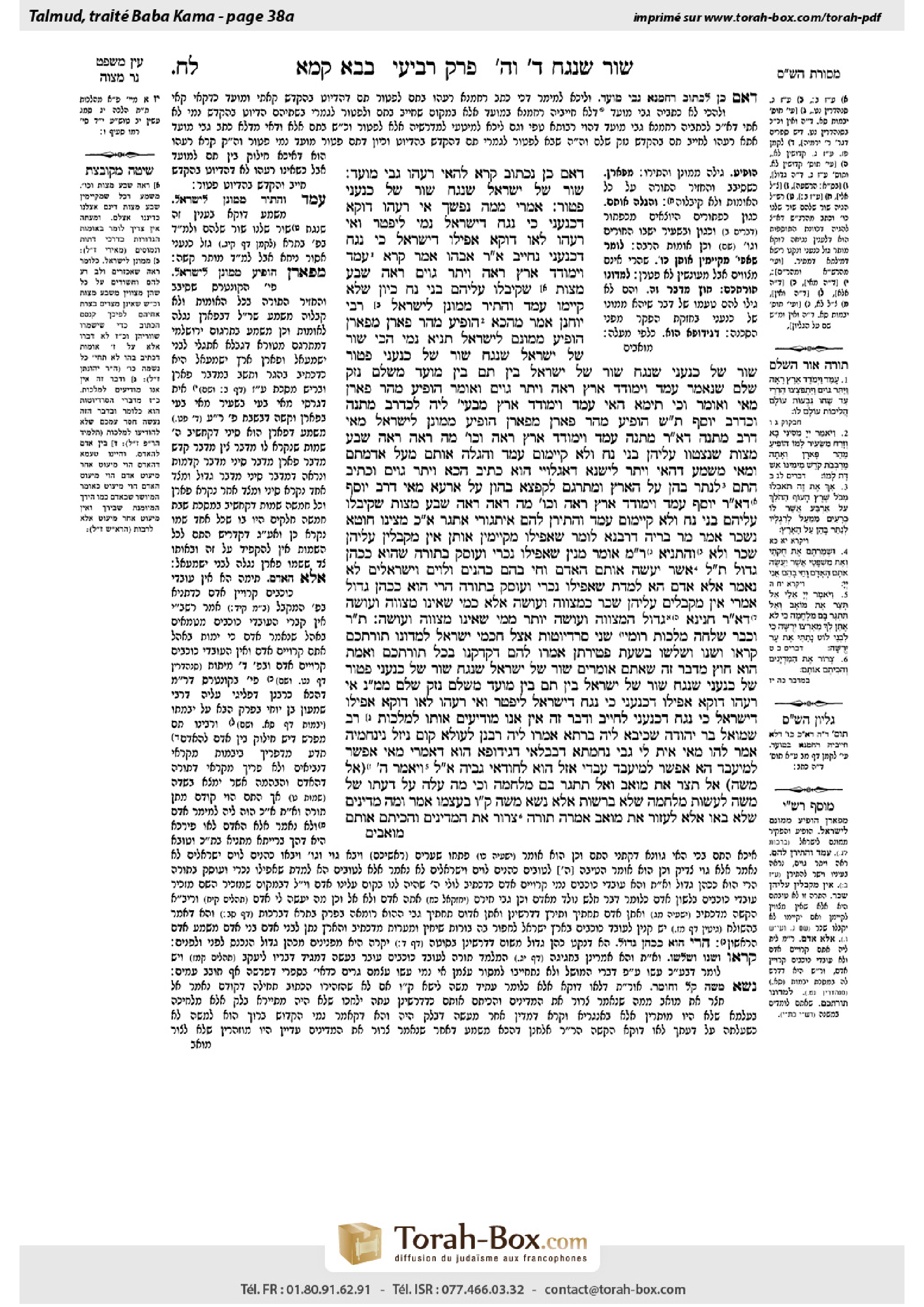
Bava Kamma 38a: Talmud study for Daf Yomi
Study the Talmud for Daf Yomi with scanned pages, Hebrew text, English translations from Sefaria and AI-generated French translations.
Passage selection and English or AI-generated French translation are available where the scan has annotations. Daf Study is independent of Torah-Box and Sefaria.
Browse Bava Kamma · בבא קמא · All tractatesBava Kamma 38a text and translations
This page of Bava Kamma includes the Aramaic text, an English translation and an AI-generated French translation, alongside the scan above.
בבא קמא ל״ח א · Aramaic and Hebrew text
דְּאִם כֵּן, נִכְתּוֹב קְרָא לְהַאי ״רֵעֵהוּ״ גַּבֵּי מוּעָד.
שׁוֹר שֶׁל יִשְׂרָאֵל שֶׁנָּגַח שׁוֹר שֶׁל גּוֹי – פָּטוּר. אָמְרִי: מִמָּה נַפְשָׁךְ, אִי ״רֵעֵהוּ״ דַּוְקָא – דְּגוֹי כִּי נָגַח דְּיִשְׂרָאֵל נָמֵי לִיפְּטַר! וְאִי ״רֵעֵהוּ״ לָאו דַּוְקָא – אֲפִילּוּ דְּיִשְׂרָאֵל כִּי נָגַח דְּגוֹי נִחַיַּיב!
אָמַר רַבִּי אֲבָהוּ, אָמַר קְרָא: ״עָמַד וַיְמֹדֶד אֶרֶץ, רָאָה וַיַּתֵּר גּוֹיִם״ – רָאָה שֶׁבַע מִצְוֹת שֶׁקִּיבְּלוּ עֲלֵיהֶם בְּנֵי נֹחַ. כֵּיוָן שֶׁלֹּא קִיְּימוּ – עָמַד וְהִתִּיר מָמוֹנָן לְיִשְׂרָאֵל.
רַבִּי יוֹחָנָן אָמַר מֵהָכָא: ״הוֹפִיעַ מֵהַר פָּארָן״ – מִפָּארָן הוֹפִיעַ מָמוֹנָם לְיִשְׂרָאֵל.
תַּנְיָא נָמֵי הָכִי: שׁוֹר שֶׁל יִשְׂרָאֵל שֶׁנָּגַח שׁוֹר שֶׁל גּוֹי – פָּטוּר. שׁוֹר שֶׁל גּוֹי שֶׁנָּגַח שׁוֹר שֶׁל יִשְׂרָאֵל – בֵּין תָּם בֵּין מוּעָד מְשַׁלֵּם נֶזֶק שָׁלֵם, שֶׁנֶּאֱמַר: ״עָמַד וַיְמֹדֶד אֶרֶץ, רָאָה וַיַּתֵּר גּוֹיִם״. וְאוֹמֵר: ״הוֹפִיעַ מֵהַר פָּארָן״.
מַאי ״וְאוֹמֵר״?
וְכִי תֵּימָא, הַאי ״עָמַד וַיְמֹדֶד אֶרֶץ״ – מִבַּעְיָא לֵיהּ לְכִדְרַב מַתְנָה וְכִדְרַב יוֹסֵף, תָּא שְׁמַע: ״הוֹפִיעַ מֵהַר פָּארָן״ – מִפָּארָן הוֹפִיעַ מָמוֹנָן לְיִשְׂרָאֵל. מַאי דְּרַב מַתְנָה? דְּאָמַר רַב מַתְנָה: ״עָמַד וַיְמֹדֶד אֶרֶץ, רָאָה וְכוּ׳״. מָה רָאָה – רָאָה שֶׁבַע מִצְוֹת שֶׁנִּצְטַוּוּ עֲלֵיהֶן בְּנֵי נֹחַ וְלֹא קִיְּימוּם, עָמַד וְהִגְלָה אוֹתָם מֵעַל אַדְמָתָם.
וּמַאי מַשְׁמַע דְּהַאי ״וַיַּתֵּר״ לִישָּׁנָא דְּאִגַּלּוֹיֵי הוּא? כְּתִיב הָכָא: ״וַיַּתֵּר גּוֹיִם״, וּכְתִיב הָתָם: ״לְנַתֵּר בָּהֵן עַל הָאָרֶץ״ – וּמְתַרְגְּמִינַן: לְקַפָּצָא בְּהוֹן עַל אַרְעָא.
מַאי דְּרַב יוֹסֵף? דְּאָמַר רַב יוֹסֵף: ״עָמַד וַיְמֹדֶד אֶרֶץ, רָאָה וְכוּ׳״; מָה רָאָה? רָאָה שֶׁבַע מִצְוֹת שֶׁקִּיבְּלוּ עֲלֵיהֶם בְּנֵי נֹחַ וְלֹא קִיְּימוּם, עָמַד וְהִתִּירָן לָהֶם.
אִיתְּגוֹרֵי אִתְּגוּר?! אִם כֵּן, מָצִינוּ חוֹטֵא נִשְׂכָּר! אָמַר מָר בְּרֵיהּ דְּרַבְנָא: לוֹמַר שֶׁאֲפִילּוּ מְקַיְּימִין אוֹתָן – אֵין מְקַבְּלִין עֲלֵיהֶן שָׂכָר.
וְלָא?! וְהָתַנְיָא, רַבִּי מֵאִיר אוֹמֵר: מִנַּיִן שֶׁאֲפִילּוּ גּוֹי וְעוֹסֵק בַּתּוֹרָה – שֶׁהוּא כְּכֹהֵן גָּדוֹל? תַּלְמוּד לוֹמַר: ״אֲשֶׁר יַעֲשֶׂה אֹתָם הָאָדָם, וָחַי בָּהֶם״ – ״כֹּהֲנִים וּלְוִיִּם וְיִשְׂרְאֵלִים״ לֹא נֶאֱמַר, אֶלָּא ״אָדָם״; הָא לָמַדְתָּ, שֶׁאֲפִילּוּ גּוֹי וְעוֹסֵק בַּתּוֹרָה – הֲרֵי הוּא כְּכֹהֵן גָּדוֹל!
אָמְרִי: אֵין מְקַבְּלִים עֲלֵיהֶן שָׂכָר כִּמְצֻוֶּוה וְעוֹשֶׂה, אֶלָּא כְּמִי שֶׁאֵינוֹ מְצֻוֶּוה וְעוֹשֶׂה. דְּאָמַר רַבִּי חֲנִינָא: גָּדוֹל הַמְצֻוֶּוה וְעוֹשֶׂה יוֹתֵר מִמִּי שֶׁאֵינוֹ מְצֻוֶּוה וְעוֹשֶׂה.
תָּנוּ רַבָּנַן, וּכְבָר שָׁלְחָה מַלְכוּת רוֹמִי שְׁנֵי סְרַדְיוֹטוֹת אֵצֶל חַכְמֵי יִשְׂרָאֵל: לַמְּדוּנוּ תּוֹרַתְכֶם. קָרְאוּ וְשָׁנוּ וְשִׁלֵּשׁוּ. בִּשְׁעַת פְּטִירָתָן אָמְרוּ לָהֶם: דִּקְדַּקְנוּ בְּכׇל תּוֹרַתְכֶם – וֶאֱמֶת הוּא; חוּץ מִדָּבָר זֶה שֶׁאַתֶּם אוֹמְרִים: שׁוֹר שֶׁל יִשְׂרָאֵל שֶׁנָּגַח שׁוֹר שֶׁל גּוֹי – פָּטוּר. שֶׁל גּוֹי שֶׁנָּגַח שׁוֹר שֶׁל יִשְׂרָאֵל – בֵּין תָּם בֵּין מוּעָד, מְשַׁלֵּם נֶזֶק שָׁלֵם.
מִמָּה נַפְשָׁךְ, אִי ״רֵעֵהוּ״ דַּוְקָא – אֲפִילּוּ דְּגוֹי כִּי נָגַח דְּיִשְׂרָאֵל לִיפְּטַר; וְאִי ״רֵעֵהוּ״ לָאו דַּוְקָא – אֲפִילּוּ דְיִשְׂרָאֵל כִּי נָגַח דְּגוֹי לִחַיַּיב! וְדָבָר זֶה אֵין אָנוּ מוֹדִיעִים אוֹתוֹ לַמַּלְכוּת.
רַב שְׁמוּאֵל בַּר יְהוּדָה שְׁכִיבָא לֵיהּ בְּרַתָּא, אֲמַרוּ לֵיהּ רַבָּנַן לְעוּלָּא: קוּם נֵיזִל נִינַחֲמֵיהּ, אֲמַר לְהוּ: מַאי אִית לִי גַּבֵּי נֶחָמְתָּא דְבַבְלָאֵי – דְּגִידּוּפָא הוּא? דְּאָמְרִי: ״מַאי אֶפְשָׁר לְמִיעְבַּד״; הָא אֶפְשָׁר לְמִיעְבַּד – עָבְדִי.
אֲזַל הוּא לְחוֹדֵיהּ גַּבֵּיהּ. אֲמַר לֵיהּ: ״וַיֹּאמֶר ה׳ (אֶל מֹשֶׁה) אַל תָּצַר אֶת מוֹאָב וְאַל תִּתְגָּר בָּם מִלְחָמָה״; וְכִי מָה עָלָה עַל דַּעְתּוֹ שֶׁל מֹשֶׁה, לַעֲשׂוֹת מִלְחָמָה שֶׁלֹּא בִּרְשׁוּת?! אֶלָּא נָשָׂא מֹשֶׁה קַל וָחוֹמֶר בְּעַצְמוֹ – אָמַר: וּמָה מִדְיָנִים שֶׁלֹּא בָּאוּ אֶלָּא לַעֲזוֹר אֶת מוֹאָב, אָמְרָה תּוֹרָה: ״צָרוֹר אֶת הַמִּדְיָנִים וְהִכִּיתֶם אוֹתָם״,
Bava Kamma 38a · English translation
Because if so, if one whose ox gores a consecrated ox is exempt from liability, let the verse write this phrase: “Of another,” with regard to the case of a forewarned ox. One could then infer that the owner is exempt from liability in the case of an innocuous ox as well, as the liability with regard to an innocuous ox is less severe than with regard to a forewarned ox. The stating of this exemption specifically in the context of an innocuous ox indicates that the exemption is only concerning the leniency stated in the verse, that if the gored ox belongs to another person, the owner of the belligerent ox is liable to pay only half the cost of the damage.
§ The mishna teaches: With regard to an ox of a Jew that gored the ox of a gentile, the owner of the belligerent ox is exempt from liability; whereas if a gentile’s ox gores a Jew’s ox, the owner is liable to pay the full cost of the damage. The Sages said: This statement is difficult whichever way you look at it. If the phrase “of another” is meant in a precise manner, and therefore the liability applies only if his ox gores the ox of another Jew, when a gentile’s ox gores that of a Jew he should also be exempt from liability. And if the phrase “of another” is not meant in a precise manner, then even when a Jew’s ox gores that of a gentile the owner of the belligerent ox should be liable.
Rabbi Abbahu said that the reason for this ruling is that the verse states: “He stood and shook the earth; He beheld, and made the nations tremble [vayyatter]” (Habakkuk 3:6). This is homiletically interpreted to mean that God saw the seven mitzvot that the descendants of Noah accepted upon themselves to fulfill, and since they did not fulfill them, He arose and permitted [vehittir] their money to the Jewish people, so that in certain cases Jews are not liable for damage caused to gentiles.
Rabbi Yoḥanan said that the source for this halakha is from here: It is stated in reference to the giving of the Torah: “The Lord came from Sinai and rose from Seir unto them; He appeared from Mount Paran” (Deuteronomy 33:2), which is homiletically interpreted to mean: From the time God came from Mount Paran, when giving the Torah, the money of the gentile nations appeared, i.e., it was revealed and granted to the Jewish people.
This is also taught in a baraita: With regard to an ox of a Jew that gored the ox of a gentile, the owner of the belligerent ox is exempt from liability. By contrast, with regard to an ox of a gentile that gored the ox of a Jew, whether it was innocuous or forewarned, the owner of the belligerent ox pays the full cost of the damage, as it is stated: “He stood and shook the earth; He beheld, and made the nations tremble.” And another verse states: “He appeared from Mount Paran.”
The Gemara asks: What is the reason the baraita adds: And another verse states, indicating that the first verse is not a sufficient source?
The Gemara explains that this is how the baraita is to be understood: And if you would say that this verse: “He stood and shook the earth” is necessary to express that which Rav Mattana and Rav Yosef derived from the verse, come and hear another source: “He appeared from Mount Paran,” meaning: From Paran their money appeared to the Jewish people. What is Rav Mattana’s exposition? It is as Rav Mattana says: “He stood and shook the earth.” What did He see? He saw the seven mitzvot that the descendants of Noah were commanded but did not fulfill, and He arose and exiled them from their land on account of their transgressions.
And from where may it be inferred that this term vayyatter is a term of exile? It is written here: “And made the nations tremble [vayyatter]” (Habakkuk 3:6), and it is written there: “Lenatter upon the earth” (Leviticus 11:21), which is translated into Aramaic as: “To leap upon the earth.” Apparently, the root nun, tav, reish, common to both words, indicates uprooting from one place to another.
What is Rav Yosef’s exposition? It is as Rav Yosef says: “He stood and shook the earth; He beheld.” What did He see? He saw the seven mitzvot that the descendants of Noah accepted upon themselves and did not fulfill, so He arose and permitted their prohibitions to them.
The Gemara asks: Did they thereby profit, in that their prohibitions became permitted to them? If so, we have found a transgressor who is rewarded. Mar, son of Rabbana, says: This is not to say that for them to transgress their mitzvot is no longer a sin; rather, it is to say that even if they fulfill them, they do not receive reward for fulfilling them.
The Gemara asks: But do they not receive reward for fulfilling those mitzvot? But isn’t it taught in a baraita that Rabbi Meir says: From where is it derived that even a gentile who engages in Torah is considered like a High Priest? The verse states with regard to the mitzvot: “Which if a person does, he shall live by them” (Leviticus 18:5). It is not stated: Which if priests and Levites and Israelites do, they shall live by them, but rather: A person, indicating that all people are included. You have therefore learned that even a gentile who engages in Torah study is considered like a High Priest.
The Sages said in response: Rav Yosef meant that they do not receive the reward as does one who is commanded to perform a mitzva and performs it, but as does one who is not commanded to perform a mitzva and performs it anyway. As Rabbi Ḥanina says: One who is commanded and performs a mitzva is greater than one who is not commanded and performs it.
The Sages taught the following story in the context of the aforementioned halakha: And the Roman kingdom once sent two military officials [sardeyotot] to the Sages of Israel, and ordered them in the name of the king: Teach us your Torah. The officials read the Torah, and repeated it, and repeated it again, reading it for the third time. At the time of their departure, they said to the Sages: We have examined your entire Torah and it is true, except for this one matter that you state, i.e., that with regard to an ox of a Jew that gored the ox of a gentile, the owner is exempt from liability, whereas with regard to the ox of a gentile that gored the ox of a Jew, whether it was innocuous or forewarned, the owner pays the full cost of the damage.
The officials’ reasoning was that this halakha is difficult whichever way you look at it. If the phrase “of another” is meant in a precise manner, that the owners of both oxen must both be Jewish, then even when the ox of a gentile gores the ox of a Jew the owner of the ox should be exempt from liability. And if the phrase “of another” is not meant in a precise manner, and the oxen of all are included, then even when the ox of a Jew gores the ox of a gentile the owner should be liable. They added: But we will not inform this matter to the kingdom; having acknowledged that the entire Torah is true, we will not reveal this ruling, as it will displease the kingdom.
§ Incidentally, it is related that the daughter of Rav Shmuel bar Yehuda died. The Sages said to Ulla: Arise; let us go console him. Ulla said to them: What business do I have with the consolation of Babylonians, which is actually heresy? As, they say while consoling mourners: What can be done? This seems to suggest that if it were possible to do something, acting against the Almighty’s decree, they would do so, which is tantamount to heresy. Therefore, Ulla declined to accompany the Babylonian Sages.
Ulla therefore went to console Rav Shmuel bar Yehuda by himself, and said to him: The verse states: “And the Lord said to me, do not be at enmity with Moab, neither contend with them in battle” (Deuteronomy 2:9). What entered Moses’s mind, that God had to warn him not to undertake a particular action? Did it enter his mind to wage war with the Moabites without permission? Rather, Moses reasoned an a fortiori inference by himself, saying: And if with regard to the Midianites, who came only to help the Moabites harm the Jewish people (see Numbers, chapter 22), the Torah said: “Harass the Midianites and smite them” (Numbers 25:17),
Bava Kamma 38a · Traduction française (IA)
Car si c'était le cas, si un propriétaire dont un bœuf a blessé un bœuf consacré est exempt de responsabilité, la Bible aurait dû écrire cette phrase : « De l'autre », concernant le cas d'un bœuf averti. On pourrait alors en déduire que le propriétaire est exempt de responsabilité dans le cas d'un bœuf inoffensif également, car la responsabilité concernant un bœuf inoffensif est moins sévère que celle concernant un bœuf averti. L'indication de cette exemption spécifiquement dans le contexte d'un bœuf inoffensif montre que l'exemption concerne uniquement la leniante mentionnée dans la Bible, à savoir que si le bœuf blessé appartient à un autre, le propriétaire du bœuf agressif est tenu de payer seulement la moitié du coût des dommages.
§ La Michna enseigne : Concernant un bœuf d'un Juif qui a blessé un bœuf d'un non-Juif, le propriétaire du bœuf agressif est exempt de responsabilité ; tandis que si un bœuf d'un non-Juif blessait un bœuf d'un Juif, le propriétaire est tenu de payer le coût complet des dommages. Les Sages ont dit : Cette déclaration est difficile à comprendre d'un point de vue ou d'un autre. Si la phrase « de l'autre » est entendue de manière précise, et donc la responsabilité s'applique uniquement si son bœuf blessait un bœuf d'un autre Juif, alors quand un bœuf d'un non-Juif blessait celui d'un Juif, il devrait être exempt de responsabilité également. Et si la phrase « de l'autre » n'est pas entendue de manière précise, alors même quand un bœuf d'un Juif blessait celui d'un non-Juif, le propriétaire du bœuf agressif devrait être tenu de responsabilité.
Rabbi Abbahu a dit que la raison de cette décision est que la Bible dit : « Il s'est levé et a secoué la terre ; Il a regardé, et a fait trembler les nations [vayyatter] » (Habacuc 3:6). Cela est interprété de manière allégorique pour signifier que Dieu a vu les sept commandements que les descendants de Noé s'étaient engagés à accomplir, et puisque ceux-ci n'ont pas été accomplis, Il s'est levé et a permis [vehittir] leur argent au peuple juif, de sorte que dans certains cas les Juifs ne sont pas tenus responsables des dommages causés aux non-Juifs.
Rabbi Yoḥanan a dit que la source de cette halakha est ici : Il est dit concernant la donnée de la Torah : « L'Éternel est descendu de Sinaï et s'est levé de Séir pour eux ; Il est apparu de la montagne Paran » (Deutéronome 33:2), ce qui est interprété de manière allégorique pour signifier : Depuis que Dieu est descendu de la montagne Paran, lors de la donnée de la Torah, l'argent des nations païennes est apparu, c'est-à-dire il a été révélé et donné au peuple juif.
Cela est également enseigné dans une baraïta : Concernant un bœuf d'un Juif qui a blessé un bœuf d'un non-Juif, le propriétaire du bœuf agressif est exempt de responsabilité. À l'inverse, concernant un bœuf d'un non-Juif qui a blessé un bœuf d'un Juif, que ce soit un bœuf inoffensif ou un bœuf averti, le propriétaire du bœuf agressif paie le coût complet des dommages, car il est dit : « Il s'est levé et a secoué la terre ; Il a regardé, et a fait trembler les nations. » Et un autre verset dit : « Il est apparu de la montagne Paran. »
Le Guemara demande : Quelle est la raison pour laquelle la baraïta ajoute : Et un autre verset dit, indiquant que le premier verset n'est pas une source suffisante ?
Le Guemara explique que c'est ainsi que la baraïta doit être comprise : Et si vous dites que ce verset : « Il s'est levé et a secoué la terre » est nécessaire pour exprimer ce que Rav Mattana et Rav Yosef ont dérivé du verset, viens écouter une autre source : « Il est apparu de la montagne Paran », c'est-à-dire : Depuis que leur argent est apparu pour le peuple juif. Quelle est l'explication de Rav Mattana ? C'est comme Rav Mattana dit : « Il s'est levé et a secoué la terre. » Qu'a-t-il vu ? Il a vu les sept mitsvot que les descendants de Noé étaient commandés à accomplir mais n'ont pas accomplis, et Il s'est levé et a exilé les nations à cause de leurs transgressions.
Et d'où peut-on déduire que ce terme vayyatter est un terme d'exil ? Il est écrit ici : « Et a fait trembler les nations [vayyatter] » (Habacuc 3:6), et il est écrit là : « Lenatter sur la terre » (Lévitique 11:21), ce qui est traduit en araméen comme : « Pour sauter sur la terre. » Apparemment, la racine nun, tav, reish, commune aux deux mots, indique l'arrachement d'un lieu à un autre.
Quelle est l'explication de Rav Yosef ? C'est comme Rav Yosef dit : « Il s'est levé et a secoué la terre ; Il a regardé. » Qu'a-t-il vu ? Il a vu les sept mitsvot que les descendants de Noé s'étaient engagés à accomplir mais n'ont pas accomplis, donc Il s'est levé et a permis leurs interdits à eux.
Le Guemara demande : Ont-ils donc bénéficié, en ce sens que leurs interdits sont devenus permis à eux ? Si c'est le cas, nous avons trouvé un transgresseur qui est récompensé. Mar, fils de Rabbana, dit : Ce n'est pas pour dire que pour eux transgresser leurs commandements n'est plus un péché ; plutôt, c'est pour dire que même s'ils les accomplissent, ils ne reçoivent pas de récompense pour leur accomplissement.
Le Guemara demande : Mais ne reçoivent-ils pas la récompense pour l'accomplissement de ces commandements ? Mais n'est-il pas enseigné dans une baraïta que Rabbi Meir dit : D'où est dérivé que même un non-Juif qui s'engage dans l'étude de la Torah est considéré comme un grand prêtre ? Le verset dit concernant les commandements : « Qui fait cela vivra par là » (Lévitique 18:5). Il n'est pas dit : Qui les prêtres et les Lévites et les Israélites font, ils vivront par là, mais plutôt : Une personne, indiquant que toutes les personnes sont incluses. Vous avez donc appris que même un non-Juif qui s'engage dans l'étude de la Torah est considéré comme un grand prêtre.
Les Sages ont répondu : Rav Yosef voulait dire qu'ils ne reçoivent pas la récompense comme celui qui est commandé à accomplir un commandement et l'accomplit, mais comme celui qui n'est pas commandé à accomplir un commandement et l'accomplit quand même. Comme Rabbi Ḥanina dit : Celui qui est commandé et accomplit un commandement est supérieur à celui qui n'est pas commandé et l'accomplit.
Les Sages racontèrent l'histoire suivante dans le contexte de la halakha mentionnée précédemment : Et l'empire romain envoya un jour deux officiers militaires [sardeyotot] aux Sages d'Israël, et leur ordonna en nom du roi : Apprenez-nous votre Torah. Les officiers liront la Torah, la répétèrent, puis la répétèrent à nouveau, la lisant une troisième fois. À l'heure de leur départ, ils dirent aux Sages : Nous avons examiné toute votre Torah et elle est vraie, sauf pour une seule chose que vous énoncez, à savoir que concernant un bœuf juif qui a blessé un bœuf gentil, l'propriétaire est exempt de responsabilité, tandis que concernant un bœuf gentil qui a blessé un bœuf juif, qu'il soit inoffensif ou avertis, l'propriétaire paie le coût complet des dommages.
La raisonnement des officiers était que cette halakha est difficile à comprendre, qu'importe la manière dont on la considère. Si la phrase « d'autrui » signifie précisément que les propriétaires des deux bœufs doivent être juifs, alors même lorsque le bœuf gentil blessait le bœuf juif, le propriétaire du bœuf devrait être exempt de responsabilité. Et si la phrase « d'autrui » ne signifie pas précisément cela, et que tous les bœufs sont inclus, alors même lorsque le bœuf juif blessait le bœuf gentil, le propriétaire devrait être responsable. Ils ajoutèrent : Mais nous ne divulguerons pas cette affaire à la couronne ; ayant reconnu que toute la Torah est vraie, nous ne révélerons pas cette décision, car cela déplairait à la couronne.
§ Il est rapporté par ailleurs que la fille de Rav Shmuel bar Yehuda mourut. Les Sages dirent à Ulla : Lève-toi ; allons le consoler. Ulla répondit à ceux-ci : Quel intérêt ai-je à participer à la consolation des Babyloniens, qui est en réalité une hérésie ? Car ils disent, lorsqu'ils consolent les veuves : Que peut-on faire ? Cela semble suggérer que s'il était possible de faire quelque chose, en contredisant le décret divin, ils le feraient, ce qui équivaut à une hérésie. Ainsi, Ulla refusa de suivre les Sages babyloniens.
Ulla alla donc consoler Rav Shmuel bar Yehuda tout seul, et lui dit : La Parashah dit : « Et l'Éternel dit à moi, ne sois pas en guerre avec Moab, ni ne le combattes en bataille » (Deutéronome 2:9). Qu'entrait-il dans l'esprit de Moïse, que Dieu dut le prévenir de ne pas entreprendre une action particulière ? Est-ce que cela entrait dans l'esprit de Moïse de mener une guerre contre les Moabites sans autorisation ? Plutôt, Moïse raisonnait par une déduction a fortiori, en disant : Et si, concernant les Midianites, qui sont venus seulement pour aider les Moabites à nuire au peuple juif (voir Nombres, chapitre 22), la Torah dit : « Persécute les Midianites et frappe-les » (Nombres 25:17),
Traduction française générée par IA à partir de l’édition anglaise de Sefaria. Vérifie toujours un passage avec le texte source.
Text from Sefaria: William Davidson Edition - Vocalized Aramaic (CC BY NC); William Davidson Edition - English (CC BY NC).