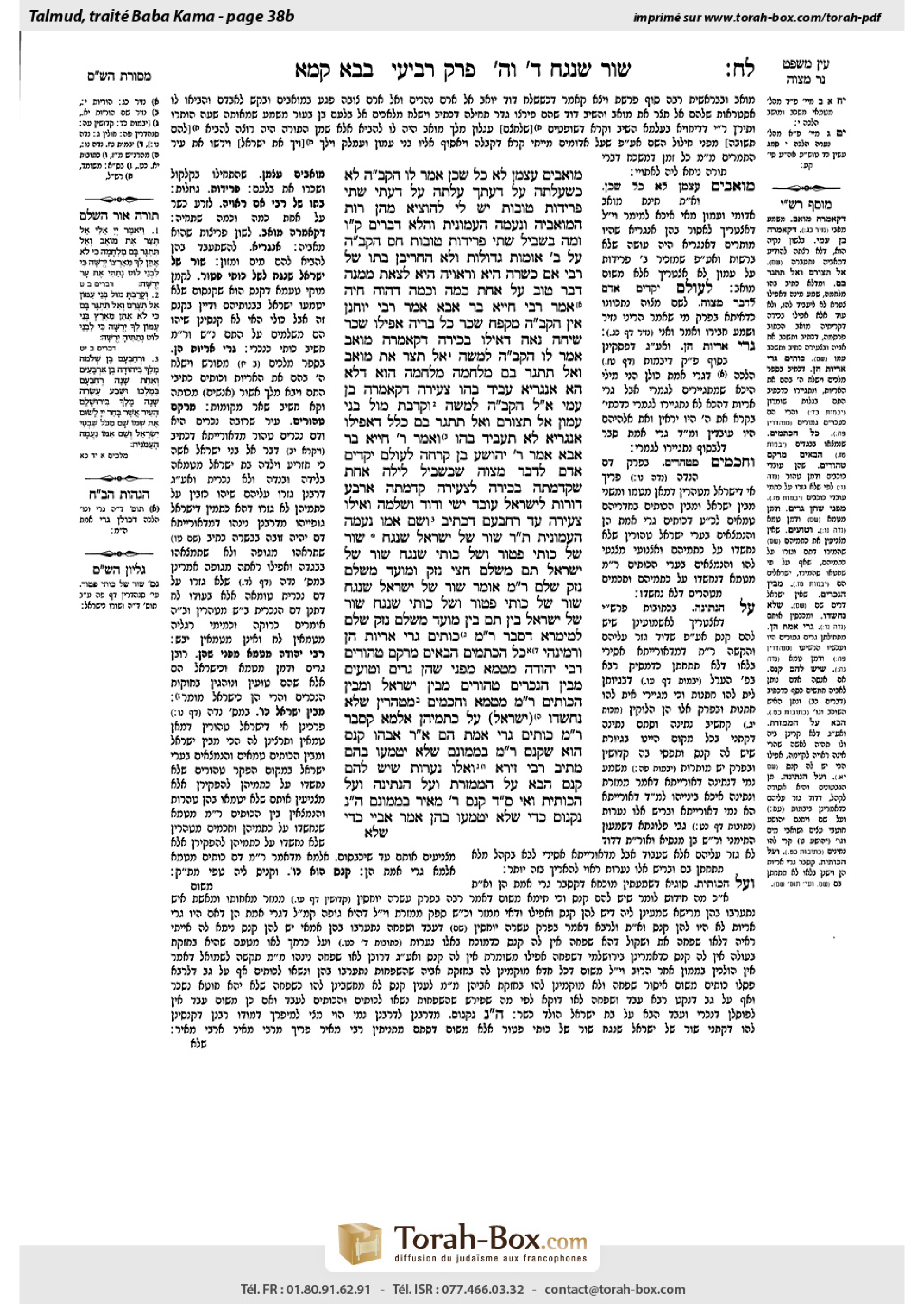
Bava Kamma 38b: Talmud study for Daf Yomi
Study the Talmud for Daf Yomi with scanned pages, Hebrew text, English translations from Sefaria and AI-generated French translations.
Passage selection and English or AI-generated French translation are available where the scan has annotations. Daf Study is independent of Torah-Box and Sefaria.
Browse Bava Kamma · בבא קמא · All tractatesBava Kamma 38b text and translations
This page of Bava Kamma includes the Aramaic text, an English translation and an AI-generated French translation, alongside the scan above.
בבא קמא ל״ח ב · Aramaic and Hebrew text
מוֹאָבִים עַצְמָן לֹא כׇּל שֶׁכֵּן?
אָמַר לוֹ הַקָּדוֹשׁ בָּרוּךְ הוּא: לֹא כְּשֶׁעָלְתָה עַל דַּעְתְּךָ עָלְתָה עַל דַּעְתִּי, שְׁתֵּי פְּרִידוֹת טוֹבוֹת יֵשׁ לִי לְהוֹצִיא מֵהֶן – רוּת הַמּוֹאֲבִיָּה וְנַעֲמָה הָעַמּוֹנִית.
וַהֲלֹא דְּבָרִים קַל וָחוֹמֶר, וּמָה בִּשְׁבִיל שְׁתֵּי פְּרִידוֹת טוֹבוֹת – חָס הַקָּדוֹשׁ בָּרוּךְ הוּא עַל שְׁתֵּי אוּמּוֹת גְּדוֹלוֹת וְלֹא הֶחֱרִיבָן; בִּתּוֹ שֶׁל רַבִּי – אִם כְּשֵׁרָה הִיא וּרְאוּיָה הִיא לָצֵאת מִמֶּנָּה דָּבָר טוֹב, עַל אַחַת כַּמָּה וְכַמָּה דַּהֲוָה חַיָּה.
אָמַר רַבִּי חִיָּיא בַּר אַבָּא אָמַר רַבִּי יוֹחָנָן: אֵין הַקָּדוֹשׁ בָּרוּךְ הוּא מְקַפֵּחַ שְׂכַר כׇּל בְּרִיָּה, אֲפִילּוּ שְׂכַר שִׂיחָה נָאָה.
דְּאִילּוּ בְּכִירָה דְּקָאָמְרָה ״מוֹאָב״, אָמַר לוֹ הַקָּדוֹשׁ בָּרוּךְ הוּא לְמֹשֶׁה ״אַל תָּצַר אֶת מוֹאָב וְאַל תִּתְגָּר בָם מִלְחָמָה״ – מִלְחָמָה הוּא דְּלָא, הָא אַנְגַּרְיָא עֲבֵיד בְּהוּ;
צְעִירָה דְּקָאָמְרָה ״בֶּן עַמִּי״, אֲמַר לֵיהּ הַקָּדוֹשׁ בָּרוּךְ הוּא לְמֹשֶׁה: ״וְקָרַבְתָּ מוּל בְּנֵי עַמּוֹן, אַל תְּצֻרֵם וְאַל תִּתְגָּר בָּם״ – כְּלָל, דַּאֲפִילּוּ אַנְגַּרְיָא לָא תַּעֲבֵיד בְּהוּ.
וְאָמַר רַבִּי חִיָּיא בַּר אַבָּא אָמַר רַבִּי יְהוֹשֻׁעַ בֶּן קׇרְחָה: לְעוֹלָם יַקְדִּים אָדָם לִדְבַר מִצְוָה, שֶׁבִּשְׁבִיל לַיְלָה אַחַת שֶׁקְּדָמַתָּה בְּכִירָה לִצְעִירָה – קְדָמַתָּה אַרְבַּע דּוֹרוֹת לְיִשְׂרָאֵל: עוֹבֵד, יִשַׁי, וְדָוִד, וּשְׁלֹמֹה; וְאִילּוּ צְעִירָה – עַד רְחַבְעָם, דִּכְתִיב: ״וְשֵׁם אִמּוֹ נַעֲמָה הָעַמֹּנִית״.
תָּנוּ רַבָּנַן: שׁוֹר שֶׁל יִשְׂרָאֵל שֶׁנָּגַח שׁוֹר שֶׁל כּוּתִי – פָּטוּר; וְשֶׁל כּוּתִי שֶׁנָּגַח שׁוֹר שֶׁל יִשְׂרָאֵל – תָּם מְשַׁלֵּם חֲצִי נֶזֶק, וּמוּעָד מְשַׁלֵּם נֶזֶק שָׁלֵם.
רַבִּי מֵאִיר אוֹמֵר: שׁוֹר שֶׁל יִשְׂרָאֵל שֶׁנָּגַח שׁוֹר שֶׁל כּוּתִי – פָּטוּר. וְשֶׁל כּוּתִי שֶׁנָּגַח שׁוֹר שֶׁל יִשְׂרָאֵל – בֵּין תָּם בֵּין מוּעָד מְשַׁלֵּם נֶזֶק שָׁלֵם.
לְמֵימְרָא דְּסָבַר רַבִּי מֵאִיר: כּוּתִים גֵּרֵי אֲרָיוֹת הֵן?
ורְמִינְהִי: כׇּל הַכְּתָמִים הַבָּאִים מֵרְקָם – טְהוֹרִים. רַבִּי יְהוּדָה מְטַמֵּא, מִפְּנֵי שֶׁהֵן גֵּרִים וְטוֹעִים.
מִבֵּין הַגּוֹיִם – טְהוֹרִים. מִבֵּין יִשְׂרָאֵל וּמִבֵּין הַכּוּתִים – רַבִּי מֵאִיר מְטַמֵּא; וַחֲכָמִים מְטַהֲרִין – שֶׁלֹּא נֶחְשְׁדוּ יִשְׂרָאֵל עַל כִּתְמֵיהֶן.
אַלְמָא קָסָבַר רַבִּי מֵאִיר כּוּתִים גֵּרֵי אֱמֶת הֵם!
אָמַר רַבִּי אֲבָהוּ: קְנָס הוּא שֶׁקָּנַס רַבִּי מֵאִיר בְּמָמוֹנָם, שֶׁלֹּא יִטָּמְעוּ בָּהֶם.
מֵתִיב רַבִּי זֵירָא: וְאֵלּוּ נְעָרוֹת שֶׁיֵּשׁ לָהֶם קְנָס – הַבָּא עַל הַמַּמְזֶרֶת, וְעַל הַנְּתִינָה, וְעַל הַכּוּתִית. וְאִי סָלְקָא דַעְתָּךְ קָנַס רַבִּי מֵאִיר בְּמָמוֹנָם, הָכִי נָמֵי נִקְנוֹס, כְּדֵי שֶׁלֹּא יִטָּמְעוּ בָּהֶן!
אָמַר אַבָּיֵי: כְּדֵי
Bava Kamma 38b · English translation
with regard to the Moabites themselves, is it not clear all the more so that they should be attacked?
To counter this, the Holy One, Blessed be He, said to him: That which has entered your mind has not entered Mine, because I have two virtuous fledglings [feridot], i.e., girls, to extract from them: Ruth the Moabite, who will be the foremother of the dynasty of David, and Naamah the Ammonite, Solomon’s wife, from whom the continuation of that dynasty will emerge. For the sake of these women, the Moabites and Ammonites must not be destroyed.
Ulla continued: And are these matters not inferred a fortiori? If for the sake of two virtuous fledglings the Holy One, Blessed be He, had pity on two large nations and did not destroy them, then if the daughter of my teacher, Rav Shmuel bar Yehuda, was righteous, and she had the potential for something good to emerge from her, it is all the more so clear that she would have lived.
§ Having mentioned the Moabites and Ammonites, the Gemara cites that Rabbi Ḥiyya bar Abba says that Rabbi Yoḥanan says: The Holy One, Blessed be He, does not deprive any creature of its reward. He rewards every person for his good deeds, and provides reward even for using pleasant speech by using euphemisms.
As with regard to the descendants of the elder of the two daughters of Lot, who said that the name of her son, whom she conceived with her father, would be Moab, meaning: From father, the Holy One, Blessed be He, said to Moses: “Do not be at enmity with Moab, neither contend with them in battle,” indicating that specifically a full-fledged battle was not authorized but that the Jewish people could impose forced labor [angarya] on them.
By contrast, with regard to the descendants of the younger daughter, who said her son’s name would be ben Ami, meaning: Son of my nation, merely alluding to the fact she conceived him through an incestuous union, the Holy One, Blessed be He said to Moses: “And when you come near against the children of Ammon, do not harass them, nor contend with them” (Deuteronomy 2:19). In other words, do not contend with them at all; do not even impose forced labor on them. This additional prohibition was a reward for her employing a euphemism when naming her son.
And with regard to the daughters of Lot, Rabbi Ḥiyya bar Abba says that Rabbi Yehoshua ben Korḥa says: A person should always hasten to perform a mitzva, as due to the one night by which the elder daughter of Lot preceded the younger daughter, with the intention of performing a mitzva by bringing children into the world, she preceded her by four generations in having her descendants enter into the Jewish people. They are: Obed, son of Ruth the Moabite, Yishai, David, and Solomon. Whereas, the descendants of the younger daughter did not join the Jewish people until Rehoboam, Solomon’s son, was born, as it is written: “And his mother’s name was Naamah the Ammonite” (I Kings 14:31).
§ The Sages taught: With regard to the ox of a Jew that gored the ox of a Samaritan, the owner is exempt from liability. But with regard to the ox of a Samaritan that gored the ox of a Jew, if the Samaritan’s ox was innocuous he pays half the cost of the damage, and if it was forewarned, he pays the full cost of the damage. Accordingly, the halakha with regard to Samaritans is not identical to that of a gentile, who is liable to pay the full cost of the damage even for the act of an innocuous ox.
Rabbi Meir says: With regard to the ox of a Jew that gored the ox of a Samaritan, the owner of the ox is exempt from liability. And with regard to the ox of a Samaritan that gored the ox of a Jew, whether it was innocuous or forewarned, the owner pays the full cost of the damage, like a gentile.
The Gemara asks: Is this to say that Rabbi Meir holds that Samaritans are converts who had converted due to fear of lions, i.e., the original conversion of the Samaritans was under duress and consequently meaningless, and therefore he assigns to them the same status as gentiles with regard to liability for damages?
And the Gemara raises a contradiction to this suggestion from a mishna (Nidda 56b): All bloodstained clothes, presumably from menstrual blood, that come from the city of Rekem are ritually pure, since most of the residents there are gentiles, and the bloodstains of gentile women are not ritually impure. Nevertheless, Rabbi Yehuda deems them impure because, in his opinion, the inhabitants of Rekem are converts who are mistaken, i.e., they converted, and they do not observe the mitzvot because they have forgotten Judaism. He holds that since they are halakhically Jewish, their blood is ritually impure.
Bloodstained clothes that come from among gentiles are considered pure. With regard to bloodstained clothes that come from among Jews or from among Samaritans, Rabbi Meir deems them impure, as he suspects them of not taking care to keep impure clothes out of the public domain. And the Rabbis deem them pure, as Jews and Samaritans are not suspected of not being careful about their bloodstains.
Apparently, Rabbi Meir holds that Samaritans are true converts; otherwise the halakha concerning them would be the same as for gentiles, whose bloodstains are not impure at all. This being the case, why does Rabbi Meir regard them as gentiles with regard to liability to pay damages?
Rabbi Abbahu says: They are true converts, and are therefore considered Jews by Torah law inasmuch as in the event that a Jew’s ox causes damage to them, the owner of the ox is liable to pay damages, and if an innocuous ox belonging to them gores a Jew’s ox, the owner pays only half the cost of the damage. Nevertheless, Rabbi Meir imposed a monetary fine on them, giving them the status of gentiles, so that Jews would not assimilate with them.
Rabbi Zeira raises an objection to this answer from a mishna (Ketubot 29a): And these are the cases of young women for whom there is a fine paid to their fathers by one who rapes them. Not only is one who rapes a Jewish young woman of unflawed lineage liable to pay this fine, but so is one who engages in intercourse with a mamzeret, or with a female Gibeonite, or with a female Samaritan. Rabbi Zeira states his objection: And if it enters your mind that Rabbi Meir imposed a monetary fine on them to render them like gentiles, so too, let us fine a female Samaritan who is raped, by rendering her ineligible to receive the fine for rape, so that people will not consider them regular Jews and will not assimilate with them.
Abaye said: According to Rabbi Meir, the reason the Sages did not revoke this fine is in order
Bava Kamma 38b · Traduction française (IA)
Concernant les Moabites eux-mêmes, n'est-il pas clair qu'ils devraient être attaqués avec encore plus de force ?
Pour y répondre, le Saint, le Très Haut, a dit à lui : Ce qui t’est venu à l’esprit n’est pas venu à Mon esprit, car J’ai deux jeunes poulettes vertueuses, c’est-à-dire des filles, à extraire d’elles : Ruth la Moabite, qui sera la mère de la dynastie de David, et Naamah l’Ammonite, épouse de Salomon, d’où émergera la continuation de cette dynastie. À cause de ces femmes, les Moabites et les Ammonites ne doivent pas être détruits.
Ulla continua : Et ces choses ne ne sont-elles pas déduites a fortiori ? Si, à cause de deux jeunes poulettes vertueuses, le Saint, le Très Haut, a pitié de deux grandes nations et n’a pas détruites, alors si la fille de mon maître, Rav Shmuel bar Yehuda, était juste, et qu’elle avait le potentiel de quelque chose de bon à en tirer, il est encore plus clair qu’elle aurait vécu.
§ Ayant mentionné les Moabites et les Ammonites, la Guemara cite que Rabbi Ḥiyya bar Abba dit que Rabbi Yoḥanan dit : Le Saint, le Très Haut, ne prive aucun être de son récompense. Il récompense chaque personne pour ses bonnes œuvres, et il récompense même l'usage de paroles agréables en utilisant des euphémismes.
Comme concernant les descendants de l’aînée des deux filles de Lot, qui dit que le nom de son fils, qu’elle a conçu avec son père, serait Moab, c’est-à-dire : De père, le Saint, le Très Haut, a dit à Moïse : « Ne sois pas en guerre avec Moab, ni ne le combats en bataille », indiquant que spécifiquement une bataille complète n’était pas autorisée, mais que le peuple juif pouvait imposer un travail forcé [angarya] sur eux.
Par contraste, concernant les descendants de la jeune fille, qui dit que le nom de son fils serait ben Ami, c’est-à-dire : Fils de ma nation, simplement en allusion au fait qu’elle l’a conçu par une union incestueuse, le Saint, le Très Haut, a dit à Moïse : « Et quand tu approches des enfants d’Ammon, ne les opprimes pas, ni ne les combats », (Deutéronome 2:19). En d'autres termes, ne les combats pas du tout ; ne leur imposons même pas de travail forcé. Cette interdiction supplémentaire était une récompense pour qu’elle ait utilisé un euphémisme lorsqu’elle a nommé son fils.
Et concernant les filles de Lot, Rabbi Ḥiyya bar Abba dit que Rabbi Yehoshua ben Korḥa dit : Une personne devrait toujours accélérer à accomplir une mitsva, car, en raison de la nuit par laquelle la fille aînée de Lot a précédé la jeune fille, avec l’intention d’accomplir une mitsva en faisant naître des enfants, elle a précédé celle-ci de quatre générations en ayant ses descendants entrer dans le peuple juif. Ils sont : Obed, fils de Ruth la Moabite, Yishai, David, et Solomon. En revanche, les descendants de la jeune fille n’ont pas rejoint le peuple juif jusqu’à la naissance de Rehoboam, fils de Solomon, comme il est écrit : « Et le nom de sa mère était Naamah l’Ammonite » (I Rois 14:31).
§ Les Sages enseignèrent : Concernant l’ox d’un Juif qui a blessé l’ox d’un Samaritain, le propriétaire est exempt de responsabilité. Mais concernant l’ox d’un Samaritain qui a blessé l’ox d’un Juif, si l’ox du Samaritain était inoffensif, il paie la moitié du coût des dommages, et si il était averti, il paie le coût complet des dommages. Ainsi, la halakha concernant les Samaritains n’est pas identique à celle d’un non-Juif, qui est responsable de payer le coût complet des dommages même pour l’acte d’un ox inoffensif.
Rabbi Meir dit : Concernant l’ox d’un Juif qui a blessé l’ox d’un Samaritain, le propriétaire de l’ox est exempt de responsabilité. Et concernant l’ox d’un Samaritain qui a blessé l’ox d’un Juif, qu’il soit inoffensif ou averti, le propriétaire paie le coût complet des dommages, comme un non-Juif.
La Guemara demande : Est-ce que cela signifie que Rabbi Meir considère que les Samaritains sont des convertis qui se sont convertis à cause de la peur des lions, c’est-à-dire que la conversion originale des Samaritains s’est faite sous la contrainte et donc n’était pas valide, et donc il attribue à eux le même statut que les non-Juifs concernant la responsabilité pour les dommages ?
Et la Guemara soulève une contradiction à cette suggestion à partir d’une mitsva (Nidda 56b) : Tous les vêtements souillés, supposément de sang menstruel, qui proviennent de la ville de Rekem sont rituellement purs, car la plupart des habitants y sont des non-Juifs, et les sangs de femmes non-Juives ne sont pas rituellement impurs. Cependant, Rabbi Yehuda considère qu’ils sont impurs, car, selon son avis, les habitants de Rekem sont des convertis qui sont trompeurs, c’est-à-dire qu’ils se sont convertis, mais ils ne respectent pas les mitsvot car ils ont oublié la Torah. Il considère qu’ils sont halakhiquement juifs, donc leur sang est rituellement impur.
Les vêtements souillés qui proviennent des non-Juifs sont considérés comme purs. Concernant les vêtements souillés qui proviennent des Juifs ou des Samaritains, Rabbi Meir considère qu’ils sont impurs, car il soupçonne qu’ils ne prennent pas soin de garder les vêtements impurs hors du domaine public. Et les Rabbins considèrent qu’ils sont purs, car les Juifs et les Samaritains ne sont pas soupçonnés de ne pas être attentifs à leurs souillures.
Apparemment, Rabbi Meir considère que les Samaritains sont des convertis véritables ; autrement, la halakha concernant eux serait la même que pour les Gentils, dont le sang ne rend pas impur du tout. Cela étant, pourquoi Rabbi Meir les considère-t-il comme des Gentils en ce qui concerne la responsabilité de payer des dommages ?
Rabbi Abbahu dit : Ils sont des convertis véritables, et sont donc considérés comme des Juifs par la Torah, car, en cas où un taureau d’un Juif cause des dommages à eux, le propriétaire du taureau est responsable de payer les dommages, et si un taureau inoffensif leur appartient blesse un taureau d’un Juif, le propriétaire paie seulement la moitié du coût des dommages. Cependant, Rabbi Meir a imposé une amende monétaire sur eux, leur donnant le statut de Gentils, afin que les Juifs ne s’assimilent pas à eux.
Rabbi Zeira émet un objet contre cette réponse, en se basant sur une mitsva (Ketubot 29a) : Et ces sont les cas de jeunes femmes pour lesquelles un prix est payé à leurs pères par celui qui les viole. Non seulement celui qui viole une jeune juive de lignée pure est tenu de payer ce prix, mais aussi celui qui a des relations sexuelles avec une mamzeret, ou avec une femme Gibéonite, ou avec une femme Samaritaine. Rabbi Zeira formule son objection : Et si cela vous vient à l'esprit que Rabbi Meir a imposé une amende sur eux afin de les rendre semblables aux non-Juifs, alors aussi, faisons amende honorable à une femme Samaritaine violée, en la rendant inéligible à recevoir cette amende pour viol, afin que les gens ne les considèrent pas comme des Juifs ordinaires et ne s'assimilent pas à eux.
Abaye dit : Selon Rabbi Meir, la raison pour laquelle les Sages n'ont pas révoqué cette amende est afin que
Traduction française générée par IA à partir de l’édition anglaise de Sefaria. Vérifie toujours un passage avec le texte source.
Text from Sefaria: William Davidson Edition - Vocalized Aramaic (CC BY NC); William Davidson Edition - English (CC BY NC).