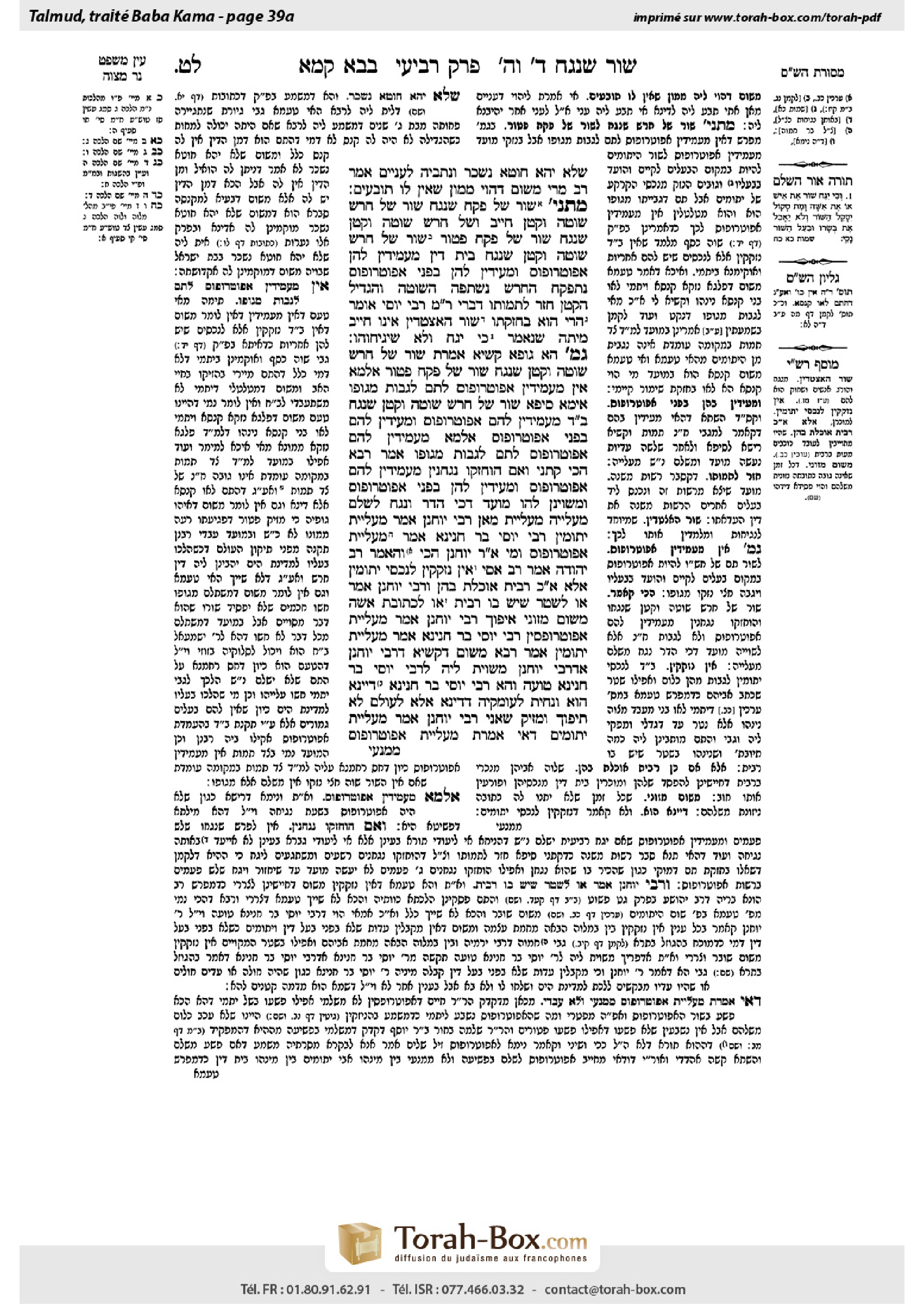
Bava Kamma 39a: Talmud study for Daf Yomi
Study the Talmud for Daf Yomi with scanned pages, Hebrew text, English translations from Sefaria and AI-generated French translations.
Passage selection and English or AI-generated French translation are available where the scan has annotations. Daf Study is independent of Torah-Box and Sefaria.
Browse Bava Kamma · בבא קמא · All tractatesBava Kamma 39a text and translations
This page of Bava Kamma includes the Aramaic text, an English translation and an AI-generated French translation, alongside the scan above.
בבא קמא ל״ט א · Aramaic and Hebrew text
שֶׁלֹּא יְהֵא חוֹטֵא נִשְׂכָּר.
וְנִתְּבֵיהּ לַעֲנִיִּים! אָמַר רַב מָרִי: מִשּׁוּם דְּהָוֵי מָמוֹן שֶׁאֵין לוֹ תּוֹבְעִים.
מַתְנִי׳ שׁוֹר שֶׁל פִּקֵּחַ שֶׁנָּגַח שׁוֹר שֶׁל חֵרֵשׁ שׁוֹטֶה וְקָטָן – חַיָּיב. וְשֶׁל חֵרֵשׁ שׁוֹטֶה וְקָטָן שֶׁנָּגַח שׁוֹר שֶׁל פִּקֵּחַ – פָּטוּר.
שׁוֹר שֶׁל חֵרֵשׁ שׁוֹטֶה וְקָטָן שֶׁנָּגַח – בֵּית דִּין מַעֲמִידִין לָהֶן אַפּוֹטְרוֹפּוֹס, וּמְעִידִין לָהֶן בִּפְנֵי אַפּוֹטְרוֹפּוֹס.
נִתְפַּקֵּחַ הַחֵרֵשׁ, נִשְׁתַּפָּה הַשּׁוֹטֶה וְהִגְדִּיל הַקָּטָן – חָזַר לְתַמּוּתוֹ, דִּבְרֵי רַבִּי מֵאִיר. רַבִּי יוֹסֵי אוֹמֵר: הֲרֵי הוּא בְּחֶזְקָתוֹ.
שׁוֹר הָאִצְטָדִין – אֵינוֹ חַיָּיב מִיתָה, שֶׁנֶּאֱמַר: ״כִּי יִגַּח״ – וְלֹא שֶׁיַּגִּיחוּהוּ.
גְּמָ׳ הָא גוּפָא קַשְׁיָא – אָמְרַתְּ: שׁוֹר שֶׁל חֵרֵשׁ שׁוֹטֶה וְקָטָן, שֶׁנָּגַח שׁוֹר שֶׁל פִּקֵּחַ – פָּטוּר; אַלְמָא אֵין מַעֲמִידִין אַפּוֹטְרוֹפּוֹס לְתָם – לִגְבּוֹת מִגּוּפוֹ. אֵימָא סֵיפָא: שׁוֹר שֶׁל חֵרֵשׁ שׁוֹטֶה וְקָטָן שֶׁנָּגַח – בֵּית דִּין מַעֲמִידִין לָהֶם אַפּוֹטְרוֹפּוֹס, וּמְעִידִין לָהֶם בִּפְנֵי אַפּוֹטְרוֹפּוֹס. אַלְמָא מַעֲמִידִין לָהֶם אַפּוֹטְרוֹפּוֹס לְתָם, לִגְבּוֹת מִגּוּפוֹ!
אָמַר רָבָא, הָכִי קָתָנֵי: וְאִם הוּחְזְקוּ נַגְחָנִין – מַעֲמִידִין לָהֶם אַפּוֹטְרוֹפּוֹס, וּמְעִידִין לָהֶן בִּפְנֵי אַפּוֹטְרוֹפּוֹס, וּמְשַׁוֵּינַן לְהוּ מוּעָד; דְּכִי הָדַר וְנָגַח – לְשַׁלֵּם מֵעֲלִיָּיה.
מֵעֲלִיַּית מַאן? רַבִּי יוֹחָנָן אָמַר: מֵעֲלִיַּית יְתוֹמִין, רַבִּי יוֹסֵי בַּר חֲנִינָא אָמַר: מֵעֲלִיַּית אַפּוֹטְרוֹפּוֹס.
וּמִי אָמַר רַבִּי יוֹחָנָן הָכִי? וְהָאָמַר רַב יְהוּדָה אָמַר רַב אַסִּי: אֵין נִזְקָקִין לְנִכְסֵי יְתוֹמִין, אֶלָּא אִם כֵּן רִבִּית אוֹכֶלֶת בָּהֶן.
וְרַבִּי יוֹחָנָן אָמַר: אוֹ לִשְׁטָר שֶׁיֵּשׁ בּוֹ רִבִּית, אוֹ לִכְתוּבַּת אִשָּׁה מִשּׁוּם מְזוֹנֵי!
אֵיפוֹךְ – רַבִּי יוֹחָנָן אָמַר: מֵעֲלִיַּית אַפּוֹטְרוֹפְּסִין, רַבִּי יוֹסֵי בַּר חֲנִינָא אָמַר: מֵעֲלִיַּית יְתוֹמִין.
אָמַר רָבָא: מִשּׁוּם דְּקַשְׁיָא דְּרַבִּי יוֹחָנָן אַדְּרַבִּי יוֹחָנָן – מְשַׁוֵּית לֵיהּ לְרַבִּי יוֹסֵי בַּר חֲנִינָא טוֹעֶה? וְהָא רַבִּי יוֹסֵי בַּר חֲנִינָא דַּיָּינָא הוּא, וְנָחֵית לְעוּמְקֵיהּ דְּדִינָא!
אֶלָּא לְעוֹלָם לָא תֵּיפוֹךְ, וּמַזִּיק שָׁאנֵי. רַבִּי יוֹחָנָן אָמַר מֵעֲלִיַּית יְתוֹמִים – דְּאִי אָמְרַתְּ מֵעֲלִיַּית אַפּוֹטְרוֹפּוֹס,
Bava Kamma 39a · English translation
that the sinner, i.e., the rapist, should not be rewarded.
The Gemara suggests: But if that is the reason, let him give the fine to the poor instead of to the Samaritan who he raped, to prevent assimilation. Rav Mari said: This is not done, because it is money that has no claimants. Since one would not be liable to give it to a specific poor person, the rapist could evade payment by responding to any claimant that he wants to give it to a different poor person. The Sages upheld the Torah law as it stands, and the fine is given to the Samaritan so that the sinner will not benefit.
MISHNA: If an ox of a halakhically competent person gored an ox of a deaf-mute, an imbecile, or a minor, all of whom are not considered halakhically competent, the owner is liable for damages. But if an ox of a deaf-mute, an imbecile, or a minor gored an ox of a halakhically competent person, the owner of the ox is exempt from liability.
If an ox belonging to a deaf-mute, an imbecile, or a minor gored another ox and caused damage, the court appoints a steward for them and warns them with regard to the ox that gored in the presence of the steward. The ox is thereby rendered a forewarned ox, since the steward is considered its owner with regard to the requirement of the verse: “And warning has been given to its owner” (Exodus 21:29).
If, after the ox was rendered forewarned in this manner, the deaf-mute regained his hearing, the imbecile became halakhically competent, or the minor reached the age of majority, the ox has thereby reverted to its status of innocuousness. This is the statement of Rabbi Meir, who maintains that the ox had the status of a forewarned ox only while it was under the custody of the steward. Rabbi Yosei says: It retains its previous status of being forewarned.
If a stadium [ha’itztadin] ox, i.e., one that is trained to fight in a stadium, gores and kills a person, it is not liable to be put to death, as it is stated: “And if an ox gores a man or a woman” (Exodus 21:28). This is referring only to an ox that gores on its own initiative, but not to the case of an ox where others induced it to gore. Therefore, the owner of a stadium ox, which is trained to gore, is exempt from liability if it does.
GEMARA: The Gemara comments: This matter itself is difficult. First the mishna said: If an ox of a deaf-mute, an imbecile, or a minor gored an ox of a halakhically competent person, the owner of the ox is exempt from liability. Apparently, the court does not appoint a steward for the owner of an innocuous ox for the purpose of collecting damages from the proceeds of the sale of its body. But say the latter clause of the mishna: If an ox belonging to a deaf-mute, an imbecile, or a minor gored another ox and caused damage, the court appoints a steward for them and warns them with regard to the ox that gored in the presence of the steward. Apparently, the court appoints a steward for the owner of an innocuous ox for the purpose of collecting damages from its body.
Rava said that this is what the mishna is teaching: A steward is not appointed to enable collection of compensation from the bodies of innocuous oxen, but if they have acquired the reputation of being habitually goring oxen, as this was not an isolated incident, the court appoints a steward for the owners, and warns them in the presence of the steward, and thereby renders the oxen forewarned. This is so that when one of the oxen gores again, the owner will be liable to pay compensation from his superior-quality property, and not only from the proceeds of the sale of the goring ox.
The Gemara asks: From whose superior-quality property is compensation collected for damage caused by a forewarned ox belonging to minor orphans? Rabbi Yoḥanan says: From the superior-quality property of the orphans. Rabbi Yosei bar Ḥanina says: From the superior-quality property of the steward.
The Gemara asks: But did Rabbi Yoḥanan actually say this? But doesn’t Rav Yehuda say that Rav Asi says: The court does not attend to the property of orphans to have them pay a debt unless interest is eroding their estate. In other words, in a case where the orphans’ father borrowed money from a gentile with interest, the court ensures that the debt is paid from the orphans’ property, since if they wait to pay the debt, it will grow dramatically. Apparently, in other cases the court does not collect from their property.
And Rabbi Yoḥanan says: The court collects from them either to pay a debt recorded in a document that has the payment of interest stipulated in it, in order to ensure that the interest does not diminish the value their estate, or for the payment of a woman’s marriage contract, due to their interest in not paying for her sustenance. A widow can claim her marriage contract from her deceased husband’s property, and as long as she does not receive it, her husband’s heirs are responsible for providing her sustenance. In a case where the heirs are minor orphans, the court collects payment of the marriage contract from the orphans’ property, so that they will not have to pay for her sustenance in the interim. Evidently, Rabbi Yoḥanan holds that with the exception of these two cases, the court does not collect debts from the property of orphans.
The Gemara answers: Reverse the opinions. Rabbi Yoḥanan is the one who says that payment for damage caused by forewarned oxen is collected from the superior-quality property of the steward, and Rabbi Yosei bar Ḥanina is the one who says that it is collected from the superior-quality property of the orphans.
Rava said in response: Due to the difficulty created by the contradiction between the statement of Rabbi Yoḥanan here and the statement of Rabbi Yoḥanan there, you render Rabbi Yosei bar Ḥanina mistaken, by attributing an opinion to him that is not the halakha? Wasn’t Rabbi Yosei bar Ḥanina a judge who delved into the complexities of the halakha?
Rather, one can resolve the contradiction in another manner: Actually, do not reverse the opinions. And the resolution to the contradiction is that although Rabbi Yoḥanan holds that debts are not collected from the property of minor orphans, the halakha with regard to one who causes damage to another by not safeguarding his animal is different. Rabbi Yoḥanan says that compensation is collected from the superior-quality property of the orphans, because if you say that it should be collected from the superior-quality property of the steward,
Bava Kamma 39a · Traduction française (IA)
que le coupable, c'est-à-dire le violateur, ne doive pas être récompensé.
La Guemara suggère : Mais si c'est pour cette raison, qu'il donne la somme aux pauvres plutôt qu'au Samaritain qu'il a violé, afin d'éviter l'assimilation. Rav Mari a dit : Cela n'est pas fait, car c'est de l'argent dont personne ne revendique la propriété. Puisqu'on ne serait pas tenu de le donner à une personne pauvre spécifique, le violateur pourrait échapper au paiement en répondant à tout revendiquant qu'il veut le donner à une autre personne pauvre. Les Sages ont maintenu la loi du Torah telle qu'elle est, et la somme est donnée au Samaritain afin que le coupable ne bénéficie pas.
MICHNA : Si un taureau d'une personne halakhiquement compétente a blessé un taureau d'un sourd-muet, d'un imbécile ou d'un mineur, tous qui ne sont pas considérés comme halakhiquement compétents, l'propriétaire est tenu responsable des dommages. Mais si un taureau d'un sourd-muet, d'un imbécile ou d'un mineur a blessé un taureau d'une personne halakhiquement compétente, l'propriétaire du taureau est exempt de responsabilité.
Si un taureau appartenant à un sourd-muet, un imbécile ou un mineur a blessé un autre taureau et causé des dommages, le tribunal désigne un administrateur pour eux et les avertissement concernant le taureau qui a blessé en présence de l'administrateur. Le taureau est ainsi rendu un taureau averti, puisque l'administrateur est considéré comme son propriétaire concernant la nécessité de la parole : « Et l'avertissement a été donné à son propriétaire » (Exode 21:29).
Si, après que le taureau a été rendu averti de cette manière, le sourd-muet a récupéré son ouïe, l'imbécile est devenu halakhiquement compétent, ou le mineur a atteint l'âge de la majorité, le taureau a ainsi réverti à son statut d'innocuité. C'est l'opinion de Rabbi Meir, qui maintient que le taureau avait le statut de taureau averti uniquement pendant qu'il était sous la garde de l'administrateur. Rabbi Yosei dit : Il conserve son statut précédent d'être averti.
Si un taureau de l'arène [ha’itztadin], c'est-à-dire un taureau entraîné à combattre dans l'arène, blessé et tué une personne, il n'est pas tenu de mourir, car il est dit : « Et si un taureau blesse un homme ou une femme » (Exode 21:28). Cela fait référence uniquement à un taureau qui blesse de son propre chef, mais pas au cas d'un taureau où d'autres l'ont incité à blesser. Ainsi, le propriétaire d'un taureau de l'arène, entraîné à blesser, est exempt de responsabilité si cela arrive.
GUEMARA : La Guemara commente : Cette question elle-même est difficile. D'abord la Michna dit : Si un taureau d'un sourd-muet, d'un imbécile ou d'un mineur a blessé un taureau d'une personne halakhiquement compétente, le propriétaire du taureau est exempt de responsabilité. Apparemment, le tribunal ne désigne pas un administrateur pour le propriétaire d'un taureau innocent afin de collecter les dommages des recettes de la vente de son corps. Mais disons la seconde partie de la Michna : Si un taureau appartenant à un sourd-muet, un imbécile ou un mineur a blessé un autre taureau et causé des dommages, le tribunal désigne un administrateur pour eux et les avertissement concernant le taureau qui a blessé en présence de l'administrateur. Apparemment, le tribunal désigne un administrateur pour le propriétaire d'un taureau innocent afin de collecter les dommages de son corps.
Rava a dit que c'est ce que la Michna enseigne : Un administrateur n'est pas désigné afin de permettre la collecte de compensation des corps des taureaux innocents, mais si ils ont acquis la réputation d'être des taureaux habituellement agressifs, comme cela n'était pas un incident isolé, le tribunal désigne un administrateur pour les propriétaires et les avertissement en présence de l'administrateur, et ainsi rend le taureau averti. C'est ainsi que lorsqu'un de ces taureaux blesse à nouveau, le propriétaire sera tenu de payer la compensation à partir de ses biens de qualité supérieure, et non seulement à partir des recettes de la vente du taureau agressif.
La Guemara pose la question : De la propriété de qualité supérieure de qui est collectée la compensation pour les dommages causés par un taureau averti appartenant à des orphelins mineurs ? Rabbi Yoḥanan dit : De la propriété de qualité supérieure des orphelins. Rabbi Yosei bar Ḥanina dit : De la propriété de qualité supérieure de l'administrateur.
La Guemara pose la question : Mais Rabbi Yoḥanan a-t-il vraiment dit cela ? Mais n'est-ce pas Rav Yehuda qui dit que Rav Asi dit : Le tribunal ne s'occupe pas de la propriété des orphelins pour les faire payer une dette, sauf si l'intérêt érode leur patrimoine. En d'autres termes, dans le cas où le père des orphelins a emprunté de l'argent à un non-Juif avec intérêt, le tribunal s'assure que la dette soit payée à partir de la propriété des orphelins, car s'ils attendent de la payer, elle augmentera considérablement. Apparemment, dans d'autres cas, le tribunal ne collecte pas à partir de leur propriété.
Et Rabbi Yoḥanan dit : Le tribunal collecte d'eux pour payer une dette inscrite dans un document stipulant le paiement d'intérêt, afin d'assurer que l'intérêt ne diminue pas la valeur de leur patrimoine, ou pour le paiement d'un contrat de mariage d'une femme, en raison de leur intérêt à ne pas payer pour son entretien. Une veuve peut réclamer son contrat de mariage à la propriété de son mari défunt, et tant qu'elle ne le reçoit pas, ses héritiers sont responsables de lui fournir son entretien. Dans le cas où les héritiers sont des orphelins mineurs, le tribunal collecte le paiement du contrat de mariage à partir de la propriété des orphelins, afin qu'ils n'aient pas à payer pour son entretien pendant l'intervalle. Apparemment, Rabbi Yoḥanan maintient que, à l'exception de ces deux cas, le tribunal ne collecte pas les dettes à partir de la propriété des orphelins.
La Guemara répond : Inversez les opinions. Rabbi Yoḥanan est celui qui dit que le paiement des dommages causés par des taureaux avertis est collecté à partir de la propriété de qualité supérieure de l'administrateur, et Rabbi Yosei bar Ḥanina est celui qui dit qu'il est collecté à partir de la propriété de qualité supérieure des orphelins.
Rava a répondu : En raison de la difficulté créée par le conflit entre l'affirmation de Rabbi Yoḥanan ici et celle de Rabbi Yoḥanan là, vous considérez Rabbi Yosei bar Ḥanina comme erroné, en attribuant à lui une opinion qui n'est pas la halakha ? N'était-ce pas Rabbi Yosei bar Ḥanina un juge qui s'est plongé dans les complexités de la halakha ?
En effet, on peut résoudre la contradiction d'une autre manière : en réalité, ne pas inverser les opinions. La résolution de la contradiction est que bien que Rabbi Yoḥanan affirme que les dettes ne sont pas recouvertes par la propriété des orphelins mineurs, la halakha concernant celui qui cause un préjudice à autrui en ne gardant pas son animal en sécurité est différente. Rabbi Yoḥanan dit que la compensation est recueillie à partir de la propriété de qualité supérieure des orphelins, car si l'on dit qu'elle doit être recueillie à partir de la propriété de qualité supérieure du gardien,
Traduction française générée par IA à partir de l’édition anglaise de Sefaria. Vérifie toujours un passage avec le texte source.
Text from Sefaria: William Davidson Edition - Vocalized Aramaic (CC BY NC); William Davidson Edition - English (CC BY NC).