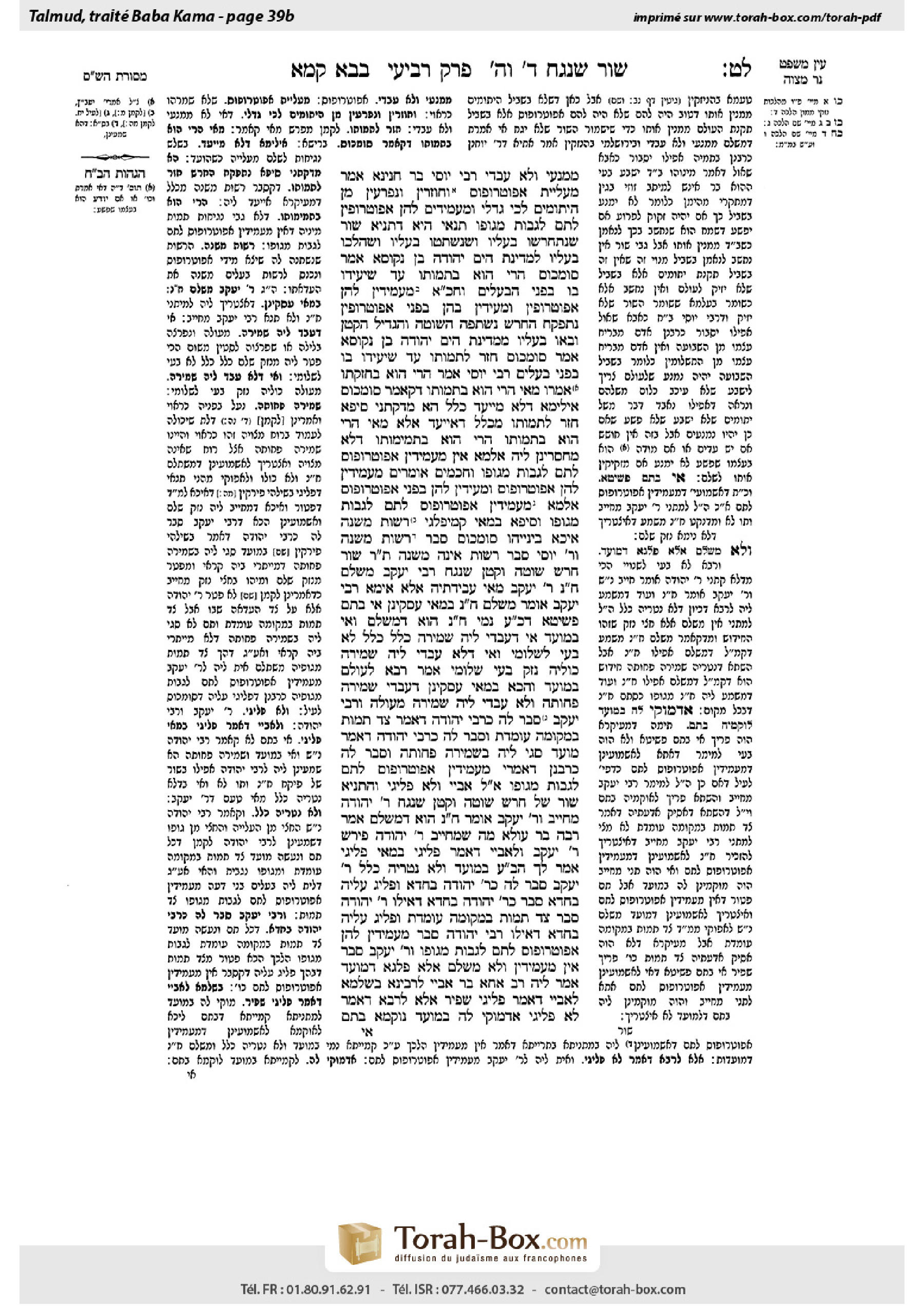
Bava Kamma 39b: Talmud study for Daf Yomi
Study the Talmud for Daf Yomi with scanned pages, Hebrew text, English translations from Sefaria and AI-generated French translations.
Passage selection and English or AI-generated French translation are available where the scan has annotations. Daf Study is independent of Torah-Box and Sefaria.
Browse Bava Kamma · בבא קמא · All tractatesBava Kamma 39b text and translations
This page of Bava Kamma includes the Aramaic text, an English translation and an AI-generated French translation, alongside the scan above.
בבא קמא ל״ט ב · Aramaic and Hebrew text
מִמַּנְעִי וְלָא עָבְדִי. רַבִּי יוֹסֵי בַּר חֲנִינָא אָמַר מֵעֲלִיַּית אַפּוֹטְרוֹפּוֹס – וְחוֹזְרִין וְנִפְרָעִין מִן הַיְּתוֹמִים לְכִי גָדְלִי.
וּ״מַעֲמִידִים לָהֶן אַפּוֹטְרוֹפִּין לְתָם לִגְבּוֹת מִגּוּפוֹ״ – תַּנָּאֵי הִיא,
דְּתַנְיָא: שׁוֹר שֶׁנִּתְחָרְשׁוּ בְּעָלָיו, וְשֶׁנִּשְׁתַּטּוּ בְּעָלָיו, וְשֶׁהָלְכוּ בְּעָלָיו לִמְדִינַת הַיָּם – יְהוּדָה בֶּן נְקוֹסָא אָמַר סוֹמְכוֹס: הֲרֵי הוּא בְּתַמּוּתוֹ עַד שֶׁיָּעִידוּ בּוֹ בִּפְנֵי הַבְּעָלִים. וַחֲכָמִים אוֹמְרִים: מַעֲמִידִין לָהֶן אַפּוֹטְרוֹפִּין, וּמְעִידִין בָּהֶן בִּפְנֵי אַפּוֹטְרוֹפִּין.
נִתְפַּקֵּחַ הַחֵרֵשׁ, נִשְׁתַּפָּה הַשּׁוֹטֶה וְהִגְדִּיל הַקָּטָן – וּבָאוּ בְּעָלָיו מִמְּדִינַת הַיָּם, יְהוּדָה בֶּן נְקוֹסָא אָמַר סוֹמְכוֹס: חָזַר לְתַמּוּתוֹ, עַד שֶׁיָּעִידוּ בּוֹ בִּפְנֵי בְעָלִים. רַבִּי יוֹסֵי אָמַר: הֲרֵי הוּא בְּחֶזְקָתוֹ.
אֲמַרוּ: מַאי ״הֲרֵי הוּא בְּתַמּוּתוֹ״ דְּקָאָמַר סוֹמְכוֹס? אִילֵּימָא דְּלָא מִיַּיעַד כְּלָל – הָא מִדְּקָתָנֵי סֵיפָא ״חָזַר לְתַמּוּתוֹ״, מִכְּלָל דְּאִיַּיעַד!
אֶלָּא מַאי ״הֲרֵי הוּא בְּתַמּוּתוֹ״ – הֲרֵי הוּא בִּתְמִימוּתוֹ, דְּלָא מְחַסְּרִינַן לֵיהּ. אַלְמָא אֵין מַעֲמִידִין אַפּוֹטְרוֹפּוֹס לְתָם לִגְבּוֹת מִגּוּפוֹ. וַחֲכָמִים אוֹמְרִים: מַעֲמִידִין לָהֶן אַפּוֹטְרוֹפּוֹס, וּמְעִידִין לָהֶן בִּפְנֵי אַפּוֹטְרוֹפּוֹס – אַלְמָא מַעֲמִידִין אַפּוֹטְרוֹפּוֹס לְתָם לִגְבּוֹת מִגּוּפוֹ.
וְסֵיפָא בְּמַאי קָמִיפַּלְגִי? רְשׁוּת מְשַׁנָּה אִיכָּא בֵּינַיְיהוּ – סוֹמְכוֹס סָבַר: רְשׁוּת מְשַׁנָּה, וְרַבִּי יוֹסֵי סָבַר: רְשׁוּת אֵינָהּ מְשַׁנָּה.
תָּנוּ רַבָּנַן: שׁוֹר חֵרֵשׁ שׁוֹטֶה וְקָטָן שֶׁנָּגַח – רַבִּי יַעֲקֹב מְשַׁלֵּם חֲצִי נֶזֶק.
רַבִּי יַעֲקֹב מַאי עֲבִידְתֵּיהּ? אֶלָּא אֵימָא, רַבִּי יַעֲקֹב אוֹמֵר: מְשַׁלֵּם חֲצִי נֶזֶק.
בְּמַאי עָסְקִינַן? אִי בְּתָם – פְּשִׁיטָא, דְּכוּלֵּי עָלְמָא נָמֵי חֲצִי נֶזֶק הוּא דִּמְשַׁלֵּם! וְאִי בְּמוּעָד, אִי דְּעָבְדִי לֵיהּ שְׁמִירָה – כְּלָל כְּלָל לָא בָּעֵי לְשַׁלּוֹמֵי, וְאִי דְּלָא עָבְדִי לֵיהּ שְׁמִירָה – כּוּלֵּיהּ נֶזֶק בָּעֵי שַׁלּוֹמֵי!
אָמַר רָבָא: לְעוֹלָם בְּמוּעָד, וְהָכָא בְּמַאי עָסְקִינַן – דְּעָבְדִי שְׁמִירָה פְּחוּתָה, וְלָא עָבְדִי לֵיהּ שְׁמִירָה מְעוּלָּה.
וְרַבִּי יַעֲקֹב סָבַר לַהּ כְּרַבִּי יְהוּדָה – דְּאָמַר: צַד תַּמּוּת בִּמְקוֹמָהּ עוֹמֶדֶת; וְסָבַר לַהּ כְּרַבִּי יְהוּדָה – דְּאָמַר: מוּעָד סַגִּי לֵיהּ בִּשְׁמִירָה פְּחוּתָה;
וְסָבַר לַהּ כְּרַבָּנַן – דְּאָמְרִי: מַעֲמִידִין אַפּוֹטְרוֹפּוֹס לְתָם לִגְבּוֹת מִגּוּפוֹ.
אֲמַר לֵיהּ אַבָּיֵי: וְלָא פְּלִיגִי?! וְהָתַנְיָא: שׁוֹר שֶׁל חֵרֵשׁ, שׁוֹטֶה וְקָטָן שֶׁנָּגַח – רַבִּי יְהוּדָה מְחַיֵּיב, וְרַבִּי יַעֲקֹב אוֹמֵר: חֲצִי נֶזֶק הוּא דִּמְשַׁלֵּם! אָמַר רַבָּה בַּר עוּלָּא: מַה שֶּׁמְּחַיֵּיב רַבִּי יְהוּדָה פֵּירֵשׁ רַבִּי יַעֲקֹב.
וּלְאַבָּיֵי דְּאָמַר פְּלִיגִי, בְּמַאי פְּלִיגִי?
אָמַר לָךְ: הָכָא בְּמַאי עָסְקִינַן – בְּמוּעָד, וְלָא נַטְרֵיהּ כְּלָל.
רַבִּי יַעֲקֹב סָבַר לַהּ כְּרַבִּי יְהוּדָה בַּחֲדָא, וּפְלִיג עֲלֵיהּ בַּחֲדָא. סָבַר כְּרַבִּי יְהוּדָה בַּחֲדָא – דְּאִילּוּ רַבִּי יְהוּדָה סָבַר: צַד תַּמּוּת בִּמְקוֹמָהּ עוֹמֶדֶת; וּפְלִיג עֲלֵיהּ בַּחֲדָא – דְּאִילּוּ רַבִּי יְהוּדָה סָבַר: מַעֲמִידִין לָהֶן אַפּוֹטְרוֹפּוֹס לְתָם לִגְבּוֹת מִגּוּפוֹ, וְרַבִּי יַעֲקֹב סָבַר: אֵין מַעֲמִידִין, וְלָא מְשַׁלֵּם אֶלָּא פַּלְגָא דְמוּעָד.
אֲמַר לֵיהּ רַב אַחָא בַּר אַבָּיֵי לְרָבִינָא: בִּשְׁלָמָא לְאַבָּיֵי דְּאָמַר פְּלִיגִי – שַׁפִּיר; אֶלָּא לְרָבָא דְּאָמַר לָא פְּלִיגִי – אַדְּמוֹקֵי לַהּ בְּמוּעָד, נוֹקְמַהּ בְּתָם!
Bava Kamma 39b · English translation
people will refrain from becoming stewards, fearing that they would incur a financial loss by having to pay for damage caused by the orphans’ animals. By contrast, Rabbi Yosei bar Ḥanina says that it is collected from the superior-quality property of the steward, and there is no concern that people will refrain from becoming stewards, because if they pay for the orphans they are subsequently repaid by the orphans when they grow up.
The Gemara notes: And the matter of whether or not the court appoints stewards for the halakhically incompetent owners of an innocuous ox for the purpose of collecting damages from the sale of its body if it gores is subject to a dispute between tanna’im.
As it is taught in a baraita: With regard to an ox whose owner became a deaf-mute, or whose owner became an imbecile, or whose owner went overseas, if the ox gores, Yehuda ben Nakosa said that Sumakhos said: It retains its status of innocuousness until the court renders it forewarned in the presence of the owner. And the Rabbis say: The court appoints stewards for them, and the ox is rendered forewarned in the presence of the stewards.
If the deaf-mute regained his hearing, or the imbecile became halakhically competent, or the minor reached majority, or its owner came back from overseas, Yehuda ben Nakosa said that Sumakhos said: The ox has reverted to its previous status of innocuousness, until it is rendered forewarned in the presence of the owner. Rabbi Yosei said: The ox retains its status of being forewarned.
The Sages said: What did Sumakhos mean by saying that it retains its status of innocuousness? If we say that he meant that it is not rendered forewarned at all, and is still considered innocuous, from the fact that Sumakhos himself teaches in the latter clause of the baraita that the ox has reverted to its previous status of innocuousness, it is clear by inference that previously it was rendered forewarned.
Rather, what did Sumakhos mean by saying that it retains its status of innocuousness [betammuto]? He meant that it retains its completeness [bitmimuto], as we do not reduce its owner’s share of it by collecting compensation from the sale of its body. Rather, the injured party must wait until the owner becomes competent or returns. Apparently, the court does not appoint a steward for the owner of an innocuous ox to enable the injured party to collect damages from its body. And the Rabbis, who disagree with Sumakhos, say that the court appoints a steward for the owner and renders the ox forewarned in the presence of the steward. Apparently, they hold that the court does appoint a steward for the owner of an innocuous ox to enable the injured party to collect damages from its body.
The Gemara asks: And in the latter clause of the baraita, with regard to what principle do they disagree? The Gemara answers: The difference between them is with regard to whether a change of custody changes the status of the ox. Sumakhos holds that a change of custody changes the status of the ox, whereas Rabbi Yosei holds that a change of custody does not change it; rather, it is determined by the actions of the ox itself, regardless of its custody.
§ The Sages taught in a baraita: With regard to an ox that gored that belonged to a deaf-mute, an imbecile, or a minor, Rabbi Ya’akov pays half the cost of the damage.
The Gemara asks: What did Rabbi Ya’akov do that he should pay for the damage? Rather, emend the baraita and say: Rabbi Ya’akov says that he pays half the cost of the damage.
The Gemara asks: With what are we dealing? If it is with regard to an innocuous ox, isn’t this obvious? Everyone else also holds that one pays half the cost of the damage caused by their ox that gored, so what is the novel element of Rabbi Ya’akov’s statement? And if it is with regard to a forewarned ox it is unclear why the owner pays half the cost of the damage, as if it is a case where he provided adequate safeguarding for it he is not required to pay at all, and if it is a case where he did not provide adequate safeguarding for it he is required to pay the entire cost of the damage.
Rava said: Actually, Rabbi Ya’akov stated his ruling with regard to a forewarned ox, and here we are dealing with a case where he provided reduced safeguarding and did not provide superior safeguarding for it.
And Rabbi Ya’akov holds in accordance with the opinion of Rabbi Yehuda, who says that when an ox is rendered forewarned the liability for its element of innocuousness remains in place. In other words, with regard to half of the damages, it is treated like an innocuous ox, and it is treated as a forewarned ox only with regard to the other half of the damages. Therefore, half the cost of the damage is still collected from the proceeds of the sale of its body. And furthermore, with regard to another issue Rabbi Ya’akov holds in accordance with the opinion of Rabbi Yehuda, who says that although superior safeguarding is necessary for an innocuous ox, reduced safeguarding is sufficient for a forewarned ox. Consequently, one who safeguards his forewarned ox in this manner is exempt from paying the additional half that he would be liable to pay due to the ox’s forewarned status. He is liable with respect to the half that he pays due to its remaining element of innocuousness.
And Rabbi Ya’akov also holds in accordance with the opinion of the Rabbis, who say that the court appoints a steward for the owner of an innocuous ox to enable the injured party to collect damages from its body. Therefore, Rabbi Ya’akov rules that in the case in the baraita, where a forewarned ox owned by a halakhically incompetent person is safeguarded in a reduced fashion, half the cost of the damage must be paid from the proceeds of the sale of its body.
Abaye said to Rava: But do Rabbi Yehuda and Rabbi Ya’akov not disagree with regard to this matter? But isn’t it taught in a baraita that with regard to an ox of a deaf-mute, an imbecile, or a minor, that gored, Rabbi Yehuda deems the owner liable, and Rabbi Ya’akov says that he pays only half the cost of the damage? Rabba bar Ulla says: There is no disagreement here; Rabbi Ya’akov merely explained what Rabbi Yehuda deems him liable to pay.
The Gemara asks: And according to Abaye, who says that Rabbi Ya’akov and Rabbi Yehuda disagree, with regard to what principle do they disagree?
The Gemara answers: Abaye could have said to you that here we are dealing with a forewarned ox whose owner did not safeguard it at all and that is consequently liable for the full cost of the damage.
And Rabbi Ya’akov holds in accordance with the opinion of Rabbi Yehuda with regard to one issue and disagrees with him with regard to one issue. He holds in accordance with the opinion of Rabbi Yehuda with regard to one issue, as Rabbi Yehuda holds that when an ox is rendered forewarned its element of innocuousness remains in its place, and Rabbi Ya’akov agrees. And he disagrees with him with regard to one issue, as Rabbi Yehuda holds that the court appoints a steward for the owner of an innocuous ox to enable the injured party to collect damages from its body, whereas Rabbi Ya’akov holds that the court does not appoint a steward. Therefore, the owner is exempt from paying the half for which he would be liable due to the ox’s element of innocuousness, and pays only the half damages he is liable to pay due to its forewarned status.
Rav Aḥa bar Abaye said to Ravina: Granted, according to Abaye, who says that they disagree, the explanation works out well. But according to Rava, who says that they do not disagree, instead of interpreting the baraita as referring to a forewarned ox, he should have interpreted it as referring to an innocuous ox.
Bava Kamma 39b · Traduction française (IA)
les gens se refuseront à devenir des administrateurs, craignant de subir une perte financière en ayant à payer les dommages causés par les animaux des orphelins. En revanche, Rabbi Yosei bar Ḥanina affirme qu'il est recouvert par la propriété de meilleure qualité de l'administrateur, et il n'y a pas de crainte que les gens se refusent à devenir administrateurs, car s'ils paient pour les orphelins, ils sont ultérieurement rétribués par les orphelins lorsqu'ils grandissent.
La Guemara note : La question de savoir si la cour désigne des administrateurs pour les propriétaires halakhiquement incapables d'un taureau inoffensif afin de collecter des dommages liés à la vente de son corps si celui-ci blesse est sujette à un débat entre les tannaïm.
Comme il est enseigné dans une baraïta : Concernant un taureau dont l'propriétaire est devenu sourd-muet, ou un imbécile, ou qui est parti à l'étranger, si le taureau blesse, Yehuda ben Nakosa a dit que Sumakhos a dit : Il conserve son statut d'inoffensivité jusqu'à ce que la cour le prévienne en présence du propriétaire. Et les Rabbins disent : La cour désigne des administrateurs pour eux, et le taureau est prévenu en présence des administrateurs.
Si le sourd-muet a récupéré son ouïe, ou l'imbécile est devenu halakhiquement compétent, ou le mineur a atteint la majorité, ou son propriétaire est revenu d'à l'étranger, Yehuda ben Nakosa a dit que Sumakhos a dit : Le taureau a réverti à son statut d'inoffensivité précédent, jusqu'à ce qu'il soit prévenu en présence du propriétaire. Rabbi Yosei a dit : Le taureau conserve son statut de prévenu.
Les Sages ont dit : De quoi Sumakhos voulait-il dire en disant qu'il conserve son statut d'inoffensivité ? Si nous disons qu'il voulait dire qu'il n'est pas prévenu du tout et est toujours considéré comme inoffensif, et à partir du fait que Sumakhos lui-même enseigne dans la seconde partie de la baraïta que le taureau a réverti à son statut d'inoffensivité précédent, il est clair par déduction que précédemment il était prévenu.
Plutôt, de quoi Sumakhos voulait-il dire en disant qu'il conserve son statut d'inoffensivité [betammuto] ? Il voulait dire qu'il conserve sa complétude [bitmimuto], car nous ne réduisons pas la part de son propriétaire en collectant une compensation de la vente de son corps. Plutôt, la partie blessée doit attendre que le propriétaire devienne compétent ou revienne. Apparemment, la cour ne désigne pas un administrateur pour le propriétaire d'un taureau inoffensif afin de permettre à la partie blessée de collecter des dommages de son corps. Et les Rabbins, qui s'opposent à Sumakhos, disent que la cour désigne un administrateur pour le propriétaire et prévient le taureau en présence de l'administrateur. Apparemment, ils pensent que la cour désigne un administrateur pour le propriétaire d'un taureau inoffensif afin de permettre à la partie blessée de collecter des dommages de son corps.
La Guemara pose la question : Et dans la seconde partie de la baraïta, sur quel principe se déroule le débat ? La Guemara répond : La différence entre eux est sur le fait que le changement de garde change le statut du taureau. Sumakhos considère que le changement de garde change le statut du taureau, tandis que Rabbi Yosei considère que le changement de garde ne le change pas ; plutôt, il est déterminé par les actions du taureau lui-même, indépendamment de sa garde.
§ Les Sages ont enseigné dans une baraïta : Concernant un taureau qui a blessé appartenant à un sourd-muet, un imbécile ou un mineur, Rabbi Ya’akov paie la moitié du coût des dommages.
La Guemara pose la question : De quoi Rabbi Ya’akov a-t-il fait pour qu'il paie les dommages ? Plutôt, corrigez la baraïta et dites : Rabbi Ya’akov dit qu'il paie la moitié du coût des dommages.
La Guemara pose la question : Avec quoi sommes-nous en train de travailler ? Si c'est concernant un taureau inoffensif, n'est-ce pas évident ? Tout le monde considère également que l'on paie la moitié du coût des dommages causés par leur taureau qui a blessé, donc qu'est-ce qui est nouveau dans l'affirmation de Rabbi Ya’akov ? Et si c'est concernant un taureau prévenu, il est unclear pourquoi le propriétaire paie la moitié du coût des dommages, car si c'est un cas où il a fourni une protection adéquate, il n'est pas requis de payer du tout, et si c'est un cas où il n'a pas fourni une protection adéquate, il est requis de payer le coût total des dommages.
Rava a dit : En réalité, Rabbi Ya’akov a formulé son jugement concernant un taureau prévenu, et ici nous sommes en train de travailler sur un cas où il a fourni une protection réduite et n'a pas fourni une protection supérieure.
Et Rabbi Ya’akov considère l'opinion de Rabbi Yehuda, qui dit que lorsque un taureau est prévenu, la responsabilité pour son élément d'inoffensivité reste en place. En d'autres termes, concernant la moitié des dommages, il est traité comme un taureau inoffensif, et il est traité comme un taureau prévenu seulement concernant l'autre moitié des dommages. Par conséquent, la moitié du coût des dommages est encore collectée à partir des recettes de la vente de son corps. Et de plus, concernant une autre question, Rabbi Ya’akov considère l'opinion de Rabbi Yehuda, qui dit que bien que la protection supérieure soit nécessaire pour un taureau inoffensif, la protection réduite est suffisante pour un taureau prévenu. Ainsi, celui qui protège son taureau prévenu de cette manière est exempt de payer la moitié supplémentaire qu'il serait tenu de payer en raison du statut prévenu du taureau. Il est tenu responsable concernant la moitié qu'il paie en raison de son élément restant d'inoffensivité.
Et Rabbi Ya’akov adopte également l’opinion des Rabbins, qui disent que la cour désigne un administrateur pour le propriétaire d’un taureau inoffensif afin de permettre à la partie blessée de récupérer des dommages à partir de son corps. Par conséquent, Rabbi Ya’akov conclut que dans le cas de la baraïta, où un taureau avertis appartenant à une personne halakhiquement incapable est gardé de manière réduite, la moitié du coût des dommages doit être payée à partir des recettes de la vente de son corps.
Abaye a dit à Rava : Mais Rabbi Yéhuda et Rabbi Yaakov ne neuent-ils pas l'entente sur ce point ? Mais n'est-il pas enseigné dans une baraïta que concernant un bœuf d'un sourd-muet, d'un imbécile ou d'un mineur, qui a tué, Rabbi Yéhuda considère le propriétaire responsable, et Rabbi Yaakov dit qu'il paie seulement la moitié du coût des dommages ? Rabba bar Ulla a dit : Il n'y a pas de désaccord ici ; Rabbi Yaakov explique simplement ce que Rabbi Yéhuda considère comme responsable de payer.
Le Guemara demande : Et selon Abaye, qui dit que Rabbi Yaakov et Rabbi Yéhuda ne s'entendent pas, sur quel principe s'entendent-ils pas ?
Le Guemara répond : Abaye aurait pu te dire que nous sommes ici en présence d'un bœuf averti dont le propriétaire n'a pas pris la moindre précaution et qui est donc responsable du coût complet des dommages.
Et Rabbi Yaakov suit l'opinion de Rabbi Yéhuda sur un point et s'en différencie sur un autre. Il suit l'opinion de Rabbi Yéhuda sur un point, car Rabbi Yéhuda considère que lorsqu'un bœuf est rendu averti, son élément d'innocuité reste en place, et Rabbi Yaakov est d'accord. Il s'en différencie sur un autre point, car Rabbi Yéhuda considère que le tribunal désigne un administrateur pour le propriétaire d'un bœuf innocent afin que la partie blessée puisse récupérer des dommages à partir de son corps, tandis que Rabbi Yaakov considère que le tribunal ne désigne pas d'administrateur. Ainsi, le propriétaire est exempt de payer la moitié pour laquelle il serait responsable en raison de l'élément d'innocuité du bœuf, et paie seulement la moitié des dommages qu'il est responsable en raison de son statut d'avertissement.
Rav Acha bar Abaye a dit à Ravina : D'accord, selon Abaye, qui dit qu'ils s'entendent pas, l'explication s'aligne bien. Mais selon Rava, qui dit qu'ils s'entendent, au lieu d'interpréter la baraïta comme concernant un bœuf averti, il aurait dû l'interpréter comme concernant un bœuf innocent.
Traduction française générée par IA à partir de l’édition anglaise de Sefaria. Vérifie toujours un passage avec le texte source.
Text from Sefaria: William Davidson Edition - Vocalized Aramaic (CC BY NC); William Davidson Edition - English (CC BY NC).