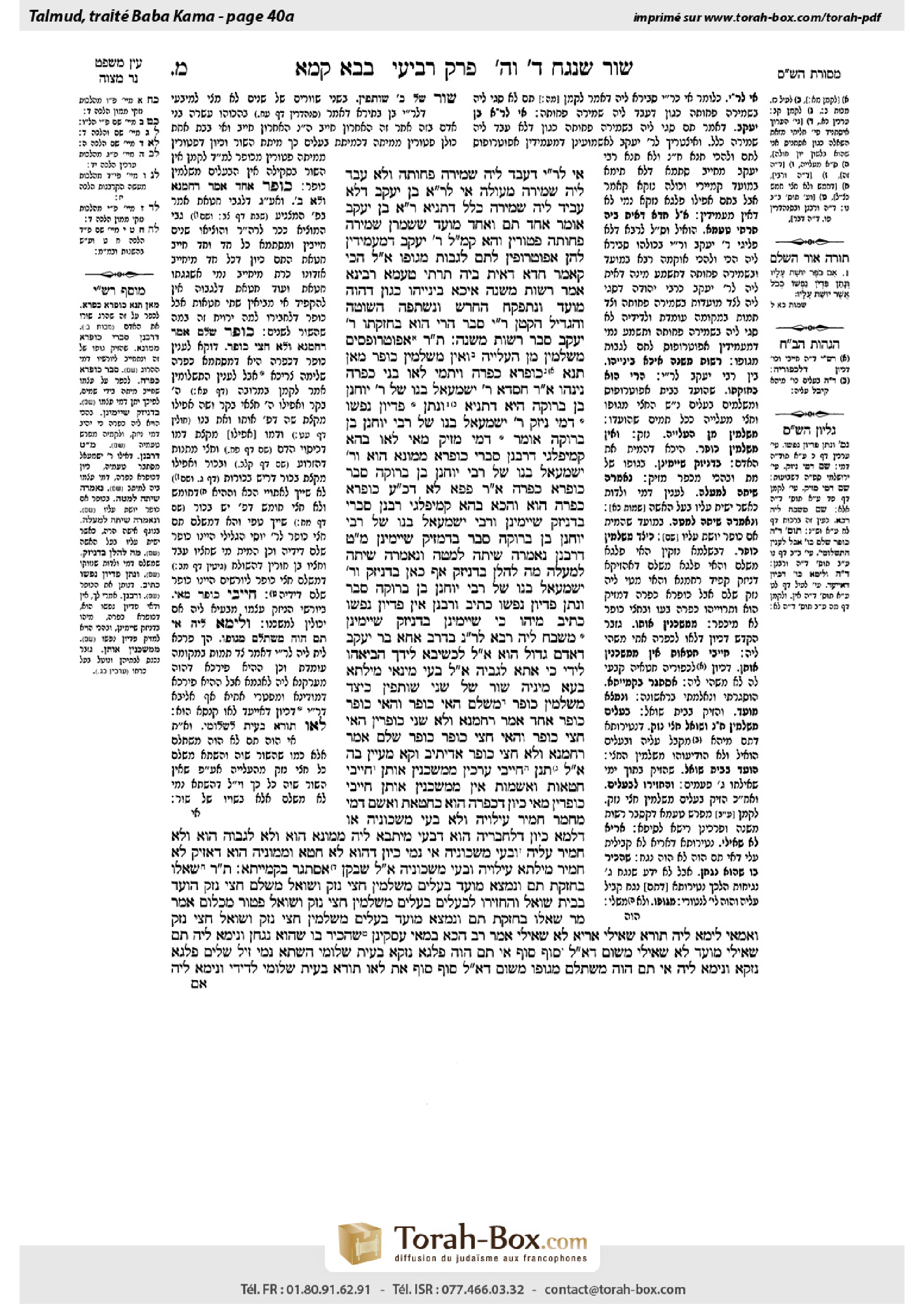
Bava Kamma 40a: Talmud study for Daf Yomi
Study the Talmud for Daf Yomi with scanned pages, Hebrew text, English translations from Sefaria and AI-generated French translations.
Passage selection and English or AI-generated French translation are available where the scan has annotations. Daf Study is independent of Torah-Box and Sefaria.
Browse Bava Kamma · בבא קמא · All tractatesBava Kamma 40a text and translations
This page of Bava Kamma includes the Aramaic text, an English translation and an AI-generated French translation, alongside the scan above.
בבא קמא מ׳ א · Aramaic and Hebrew text
אִי לְרַבִּי יְהוּדָה – דַּעֲבַד לֵיהּ שְׁמִירָה פְּחוּתָה, וְלָא עֲבַד לֵיהּ שְׁמִירָה מְעוּלָּה. אִי לְרַבִּי אֱלִיעֶזֶר בֶּן יַעֲקֹב – דְּלָא עָבֵיד לֵיהּ שְׁמִירָה כְּלָל;
דְּתַנְיָא, רַבִּי אֱלִיעֶזֶר בֶּן יַעֲקֹב אוֹמֵר: אֶחָד תָּם וְאֶחָד מוּעָד שֶׁשְּׁמָרָן שְׁמִירָה פְּחוּתָה – פְּטוּרִין. וְהָא קָא מַשְׁמַע לַן רַבִּי יַעֲקֹב – דְּמַעֲמִידִין (לָהֶן) אַפּוֹטְרוֹפִּין לְתָם, לִגְבּוֹת מִגּוּפוֹ.
אֲמַר לֵיהּ: הָכִי קָאָמַר – חֲדָא דְּאִית בֵּיהּ תַּרְתֵּי טַעְמָא.
רָבִינָא אָמַר: רְשׁוּת מְשַׁנָּה אִיכָּא בֵּינַיְיהוּ – כְּגוֹן דַּהֲוָה מוּעָד; וְנִתְפַּקֵּחַ הַחֵרֵשׁ, וְנִשְׁתַּפָּה הַשּׁוֹטֶה, וְהִגְדִּיל הַקָּטָן. רַבִּי יְהוּדָה סָבַר: הֲרֵי הוּא בְּחֶזְקָתוֹ, רַבִּי יַעֲקֹב סָבַר: רְשׁוּת מְשַׁנָּה.
תָּנוּ רַבָּנַן: אַפּוֹטְרוֹפְּסִים מְשַׁלְּמִין מִן הָעֲלִיָּיה, וְאֵין מְשַׁלְּמִין כּוֹפֶר.
מַאן תְּנָא כּוּפְרָא – כַּפָּרָה, וְיַתְמֵי לָאו בְּנֵי כַפָּרָה נִינְהוּ?
אָמַר רַב חִסְדָּא: רַבִּי יִשְׁמָעֵאל בְּנוֹ שֶׁל רַבִּי יוֹחָנָן בֶּן בְּרוֹקָה הִיא, דְּתַנְיָא: ״וְנָתַן פִּדְיֹן נַפְשׁוֹ״ – דְּמֵי נִיזָּק. רַבִּי יִשְׁמָעֵאל בְּנוֹ שֶׁל רַבִּי יוֹחָנָן בֶּן בְּרוֹקָה אוֹמֵר: דְּמֵי מַזִּיק.
מַאי, לָאו בְּהָא קָמִיפַּלְגִי – דְּרַבָּנַן סָבְרִי: כּוּפְרָא מָמוֹנָא הוּא; וְרַבִּי יִשְׁמָעֵאל בְּנוֹ שֶׁל רַבִּי יוֹחָנָן בֶּן בְּרוֹקָה סָבַר: כּוּפְרָא כַּפָּרָה?
אָמַר רַב פָּפָּא: לָא; דְּכוּלֵּי עָלְמָא כּוּפְרָא כַּפָּרָה הוּא, וְהָכָא בְּהָא קָמִיפַּלְגִי – רַבָּנַן סָבְרִי: בִּדְנִיזָּק שָׁיְימִינַן, וְרַבִּי יִשְׁמָעֵאל בְּנוֹ שֶׁל רַבִּי יוֹחָנָן בֶּן בְּרוֹקָה סָבַר: בִּדְמַזִּיק שָׁיְימִינַן.
מַאי טַעְמָא דְּרַבָּנַן? נֶאֶמְרָה ״שִׁיתָה״ לְמַטָּה, וְנֶאֶמְרָה ״שִׁיתָה״ לְמַעְלָה; מָה לְהַלָּן בִּדְנִיזָּק, אַף כָּאן בִּדְנִיזָּק.
וְרַבִּי יִשְׁמָעֵאל בְּנוֹ שֶׁל רַבִּי יוֹחָנָן בֶּן בְּרוֹקָה סָבַר: ״וְנָתַן פִּדְיֹן נַפְשׁוֹ״ כְּתִיב.
וְרַבָּנַן: אִין, ״פִּדְיוֹן נַפְשׁוֹ״ כְּתִיב; מִיהוּ כִּי שָׁיְימִינַן – בִּדְנִיזָּק שָׁיְימִינַן.
מְשַׁבַּח לֵיהּ רָבָא לְרַב נַחְמָן בִּדְרַב אַחָא בַּר יַעֲקֹב, דְּאָדָם גָּדוֹל הוּא. אָמַר לֵיהּ: לִכְשֶׁיָּבֹא לְיָדְךָ, הֲבִיאֵהוּ לְיָדִי.
כִּי אֲתָא לְגַבֵּיהּ, אֲמַר לֵיהּ: בָּעֵי מִינַּאי מִילְּתָא. בְּעָא מִינֵּיהּ: שׁוֹר שֶׁל שְׁנֵי שׁוּתָּפִין, כֵּיצַד מְשַׁלְּמִין כּוֹפֶר?
מְשַׁלֵּם הַאי כּוֹפֶר וְהַאי כּוֹפֶר? כּוֹפֶר אֶחָד אָמַר רַחֲמָנָא, וְלֹא שְׁנֵי כוּפְרִין! הַאי חֲצִי כוֹפֶר וְהַאי חֲצִי כוֹפֶר? כּוֹפֶר שָׁלֵם אָמַר רַחֲמָנָא, וְלֹא חֲצִי כוֹפֶר!
אַדְּיָתֵיב וְקָא מְעַיֵּין בַּהּ, אֲמַר לֵיהּ – תְּנַן: חַיָּיבֵי עֲרָכִין – מְמַשְׁכְּנִין אוֹתָן. חַיָּיבֵי חַטָּאוֹת וַאֲשָׁמוֹת – אֵין מְמַשְׁכְּנִין אוֹתָן. חַיָּיבֵי כוּפְרִין מַאי?
כֵּיוָן דְּכַפָּרָה הוּא – כְּחַטָּאת וְאָשָׁם דָּמֵי,ּ מִחְמָר חֲמִיר עִילָּוֵיהּ וְלָא בָּעֵי מַשְׁכּוֹנֵיהּ; אוֹ דִלְמָא, כֵּיוָן דִּלְחַבְרֵיהּ הוּא דְּבָעֵי מִיתְּבָא לֵיהּ – מָמוֹנָא הוּא וְלָא לְגָבוֹהַּ הוּא, וְלָא חֲמִיר עֲלֵיהּ, וּבָעֵי מַשְׁכּוֹנֵיהּ?
אִי נָמֵי, כֵּיוָן דְּהוּא לָא חֲטָא, וּמָמוֹנֵיהּ הוּא דְּאַזֵּיק – לָא חֲמִיר מִילְּתָא עִילָּוֵיהּ, וּבָעֵי מַשְׁכּוֹנֵיהּ.
אֲמַר לֵיהּ: שִׁבְקַן, אֶסְתַּגַּר בְּקַמַּיְיתָא.
תָּנוּ רַבָּנַן: שְׁאָלוֹ בְּחֶזְקַת תָּם, וְנִמְצָא מוּעָד – בְּעָלִים מְשַׁלְּמִין חֲצִי נֶזֶק, וְשׁוֹאֵל מְשַׁלֵּם חֲצִי נֶזֶק.
הוּעַד בְּבֵית שׁוֹאֵל, וְהֶחְזִירוֹ לַבְּעָלִים – בְּעָלִים מְשַׁלְּמִין חֲצִי נֶזֶק, וְשׁוֹאֵל פָּטוּר מִכְּלוּם.
אָמַר מָר: שְׁאָלוֹ בְּחֶזְקַת תָּם, וְנִמְצָא מוּעָד – בְּעָלִים מְשַׁלְּמִין חֲצִי נֶזֶק, וְשׁוֹאֵל חֲצִי נֶזֶק. וְאַמַּאי? לֵימָא לֵיהּ: תּוֹרָא שְׁאֵילִי, אַרְיָא לָא שְׁאֵילִי!
אָמַר רַב: הָכָא בְּמַאי עָסְקִינַן – שֶׁהִכִּיר בּוֹ שֶׁהוּא נַגְחָן.
וְנֵימָא לֵיהּ: תָּם שְׁאֵילִי, מוּעָד לָא שְׁאֵילִי!
מִשּׁוּם דְּאָמַר לֵיהּ: סוֹף סוֹף אִי תָּם הֲוָה – פַּלְגָא נִזְקָא בָּעֵית שַׁלּוֹמֵי; הַשְׁתָּא נָמֵי, זִיל שַׁלֵּים פַּלְגָא נִזְקָא.
וְנֵימָא לֵיהּ: אִי תָּם – הֲוָה מִשְׁתַּלֵּם מִגּוּפוֹ!
מִשּׁוּם דְּאָמַר לֵיהּ: סוֹף סוֹף, אַתְּ – לָאו תּוֹרָא בָּעֵית שַׁלּוֹמֵי לְדִידִי?
וְנֵימָא לֵיהּ:
Bava Kamma 40a · English translation
There are two scenarios in which the baraita could be interpreted as referring to an innocuous ox. If one wants to interpret it in accordance with the opinion of Rabbi Yehuda, it can be discussing a case where he provided reduced safeguarding for it and did not provide superior safeguarding for it. If one wants to interpret it in accordance with the opinion of Rabbi Eliezer ben Ya’akov, it can be discussing a case where he did not provide safeguarding for it at all.
As it is taught in a baraita: Rabbi Eliezer ben Ya’akov says: With regard to both an innocuous ox and a forewarned ox whose owner provided reduced safeguarding for them, he is exempt. The owner is liable only if he did not safeguard them at all. And accordingly, Rabbi Ya’akov teaches us this, that the court appoints stewards for the owners of an innocuous ox to enable the injured party to collect damages from the proceeds of the sale of its body.
Ravina said to him that this is what Rava was saying by interpreting Rabbi Ya’akov’s statement with regard to a forewarned ox: Rabbi Ya’akov stated one matter containing two elements of reasoning [ta’ama] in accordance with Rabbi Yehuda’s opinion, namely, that a forewarned ox retains its element of innocuousness, and that reduced safeguarding is sufficient for a forewarned ox.
Ravina himself said a different explanation of the baraita: The practical difference between Rabbi Yehuda and Rabbi Ya’akov is with regard to whether a change of custody changes the status of the ox. For example, in a case where the ox was forewarned while in the custody of the steward and subsequently the deaf-mute regained his hearing, or the imbecile became halakhically competent, or the minor reached majority, and the ox returned to its owner’s custody. Rabbi Yehuda holds that it is still in its previous status, the change of custody notwithstanding, and that therefore the owner is liable for the full cost of the damage. By contrast, Rabbi Ya’akov holds that the change of custody changes the status of the ox, which reverts to innocuousness, and so the owner pays only half the cost of the damage.
§ The Sages taught in a baraita: Stewards are liable to pay from their superior-quality property for damage caused by forewarned oxen under their custody, but they do not pay a ransom if the oxen killed a person.
The Gemara asks: Who is the tanna who taught that the purpose of ransom is atonement for the owner of the ox, and that therefore a minor orphan’s steward is exempt from liability to pay it, as orphans are not subject to the obligation of atonement since they are not morally responsible?
Rav Ḥisda said: It is Rabbi Yishmael, son of Rabbi Yoḥanan ben Beroka. As it is taught in a baraita: The verse: “If a ransom is imposed upon him, then he shall give for the redemption of his life” (Exodus 21:30), is referring to the monetary value of the injured party. Rabbi Yishmael, son of Rabbi Yoḥanan ben Beroka, says: The ransom corresponds to the monetary value of the one liable for the damage.
What, do they not disagree with regard to this very issue? In other words, the Rabbis hold that ransom is monetary restitution for the damage caused, and therefore the heirs of the victim must be paid the monetary value of the victim. And Rabbi Yishmael, son of Rabbi Yoḥanan ben Beroka, holds that ransom is atonement for causing the death of a person. Accordingly, the amount of the ransom is the monetary value of the one liable, since, from the perspective of his moral responsibility for the incident, he deserves to pay with his life. Although the court does not impose capital punishment, his atonement is through payment of his own value.
Rav Pappa said: No, it is possible that according to everyone ransom is atonement, and here they disagree with regard to this issue: The Rabbis hold that we evaluate the amount that is appropriate for atonement according to the monetary value of the injured party, and Rabbi Yishmael, son of Rabbi Yoḥanan ben Beroka, holds that we evaluate it according to the value of the one liable for the damage. All agree that the purpose of the ransom is atonement.
The Gemara elaborates: What is the reasoning of the Rabbis? Imposing is stated in the later verse: “If ransom is imposed upon him” (Exodus 21:30), and imposing is stated in the earlier verse, concerning a person who injures a pregnant woman, causing her to miscarry: “He shall be punished as the husband of the woman shall impose upon him” (Exodus 21:22). This verbal analogy indicates comparison of the two halakhot: Just as there, with regard to compensation for causing miscarriage, the evaluation is according to the monetary value of the injured party, i.e., the fetus, so too here, the ransom is according to the value of the injured party.
And Rabbi Yishmael, son of Rabbi Yoḥanan ben Beroka, holds that the fact that it is written: “And he shall give for the redemption of his life,” indicates that the ransom is redemption of the life of the ox’s owner, and its amount should accordingly be the owner’s monetary value.
And the Rabbis would respond to this reasoning that indeed, the phrase: “For the redemption of his life,” is written, indicating that the purpose of the ransom is redemption of his life. Nevertheless, when we evaluate the amount he is liable to pay, we evaluate it according to the value of the injured party.
§ Rava was praising Rav Aḥa bar Ya’akov before Rav Naḥman, saying that he is a great man. Rav Naḥman said to him: When he happens to come to you, bring him to visit me.
When Rav Aḥa bar Ya’akov eventually came to him, Rav Naḥman said to him: Ask me something. Rav Aḥa bar Ya’akov asked him: If an ox belonging to two partners kills a person, how do they pay the ransom?
If this partner pays the ransom in full and that partner also pays the ransom in full, it would seem incorrect, as the Merciful One states that one ransom shall be paid, but not two ransoms. If this partner pays half the ransom and that partner pays half the ransom, it would also seem incorrect, as the Merciful One states that a full ransom shall be paid, but not half a ransom.
While Rav Naḥman was sitting and pondering this question, Rav Aḥa bar Ya’akov asked him another question. He said to him: We learned in a mishna: The court repossesses property from those liable to pay their valuations who are delaying their payments. But the court does not repossess property from those liable to bring sin-offerings and guilt-offerings; they are relied upon to bring their offerings of their own initiative, as it is assumed they want to atone for their transgressions (Arakhin 21a). In light of this mishna, what is the halakha with regard to those liable to pay ransom?
Should it be reasoned that since it is atonement, it is similar to the cases of a sin-offering and a guilt-offering, which a person treats seriously, as it is in his interest to achieve atonement, and therefore the court does not need to repossess property from him? Or perhaps it should be reasoned that since he is required to give the ransom to another person, he considers it a financial liability and does not consider it an obligation toward the Most High, and consequently he does not treat it seriously enough; and therefore the court needs to repossess property from him, as he might not pay it.
Alternatively, it could be reasoned that since he himself did not sin but rather it is his property, i.e., his ox, that caused the damage, he does not treat the matter seriously enough, and therefore the court needs to repossess property from him to ensure payment.
Rav Naḥman said to him: Leave me alone. I am still stuck on the first question and have no solution, so you must not raise further difficult questions.
The Sages taught: Even though one who borrows an ox from another is generally responsible for damage that it causes, if he borrowed it on the presumption that it was innocuous and it gored and caused damage, and it was then found to be forewarned, the owner pays half the cost of the damage and the borrower pays half the cost of the damage.
If the ox was rendered forewarned in the house of the borrower, i.e., it gored three times while in his possession, and he was warned in court, and he then returned it to the owner and it subsequently gored, the owner pays half the cost of the damage, as with regard to him it is still considered innocuous, having become forewarned while not in his custody, and the borrower is exempt from paying any compensation, since the ox is no longer in his custody.
The Master said in the baraita: If one borrowed the ox on the presumption that it was innocuous and it was found to be forewarned, the owner pays half the cost of the damage and the borrower pays half the cost of the damage. The Gemara asks: But why should the borrower pay at all? Let him say to the owner: I borrowed an ox; I did not borrow a lion. I did not accept responsibility for safeguarding a forewarned ox, which behaves violently like a lion.
Rav said: Here we are dealing with a case where the borrower was aware at the time he borrowed it that it was a goring ox and liable to cause damage.
The Gemara asks: But if that is the case, let him say to the owner: Even though I knew that it was a goring ox, nevertheless, I borrowed an innocuous ox. I did not intend to borrow a forewarned ox and thereby accept responsibility for safeguarding an ox for which one must pay the full cost of its damage.
The Gemara answers that the borrower is liable because the owner can say to him: Ultimately, even if it was innocuous, you would be required to pay half the damages. Therefore, now too, go pay half the damages.
The Gemara asks: But if that is the case, let the borrower say to the owner: If it was innocuous, the damages would be paid from the proceeds of the sale of the body of the ox, not from my property.
The Gemara answers: The borrower cannot say this, because the owner can say to him: Ultimately, would you not have been required to pay me back the full value of my ox? As a borrower you are obligated to return the ox to me in the same condition that you borrowed it. Even if compensation was collected from the proceeds of its sale you would still have been required to return its full value to me. Therefore, in any event you would effectively be paying for the damage, so you are not losing anything from the fact that the ox is forewarned.
The Gemara asks: But if that is the case, let the borrower say to him:
Bava Kamma 40a · Traduction française (IA)
Il existe deux scénarios dans lesquels la baraïta pourrait être interprétée comme faisant référence à un taureau inoffensif. Si l'on veut l'interpréter conformément à l'opinion de Rabbi Yéhuda, cela pourrait concerner un cas où l'on a fourni une protection réduite pour lui et n'a pas fourni une protection supérieure pour lui. Si l'on veut l'interpréter conformément à l'opinion de Rabbi Éliezer ben Ya'akov, cela pourrait concerner un cas où l'on n'a fourni aucune protection pour lui du tout.
Comme il est enseigné dans une baraïta : Rabbi Éliezer ben Ya'akov dit : Concernant à la fois un taureau inoffensif et un taureau averti dont l'propriétaire a fourni une protection réduite, il est exempt. L'propriétaire est responsable uniquement s'il n'a fourni aucune protection du tout. Et ainsi, Rabbi Ya'akov nous enseigne cela, que la cour désigne des administrateurs pour les propriétaires d'un taureau inoffensif afin de permettre à la partie blessée de récupérer des dommages à partir des revenus de la vente de son corps.
Ravina dit à lui que c'est ce que Rava disait en interprétant la déclaration de Rabbi Ya'akov concernant un taureau averti : Rabbi Ya'akov a énoncé une seule question contenant deux raisons [ta'ama] selon l'opinion de Rabbi Yéhuda, à savoir que le taureau averti conserve son caractère inoffensif, et que la protection réduite suffit pour un taureau averti.
Ravina lui-même a donné une autre interprétation de la baraïta : La différence pratique entre Rabbi Yéhuda et Rabbi Ya'akov concerne la question de savoir si un changement de garde modifie le statut du taureau. Par exemple, dans un cas où le taureau était averti pendant la garde de l'administrateur et ensuite le sourd est devenu entendant, ou l'imbécile est devenu halakhiquement compétent, ou l'enfant est devenu majeur, et le taureau est revenu sous la garde de son propriétaire. Rabbi Yéhuda considère qu'il reste dans son statut précédent, indépendamment du changement de garde, et donc le propriétaire est responsable du coût complet des dommages. En revanche, Rabbi Ya'akov considère que le changement de garde modifie le statut du taureau, qui redevient inoffensif, et donc le propriétaire paie seulement la moitié du coût des dommages.
§ Les Sages ont enseigné dans une baraïta : Les administrateurs sont responsables de payer avec leurs biens de qualité supérieure pour les dommages causés par des taureaux avertis sous leur garde, mais ils ne paient pas une rançon si les taureaux ont tué une personne.
La Guemara pose la question : Qui est le tanna qui a enseigné que la rançon a pour but l'atonement pour le propriétaire du taureau, et que par conséquent un administrateur d'un orphelin mineur est exempt de responsabilité à payer cette rançon, car les orphelins ne sont pas soumis à l'obligation d'atoneur puisqu'ils ne sont pas moralement responsables ?
Rav Ḥisda a dit : C'est Rabbi Yishmael, fils de Rabbi Yoḥanan ben Beroka. Comme il est enseigné dans une baraïta : La versette : « Si une rançon est imposée à lui, il devra donner pour la rançon de sa vie » (Exode 21:30), fait référence à la valeur monétaire de la partie blessée. Rabbi Yishmael, fils de Rabbi Yoḥanan ben Beroka, dit : La rançon correspond à la valeur monétaire de celui qui est responsable des dommages.
Qu'est-ce que cela ne leur fait pas disposer sur ce point même ? En d'autres termes, les Rabbins considèrent que la rançon est une restitution monétaire pour les dommages causés, et donc les héritiers de la victime doivent être payés la valeur monétaire de la victime. Et Rabbi Yishmael, fils de Rabbi Yoḥanan ben Beroka, considère que la rançon est l'atonement pour avoir causé la mort d'une personne. Ainsi, le montant de la rançon est la valeur monétaire de celui qui est responsable, car, du point de vue de sa responsabilité morale pour l'incident, il mérite de payer avec sa vie. Bien que la cour ne sanctionne pas la peine de mort, son atonement est réalisé par le paiement de sa propre valeur.
Rav Pappa a dit : Non, il est possible que selon tout le monde la rançon soit l'atonement, et ici ils diffèrent sur ce point : Les Rabbins considèrent que nous évaluons le montant approprié pour l'atonement selon la valeur monétaire de la partie blessée, et Rabbi Yishmael, fils de Rabbi Yoḥanan ben Beroka, considère que nous l'évaluons selon la valeur de celui qui est responsable des dommages. Tout le monde convient que le but de la rançon est l'atonement.
La Guemara développe : Quel est le raisonnement des Rabbins ? L'expression « imposé » est mentionnée dans la versette ultérieure : « Si une rançon est imposée à lui » (Exode 21:30), et « imposé » est mentionnée dans la versette précédente, concernant une personne qui blesse une femme enceinte, causant un avortement : « Il sera puni comme le mari de la femme imposera à lui » (Exode 21:22). Cette analogie verbale indique une comparaison des deux halakhot : Tout comme là, concernant la compensation pour un avortement, l'évaluation est selon la valeur monétaire de la partie blessée, c'est-à-dire le fœtus, de même ici, la rançon est selon la valeur de la partie blessée.
Et Rabbi Yishmael, fils de Rabbi Yoḥanan ben Beroka, affirme que le fait que cela est écrit : « Et il devra donner pour la rançon de sa vie », indique que la rançon est la rançon de la vie du propriétaire du taureau, et son montant doit donc correspondre à la valeur monétaire du propriétaire.
Et les Rabbins répondraient à ce raisonnement en disant que certes, la phrase : « Pour la rançon de sa vie », est écrite, indiquant que le but de la rançon est la rançon de sa vie. Cependant, lorsqu'on évalue le montant qu'il doit payer, on l'évalue selon la valeur de la partie blessée.
§ Rava louait Rav Aḥa bar Ya’akov devant Rav Naḥman, disant qu'il est un homme d'exception. Rav Naḥman dit à Rava : Quand il vient te voir, amène-le me voir.
Quand Rav Aḥa bar Ya’akov est enfin venu le voir, Rav Naḥman dit à lui : Pose-moi une question. Rav Aḥa bar Ya’akov demanda : Si un taureau appartenant à deux associés tue une personne, comment paient-ils la rançon ?
Si ce partenaire paie le rançon en totalité et que l'autre partenaire paie également le rançon en totalité, cela semble incorrect, car le Très Miséricordieux dit qu'un seul rançon doit être payé, pas deux rançons. Si ce partenaire paie la moitié du rançon et que l'autre partenaire paie la moitié du rançon, cela semble également incorrect, car le Très Miséricordieux dit qu'un rançon complet doit être payé, pas la moitié d'un rançon.
Tandis que Rav Naḥman était assis et réfléchissait à cette question, Rav Aḥa bar Ya’akov lui posa une autre question. Il lui dit : Nous avons appris dans une mitsna : Le tribunal révoque les biens de ceux qui doivent payer leur estimation et qui retardent leurs paiements. Mais le tribunal ne révoque pas les biens de ceux qui doivent présenter des sacrifices expiatoires et des sacrifices de culpabilité ; ils sont considérés comme disposés à présenter leurs offrandes de leur propre initiative, car on suppose qu'ils veulent s'attirer la miséricorde (Arakhin 21a). À la lumière de cette mitsna, quelle est la halakha concernant ceux qui doivent payer un rançon ?
Doit-on raisonner que puisque c'est une expiation, cela ressemble aux cas des sacrifices expiatoires et des sacrifices de culpabilité, que la personne traite sérieusement, car c'est dans son intérêt d'obtenir l'expiation, et donc le tribunal n'a pas besoin de révoquer ses biens ? Ou peut-être doit-on raisonner que puisque il doit donner le rançon à une autre personne, il le considère comme une charge financière et ne le considère pas comme une obligation envers le Très Haut, et par conséquent il ne le traite pas sérieusement assez ; et donc le tribunal a besoin de révoquer ses biens, car il pourrait ne pas payer.
Une autre possibilité est que puisque c'est lui-même qui n'a pas péché, mais plutôt c'est sa propriété, c'est-à-dire son bœuf, qui a causé le préjudice, il ne prend pas la question assez sérieusement, et donc le tribunal doit saisir des biens à son encontre pour garantir le paiement.
Rav Naḥman dit à lui : Laisse-moi tranquille. Je suis encore coincé sur la première question et n'ai pas de solution, donc tu ne dois pas poser d'autres questions difficiles.
Les Sages ont enseigné : Même si celui qui emprunte un bœuf à un autre est généralement responsable des dommages qu'il cause, si l'on emprunte un bœuf en supposant qu'il est inoffensif et qu'il a blessé et causé des dommages, et qu'il a ensuite été trouvé être prévenu, l'owner paie la moitié du coût des dommages et l'emprunteur paie la moitié du coût des dommages.
Si le bœuf a été rendu prévenu dans la maison de l'emprunteur, c'est-à-dire s'il a blessé trois fois pendant qu'il était en son possession, et s'il a été averti en cour, et qu'il l'a ensuite rendu à l'owner et qu'il a ensuite blessé, l'owner paie la moitié du coût des dommages, car envers lui il est encore considéré comme inoffensif, ayant été rendu prévenu sans être en son possession, et l'emprunteur est exempt de payer toute compensation, car le bœuf n'est plus en son possession.
Le Maître a dit dans la baraïta : Si l'on emprunte un bœuf en supposant qu'il est inoffensif et qu'il est trouvé être prévenu, l'owner paie la moitié du coût des dommages et l'emprunteur paie la moitié du coût des dommages. La Guemara pose la question : Mais pourquoi l'emprunteur devrait-il payer du tout ? Laisse-le dire à l'owner : J'ai emprunté un bœuf ; je n'ai pas emprunté un lion. Je n'ai pas accepté la responsabilité de garder un bœuf prévenu, qui se comporte comme un lion.
Rav a dit : Ici nous sommes dans un cas où l'emprunteur savait à l'époque où il l'empruntait qu'il était un bœuf qui blessait et susceptible de causer des dommages.
La Guemara pose la question : Mais si c'est le cas, que l'emprunteur dise à l'propriétaire : Même si je savais qu'il s'agissait d'un bœuf qui charge, néanmoins, j'ai emprunté un bœuf inoffensif. Je n'ai pas voulu emprunter un bœuf prévenu et donc accepter la responsabilité de garder un bœuf dont on doit payer le coût total des dommages.
La Guemara répond que l'emprunteur est responsable, car l'propriétaire peut lui dire : Finalement, même si c'était inoffensif, tu aurais dû payer la moitié des dommages. Donc maintenant aussi, va payer la moitié des dommages.
La Guemara pose la question : Mais si c'est le cas, que l'emprunteur dise à l'propriétaire : Si c'était inoffensif, les dommages seraient payés à partir des revenus de la vente du corps du bœuf, et non de mes biens.
La Guemara répond : L'emprunteur ne peut pas dire cela, car l'propriétaire peut lui dire : Finalement, ne devrais-tu pas avoir dû me rembourser la valeur totale de mon bœuf ? En tant qu'emprunteur, tu es tenu de me rendre le bœuf dans le même état où tu l'as emprunté. Même si des compensations ont été collectées à partir des revenus de la vente de son corps, tu aurais dû me rembourser sa valeur totale. Donc, dans tous les cas, tu paieras effectivement les dommages, donc tu ne perds rien du fait que le bœuf est prévenu.
La Guemara pose la question : Mais si c'est le cas, laisse l'emprunteur dire à l'propriétaire :
Traduction française générée par IA à partir de l’édition anglaise de Sefaria. Vérifie toujours un passage avec le texte source.
Text from Sefaria: William Davidson Edition - Vocalized Aramaic (CC BY NC); William Davidson Edition - English (CC BY NC).