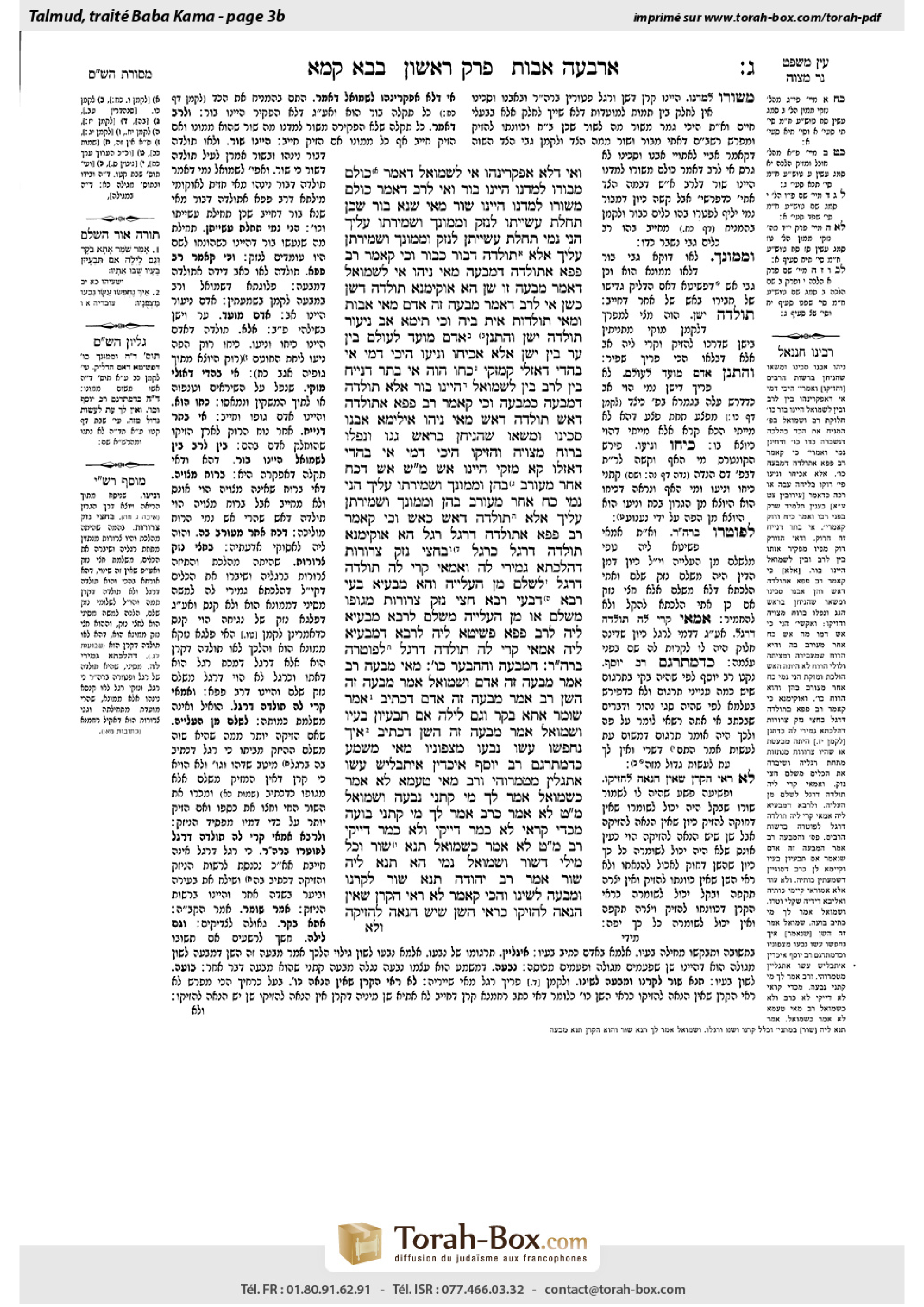
Bava Kamma 3b: Talmud study for Daf Yomi
Study the Talmud for Daf Yomi with scanned pages, Hebrew text, English translations from Sefaria and AI-generated French translations.
Passage selection and English or AI-generated French translation are available where the scan has annotations. Daf Study is independent of Torah-Box and Sefaria.
Browse Bava Kamma · בבא קמא · All tractatesBava Kamma 3b text and translations
This page of Bava Kamma includes the Aramaic text, an English translation and an AI-generated French translation, alongside the scan above.
בבא קמא ג׳ ב · Aramaic and Hebrew text
וְאִי דְּלָא אַפְקְרִינְהוּ – אִי לִשְׁמוּאֵל, דְּאָמַר: כּוּלָּם מִבּוֹרוֹ לָמַדְנוּ, הַיְינוּ בּוֹר; וְאִי לְרַב, דְּאָמַר: כּוּלָּם מִשּׁוֹרוֹ לָמַדְנוּ, הַיְינוּ שׁוֹר!
מַאי שְׁנָא בּוֹר – שֶׁכֵּן תְּחִלַּת עֲשִׂיָּיתוֹ לְנֵזֶק, וּמָמוֹנְךָ וּשְׁמִירָתוֹ עָלֶיךָ; הָנֵי נָמֵי – תְּחִלַּת עֲשִׂיָּיתָן לְנֵזֶק, וּמָמוֹנְךָ וּשְׁמִירָתָן עָלֶיךָ! אֶלָּא תּוֹלָדָה דְבוֹר כְּבוֹר, וְכִי קָאָמַר רַב פָּפָּא – אַתּוֹלָדָה דְמַבְעֶה.
מַאי נִיהוּ? אִי לִשְׁמוּאֵל, דְּאָמַר: מַבְעֶה זוֹ שֵׁן – הָא אוֹקֵימְנָא תּוֹלָדָה דְשֵׁן כְּשֵׁן. אִי לְרַב, דְּאָמַר: מַבְעֶה זֶה אָדָם – מַאי אָבוֹת וּמַאי תּוֹלָדוֹת אִית בֵּיהּ?
וְכִי תֵּימָא: אָב – נֵיעוֹר, תּוֹלָדָה – יָשֵׁן; וְהָתְנַן: אָדָם מוּעָד לְעוֹלָם, בֵּין עֵר בֵּין יָשֵׁן!
אֶלָּא אַכִּיחוֹ וְנִיעוֹ. הֵיכִי דָּמֵי? אִי בַּהֲדֵי דְּאָזְלִי קָמַזְּקִי – כֹּחוֹ הָוֵה! אִי בָּתַר דְּנָיַיח – בֵּין לְרַב בֵּין לִשְׁמוּאֵל, הַיְינוּ בּוֹר! אֶלָּא תּוֹלָדָה דְמַבְעֶה כְּמַבְעֶה. וְכִי קָאָמַר רַב פָּפָּא, אַתּוֹלָדָה דְאֵשׁ.
תּוֹלָדָה דְאֵשׁ מַאי נִיהוּ? אִילֵּימָא אַבְנוֹ, סַכִּינוֹ וּמַשָּׂאוֹ שֶׁהִנִּיחָן בְּרֹאשׁ גַּגּוֹ, וְנָפְלוּ בְּרוּחַ מְצוּיָה וְהִזִּיקוּ; הֵיכִי דָמֵי? אִי בַּהֲדֵי דְּאָזְלוּ קָא מַזְּקִי – הַיְינוּ אֵשׁ,
מַאי שְׁנָא אֵשׁ – דְּכֹחַ אַחֵר מְעוֹרָב בָּהֶן, וּמָמוֹנְךָ וּשְׁמִירָתוֹ עָלֶיךָ; הָנֵי נָמֵי – כֹּחַ אַחֵר מְעוֹרָב בָּהֶן, וּמָמוֹנְךָ וּשְׁמִירָתָן עָלֶיךָ! אֶלָּא תּוֹלָדָה דְאֵשׁ כְּאֵשׁ, וְכִי קָאָמַר רַב פָּפָּא – אַתּוֹלָדָה דְרֶגֶל.
רֶגֶל?! הָא אוֹקֵימְנָא תּוֹלָדָה דְרֶגֶל כְּרֶגֶל! בַּחֲצִי נֶזֶק צְרוֹרוֹת, דְּהִלְכְתָא גְּמִירִי לַהּ.
וְאַמַּאי קָרֵי לַהּ תּוֹלָדָה דְרֶגֶל? לְשַׁלֵּם מִן הָעֲלִיָּיה.
וְהָא מִבַּעְיָא בָּעֵי רָבָא – דְּבָעֵי רָבָא: חֲצִי נֶזֶק צְרוֹרוֹת – מִגּוּפוֹ מְשַׁלֵּם, אוֹ מִן הָעֲלִיָּיה מְשַׁלֵּם?
לְרָבָא מִבַּעְיָא לֵיהּ, לְרַב פָּפָּא פְּשִׁיטָא לֵיהּ.
לְרָבָא דְּמִבַּעְיָא לֵיהּ, אַמַּאי קָרֵי לַהּ תּוֹלָדָה דְרֶגֶל? לְפוֹטְרָהּ בִּרְשׁוּת הָרַבִּים.
הַמַּבְעֶה וְהַהֶבְעֵר כּוּ׳. מַאי ״מַבְעֶה״? רַב אָמַר: מַבְעֶה זֶה אָדָם, וּשְׁמוּאֵל אָמַר: מַבְעֶה זֶה הַשֵּׁן.
רַב אָמַר מַבְעֶה זֶה אָדָם, דִּכְתִיב: ״אָמַר שֹׁמֵר אָתָא בֹקֶר וְגַם לָיְלָה, אִם תִּבְעָיוּן בְּעָיוּ״.
וּשְׁמוּאֵל אָמַר מַבְעֶה זֶה הַשֵּׁן, דִּכְתִיב: ״אֵיךְ נֶחְפְּשׂוּ עֵשָׂו, נִבְעוּ מַצְפֻּנָיו״. מַאי מַשְׁמַע? כְּדִמְתַרְגֵּם רַב יוֹסֵף: אֵיכְדֵין אִיתְבְּלֵישׁ עֵשָׂו, אִתְגַּלִּין מַטְמֹרוֹהִי.
וְרַב, מַאי טַעְמָא לָא אָמַר כִּשְׁמוּאֵל? אָמַר לָךְ: מִי קָתָנֵי ״נִבְעֶה״?
וּשְׁמוּאֵל, מַאי טַעְמָא לָא אָמַר כְּרַב? אָמַר לְךָ: מִי קָתָנֵי ״בּוֹעֶה״?
מִכְּדֵי קְרָאֵי לָא כְּמַר דָּיְיקִי וְלָא כְּמַר דָּיְיקִי, רַב מַאי טַעְמָא לָא אָמַר כִּשְׁמוּאֵל? תְּנָא שׁוֹר – וְכׇל מִילֵּי דְשׁוֹר.
וּשְׁמוּאֵל נָמֵי, הָא תְּנָא לֵיהּ שׁוֹר! אָמַר רַב יְהוּדָה: תְּנָא שׁוֹר – לְקַרְנוֹ, וּמַבְעֶה – לְשִׁינּוֹ. וְהָכִי קָאָמַר: לֹא רְאִי הַקֶּרֶן – שֶׁאֵין הֲנָאָה לְהֶזֵּיקוֹ, כִּרְאִי הַשֵּׁן – שֶׁיֵּשׁ הֲנָאָה לְהֶזֵּיקָהּ.
Bava Kamma 3b · English translation
And if it is a case where one did not declare them ownerless, there is still a difficulty. If Rav Pappa’s statement is in accordance with the opinion of Shmuel, who says: We learned that one is liable for damage caused by all obstacles that he places in a public domain, whether or not he declares them ownerless, from the halakhot with regard to one’s pit, these cases are a subcategory of Pit. And if Rav Pappa’s statement is in accordance with the opinion of Rav, who says: We learned that one is liable for damage caused by all obstacles that he places in a public domain that he did not declare ownerless, from the halakhot with regard to one’s ox that gored another animal, these cases are a subcategory of Ox. With regard to the subcategories of Ox, the Gemara already established that their legal status is like that of the primary category of Ox.
The Gemara asks concerning an obstacle that is a subcategory of Pit: What is different about Pit that it is defined it as a unique category? It is that its initial formation, i.e., the digging of the pit, is done in a manner that can result in damage, and it is your property, and responsibility for its safeguarding, to prevent it from causing damage to others, is incumbent upon you. In these subcategories of Pit, too, their initial formation, i.e., the placement of the obstacle in the public domain, is done in a manner that can result in damage, and they are your property, and responsibility for their safeguarding, to prevent them from causing damage, is incumbent upon you. Rather, it is apparent that the status of a subcategory of Pit is like that of the primary category of Pit, and when Rav Pappa says: There are among them some whose subcategories are dissimilar to them, he is referring to a subcategory of Maveh.
The meaning of the term Maveh is not clear; therefore, the Gemara asks: What is the primary category of Maveh to whose subcategories the Gemara referred? If one suggests that Rav Pappa said his statement in accordance with the opinion of Shmuel, who says: Maveh, this is the category of Eating, this cannot be Rav Pappa’s intent. But didn’t we already establish that the legal status of a subcategory of Eating is like that of the primary category of Eating? Clearly, Rav Pappa was not referring to subcategories of Maveh. And if one suggests that Rav Pappa said his statement in accordance with the opinion of Rav, who says: Maveh, this is the primary category of Man, which includes damage caused by a person, not by his property or animals, what primary categories and what subcategories are there in that category? The halakha is the same with regard to all damage that a person causes.
And if you would say that there is a distinction: The primary category is a case where one causes damage while awake, and a subcategory is a case where one causes damage while asleep; but didn’t we learn in a mishna (26a): The legal status of a person is always that of one forewarned, and he is liable for any damage that he causes, both when he is awake and when he is asleep? Accordingly, that is not the distinction between a primary category and a subcategory.
Rather, perhaps Rav Pappa was referring to cases where one causes damage with his phlegm or his spittle. The Gemara asks: What are the circumstances where one would be liable for damage in that case? If it is a case where his phlegm and spittle cause damage as they were moving through the air after the person expectorated, that is damage caused by his direct action and there is no room to distinguish between the damage that it caused and any other damage caused by one’s direct action. If it is a case where his phlegm or spittle causes damage after it comes to rest on the ground, e.g., if one slipped in the spittle, fell, and was injured, both according to Rav and according to Shmuel this is a subcategory of Pit, as the spittle is an ownerless obstacle in the public domain. Rather, it is apparent that the status of a subcategory of Maveh is like that of the primary category of Maveh, and when Rav Pappa says: There are among them some whose subcategories are dissimilar to them; he was referring to a subcategory of Fire.
The Gemara asks: What is a subcategory of Fire? If we say that it is a case of his stone, his knife, or his load, where he placed them on top of his roof, and they fell off the roof by means of a common wind, and they caused damage, what are the circumstances in which one would be liable for the damage that was caused? If it is a case where those items caused damage as they were moving through the air propelled by the wind, that is a case of Fire.
If so, what is different about Fire that defines it as a unique category? What is different is that another force, the wind, is involved with the fire in causing damage, as the wind causes the fire to spread, and the fire is your property, and responsibility for its safeguarding, to prevent it from causing damage, is incumbent upon you. In these subcategories of Fire too, another force is involved with the items placed on the roof and causes damage, as the wind causes them to fall, and they are your property, and responsibility for their safeguarding, to prevent them from causing damage, is incumbent upon you. Rather, it is apparent that the status of a subcategory of Fire is like that of the primary category of Fire, and when Rav Pappa says: There are among them some whose subcategories are dissimilar to them, he was referring to a subcategory of Trampling.
The Gemara questions this explanation: A subcategory of Trampling? But didn’t we already establish that the status of a subcategory of Trampling is similar to that of the primary category of Trampling? The Gemara explains: Rav Pappa was referring to one’s liability to pay half the cost of the damage caused by pebbles in a case where they were inadvertently propelled by the foot of a walking animal, which is a halakha learned through tradition and not explicitly written in the Torah.
The Gemara asks: But if it is a unique halakhic category and the payment is different, why is it characterized as a subcategory of Trampling? The Gemara explains: It is due to the fact that it shares a common aspect with Trampling. One whose animal propels pebbles while it walks and thereby causes damage is liable to pay half of the damages from his superior-quality property, and he does not pay only from the body of his animal, as is the halakha concerning half the cost of the damage paid by the owner of an innocuous ox that gored a person or an animal.
The Gemara asks: But didn’t Rava raise a dilemma with regard to that matter? As Rava raised a dilemma: With regard to one’s liability to pay half the cost of the damage caused by pebbles propelled by the foot of his animal, does one pay damages exclusively from the body of his ox that caused the damage, or does one pay damages from his superior-quality property?
The Gemara explains: Although it is a dilemma for Rava, it is obvious to Rav Pappa that one pays from his superior-quality property, and in that sense, he classified the pebbles that cause damage as a subcategory of Trampling.
The Gemara asks: According to Rava, who raises it as a dilemma, why is it characterized as a subcategory of Trampling when its legal status is different both in terms of the extent of one’s liability and in terms of the manner of payment? The Gemara explains: It is classified as a subcategory of Trampling in order to exempt from liability pebbles that cause damage in the public domain, just as damage in the category of Trampling is exempt in the public domain.
§ One of the primary categories of damage enumerated in the mishna is the category of Maveh and another is the category of Fire. The Gemara asks: What is the meaning of Maveh? Rav says: Maveh, that is the category of Man, which includes a person who causes damage, but not the property or animal of a person that causes damage. And Shmuel says: Maveh, this is the category of Eating.
The Gemara elaborates: Rav says: Maveh, this is the category of Man, as it is written: “The watchman said: Morning has come, and also night; if you will inquire [tivayun], inquire [be’ayu]” (Isaiah 21:12). The terms “tivayun” and “be’ayu,” meaning inquire, refer to a person, who is able to inquire. Accordingly, Maveh relates to an action performed by a person.
And Shmuel says: Maveh, this is the category of Eating, as it is written: “How is Esau searched out [neḥpesu]; how are his hidden places revealed [nivu]” (Obadiah 1:6)? The terms nivu and maveh share a common root. The Gemara asks: From where may it be inferred that nivu connotes Eating? The Gemara explains that it is as Rav Yosef translates the verse into Aramaic: How is Esau searched out [itbelish]; how are his hidden places revealed [itgaleyan]? The meaning of the Aramaic term itgaleyan means revealed, and that is the meaning of the Hebrew term “nivu.” Maveh references the animal’s teeth, which are covered when its mouth is closed and revealed when it eats.
The Gemara asks: And as for Rav, what is the reason that he did not say that Maveh refers to Eating, as does Shmuel? The Gemara explains that Rav could have said to you: Is it taught in the mishna: Niveh? Niveh is the passive form of the word maveh, which would be the appropriate form if the reference was to teeth that are revealed. The term in the mishna is maveh, an active form of the verb.
And as for Shmuel, what is the reason that he did not say that Maveh refers to the category of Man, as does Rav? The Gemara explains that Shmuel could have said to you: Is it taught in the mishna: Bo’eh? Bo’eh is a form of the word maveh connoting an action taken directly, which would be appropriate were the reference to one’s actions that cause damage. The term in the mishna is maveh, which connotes an action that one causes another to take.
The Gemara notes: After all, the meaning of the term in the verses is not precise according to one Sage, Rav, and it is not precise according to the other Sage, Shmuel. It is apparent that their dispute is not based upon their interpretation of the verses; it must be based on another issue. The Gemara asks again: As for Rav, what is the reason that he did not say that Maveh refers to Eating, as does Shmuel? The Gemara explains: Rav holds that the tanna teaches the primary category of Ox in the mishna. This includes damage caused by an ox and all matters involving damaging actions that are completed by an ox, i.e., the actions included in the categories of Goring, Eating, and Trampling. Perforce, Maveh refers to a different category of damage, i.e., Man.
The Gemara asks: And as for Shmuel too, who interpreted Maveh as Eating, doesn’t the mishna teach the category of Ox, which should include all matters involving damaging actions that are completed by an ox? Rav Yehuda said that according to Shmuel, the tanna teaches Ox specifically with regard to damage caused with its horn, and it teaches Maveh with regard to damage caused with its tooth. And when the mishna contrasts Ox with Maveh, this is what the tanna is saying: The defining characteristic of the primary category of Goring, where there is no inherent pleasure for the animal in the course of its causing damage, is not similar to the defining characteristic of the category of Eating, where there is pleasure for the animal in the course of its causing damage.
Bava Kamma 3b · Traduction française (IA)
Et si c'est un cas où l'on n'a pas déclaré ces choses comme propriété étrangère, il reste une difficulté. Si la déclaration de Rav Pappa s'inscrit dans l'opinion de Shmuel, qui dit : Nous avons appris que l'on est tenu responsable des dommages causés par tous les obstacles que l'on place dans un domaine public, qu'on les ait déclarés comme propriété étrangère ou non, à partir des halakhot concernant son puits, ces cas sont une sous-catégorie du puits. Et si la déclaration de Rav Pappa s'inscrit dans l'opinion de Rav, qui dit : Nous avons appris que l'on est tenu responsable des dommages causés par tous les obstacles que l'on place dans un domaine public qu'on n'a pas déclaré comme propriété étrangère, à partir des halakhot concernant son bœuf qui a blessé un autre bœuf, ces cas sont une sous-catégorie du bœuf. En ce qui concerne les sous-catégories du bœuf, la Guemara a déjà établi que leur statut juridique est celui du catégorique principal du bœuf.
La Guemara pose la question concernant un obstacle qui est une sous-catégorie du puits : Qu'est-ce qui distingue le puits de sorte qu'il est défini comme une catégorie unique ? C'est que sa formation initiale, c'est-à-dire le creusement du puits, est faite d'une manière pouvant entraîner des dommages, et c'est votre propriété, et la responsabilité de sa protection, afin d'éviter qu'elle ne cause des dommages à autrui, incombe à vous. De même, pour ces sous-catégories du puits, leur formation initiale, c'est-à-dire la mise en place de l'obstacle dans le domaine public, est faite d'une manière pouvant entraîner des dommages, et ce sont vos propriétés, et la responsabilité de leur protection, afin d'éviter qu'elles ne causent des dommages, incombe à vous. Plutôt, il est évident que le statut d'une sous-catégorie du puits est celui du catégorique principal du puits, et lorsque Rav Pappa dit : Parmi eux, il y a certains dont les sous-catégories diffèrent, il fait référence à une sous-catégorie de Maveh.
Le sens du terme Maveh n'est pas clair ; donc, la Guemara pose la question : Quelle est la catégorie principale de Maveh à laquelle les sous-catégories mentionnées font référence ? Si l'on suggère que Rav Pappa a formulé sa déclaration selon l'opinion de Shmuel, qui dit : Maveh, c'est la catégorie de la consommation, cela ne correspond pas à l'intention de Rav Pappa. Mais n'avons-nous pas déjà établi que le statut juridique d'une sous-catégorie de la consommation est celui du catégorique principal de la consommation ? Évidemment, Rav Pappa ne faisait pas référence aux sous-catégories de Maveh. Et si l'on suggère que Rav Pappa a formulé sa déclaration selon l'opinion de Rav, qui dit : Maveh, c'est la catégorie principale de l'homme, qui inclut les dommages causés par une personne, pas par ses biens ou ses animaux, quels sont les catégories principales et les sous-catégories dans cette catégorie ? La halakha est la même concernant tout dommage causé par une personne.
Et si l'on dit qu'il y a une distinction : la catégorie principale est un cas où l'on cause des dommages en état de veille, et une sous-catégorie est un cas où l'on cause des dommages en état de sommeil ; mais n'avons-nous pas appris dans une mitsna (26a) : Le statut juridique d'une personne est toujours celui d'une personne avertie, et il est tenu responsable de tout dommage qu'il cause, qu'il soit en état de veille ou en état de sommeil ? Ainsi, cela n'est pas la distinction entre une catégorie principale et une sous-catégorie.
Plutôt, peut-être Rav Pappa faisait référence à des cas où l'on cause des dommages avec son expectoration ou sa salive. La Guemara pose la question : Quelles sont les circonstances où l'on serait tenu responsable du dommage dans ce cas ? Si c'est un cas où son expectoration et sa salive causent des dommages alors qu'elles se déplacent dans l'air après qu'il a toussé, c'est un dommage causé par son action directe et il n'y a pas de place pour distinguer entre le dommage qu'elles ont causé et tout autre dommage causé par une action directe. Si c'est un cas où son expectoration ou sa salive causent des dommages après qu'elles se sont posées sur le sol, par exemple, si l'on glisse dans la salive, tombe et se blesse, à la fois selon Rav et selon Shmuel, cela est une sous-catégorie du puits, car la salive est un obstacle propriété étrangère dans le domaine public. Plutôt, il est évident que le statut d'une sous-catégorie de Maveh est celui du catégorique principal de Maveh, et lorsque Rav Pappa dit : Parmi eux, il y a certains dont les sous-catégories diffèrent, il faisait référence à une sous-catégorie du feu.
La Guemara pose la question : Quelle est une sous-catégorie du feu ? Si l'on dit que c'est un cas de sa pierre, de son couteau ou de son chargement, qu'il les a placés sur le toit, et qu'ils sont tombés du toit grâce au vent commun, et qu'ils ont causé des dommages, quels sont les circonstances où l'on serait tenu responsable du dommage causé ? Si c'est un cas où ces objets ont causé des dommages alors qu'ils se déplaçaient dans l'air propulsés par le vent, c'est un cas de feu.
Si c'est ainsi, qu'est-ce qui distingue le feu pour le définir comme une catégorie unique ? Ce qui distingue est que l'autre force, le vent, est impliquée dans la cause du dommage par le feu, car le vent fait se propager le feu, et le feu est votre propriété, et la responsabilité de sa protection, afin d'éviter qu'il ne cause des dommages, incombe à vous. De même, pour ces sous-catégories du feu, une autre force est impliquée avec les objets placés sur le toit et cause des dommages, car le vent fait tomber ces objets, et ce sont vos propriétés, et la responsabilité de leur protection, afin d'éviter qu'ils ne causent des dommages, incombe à vous. Plutôt, il est évident que le statut d'une sous-catégorie du feu est celui du catégorie principale du feu, et lorsque Rav Pappa dit : Parmi eux, il y a certains dont les sous-catégories diffèrent, il faisait référence à une sous-catégorie de l'écrasement.
La Guemara questionne cette explication : Une sous-catégorie de l'écrasement ? Mais n'avons-nous pas déjà établi que le statut d'une sous-catégorie de l'écrasement est similaire à celui du catégorie principale de l'écrasement ? La Guemara explique : Rav Pappa faisait référence à la responsabilité de payer la moitié du coût des dommages causés par des cailloux dans un cas où ils ont été accidentellement projetés par le pied d'un animal marchant, qui est une halakha apprise par tradition et non explicitement écrite dans la Torah.
Le Guemara pose la question : Mais si c'est une catégorie halakhique unique et que le paiement est différent, pourquoi est-elle caractérisée comme une sous-catégorie du Trampling ? Le Guemara explique : C'est en raison du fait qu'elle partage un aspect commun avec le Trampling. Celui dont l'animal projette des cailloux en marchant et cause ainsi des dommages est tenu de payer la moitié des dommages à partir de ses biens de qualité supérieure, et il ne paie pas uniquement à partir du corps de son animal, comme c'est le cas pour la halakha concernant la moitié du coût des dommages payé par l'propriétaire d'un taureau inoffensif qui a blessé une personne ou un animal.
Le Guemara pose la question : Mais n'avait-il pas posé un dilemme concernant cette question ? Comme Rava avait posé un dilemme : Concernant la responsabilité d'un individu à payer la moitié du coût des dommages causés par des cailloux projetés par le pied de son animal, paie-t-on les dommages uniquement à partir du corps de son taureau qui a causé les dommages, ou paie-t-on les dommages à partir de ses biens de qualité supérieure ?
Le Guemara explique : Bien que cela soit un dilemme pour Rava, il est évident pour Rav Pappa que l'on paie à partir de ses biens de qualité supérieure, et dans ce sens, il a classé les cailloux qui causent des dommages comme une sous-catégorie du Trampling.
Le Guemara pose la question : Selon Rava, qui le présente comme un dilemme, pourquoi est-il caractérisé comme une sous-catégorie du Trampling alors que son statut juridique est différent tant en termes de l'étendue de la responsabilité qu'en termes de mode de paiement ? Le Guemara explique : Il est classé comme une sous-catégorie du Trampling afin d'exonérer les cailloux qui causent des dommages dans le domaine public de la responsabilité, tout comme les dommages dans la catégorie du Trampling sont exonérés dans le domaine public.
§ L'une des catégories principales de dommages énumérées dans la mitsna est la catégorie du Maveh et une autre est la catégorie du Feu. Le Guemara pose la question : Quelle est la signification du Maveh ? Rav dit : Maveh, c'est la catégorie de l'Homme, qui inclut une personne qui cause des dommages, mais pas la propriété ou l'animal d'une personne qui cause des dommages. Et Shmuel dit : Maveh, c'est la catégorie de la Consommation.
Le Guemara développe : Rav dit : Maveh, c'est la catégorie de l'Homme, car il est écrit : « Le gardien dit : Le matin est venu, et aussi la nuit ; si tu veux interroger [tivayun], interroge [be’ayu] » (Yachin 21:12). Les termes « tivayun » et « be’ayu », signifiant interroger, font référence à une personne, qui est capable d'interroger. Ainsi, Maveh se rapporte à une action accomplie par une personne.
Et Shmuel dit : Maveh, c'est la catégorie de la Consommation, car il est écrit : « Comment Esau est-il recherché [neḥpesu] ; comment ses endroits cachés sont-ils révélés [nivu] » (Obadiah 1:6) ? Les termes nivu et maveh partagent une racine commune. Le Guemara pose la question : D'où peut-on déduire que nivu signifie la Consommation ? Le Guemara explique que c'est comme Rav Yosef traduit la verset en araméen : « Comment Esau est-il recherché [itbelish] ; comment ses endroits cachés sont-ils révélés [itgaleyan] ? » Le sens du terme araméen itgaleyan signifie révélé, et c'est le sens du terme hébreu « nivu ». Maveh fait référence aux dents de l'animal, qui sont cachées lorsque sa bouche est fermée et révélées lorsqu'il mange.
Le Guemara pose la question : Et concernant Rav, quelle est la raison qu'il n'ait pas dit que Maveh fait référence à la Consommation, comme le fait Shmuel ? Le Guemara explique que Rav aurait pu dire à vous : Est-ce enseigné dans la mitsna : Niveh ? Niveh est la forme passive du verbe maveh, ce qui serait approprié si la référence était aux dents qui sont révélées. Le terme dans la mitsna est maveh, une forme active du verbe.
Et concernant Shmuel, quelle est la raison qu'il n'ait pas dit que Maveh fait référence à la catégorie de l'Homme, comme le fait Rav ? Le Guemara explique que Shmuel aurait pu dire à vous : Est-ce enseigné dans la mitsna : Bo'eh ? Bo'eh est une forme du verbe maveh signifiant une action directe, ce qui serait approprié si la référence était aux actions de l'individu qui causent des dommages. Le terme dans la mitsna est maveh, qui signifie une action que l'on fait subir à un autre.
Le Guemara note : En effet, le sens du terme dans les versets n'est pas précis selon l'un des Sages, Rav, et n'est pas précis selon l'autre Sage, Shmuel. Il est évident que leur débat ne repose pas sur leur interprétation des versets ; il doit reposer sur un autre point. Le Guemara pose à nouveau la question : Concernant Rav, quelle est la raison qu'il n'ait pas dit que Maveh fait référence à la Consommation, comme le fait Shmuel ? Le Guemara explique : Rav considère que le tanna enseigne la catégorie principale du taureau dans la mitsva. Cela inclut les dommages causés par un taureau et toutes les questions concernant les actions destructrices accomplies par un taureau, c'est-à-dire les actions incluses dans les catégories de la Bataille, de la Consommation et du Trampling. Par conséquent, Maveh fait référence à une autre catégorie de dommages, c'est-à-dire l'Homme.
Le Guemara pose la question : Et concernant Shmuel également, qui interprète Maveh comme la Consommation, ne fait-il pas enseigner la catégorie du Taureau, qui devrait inclure toutes les questions concernant les actions destructrices accomplies par un taureau ? Rav Yehuda a dit que selon Shmuel, le tanna enseigne spécifiquement le Taureau concernant les dommages causés par son cor, et il enseigne Maveh concernant les dommages causés par ses dents. Et lorsque la mitsva oppose le Taureau au Maveh, c'est ce que le tanna dit : Le caractère définissant la catégorie principale de la Bataille, où il n'y a pas de plaisir intrinsèque pour l'animal lors de la cause de dommages, n'est pas semblable au caractère définissant la catégorie de la Consommation, où il y a un plaisir pour l'animal lors de la cause de dommages.
Traduction française générée par IA à partir de l’édition anglaise de Sefaria. Vérifie toujours un passage avec le texte source.
Text from Sefaria: William Davidson Edition - Vocalized Aramaic (CC BY NC); William Davidson Edition - English (CC BY NC).