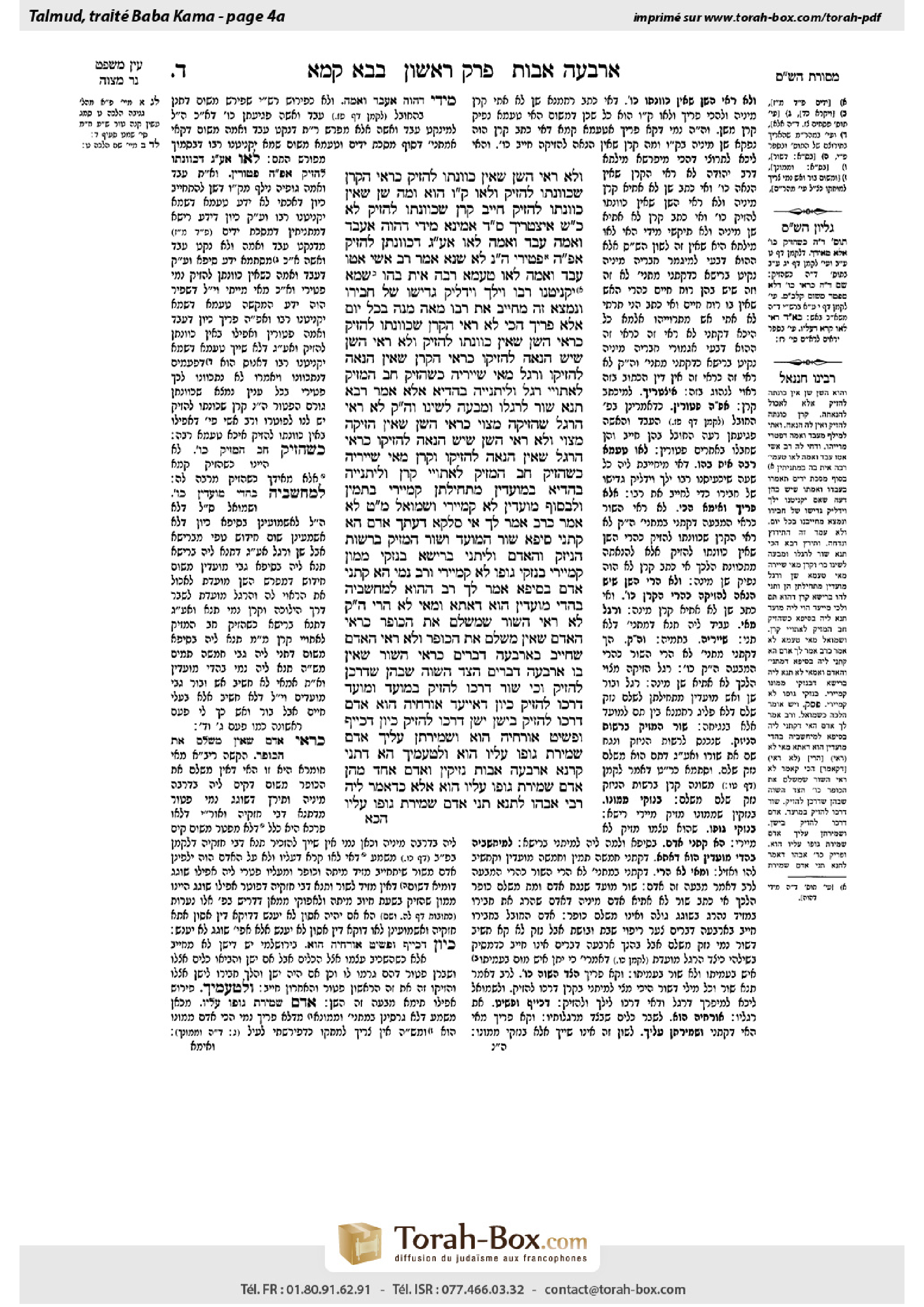
Bava Kamma 4a: Talmud study for Daf Yomi
Study the Talmud for Daf Yomi with scanned pages, Hebrew text, English translations from Sefaria and AI-generated French translations.
Passage selection and English or AI-generated French translation are available where the scan has annotations. Daf Study is independent of Torah-Box and Sefaria.
Browse Bava Kamma · בבא קמא · All tractatesBava Kamma 4a text and translations
This page of Bava Kamma includes the Aramaic text, an English translation and an AI-generated French translation, alongside the scan above.
בבא קמא ד׳ א · Aramaic and Hebrew text
וְלֹא רְאִי הַשֵּׁן – שֶׁאֵין כַּוּוֹנָתוֹ לְהַזִּיק, כִּרְאִי הַקֶּרֶן – שֶׁכַּוּוֹנָתוֹ לְהַזִּיק.
וְלָאו קַל וָחוֹמֶר הוּא – וּמָה שֵׁן, שֶׁאֵין כַּוּוֹנָתוֹ לְהַזִּיק – חַיָּיב; קֶרֶן, שֶׁכַּוּוֹנָתוֹ לְהַזִּיק – לֹא כׇּל שֶׁכֵּן? אִיצְטְרִיךְ, סָלְקָא דַּעְתָּךְ אָמֵינָא: מִידֵּי דְּהָוֵה אַעֶבֶד וְאָמָה – עֶבֶד וְאָמָה, לָאו אַף עַל גַּב דְּכַוּוֹנָתָן לְהַזִּיק, אֲפִילּוּ הָכִי פְּטִירִי? הָכִי נָמֵי לָא שְׁנָא.
אָמַר רַב אָשֵׁי: אַטּוּ עֶבֶד וְאָמָה לָאו טַעְמָא רַבָּה אִית בְּהוּ? שֶׁמָּא יַקְנִיטֶנּוּ רַבּוֹ, וְיֵלֵךְ וְיַדְלִיק גְּדִישׁוֹ שֶׁל חֲבֵירוֹ, וְנִמְצָא זֶה מְחַיֵּיב אֶת רַבּוֹ מֵאָה מָנֶה בְּכׇל יוֹם!
אֶלָּא פָּרֵיךְ הָכִי: לֹא רְאִי הַקֶּרֶן – שֶׁכַּוּוֹנָתוֹ לְהַזִּיק, כִּרְאִי הַשֵּׁן – שֶׁאֵין כַּוּוֹנָתוֹ לְהַזִּיק; וְלֹא רְאִי הַשֵּׁן – שֶׁיֵּשׁ הֲנָאָה לְהֶזֵּיקוֹ, כִּרְאִי הַקֶּרֶן – שֶׁאֵין הֲנָאָה לְהֶזֵּיקוֹ.
וְרֶגֶל מַאי? שַׁיְּירֵיהּ?! ״כְּשֶׁהִזִּיק חָב הַמַּזִּיק״ – לְאֵתוֹיֵי רֶגֶל.
וְלִיתְנְיֵיהּ בְּהֶדְיָא!
אֶלָּא אָמַר רָבָא: תְּנָא שׁוֹר – לְרַגְלוֹ, וּמַבְעֶה – לְשִׁינּוֹ. וְהָכִי קָאָמַר: לֹא רְאִי הָרֶגֶל – שֶׁהֶזֵּיקָהּ מָצוּי, כִּרְאִי הַשֵּׁן – שֶׁאֵין הֶזֵּיקָהּ מָצוּי; וְלֹא רְאִי הַשֵּׁן – שֶׁיֵּשׁ הֲנָאָה לְהֶזֵּיקוֹ, כִּרְאִי הָרֶגֶל – שֶׁאֵין הֲנָאָה לְהֶזֵּיקוֹ.
וְקֶרֶן מַאי? שַׁיְּירֵיהּ?! ״כְּשֶׁהִזִּיק חָב הַמַּזִּיק״ – לְאֵתוֹיֵי קֶרֶן.
וְלִיתְנְיֵיהּ בְּהֶדְיָא! בְּמוּעָדִין מִתְּחִילָּתָן קָמַיְירֵי, בְּתַמִּין וּלְבַסּוֹף מוּעָדִין לָא קָמַיְירֵי.
וּשְׁמוּאֵל, מַאי טַעְמָא לָא אָמַר כְּרַב? אָמַר לָךְ: אִי סָלְקָא דַעְתָּךְ אָדָם, הָא קָתָנֵי סֵיפָא: שׁוֹר הַמּוּעָד, וְשׁוֹר הַמַּזִּיק בִּרְשׁוּת הַנִּיזָּק, וְהָאָדָם!
וְלִיתְנֵי בְּרֵישָׁא! בְּנִזְקֵי מָמוֹן קָמַיְירֵי, בְּנִזְקֵי גוּפוֹ לָא קָמַיְירֵי.
וְרַב נָמֵי, הָא קָתָנֵי אָדָם בְּסֵיפָא! אָמַר לְךָ רַב: הָהוּא לְמֶחְשְׁבֵיהּ בַּהֲדֵי מוּעָדִין הוּא דַּאֲתָא.
וּמַאי ״לֹא הֲרֵי״?
הָכִי קָאָמַר: לֹא רְאִי הַשּׁוֹר – שֶׁמְּשַׁלֵּם אֶת הַכּוֹפֶר, כִּרְאִי הָאָדָם – שֶׁאֵין מְשַׁלֵּם אֶת הַכּוֹפֶר; וְלֹא רְאִי הָאָדָם – שֶׁחַיָּיב בְּאַרְבָּעָה דְּבָרִים, כִּרְאִי הַשּׁוֹר – שֶׁאֵין בּוֹ אַרְבָּעָה דְּבָרִים.
הַצַּד הַשָּׁוֶה שֶׁבָּהֶן – שֶׁדַּרְכָּן לְהַזִּיק. וְכִי שׁוֹר דַּרְכּוֹ לְהַזִּיק?! בְּמוּעָד. וּמוּעָד – דַּרְכּוֹ לְהַזִּיק?! כֵּיוָן דְּאִיַּיעַד – אוֹרְחֵיהּ הוּא.
אָדָם דַּרְכּוֹ לְהַזִּיק?! בְּיָשֵׁן. יָשֵׁן דַּרְכּוֹ לְהַזִּיק?! כֵּיוָן דְּכָיֵיף וּפָשֵׁיט – אוֹרְחֵיהּ הוּא.
״וּשְׁמִירָתָן עָלֶיךָ״?! אָדָם – שְׁמִירַת גּוּפוֹ עָלָיו הוּא!
וּלְטַעְמָיךְ, הָא דְּתָנֵי קַרְנָא: אַרְבָּעָה אֲבוֹת נְזִיקִין, וְאָדָם אֶחָד מֵהֶן; אָדָם – שְׁמִירַת גּוּפוֹ עָלָיו הוּא! אֶלָּא כְּדַאֲמַר לֵיהּ רַבִּי אֲבָהוּ לְתַנָּא: תְּנִי: אָדָם – שְׁמִירַת גּוּפוֹ עָלָיו;
Bava Kamma 4a · English translation
And the defining characteristic [re’i] of the category of Eating, where it is not the objective of the animal to cause damage, is not similar to the defining characteristic of the category of Goring, where the objective of the animal is to cause damage.
The Gemara asks: But isn’t it possible to derive Goring from Eating by means of an a fortiori inference: If in a case of Eating, where it is not the objective of the animal to cause damage, its owner is liable, with regard to Goring, where the objective of the animal is to cause damage, should the owner not all the more so be liable? The Gemara answers: Nevertheless, it was necessary for the Torah to state the case of Goring, as it might enter your mind to say that the owner is exempt, just as he is exempt in the case where his slave or maidservant causes damage. When a slave or maidservant causes damage, is it not so that although their objective is to cause damage, even so their owners are exempt from liability; and so too, when one’s animal causes damage, it is no different. To dispel this notion, the Torah explicitly states that one is liable for damage caused by the primary category of Goring.
Rav Ashi said: Is that to say that in a case where one’s slave or maidservant causes damage there is not a substantial reason to exempt the master? In that case there is concern that perhaps his master will provoke him and in retribution he will go and set fire to another’s stack of grain, and it is found that this slave renders his master liable to pay one hundred maneh, ten thousand dinars, each day. Therefore, there is no basis for the notion that an ox that gores would be exempt just as a slave is exempt, as perhaps, fundamentally, one is liable to pay for damage caused by his slave. A master is exempt from payment to prevent a situation where a slave would exploit that situation to take revenge against his master.
Rather, the mishna refutes any possibility to derive the halakhot of Ox from Maveh or Maveh from Ox in this manner: The characteristic of the category of Goring, where the objective of the animal is to cause damage, is not similar to the characteristic of the category of Eating, where it is not the objective of the animal to cause damage, and the characteristic of the category of Eating, where there is pleasure for the animal in the course of its causing damage, is not similar to the characteristic of the category of Goring, where there is no pleasure for the animal in the course of its causing damage.
According to Rav Yehuda’s explanation of Shmuel’s opinion, among the primary categories of damage caused by an ox, the mishna mentions only Goring and Eating. The Gemara asks: But what of the category of Trampling; did the tanna omit it from the mishna? The Gemara answers: The principle stated in general terms at the end of the mishna: And when a component of any of these categories causes damage, the owner or generator of the component that caused damage is obligated to remit payments of restitution for damage with best-quality land, serves to include the primary category of Trampling.
The Gemara asks: But if the intent of the tanna is to teach the primary category of Trampling as well, let him teach it explicitly. Accordingly, Rav Yehuda’s explanation of how Shmuel interprets the mishna is rejected.
Rather, Rava said that according to Shmuel, the tanna teaches Ox specifically with regard to actions that cause damage with its foot and it teaches Maveh with regard to actions that cause damage with its tooth. And when the mishna contrasts Ox with Maveh this is what the tanna is saying: The defining characteristic of the primary category of Trampling, where its damage is commonplace, is not similar to the defining characteristic of the primary category of Eating, where its damage is not commonplace, and the defining characteristic of the primary category of Eating, where there is pleasure for the animal in the course of its causing damage, is not similar to the characteristic of the primary category of Trampling, where there is no pleasure for the animal in the course of its causing damage.
According to Rav Yehuda’s explanation of Shmuel’s opinion, among the primary categories of damage with regard to an ox, the mishna mentions only Goring and Trampling. The Gemara asks: But what of the primary category of Goring; did the tanna omit it from the mishna? The Gemara answers: The principle stated in general terms at the end of the mishna: And when a component of any of these categories causes damage, the owner or generator of the component that caused damage is obligated to remit payments of restitution for damage with best-quality land, serves to include the primary category of Goring.
The Gemara asks: But if the intent of the tanna is to teach the primary category of Goring as well, let him teach it explicitly. The Gemara explains: It is with regard to those categories of damage where the animal is forewarned from the outset and the owner is liable to pay for the entire damage the first time his animal causes damage that the tanna of the mishna speaks; but with regard to those categories of damage where the animal is initially innocuous and the owner is liable to pay only half the cost of the damage caused by his animal, and the animal is ultimately forewarned, the tanna of the mishna does not speak of them. With regard to Goring, the first three times an ox gores a person or an animal the owner of the ox pays only half of the damages. This is because an ox is considered forewarned with regard to damage categorized as Goring only after it attacks three times.
After addressing the reason that Rav did not say that Maveh refers to Eating in accordance with the explanation of Shmuel, the Gemara asks: And as for Shmuel, what is the reason that he did not say that Maveh refers to Man, as does Rav? Shmuel could have said to you, if it enters your mind to say that Maveh is Man, isn’t it taught in the latter clause of the mishna (15b): Both a forewarned ox, and an ox that causes damage in the domain of the injured party, and any damage caused by man? Apparently, Man was mentioned in the latter clause of the mishna because it was not mentioned in the first clause.
The Gemara asks: But let the tanna teach Man among the primary categories of damage in the first clause. The Gemara explains: It is with regard to those categories of damage caused by one’s property that the tanna of the mishna speaks; but with regard to the category of damage caused by one’s body, the category of Man, the tanna of the mishna does not speak.
The Gemara asks: And according to Rav, too, the same difficulty arises: Isn’t damage caused by a man taught in the latter clause of the mishna? The Gemara answers: Rav could have said to you: That mention of damage caused by a man in the latter clause comes to enumerate that damage together with the other forms of damage in a case where the owner of the cause of damage or the generator of that damage is forewarned.
The Gemara asks: And according to Rav, what is the meaning of the statement in the mishna: The defining characteristic of the primary category of Ox is not similar to the defining characteristic of the primary category of Maveh?
The Gemara explains: This is what the mishna is saying: The defining characteristic of the primary category of Ox, where if the ox kills a person the owner pays the ransom to the heirs of the injured party, is not similar to the defining characteristic of the primary category of Man, where one who kills another does not pay the ransom for killing him; rather, if he killed him unwittingly he is exiled and if he did so intentionally he is executed. And the defining characteristic of the primary category of Man, where if one injures another he is liable to pay four types of indemnity, i.e., pain, humiliation, medical costs, and the loss of livelihood, in addition to payment for the damage, is not similar to the defining characteristic of the primary category of Ox, where the owner of the ox is not liable to pay four types of indemnity and is liable to pay only the cost of the damage.
The Gemara questions Rav’s understanding that Ox, as mentioned in the mishna, includes all actions an ox performs that cause damage, including goring, based on the continuation of the mishna: The common denominator of the components in all these primary categories of damage is that it is their typical manner to cause damage. The Gemara asks: But is it the typical manner of an ox to cause damage by goring? The Gemara answers: The statement in the mishna is with regard to a forewarned ox. The Gemara asks: But is it the typical manner of a forewarned ox to cause damage by goring? The Gemara answers: Yes, once it was forewarned after goring repeatedly, its typical manner is to cause damage by goring.
The Gemara questions Rav’s understanding that Maveh is the primary category of Man: Is it man’s typical manner to cause damage? The Gemara answers: The statement in the mishna is referring to the damage one causes while sleeping. The Gemara asks: Is it the typical manner of a person to cause damage while sleeping? The Gemara answers: Since one contracts and extends his limbs while sleeping, it is his typical manner to damage objects placed next to him.
If Maveh is referring to Man, is it correct to state, as the mishna does in its enumeration of common denominators of the primary categories: And responsibility for their safeguarding is incumbent upon you? That formulation is appropriate in cases where one is safeguarding another person, animal, or item. When applied to the primary category of Man, it would indicate that responsibility to safeguard one person is incumbent upon another person. With regard to man, responsibility for safeguarding his body is incumbent upon him alone, not upon anyone else.
The Gemara responds: And according to your reasoning, that the formulation: And their safeguarding is incumbent upon you, indicates that Maveh is not Man, there is a difficulty with that which the Sage Karna taught in a baraita: There are four primary categories of damage, and Man is one of them. That baraita continues and states that one common denominator is: Their safeguarding is incumbent upon you. With regard to that baraita, the same question arises: With regard to Man, responsibility for safeguarding his body is incumbent upon him, not upon anyone else, and the wording of Karna is imprecise. Rather, just as Rabbi Abbahu said to the tanna, who was reciting the baraita in the study hall: Teach the baraita: And with regard to Man, responsibility for safeguarding his body is incumbent upon him;
Bava Kamma 4a · Traduction française (IA)
Et la caractéristique définissante [re’i] de la catégorie de la consommation, où il n’est pas l’objectif de l’animal de causer un préjudice, n’est pas semblable à la caractéristique définissante de la catégorie de l’attaque, où l’objectif de l’animal est de causer un préjudice.
La Guemara pose la question : Mais ne pourrait-on pas déduire l’attaque de la consommation par une inférence a fortiori : Si, dans le cas d’une consommation, où il n’est pas l’objectif de l’animal de causer un préjudice, son propriétaire est responsable, alors, dans le cas d’une attaque, où l’objectif de l’animal est de causer un préjudice, ne devrait-il pas être encore plus responsable ? La Guemara répond : Toutefois, il était nécessaire que la Torah mentionne le cas d’une attaque, car il pourrait entrer en votre esprit de penser que le propriétaire est exempt, tout comme il l’est dans le cas où son serviteur ou sa servante cause un préjudice. Lorsqu’un serviteur ou une servante cause un préjudice, n’est-ce pas que bien qu’il ait pour objectif de causer un préjudice, le propriétaire est tout de même exempt de responsabilité ; de même, lorsqu’un animal cause un préjudice, cela n’est pas différent. Pour éliminer cette idée, la Torah mentionne explicitement que l’on est responsable du préjudice causé par la catégorie principale d’attaque.
Rav Ashi dit : Est-ce que cela signifie que, dans le cas où un serviteur ou une servante cause un préjudice, il n’y a pas de raison suffisante pour exempter le maître ? Dans ce cas, il y a une crainte que peut-être le maître le provoque et, en représailles, il ira et mettra le feu à un tas de blé d’un autre, et on découvre que ce serviteur rend son maître responsable de payer cent maneh, dix mille dinars, chaque jour. Par conséquent, il n’y a pas de fondement pour l’idée que bœuf attaquant serait exempt, tout comme le serviteur est exempt, car peut-être, fondamentalement, l’on est responsable de payer pour le préjudice causé par son serviteur. Un maître est exempt de paiement pour empêcher une situation où un serviteur pourrait exploiter cette situation pour se venger de son maître.
Plutôt, la Michna réfute toute possibilité de déduire les halakhot du bœuf à partir de Maveh ou vice versa de cette manière : La caractéristique de la catégorie d’attaque, où l’objectif de l’animal est de causer un préjudice, n’est pas semblable à la caractéristique de la catégorie d’alimentation, où il n’est pas l’objectif de l’animal de causer un préjudice, et la caractéristique de la catégorie d’alimentation, où l’animal éprouve du plaisir pendant qu’il cause un préjudice, n’est pas semblable à la caractéristique de la catégorie d’attaque, où il n’y a pas de plaisir pour l’animal pendant qu’il cause un préjudice.
Selon l’explication de Rav Yehuda sur l’opinion de Shmuel, parmi les catégories principales de préjudice causé par un bœuf, la Michna mentionne seulement l’attaque et l’alimentation. La Guemara pose la question : Mais que devient la catégorie de l’écrasement ? Le tanna a-t-il omis cela de la Michna ? La Guemara répond : Le principe énoncé de manière générale à la fin de la Michna : Et lorsque un composant de l’une de ces catégories cause un préjudice, le propriétaire ou le générateur du composant qui a causé le préjudice est tenu de remettre des paiements de réparation de préjudice avec un terrain de qualité supérieure, sert à inclure la catégorie principale d’écrasement.
La Guemara pose la question : Mais si l’intention du tanna est d’enseigner la catégorie principale d’écrasement également, qu’il l’enseigne explicitement. Ainsi, l’explication de Rav Yehuda sur la manière dont Shmuel interprète la Michna est rejetée.
Plutôt, Rava dit que selon Shmuel, le tanna enseigne spécifiquement le bœuf concernant les actions qui causent un préjudice avec ses pieds et il enseigne Maveh concernant les actions qui causent un préjudice avec ses dents. Et lorsque la Michna compare le bœuf à Maveh, c’est ce que le tanna dit : La caractéristique définissante de la catégorie principale d’écrasement, où le préjudice est courant, n’est pas semblable à la caractéristique définissante de la catégorie principale d’alimentation, où le préjudice n’est pas courant, et la caractéristique définissante de la catégorie principale d’alimentation, où l’animal éprouve du plaisir pendant qu’il cause un préjudice, n’est pas semblable à la caractéristique de la catégorie principale d’écrasement, où il n’y a pas de plaisir pour l’animal pendant qu’il cause un préjudice.
Selon l’explication de Rav Yehuda sur l’opinion de Shmuel, parmi les catégories principales de préjudice concernant un bœuf, la Michna mentionne seulement l’attaque et l’écrasement. La Guemara pose la question : Mais que devient la catégorie principale d’attaque ? Le tanna a-t-il omis cela de la Michna ? La Guemara répond : Le principe énoncé de manière générale à la fin de la Michna : Et lorsque un composant de l’une de ces catégories cause un préjudice, le propriétaire ou le générateur du composant qui a causé le préjudice est tenu de remettre des paiements de réparation de préjudice avec un terrain de qualité supérieure, sert à inclure la catégorie principale d’attaque.
La Guemara pose la question : Mais si l’intention du tanna est d’enseigner la catégorie principale d’attaque également, qu’il l’enseigne explicitement. La Guemara explique : C’est concernant les catégories de préjudice où l’animal est averti dès le départ et le propriétaire est tenu de payer le préjudice entier la première fois que son animal cause un préjudice que le tanna de la Michna parle ; mais concernant les catégories de préjudice où l’animal est initialement inoffensif et le propriétaire est tenu de payer seulement la moitié du coût du préjudice causé par son animal, et l’animal est finalement averti, le tanna de la Michna ne parle pas de ces cas. Concernant l’attaque, les trois premières fois qu’un bœuf attaque une personne ou un animal, le propriétaire du bœuf paie seulement la moitié des dommages. Cela est dû au fait qu’un bœuf est considéré comme averti concernant le préjudice classé comme attaque seulement après avoir attaqué trois fois.
Après avoir abordé la raison pour laquelle Rav n'a pas dit que Maveh désigne l'alimentation, conformément à l'explication de Shmuel, la Guemara pose la question : Et quant à Shmuel, quelle est la raison pour laquelle il n'a pas dit que Maveh désigne l'homme, comme le fait Rav ? Shmuel aurait pu te dire : Si tu penses que Maveh désigne l'homme, n'est-ce pas enseigné dans la clause ultérieure de la Michna (15b) : L'ox averti, et l'ox qui cause des dommages dans le domaine de la victime, et tout dommage causé par l'homme ? Apparemment, l'homme a été mentionné dans la clause ultérieure de la Michna car il n'était pas mentionné dans la première clause.
La Guemara pose la question : Mais pourquoi le tanna n'enseigne-t-il pas l'homme parmi les catégories principales de dommages dans la première clause ? La Guemara explique : Il s'agit des catégories de dommages causés par ses biens que le tanna de la Michna évoque ; mais concernant la catégorie de dommages causés par son corps, la catégorie de l'homme, le tanna de la Michna ne parle pas.
La Guemara pose la question : Et selon Rav également, la même difficulté survient : N'est-ce pas enseigné dans la clause ultérieure de la Michna que le dommage causé par l'homme ? La Guemara répond : Rav aurait pu te dire : Cette mention du dommage causé par l'homme dans la clause ultérieure a pour but d'énumérer ce dommage parmi les autres formes de dommages dans un cas où l'propriétaire de la cause de dommage ou le générateur de ce dommage est averti.
La Guemara pose la question : Et selon Rav, quelle est la signification de l'affirmation de la Michna : La caractéristique définissante de la catégorie principale d'ox n'est pas semblable à la caractéristique définissante de la catégorie principale de Maveh ?
La Guemara explique : C'est ce que la Michna affirme : La caractéristique définissante de la catégorie principale d'ox, où si l'ox tue une personne, l'propriétaire paie le rançon aux héritiers de la victime, n'est pas semblable à la caractéristique définissante de la catégorie principale d'homme, où celui qui tue un autre ne paie pas le rançon pour avoir tué ; plutôt, s'il l'a tué sans le vouloir, il est exilé et s'il l'a fait intentionnellement, il est exécuté. Et la caractéristique définissante de la catégorie principale d'homme, où celui qui blesse un autre est tenu responsable de quatre types de réparation, c'est-à-dire la douleur, la humiliation, les coûts médicaux et la perte de revenu, en plus du paiement pour le dommage, n'est pas semblable à la caractéristique définissante de la catégorie principale d'ox, où l'propriétaire de l'ox n'est pas tenu responsable de quatre types de réparation et est tenu responsable uniquement du coût du dommage.
La Guemara questionne la compréhension de Rav selon laquelle l'ox, tel que mentionné dans la Michna, inclut toutes les actions que l'ox peut effectuer causant des dommages, y compris l'attaque, en se basant sur la continuation de la Michna : Le point commun des composants de toutes ces catégories principales de dommages est qu'il est leur manière typique de causer des dommages. La Guemara pose la question : Mais est-ce la manière typique d'un ox de causer des dommages par attaque ? La Guemara répond : L'affirmation de la Michna est concernant un ox averti. La Guemara pose la question : Mais est-ce la manière typique d'un ox averti de causer des dommages par attaque ? La Guemara répond : Oui, une fois qu'il a été averti après avoir attaqué plusieurs fois, sa manière typique est de causer des dommages par attaque.
La Guemara questionne la compréhension de Rav selon laquelle Maveh désigne la catégorie principale de l'homme : Est-ce la manière typique de l'homme de causer des dommages ? La Guemara répond : L'affirmation de la Michna fait référence aux dommages causés pendant le sommeil. La Guemara pose la question : Est-ce la manière typique d'une personne de causer des dommages pendant le sommeil ? La Guemara répond : Puisque l'on contracte et étire ses membres pendant le sommeil, c'est sa manière typique de faire des dommages aux objets placés à côté de lui.
Si Maveh désigne l'homme, est-il correct d'affirmer, comme le fait la Michna dans son énumération des points communs des catégories principales : Et la responsabilité de leur garde incombe à vous ? Cette formulation est appropriée dans les cas où l'on garde une autre personne, un animal ou un objet. Lorsqu'elle est appliquée à la catégorie principale de l'homme, elle suggère que la responsabilité de garder un individu incombe à un autre individu. Concernant l'homme, la responsabilité de garder son corps incombe uniquement à lui-même, pas à quelqu'un d'autre.
La Guemara répond : Et selon votre raisonnement, que la formulation : Et leur garde incombe à vous, indique que Maveh n'est pas l'homme, il y a une difficulté avec ce que le Sage Karna a enseigné dans une baraïta : Il y a quatre catégories principales de dommages, et l'homme en est une. Cette baraïta continue et affirme que l'un des points communs est : Leur garde incombe à vous. Concernant cette baraïta, la même question se pose : Concernant l'homme, la responsabilité de garder son corps incombe à lui, pas à quelqu'un d'autre, et la formulation de Karna est imprecise. Plutôt, tout comme Rabbi Abbahu a dit au tanna, qui récitait la baraïta dans la salle de étude : Enseigne la baraïta : Et concernant l'homme, la responsabilité de garder son corps incombe à lui ;
Traduction française générée par IA à partir de l’édition anglaise de Sefaria. Vérifie toujours un passage avec le texte source.
Text from Sefaria: William Davidson Edition - Vocalized Aramaic (CC BY NC); William Davidson Edition - English (CC BY NC).