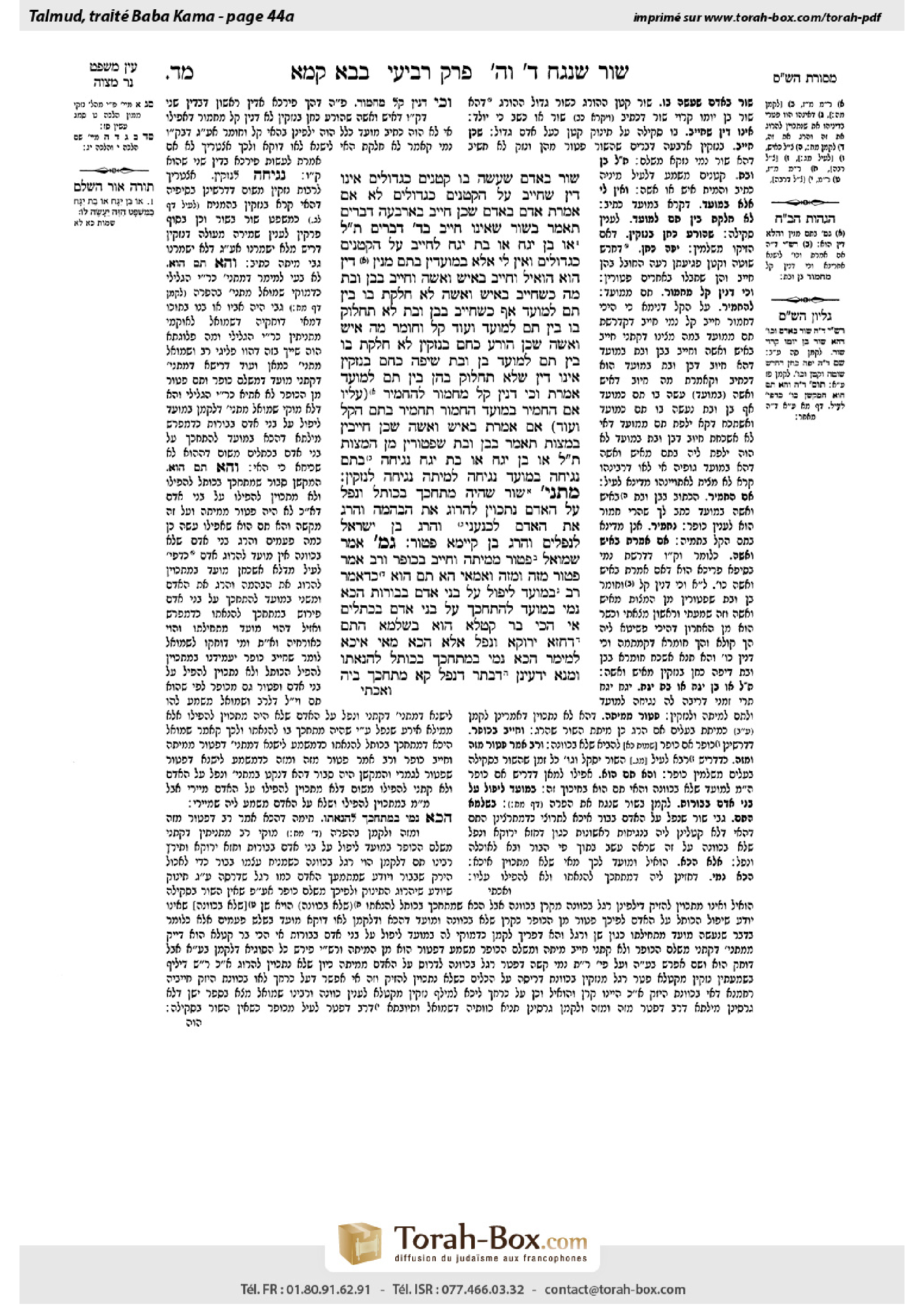
Bava Kamma 44a: Talmud study for Daf Yomi
Study the Talmud for Daf Yomi with scanned pages, Hebrew text, English translations from Sefaria and AI-generated French translations.
Passage selection and English or AI-generated French translation are available where the scan has annotations. Daf Study is independent of Torah-Box and Sefaria.
Browse Bava Kamma · בבא קמא · All tractatesBava Kamma 44a text and translations
This page of Bava Kamma includes the Aramaic text, an English translation and an AI-generated French translation, alongside the scan above.
בבא קמא מ״ד א · Aramaic and Hebrew text
שׁוֹר בְּאָדָם – שֶׁעָשָׂה בּוֹ קְטַנִּים כִּגְדוֹלִים, אֵינוֹ דִּין שֶׁחַיָּיב עַל הַקְּטַנִּים כִּגְדוֹלִים?
לֹא, אִם אָמַרְתָּ אָדָם בְּאָדָם – שֶׁכֵּן חַיָּיב בְּאַרְבָּעָה דְּבָרִים, תֹּאמַר בְּשׁוֹר – שֶׁאֵינוֹ חַיָּיב בְּאַרְבָּעָה דְּבָרִים? תַּלְמוּד לוֹמַר: ״אוֹ בֵן יִגָּח אוֹ בַת יִגָּח״ – לְחַיֵּיב עַל הַקְּטַנִּים כִּגְדוֹלִים.
וְאֵין לִי אֶלָּא בְּמוּעָדִין, בְּתָם מִנַּיִן?
דִּין הוּא – הוֹאִיל וְחִיֵּיב בְּאִישׁ וְאִשָּׁה, וְחִיֵּיב בְּבֵן וּבַת; מָה כְּשֶׁחִיֵּיב בְּאִישׁ וְאִשָּׁה – לֹא חִלַּקְתָּ בּוֹ בֵּין תָּם לְמוּעָד; אַף כְּשֶׁחִיֵּיב בְּבֵן וּבַת – לֹא תַּחְלוֹק בּוֹ בֵּין תָּם לְמוּעָד.
וְעוֹד, קַל וָחוֹמֶר – מָה אִישׁ וְאִשָּׁה, שֶׁכֵּן הוֹרַע כֹּחָם בִּנְזָקִין – לֹא חִלַּקְתָּ בּוֹ בֵּין תָּם לְמוּעָד; בֵּן וּבַת, שֶׁיִּפָּה כֹּחָם בִּנְזָקִין – אֵינוֹ דִּין שֶׁלֹּא תַּחְלוֹק בָּהֶן בֵּין תָּם לְמוּעָד?
אָמַרְתָּ: וְכִי דָּנִין קַל מֵחָמוּר לְהַחְמִיר עָלָיו? אִם הֶחְמִיר בְּמוּעָד הֶחָמוּר, תַּחְמִיר בְּתָם הַקַּל?
וְעוֹד: אִם אָמַרְתָּ בְּאִישׁ וְאִשָּׁה – שֶׁכֵּן חַיָּיבִין בְּמִצְוֹת, תֹּאמַר בְּבֵן וּבַת – שֶׁפְּטוּרִין מִן הַמִּצְוֹת?
תַּלְמוּד לוֹמַר: ״אוֹ בֵן יִגָּח אוֹ בַת יִגָּח״ – נְגִיחָה בְּתָם נְגִיחָה בְּמוּעָד, נְגִיחָה לְמִיתָה נְגִיחָה לִנְזָקִין.
מַתְנִי׳ שׁוֹר שֶׁהָיָה מִתְחַכֵּךְ בַּכּוֹתֶל – וְנָפַל עַל הָאָדָם; נִתְכַּוֵּין לַהֲרוֹג אֶת הַבְּהֵמָה – וְהָרַג אֶת הָאָדָם; לְגוֹי – וְהָרַג בֶּן יִשְׂרָאֵל; לִנְפָלִים – וְהָרַג בֶּן קַיָּימָא; פָּטוּר.
גְּמָ׳ אָמַר שְׁמוּאֵל: פָּטוּר מִמִּיתָה, וְחַיָּיב בְּכוֹפֶר. וְרַב אָמַר: פָּטוּר מִזֶּה וּמִזֶּה.
וְאַמַּאי? הָא תָּם הוּא! כִּדְאָמַר רַב: בְּמוּעָד לִיפּוֹל עַל בְּנֵי אָדָם בְּבוֹרוֹת, הָכָא נָמֵי – בְּמוּעָד לְהִתְחַכֵּךְ עַל בְּנֵי אָדָם בִּכְתָלִים.
אִי הָכִי, בַּר קְטָלָא הוּא! בִּשְׁלָמָא הָתָם – דַּחֲזָא יְרוֹקָא וּנְפַל, אֶלָּא הָכָא – מַאי אִיכָּא לְמֵימַר?
הָכָא נָמֵי – בְּמִתְחַכֵּךְ בַּכּוֹתֶל לַהֲנָאָתוֹ. וּמְנָא יָדְעִינַן? דְּבָתַר דִּנְפַל קָא מִתְחַכַּךְ בֵּיהּ.
Bava Kamma 44a · English translation
then in the case of an ox killing a person, where the Torah renders small oxen like large ones with regard to this act, as a young calf that kills a person is killed just as an adult ox that kills a person, is it not logical that the Torah renders it liable for killing minors, i.e., a boy or a girl, just as for killing adults? Why is it necessary for the verse to teach this halakha?
The Gemara rejects this claim: No, this cannot be derived by logic alone. If you say that a person who kills a person is liable even when the victim is a minor, this may be due to the extra severity in the case of a human assailant, as he is liable to pay four types of indemnity for causing injury; pain, humiliation, medical costs, and loss of livelihood, in addition to payment for the actual damage. Shall you also say that this is the halakha with regard to an ox, whose owner is not liable to pay these four types of indemnity? Clearly, this halakha cannot be derived merely through logical comparison between the two cases. Therefore, the verse states: “Whether it has gored a son or has gored a daughter,” to render it liable for minors as well as adults.
And I have derived this halakha only with regard to forewarned oxen; from where do I derive that in the case of an innocuous ox, it is killed if it kills a boy or a girl?
The baraita asks: Could this not be derived through logical inference? Since the Torah renders an ox liable to be killed for killing a man or a woman, and likewise renders it liable to be killed for killing a boy or a girl; then just as when it renders it liable to be killed for killing a man or a woman you do not differentiate between an innocuous ox and a forewarned ox, as both are stoned, so too, when it renders an ox liable to be killed for killing a boy or a girl do not differentiate between an innocuous ox and a forewarned ox.
And furthermore, it can be inferred a fortiori: If with regard to a man or a woman, whose power is diminished with regard to damages because adults who cause damage are liable to pay, but nevertheless you do not differentiate between an innocuous ox and a forewarned ox that kills them; then with regard to a boy or girl, whose power is enhanced with regard to damages because they are not liable to pay for damage they cause, is it not logical that you should not differentiate between an innocuous ox and a forewarned ox that kills them?
The baraita answers that you could say in response: But does one derive the halakha of a lenient matter from a stringent matter in order to be more stringent with regard to it? If the Torah is stringent with regard to the case of a forewarned ox, which is a stringent matter, rendering it liable to be killed for killing a minor, does that mean that you should be stringent with regard to an innocuous ox, which is a relatively lenient matter?
And furthermore, there is another reason to reject the earlier opinion: If you say that an innocuous ox is liable to be killed for killing a man or a woman, as they are obligated to observe the mitzvot, which gives them importance, does that mean that you should say the same with regard to a boy or a girl, who are exempt from the mitzvot?
Since this halakha could not have been derived through logic alone, the verse states: “Whether it has gored a son or has gored a daughter,” stating the phrase “has gored” twice, to teach that it is referring both to the goring of an innocuous ox and to the goring of a forewarned ox, and both to goring that causes death and to goring that causes injury. In all these cases the owner of the ox is liable even if the ox gores a minor.
MISHNA: If an ox was rubbing against a wall, and as a result the wall fell on a person and killed him; or if the ox intended to kill another animal but killed a person; or if it intended to kill a gentile but killed a Jew; or intended to kill a non-viable baby but killed a viable person; in all these cases the ox is exempt from being killed.
GEMARA: Shmuel says: The ox is exempt from being put to death, since it did not intend to kill, but its owner is liable to pay ransom. And Rav says: They are exempt from this liability and from that liability.
The Gemara asks about Shmuel’s opinion: And why is he liable to pay ransom? Isn’t the ox innocuous with regard to this action? The Gemara answers: As Rav says in a different context, it is referring to an ox that was forewarned with regard to falling on people in pits. Here too, it is referring to an ox that was forewarned with regard to rubbing against walls, causing them to fall on people.
The Gemara asks: If so, if it was forewarned with regard to this behavior, it clearly intended to kill the person and is therefore subject to being put to death, contrary to the ruling in the mishna. The Gemara explains: Granted there, in the case where the ox was forewarned with regard to falling on people in pits, it could be that it saw a vegetable on the edge of the pit and subsequently fell in, without any intention to kill. But here, where it rubbed against a wall, causing it to fall on a person, and was forewarned with regard to this behavior, what is there to say in its defense?
The Gemara answers: Here also the case is where it rubbed against the wall for its pleasure and not in order to kill. The Gemara asks: And from where do we know that it did not intend to kill? The Gemara answers: Because even after the wall fell it was still rubbing against it, which proves that this was its intention.
Bava Kamma 44a · Traduction française (IA)
Dans le cas d'un bœuf qui tue une personne, où la Torah considère les jeunes bœufs comme des grands bœufs concernant cet acte, puisqu'un veau qui tue une personne est tué de la même manière qu'un bœuf adulte qui tue une personne, n'est-il pas logique que la Torah rende ce bœuf responsable de tuer des mineurs, c'est-à-dire un garçon ou une fille, de la même manière qu'elle le fait pour tuer des adultes ? Pourquoi est-il nécessaire que le verset nous enseigne cette halakha ?
La Guemara rejette cette affirmation : Non, cela ne peut pas être déduit par la logique seule. Si vous dites qu'une personne qui tue une personne est responsable même lorsque la victime est un mineur, cela pourrait être dû à la gravité accrue dans le cas d'un agresseur humain, puisqu'il est responsable de payer quatre types de réparation : la douleur, la humiliation, les frais médicaux et la perte de revenu, en plus du dommage réel. Pourriez-vous aussi dire que c'est la halakha concernant un bœuf, dont le propriétaire n'est pas responsable de payer ces quatre types de réparation ? Il est clair que cette halakha ne peut pas être déduite uniquement par une comparaison logique entre les deux cas. Par conséquent, le verset dit : « Qu'il ait écrasé un fils ou qu'il ait écrasé une fille », afin de rendre responsable des mineurs comme des adultes.
Et je déduis cette halakha uniquement concernant les bœufs avertis ; d'où puis-je déduire que dans le cas d'un bœuf inoffensif, il est tué s'il tue un enfant ou une fille ?
La baraïta pose la question : Pourrait-on ne pas déduire cela par une inférence logique ? Puisque la Torah rend un bœuf responsable d'être tué pour avoir tué un homme ou une femme, et de la même manière responsable d'être tué pour avoir tué un enfant ou une fille ; alors, justement lorsque la Torah rend responsable d'être tué pour avoir tué un homme ou une femme, on ne distingue pas entre un bœuf inoffensif et un bœuf averti, puisque les deux sont lapidés, de même, lorsque la Torah rend responsable d'être tué pour avoir tué un enfant ou une fille, on ne distingue pas entre un bœuf inoffensif et un bœuf averti.
Et de plus, on peut en déduire a fortiori : Si, concernant un homme ou une femme, dont la puissance est diminuée concernant les dommages, puisque les adultes qui causent des dommages sont responsables de payer, mais néanmoins on ne distingue pas entre un bœuf inoffensif et un bœuf averti qui les tue ; alors, concernant un enfant ou une fille, dont la puissance est accrue concernant les dommages, puisque ils ne sont pas responsables de payer pour les dommages qu'ils causent, n'est-il pas logique que l'on ne distingue pas entre un bœuf inoffensif et un bœuf averti qui les tue ?
La baraïta répond que l'on pourrait dire en réponse : Mais est-ce que l'on déduit une halakha d'une situation plus clémente à partir d'une situation plus stricte afin d'être plus stricte à son égard ? Si la Torah est stricte concernant le cas d'un bœuf averti, qui est une situation stricte, en rendant responsable d'être tué pour avoir tué un mineur, cela signifie-t-il que l'on devrait être stricte concernant un bœuf inoffensif, qui est une situation relativement clémente ?
Et de plus, il y a une autre raison pour rejeter l'opinion précédente : Si vous dites qu'un bœuf inoffensif est tenu responsable d'être tué pour avoir tué un homme ou une femme, puisqu'ils sont tenus de respecter les mitsvot, ce qui leur confère une importance particulière, cela signifie-t-il que l'on devrait dire la même chose concernant un enfant ou une fille, qui sont exemptés des mitsvot ?
Puisque cette halakha ne pouvait pas être déduite par la logique seule, le verset dit : « Qu'il ait écrasé un fils ou qu'il ait écrasé une fille », en répétant la phrase « a écrasé » deux fois, pour enseigner qu'il s'agit à la fois de l'écrasement d'un bœuf inoffensif et de l'écrasement d'un bœuf averti, et à la fois de l'écrasement qui cause la mort et de l'écrasement qui cause une blessure. Dans tous ces cas, le propriétaire du bœuf est tenu responsable même si le bœuf écrase un mineur.
MICHNA : Si un bœuf frottait contre un mur, et que par conséquent le mur tomba sur une personne et le tua ; ou si le bœuf voulait tuer un autre animal mais tua une personne ; ou s'il voulait tuer un non-Juif mais tua un Juif ; ou s'il voulait tuer un bébé non viable mais tua un bébé viable ; dans tous ces cas, le bœuf est exempt d'être tué.
GUEMARA : Shmuel dit : Le bœuf est exempt d'être tué, puisqu'il n'avait pas l'intention de tuer, mais son propriétaire est responsable de payer une rançon. Et Rav dit : Ils sont exempts de cette responsabilité et de celle-ci.
La Guemara pose la question concernant l'opinion de Shmuel : Et pourquoi est-il responsable de payer une rançon ? N'est-ce pas que le bœuf est inoffensif concernant cet acte ? La Guemara répond : Comme Rav dit dans un contexte différent, il s'agit d'un bœuf averti concernant la chute dans des fossés. Ici aussi, il s'agit d'un bœuf averti concernant le frottement contre les murs, causant leur chute sur les personnes.
La Guemara pose la question : Si tel est le cas, si le bœuf était averti concernant ce comportement, il est clair qu'il avait l'intention de tuer la personne et est donc soumis à la peine de mort, contrairement à la décision de la mishna. La Guemara explique : En effet, dans le cas où le bœuf était averti concernant la chute dans des fossés, il pouvait être que le bœuf ait vu un légume au bord du fossé et est ensuite tombé dedans, sans aucune intention de tuer. Mais ici, où il frottait contre un mur, causant sa chute sur une personne, et était averti concernant ce comportement, de quoi pourrait-on défendre ce bœuf ?
La Guemara répond : Ici aussi, le cas est celui où le bœuf frottait contre le mur par plaisir et non pour tuer. La Guemara pose la question : Et d'où savons-nous qu'il n'avait pas l'intention de tuer ? La Guemara répond : Parce que même après que le mur eut tombé, il continuait à frotter contre lui, ce qui prouve que c'était son intention.
Traduction française générée par IA à partir de l’édition anglaise de Sefaria. Vérifie toujours un passage avec le texte source.
Text from Sefaria: William Davidson Edition - Vocalized Aramaic (CC BY NC); William Davidson Edition - English (CC BY NC).