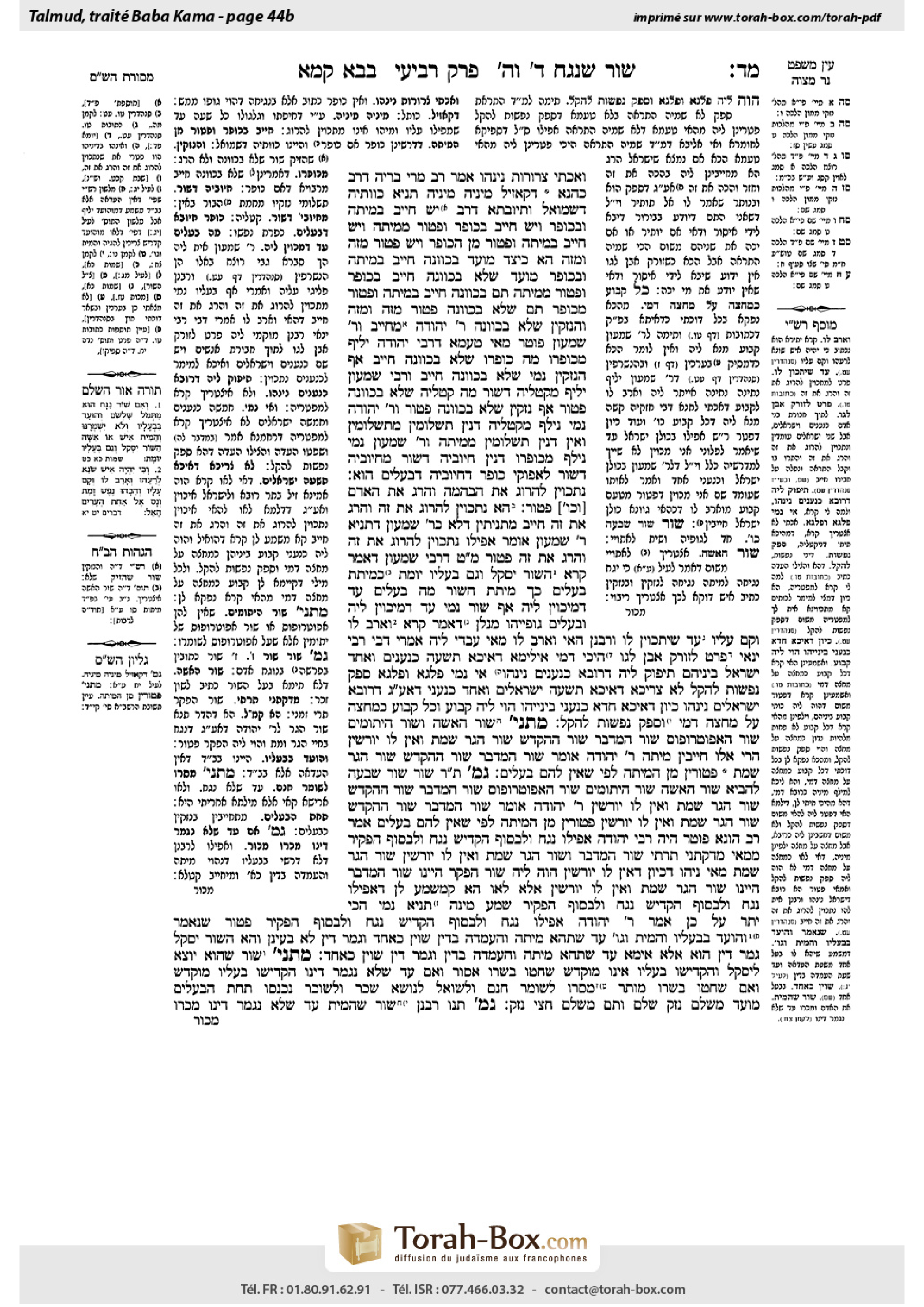
Bava Kamma 44b: Talmud study for Daf Yomi
Study the Talmud for Daf Yomi with scanned pages, Hebrew text, English translations from Sefaria and AI-generated French translations.
Passage selection and English or AI-generated French translation are available where the scan has annotations. Daf Study is independent of Torah-Box and Sefaria.
Browse Bava Kamma · בבא קמא · All tractatesBava Kamma 44b text and translations
This page of Bava Kamma includes the Aramaic text, an English translation and an AI-generated French translation, alongside the scan above.
בבא קמא מ״ד ב · Aramaic and Hebrew text
וְאַכַּתִּי צְרוֹרוֹת נִינְהוּ! אָמַר רַב מָרִי בְּרֵיהּ דְּרַב כָּהֲנָא: דְּקָאָזֵיל מִינֵּיהּ מִינֵּיהּ.
תַּנְיָא כְּווֹתֵיהּ דִּשְׁמוּאֵל – וּתְיוּבְתָּא דְּרַב: יֵשׁ חַיָּיב בְּמִיתָה וּבְכוֹפֶר, וְיֵשׁ חַיָּיב בְּכוֹפֶר וּפָטוּר מִמִּיתָה, וְיֵשׁ חַיָּיב בְּמִיתָה וּפָטוּר מִן הַכּוֹפֶר, וְיֵשׁ פָּטוּר מִזֶּה וּמִזֶּה.
הָא כֵּיצַד? מוּעָד בְּכַוָּונָה – חַיָּיב בְּמִיתָה וּבְכוֹפֶר. מוּעָד שֶׁלֹּא בְּכַוָּונָה – חַיָּיב בְּכוֹפֶר וּפָטוּר מִמִּיתָה. תָּם בְּכַוָּונָה – חַיָּיב בְּמִיתָה וּפָטוּר מִכּוֹפֶר. תָּם שֶׁלֹּא בְּכַוָּונָה – פָּטוּר מִזֶּה וּמִזֶּה.
וְהַנְּזָקִין שֶׁלֹּא בְּכַוָּונָה – רַבִּי יְהוּדָה מְחַיֵּיב, וְרַבִּי שִׁמְעוֹן פּוֹטֵר.
מַאי טַעְמָא דְּרַבִּי יְהוּדָה? יָלֵיף מִכּוֹפְרוֹ; מָה כּוֹפְרוֹ – שֶׁלֹּא בְּכַוָּונָה חַיָּיב, אַף הַנְּזָקִין נָמֵי – שֶׁלֹּא בְּכַוָּונָה חַיָּיב.
וְרַבִּי שִׁמְעוֹן יָלֵיף מִקְּטָלֵיהּ דְּשׁוֹר, מָה קְטָלֵיהּ – שֶׁלֹּא בְּכַוָּונָה פָּטוּר, אַף נְזָקִין – שֶׁלֹּא בְּכַוָּונָה פָּטוּר.
וְרַבִּי יְהוּדָה נָמֵי, נֵילַף מִקְּטָלֵיהּ! דָּנִין תַּשְׁלוּמִין מִתַּשְׁלוּמִין, וְאֵין דָּנִין תַּשְׁלוּמִין מִמִּיתָה.
וְרַבִּי שִׁמְעוֹן נָמֵי, נֵילַף מִכּוֹפְרוֹ! דָּנִין חִיּוּבֵיהּ דְּשׁוֹר מֵחִיּוּבֵיהּ דְּשׁוֹר, לְאַפּוֹקֵי כּוֹפֶר דְּחִיּוּבֵיהּ דִּבְעָלִים הוּא.
נִתְכַּוֵּין לַהֲרוֹג אֶת הַבְּהֵמָה וְהָרַג אֶת הָאָדָם [וְכוּ׳] – פָּטוּר. הָא נִתְכַּוֵּין לַהֲרוֹג אֶת זֶה, וְהָרַג אֶת זֶה – חַיָּיב, מַתְנִיתִין דְּלָא כְּרַבִּי שִׁמְעוֹן. דְּתַנְיָא, רַבִּי שִׁמְעוֹן אוֹמֵר: אֲפִילּוּ נִתְכַּוֵּין לַהֲרוֹג אֶת זֶה, וְהָרַג אֶת זֶה – פָּטוּר.
מַאי טַעְמָא דְּרַבִּי שִׁמְעוֹן? דְּאָמַר קְרָא: ״הַשּׁוֹר יִסָּקֵל וְגַם בְּעָלָיו יוּמָת״ – כְּמִיתַת בְּעָלִים, כָּךְ מִיתַת הַשּׁוֹר; מָה בְּעָלִים – עַד דְּמִיכַּוֵּין לֵיהּ, אַף שׁוֹר נָמֵי – עַד דְּמִיכַּוֵּין לֵיהּ.
וּבְעָלִים גּוּפַיְיהוּ מְנָלַן? דְּאָמַר קְרָא: ״וְאָרַב לוֹ וְקָם עָלָיו״ – עַד שֶׁיִּתְכַּוֵּין לוֹ.
וְרַבָּנַן, הַאי ״וְאָרַב לוֹ״ מַאי עָבְדִי לֵיהּ? אָמְרִי דְּבֵי רַבִּי יַנַּאי: פְּרָט לַזּוֹרֵק אֶבֶן לְגוֹ.
הֵיכִי דָמֵי? אִילֵּימָא דְּאִיכָּא תִּשְׁעָה גּוֹיִם וְאֶחָד יִשְׂרָאֵל בֵּינֵיהֶם – תִּיפּוֹק לֵיהּ דְּרוּבָּא גּוֹיִם נִינְהוּ; אִי נָמֵי פַּלְגָא וּפַלְגָא – סְפֵק נְפָשׁוֹת לְהָקֵל!
לָא צְרִיכָא, דְּאִיכָּא תִּשְׁעָה יִשְׂרְאֵלִים וְאֶחָד גּוֹי. דְּאַף עַל גַּב דְּרוּבָּא יִשְׂרְאֵלִים נִינְהוּ; כֵּיוָן דְּאִיכָּא חֲדא גּוֹי בֵּינַיְיהוּ – הָוֵי לֵיהּ קָבוּעַ, וְכׇל קָבוּעַ כְּמֶחֱצָה עַל מֶחֱצָה דָּמֵי, וְסָפֵק נְפָשׁוֹת לְהָקֵל.
מַתְנִי׳ שׁוֹר הָאִשָּׁה, וְשׁוֹר הַיְּתוֹמִים, שׁוֹר הָאַפּוֹטְרוֹפּוֹס, שׁוֹר הַמִּדְבָּר, שׁוֹר הַהֶקְדֵּשׁ, שׁוֹר הַגֵּר שֶׁמֵּת וְאֵין לוֹ יוֹרְשִׁין – הֲרֵי אֵלּוּ חַיָּיבִין מִיתָה. רַבִּי יְהוּדָה אוֹמֵר: שׁוֹר הַמִּדְבָּר, שׁוֹר הַהֶקְדֵּשׁ, שׁוֹר הַגֵּר שֶׁמֵּת – פְּטוּרִין מִן הַמִּיתָה, לְפִי שֶׁאֵין לָהֶם בְּעָלִים.
גְּמָ׳ תָּנוּ רַבָּנַן: ״שׁוֹר״ ״שׁוֹר״ שִׁבְעָה – לְהָבִיא שׁוֹר הָאִשָּׁה, שׁוֹר הַיְּתוֹמִים, שׁוֹר הָאַפּוֹטְרוֹפּוֹס, שׁוֹר הַמִּדְבָּר, שׁוֹר הַהֶקְדֵּשׁ, שׁוֹר הַגֵּר שֶׁמֵּת וְאֵין לוֹ יוֹרְשִׁין. רַבִּי יְהוּדָה אוֹמֵר: שׁוֹר הַמִּדְבָּר, שׁוֹר הַהֶקְדֵּשׁ, שׁוֹר הַגֵּר שֶׁמֵּת וְאֵין לוֹ יוֹרְשִׁין – פְּטוּרִין מִן הַמִּיתָה, לְפִי שֶׁאֵין לָהֶם בְּעָלִים.
אָמַר רַב הוּנָא: פּוֹטֵר הָיָה רַבִּי יְהוּדָה אֲפִילּוּ נָגַח וּלְבַסּוֹף הִקְדִּישׁ, נָגַח וּלְבַסּוֹף הִפְקִיר.
מִמַּאי? מִדְּקָתָנֵי תַּרְתֵּי – שׁוֹר הַמִּדְבָּר, וְשׁוֹר הַגֵּר שֶׁמֵּת וְאֵין לוֹ יוֹרְשִׁין. שׁוֹר הַגֵּר שֶׁמֵּת מַאי נִיהוּ? דְּכֵיוָן דְּאֵין לוֹ יוֹרְשִׁין – הֲוָה לֵיהּ שׁוֹר הֶפְקֵר; הַיְינוּ שׁוֹר הַמִּדְבָּר, הַיְינוּ שׁוֹר הַגֵּר שֶׁמֵּת וְאֵין לוֹ יוֹרְשִׁין! אֶלָּא לָאו הָא קָמַשְׁמַע לַן – דַּאֲפִילּוּ נָגַח וּלְבַסּוֹף הִקְדִּישׁ, נָגַח וּלְבַסּוֹף הִפְקִיר? שְׁמַע מִינַּהּ.
תַּנְיָא נָמֵי הָכִי, יָתֵר עַל כֵּן אָמַר רַבִּי יְהוּדָה: אֲפִילּוּ נָגַח וּלְבַסּוֹף הִקְדִּישׁ, נָגַח וּלְבַסּוֹף הִפְקִיר – פָּטוּר, שֶׁנֶּאֱמַר: ״וְהוּעַד בִּבְעָלָיו״ – ״וְהֵמִית וְגוֹ׳״, עַד שֶׁתְּהֵא מִיתָה וְהַעֲמָדָה בַּדִּין שָׁוִין כְּאֶחָד.
וּגְמַר דִּין לָא בָּעֵינַן? וְהָא ״הַשּׁוֹר יִסָּקֵל״ גְּמַר דִּין הוּא! אֶלָּא אֵימָא: עַד שֶׁתְּהֵא מִיתָה, וְהַעֲמָדָה בַּדִּין, וּגְמַר דִּין שָׁוִין כְּאֶחָד.
מַתְנִי׳ שׁוֹר שֶׁהוּא יוֹצֵא לִיסָּקֵל, וְהִקְדִּישׁוֹ בְּעָלָיו – אֵינוֹ מוּקְדָּשׁ. שְׁחָטוֹ – בְּשָׂרוֹ אָסוּר. וְאִם עַד שֶׁלֹּא נִגְמַר דִּינוֹ הִקְדִּישׁוֹ בְּעָלָיו – מוּקְדָּשׁ. וְאִם שְׁחָטוֹ – בְּשָׂרוֹ מוּתָּר.
מְסָרוֹ לְשׁוֹמֵר חִנָּם וּלְשׁוֹאֵל לְנוֹשֵׂא שָׂכָר וּלְשׂוֹכֵר – נִכְנְסוּ תַּחַת הַבְּעָלִים; מוּעָד – מְשַׁלֵּם נֶזֶק שָׁלֵם, וְתָם – מְשַׁלֵּם חֲצִי נֶזֶק.
גְּמָ׳ תָּנוּ רַבָּנַן: שׁוֹר שֶׁהֵמִית; עַד שֶׁלֹּא נִגְמַר דִּינוֹ – מְכָרוֹ
Bava Kamma 44b · English translation
The Gemara asks: But still, is it not a case of pebbles? Is this case not analogous to damage caused by pebbles inadvertently propelled from under the feet of an animal while it is walking, which is not considered damage caused directly by the ox, but rather, damage caused indirectly? Ransom is not imposed for such indirect killing. Rav Mari, son of Rav Kahana, said: It is a case where the wall gradually gave way under the pressure applied by the ox, and so while the ox was still pushing the wall it collapsed and killed the person.
It is taught in a baraita in accordance with the opinion of Shmuel, and this baraita is a conclusive refutation of the opinion of Rav: There are cases where the ox is liable to be put to death and the owner is liable to pay ransom, and there are cases where the owner is liable to pay ransom but the ox is exempt from being put to death, and there are cases where the ox is liable to be put to death but the owner is exempt from paying ransom, and there are cases where they are exempt from this punishment and from that one.
How so? In a case where a forewarned ox kills a person intentionally, the ox is liable to be put to death and the owner is liable to pay ransom; if a forewarned ox kills unintentionally, the owner is liable to pay ransom but the ox is exempt from being put to death; if an innocuous ox kills intentionally, the ox is liable to be put to death but the owner is exempt from paying ransom; and if an innocuous ox kills unintentionally, they are exempt from this punishment and from that one. The baraita states explicitly that although a forewarned ox that kills a person unintentionally is exempt from being put to death, its owner is liable to pay ransom, in accordance with Shmuel’s opinion, and in contrast with Rav’s opinion.
The baraita adds: And for injuries caused by an ox unintentionally, from which the victim is not killed, Rabbi Yehuda deems the owner liable to pay for the injury and Rabbi Shimon exempts him.
The Gemara asks: What is the reason for the opinion of Rabbi Yehuda? The Gemara answers: He derives the halakha with regard to injury caused by the ox from the halakha with regard to its owner’s ransom payment. Just as with regard to its owner’s ransom payment he is liable even if the ox gores unintentionally, so too, with regard to injuries he is also liable even if it gores unintentionally.
And Rabbi Shimon derives his opinion from the halakha of the putting to death of an ox by the court: Just as with regard to its being put to death, if it kills a person unintentionally it is exempt, so too, if it causes injuries unintentionally its owner is exempt from payment.
The Gemara questions the above explanation: And let Rabbi Yehuda also derive the halakha concerning an ox unintentionally causing injury from the halakha of its being put to death. The Gemara answers: In his opinion, we can derive a halakha with regard to payment for injury from the halakha of ransom, which is another halakha with regard to payment. But we cannot derive a halakha with regard to payment from a halakha concerning death.
Conversely, the Gemara asks: And let Rabbi Shimon also derive the halakha here from the halakha concerning its owner’s ransom payment. The Gemara answers: We can derive a halakha with regard to the liability of an ox from a halakha with regard to the liability of an ox, to the exclusion of the payment of ransom, which is the liability of the owner. Compensation for injury is considered the ox’s liability, as it is the ox that caused the injury, whereas the ransom paid is for the owner’s atonement. Therefore, the halakha concerning injury cannot be derived from the halakha of ransom, as they are dissimilar.
§ The mishna teaches that if an ox intended to kill another animal but killed a person, or if it intended to kill a person for whom it would not be liable to be put to death but killed a person for whom it would be liable, it is exempt. The Gemara infers: If the ox intended to kill this person, for whom it would be liable, but killed that person instead, it is still liable. Accordingly, the mishna is not in accordance with the opinion of Rabbi Shimon, as it is taught in a baraita that Rabbi Shimon says: Even if the ox intended to kill this person but killed that person, it is exempt.
The Gemara asks: What is the reason for the opinion of Rabbi Shimon? The Gemara answers that it is because the verse states: “The ox shall be stoned, and its owner also shall be put to death” (Exodus 21:29); the juxtaposition of the ox and its owner indicates that as the death of the owner, i.e., a person, for killing another person, so is the death of the ox for killing a person. In other words, the two halakhot are applied in the same circumstances. Specifically, just as the owner, i.e., a person, is not liable to receive court-imposed capital punishment unless he intends to kill the person whom he ultimately kills, so too, an ox is not put to death either, unless it intends to kill the one whom it ultimately kills.
The Gemara asks: And with regard to the owner himself, from where do we derive that he is not liable unless he killed the one whom he intended to kill? It is as the verse states: “And he lay in wait for him, and rose against him, and struck him mortally and he died” (Deuteronomy 19:11). From the term “for him,” Rabbi Shimon derives that the killer is not liable unless he intends to kill him, i.e., the one whom he ultimately killed.
The Gemara asks: And what do the Rabbis, who deem the killer liable in that case and who therefore disagree with Rabbi Shimon’s opinion, do with this phrase: “And he lay in wait for him”? How do they interpret it? The Gemara answers that the Sages of the school of Rabbi Yannai say that this phrase excludes from liability one who throws a stone into an area where there are several people, some of whom are people for whom he would not be liable to receive court-imposed capital punishment, e.g., gentiles, and a stone killed a person for whom he would receive court-imposed capital punishment.
The Gemara asks: What are the circumstances of this case? If we say that there are nine gentiles in the crowd and one Jew among them, even without the verse derive the exemption from the fact that a majority of them are gentiles. Alternatively, even if half the people are gentiles and half are Jews, derive the exemption from the principle that when there is uncertainty concerning capital law, the halakha is to be lenient.
The Gemara answers: No, the verse is necessary in a case where there are nine Jews and one gentile. Although a majority of them are Jews, the thrower is exempt from liability because there is one gentile among them who is considered fixed in his place, and the legal status of any item fixed in its place is like that of an uncertainty that is equally balanced; and when there is uncertainty concerning capital law the halakha is to be lenient. This is what the Rabbis derive from the phrase: “And he lay in wait for him.”
MISHNA: With regard to an ox belonging to a woman, and similarly an ox belonging to orphans, and an ox belonging to orphans that is in the custody of their steward, and a desert ox, which is ownerless, and an ox that was consecrated to the Temple treasury, and an ox belonging to a convert who died and has no heirs, rendering the ox ownerless; all of these oxen are liable to be put to death for killing a person. Rabbi Yehuda says: A desert ox, a consecrated ox, and an ox belonging to a convert who died are exempt from being put to death, since they have no owners.
GEMARA: The Sages taught: In the passage discussing an ox that kills a person (Exodus 21:28–32), the Torah states: “An ox,” “an ox,” repeating this word seven times, to include an additional six cases, in addition to the classic case of an ox goring and killing a person. They are: An ox belonging to a woman, an ox belonging to orphans, an ox belonging to orphans that is in the custody of a steward, a desert ox, a consecrated ox, and an ox belonging to a convert who died and has no heirs. Rabbi Yehuda says: A desert ox, a consecrated ox, and an ox belonging to a convert who died and has no heirs are all exempt from being put to death, since they have no owners.
Rav Huna says: Rabbi Yehuda would deem the ox exempt even if it gored and killed and its owner ultimately consecrated it, or if it gored and he ultimately renounced his ownership over it, since at the time of the trial in court the ox does not have an owner.
The Gemara asks: From where did Rav Huna derive this assertion? From the fact that Rabbi Yehuda teaches two cases, a desert ox and an ox belonging to a convert who died and has no heirs. What is the legal status of an ox belonging to a convert who died? Since he has no heirs it is considered to be an ownerless ox. Accordingly, the case of a desert ox is the same as the case of an ox belonging to a convert who died and has no heirs, and it does not seem necessary for the baraita to state both cases. Rather, does it not teach us this: That even if the ox gored and he ultimately consecrated it, or, if it gored and he ultimately renounced ownership over it, it is exempt, just as in a case where a convert’s ox gores and subsequently the owner dies? The Gemara concludes: Indeed, conclude from the baraita that this is the opinion of Rabbi Yehuda.
This assertion is also taught in a baraita: Moreover, Rabbi Yehuda said that even if it gored and he ultimately consecrated it, or if it gored and he ultimately renounced ownership over it, the ox is exempt, as it is stated: “And warning has been given [vehuad] to its owner…and it killed…the ox shall be stoned” (Exodus 21:29). It is derived from here that the owner of the ox is exempt unless the ox’s status as the owner’s property at the time of the death of the victim and at the time of the owner’s standing trial is the same, i.e., that the ox has an owner.
The Gemara asks: But don’t we require that the ox’s status be the same at the time of the verdict as well? And isn’t the phrase “the ox shall be stoned” also referring to the verdict? Rather, emend the statement and say that the owner of the ox is exempt unless the ox’s status as the owner’s property at the time of the death of the victim and at the time of the owner’s standing trial and at the time of the verdict are identical as one.
MISHNA: With regard to an ox that is leaving court to be stoned for killing a person and its owner then consecrated it, it is not considered consecrated, i.e., the consecration does not take effect, since deriving benefit from the ox is prohibited and the ox is therefore worthless. If one slaughtered it, its flesh is forbidden to be eaten and it is prohibited to derive benefit from it. But if its owner consecrated it before its verdict the ox is considered consecrated, and if he slaughtered it its flesh is permitted.
If the owner of an ox conveyed it to an unpaid bailee, or to a borrower, or to a paid bailee, or to a renter, and it caused damage while in their custody, they enter into the responsibilities and liabilities in place of the owner. Therefore, if it was forewarned the bailee pays the full cost of the damage, and if it was innocuous he pays half the cost of the damage.
GEMARA: The Sages taught: With regard to an ox that killed a person, if its owner sold it before its verdict,
Bava Kamma 44b · Traduction française (IA)
La Guemara pose la question : Mais alors, n'est-ce pas un cas de cailloux ? Ce cas n'est-il pas analogue à celui d'un dommage causé par des cailloux propulsés accidentellement sous les pieds d'un animal en marche, ce qui n'est pas considéré comme un dommage directement causé par l'ox, mais comme un dommage indirect ? Aucune rançon n'est imposée pour tels meurtres indirects. Rav Mari, fils de Rav Kahana, dit : Il s'agit d'un cas où le mur s'est progressivement effondré sous la pression exercée par l'ox, et donc, pendant que l'ox poussait le mur, il s'est effondré et a tué la personne.
Il est enseigné dans une baraïta selon l'opinion de Shmuel, et cette baraïta constitue une réfutation définitive de l'opinion de Rav : Il existe des cas où l'ox est tenu responsable de la mort et où l'propriétaire est tenu responsable de rançon, et il existe des cas où l'propriétaire est tenu responsable de rançon mais l'ox est exempt de la mort, et il existe des cas où l'ox est tenu responsable de la mort mais l'propriétaire est exempt de rançon, et il existe des cas où ils sont exemptés de ce châtiment et de celui-là.
Comment cela ? Dans le cas où un ox averti tue une personne intentionnellement, l'ox est tenu responsable de la mort et l'propriétaire est tenu responsable de rançon ; si un ox averti tue accidentellement, l'propriétaire est tenu responsable de rançon mais l'ox est exempt de la mort ; si un ox inoffensif tue intentionnellement, l'ox est tenu responsable de la mort mais l'propriétaire est exempt de rançon ; et si un ox inoffensif tue accidentellement, ils sont exemptés de ce châtiment et de celui-là. La baraïta affirme explicitement que bien qu'un ox averti qui tue une personne accidentellement soit exempt de la mort, son propriétaire est tenu responsable de rançon, conformément à l'opinion de Shmuel, et contrairement à l'opinion de Rav.
La baraïta ajoute : Et pour les blessures causées par un taureau accidentellement, dont la victime ne meurt pas, Rabbi Yéhuda considère que l'propriétaire est tenu responsable de la blessure et Rabbi Shimon l'exonère.
La Guemara pose la question : Quel est le fondement de l'opinion de Rabbi Yéhuda ? La Guemara répond : Il dérive la halakha concernant les blessures causées par l'ox de la halakha concernant le paiement de rançon par son propriétaire. Aussi longtemps que le propriétaire est tenu responsable de rançon même si l'ox charge accidentellement, de même, concernant les blessures, il est tenu responsable même si l'ox charge accidentellement.
Et Rabbi Shimon dérive son opinion de la halakha concernant la mise à mort de l'ox par le tribunal : Aussi longtemps que concernant sa mise à mort, s'il tue une personne accidentellement, il est exempt, de même, concernant les blessures, son propriétaire est exempt de paiement.
La Guemara questionne l'explication ci-dessus : Et Rabbi Yéhuda dérive également la halakha concernant un bœuf causant accidentellement des blessures de la halakha concernant sa mise à mort. La Guemara répond : Selon son opinion, nous pouvons dériver une halakha concernant le paiement pour les blessures de la halakha concernant le rançon, qui est une autre halakha concernant le paiement. Mais nous ne pouvons pas dériver une halakha concernant le paiement d'une halakha concernant la mort.
Inversement, la Guemara pose la question : Et Rabbi Shimon dérive également la halakha ici de la halakha concernant le paiement de rançon par son propriétaire. La Guemara répond : Nous pouvons dériver une halakha concernant la responsabilité d'un bœuf d'une halakha concernant la responsabilité d'un bœuf, en excluant le paiement de rançon, qui est la responsabilité du propriétaire. La compensation pour les blessures est considérée comme la responsabilité du bœuf, car c'est le bœuf qui a causé les blessures, tandis que le rançon payé est pour l'atonement du propriétaire. Par conséquent, la halakha concernant les blessures ne peut pas être dérivée de la halakha du rançon, car elles sont différentes.
§ La mitsna enseigne que si un bœuf avait l'intention de tuer un autre animal mais a tué une personne, ou s'il avait l'intention de tuer une personne pour laquelle il ne serait pas tenu responsable de la mort mais a tué une personne pour laquelle il le serait, il est exempt. La Guemara infère : Si le bœuf avait l'intention de tuer cette personne, pour laquelle il serait tenu responsable, mais a tué celle-ci au lieu, il est toujours responsable. Ainsi, la mitsna ne correspond pas à l'opinion de Rabbi Shimon, car il est enseigné dans une baraïta que Rabbi Shimon dit : Même si le bœuf avait l'intention de tuer cette personne mais a tué celle-ci, il est exempt.
La Guemara pose la question : Quel est le fondement de l'opinion de Rabbi Shimon ? La Guemara répond que c'est parce que le verset dit : « L'ox sera lapidé, et son propriétaire sera également mis à mort » (Exode 21:29) ; la juxtaposition de l'ox et de son propriétaire indique que, comme la mort du propriétaire, c'est-à-dire une personne, pour avoir tué une autre personne, ainsi est la mort de l'ox pour avoir tué une personne. En d'autres termes, les deux halakhot s'appliquent dans les mêmes circonstances. En particulier, aussi longtemps que le propriétaire, c'est-à-dire une personne, n'est pas tenu responsable d'une peine de mort imposée par le tribunal à moins qu'il n'ait l'intention de tuer la personne qu'il a finalement tuée, de même, l'ox n'est pas mis à mort non plus à moins qu'il n'ait l'intention de tuer la personne qu'il a finalement tuée.
La Guemara pose la question : Et concernant le propriétaire lui-même, d'où dérivons-nous que celui-ci n'est pas tenu responsable à moins qu'il n'ait tué la personne qu'il avait l'intention de tuer ? C'est comme le verset dit : « Et il attendit pour lui, et se leva contre lui, et le frappa mortellement et il mourut » (Deutéronome 19:11). Du terme « pour lui », Rabbi Shimon dérive que le meurtrier n'est pas tenu responsable à moins qu'il n'ait l'intention de le tuer, c'est-à-dire la personne qu'il a finalement tué.
La Guemara pose la question : Et que font les Rabbins, qui considèrent le meurtrier comme responsable dans ce cas et qui sont donc opposés à l'opinion de Rabbi Shimon, avec cette phrase : « Et il attendit pour le tuer » ? Comment interprètent-ils cette phrase ? La Guemara répond que les Sages de la maison de Rabbi Yannai disent que cette phrase exclut de la responsabilité celui qui jette une pierre dans une zone où il y a plusieurs personnes, certaines d'entre elles étant des personnes pour lesquelles il ne serait pas responsable de recevoir une peine de mort imposée par la justice, par exemple les non-Juifs, et une pierre a tué une personne pour laquelle il recevrait une peine de mort imposée par la justice.
La Guemara pose la question : Quelles sont les circonstances de ce cas ? Si nous disons qu'il y a neuf non-Juifs dans la foule et un Juif parmi eux, même sans la parole, on peut déduire l'exemption du fait qu'une majorité d'entre eux sont des non-Juifs. Alternativement, même si la moitié des personnes sont des non-Juifs et l'autre moitié des Juifs, on déduit l'exemption du principe selon lequel, en cas d'incertitude concernant la loi pénale, la halakha est leniente.
La Guemara répond : Non, la parole est nécessaire dans un cas où il y a neuf Juifs et un non-Juif. Bien que la majorité d'entre eux soient des Juifs, le jeteur est exempt de responsabilité car il y a un non-Juif parmi eux qui est considéré comme fixé à son lieu, et le statut juridique d'un objet fixé à son lieu est comme celui d'une incertitude équilibrée ; et lorsqu'il y a une incertitude concernant la loi pénale, la halakha est leniente. C'est ce que les Rabbis déduisent de la phrase : « Et il attendit pour le tuer. »
MICHNA : Concernant un bœuf appartenant à une femme, et de même un bœuf appartenant aux orphelins, et un bœuf appartenant aux orphelins qui est en dépôt chez leur administrateur, et un bœuf sauvage, qui est sans propriétaire, et un bœuf consacré au trésor du Temple, et un bœuf appartenant à un converti décédé sans héritiers, rendant le bœuf sans propriétaire ; tous ces bœufs sont redevables de la mort pour avoir tué une personne. Rabbi Yehuda dit : Le bœuf sauvage, le bœuf consacré, et le bœuf appartenant à un converti décédé sont exemptés de la mort, car ils n'ont pas de propriétaire.
GUEMARA : Les Sages enseignent : Dans le passage discutant un bœuf qui tue une personne (Exode 21:28–32), la Torah dit : « Un bœuf », « un bœuf », répétant ce mot sept fois, pour inclure six cas supplémentaires, en plus du cas classique d'un bœuf qui charge et tue une personne. Ils sont : un bœuf appartenant à une femme, un bœuf appartenant aux orphelins, un bœuf appartenant aux orphelins qui est en dépôt chez un administrateur, un bœuf sauvage, un bœuf consacré, et un bœuf appartenant à un converti décédé sans héritiers. Rabbi Yehuda dit : Le bœuf sauvage, le bœuf consacré, et le bœuf appartenant à un converti décédé sans héritiers sont tous exemptés de la mort, car ils n'ont pas de propriétaire.
Rav Huna dit : Rabbi Yehuda considérerait le bœuf comme exempt même s'il a chargé et tué et que son propriétaire a finalement consacré le bœuf, ou même s'il a chargé et qu'il a finalement renoncé à son droit d'ownership, car à l'époque du procès en justice le bœuf n'a pas de propriétaire.
La Guemara pose la question : D'où Rav Huna a-t-il tiré cette affirmation ? De la réalité que Rabbi Yehuda enseigne deux cas, un bœuf sauvage et un bœuf appartenant à un converti décédé sans héritiers. Quel est le statut juridique d'un bœuf appartenant à un converti décédé ? Puisque celui-ci n'a pas d'héritiers, il est considéré comme un bœuf sans propriétaire. Ainsi, le cas d'un bœuf sauvage est identique à celui d'un bœuf appartenant à un converti décédé sans héritiers, et il ne semble pas nécessaire que la baraïta énonce les deux cas. Plutôt, ne déduit-il pas cela : que même si le bœuf a chargé et qu'il a finalement consacré le bœuf, ou si le bœuf a chargé et qu'il a finalement renoncé à sa propriété, il est exempt, tout comme dans le cas où un bœuf d'un converti charge et que l'propriétaire meurt ensuite ? La Guemara conclut : En effet, concluez de la baraïta que c'est l'opinion de Rabbi Yehuda.
Cette affirmation est également enseignée dans une baraïta : De plus, Rabbi Yehuda dit que même si le bœuf a chargé et qu'il a finalement consacré le bœuf, ou si le bœuf a chargé et qu'il a finalement renoncé à sa propriété, le bœuf est exempt, comme il est dit : « Et une mise en garde [vehuad] a été donnée à son propriétaire… et il tua… le bœuf sera lapidé » (Exode 21:29). Il est tiré d'ici que le propriétaire du bœuf est exempt à moins que le statut du bœuf comme propriété du propriétaire à l'époque de la mort de la victime et à l'époque du procès du propriétaire soit le même, c'est-à-dire que le bœuf a un propriétaire.
La Guemara pose la question : Mais ne requiert-on pas que le statut du bœuf soit le même à l'époque du verdict également ? Et n'est-ce pas la phrase « le bœuf sera lapidé » qui fait référence également au verdict ? Plutôt, corrigez l'affirmation et dites que le propriétaire du bœuf est exempt à moins que le statut du bœuf comme propriété du propriétaire à l'époque de la mort de la victime et à l'époque du procès du propriétaire et à l'époque du verdict soit identique.
MICHNA : Concernant un bœuf qui quitte la cour pour être lapidé pour avoir tué une personne et dont son propriétaire a consacré le bœuf, il n'est pas considéré comme consacré, c'est-à-dire que la consécration ne prend effet, car il est interdit d'en tirer un bénéfice et le bœuf est donc inutilisable. Si l'on a sacrifié le bœuf, sa viande est interdite à l'ingestion et il est interdit d'en tirer un bénéfice. Mais si son propriétaire a consacré le bœuf avant son verdict, le bœuf est considéré comme consacré, et si l'on a sacrifié le bœuf, sa viande est permise.
Si le propriétaire d'un bœuf a transféré le bœuf à un dépositaire non rémunéré, ou à un prêteur, ou à un dépositaire rémunéré, ou à un locataire, et que le bœuf a causé des dommages pendant qu'il était en leur possession, ils prennent les responsabilités et les obligations à la place du propriétaire. Ainsi, si le bœuf était averti, le dépositaire paie le coût complet des dommages, et si le bœuf était inoffensif, il paie la moitié du coût des dommages.
GUEMARA : Les Sages enseignent : Concernant un bœuf qui a tué une personne, si son propriétaire l'a vendu avant son verdict,
Traduction française générée par IA à partir de l’édition anglaise de Sefaria. Vérifie toujours un passage avec le texte source.
Text from Sefaria: William Davidson Edition - Vocalized Aramaic (CC BY NC); William Davidson Edition - English (CC BY NC).