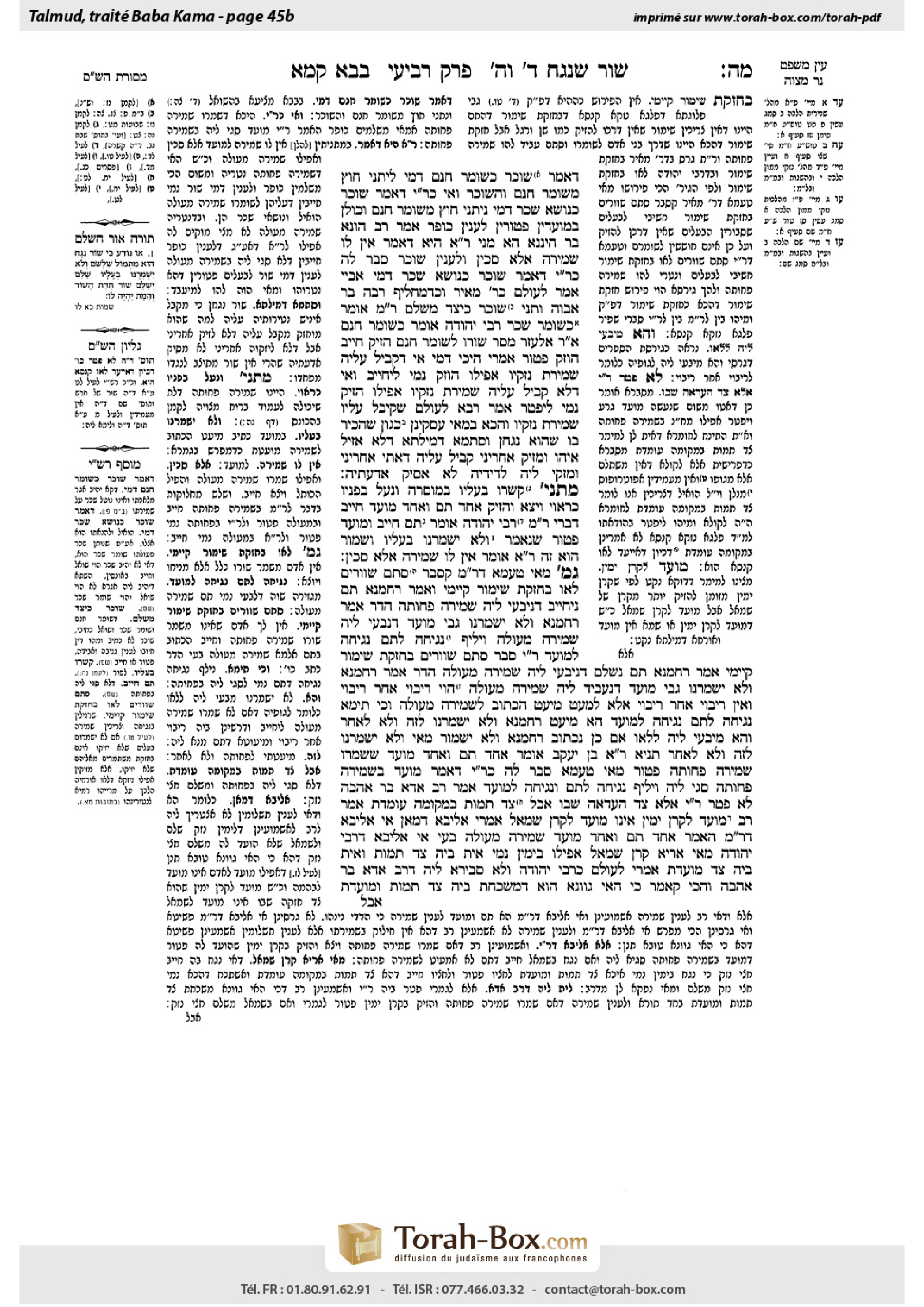
Bava Kamma 45b: Talmud study for Daf Yomi
Study the Talmud for Daf Yomi with scanned pages, Hebrew text, English translations from Sefaria and AI-generated French translations.
Passage selection and English or AI-generated French translation are available where the scan has annotations. Daf Study is independent of Torah-Box and Sefaria.
Browse Bava Kamma · בבא קמא · All tractatesBava Kamma 45b text and translations
This page of Bava Kamma includes the Aramaic text, an English translation and an AI-generated French translation, alongside the scan above.
בבא קמא מ״ה ב · Aramaic and Hebrew text
דְּאָמַר: שׂוֹכֵר כְּשׁוֹמֵר חִנָּם דָּמֵי, לִיתְנֵי: חוּץ מִשּׁוֹמֵר חִנָּם וְהַשּׂוֹכֵר!
וְאִי כְּרַבִּי יְהוּדָה, דְּאָמַר: שׂוֹכֵר כְּנוֹשֵׂא שָׂכָר דָּמֵי – נִיתְנֵי: ״חוּץ מִשּׁוֹמֵר חִנָּם, וְכוּלָּן בְּמוּעָדִין פְּטוּרִין לְעִנְיַן כּוֹפֶר״!
אָמַר רַב הוּנָא בַּר חִינָּנָא: הָא מַנִּי – רַבִּי אֱלִיעֶזֶר הִיא, דְּאָמַר: אֵין לוֹ שְׁמִירָה אֶלָּא סַכִּין; וּלְעִנְיַן שׂוֹכֵר סָבַר לַהּ כְּרַבִּי יְהוּדָה, דְּאָמַר: שׂוֹכֵר כְּנוֹשֵׂא שָׂכָר דָּמֵי.
אַבָּיֵי אָמַר: לְעוֹלָם כְּרַבִּי מֵאִיר – וְכִדְמַחְלִיף רַבָּה בַּר אֲבוּהּ, וְתָנֵי: שׂוֹכֵר כֵּיצַד מְשַׁלֵּם? רַבִּי מֵאִיר אוֹמֵר: כְּשׁוֹמֵר שָׂכָר, רַבִּי יְהוּדָה אוֹמֵר: כְּשׁוֹמֵר חִנָּם.
אָמַר רַבִּי אֶלְעָזָר: מָסַר שׁוֹרוֹ לְשׁוֹמֵר חִנָּם, הִזִּיק – חַיָּיב, הוּזַּק – פָּטוּר.
אָמְרִי: הֵיכִי דָמֵי? אִי דְּקַבֵּיל עֲלֵיהּ שְׁמִירַת נְזָקָיו – אֲפִילּוּ הוּזַּק נָמֵי לִיחַיֵּיב! וְאִי דְּלָא קַבֵּיל עֲלֵיהּ שְׁמִירַת נְזָקָיו – אֲפִילּוּ הִזִּיק נָמֵי לִיפְּטַר!
אָמַר רָבָא: לְעוֹלָם שֶׁקִּיבֵּל עָלָיו שְׁמִירַת נְזָקָיו, וְהָכָא בְּמַאי עָסְקִינַן – כְּגוֹן שֶׁהִכִּיר בּוֹ שֶׁהוּא נַגְחָן. וּסְתָמָא דְּמִילְּתָא, דְּלָא אָזֵיל אִיהוּ וּמַזִּיק אַחֲרִינֵי – קַבֵּיל עֲלֵיהּ, דְּאָתֵי אַחֲרִינֵי וּמַזְּקִי לֵיהּ לְדִידֵיהּ – לָא אַסֵּיק אַדַּעְתֵּיהּ.
מַתְנִי׳ קְשָׁרוֹ בְּעָלָיו בְּמוֹסֵרָה וְנָעַל בְּפָנָיו כָּרָאוּי, וְיָצָא וְהִזִּיק – אֶחָד תָּם וְאֶחָד מוּעָד חַיָּיב, דִּבְרֵי רַבִּי מֵאִיר.
רַבִּי יְהוּדָה אוֹמֵר: תָּם חַיָּיב, וּמוּעָד פָּטוּר; שֶׁנֶּאֱמַר: ״וְלֹא יִשְׁמְרֶנּוּ בְּעָלָיו״ – וְשָׁמוּר הוּא זֶה.
רַבִּי אֱלִיעֶזֶר אוֹמֵר: אֵין לוֹ שְׁמִירָה אֶלָּא סַכִּין.
גְּמָ׳ מַאי טַעְמָא דְּרַבִּי מֵאִיר? קָסָבַר: סְתָם שְׁווֹרִים – לָאו בְּחֶזְקַת שִׁימּוּר קָיְימִי; וְאָמַר רַחֲמָנָא תָּם נִיחַיַּיב – דְּנִיבְעֵי לֵיהּ שְׁמִירָה פְּחוּתָה, הֲדַר אָמַר רַחֲמָנָא ״וְלֹא יִשְׁמְרֶנּוּ״ גַּבֵּי מוּעָד – דְּנִבְעֵי לֵיהּ שְׁמִירָה מְעוּלָּה; וְיָלֵיף נְגִיחָה לְתָם – נְגִיחָה לְמוּעָד.
רַבִּי יְהוּדָה סָבַר: סְתָם שְׁווֹרִים – בְּחֶזְקַת שִׁימּוּר קָיְימִי; אָמַר רַחֲמָנָא תָּם נְשַׁלֵּם, דְּנִיבְעֵי לֵיהּ שְׁמִירָה מְעוּלָּה; הֲדַר אָמַר רַחֲמָנָא ״וְלֹא יִשְׁמְרֶנּוּ״ גַּבֵּי מוּעָד – דְּנַעֲבֵיד לֵיהּ שְׁמִירָה מְעוּלָּה. הָוֵי רִיבּוּי אַחַר רִיבּוּי, וְאֵין רִיבּוּי אַחַר רִיבּוּי אֶלָּא לְמַעֵט – מִיעֵט הַכָּתוּב לִשְׁמִירָה מְעוּלָּה.
וְכִי תֵּימָא: נְגִיחָה לְתָם נְגִיחָה לְמוּעָד – הָא מִיעֵט רַחֲמָנָא ״וְלֹא יִשְׁמְרֶנּוּ״ – לָזֶה, וְלֹא לְאַחֵר.
וְהָא מִיבְּעֵי לֵיהּ לְלָאו! אִם כֵּן, נִכְתּוֹב רַחֲמָנָא ״וְלֹא יִשְׁמוֹר״, מַאי ״וְלֹא יִשְׁמְרֶנּוּ״? לָזֶה וְלֹא לְאַחֵר.
תַּנְיָא, רַבִּי אֱלִיעֶזֶר בֶּן יַעֲקֹב אוֹמֵר: אֶחָד תָּם וְאֶחָד מוּעָד שֶׁשְּׁמָרוֹ שְׁמִירָה פְּחוּתָה – פָּטוּר.
מַאי טַעְמָא? סָבַר לַהּ כְּרַבִּי יְהוּדָה, דְּאָמַר: מוּעָד – בִּשְׁמִירָה פְּחוּתָה סַגִּי לֵיהּ, וְיָלֵיף נְגִיחָה לְתָם וּנְגִיחָה לְמוּעָד.
אָמַר רַב אַדָּא בַּר אַהֲבָה: לָא פָּטַר רַבִּי יְהוּדָה אֶלָּא צַד הַעֲדָאָה שֶׁבּוֹ, אֲבָל צַד תַּמּוּת בִּמְקוֹמָהּ עוֹמֶדֶת.
אָמַר רַב: מוּעָד לְקֶרֶן יָמִין – אֵינוֹ מוּעָד לְקֶרֶן שְׂמֹאל.
אָמְרִי: אַלִּיבָּא דְּמַאן? אִי אַלִּיבָּא דְרַבִּי מֵאִיר, הָאָמַר: אֶחָד תָּם וְאֶחָד מוּעָד, שְׁמִירָה מְעוּלָּה בָּעֵי! אִי אַלִּיבָּא דְּרַבִּי יְהוּדָה, מַאי אִרְיָא קֶרֶן שְׂמֹאל? אֲפִילּוּ בְּיָמִין נָמֵי – אִית בֵּיהּ צַד תַּמּוּת, וְאִית בֵּיהּ צַד מוּעָדֻת!
אָמְרִי: לְעוֹלָם כְּרַבִּי יְהוּדָה, וְלָא סְבִירָא לֵיהּ דְּרַב אַדָּא בַּר אַהֲבָה; וְהָכִי קָאָמַר: כִּי הַאי גַוְונָא הוּא דְּמַשְׁכַּחַתְּ בֵּיהּ צַד תַּמּוּת וּמוּעָדֻת,
Bava Kamma 45b · English translation
who says that a renter is considered like an unpaid bailee with regard to his responsibility for the rented item, let it teach that bailees are liable to compensate the owner, with the exception of an unpaid bailee and a renter.
And if it is in accordance with the opinion of Rabbi Yehuda, who says that a renter is considered like a paid bailee, let it teach: With the exception of an unpaid bailee, as it in fact states; but it should also state that in a case where the oxen are forewarned, all of them are exempt with regard to ransom, as Rabbi Yehuda says in the next mishna that a forewarned ox requires only a reduced level of safeguarding. Therefore, this baraita does not appear to be in accordance with the opinion of either tanna.
Rav Huna bar Ḥinnana said: In accordance with whose opinion is this baraita? It is in accordance with the opinion of Rabbi Eliezer, who says that an ox has no sufficient safeguarding at all other than slaughtering it with a knife; i.e., there is no degree of safeguarding that exempts the ox’s owner, or in the context of the baraita, the bailee, from liability if the ox causes damage or kills. And with regard to a renter, the baraita holds in accordance with the opinion of Rabbi Yehuda, who says that a renter is considered like a paid bailee.
Abaye said: Actually, the baraita is in accordance with the opinion of Rabbi Meir; and it is as Rabba bar Avuh reversed the two opinions and taught: How does a renter pay? In other words, what is his degree of responsibility? Rabbi Meir says: Like a paid bailee. Rabbi Yehuda says: Like an unpaid bailee.
§ Rabbi Elazar says: If the owner conveyed his ox to an unpaid bailee, if the ox caused damage, the bailee is liable to pay damages; but if the ox was injured, he is exempt.
The Sages said: What are the circumstances? If Rabbi Elazar was referring to a bailee who accepted responsibility upon himself for guarding it from causing damage, even if the ox was injured he should be liable. And if he was referring to a bailee who did not accept responsibility for guarding it from causing damage, even if it causes damage he should be exempt from payment.
Rava said: Actually, Rabbi Elazar was referring to a case where he accepted responsibility upon himself for guarding it from causing damage; but here we are dealing with a case where the bailee recognized that the ox was a goring ox, and in that case the normal way of things is that the bailee accepted upon himself responsibility for safeguarding it so that it would not go and injure others, since he knew that it was dangerous. But it presumably did not enter his mind that other oxen would come and injure it. Therefore, he did not accept responsibility for safeguarding against such an occurrence.
MISHNA: If the ox’s owner tied it with reins to a fence or locked the gate before it in an appropriate manner, but nevertheless the ox emerged and caused damage, whether the ox is innocuous or forewarned the owner is liable, since this is not considered sufficient precaution to prevent damage; this is the statement of Rabbi Meir.
Rabbi Yehuda says that if the ox is innocuous the owner is liable even if he safeguarded it appropriately, since the Torah does not limit the required safeguarding for an innocuous ox. But if the ox is forewarned, the owner is exempt from paying compensation for damage, as it is stated in the verse describing damage by a forewarned ox: “And the owner has not secured it” (Exodus 21:36), and this ox that was tied with reins or behind a locked gate was secured.
Rabbi Eliezer says: An ox has no sufficient safeguarding at all other than slaughtering it with a knife; there is no degree of safeguarding that exempts the ox’s owner from liability.
GEMARA: What is the reason for the opinion of Rabbi Meir? He holds that ordinary oxen are not presumed to be under safeguarding, as their owners do not ordinarily safeguard them; and the Merciful One stated in the Torah that one will be liable even for damage caused by an innocuous ox inasmuch as it requires at least a reduced level of safeguarding, such as with reins. The Merciful One then stated with regard to a forewarned ox: “And the owner has not secured it,” to indicate that it is not sufficient to provide it with only a reduced level of safeguarding, as it requires superior safeguarding. And Rabbi Meir derives this requirement with regard to an innocuous ox from a verbal analogy between the term goring stated with regard to an innocuous ox and the term goring stated with regard to a forewarned ox. In both cases superior safeguarding is required; otherwise the owner is liable.
By contrast, Rabbi Yehuda holds that ordinary oxen are presumed to be under some reduced level of safeguarding. Since the Merciful One stated nevertheless that even for damage caused by an innocuous ox the owner will pay, it may be inferred that it requires superior safeguarding. The Merciful One then states with regard to a forewarned ox: “And the owner has not secured it,” emphasizing again that one must provide it with superior safeguarding. This constitutes one amplification following another amplification, and the principle is that an amplification following an amplification is stated only in order to restrict its extent. Accordingly, the verse excludes the requirement of superior safeguarding with regard to a forewarned ox, and therefore reduced safeguarding is sufficient to exempt the owner from liability.
And if you would say that through the verbal analogy between the term goring stated with regard to an innocuous ox and the term goring stated with regard to a forewarned ox the Torah compares their halakhot, nevertheless, the Merciful One restricted this halakha by emphasizing: “And the owner has not secured it,” referring specifically to it, a forewarned ox, and not to the other, i.e., innocuous, ox.
The Gemara asks: But isn’t this phrase necessary for the negative [lav] statement that if the owner does not provide superior safeguarding he is liable? The Gemara answers: If that is so, let the Merciful One write: And the owner has not secured. What is the purpose of the added emphasis: “And the owner has not secured it”? It is to indicate that the restriction of this halakha relates specifically to it, a forewarned ox, and not to the other, i.e., innocuous, ox.
It is taught in a baraita that there is a fourth opinion. Rabbi Eliezer ben Ya’akov says: In the cases of both an innocuous ox and a forewarned ox in which its owner provided reduced safeguarding, he is exempt from liability.
The Gemara asks: What is the reason for his opinion? He holds in accordance with the opinion of Rabbi Yehuda, who says that reduced safeguarding is sufficient for a forewarned ox, and he derives from the verbal analogy between the term goring stated with regard to an innocuous ox and the term goring stated with regard to a forewarned ox that just as reduced safeguarding is sufficient for a forewarned ox, it is sufficient for an innocuous ox as well.
Rav Adda bar Ahava said: Rabbi Yehuda deemed only the forewarned element of the ox exempt. Rabbi Yehuda’s ruling that reduced safeguarding is sufficient to exempt the owner of a forewarned ox relates only to the additional half of the damage that is paid for a forewarned ox beyond the half of the damage that one is liable to pay for an innocuous ox. But the liability for its element of innocuousness remains in place. Therefore, if the owner did not provide superior safeguarding for the forewarned ox he is still liable to pay half the cost of the damage as he would if it were innocuous.
Rav says: If an ox is forewarned with regard to goring with its right horn, it is not thereby forewarned with regard to goring with its left horn.
The Sages said: In accordance with whose opinion is Rav’s statement made? If it is in accordance with the opinion of Rabbi Meir, doesn’t Rabbi Meir say that both an innocuous ox and a forewarned ox require superior safeguarding? If it is in accordance with the opinion of Rabbi Yehuda, why did he state that the ox still has an innocuous element specifically with regard to the left horn? Even with regard to the right horn itself it has both elements; it has an element of innocuousness and it also has a forewarned element.
The Sages said: Actually, Rav’s statement is in accordance with the opinion of Rabbi Yehuda, and he does not hold in accordance with the opinion of Rav Adda bar Ahava that the ox’s innocuous element remains. And this is what he is saying: You find an element both of innocuousness and of a forewarned status in the same ox specifically in a case like this, where an ox is forewarned with regard to one horn but not with regard to the other.
Bava Kamma 45b · Traduction française (IA)
qui affirme qu'un locataire est considéré comme un dépositaire non rémunéré en ce qui concerne sa responsabilité concernant l'objet loué, qu'on doit enseigner que les dépositaires sont tenus de réparer le propriétaire, à l'exception du dépositaire non rémunéré et du locataire.
Et si cela correspond à l'opinion de Rabbi Yéhuda, qui affirme qu'un locataire est considéré comme un dépositaire rémunéré, qu'on doit enseigner : À l'exception du dépositaire non rémunéré, car c'est effectivement ce qui est dit ; mais il devrait aussi indiquer que dans le cas où les bœufs sont avertis, tous sont exemptés concernant la rançon, comme Rabbi Yéhuda le dit dans la mishna suivante que le bœuf averti nécessite seulement un niveau réduit de protection. Ainsi, ce baraïta ne semble pas correspondre à l'opinion de l'un ou l'autre tanna.
Rav Huna bar Chinnana dit : Selon l'opinion de qui est ce baraïta ? C'est selon l'opinion de Rabbi Eléazar, qui affirme qu'un bœuf n'a pas de protection suffisante autre que de le tuer avec un couteau ; c'est-à-dire qu'il n'y a aucun degré de protection qui exempterait le propriétaire du bœuf, ou dans le contexte du baraïta, le dépositaire, de responsabilité si le bœuf cause des dommages ou meurt. Et concernant le locataire, le baraïta suit l'opinion de Rabbi Yéhuda, qui affirme qu'un locataire est considéré comme un dépositaire rémunéré.
Abaye dit : En réalité, le baraïta suit l'opinion de Rabbi Méir ; et c'est Rabba bar Avoua qui a inversé les deux opinions et a enseigné : Comment un locataire paie-t-il ? En d'autres termes, quel est son degré de responsabilité ? Rabbi Méir dit : Comme un dépositaire rémunéré. Rabbi Yéhuda dit : Comme un dépositaire non rémunéré.
§ Rabbi Eléazar dit : Si le propriétaire a confié son bœuf à un dépositaire non rémunéré, et si le bœuf a causé des dommages, le dépositaire est responsable de payer les dommages ; mais si le bœuf a été blessé, il est exempt.
Les Sages dirent : Quelles sont les circonstances ? Si Rabbi Eléazar faisait référence à un dépositaire qui a accepté la responsabilité de le garder afin qu'il ne cause pas de dommages, même si le bœuf a été blessé, il devrait être responsable. Et si il faisait référence à un dépositaire qui n'a pas accepté la responsabilité de le garder afin qu'il ne cause pas de dommages, même s'il cause des dommages, il devrait être exempt de paiement.
Rava dit : En réalité, Rabbi Eléazar faisait référence à un cas où il avait accepté la responsabilité de le garder afin qu'il ne cause pas de dommages ; mais ici nous sommes en présence d'un cas où le dépositaire savait que le bœuf était un bœuf meurtrier, et dans ce cas, la manière normale est que le dépositaire ait accepté la responsabilité de le garder afin qu'il ne sorte pas et ne cause des dommages à d'autres, puisqu'il savait qu'il était dangereux. Mais il ne semble pas avoir en tête que d'autres bœufs viendraient le blesser. Ainsi, il n'a pas accepté la responsabilité de le garder contre un tel événement.
MICHNA : Si le propriétaire a attaché le bœuf avec des brides à un mur ou a verrouillé la porte avant de le placer de manière appropriée, mais que le bœuf est sorti et a causé des dommages, que le bœuf soit inoffensif ou averti, le propriétaire est responsable, car cela n'est pas considéré comme une précaution suffisante pour prévenir les dommages ; c'est l'opinion de Rabbi Méir.
Rabbi Yéhuda dit que si le bœuf est inoffensif, le propriétaire est responsable même s'il l'a gardé de manière appropriée, car la Torah ne limite pas la précaution requise pour un bœuf inoffensif. Mais si le bœuf est averti, le propriétaire est exempt de payer les dommages, comme il est dit dans la parole du verset décrivant les dommages causés par un bœuf averti : « Et l'propriétaire n'a pas sécurisé le bœuf » (Exode 21:36), et ce bœuf attaché avec des brides ou derrière une porte verrouillée était sécurisé.
Rabbi Eléazar dit : Un bœuf n'a pas de précaution suffisante autre que de le tuer avec un couteau ; il n'y a aucun degré de précaution qui exempt le propriétaire du bœuf de responsabilité.
GUEMARA : Quel est le fondement de l'opinion de Rabbi Méir ? Il affirme que les bœufs ordinaires ne sont pas supposés être sous une protection, car leurs propriétaires ne les protègent généralement pas ; et le Très Miséricordieux a dit dans la Torah que l'on sera responsable même pour les dommages causés par un bœuf inoffensif, car il faut au moins un niveau réduit de protection, comme des brides. Le Très Miséricordieux a ensuite dit concernant un bœuf averti : « Et l'propriétaire n'a pas sécurisé le bœuf », pour indiquer que cela ne suffit pas à fournir une protection réduite, car il faut une protection supérieure. Et Rabbi Méir dérive cette exigence concernant un bœuf inoffensif d'une analogie verbale entre le terme « bœuf meurtrier » concernant un bœuf inoffensif et le terme « bœuf meurtrier » concernant un bœuf averti. Dans les deux cas, une protection supérieure est requise ; autrement, le propriétaire est responsable.
Par contraste, Rabbi Yéhuda affirme que les bœufs ordinaires sont supposés être sous un certain niveau réduit de protection. Puisque le Très Miséricordieux a dit néanmoins que même pour les dommages causés par un bœuf inoffensif, le propriétaire paie, on peut en déduire qu'une protection supérieure est requise. Le Très Miséricordieux a ensuite dit concernant un bœuf averti : « Et l'propriétaire n'a pas sécurisé le bœuf », soulignant à nouveau qu'il faut lui fournir une protection supérieure. Cela constitue une amplification suivant une amplification, et le principe est que l'amplification suivant une amplification est énoncée uniquement pour restreindre son étendue. Ainsi, le verset exclut la nécessité d'une protection supérieure concernant un bœuf averti, et par conséquent, une protection réduite suffit pour exempter le propriétaire de responsabilité.
Et si vous dites que par l'analogie verbale entre le terme « bœuf meurtrier » concernant un bœuf inoffensif et le terme « bœuf meurtrier » concernant un bœuf averti, la Torah compare leurs halakhtot, néanmoins, le Très Miséricordieux a restreint cette halakha en soulignant : « Et l'owner n'a pas sécurisé le bœuf », faisant référence spécifiquement à lui, le bœuf averti, et non à l'autre, c'est-à-dire le bœuf inoffensif.
La Guemara pose la question : Mais ce phrasé n’est-il pas nécessaire pour l’affirmation négative [lav] selon laquelle si l’propriétaire ne fournit pas un gardiennage supérieur, il est responsable ? La Guemara répond : Si c’est ainsi, que le Miséricordieux écrive : « Et l’propriétaire n’a pas sécurisé. » Quel est l’objectif de l’ajout de l’expression : « Et l’propriétaire n’a pas sécurisé » ? C’est pour indiquer que la restriction de cette halakha concerne spécifiquement cela, un taureau averti, et non l’autre, c’est-à-dire un taureau inoffensif.
Il est enseigné dans une baraïta qu’il existe un quatrième avis. Rabbi Eliezer ben Ya’akov dit : Dans les cas d’un taureau inoffensif et d’un taureau averti, lorsque son propriétaire a fourni un gardiennage réduit, il est exempt de responsabilité.
La Guemara pose la question : Quel est le fondement de son avis ? Il adopte l’opinion de Rabbi Yehuda, qui dit que le gardiennage réduit est suffisant pour un taureau averti, et il tire cette conclusion de l’analogie verbale entre le terme « cornage » relatif à un taureau inoffensif et le terme « cornage » relatif à un taureau averti, c’est-à-dire que tout comme le gardiennage réduit est suffisant pour un taureau averti, il l’est aussi pour un taureau inoffensif.
Rav Adda bar Ahava dit : Rabbi Yehuda considère uniquement l’élément averti du taureau comme exempt. La décision de Rabbi Yehuda selon laquelle un gardiennage réduit suffit à exempter l’propriétaire d’un taureau averti concerne uniquement la moitié supplémentaire du préjudice payé pour un taureau averti par rapport à la moitié du préjudice que l’on est tenu de payer pour un taureau inoffensif. La responsabilité liée à son élément inoffensif demeure. Ainsi, si l’propriétaire n’a pas fourni un gardiennage supérieur pour le taureau averti, il reste responsable de la moitié du coût du préjudice, comme s’il s’agissait d’un taureau inoffensif.
Rav dit : Si un taureau est averti concernant le cornage avec son cornon droit, il n’en est pas moins averti concernant le cornage avec son cornon gauche.
Les Sages dirent : Selon quel avis est formulée la déclaration de Rav ? Si c’est selon l’avis de Rabbi Meir, ne dit-il pas que tant un taureau inoffensif qu’un taureau averti nécessitent un gardiennage supérieur ? Si c’est selon l’avis de Rabbi Yehuda, pourquoi a-t-il dit que le taureau a encore un élément inoffensif spécifiquement concernant le cornon gauche ? Même concernant le cornon droit lui-même, il possède à la fois un élément inoffensif et un élément averti.
Les Sages dirent : En réalité, la déclaration de Rav est selon l’avis de Rabbi Yehuda, et il ne suit pas celui de Rav Adda bar Ahava selon lequel l’élément inoffensif du taureau demeure. Et c’est ce qu’il dit : Vous trouvez à la fois un élément d’inoffensivité et un élément d’avertissement dans le même taureau, spécifiquement dans un cas comme celui-ci, où un taureau est averti concernant un cornet mais pas concernant l’autre.
Traduction française générée par IA à partir de l’édition anglaise de Sefaria. Vérifie toujours un passage avec le texte source.
Text from Sefaria: William Davidson Edition - Vocalized Aramaic (CC BY NC); William Davidson Edition - English (CC BY NC).