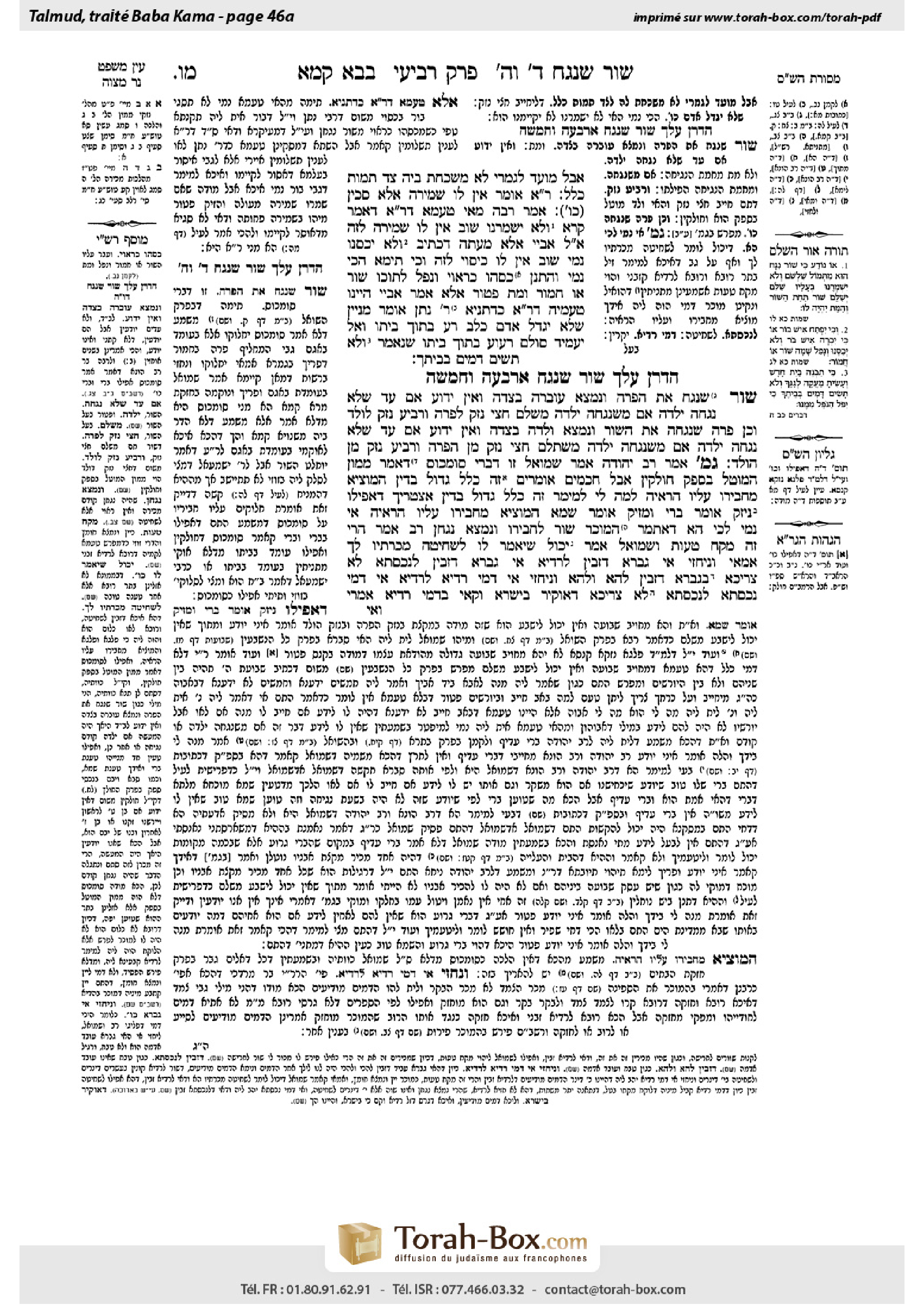
Bava Kamma 46a: Talmud study for Daf Yomi
Study the Talmud for Daf Yomi with scanned pages, Hebrew text, English translations from Sefaria and AI-generated French translations.
Passage selection and English or AI-generated French translation are available where the scan has annotations. Daf Study is independent of Torah-Box and Sefaria.
Browse Bava Kamma · בבא קמא · All tractatesBava Kamma 46a text and translations
This page of Bava Kamma includes the Aramaic text, an English translation and an AI-generated French translation, alongside the scan above.
בבא קמא מ״ו א · Aramaic and Hebrew text
אֲבָל מוּעָד לִגְמָרֵי – לָא מַשְׁכַּחַתְּ בֵּיהּ צַד תַּמּוּת כְּלָל.
רַבִּי אֱלִיעֶזֶר אוֹמֵר: אֵין לוֹ שְׁמִירָה אֶלָּא סַכִּין (כּוּ׳). אָמַר רַבָּה: מַאי טַעְמָא דְּרַבִּי אֱלִיעֶזֶר? דְּאָמַר קְרָא: ״וְלֹא יִשְׁמְרֶנּוּ״ – שׁוּב אֵין לוֹ שְׁמִירָה לָזֶה.
אֲמַר לֵיהּ אַבָּיֵי: אֶלָּא מֵעַתָּה, דִּכְתִיב ״וְלֹא יְכַסֶּנּוּ״ נָמֵי – שׁוּב אֵין לוֹ כִּיסּוּי לָזֶה?
וְכִי תֵּימָא הָכִי נָמֵי, וְהָתְנַן: כִּסָּהוּ כָּרָאוּי, וְנָפַל לְתוֹכוֹ שׁוֹר אוֹ חֲמוֹר וּמֵת – פָּטוּר.
אֶלָּא אָמַר אַבָּיֵי: הַיְינוּ טַעְמֵיהּ דְּרַבִּי אֱלִיעֶזֶר – כִּדְתַנְיָא, רַבִּי נָתָן אוֹמֵר: מִנַּיִין שֶׁלֹּא יְגַדֵּל אָדָם כֶּלֶב רַע בְּתוֹךְ בֵּיתוֹ, וְאַל יַעֲמִיד סוּלָּם רָעוּעַ בְּתוֹךְ בֵּיתוֹ? שֶׁנֶּאֱמַר: ״וְלֹא תָשִׂים דָּמִים בְּבֵיתֶךָ״.
הֲדַרַן עֲלָךְ שׁוֹר שֶׁנָּגַח אַרְבָּעָה וַחֲמִשָּׁה
מַתְנִי׳ שׁוֹר שֶׁנָּגַח אֶת הַפָּרָה וְנִמְצָא עוּבָּרָהּ בְּצִדָּהּ, וְאֵין יָדוּעַ אִם עַד שֶׁלֹּא נָגְחָה יָלְדָה, אִם מִשֶּׁנָּגְחָה יָלְדָה – מְשַׁלֵּם חֲצִי נֶזֶק לַפָּרָה, וּרְבִיעַ נֶזֶק לַוָּלָד.
וְכֵן פָּרָה שֶׁנָּגְחָה אֶת הַשּׁוֹר וְנִמְצָא וְלָדָהּ בְּצִדָּהּ, וְאֵין יָדוּעַ אִם עַד שֶׁלֹּא נָגְחָה יָלְדָה, אִם מִשֶּׁנָּגְחָה יָלְדָה – מִשְׁתַּלֵּם חֲצִי נֶזֶק מִן הַפָּרָה, וּרְבִיעַ נֶזֶק מִן הַוָּלָד.
גְּמָ׳ אָמַר רַב יְהוּדָה אָמַר שְׁמוּאֵל: זוֹ דִּבְרֵי סוֹמְכוֹס – דְּאָמַר: מָמוֹן הַמּוּטָּל בְּסָפֵק – חוֹלְקִין. אֲבָל חֲכָמִים אוֹמְרִים: זֶה כְּלָל גָּדוֹל בַּדִּין, הַמּוֹצִיא מֵחֲבֵירוֹ – עָלָיו הָרְאָיָה.
לְמָה לִי לְמֵימַר ״זֶה כְּלָל גָּדוֹל בַּדִּין״? אִצְטְרִיךְ, דַּאֲפִילּוּ נִיזָּק אוֹמֵר בָּרִי, וּמַזִּיק אוֹמֵר שֶׁמָּא – הַמּוֹצִיא מֵחֲבֵירוֹ עָלָיו הָרְאָיָה.
אִי נָמֵי, לְכִי הָא דְּאִתְּמַר: הַמּוֹכֵר שׁוֹר לַחֲבֵירוֹ, וְנִמְצָא נַגְחָן – רַב אָמַר: הֲרֵי זֶה מִקָּח טָעוּת. וּשְׁמוּאֵל אָמַר: יָכוֹל שֶׁיֹּאמַר לוֹ ״לִשְׁחִיטָה מְכַרְתִּיו לָךְ״.
אַמַּאי? וְנִיחְזֵי אִי גַּבְרָא דְּזָבֵין לְרִדְיָא, אִי גַּבְרָא דְּזָבֵין לְנִכְסְתָא! לָא צְרִיכָא, בְּגַבְרָא דְּזָבֵין לְהָא וּלְהָא.
וְנִיחְזֵי אִי דְּמֵי רִדְיָא – לְרִדְיָא, אִי דְּמֵי נִכְסְתָא – לְנִכְסְתָא!
לָא צְרִיכָא, דְּאִיַּקַּיר בִּישְׂרָא, וְקָאֵי בִּדְמֵי רִדְיָא.
אָמְרִי:
Bava Kamma 46a · English translation
But if an ox is entirely rendered forewarned, you do not find an element of innocuousness with regard to it at all. If it is forewarned with regard to goring with either horn, its status of innocuousness is completely revoked.
§ The mishna teaches that Rabbi Eliezer says: An ox has no sufficient safeguarding at all other than slaughtering it with a knife. Rabba said: What is the reason for the opinion of Rabbi Eliezer? It is as the verse states with regard to a forewarned ox: “And the owner has not secured it” (Exodus 21:36), meaning that once it is rendered forewarned the owner no longer has any sufficient manner of safeguarding this animal, and the owner is responsible for all damage it causes.
Abaye said to Rabba: If that is so, does that which is written with regard to a pit: “And if a man shall open a pit, or if a man shall dig a pit and not cover it” (Exodus 21:33), also mean that once a pit has been dug the owner no longer has any adequate way of covering this pit, which would exempt its owner from paying damages?
And if you would say that indeed that is the halakha, but didn’t we learn in a mishna (52a) that if he covered the pit appropriately, and an ox or a donkey fell into it and died, he is exempt? Evidently, a pit can be covered adequately.
Rather, Abaye rejected Rabba’s explanation of Rabbi Eliezer’s opinion, and said that this is the reason for the opinion of Rabbi Eliezer: As it is taught in a baraita that Rabbi Natan says: From where is it derived that one may not raise a vicious dog in his house, and that one may not set up an unstable ladder in his house? As it is stated: “You shall not bring blood into your house” (Deuteronomy 22:8), which means that one may not allow a hazardous situation to remain in his house. Similarly, a person should not keep a forewarned ox in his possession, as it is dangerous. This is why Rabbi Eliezer rules that no level of safeguarding is sufficient for it; the ox should be slaughtered so that it will not cause damage.
MISHNA: In the case of an innocuous ox that gored and killed a cow, and the cow’s fetus was found dead at its side, and it is not known whether the cow gave birth before the ox gored it and the fetus’s death is unrelated to the goring or whether it gave birth after the ox gored it and the fetus died on account of the goring, the owner of the ox pays half the cost of the damage for the cow and one-quarter of the cost of the damage for the offspring. Since it is uncertain whether the ox was responsible for the death of the fetus, in which case he would pay half the damages, its owner pays only half the amount for the fetus that he would ordinarily be required to pay, i.e., one-quarter.
And likewise, there is uncertainty in the case of an innocuous cow that gored an ox, and the cow’s newborn offspring was found at its side dead or alive, and it is not known whether the cow gave birth before it gored the ox or whether the cow gave birth after it gored. When damage is caused by an innocuous animal, the liability of the owner is limited to the value of the animal that gored. Therefore, half the cost of the damage is paid from the value of the cow, as in the standard case of an innocuous animal. And if that does not suffice to pay for half the cost of the damage, one-quarter of the cost of the damage is paid from the offspring. Since it is uncertain whether the offspring was part of the cow at the time the cow gored, the owner pays only half of what he would pay if it were certain that it was part of the cow.
GEMARA: Rav Yehuda says that Shmuel says: This ruling in the mishna is the statement of Sumakhos, who says: Property of uncertain ownership is divided by the two parties. But the Rabbis say that this is the significant principle of monetary law: The burden of proof rests upon the claimant, and the disputed sum is not divided. According to the Rabbis, in the cases of uncertainty in the mishna, no payment is made for the fetus or from the offspring, respectively.
The Gemara asks: Why do I need for the Rabbis to say the words: This is the significant principle of monetary law? Why not just state the principle? The Gemara answers: It was necessary to say them because even in a case where the injured party states: I am certain that such and such occurred, and the one liable for the damage says: Perhaps it was otherwise, without definitively refuting the claim against him, the burden of proof rests upon the claimant. Although the injured party claims with certainty that he is correct and the defendant’s claim is only speculative, the definite claim still does not render the defendant liable to pay, absent proof.
Alternatively, the phrase: This is the significant principle of monetary law, was necessary for instances such as this, as it was stated: In the case of one who sells an ox to another and the ox is found to be one that habitually gores, Rav says that this is considered to be a mistaken transaction, since the purchaser can claim that he bought the ox specifically for labor, and an ox that gores is not suitable for such tasks. And Shmuel says: The seller can say to him: I sold it to you for slaughter, and the fact that it gores is immaterial.
The Gemara asks: Why are Rav and Shmuel speculating about the purpose of the sale? But let us simply see if the purchaser is a person who buys oxen for plowing or a person who buys oxen for slaughter. The Gemara answers: No, it is necessary for them to engage in a dispute in the case of a person who buys oxen for both this and for that reason, and in this instance it was unclear for which purpose it was intended.
The Gemara asks: But let us see what the purchase price was: If he paid the price of an ox fit for plowing, which is a large amount of money, then it can be assumed it was intended for plowing. But if he paid the price of an ox for slaughtering, which is a much smaller amount, it can be assumed that it was sold for slaughtering.
The Gemara answers: No, it is necessary for them to engage in a dispute in a case where the cost of meat rose and an ox purchased for slaughtering stands at the same price as an ox purchased for plowing. In that case, Rav and Shmuel dispute whether the purchaser can claim that the transaction was made in error, or whether the seller can claim that he sold it to be slaughtered and the purchaser must provide proof for his claim.
The Sages said:
Bava Kamma 46a · Traduction française (IA)
Mais si un bœuf est entièrement averti, on ne trouve aucun élément d'innocuité concernant lui. Si il est averti concernant l'attaque avec l'un des cornes, son statut d'innocuité est entièrement révoqué.
§ La mitsva enseigne que Rabbi Eliezer dit : Un bœuf n'a aucun moyen suffisant de protection autre que de le tuer avec un couteau. Rabba dit : Quelle est la raison de l'opinion de Rabbi Eliezer ? C'est comme la parabole qui mentionne un bœuf averti : « Et l'propriétaire n'a pas sécurisé ce bœuf » (Exode 21:36), ce qui signifie que dès qu'il est rendu averti, l'propriétaire n'a plus aucun moyen suffisant de protection pour cet animal, et l'propriétaire est responsable de tous les dommages qu'il cause.
Abaye dit à Rabba : Si c'est ainsi, ce qui est écrit concernant un puits : « Et si un homme ouvre un puits, ou si un homme creuse un puits et ne le recouvre pas » (Exode 21:33), signifie-t-il aussi que dès que le puits a été creusé, l'propriétaire n'a plus aucun moyen suffisant de le recouvrir, ce qui exempterait son propriétaire de payer des dommages ?
Et si vous dites que c'est effectivement la halakha, mais n'avons-nous pas appris dans une mitsva (52a) que si l'on a recouvert le puits convenablement, et qu'un bœuf ou un âne y est tombé et est mort, il est exempt ? Évidemment, un puits peut être recouvert convenablement.
Plutôt, Abaye rejeta l'explication de Rabba concernant l'opinion de Rabbi Eliezer, et dit que c'est la raison de l'opinion de Rabbi Eliezer : Comme il est enseigné dans une baraïta que Rabbi Natan dit : D'où est-il dérivé que l'on ne doit pas dresser un chien méchant dans sa maison, et que l'on ne doit pas ériger une échelle instable dans sa maison ? Comme il est dit : « Tu ne dois pas apporter le sang dans ta maison » (Deutéronome 22:8), ce qui signifie que l'on ne doit pas permettre une situation dangereuse de rester dans sa maison. De même, une personne ne doit pas garder un bœuf averti en son possession, car c'est dangereux. C'est pourquoi Rabbi Eliezer déclare qu'aucun niveau de protection n'est suffisant pour lui ; le bœuf doit être sacrifié afin de ne pas causer de dommages.
MITSVA : Dans le cas d'un bœuf innocent qui a attaqué et tué une vache, et que l'on a trouvé le fœtus de la vache mort à ses côtés, et qu'il n'est pas connu si la vache a donné naissance avant que le bœuf ne l'attaque et que la mort du fœtus n'est pas liée à l'attaque, ou si elle a donné naissance après que le bœuf l'ait attaqué et que la mort du fœtus est due à l'attaque, l'propriétaire du bœuf paie la moitié du coût des dommages pour la vache et un quart du coût des dommages pour l'offspring. Puisque c'est incertain si le bœuf était responsable de la mort du fœtus, dans le cas où il serait responsable, il paierait la moitié des dommages, l'propriétaire paie seulement la moitié de la somme qu'il devrait normalement payer pour le fœtus, c'est-à-dire un quart.
Et de même, il y a une incertitude dans le cas d'une vache innocente qui a blessé un bœuf, et que l'on a trouvé l'offspring de la vache à ses côtés mort ou vivant, et qu'il n'est pas connu si la vache a donné naissance avant qu'elle ne l'attaque ou si elle a donné naissance après qu'elle l'ait attaqué. Lorsque des dommages sont causés par un animal innocent, la responsabilité de l'propriétaire est limitée à la valeur de l'animal qui a attaqué. Par conséquent, la moitié du coût des dommages est payée à partir de la valeur de la vache, comme dans le cas standard d'un animal innocent. Et si cela ne suffit pas pour payer la moitié du coût des dommages, un quart du coût des dommages est payé à partir de l'offspring. Puisque c'est incertain si l'offspring faisait partie de la vache au moment où la vache l'a attaqué, l'propriétaire paie seulement la moitié de ce qu'il paierait si c'était certain qu'il faisait partie de la vache.
GUEMARA : Rav Yehuda dit que Shmuel dit : Ce jugement dans la mitsna est la déclaration de Sumakhos, qui dit : La propriété dont l'origine est incertaine est divisée entre les deux parties. Mais les Rabbins disent que c'est le principe principal du droit des choses : La charge de la preuve repose sur le plaignant, et la somme disputée n'est pas divisée. Selon les Rabbins, dans les cas d'incertitude mentionnés dans la mitsna, aucun paiement n'est fait pour le fœtus ou à partir de l'offspring, respectivement.
La Guemara demande : Pourquoi avons-nous besoin que les Rabbins disent les mots : C'est le principe principal du droit des choses ? Pourquoi ne pas simplement énoncer le principe ? La Guemara répond : Il était nécessaire de le dire car même dans un cas où la partie blessée dit : Je suis certain que cela s'est produit, et l'individu responsable des dommages dit : Peut-être c'était autre chose, sans définitivement réfuter la réclamation contre lui, la charge de la preuve repose sur le plaignant. Bien que la partie blessée affirme avec certitude qu'il a raison et que la réclamation de l'accusé est seulement spéculative, la déclaration certaine ne rend pas l'accusé responsable de payer, sans preuve.
Alternativement, la phrase : C'est le principe principal du droit des choses, était nécessaire pour des cas tels que celui-ci, comme il a été dit : Dans le cas d'une personne qui vend un bœuf à une autre et que le bœuf est trouvé être un bœuf qui attaque régulièrement, Rav dit que cela est considéré comme une transaction erronée, car l'acheteur peut affirmer qu'il a acheté le bœuf spécifiquement pour le travail, et un bœuf qui attaque n'est pas adapté à de telles tâches. Et Shmuel dit : Le vendeur peut dire à lui : J'ai vendu cela pour la boucherie, et le fait qu'il attaque est sans importance.
La Guemara demande : Pourquoi Rav et Shmuel spéculent-ils sur le but de la vente ? Mais voyons simplement si l'acheteur est une personne qui achète des bœufs pour la culture ou une personne qui achète des bœufs pour la boucherie. La Guemara répond : Non, il était nécessaire qu'ils engagent un débat dans le cas d'une personne qui achète des bœufs à la fois pour ce et pour cela, et dans ce cas-ci, il était incertain pour quel but il était destiné.
La Guemara demande : Mais voyons ce que le prix d'achat était : Si l'acheteur a payé le prix d'un bœuf adapté à la culture, qui est une somme importante, alors on peut supposer qu'il était destiné à la culture. Mais si l'acheteur a payé le prix d'un bœuf pour la boucherie, qui est une somme beaucoup plus petite, on peut supposer qu'il était vendu pour la boucherie.
La Guemara répond : Non, il est nécessaire qu'ils disputent dans un cas où le prix du bœuf a augmenté et qu'un bœuf acheté pour être sacrifié est au même prix qu'un bœuf acheté pour la culture. Dans ce cas, Rav et Shmuel disputent si l'acheteur peut affirmer que la transaction a été faite par erreur, ou si le vendeur peut affirmer qu'il l'a vendu pour être sacrifié et que l'acheteur doit fournir la preuve de sa revendication.
Les Sages ont dit :
Traduction française générée par IA à partir de l’édition anglaise de Sefaria. Vérifie toujours un passage avec le texte source.
Text from Sefaria: William Davidson Edition - Vocalized Aramaic (CC BY NC); William Davidson Edition - English (CC BY NC).