Bava Kamma 46b: Talmud study for Daf Yomi
Study the Talmud for Daf Yomi with scanned pages, Hebrew text, English translations from Sefaria and AI-generated French translations.
Passage selection and English or AI-generated French translation are available where the scan has annotations. Daf Study is independent of Torah-Box and Sefaria.
Browse Bava Kamma · בבא קמא · All tractatesBava Kamma 46b text and translations
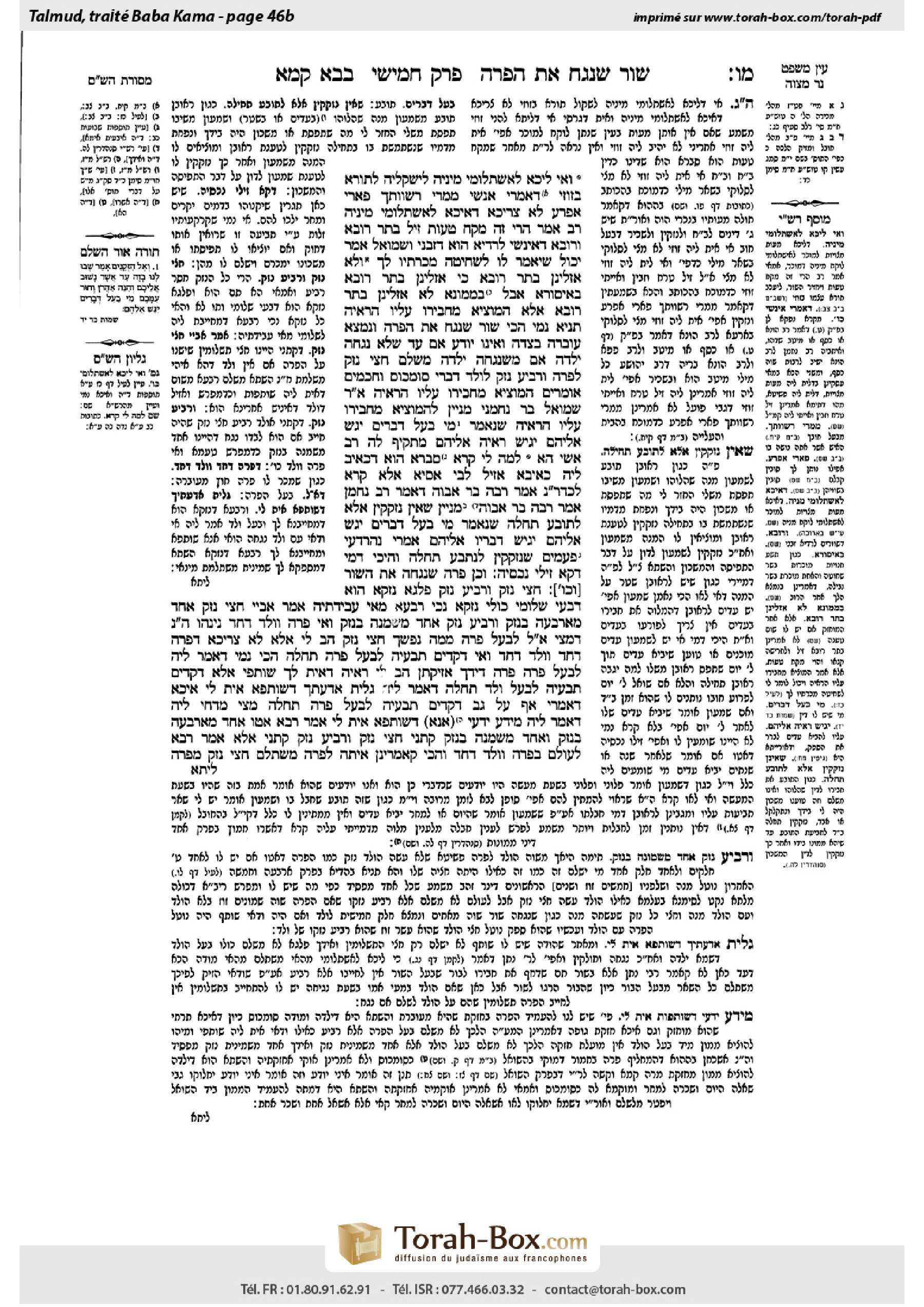
This page of Bava Kamma includes the Aramaic text, an English translation and an AI-generated French translation, alongside the scan above.
בבא קמא מ״ו ב · Aramaic and Hebrew text
וְאִי לֵיכָּא לְאִשְׁתַּלּוֹמֵי מִינֵּיהּ, לִישְׁקְלֵיהּ לְתוֹרָא בְּזוּזֵי! דְּאָמְרִי אֱנָשֵׁי: מִמָּרֵי רַשְׁווֹתָךְ פָּארֵי אִפְּרַע!
לָא צְרִיכָא, דְּאִיכָּא לְאִשְׁתַּלּוֹמֵי מִינֵּיהּ.
רַב אָמַר הֲרֵי זֶה מִקָּח טָעוּת – זִיל בָּתַר רוּבָּא, וְרוּבָּא דְאִינָשֵׁי לְרִדְיָא הוּא דְּזָבְנִי. וּשְׁמוּאֵל אָמַר, יָכוֹל שֶׁיֹּאמַר לוֹ ״לִשְׁחִיטָה מְכַרְתִּיו לָךְ״ – וְלָא אָזְלִינַן בָּתַר רוּבָּא. כִּי אָזְלִינַן בָּתַר רוּבָּא – בְּאִיסּוּרָא, אֲבָל בְּמָמוֹנָא – לָא אָזְלִינַן בָּתַר רוּבָּא, אֶלָּא הַמּוֹצִיא מֵחֲבֵירוֹ עָלָיו הָרְאָיָה.
תַּנְיָא נָמֵי הָכִי: שׁוֹר שֶׁנָּגַח אֶת הַפָּרָה וְנִמְצָא עוּבָּרָהּ בְּצִדָּהּ, וְאֵינוֹ יוֹדֵעַ אִם עַד שֶׁלֹּא נְגָחָהּ יָלְדָה אִם מִשֶּׁנְּגָחָהּ יָלְדָה – מְשַׁלֵּם חֲצִי נֶזֶק לַפָּרָה, וּרְבִיעַ נֶזֶק לַוָּלָד; דִּבְרֵי סוֹמְכוֹס. וַחֲכָמִים אוֹמְרִים: הַמּוֹצִיא מֵחֲבֵירוֹ – עָלָיו הָרְאָיָה.
אָמַר רַבִּי שְׁמוּאֵל בַּר נַחְמָנִי: מִנַּיִין לְהַמּוֹצִיא מֵחֲבֵירוֹ עָלָיו הָרְאָיָה – שֶׁנֶּאֱמַר: ״מִי בַעַל דְּבָרִים יִגַּשׁ אֲלֵהֶם״ – יַגִּישׁ רְאָיָה אֲלֵיהֶם.
מַתְקֵיף לַהּ רַב אָשֵׁי: הָא לְמָה לִי קְרָא? סְבָרָא הוּא – דְּכָאֵיב לֵיהּ כְּאֵיבָא, אָזֵיל לְבֵי אָסְיָא!
אֶלָּא קְרָא לְכִדְרַב נַחְמָן אָמַר רַבָּה בַּר אֲבוּהּ, דְּאָמַר רַב נַחְמָן אָמַר רַבָּה בַּר אֲבוּהּ: מִנַּיִין שֶׁאֵין נִזְקָקִין אֶלָּא לַתּוֹבֵעַ תְּחִלָּה? שֶׁנֶּאֱמַר: ״מִי בַעַל דְּבָרִים יִגַּשׁ אֲלֵהֶם״ – יַגִּישׁ דְּבָרָיו אֲלֵיהֶם.
אָמְרִי נְהַרְדָּעֵי: פְּעָמִים שֶׁנִּזְקָקִין לַנִּתְבָּע תְּחִלָּה. וְהֵיכִי דָּמֵי? דְּקָא זִילִי נִכְסֵיהּ.
וְכֵן פָּרָה שֶׁנָּגְחָה אֶת הַשּׁוֹר [וְכוּ׳]. חֲצִי נֶזֶק וּרְבִיעַ נֶזֶק?! פַּלְגָא נִזְקָא הוּא דְּבָעֵי שַׁלּוֹמֵי! כּוּלֵּי נִזְקָא נְכֵי רִבְעָא מַאי עֲבִידְתֵּיהּ?
אָמַר אַבָּיֵי: חֲצִי נֶזֶק – אֶחָד מֵאַרְבָּעָה בַּנֶּזֶק, וּרְבִיעַ נֶזֶק – אֶחָד מִשְּׁמֹנָה בַּנֶּזֶק.
וְאִי פָּרָה וּוָלָד דְּחַד נִינְהוּ – הָכִי נָמֵי דְּמָצֵי אָמַר לֵיהּ לְבַעַל פָּרָה: מִמָּה נַפְשָׁךְ, חֲצִי נֶזֶק הַב לִי. אֶלָּא לָא צְרִיכָא, דְּפָרָה דְּחַד, וּוָלָד דְּחַד.
וְאִי דִּקְדֵים תַּבְעֵיהּ לְבַעַל פָּרָה תְּחִלָּה – הָכִי נָמֵי דְּאָמַר לֵיהּ לְבַעַל פָּרָה: פָּרָה דִּידָךְ אַזֵּיקְתַּן, הַב לִי רְאָיָה דְּאִית לָךְ שׁוּתָּפֵי.
אֶלָּא דִּקְדֵים תַּבְעֵיהּ לְבַעַל וָלָד תְּחִלָּה, דַּאֲמַר לֵיהּ: גַּלֵּית אַדַּעְתָּךְ דְּשׁוּתָּפָא אִית לִי.
אִיכָּא דְּאָמְרִי: אַף עַל גַּב דִּקְדֵים תַּבְעֵיהּ לְבַעַל פָּרָה תְּחִלָּה, מָצֵי מְדַחֵי לֵיהּ – דַּאֲמַר לֵיהּ: מִידָּע יְדַעִי אֲנָא דְּשׁוּתָּפָא אִית לִי.
אָמַר רָבָא: אַטּוּ ״אֶחָד מֵאַרְבָּעָה בַּנֶּזֶק״ וְ״אֶחָד מִשְּׁמֹנָה בַּנֶּזֶק״ קָתָנֵי? ״חֲצִי נֶזֶק״ וּ״רְבִיעַ נֶזֶק״ קָתָנֵי! אֶלָּא אָמַר רָבָא: לְעוֹלָם בְּפָרָה וּוָלָד דְּחַד, וְהָכִי קָאָמְרִינַן: אִיתַהּ לְפָרָה – מִשְׁתַּלַּם חֲצִי נֶזֶק מִפָּרָה.
Bava Kamma 46b · English translation
But if the loss to the purchaser cannot be reimbursed from the purchasing money by returning it, e.g., if the seller spent it already, let the purchaser take the ox itself in lieu of the money, as people say: Allow yourself to be repaid by your debtors even in bran, since anything may be used as payment for a debt. In the event that the seller has no money with which to reimburse the purchaser, even if it is a mistaken transaction the result may be that the purchaser keeps the ox in lieu of having his money returned. Accordingly, there would be no practical difference between the opinions of Rav and Shmuel.
The Gemara answers: No, it is necessary for them to engage in a dispute in a case where the seller does have sufficient funds from which to repay the purchaser, and the purchaser demands that his money be returned as opposed to keeping the ox as payment.
The Gemara now explains the logic of Rav and Shmuel: Rav says that this is a case of a mistaken transaction, due to the principle: Follow the majority, and the majority of people buy oxen for plowing. And Shmuel says that the seller can say to him: I sold it to you for slaughtering, and we do not follow the majority in this case. When do we follow the majority according to Shmuel? Only in determining the prohibited or permitted status of an item. But in monetary matters such as this, we do not follow the majority. Rather, the operative principle is that the burden of proof rests upon the claimant.
That which Rav Yehuda stated above, that the mishna follows the opinion of Sumakhos, is also taught in a baraita: In the case of an ox that gores a cow, and its fetus is found dead at its side, and he does not know whether it gave birth before the ox gored it or it gave birth after the ox gored it, the owner of the ox pays half the cost of the damage for the cow and one-quarter of the cost of the damage for the offspring; this is the statement of Sumakhos. The Rabbis say: The burden of proof rests upon the claimant.
Rabbi Shmuel bar Naḥmani said: From where is it derived that the burden of proof rests upon the claimant? As it is stated in the Torah when Moses appointed Aaron and Hur to judge the people: “Whoever has a cause, let him come near [yiggash] to them” (Exodus 24:14). This is interpreted to mean that whoever has a claim against another should submit [yaggish] proof to them. According to this interpretation, this verse demonstrates clearly that the claimant is responsible for supplying the proof.
Rav Ashi objects to this: Why do I need a verse to derive this? It is based on logical reasoning that one who suffers from pain goes to the doctor. Just as here the individual with the problem has the responsibility to resolve it, so too, someone with a claim against another must bring a proof to corroborate his claim.
Rather, the verse is needed for that which Rav Naḥman says that Rabba bar Avuh says, as Rav Naḥman says that Rabba bar Avuh says: From where is it derived that a court first attends only to the arguments of the claimant and only afterward attends to the counterclaims of the defendant and discusses them? As it is stated: “Whoever has a cause, let him come near [yiggash] to them,” which is interpreted to mean that whoever has a claim against another should submit [yaggish] his claim to them first before the defendant.
The Sages of Neharde’a say that despite this principle, sometimes a court attends to the defendant first and listens to his defense before discussing the arguments of the claimant. What are the circumstances where this occurs? This occurs in a case where his assets are depreciating because of the claim against him. In that situation, the court allows him to present his arguments first so that he can sell his assets at their true price.
§ The mishna teaches: And likewise, in the case of a cow that gored an ox, and the cow’s newborn offspring was subsequently found at its side, half the cost of the damage is paid from the cow and one-quarter of the cost of the damage is paid from the offspring. The Gemara asks: The mishna’s wording indicates that the owner of the cow pays half the cost of the damage and an additional one-quarter of the cost of the damage, thereby amounting to three-quarters of the cost of the damage. This is difficult to understand, as he is required to pay only half the cost of the damage, since the ox is innocuous. If the mishna states that he pays three-quarters of the cost of the damage, what is its purpose?
Abaye said: The phrase: Half the cost of the damage, actually means one-fourth of the cost of the damage. Since there are two animals that may have accomplices in the incident, the owner of the cow pays only half of the normal amount from the value of the cow, i.e., one-quarter of the cost of the damage. The other half of the payment, which is one-quarter of the cost of the damage, should be paid from the value of the newborn, who is the accomplice of the cow. Yet, due to the uncertainty of whether it was born before the goring or afterward, only half of that amount is paid from it, which is one-eighth of the cost of the damage. Therefore, the owner of the ox receives a total of three-eighths of the cost of the damage.
The Gemara asks: But if the cow and the offspring are owned by one person, the injured party can indeed say to the owner of the cow: Whichever way you look at it, give me half the cost of the damage, either from the value of the cow or the newborn, which both belong to you. Why is it necessary to give half of the payment specifically from the cow and half from the newborn? Rather, this ruling of the mishna is not necessary except for the case where the cow belongs to one person and the offspring to another, and so each can claim that he is only partially responsible for the damage.
The Gemara asks: But even in this case, if the injured party came forward and claimed payment from the owner of the cow first, he can indeed say to the owner of the cow: Your cow certainly caused damage to my property, so bring me a proof that you have a partner. The owner of the cow would then have to prove that the newborn calf was still a fetus at the time and therefore a partner in the incident, in order to exempt himself from paying the entire payment of half the cost of the damage.
Rather, the case of the mishna is one where he claimed payment from the owner of the offspring first, as in this case the owner of the cow can say to him: Since you claimed payment from the owner of the newborn, you thereby disclosed your opinion on the matter, that I have a partner who is responsible for part of the damage. Therefore, I am not prepared to pay the full amount required, i.e., half the cost of the damage, but only half of that amount, i.e., one-quarter.
There are those who say: Even though the injured party came forward and claimed payment from the owner of the cow first, the latter can dismiss his claim, as he can say to him: I know that I have a partner in this matter, i.e., the owner of the newborn calf.
Rava said, in challenging Abaye’s explanation: Is that to say that the mishna teaches: One-quarter of the cost of the damage and one-eighth of the cost of the damage? The mishna teaches half the cost of the damage and one-quarter of the cost of the damage. Rather, Rava said: Actually, the mishna is referring to a case where the cow and its offspring belong to one person, and this is what we are saying: The halakha is that with regard to damage caused by an innocuous animal, restitution is paid only from the money realized by selling the belligerent animal. Therefore, if the cow is here, half the cost of the damage is paid from the value of the cow itself;
Bava Kamma 46b · Traduction française (IA)
Mais si la perte subie par l'acheteur ne peut être indemnisée à partir de l'argent de l'achat en le restituant, par exemple si le vendeur l'a déjà dépensé, que l'acheteur prenne l'ox lui-même à la place de l'argent, comme on dit : Permettez-vous d'être récompensé par vos créanciers même en blé, car toute chose peut être utilisée comme paiement d'une dette. Dans le cas où le vendeur n'a pas d'argent pour indemniser l'acheteur, même si la transaction est erronée, le résultat peut être que l'acheteur garde l'ox à la place de l'argent. Ainsi, il n'y aurait plus de différence pratique entre les opinions de Rav et de Shmuel.
La Guemara répond : Non, il est nécessaire qu'ils s'engagent dans un débat dans un cas où le vendeur dispose suffisamment de fonds pour indemniser l'acheteur, et que l'acheteur exige que son argent soit restitué plutôt que de garder l'ox comme paiement.
La Guemara explique maintenant la logique de Rav et de Shmuel : Rav dit que c'est un cas de transaction erronée, en vertu du principe : Suivez la majorité, et la majorité des gens achètent des bœufs pour la culture. Et Shmuel dit que le vendeur peut dire à l'acheteur : J'ai vendu ce bœuf pour l'abattre, et nous ne suivons pas la majorité dans ce cas. Dans quel cas suivons-nous la majorité selon Shmuel ? Seulement pour déterminer le statut interdit ou permis d'un objet. Mais en matière monétaire comme celle-ci, nous ne suivons pas la majorité. Au contraire, le principe applicable est que la charge de la preuve incombe au plaignant.
Ce que Rav Yéhuda a dit ci-dessus, à savoir que la mitsna suit l'opinion de Sumakhos, est également enseigné dans une baraïta : Dans le cas d'un bœuf qui tue une vache, et que son fœtus est trouvé mort à ses côtés, et qu'on ne sait pas s'il a donné naissance avant que le bœuf ne l'ait attaqué ou après, l'propriétaire du bœuf paie la moitié du coût des dommages pour la vache et un quart du coût des dommages pour l'offspring ; c'est l'opinion de Sumakhos. Les Rabbins disent : La charge de la preuve incombe au plaignant.
Rabbi Shmuel bar Naḥmani dit : D'où est-il tiré que la charge de la preuve incombe au plaignant ? Comme il est dit dans la Torah lorsque Moïse a désigné Aharon et Hur pour juger le peuple : « Qui a une cause, qu'il s'approche [yiggash] d'eux » (Exode 24:14). Cela signifie que celui qui a une réclamation contre un autre doit présenter [yiggash] la preuve à eux. Selon cette interprétation, cette verset montre clairement que le plaignant est responsable de fournir la preuve.
Rav Ashi s'oppose à cela : Pourquoi ai-je besoin d'un verset pour tirer cela ? Cela repose sur un raisonnement logique : celui qui souffre de douleur va chez le médecin. Tout comme ici, celui qui a un problème a la responsabilité de le résoudre, de même, celui qui a une réclamation contre un autre doit présenter une preuve pour corroborer sa réclamation.
En réalité, le verset est nécessaire pour ce que Rav Naḥman dit que Rabba bar Avuh dit, comme Rav Naḥman dit que Rabba bar Avuh dit : D'où est-il tiré que la cour écoute d'abord les arguments du plaignant et seulement ensuite ceux du défendeur et les discute ? Comme il est dit : « Qui a une cause, qu'il s'approche [yiggash] d'eux », ce qui signifie que celui qui a une réclamation contre un autre doit présenter [yaggish] sa réclamation à eux avant le défendeur.
Les Sages de Neharde’a disent que malgré ce principe, parfois la cour écoute d'abord le défendeur et l'écoute défendre avant de discuter les arguments du plaignant. Quelles sont les circonstances où cela arrive ? Cela arrive dans un cas où ses biens se déprécient à cause de la réclamation contre lui. Dans ce cas, la cour permet à lui de présenter ses arguments d'abord afin qu'il puisse vendre ses biens à leur prix réel.
§ La mitsna enseigne : Et de même, dans le cas d'une vache qui a tué un bœuf, et que son petit a été trouvé à ses côtés, la moitié du coût des dommages est payée à partir de la vache et un quart du coût des dommages est payé à partir de l'offspring. La Guemara demande : Le wording de la mitsna indique que le propriétaire de la vache paie la moitié du coût des dommages et un supplément de un quart du coût des dommages, ce qui équivaut à trois quarts du coût des dommages. Cela est difficile à comprendre, car il est requis de payer seulement la moitié du coût des dommages, puisque le bœuf est innocent. Si la mitsna stipule qu'il paie trois quarts du coût des dommages, à quoi cela sert-il ?
Abaye dit : La phrase : La moitié du coût des dommages, signifie en réalité un quart du coût des dommages. Puisque deux animaux peuvent être des complices dans l'incident, le propriétaire de la vache paie seulement la moitié de la somme normale à partir de la valeur de la vache, c'est-à-dire un quart du coût des dommages. L'autre moitié du paiement, qui est un quart du coût des dommages, doit être payée à partir de la valeur du petit, qui est le complice de la vache. Cependant, en raison de l'incertitude sur le fait qu'il ait été né avant ou après l'attaque, seulement la moitié de cette somme est payée à partir de lui, ce qui équivaut à un huitième du coût des dommages. Ainsi, le propriétaire du bœuf reçoit un total de trois huitièmes du coût des dommages.
La Guemara demande : Mais si la vache et l'offspring appartiennent à la même personne, la partie blessée peut effectivement dire au propriétaire de la vache : Quel que soit le cas, donnez-moi la moitié du coût des dommages, que ce soit à partir de la valeur de la vache ou du petit, qui appartiennent tous les deux à vous. Pourquoi est-il nécessaire de donner la moitié du paiement spécifiquement à partir de la vache et la moitié à partir du petit ? En réalité, cette décision de la mitsna n'est nécessaire que dans le cas où la vache appartient à une personne et l'offspring à une autre, et ainsi chacun peut affirmer qu'il est seulement partiellement responsable du dommage.
La Guemara pose la question : Mais même dans ce cas, si la partie blessée s'est présentée et a réclamé le paiement à l'propriétaire de la vache, il peut effectivement dire à l'propriétaire de la vache : Votre vache a certainement causé des dommages à ma propriété, donc apportez-moi une preuve que vous avez un partenaire. L'propriétaire de la vache devrait alors prouver que le veau nouveau-né était encore un fœtus à l'époque et donc un partenaire dans l'incident, afin de s'exonorer de payer l'intégralité du paiement correspondant à la moitié du coût des dommages.
Au contraire, le cas de la Michna est celui où il a réclamé le paiement à l'propriétaire de l'offspring en premier, comme dans ce cas l'propriétaire de la vache peut dire à lui : Puisque vous avez réclamé le paiement à l'propriétaire du veau nouveau-né, vous avez ainsi révélé votre opinion sur la question, à savoir que j'ai un partenaire responsable d'une partie des dommages. Par conséquent, je ne suis pas prêt à payer le montant total requis, c'est-à-dire la moitié du coût des dommages, mais seulement la moitié de ce montant, c'est-à-dire un quart.
Certains disent : Même si la partie blessée s'est présentée et a réclamé le paiement à l'propriétaire de la vache en premier, le dernier peut rejeter sa réclamation, car il peut dire à lui : Je sais que j'ai un partenaire dans cette affaire, c'est-à-dire l'propriétaire du veau nouveau-né.
Rava a dit, en contestant l'explication d'Abaye : Cela signifie-t-il que la mitsna enseigne : un quart du coût des dommages et un huitième du coût des dommages ? La mitsna enseigne la moitié du coût des dommages et un quart du coût des dommages. Au contraire, Rava a dit : En réalité, la mitsna fait référence à un cas où la vache et son bétail appartiennent à la même personne, et c'est ce que nous disons : La halakha est que concernant les dommages causés par un animal inoffensif, la réparation est payée uniquement à partir de la valeur du belligérant vendu. Par conséquent, si la vache est ici, la moitié du coût des dommages est payée à partir de la valeur de la vache elle-même ;
Traduction française générée par IA à partir de l’édition anglaise de Sefaria. Vérifie toujours un passage avec le texte source.
Text from Sefaria: William Davidson Edition - Vocalized Aramaic (CC BY NC); William Davidson Edition - English (CC BY NC).