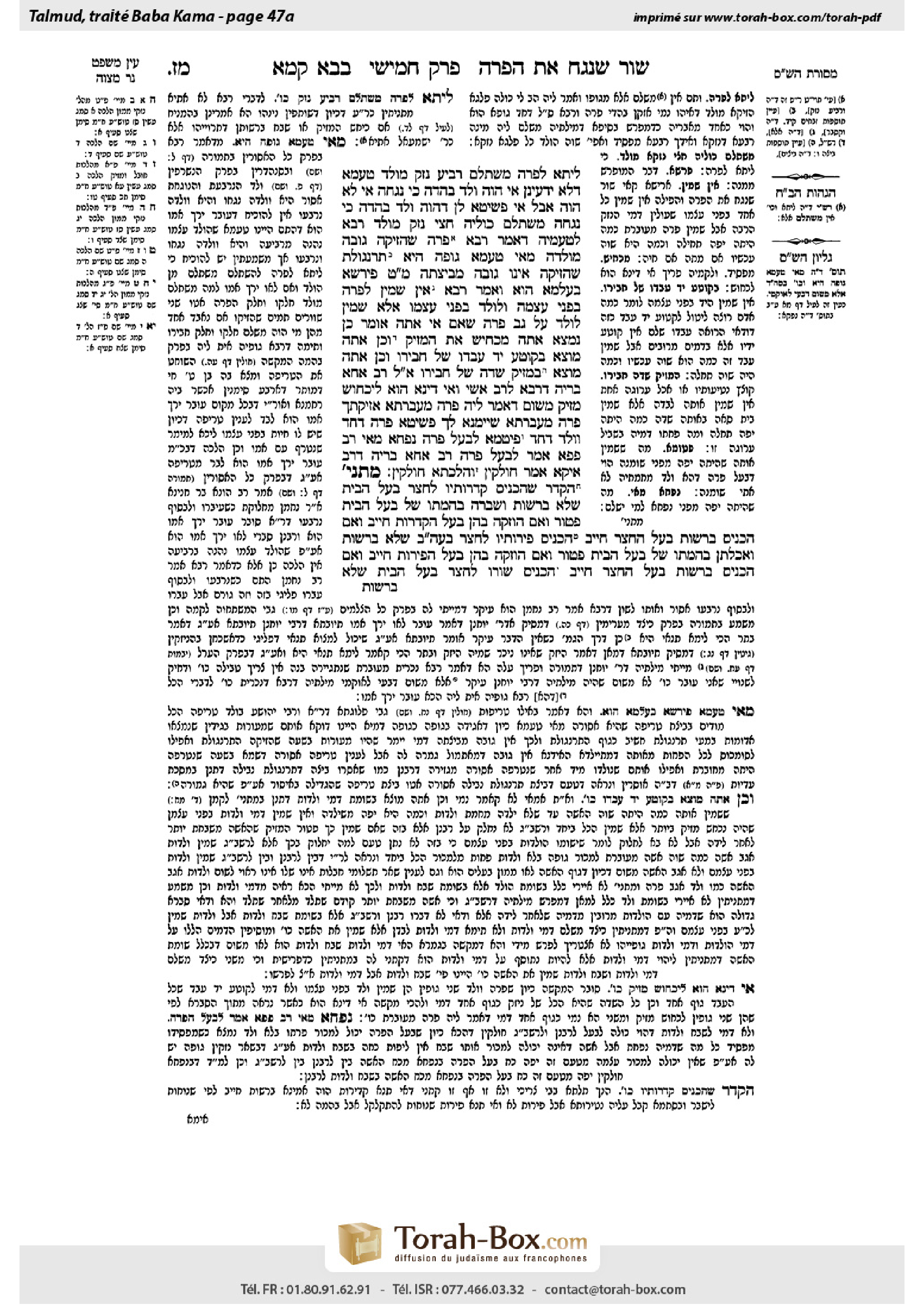
Bava Kamma 47a: Talmud study for Daf Yomi
Study the Talmud for Daf Yomi with scanned pages, Hebrew text, English translations from Sefaria and AI-generated French translations.
Passage selection and English or AI-generated French translation are available where the scan has annotations. Daf Study is independent of Torah-Box and Sefaria.
Browse Bava Kamma · בבא קמא · All tractatesBava Kamma 47a text and translations
This page of Bava Kamma includes the Aramaic text, an English translation and an AI-generated French translation, alongside the scan above.
בבא קמא מ״ז א · Aramaic and Hebrew text
לֵיתַהּ לְפָרָה – מִשְׁתַּלֵּם רְבִיעַ נֶזֶק מִוָּלָד.
טַעְמָא דְּלָא יָדְעִינַן אִי הֲוָה וָלָד בַּהֲדַהּ כִּי נְגַחָה, אִי לָא הֲוָה; אֲבָל אִי פְּשִׁיטָא לַן דַּהֲוָה וָלָד בַּהֲדַהּ כִּי נְגַחָה – מִשְׁתַּלֵּם כּוּלֵּיהּ חֲצִי נֶזֶק מִוָּלָד;
רָבָא לְטַעְמֵיהּ, דְּאָמַר רָבָא: פָּרָה שֶׁהִזִּיקָה – גּוֹבֶה מִוְּלָדָהּ. מַאי טַעְמָא? גּוּפַהּ הִיא. תַּרְנְגוֹלֶת שֶׁהִזִּיקָה – אֵינוֹ גּוֹבֶה מִבֵּיצָתָהּ. מַאי טַעְמָא? פִּירְשָׁא בְּעָלְמָא הוּא.
וְאָמַר רָבָא: אֵין שָׁמִין לַפָּרָה בִּפְנֵי עַצְמָהּ וְלַוָּלָד בִּפְנֵי עַצְמוֹ, אֶלָּא שָׁמִין לַוָּלָד עַל גַּב פָּרָה. שֶׁאִם אִי אַתָּה אוֹמֵר כֵּן – נִמְצָא אַתָּה מַכְחִישׁ אֶת הַמַּזִּיק.
וְכֵן אַתָּה מוֹצֵא בְּקוֹטֵעַ יַד עַבְדּוֹ שֶׁל חֲבֵירוֹ. וְכֵן אַתָּה מוֹצֵא בְּמַזִּיק שָׂדֶה שֶׁל חֲבֵירוֹ.
אֲמַר לֵיהּ רַב אַחָא בְּרֵיהּ דְּרָבָא לְרַב אָשֵׁי: וְאִי דִּינָא הוּא, לִיכְחוֹשׁ מַזִּיק!
מִשּׁוּם דַּאֲמַר לֵיהּ: פָּרָה מְעַבַּרְתָּא אַזֵּיקְתָּךְ, פָּרָה מְעַבַּרְתָּא שָׁיֵימְנָא לָךְ.
פְּשִׁיטָא, פָּרָה דְּחַד וּוָלָד דְּחַד – פִּיטְמָא לְבַעַל פָּרָה. נִפְחָא מַאי? רַב פָּפָּא אָמַר: לְבַעַל פָּרָה, רַב אַחָא בְּרֵיהּ דְּרַב אִיקָא אָמַר: חוֹלְקִין. וְהִלְכְתָא: חוֹלְקִין.
מַתְנִי׳ הַקַּדָּר שֶׁהִכְנִיס קְדֵרוֹתָיו לַחֲצַר בַּעַל הַבַּיִת שֶׁלֹּא בִּרְשׁוּת, וְשִׁבְּרָתַן בְּהֶמְתּוֹ שֶׁל בַּעַל הַבַּיִת – פָּטוּר. וְאִם הוּזְּקָה בָּהֶן – בַּעַל הַקְּדֵרוֹת חַיָּיב. וְאִם הִכְנִיס בִּרְשׁוּת – בַּעַל הֶחָצֵר חַיָּיב.
הִכְנִיס פֵּירוֹתָיו לַחֲצַר בַּעַל הַבַּיִת שֶׁלֹּא בִּרְשׁוּת, וַאֲכָלָתַן בְּהֶמְתּוֹ שֶׁל בַּעַל הַבַּיִת – פָּטוּר. וְאִם הוּזְּקָה בָּהֶן – בַּעַל הַפֵּירוֹת חַיָּיב. וְאִם הִכְנִיס בִּרְשׁוּת – בַּעַל הֶחָצֵר חַיָּיב.
הִכְנִיס שׁוֹרוֹ לַחֲצַר בַּעַל הַבַּיִת שֶׁלֹּא
Bava Kamma 47a · English translation
if the cow is not here, e.g., it went astray, only one-quarter of the cost of the damage is reimbursed from the offspring.
The Gemara infers: According to Rava, the reason for paying only one-quarter of the cost of the damage is that we do not know if the offspring was with it, as a fetus, when the cow gored or whether it was not. But if it is obvious to us that the offspring was with it as a fetus when it gored, the full amount of half the cost of the damage may be reimbursed from the offspring if the cow is not there.
The Gemara comments: In this respect, Rava conforms to his line of reasoning, as Rava says: In the case of a cow that caused damage while pregnant, the injured party collects compensation from its offspring, i.e., the offspring that had been a fetus at the time of the goring. What is the reason? It is because it is considered an integral part of its body and therefore may be used to collect payment. By contrast, in the case of a hen that caused damage, the injured party does not collect compensation from its egg. Payment can be collected only from the body of the hen. What is the reason? The egg is simply a secretion and not an integral part of the hen’s body.
§ And Rava also says: When assessing the damage inflicted by a goring ox on a cow whose newborn calf is found dead by its side, the court does not appraise the damage to the cow by itself and the damage to the offspring by itself. Rather, the court appraises the offspring together with the cow and evaluates the overall damage inflicted on the pregnant cow, which will be slightly less than it would be with two separate evaluations. The reason for this is that if you do not say this, you will be found to have ultimately weakened the one liable for damage by inflicting a loss on him, as the market value of a newborn calf is greater than the difference in market value between a pregnant cow and one that is not pregnant.
And similarly, you find this principle in a case where someone severed the hand of another’s slave. The difference in value between a slave with a hand and a slave without a hand is assessed, rather than determining how much money the owner would request in exchange for allowing the hand of his slave to be cut off. And similarly, you also find this principle in a case of one who causes damage to part of another’s field. The court appraises not the garden bed that was eaten or trampled, but the depreciation in value of the bed as part of the surrounding area. This results in a smaller payment, as the damage appears less significant in the context of a larger area.
Rav Aḥa, son of Rava, said to Rav Ashi: The main reason invoked by Rava is that otherwise you will be found to have ultimately weakened the one liable for damage. But if this is the halakha of assessing the damage, then let the one liable for damage be weakened by losing money.
Rav Ashi answered: This is because the one liable for damage can say to him: I caused damage to you through injuring a pregnant cow, and so I am assessing the value of a pregnant cow for you. Therefore, it is not correct to evaluate separately the damage to the cow and the damage to the offspring.
The Gemara raises a question: It is obvious that in a case where the cow belonged to one person and the offspring belonged to another that the compensation for the cow’s loss of fat is paid to the owner of the cow. The additional value that the cow had due to the fact that it was fatter due to the pregnancy is paid to the owner of the cow. The question is: What is the halakha concerning the cow’s bulk? There is an increase in value of a pregnant cow that is attributed to its improved appearance, which results from its carrying a fetus. Who is considered the injured party with regard to that sum? Rav Pappa said: This too belongs to the owner of the cow, whereas Rav Aḥa, son of Rav Ika, said: They divide the restitution. And the halakha is that they divide the restitution.
MISHNA: In the case of a potter who brought his pots into a homeowner’s courtyard without permission, and the homeowner’s animal broke the pots, the homeowner is exempt. If the owner’s animal was injured by the pots, the owner of the pots is liable. But if the potter brought them inside with permission, the owner of the courtyard is liable if his animal caused damage to the pots.
Similarly, if someone brought his produce into the homeowner’s courtyard without permission, and the homeowner’s animal ate them, the homeowner is exempt. If his animal was injured by them, e.g., if it slipped on them, the owner of the produce is liable. But if he brought his produce inside with permission, the owner of the courtyard is liable for the damage caused by his animal to them.
Similarly, if one brought his ox into the homeowner’s courtyard without
Bava Kamma 47a · Traduction française (IA)
Si la vache n'est pas là, par exemple, elle s'est éloignée, seulement un quart du coût des dommages est remboursé à partir de la descendance.
La Guemara conclut : Selon Rava, la raison pour laquelle on ne remboursé que le quart du coût des dommages est que nous ne savons pas si la descendance était avec elle, en tant que fœtus, lorsqu'elle a blessé ou non. Mais si cela nous est clair que la descendance était avec elle en tant que fœtus lorsqu'elle a blessé, la totalité du montant de la moitié du coût des dommages peut être remboursée à partir de la descendance si la vache n'est pas là.
La Guemara commente : En ce qui concerne cela, Rava suit sa ligne de raisonnement, car Rava dit : Dans le cas d'une vache qui a causé des dommages en étant enceinte, la partie blessée récupère une compensation à partir de sa descendance, c'est-à-dire la descendance qui était un fœtus au moment de la blessure. Quelle est la raison ? C'est parce qu'il est considéré comme faisant partie de son corps et donc peut être utilisé pour récupérer une compensation. À l'inverse, dans le cas d'une poule qui a causé des dommages, la partie blessée ne récupère pas de compensation à partir de son œuf. La compensation peut être récupérée uniquement à partir du corps de la poule. Quelle est la raison ? L'œuf est simplement une sécrétion et non une partie intégrante du corps de la poule.
§ Et Rava dit aussi : Lors de l'évaluation des dommages causés par une vache blessante à une vache enceinte dont un veau nouveau-né est trouvé à ses côtés, le tribunal ne juge pas les dommages causés à la vache en elle-même et les dommages causés à la descendance en eux-mêmes. Plutôt, le tribunal évalue la descendance ensemble avec la vache et évalue le dommage global causé à la vache enceinte, qui sera légèrement inférieur à ce qu'il serait avec deux évaluations séparées. La raison de cela est que si on ne dit pas cela, on trouvera finalement que l'on a affaibli celui qui est responsable des dommages en imposant une perte, car la valeur marchande d'un veau nouveau-né est supérieure à la différence de valeur marchande entre une vache enceinte et une vache non enceinte.
Et de même, vous trouvez ce principe dans un cas où quelqu'un a sectionné la main d'un esclave d'autrui. La différence de valeur entre un esclave avec une main et un esclave sans main est évaluée, plutôt que de déterminer combien d'argent l'owner demanderait en échange de permettre la coupe de la main de son esclave. Et de même, vous trouvez ce principe dans un cas où quelqu'un cause des dommages à une partie d'un champ d'autrui. Le tribunal évalue non la litière mangée ou foulée, mais la dépréciation de valeur de la litière en tant que partie du terrain environnant. Cela entraîne un paiement plus faible, car le dommage semble moins important dans le contexte d'un terrain plus vaste.
Rav Acha, fils de Rava, dit à Rav Ashi : La raison principale invoquée par Rava est que sinon on trouvera finalement que l'on a affaibli celui qui est responsable des dommages. Mais si c'est la halakha d'évaluer les dommages, alors laissez celui qui est responsable des dommages être affaibli en perdant de l'argent.
Rav Ashi répondit : C'est parce que celui qui est responsable des dommages peut dire à l'autre : J'ai causé des dommages à travers l'injuring d'une vache enceinte, et donc je vous évalue la valeur d'une vache enceinte. Par conséquent, il n'est pas correct d'évaluer séparément les dommages à la vache et les dommages à la descendance.
La Guemara soulève une question : Il est évident que dans un cas où la vache appartenait à une personne et la descendance à une autre, la compensation pour la perte de graisse de la vache est payée à l'propriétaire de la vache. La valeur supplémentaire que la vache avait en raison du fait qu'elle était plus grosse en raison de la grossesse est payée à l'propriétaire de la vache. La question est : Quelle est la halakha concernant la masse de la vache ? Il y a une augmentation de valeur d'une vache enceinte qui est attribuée à son apparence améliorée, qui résulte de son port d'un fœtus. Qui est considéré comme la partie blessée concernant cette somme ? Rav Pappa dit : Cela appartient également à l'propriétaire de la vache, tandis que Rav Acha, fils de Rav Ika, dit : Ils partagent la restitution. Et la halakha est qu'ils partagent la restitution.
MICHNA : Dans le cas d'un potier qui a apporté ses pots dans la cour d'un propriétaire sans autorisation, et l'animal du propriétaire a cassé les pots, le propriétaire est exempt. Si l'animal du propriétaire a été blessé par les pots, l'propriétaire des pots est responsable. Mais si le potier les a apportés à l'intérieur avec autorisation, l'propriétaire de la cour est responsable si son animal a causé des dommages aux pots.
De même, si quelqu'un a apporté ses produits dans la cour d'un propriétaire sans autorisation, et l'animal du propriétaire a mangé les produits, le propriétaire est exempt. Si son animal a été blessé par les produits, par exemple, s'il a glissé dessus, l'propriétaire des produits est responsable. Mais si il a apporté ses produits à l'intérieur avec autorisation, l'propriétaire de la cour est responsable des dommages causés par son animal aux produits.
De même, si l'on a apporté son bœuf dans la cour d'un propriétaire sans
Traduction française générée par IA à partir de l’édition anglaise de Sefaria. Vérifie toujours un passage avec le texte source.
Text from Sefaria: William Davidson Edition - Vocalized Aramaic (CC BY NC); William Davidson Edition - English (CC BY NC).