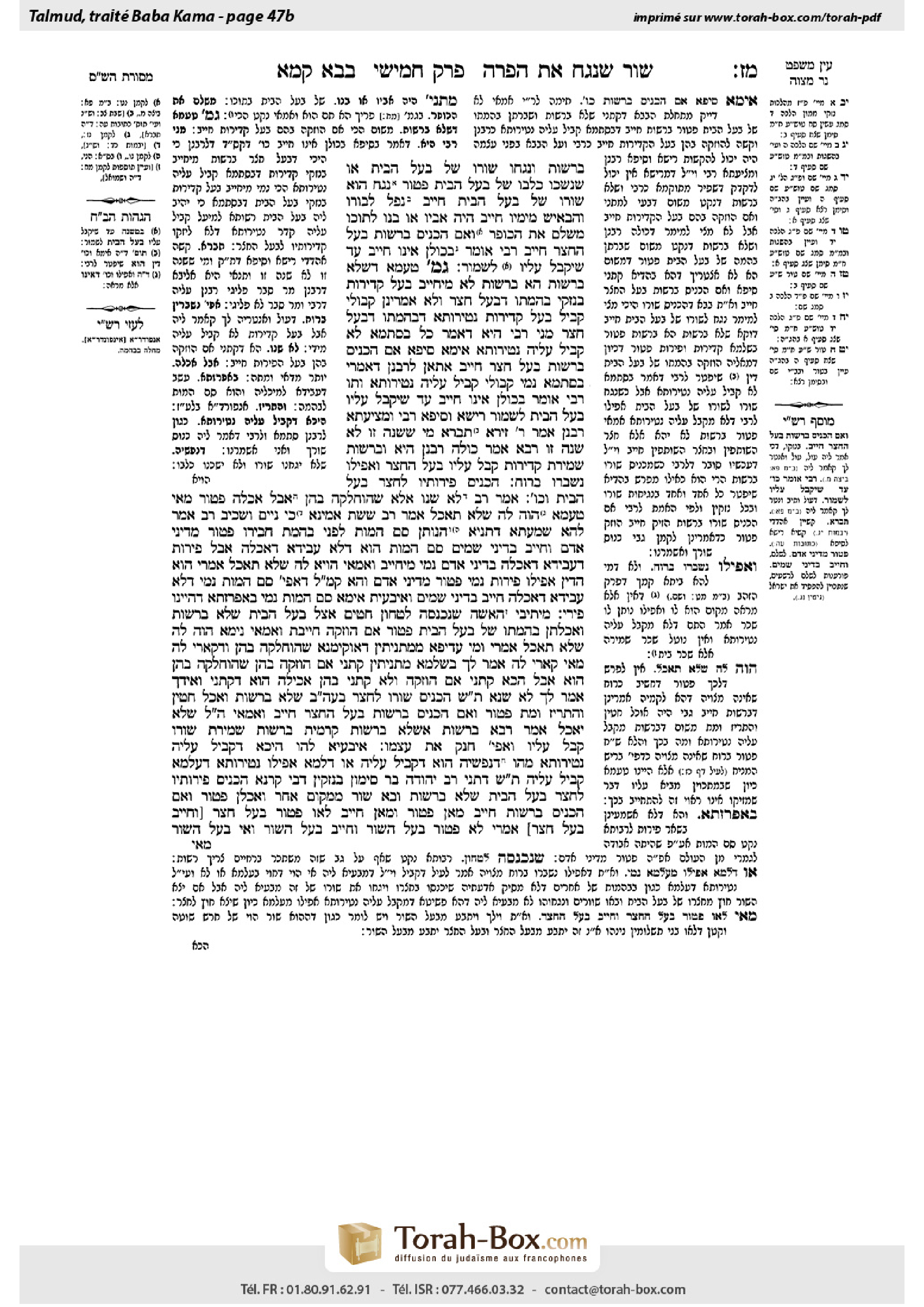
Bava Kamma 47b: Talmud study for Daf Yomi
Study the Talmud for Daf Yomi with scanned pages, Hebrew text, English translations from Sefaria and AI-generated French translations.
Passage selection and English or AI-generated French translation are available where the scan has annotations. Daf Study is independent of Torah-Box and Sefaria.
Browse Bava Kamma · בבא קמא · All tractatesBava Kamma 47b text and translations
This page of Bava Kamma includes the Aramaic text, an English translation and an AI-generated French translation, alongside the scan above.
בבא קמא מ״ז ב · Aramaic and Hebrew text
בִּרְשׁוּת, וּנְגָחוֹ שׁוֹרוֹ שֶׁל בַּעַל הַבַּיִת, אוֹ שֶׁנְּשָׁכוֹ כַּלְבּוֹ שֶׁל בַּעַל הַבַּיִת – פָּטוּר. נָגַח הוּא שׁוֹרוֹ שֶׁל בַּעַל הַבַּיִת – חַיָּיב. נָפַל לְבוֹרוֹ, וְהִבְאִישׁ מֵימָיו – חַיָּיב. הָיָה אָבִיו אוֹ בְּנוֹ לְתוֹכוֹ – מְשַׁלֵּם אֶת הַכּוֹפֶר. וְאִם הִכְנִיס בִּרְשׁוּת – בַּעַל הֶחָצֵר חַיָּיב.
רַבִּי אוֹמֵר: בְּכוּלָּן אֵינוֹ חַיָּיב, עַד שֶׁיְּקַבֵּל עָלָיו לִשְׁמוֹר.
גְּמָ׳ טַעְמָא דְּשֶׁלֹּא בִּרְשׁוּת, הָא בִּרְשׁוּת – לָא מִיחַיַּיב בַּעַל קְדֵירוֹת בְּנִזְקֵי בְהֶמְתּוֹ דְּבַעַל חָצֵר, וְלָא אָמְרִינַן קַבּוֹלֵי קַבֵּיל בַּעַל קְדֵירוֹת נְטִירוּתָא דִּבְהֶמְתּוֹ דְּבַעַל חָצֵר;
מַנִּי – רַבִּי הִיא, דְּאָמַר: כֹּל בִּסְתָמָא – לָא קַבֵּיל עֲלֵיהּ נְטִירוּתָא.
אֵימָא סֵיפָא: אִם הִכְנִיס בִּרְשׁוּת – בַּעַל חָצֵר חַיָּיב. אֲתָאן לְרַבָּנַן, דְּאָמְרִי: בִּסְתָמָא נָמֵי קַבּוֹלֵי קַבֵּיל עֲלֵיהּ נְטִירוּתָא.
וְתוּ, רַבִּי אוֹמֵר: בְּכוּלָּן אֵינוֹ חַיָּיב, עַד שֶׁיְּקַבֵּל עָלָיו בַּעַל הַבַּיִת לִשְׁמוֹר. רֵישָׁא וְסֵיפָא רַבִּי, וּמְצִיעֲתָא רַבָּנַן?!
אָמַר רַבִּי זֵירָא: תִּבְרַהּ; מִי שֶׁשָּׁנָה זוֹ – לֹא שָׁנָה זוֹ. רָבָא אָמַר: כּוּלַּהּ רַבָּנַן הִיא, וּבִרְשׁוּת – שְׁמִירַת קְדֵירוֹת קִבֵּל עָלָיו בַּעַל הֶחָצֵר, וַאֲפִילּוּ נִשְׁבְּרוּ בָּרוּחַ.
הִכְנִיס פֵּירוֹתָיו לַחֲצַר בַּעַל הַבַּיִת וְכוּ׳. אָמַר רַב: לֹא שָׁנוּ אֶלָּא שֶׁהוּחְלְקָה בָּהֶן, אֲבָל אָכְלָה – פָּטוּר. מַאי טַעְמָא? הֲוָה לַהּ שֶׁלֹּא תֹּאכַל.
אָמַר רַב שֵׁשֶׁת: אָמֵינָא, כִּי נָיֵים וְשָׁכֵיב רַב אֲמַר לְהָא שְׁמַעְתָּא. דְּתַנְיָא: הַנּוֹתֵן סַם הַמָּוֶת לִפְנֵי בֶּהֱמַת חֲבֵירוֹ – פָּטוּר מִדִּינֵי אָדָם, וְחַיָּיב בְּדִינֵי שָׁמַיִם. סַם הַמָּוֶת הוּא דְּלָא עֲבִידָא דְּאָכְלָה; אֲבָל פֵּירוֹת, דַּעֲבִידָא דְּאָכְלָה – בְּדִינֵי אָדָם נָמֵי מִיחַיַּיב! וְאַמַּאי? הֲוָיא לַהּ שֶׁלֹּא תֹּאכַל!
אָמְרִי: הוּא הַדִּין אֲפִילּוּ פֵּירוֹת – נָמֵי פָּטוּר מִדִּינֵי אָדָם; וְהָא קָא מַשְׁמַע לַן – דַּאֲפִילּוּ סַם הַמָּוֶת נָמֵי, דְּלָא עֲבִידָא דְּאָכְלָה – חַיָּיב בְּדִינֵי שָׁמַיִם.
וְאִיבָּעֵית אֵימָא: סַם הַמָּוֶת נָמֵי – בְּאַפְרַזְתָּא, דְּהַיְינוּ פֵּירֵי.
מֵיתִיבִי: הָאִשָּׁה שֶׁנִּכְנְסָה לִטְחוֹן חִטִּים אֵצֶל בַּעַל הַבַּיִת שֶׁלֹּא בִּרְשׁוּת, וַאֲכָלָתַן בְּהֶמְתּוֹ שֶׁל בַּעַל הַבַּיִת – פָּטוּר. אִם הוּזְּקָה – חַיֶּיבֶת. וְאַמַּאי? נֵימָא: הֲוָה לַהּ שֶׁלֹּא תֹּאכַל!
אָמְרִי: וּמִי עֲדִיפָא מִמַּתְנִיתִין – דְּאוֹקֵימְנָא שֶׁהוּחְלְקָה בָּהֶן?
וּדְקָאָרֵי לַהּ מַאי קָאָרֵי לַהּ? אָמַר לָךְ: בִּשְׁלָמָא מַתְנִיתִין, קָתָנֵי ״אִם הוּזְּקָה בָּהֶן״ – שֶׁהוּחְלְקָה בָּהֶן הוּא; אֲבָל הָכָא, קָתָנֵי ״אִם הוּזְּקָה״ וְלָא קָתָנֵי ״בָּהֶן״ – אֲכִילָה הוּא דְּקָתָנֵי.
וְאִידַּךְ אָמַר לָךְ: לָא שְׁנָא.
תָּא שְׁמַע: הִכְנִיס שׁוֹרוֹ לַחֲצַר בַּעַל הַבַּיִת שֶׁלֹּא בִּרְשׁוּת, וְאָכַל חִטִּין וְהִתְרִיז וָמֵת – פָּטוּר. וְאִם הִכְנִיס בִּרְשׁוּת – בַּעַל הֶחָצֵר חַיָּיב. וְאַמַּאי? הֲוָה לֵיהּ שֶׁלֹּא יֹאכַל!
אָמַר רָבָא: בִּרְשׁוּת אַשֶּׁלֹּא בִּרְשׁוּת קָרָמֵית? בִּרְשׁוּת – שְׁמִירַת שׁוֹרוֹ קִבֵּל עָלָיו, וַאֲפִילּוּ חָנַק אֶת עַצְמוֹ.
אִיבַּעְיָא לְהוּ: הֵיכָא דְּקַבֵּיל עֲלֵיהּ נְטִירוּתָא, מַהוּ? דְּנַפְשֵׁיהּ הוּא דְּקַבֵּיל עֲלֵיהּ, אוֹ דִלְמָא אֲפִילּוּ נְטִירוּתָא דְּעָלְמָא קַבֵּיל עֲלֵיהּ?
תָּא שְׁמַע, דְּתָנֵי רַב יְהוּדָה בַּר סִימוֹן בִּנְזָקִין דְּבֵי קַרְנָא: הִכְנִיס פֵּירוֹתָיו לַחֲצַר בַּעַל הַבַּיִת שֶׁלֹּא בִּרְשׁוּת, וּבָא שׁוֹר מִמָּקוֹם אַחֵר וַאֲכָלָן – פָּטוּר. וְאִם הִכְנִיס בִּרְשׁוּת – חַיָּיב. מַאן פָּטוּר וּמַאן חַיָּיב? לָאו פָּטוּר – בַּעַל חָצֵר, [וְחַיָּיב – בַּעַל חָצֵר]?
אָמְרִי: לָא; פָּטוּר בַּעַל הַשּׁוֹר, וְחַיָּיב בַּעַל הַשּׁוֹר.
וְאִי בַּעַל הַשּׁוֹר,
Bava Kamma 47b · English translation
permission, and the homeowner’s ox gored it or the homeowner’s dog bit it, the homeowner is exempt. If it gored the homeowner’s ox, the owner of the goring ox is liable. Furthermore, if the ox that he brought into the courtyard without permission fell into the owner’s pit and contaminated its water, the owner of the ox is liable to pay compensation for despoiling the water. If the homeowner’s father or son were inside the pit at the time the ox fell and the person died as a result, the owner of the ox pays the ransom. But if he brought the ox into the courtyard with permission, the owner of the courtyard is liable for the damage caused.
Rabbi Yehuda HaNasi says: The homeowner is not liable in any of the cases in the mishna, even if he gave his permission for the items to be brought into his premises, unless he explicitly accepts responsibility upon himself to safeguard them.
GEMARA: From the first case of the mishna, it can be inferred that the reason the potter is liable is that he brought his pots into another’s courtyard without permission. But if he brought them in with permission, the potter would not be liable for damage caused to the courtyard owner’s animal; and we do not say that the potter accepted responsibility for the safeguarding of the courtyard owner’s animal from his own pots.
Whose opinion is this? It is that of Rabbi Yehuda HaNasi, who says at the conclusion of the mishna that any case where permission is granted to allow an item into one’s premises without specification, i.e., without an explicit agreement as to who is responsible for safeguarding the item, it is assumed that with regard to each party, he has not accepted upon himself the responsibility of safeguarding the item. Therefore, the potter who received permission to bring his pots into the owner’s courtyard similarly did not accept responsibility to safeguard against damage to the property of the owner of the courtyard.
But say the latter clause: If the potter brought them into the courtyard with permission, the owner of the courtyard is liable. In this case, we arrive at the opinion of the Rabbis, who disagree with Rabbi Yehuda HaNasi and say that, even in a case where permission is granted to allow an item into one’s premises without specification, where the owner merely said he could bring them into the courtyard, the homeowner accepts upon himself responsibility for safeguarding the items to ensure that they are not damaged, as well.
And furthermore, the end of the mishna states: Rabbi Yehuda HaNasi says that the owner of the courtyard is not liable in any of the cases in the mishna, even if he gave his permission for the items to be brought into his premises, unless the homeowner explicitly accepts responsibility upon himself to safeguard them. Therefore, it emerges that the first clause and the last clause of the mishna are in accordance with the opinion of Rabbi Yehuda HaNasi, but the middle clause of the mishna is in accordance with the opinion of the Rabbis. Is this a reasonable way to read the mishna?
The Gemara answers that Rabbi Zeira said: This mishna is disjointed and doesn’t follow a single opinion. Rather, the one who taught this clause of the mishna did not teach that clause of the mishna. Rava said: The beginning of the mishna is entirely in accordance with the opinion of the Rabbis. In the case where the potter received permission to place his pots there, the owner of the courtyard accepted responsibility upon himself for the safeguarding of the pots, and even to the extent that if the pots broke due to the wind, he would be liable. The owner of the pots, by contrast, did not accept any responsibility to ensure that his items would not cause damage.
§ The mishna teaches: If he brought his produce into the homeowner’s courtyard without permission, and the owner’s animal was injured by the produce, he is liable. Rav says: They taught this halakha only in a case where the animal slipped on it and fell, but if it ate from the produce and was injured, he is exempt. What is the reason? The animal should not have eaten it, and it was not the owner of the fruit who acted improperly but the animal itself.
Rav Sheshet said: I say that Rav stated this halakha while dozing and lying down, and it is not entirely precise, as it is taught in a baraita: One who places poison before another’s animal is exempt according to human laws but liable according to the laws of Heaven. From the above statement, it may be inferred that it is specifically where he put poison before the animal that he is exempt, since it is not suitable for eating. But if he put produce before it, which is suitable for eating, and the animal dies from eating it, he is also liable according to human laws. The Gemara analyzes this ruling: But why is he liable? Here also Rav’s logic can be invoked, that the animal should not have eaten it. Therefore, this baraita poses a difficulty for Rav.
In order to explain Rav’s statement, the Sages said: The same is true, that even if the animal was injured by eating the produce, he would also be exempt according to human laws, and this baraita teaches us this, that even in the case of poison, which is not suitable for eating, the one who placed the poison before the animal is liable according to the laws of Heaven.
And if you wish, say instead that the case where the baraita exempts from liability according to human laws the one who placed poison before the animal is referring to an item suitable for eating as well, such as afrazta, a type of herb that appears edible for animals but is actually poisonous. Therefore, this herb is halakhically equivalent to any other produce for which he is exempt from liability according to human laws, since, as Rav explained, the animal should not have eaten it.
The Gemara raises an objection to Rav’s statement from a baraita: In the case of a woman who entered the house of a homeowner without permission in order to grind wheat, and the homeowner’s animal ate the wheat, he is exempt. Moreover, if the homeowner’s animal was injured by the wheat, the woman is liable. Now according to Rav’s explanation, why is she liable? Let us say here as well that the animal should not have eaten it.
In order to explain Rav’s statement, the Sages said: What is the difficulty here? Is this baraita preferable to the mishna that we interpreted as a scenario where the animal slipped on the produce? Similarly, the baraita is also referring to a case where the animal was injured by slipping on the wheat, not by eating it.
The Gemara asks: And he who asked it, why did he ask it? This answer seems obvious. The Gemara answers: The questioner could have said to you: Granted, the mishna that teaches: If it is injured by them [bahen], is referring to a case where the animal slipped on them [bahen]. But here in the baraita it teaches the phrase: If it is injured, and it does not teach the additional term: Bahen. Since this case is immediately preceded by the case of: And the owner’s animal ate them, it is reasonable to surmise that when the baraita teaches the case of the animal being injured, the injury is due to eating.
The Gemara notes: And the other one, i.e., the one who provided the answer, could have said to you in response: There is no difference whether it states: It was injured, or: It was injured by them, as in both cases the injury can be explained as resulting from slipping and not from eating.
Come and hear a proof from a baraita: If one brought his ox into a homeowner’s courtyard without permission, and the ox ate wheat belonging to the homeowner and consequently was stricken with diarrhea and died, then the homeowner is exempt. But if the ox’s owner brought it into the courtyard with permission, the owner of the courtyard is liable. The Gemara comments: Why, in the latter case, is the owner liable for the damage to the ox? Shouldn’t the assertion: The ox shouldn’t have eaten it, be invoked, and any injury that follows is the responsibility of the ox’s owner?
Rava said in response: Are you raising a contradiction from a case with permission and applying it against a case without permission? There is no difficulty here, since in the case where the ox’s owner brought the ox into the courtyard with permission, the homeowner thereby accepted responsibility upon himself for safeguarding against any damage to the other’s ox. And even if the ox strangled itself, he would still be liable.
§ A dilemma was raised before the Sages: In a case where the owner of the courtyard accepted upon himself responsibility for safeguarding the items entering his premises, what is the halakha? Did he accept upon himself only the responsibility of safeguarding himself and his animals from causing damage? Or, perhaps he even accepted responsibility upon himself for safeguarding against all forms of damage that originate from the outside.
Come and hear a solution based on that which Rav Yehuda bar Simon taught in the tractate of Nezikin from the school of Karna: If one brought his produce into a homeowner’s courtyard without permission, and an ox came from elsewhere and ate it, he is exempt. But if one brought the produce into the courtyard with permission, he is liable. The Gemara clarifies: Who is the phrase: He is exempt, referring to, and who is the phrase: He is liable, referring to? Does it not mean that the owner of the courtyard is exempt and the owner of the courtyard is liable? This would indicate that by granting permission for the produce to be brought in, he accepts responsibility to safeguard against other damage as well, such as that caused by another ox entering from the outside.
In response, they said that this interpretation should be rejected: No, it means that the owner of the ox that causes damage is exempt, and the owner of the ox is liable.
The Gemara asks: But if it is referring to the owner of the ox,
Bava Kamma 47b · Traduction française (IA)
La permission, et si l’ox du propriétaire a blessé ou si le chien du propriétaire a mordu, le propriétaire est exempt. Si l’ox a blessé l’ox du propriétaire, le propriétaire de l’ox est responsable. De plus, si l’ox qu’il a introduit dans la cour sans permission est tombé dans le puits du propriétaire et a contaminé l’eau, le propriétaire de l’ox est responsable de la perte de l’eau. Si le père ou le fils du propriétaire était dans le puits au moment où l’ox est tombé et que la personne est morte en conséquence, le propriétaire de l’ox paie le rançon. Mais si l’ox a été introduit dans la cour avec la permission, le propriétaire de la cour est responsable des dommages causés.
Rabbi Yehuda HaNasi dit : Le propriétaire n’est pas responsable en aucun des cas mentionnés dans la mitsva, même s’il a donné sa permission pour que les objets soient introduits dans ses lieux, à moins qu’il n’ait explicitement accepté la responsabilité de les protéger.
GUEMARA : On peut déduire de la première situation de la mitsva que la raison pour laquelle le potier est responsable est qu’il a introduit ses pots dans la cour d’un autre sans permission. Mais si il les a introduits avec la permission, le potier ne serait pas responsable des dommages causés à l’animal du propriétaire de la cour ; et nous ne disons pas que le potier a accepté la responsabilité de la protection des animaux du propriétaire de la cour.
De quel opinion s’agit-il ? C’est celle de Rabbi Yehuda HaNasi, qui dit à la fin de la Michna que dans tout cas où la permission est donnée pour permettre un objet d’être introduit dans les lieux d’un autre sans spécification, c’est-à-dire sans un accord explicite sur qui est responsable de la protection de l’objet, on suppose que pour chaque partie, il n’a pas accepté la responsabilité de la protection de l’objet. Par conséquent, le potier qui a reçu la permission d’introduire ses pots dans la cour du propriétaire n’a pas non plus accepté la responsabilité de la protection contre les dommages causés aux biens du propriétaire de la cour.
Mais disons la clause suivante : Si le potier les a introduits dans la cour avec la permission, le propriétaire de la cour est responsable. Dans ce cas, nous arrivons à l’opinion des Rabbins, qui s’opposent à celle de Rabbi Yehuda HaNasi et disent que, même dans un cas où la permission est donnée pour permettre un objet d’être introduit dans les lieux d’un autre sans spécification, où le propriétaire a simplement dit qu’il pouvait les introduire dans la cour, le propriétaire accepte la responsabilité de la protection des objets pour s’assurer qu’ils ne soient pas endommagés.
Et de plus, la fin de la Michna stipule : Rabbi Yehuda HaNasi dit que le propriétaire de la cour n’est responsable en aucun des cas mentionnés dans la Michna, même s’il a donné sa permission pour que les objets soient introduits dans ses lieux, à moins qu’il n’ait explicitement accepté la responsabilité de leur protection. Par conséquent, il ressort que la première clause et la dernière clause de la Michna sont conformes à l’opinion de Rabbi Yehuda HaNasi, mais la clause intermédiaire de la Michna est conforme à l’opinion des Rabbins. Est-ce une manière raisonnable de lire la Michna ?
La Guemara répond que Rabbi Zeira a dit : Cette mitsva est disjointe et ne suit pas une seule opinion. Plutôt, celui qui a enseigné cette clause de la mitsva n’a pas enseigné cette clause de la mitsva. Rava a dit : Le début de la mitsva est entièrement conforme à l’opinion des Rabbins. Dans le cas où le potier a reçu la permission de placer ses pots là, le propriétaire de la cour a accepté la responsabilité de la protection des pots, et même à tel point que si les pots se sont brisés à cause du vent, il serait responsable. Le propriétaire des pots, en revanche, n’a pas accepté de responsabilité pour s’assurer que ses objets ne causent pas de dommages.
§ La mitsva enseigne : Si l’on a introduit ses produits dans la cour du propriétaire sans permission, et que l’animal du propriétaire a été blessé par les produits, il est responsable. Rav dit : Ils ont enseigné cette halakha uniquement dans le cas où l’animal est tombé dessus et s’est blessé, mais si l’animal a mangé les produits et s’est blessé, il est exempt. Quelle est la raison ? L’animal ne devrait pas avoir mangé, et ce n’est pas le propriétaire des fruits qui a agi de manière inappropriée, mais l’animal lui-même.
Rav Sheshet a dit : Je dis que Rav a formulé cette halakha en dormant et allongé, et cela n’est pas entièrement précis, car il est enseigné dans une baraïta : Celui qui place un poison devant l’animal d’un autre est exempt selon les lois humaines mais responsable selon les lois du Royaume des Cieux. À partir de cette déclaration, on peut déduire que c’est spécifiquement dans le cas où il a mis du poison devant l’animal qu’il est exempt, car cela n’est pas adapté à l’ingestion. Mais si l’on a mis des produits devant l’animal, qui sont adaptés à l’ingestion, et que l’animal meurt en mangeant, il est également responsable selon les lois humaines. La Guemara analyse cette décision : Mais pourquoi est-il responsable ? Ici aussi, on peut invoquer la logique de Rav, que l’animal ne devrait pas avoir mangé. Par conséquent, cette baraïta pose un problème pour Rav.
Pour expliquer la déclaration de Rav, les Sages ont dit : La même chose est vraie, que même si l’animal a été blessé en mangeant les produits, il serait également exempt selon les lois humaines, et cette baraïta nous enseigne cela, que même dans le cas du poison, qui n’est pas adapté à l’ingestion, celui qui a placé le poison devant l’animal est responsable selon les lois du Royaume des Cieux.
Et si vous le souhaitez, dites plutôt que le cas où la baraïta exempt de responsabilité selon les lois humaines celui qui a placé du poison devant l’animal fait référence à un objet adapté à l’ingestion, tel que l’afrazta, une plante qui semble comestible pour les animaux mais qui est en réalité toxique. Par conséquent, cette plante est halakhiquement équivalente à tout autre produit pour lequel il est exempt de responsabilité selon les lois humaines, car, comme l’a expliqué Rav, l’animal ne devrait pas avoir mangé.
La Guemara soulève une objection contre l'affirmation de Rav, tirée d'une baraïta : Dans le cas d'une femme qui entre dans la maison d'un propriétaire sans permission afin de moudre du blé, et l'animal du propriétaire mange le blé, il est exempt. De plus, si l'animal du propriétaire est blessé par le blé, la femme est responsable. Maintenant, selon l'explication de Rav, pourquoi est-elle responsable ? Disons ici également que l'animal ne devrait pas avoir mangé cela.
Afin d'expliquer l'affirmation de Rav, les Sages dirent : Quel est le problème ici ? Cette baraïta est-elle préférable à la mitsva que nous avons interprétée comme un cas où l'animal glisse sur les produits ? De même, cette baraïta fait référence à un cas où l'animal est blessé en glissant sur le blé, et non en le mangeant.
La Guemara pose la question : Et celui qui a posé la question, pourquoi l'a-t-il posée ? Cette réponse semble évidente. La Guemara répond : Le questionneur aurait pu dire à vous : Bien sûr, la mitsva qui enseigne : Si elle est blessée par eux [bahen], fait référence à un cas où l'animal a glissé sur eux [bahen]. Mais ici, dans la baraïta, elle enseigne la phrase : Si elle est blessée, et ne mentionne pas le terme supplémentaire : Bahen. Puisque ce cas est immédiatement précédé par le cas de : Et l'animal du propriétaire a mangé cela, il est raisonnable de supposer que lorsque la baraïta enseigne le cas de l'animal blessé, la blessure provient de la consommation.
La Guemara note : Et l'autre, c'est-à-dire celui qui a donné la réponse, aurait pu dire à vous en réponse : Il n'y a pas de différence si elle dit : Elle a été blessée, ou : Elle a été blessée par eux, car dans les deux cas, la blessure peut être expliquée comme résultant d'une glissade et non de la consommation.
Venez écouter une preuve tirée d'une baraïta : Si l'on amène son bœuf dans la cour d'un propriétaire sans permission, et que le bœuf mange le blé appartenant au propriétaire et en conséquence est frappé de diarrhée et meurt, alors le propriétaire est exempt. Mais si l'propriétaire du bœuf l'amène dans la cour avec permission, le propriétaire de la cour est responsable. La Guemara commente : Pourquoi, dans ce dernier cas, le propriétaire est-il responsable du dommage au bœuf ? Ne devrait-on pas invoquer l'affirmation : Le bœuf ne devrait pas avoir mangé cela, et toute blessure qui en découle est la responsabilité du propriétaire du bœuf ?
Rava répondit en disant : Est-ce que vous élevez une contradiction à partir d'un cas avec permission et l'appliquez contre un cas sans permission ? Il n'y a pas de difficulté ici, car dans le cas où l'propriétaire du bœuf amène le bœuf dans la cour avec permission, le propriétaire a ainsi accepté la responsabilité de préserver contre tout dommage causé par son bœuf. Et même si le bœuf s'étouffe, il resterait responsable.
§ Un dilemme a été soulevé devant les Sages : Dans un cas où le propriétaire de la cour a accepté la responsabilité de préserver les objets entrant dans ses lieux, quelle est la halakha ? A-t-il accepté la responsabilité de préserver lui-même et ses animaux contre les dommages ? Ou, peut-être a-t-il même accepté la responsabilité de préserver contre tous les types de dommages provenant de l'extérieur ?
Venez écouter une solution basée sur ce que Rav Yéhouda bar Simon a enseigné dans le tractat de Nezikin de la scolie de Karna : Si l'on amène ses produits dans la cour d'un propriétaire sans permission, et un bœuf vient d'ailleurs et mange les produits, il est exempt. Mais si l'on amène les produits dans la cour avec permission, il est responsable. La Guemara clarifie : À qui fait référence la phrase : Il est exempt, et à qui fait référence la phrase : Il est responsable ? Ne signifie-t-il pas que le propriétaire de la cour est exempt et le propriétaire de la cour est responsable ? Cela indiquerait que, en accordant la permission pour l'aménagement des produits, il accepte la responsabilité de préserver contre d'autres dommages, tels que ceux causés par un autre bœuf entrant de l'extérieur.
En réponse, ils dirent que cette interprétation devrait être rejetée : Non, cela signifie que le propriétaire du bœuf qui cause un dommage est exempt, et le propriétaire du bœuf est responsable.
La Guemara demande : Mais si cela concerne le propriétaire du bœuf,
Traduction française générée par IA à partir de l’édition anglaise de Sefaria. Vérifie toujours un passage avec le texte source.
Text from Sefaria: William Davidson Edition - Vocalized Aramaic (CC BY NC); William Davidson Edition - English (CC BY NC).