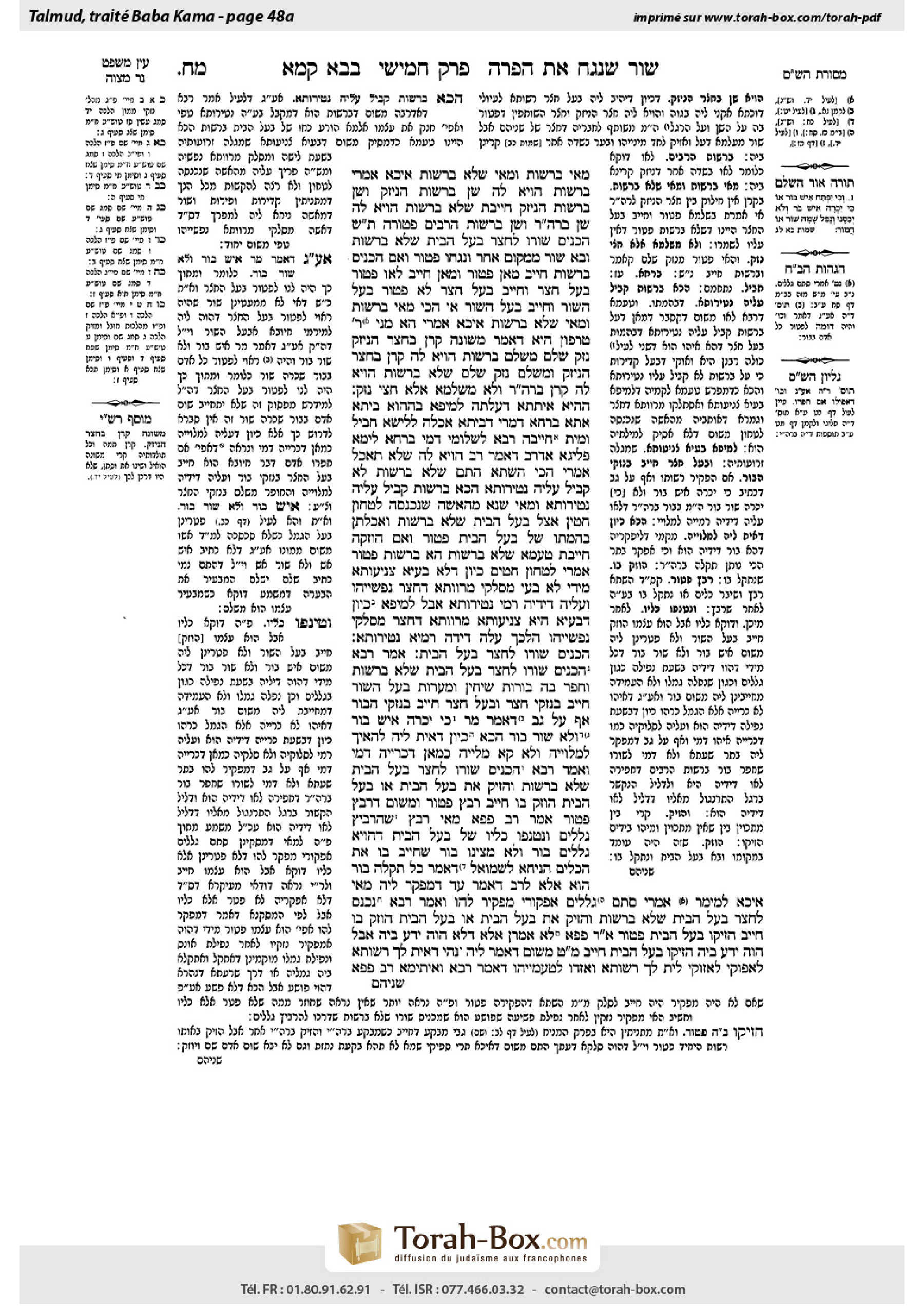
Bava Kamma 48a: Talmud study for Daf Yomi
Study the Talmud for Daf Yomi with scanned pages, Hebrew text, English translations from Sefaria and AI-generated French translations.
Passage selection and English or AI-generated French translation are available where the scan has annotations. Daf Study is independent of Torah-Box and Sefaria.
Browse Bava Kamma · בבא קמא · All tractatesBava Kamma 48a text and translations
This page of Bava Kamma includes the Aramaic text, an English translation and an AI-generated French translation, alongside the scan above.
בבא קמא מ״ח א · Aramaic and Hebrew text
מַאי בִּרְשׁוּת וּמַאי שֶׁלֹּא בִּרְשׁוּת אִיכָּא?
אָמְרִי: בִּרְשׁוּת – הָוְיָא לַהּ שֵׁן בִּרְשׁוּת הַנִּיזָּק, וְשֵׁן בִּרְשׁוּת הַנִּיזָּק חַיֶּיבֶת. שֶׁלֹּא בִּרְשׁוּת – הָוְיָא לַהּ שֵׁן בִּרְשׁוּת הָרַבִּים, וְשֵׁן בִּרְשׁוּת הָרַבִּים פְּטוּרָה.
תָּא שְׁמַע: הִכְנִיס שׁוֹרוֹ לַחֲצַר בַּעַל הַבַּיִת שֶׁלֹּא בִּרְשׁוּת, וּבָא שׁוֹר מִמָּקוֹם אַחֵר וּנְגָחוֹ – פָּטוּר. וְאִם הִכְנִיס בִּרְשׁוּת – חַיָּיב. מַאן פָּטוּר וּמַאן חַיָּיב? לָאו פָּטוּר בַּעַל חָצֵר, וְחַיָּיב בַּעַל חָצֵר?
לָא; פָּטוּר בַּעַל הַשּׁוֹר, וְחַיָּיב בַּעַל הַשּׁוֹר. אִי הָכִי, מַאי בִּרְשׁוּת וּמַאי שֶׁלֹּא בִּרְשׁוּת אִיכָּא?
אָמְרִי: הָא מַנִּי – רַבִּי טַרְפוֹן הִיא, דְּאָמַר: מְשׁוּנֶּה קֶרֶן בַּחֲצַר הַנִּיזָּק – נֶזֶק שָׁלֵם מְשַׁלֵּם. בִּרְשׁוּת – הָוְיָא לַהּ קֶרֶן בַּחֲצַר הַנִּיזָּק, וּמְשַׁלֵּם נֶזֶק שָׁלֵם; שֶׁלֹּא בִּרְשׁוּת – הָוְיָא לַהּ קֶרֶן בִּרְשׁוּת הָרַבִּים, וְלָא מְשַׁלְּמָא אֶלָּא חֲצִי נֶזֶק.
הַהִיא אִיתְּתָא דְּעַלַּא לְמֵיפָא בְּהָהוּא בֵּיתָא, אֲתָא בַּרְחָא דְּמָרֵי דְבֵיתָא אַכְלֵהּ לְלֵישָׁא, חֲבִיל וּמִית. חַיְּיבַהּ רָבָא לְשַׁלּוֹמֵי דְּמֵי בַרְחָא.
לֵימָא פְּלִיגָא אַדְּרַב – דְּאָמַר רַב: הֲוָיא לַהּ שֶׁלֹּא תֹּאכַל?
אָמְרִי: הָכִי הַשְׁתָּא?! הָתָם שֶׁלֹּא בִּרְשׁוּת – לָא קַבֵּיל עֲלֵיהּ נְטִירוּתָא, הָכָא בִּרְשׁוּת – קַבֵּיל עֲלֵיהּ נְטִירוּתָא.
וּמַאי שְׁנָא מֵהָאִשָּׁה שֶׁנִּכְנְסָה לִטְחוֹן חִטִּין אֵצֶל בַּעַל הַבַּיִת שֶׁלֹּא בִּרְשׁוּת, וַאֲכָלָתַן בְּהֶמְתּוֹ שֶׁל בַּעַל הַבַּיִת – פָּטוּר, וְאִם הוּזְּקָה – חַיֶּיבֶת; טַעְמָא שֶׁלֹּא בִּרְשׁוּת, הָא בִּרְשׁוּת – פְּטוּרָ[ה]!
אָמְרִי: לִטְחוֹן חִטִּים, כֵּיוָן דְּלָא בָּעֲיָא צְנִיעוּתָא מִידֵּי – לָא (בָּעֵי) מְסַלְּקִי מָרָווֹתָא דְּחָצֵר נַפְשַׁיְיהוּ, וַעֲלֵיהּ דִּידֵיהּ רָמֵי נְטִירוּתָא; אֲבָל לְמֵיפָא, כֵּיוָן דְּבָעֲיָא הִיא צְנִיעוּתָא – מָרָווֹתָא דְּחָצֵר מְסַלְּקִי נַפְשַׁיְיהוּ, הִלְכָּךְ עֲלַהּ דִּידַהּ רַמְיָא נְטִירוּתָא.
הִכְנִיס שׁוֹרוֹ לַחֲצַר בַּעַל הַבַּיִת. אָמַר רָבָא: הִכְנִיס שׁוֹרוֹ לַחֲצַר בַּעַל הַבַּיִת שֶׁלֹּא בִּרְשׁוּת, וְחָפַר בָּהּ בּוֹרוֹת שִׁיחִין וּמְעָרוֹת – בַּעַל הַשּׁוֹר חַיָּיב בְּנִזְקֵי חָצֵר, וּבַעַל חָצֵר חַיָּיב בְּנִזְקֵי הַבּוֹר.
אַף עַל גַּב דְּאָמַר מָר: ״כִּי יִכְרֶה אִישׁ בּוֹר״ – וְלֹא שׁוֹר בּוֹר; הָכָא, כֵּיוָן דְּאִית לֵיהּ לְהַאיְךְ לְמַלּוֹיֵיהּ, וְלָא קָא מַלְּיֵיהּ – כְּמַאן דְּכַרְיֵיהּ דָּמֵי.
וְאָמַר רָבָא: הִכְנִיס שׁוֹרוֹ לַחֲצַר בַּעַל הַבַּיִת שֶׁלֹּא בִּרְשׁוּת, וְהִזִּיק אֶת בַּעַל הַבַּיִת, אוֹ בַּעַל הַבַּיִת הוּזַּק בּוֹ – חַיָּיב. רָבַץ – פָּטוּר.
וּמִשּׁוּם דְּרָבַץ, פָּטוּר? אָמַר רַב פָּפָּא: מַאי ״רָבַץ״ – שֶׁהִרְבִּיץ גְּלָלִים, וְנִטְנְפוּ כֵּלָיו שֶׁל בַּעַל הַבַּיִת; דְּהָוֵיא גְּלָלִים בּוֹר, וְלֹא מָצִינוּ בּוֹר שֶׁחִיֵּיב בּוֹ אֶת הַכֵּלִים.
הָנִיחָא לִשְׁמוּאֵל, דְּאָמַר: כׇּל תַּקָּלָה – בּוֹר הוּא. אֶלָּא לְרַב, דְּאָמַר: עַד דְּמַפְקַר לֵיהּ, מַאי אִיכָּא לְמֵימַר?
אָמְרִי: סְתָם גְּלָלִים – אַפְקוֹרֵי מַפְקַיר לְהוּ.
וְאָמַר רָבָא: נִכְנַס לַחֲצַר בַּעַל הַבַּיִת שֶׁלֹּא בִּרְשׁוּת, וְהִזִּיק אֶת בַּעַל הַבַּיִת אוֹ בַּעַל הַבַּיִת הוּזַּק בּוֹ – חַיָּיב. הִזִּיקוֹ בַּעַל הַבַּיִת – פָּטוּר.
אָמַר רַב פָּפָּא: לָא אֲמַרַן – אֶלָּא דְּלָא הֲוָה יָדַע בֵּיהּ; אֲבָל הֲוָה יָדַע בֵּיהּ – הִזִּיקוֹ בַּעַל הַבַּיִת, חַיָּיב. מַאי טַעְמָא? מִשּׁוּם דְּאָמַר לֵיהּ: נְהִי דְּאִית לָךְ רְשׁוּתָא לְאַפּוֹקֵי, לְאַזּוֹקֵי לֵית לָךְ רְשׁוּתָא.
וְאָזְדוּ לְטַעְמַיְיהוּ, דְּאָמַר רָבָא וְאִיתֵּימָא רַב פָּפָּא:
Bava Kamma 48a · English translation
what reason is there to rule one way where the produce is brought in with permission, and what reason is there to rule another way where the produce is brought in without permission? With regard to damage done by the ox of a stranger, it should not make any difference.
The Sages said in response: If he brought in the produce with permission, it is a case of damage under the category of Eating (see 2a), in the domain of the injured party, since, with respect to the produce, the courtyard is treated as belonging to its owner, and the halakha is that if an animal causes damage categorized as Eating in the domain of the injured party, the ox’s owner is liable. But if he brought it into the courtyard without permission, it is a case of damage under the category of Eating in the public domain, and if an animal causes damage categorized as Eating in the public domain, the ox’s owner is exempt. Given this explanation, the answer to the question of what type of safeguarding the courtyard owner accepted cannot be derived from the baraita.
Come and hear a proof from another baraita: If one brought his ox into a homeowner’s courtyard without permission, and an ox from elsewhere comes and gores it, he is exempt. But if he brought it into the courtyard with permission, he is liable. The Gemara clarifies: Who is exempt and who is liable? Is it not the owner of the courtyard who is exempt and the owner of the courtyard who is liable? If so, this proves that the owner of the courtyard accepted responsibility for all damage occurring on his premises.
The Gemara responds: No, the owner of the ox that gored is exempt, and the owner of the ox that gored is liable. The Gemara asks: If so, what significance is there to specifying the case of with permission, and what significance is there to specifying the case of without permission with regard to this ox? For damage categorized as Goring (see 2b), the owner of the animal is liable wherever the goring occurred, even in the public domain.
The Sages said in response: In accordance with whose opinion is this? It is in accordance with the opinion of Rabbi Tarfon, who says: The halakha of damage categorized as Goring in the courtyard of the injured party is different, and the owner of the goring animal pays the full cost of the damage. According to this opinion, the baraita should be interpreted as follows: If the injured party brought his ox into the courtyard with permission, it is a case of damage categorized as Goring in the property of the injured party, and the owner of the Goring animal pays the full cost of the damage. But if he brought it in without permission, it is a case of damage categorized as Goring in the public domain, and he pays only half the cost of the damage.
§ The Gemara relates that there was a certain woman who entered a certain house to bake. Subsequently, a goat belonging to the owner of the house came and ate the woman’s dough, and as a result it became overheated and died. Rava deemed the woman liable to pay compensation for the goat.
The Gemara suggests: Shall we say that Rava disagrees with the opinion of Rav, as Rav says that in a case where someone brings in his produce to another’s courtyard without permission, and the latter’s animal is injured by eating it, the owner of the produce is nevertheless exempt, since the animal should not have eaten it.
The Sages said in response: How can these cases be compared? There, in the case where someone brought in his produce without permission, he did not accept responsibility upon himself for safeguarding against the produce causing damage, whereas here, where the woman brought in the dough with permission, the woman did accept responsibility upon herself for safeguarding against the dough causing damage.
The Gemara asks: And in what way is it different from the case of the baraita mentioned previously: In the case of a woman who entered the house of a homeowner without permission in order to grind wheat, and the homeowner’s animal ate the wheat, he is exempt? And moreover, if the homeowner’s animal was injured by the wheat, the woman is liable. The Gemara infers: The reason she is liable is specifically that she entered without permission, but if she entered with permission, she would be exempt.
The Sages said in response: If she entered the house to grind wheat, since she does not require any privacy, the owners of the courtyard do not need to absent themselves from there, and the responsibility for safeguarding against damage therefore rests upon them. But if she enters to bake, since she requires privacy for this, as the process of kneading involves exposing her elbows, the owners of the courtyard absent themselves from there to allow her to bake. Therefore, the responsibility for safeguarding against damage to anything in the courtyard rests upon her.
§ The mishna teaches: If one brought his ox inside the homeowner’s courtyard without permission and the homeowner’s ox gored it or the homeowner’s dog bit it, the homeowner is exempt. Rava says: If one brought his ox into a homeowner’s courtyard without permission, and the ox dug pits, ditches, or caves in it, the owner of the ox is liable for the damage caused by his animal to the courtyard, but the owner of the courtyard is liable for any damage caused by the pit if someone falls inside.
Even though the Master says that when the verse states: “And if a man shall open a pit” (Exodus 21:33), it limits the liability for the pit to a person who digs a pit, but not an ox that digs a pit, in which case the owner of the courtyard should be exempt, nevertheless, here, in Rava’s statement, since this owner of the courtyard should have filled the pit with earth and he did not fill it, he is considered like someone who actually dug the pit.
And similarly, Rava says: In the case of one who brought his ox into a homeowner’s courtyard without permission, and the ox injured the homeowner, or the homeowner stumbled and was injured by it, the owner of the ox is liable. If the ox crouched [ravatz], and by doing so caused damage, the ox’s owner is exempt.
The Gemara asks: And is he exempt because the animal caused damage when it crouched? Rav Pappa said: What is the meaning of the term ravatz? It means that it dropped feces [hirbitz] on the ground, and subsequently the clothes of the homeowner were soiled. Consequently, the feces constitute a pit, and we do not find a case of damage categorized as Pit that one is liable for causing damage to utensils. Therefore, the owner of the animal is exempt.
The Gemara asks: This works out well according to the opinion of Shmuel, who says: Any obstruction is categorized as Pit, and the same halakha exempting the one responsible for the pit from damage to utensils applies to them as well. But according to the opinion of Rav, who says that one’s property is not categorized as Pit until he renounces ownership of it, what is there to say?
The Sages said in response: The animal’s owner usually renounces ownership of ordinary feces, and so they are categorized as Pit even according to the opinion of Rav.
And Rava says: In the case of a person or an animal that entered the courtyard of a homeowner without permission and injured the homeowner, or the homeowner was injured by stumbling on the intruder, the person or owner of the animal is liable. Moreover, if the homeowner damages the person or animal, he is exempt.
Rav Pappa said: We said this only when the homeowner did not know of his presence. But if he knew of his presence, even if he entered without permission, then if the homeowner injured him, the homeowner is liable. What is the reason? It is due to the fact that the injured party can say to the owner of the courtyard: Although you have the right to eject me from your courtyard, you do not have the right to injure me.
The Gemara comments: And Rava and Rav Pappa, who hold that one who enters without permission is liable if damage is caused, follow their lines of reasoning, as Rava says, and some say it was Rav Pappa who said it:
Bava Kamma 48a · Traduction française (IA)
Quel est le motif de décider d'une manière ou d'une autre lorsque les produits sont introduits avec l'autorisation, et quel est le motif de décider d'une autre manière lorsque les produits sont introduits sans autorisation ? En ce qui concerne les dommages causés par un bœuf étranger, cela ne devrait pas faire de différence.
Les Sages dirent en réponse : Si l'on a introduit les produits avec l'autorisation, il s'agit d'un cas de dommage dans la catégorie de l'alimentation (voir 2a), dans le domaine du blessé, car, en ce qui concerne les produits, le courtil est considéré comme appartenant à son propriétaire, et la halakha est que si un animal cause un dommage dans la catégorie de l'alimentation dans le domaine du blessé, le propriétaire du bœuf est responsable. Mais si l'on a introduit les produits dans le courtil sans autorisation, il s'agit d'un cas de dommage dans la catégorie de l'alimentation dans le domaine public, et si un animal cause un dommage dans la catégorie de l'alimentation dans le domaine public, le propriétaire du bœuf est exempt. Avec cette explication, la réponse à la question de quel type de responsabilité le propriétaire du courtil a accepté ne peut pas être déduite de la baraïta.
Venez écouter une preuve tirée d'une autre baraïta : Si l'on introduit son bœuf dans le courtil d'un propriétaire sans autorisation, et qu'un bœuf d'ailleurs vient et le blesse, il est exempt. Mais si l'on a introduit le bœuf dans le courtil avec autorisation, il est responsable. La Guemara clarifie : Qui est exempt et qui est responsable ? N'est-ce pas le propriétaire du courtil qui est exempt et le propriétaire du courtil qui est responsable ? Si c'est le cas, cela prouve que le propriétaire du courtil a accepté la responsabilité pour tout dommage sur ses terres.
La Guemara répond : Non, le propriétaire du bœuf qui a blessé est exempt, et le propriétaire du bœuf qui a blessé est responsable. La Guemara demande : Si c'est ainsi, quelle est l'importance de spécifier le cas avec autorisation et le cas sans autorisation concernant ce bœuf ? En ce qui concerne les dommages dans la catégorie de la bataille (voir 2b), le propriétaire de l'animal est responsable partout où la bataille s'est produite, même dans le domaine public.
Les Sages dirent en réponse : Selon quel avis est-ce ? C'est selon l'avis de Rabbi Tarfon, qui dit : La halakha des dommages dans la catégorie de la bataille dans le courtil du blessé est différente, et le propriétaire du bœuf qui a blessé paie le coût complet du dommage. Selon cet avis, la baraïta devrait être interprétée ainsi : Si le blessé a introduit son bœuf dans le courtil avec autorisation, il s'agit d'un cas de dommage dans la catégorie de la bataille dans la propriété du blessé, et le propriétaire du bœuf qui a blessé paie le coût complet du dommage. Mais si l'on a introduit le bœuf sans autorisation, il s'agit d'un cas de dommage dans la catégorie de la bataille dans le domaine public, et il paie seulement la moitié du coût du dommage.
§ La Guemara rapporte qu'il y avait une certaine femme qui est entrée dans une certaine maison pour cuire du pain. Par la suite, un bouc appartenant au propriétaire de la maison est venu et a mangé la pâte de la femme, ce qui a fait que la pâte ait trop chaud et soit morte. Rava considérait que la femme était tenue de réparer le bouc.
La Guemara suggère : Devons-nous dire que Rava est en désaccord avec l'avis de Rav, car Rav dit que dans un cas où l'on introduit ses produits dans le courtil d'un autre sans autorisation, et que l'animal de ce dernier est blessé en mangeant les produits, le propriétaire des produits est tout de même exempt, car l'animal ne devrait pas avoir mangé les produits.
Les Sages dirent en réponse : Comment peuvent ces cas être comparés ? Là, dans le cas où l'on a introduit ses produits sans autorisation, l'on n'a pas accepté la responsabilité pour la protection contre les dommages causés par les produits, tandis que ici, où la femme a introduit la pâte avec autorisation, la femme a accepté la responsabilité pour la protection contre les dommages causés par la pâte.
La Guemara demande : Et dans quelle mesure est-ce différent du cas mentionné précédemment de la baraïta : Dans le cas d'une femme qui est entrée dans la maison d'un propriétaire sans autorisation pour moudre du blé, et que l'animal du propriétaire a mangé le blé, il est exempt ? Et de plus, si l'animal du propriétaire a été blessé par le blé, la femme est responsable. La Guemara infère : La raison pour laquelle elle est responsable est spécifiquement qu'elle est entrée sans autorisation, mais si elle était entrée avec autorisation, elle serait exemptée.
Les Sages dirent en réponse : Si elle est entrée dans la maison pour moudre du blé, puisqu'elle n'a pas besoin de confidentialité, les propriétaires du courtil n'ont pas besoin de s'absenter, et la responsabilité de la protection contre les dommages repose donc sur eux. Mais si elle entre pour cuire, puisqu'elle a besoin de confidentialité pour cela, car le processus de pétrissage implique d'exposer ses coudes, les propriétaires du courtil s'absentent pour permettre à la femme de cuire. Ainsi, la responsabilité de la protection contre les dommages dans le courtil repose donc sur elle.
§ La mitsna enseigne : Si l'on introduit son bœuf dans le courtil d'un propriétaire sans autorisation et que le bœuf du propriétaire le blesse ou que le chien du propriétaire le mord, le propriétaire est exempt. Rava dit : Si l'on introduit son bœuf dans le courtil d'un propriétaire sans autorisation, et que le bœuf creuse des trous, des fossés ou des grottes dans le courtil, le propriétaire du bœuf est responsable des dommages causés par son animal au courtil, mais le propriétaire du courtil est responsable de tout dommage causé par le trou si quelqu'un tombe dedans.
Même si le Maître dit que lorsque la parole divine dit : « Et si un homme ouvre un trou » (Lévitique 21:33), elle limite la responsabilité du trou à une personne qui le creuse, mais pas un bœuf qui le creuse, dans ce cas le propriétaire du courtil devrait être exempt, néanmoins, ici, dans l'affirmation de Rava, puisque ce propriétaire du courtil aurait dû remplir le trou de terre et qu'il ne l'a pas fait, il est considéré comme quelqu'un qui a effectivement creusé le trou.
Et de même, Rava dit : Dans le cas d'une personne qui amène son bœuf dans la cour d'un propriétaire sans permission, et que le bœuf blesse le propriétaire, ou que le propriétaire trébuche et soit blessé par lui, l'propriétaire du bœuf est responsable. Si le bœuf s'est allongé [ravatz], et en le faisant a causé un dommage, l'propriétaire du bœuf est exempt.
La Guemara demande : Et est-ce qu'il est exempt parce que l'animal a causé un dommage en s'allongeant ? Rav Pappa dit : Quelle est la signification du terme ravatz ? Cela signifie qu'il a laissé tomber des crottes [hirbitz] sur le sol, et ensuite les vêtements du propriétaire ont été souillés. Par conséquent, les crottes constituent un trou, et nous ne trouvons pas de cas de dommage classé comme trou où l'on est responsable de la destruction des ustensiles. Ainsi, l'propriétaire de l'animal est exempt.
La Guemara demande : Cela s'explique bien selon l'opinion de Shmuel, qui dit : Tout obstacle est classé comme trou, et la même halakha exemptant celui qui est responsable du trou de la destruction des ustensiles s'applique aussi à eux. Mais selon l'opinion de Rav, qui dit que la propriété n'est pas classée comme trou jusqu'à ce qu'il renonce à sa propriété, que dire alors ?
Les Sages répondent : L'propriétaire du bœuf renonce généralement à la propriété des crottes ordinaires, et ainsi elles sont classées comme trou même selon l'opinion de Rav.
Et Rava dit : Dans le cas d'une personne ou d'un animal qui entre dans la cour d'un propriétaire sans permission et blesse le propriétaire, ou que le propriétaire soit blessé en trébuchant sur l'intrus, la personne ou l'propriétaire de l'animal est responsable. De plus, si le propriétaire endommage la personne ou l'animal, il est exempt.
Rav Pappa dit : Nous avons dit cela seulement lorsque le propriétaire ne savait pas de sa présence. Mais s'il savait de sa présence, même s'il est entré sans permission, alors si le propriétaire le blesse, le propriétaire est responsable. Quelle est la raison ? C'est à cause du fait que la personne blessée peut dire à l'propriétaire de la cour : Bien que vous ayez le droit de l'expulser de votre cour, vous n'avez pas le droit de le blesser.
La Guemara observe : Et Rava et Rav Pappa, qui considèrent qu'une personne entrant sans permission est responsable en cas de dommage, suivent leur raisonnement, comme le dit Rava, et certains affirment que c'était Rav Pappa qui l'avait dit :
Traduction française générée par IA à partir de l’édition anglaise de Sefaria. Vérifie toujours un passage avec le texte source.
Text from Sefaria: William Davidson Edition - Vocalized Aramaic (CC BY NC); William Davidson Edition - English (CC BY NC).