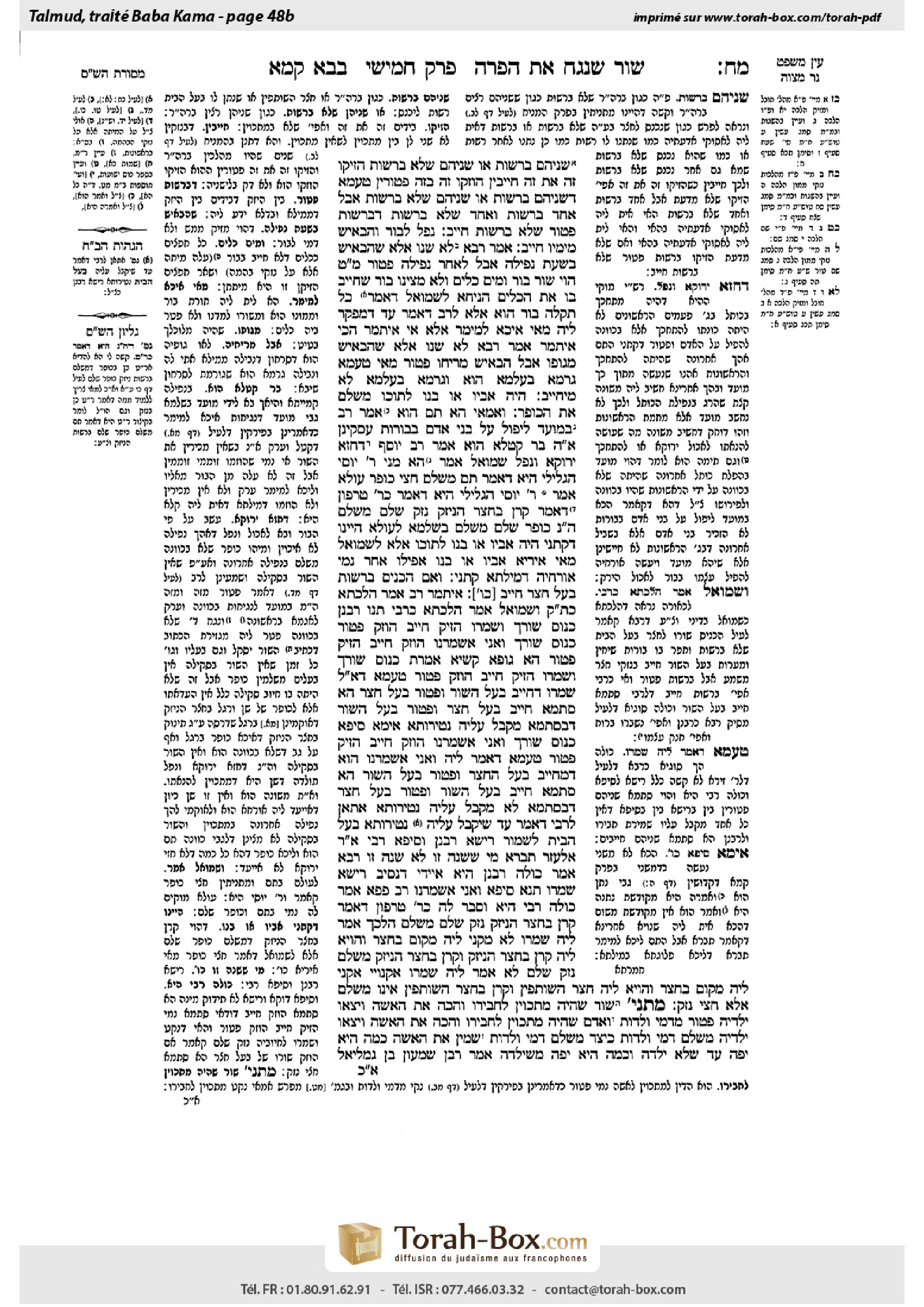
Bava Kamma 48b: Talmud study for Daf Yomi
Study the Talmud for Daf Yomi with scanned pages, Hebrew text, English translations from Sefaria and AI-generated French translations.
Passage selection and English or AI-generated French translation are available where the scan has annotations. Daf Study is independent of Torah-Box and Sefaria.
Browse Bava Kamma · בבא קמא · All tractatesBava Kamma 48b text and translations
This page of Bava Kamma includes the Aramaic text, an English translation and an AI-generated French translation, alongside the scan above.
בבא קמא מ״ח ב · Aramaic and Hebrew text
שְׁנֵיהֶם בִּרְשׁוּת אוֹ שְׁנֵיהֶם שֶׁלֹּא בִּרְשׁוּת, הִזִּיקוּ זֶה אֶת זֶה – חַיָּיבִין. הוּזְּקוּ זֶה בָּזֶה – פְּטוּרִין. טַעְמָא דִּשְׁנֵיהֶם בִּרְשׁוּת אוֹ שְׁנֵיהֶם שֶׁלֹּא בִּרְשׁוּת; אֲבָל אֶחָד בִּרְשׁוּת וְאֶחָד שֶׁלֹּא בִּרְשׁוּת, דְּבִרְשׁוּת – פָּטוּר, שֶׁלֹּא בִּרְשׁוּת – חַיָּיב.
נָפַל לְבוֹר וְהִבְאִישׁ מֵימָיו – חַיָּיב. אָמַר רָבָא: לֹא שָׁנוּ אֶלָּא שֶׁהִבְאִישׁ בִּשְׁעַת נְפִילָה, אֲבָל לְאַחַר נְפִילָה – פָּטוּר. מַאי טַעְמָא? הָוֵי שׁוֹר ״בּוֹר״ וּמַיִם ״כֵּלִים״, וְלֹא מָצִינוּ בּוֹר שֶׁחִיֵּיב בּוֹ אֶת הַכֵּלִים.
הָנִיחָא לִשְׁמוּאֵל, דְּאָמַר: כֹּל תַּקָּלָה – בּוֹר הוּא. אֶלָּא לְרַב, דְּאָמַר: עַד דְּמַפְקַר לֵיהּ, מַאי אִיכָּא לְמֵימַר?
אֶלָּא אִי אִיתְּמַר – הָכִי אִיתְּמַר, אָמַר רָבָא: לֹא שָׁנוּ אֶלָּא שֶׁהִבְאִישׁ מִגּוּפוֹ, אֲבָל הִבְאִישׁ מֵרֵיחוֹ – פָּטוּר. מַאי טַעְמָא? גְּרָמָא בְּעָלְמָא הוּא, וּגְרָמָא בְּעָלְמָא לָא מִיחַיַּיב.
הָיָה אָבִיו אוֹ בְּנוֹ לְתוֹכוֹ – מְשַׁלֵּם אֶת הַכּוֹפֶר. וְאַמַּאי? הָא תָּם הוּא! אָמַר רַב: בְּמוּעָד לִיפּוֹל עַל בְּנֵי אָדָם בְּבוֹרוֹת עָסְקִינַן.
אִי הָכִי, בַּר קְטָלָא הוּא! אָמַר רַב יוֹסֵף: דַּחֲזָא יְרוֹקָא וּנְפַל.
שְׁמוּאֵל אָמַר: הָא מַנִּי – רַבִּי יוֹסֵי הַגְּלִילִי הִיא, דְּאָמַר: תָּם מְשַׁלֵּם חֲצִי כּוֹפֶר.
עוּלָּא אָמַר: רַבִּי יוֹסֵי הַגְּלִילִי הִיא – דְּאָמַר כְּרַבִּי טַרְפוֹן, דְּאָמַר: קֶרֶן בַּחֲצַר הַנִּיזָּק – נֶזֶק שָׁלֵם מְשַׁלֵּם. הָכִי נָמֵי, כּוֹפֶר שָׁלֵם מְשַׁלֵּם.
בִּשְׁלָמָא לְעוּלָּא, הַיְינוּ דְּקָתָנֵי: הָיָה אָבִיו אוֹ בְּנוֹ לְתוֹכוֹ. אֶלָּא לִשְׁמוּאֵל, מַאי אִירְיָא אָבִיו אוֹ בְּנוֹ? אֲפִילּוּ אַחֵר נָמֵי!
אוֹרְחֵיהּ דְּמִילְּתָא קָתָנֵי.
וְאִם הִכְנִיס בִּרְשׁוּת – בַּעַל חָצֵר חַיָּיב [כּוּ׳]. אִיתְּמַר, רַב אָמַר: הִלְכְתָא כְּתַנָּא קַמָּא, וּשְׁמוּאֵל אָמַר: הִלְכְתָא כְּרַבִּי.
תָּנוּ רַבָּנַן: ״כְּנוֹס שׁוֹרְךָ וְשׇׁמְרוֹ״ – הִזִּיק חַיָּיב, הוּזַּק פָּטוּר. ״כְּנוֹס שׁוֹרְךָ וַאֲנִי אֶשְׁמְרֶנּוּ״ – הוּזַּק חַיָּיב, הִזִּיק פָּטוּר.
הָא גוּפָא קַשְׁיָא – אָמְרַתְּ: ״כְּנוֹס שׁוֹרְךָ וְשׇׁמְרוֹ״ – הִזִּיק חַיָּיב, הוּזַּק פָּטוּר;
טַעְמָא דַּאֲמַר לֵיהּ ״שׇׁמְרוֹ״ דְּחַיָּיב בַּעַל הַשּׁוֹר וּפָטוּר בַּעַל חָצֵר, הָא סְתָמָא – חַיָּיב בַּעַל חָצֵר וּפָטוּר בַּעַל הַשּׁוֹר, דְּבִסְתָמָא מְקַבֵּל עֲלֵיהּ נְטִירוּתָא.
אֵימָא סֵיפָא: ״כְּנוֹס שׁוֹרְךָ וַאֲנִי אֶשְׁמְרֶנּוּ״ – הוּזַּק חַיָּיב, הִזִּיק פָּטוּר.
טַעְמָא דַּאֲמַר לֵיהּ ״וַאֲנִי אֶשְׁמְרֶנּוּ״ הוּא דִּמְחַיֵּיב בַּעַל הֶחָצֵר וּפָטוּר בַּעַל הַשּׁוֹר, הָא סְתָמָא – חַיָּיב בַּעַל הַשּׁוֹר וּפָטוּר בַּעַל חָצֵר, דְּבִסְתָמָא לָא מְקַבֵּל עֲלֵיהּ נְטִירוּתָא;
אֲתָאן לְרַבִּי, דְּאָמַר: עַד שֶׁיְּקַבֵּל עֲלֵיהּ נְטִירוּתָא בַּעַל הַבַּיִת לִשְׁמוֹר. רֵישָׁא רַבָּנַן וְסֵיפָא רַבִּי?!
אָמַר רַבִּי אֶלְעָזָר: תַּבְרָא, מִי שֶׁשָּׁנָה זוֹ לֹא שָׁנָה זוֹ. רָבָא אָמַר: כּוּלַּהּ רַבָּנַן הִיא, אַיְּידֵי דְּנָסֵיב רֵישָׁא ״שׇׁמְרוֹ״, תְּנָא סֵיפָא ״וַאֲנִי אֶשְׁמְרֶנּוּ״.
רַב פָּפָּא אָמַר: כּוּלַּהּ רַבִּי הִיא; וְסָבַר לַהּ כְּרַבִּי טַרְפוֹן, דְּאָמַר: קֶרֶן בַּחֲצַר הַנִּיזָּק – נֶזֶק שָׁלֵם מְשַׁלֵּם.
הִלְכָּךְ, אֲמַר לֵיהּ ״שׇׁמְרוֹ״ – לָא מַקְנֵי לֵיהּ מָקוֹם בֶּחָצֵר, וְהָוְיָא לַיהּ קֶרֶן בַּחֲצַר הַנִּיזָּק, וְקֶרֶן בַּחֲצַר הַנִּיזָּק מְשַׁלֵּם נֶזֶק שָׁלֵם.
לָא אֲמַר לֵיהּ ״שׇׁמְרוֹ״ – אַקְנוֹיֵי אַקְנִי לֵיהּ מָקוֹם בֶּחָצֵר, וְהָוְיָא לֵיהּ חֲצַר הַשּׁוּתָּפִין, וְקֶרֶן בַּחֲצַר הַשּׁוּתָּפִין אֵינוֹ מְשַׁלֵּם אֶלָּא חֲצִי נֶזֶק.
מַתְנִי׳ שׁוֹר שֶׁהָיָה מִתְכַּוֵּין לַחֲבֵירוֹ, וְהִכָּה אֶת הָאִשָּׁה וְיָצְאוּ יְלָדֶיהָ – פָּטוּר מִדְּמֵי וְלָדוֹת. וְאָדָם שֶׁהָיָה מִתְכַּוֵּין לַחֲבֵירוֹ, וְהִכָּה הָאִשָּׁה וְיָצְאוּ יְלָדֶיהָ – מְשַׁלֵּם דְּמֵי וְלָדוֹת.
כֵּיצַד מְשַׁלֵּם דְּמֵי וְלָדוֹת? שָׁמִין הָאִשָּׁה כַּמָּה הִיא יָפָה עַד שֶׁלֹּא יָלָדָה, וְכַמָּה הִיא יָפָה מִשֶּׁיָּלָדָה. אָמַר רַבָּן שִׁמְעוֹן בֶּן גַּמְלִיאֵל:
Bava Kamma 48b · English translation
In a case of two people who were both somewhere with permission, or two people who were both somewhere without permission, if they injure each other directly, they are both liable. If they were injured by one another through stumbling over one another, they are exempt. From this statement, it may be inferred that the reason both are liable if either damages the other is specifically that the two of them were both there with permission or the two of them were both there without permission. But if one, i.e., the homeowner, was there with permission, and the other entered without permission, then the one who was there with permission is exempt if he injured the other, but the one who entered without permission is liable if he injured the homeowner, in accordance with the opinion of Rava and Rav Pappa.
§ The mishna teaches: If the ox that he brought into the courtyard without permission fell into the owner’s pit and contaminated its water, the owner of the ox is liable. Rava says: They taught this halakha only in a case where the ox contaminated the water at the time of the fall. But if it contaminated the water after the fall, e.g., the animal died there and the decomposing carcass despoiled the water, he is exempt. What is the reason? The ox, in this case, is considered as a pit, and the water has the status of utensils that fall into a pit, and we have not found a case of damage categorized as Pit that renders one liable for causing damage to utensils. Therefore, he is exempt.
The Gemara asks: This works out well according to the opinion of Shmuel, who says: Any obstruction is categorized as Pit, and the same halakha exempting the one responsible for the pit from damage to utensils applies to them as well. But according to the opinion of Rav, who says that one’s property is not categorized as Pit until he renounces ownership of it, what is there to say? Presumably, the owner did not renounce ownership of the ox or even of the carcass.
Rather, if this statement was stated, it was stated like this: Rava says that they taught this halakha only in the case where the ox contaminated the water with its body, i.e., its carcass. But if it contaminated the water with its stench, the owner is exempt. What is the reason? It is because the damage is caused merely by an indirect action. Although the ox’s owner was initially responsible for his animal falling into the pit, the stench did not result directly from this action. It subsequently occurred on its own, and one is not liable for damage that is caused merely by an indirect action.
§ The mishna teaches: If the homeowner’s father or son were inside the pit at the time the ox fell and the person died as a result, the owner of the ox pays the ransom. The Gemara asks: But why does he pay a ransom? Isn’t the ox innocuous, in which case its owner is not liable to pay a ransom? Rav says: Here we are dealing with an ox that is forewarned for falling on people in pits.
The Gemara asks: If so, the ox is liable to be put to death, because if it is forewarned for this behavior, it is considered to have acted intentionally. Rav Yosef said in response: This is a case where it saw some grass that it intended to eat on the edge of the pit, and fell in the pit instead. Since there was no intention to cause damage by falling, the ox is not liable to be put to death, but since it was forewarned for this behavior, its owner still pays ransom.
Shmuel said: This ox mentioned in the mishna is innocuous, and in accordance with whose opinion is this? It is the opinion of Rabbi Yosei HaGelili, who says: The owner of an innocuous ox that caused damage pays half a ransom. Therefore, when the mishna states that he pays a ransom, it means that he pays half a ransom.
Ulla said: The mishna is in accordance with the opinion of Rabbi Yosei HaGelili, who maintains that payment of a ransom is applicable even in the case of an innocuous ox, but he states his ruling in accordance with the opinion of Rabbi Tarfon, who says: For damage categorized as Goring that is carried out by an innocuous ox in the courtyard of the injured party, the ox’s owner pays the full cost of the damage. So too, he pays a full ransom despite the fact that the ox is innocuous.
The Gemara asks: Granted, according to Ulla, this explanation is consistent with that which the mishna teaches: If his father or his son were inside the pit at the time the ox fell and the person died as a result, the owner of the ox pays the ransom. The mishna thereby provides a case of damage categorized as Goring in the courtyard of the injured party. But according to Shmuel’s explanation, why mention his father or his son specifically? Even if the injured party were another person, not a close relative of the owner of the property, the owner of the animal would be required to pay half a ransom, and even if it was in the public domain.
The Gemara answers: Indeed, that is the case, and the mishna is simply teaching this ruling by means of the typical scenario, that presumably it was someone from the family of the one who owns the property containing the pit that was inside the pit.
§ The mishna teaches: But if he brought the ox into the courtyard with permission, the owner of the courtyard is liable for the damage caused. Rabbi Yehuda HaNasi says: The homeowner is not liable in any of the cases in the mishna, even if he gave his permission for the items to be brought onto his premises, unless he explicitly accepts responsibility upon himself to safeguard them. It was stated that the Sages disagreed with regard to the halakha in this dispute: Rav said that the halakha is in accordance with the opinion of the first tanna, and Shmuel said that the halakha is in accordance with the opinion of Rabbi Yehuda HaNasi.
The Sages taught a case similar to that of the mishna: If the owner of the courtyard said to the owner of the ox: Bring your ox into my courtyard and safeguard it, then if the ox caused damage to the property of the owner of the courtyard, the animal’s owner is liable. And if the ox was injured, the owner of the courtyard is exempt. If he said to him: Bring your ox in and I will safeguard it, then if the ox was injured, the owner of the courtyard is liable; if the ox caused damage, its owner is exempt.
The Gemara asks: This matter itself is difficult: You said in the first clause that if the courtyard’s owner said to him: Bring your ox into my courtyard and safeguard it, then if the ox caused damage, its owner is liable. And if it was injured, the owner of the courtyard is exempt.
The Gemara infers: The reason that the owner of the ox is liable and the owner of the courtyard is exempt is specifically that the owner of the courtyard said to the owner of the ox: Safeguard it. One can infer that if he granted permission for the ox to enter without specifying that the owner of the animal safeguard it, the owner of the courtyard is liable if the ox was injured, and the owner of the ox is exempt if it caused damage. The reason the owner of the courtyard is liable is that the tanna of this baraita holds that in an unspecified case, where the obligation to safeguard the animal was not mentioned, the owner of the courtyard implicitly accepts upon himself responsibility for safeguarding the ox.
The Gemara continues its analysis of the baraita: Say the latter clause: If he said to him: Bring your ox in and I will safeguard it, then if the ox was injured, the owner of the courtyard is liable; if the ox caused damage, its owner is exempt.
The Gemara infers: The reason that the owner of the courtyard is liable and the owner of the ox is exempt is specifically that the homeowner said to the owner of the ox: And I will safeguard it. One can infer that if the owner of the courtyard granted permission for the ox to enter without specifying that the owner of the animal safeguard it, the owner of the ox is liable if it damages the property of the owner of the courtyard, and the owner of the courtyard is exempt if the ox is damaged. The reason the owner of the courtyard is not liable is that the tanna of this baraita holds that in an unspecified case, where the obligation to safeguard the animal was not mentioned, the owner of the courtyard does not accept upon himself responsibility for safeguarding the ox.
The Gemara concludes its analysis: We come to the opinion of Rabbi Yehuda HaNasi, who says that unless the homeowner explicitly accepts upon himself responsibility for safeguarding, he is not liable. Based on this understanding, the first clause of the baraita is in accordance with the opinion of the Rabbis, and the latter clause is in accordance with the opinion of Rabbi Yehuda HaNasi.
Rabbi Elazar said: Indeed, the baraita is disjointed, and the one who taught this clause did not teach that clause. Rava said: The entire baraita is in accordance with the opinion of the Rabbis, and no inference should be drawn from the extra words: And I will safeguard it, in the latter clause. Since the first clause mentions that the owner of the courtyard instructed: Safeguard it, the latter clause also teaches that he said: And I will safeguard it, to maintain symmetry. The same halakha applies even when granting permission to enter without specification, since, according to the Rabbis, granting permission to enter includes an implicit acceptance of responsibility for safeguarding.
Rav Pappa said: The entire baraita is in accordance with the opinion of Rabbi Yehuda HaNasi, who holds that if no specification was made, the owner of the courtyard does not accept responsibility, as inferred from the latter clause of the baraita. And as for the inference drawn from the first clause, he holds in accordance with the opinion of Rabbi Tarfon, who says: For damage categorized as Goring that is carried out by an innocuous ox in the courtyard of the injured party, the ox’s owner pays the full cost of the damage.
Therefore, if the owner of the courtyard said to the owner of the ox: Safeguard it, he is clearly not transferring the rights to any portion of the courtyard to him, as evident from the fact that the owner of the ox must safeguard it and may not treat the courtyard as if it were his own. Consequently, if the ox gored, it is a case of damage categorized as Goring in the courtyard of the injured party, and one responsible for damage categorized as Goring in the courtyard of the injured party pays the full cost of the damage.
By contrast, if the owner of the courtyard did not say to the owner of the ox: Safeguard it, then by granting him permission to bring the ox onto his courtyard, he effectively transfers rights to an area within the courtyard. Therefore, with regard to damages, it becomes a courtyard of partners, and the one responsible for damage categorized as Goring in the courtyard of partners pays only half the cost of the damage.
MISHNA: In the case of an ox that was intending to gore another ox but struck a pregnant woman, and her offspring, i.e., the fetuses, emerged due to miscarriage, the owner of the ox is exempt from paying compensation for miscarried offspring. But in the case of a person who was intending to injure another but struck a pregnant woman instead, and her offspring emerged due to miscarriage, he pays compensation for miscarried offspring.
How does he pay compensation for miscarried offspring, i.e., how is their value assessed? The court appraises the value of the woman by calculating how much she would be worth if sold as a maidservant before giving birth, and how much she would be worth after giving birth. He then pays the difference in value to the woman’s husband. Rabban Shimon ben Gamliel said:
Bava Kamma 48b · Traduction française (IA)
Dans un cas où deux personnes étaient toutes les deux présentes avec autorisation, ou toutes les deux présentes sans autorisation, si elles se blessent mutuellement directement, elles sont toutes les deux tenues responsables. Si elles se sont blessées l'une par l'autre en se heurtant, elles sont exemptes. De cette déclaration, on peut déduire que la raison pour laquelle les deux sont tenues responsables si l'une endommage l'autre est spécifiquement que les deux étaient présentes avec autorisation ou les deux sans autorisation. Mais si l'un, c'est-à-dire le propriétaire, était présent avec autorisation, et l'autre est entré sans autorisation, alors celui qui était présent avec autorisation est exempt si il a blessé l'autre, mais celui qui est entré sans autorisation est responsable si il a blessé le propriétaire, conformément à l'opinion de Rava et de Rav Pappa.
§ La mitsna enseigne : Si l'ox que l'on a amené dans la cour sans autorisation tombe dans le puits du propriétaire et contamine l'eau, le propriétaire de l'ox est responsable. Rava dit : Ils ont enseigné cette halakha uniquement dans le cas où l'ox a contaminé l'eau au moment de la chute. Mais si l'ox a contaminé l'eau après la chute, par exemple, si l'animal est mort là et que le cadavre en décomposition a souillé l'eau, il est exempt. Quelle est la raison ? L'ox, dans ce cas, est considéré comme un puits, et l'eau a le statut des ustensiles qui tombent dans un puits, et nous n'avons pas trouvé de cas de dommage classé comme puits qui rend responsable de dommages aux ustensiles. Par conséquent, il est exempt.
Le Guemara pose la question : Cela s'explique bien selon l'opinion de Shmuel, qui dit : Tout obstacle est considéré comme un puits, et la même halakha exemptant celui responsable du puits de dommages aux ustensiles s'applique également à eux. Mais selon l'opinion de Rav, qui dit que la propriété d'une personne n'est pas considérée comme un puits jusqu'à ce qu'elle renonce à sa propriété, que dire alors ? On suppose que le propriétaire n'a pas renoncé à la propriété de l'ox ou même du cadavre.
Plutôt, si cette déclaration a été faite, elle a été faite ainsi : Rava dit que cette halakha a été enseignée uniquement dans le cas où l'ox a contaminé l'eau avec son corps, c'est-à-dire son cadavre. Mais si l'ox a contaminé l'eau avec son odeur, le propriétaire est exempt. Quelle est la raison ? C'est parce que le dommage est causé uniquement par une action indirecte. Bien que le propriétaire de l'ox ait été initialement responsable de la chute de l'animal dans le puits, l'odeur n'a pas résulté directement de cette action. Elle s'est produite ultérieurement de manière indépendante, et on n'est pas responsable de dommages causés uniquement par une action indirecte.
§ La mitsna enseigne : Si le père ou le fils du propriétaire étaient dans le puits au moment où l'ox est tombé et que la personne est morte en conséquence, le propriétaire de l'ox paie le rançon. Le Guemara pose la question : Mais pourquoi paie-t-il un rançon ? N'est-ce pas que l'ox est inoffensif, dans ce cas, et son propriétaire n'est pas responsable de payer un rançon ? Rav dit : Ici, nous parlons d'un ox qui est averti de tomber sur les personnes dans les puits.
Le Guemara pose la question : Si c'est ainsi, l'ox est tenu responsable d'être tué, car s'il a été mis en garde contre ce comportement, il est considéré comme ayant agi intentionnellement. Rav Yosef répondit : C'est un cas où l'ox a vu de l'herbe qu'il voulait manger sur le bord du puits, mais il est tombé dans le puits au lieu de manger l'herbe. Comme il n'avait pas l'intention de causer un dommage en tombant, l'ox n'est pas tenu responsable d'être tué, mais comme il avait été mis en garde contre ce comportement, son propriétaire paie quand même le rançon.
Shmuel dit : Cet ox mentionné dans la mitsna est inoffensif, et selon quel opinion est-ce ? C'est l'opinion de Rabbi Yosei HaGelili, qui dit : Le propriétaire d'un ox inoffensif qui a causé un dommage paie la moitié du rançon. Par conséquent, lorsque la mitsna dit qu'il paie un rançon, cela signifie qu'il paie la moitié du rançon.
Ulla dit : La mitsna est selon l'opinion de Rabbi Yosei HaGelili, qui maintient que le paiement du rançon s'applique même dans le cas d'un ox inoffensif, mais il formule sa décision selon l'opinion de Rabbi Tarfon, qui dit : Pour un dommage classé comme cornage causé par un ox inoffensif dans la cour du blessé, le propriétaire de l'ox paie le coût complet du dommage. De même, il paie un rançon complet malgré le fait que l'ox est inoffensif.
Le Guemara pose la question : Admettons, selon Ulla, cette explication est cohérente avec ce que la mitsna enseigne : Si son père ou son fils étaient dans le puits au moment où l'ox est tombé et que la personne est morte en conséquence, le propriétaire de l'ox paie le rançon. La mitsna nous montre ainsi un cas de dommage classé comme cornage dans la cour du blessé. Mais selon l'explication de Shmuel, pourquoi mentionner spécifiquement son père ou son fils ? Même si la personne blessée était une autre personne, pas un proche du propriétaire de la propriété, le propriétaire de l'animal serait tenu de payer la moitié du rançon, et même si cela s'était produit dans le domaine public.
Le Guemara répond : En effet, c'est ainsi, et la mitsna enseigne simplement cette décision par le scénario typique, à savoir que probablement c'était quelqu'un de la famille de celui qui possède la propriété contenant le puits qui était dans le puits.
§ La mitsna enseigne : Mais si l'on a amené l'ox dans la cour avec autorisation, le propriétaire de la cour est responsable du dommage causé. Rabbi Yehuda HaNasi dit : Le propriétaire n'est pas responsable dans aucun des cas de la mitsna, même s'il a donné son autorisation pour que les objets soient amenés sur ses terres, à moins qu'il ne s'engage explicitement à les protéger. Il a été dit que les Sages étaient en désaccord sur la halakha dans ce débat : Rav dit que la halakha suit l'opinion du premier tanna, et Shmuel dit que la halakha suit l'opinion de Rabbi Yehuda HaNasi.
Les Sages ont enseigné un cas similaire à celui de la mitsna : Si l'propriétaire du courtil a dit à l'propriétaire de la bête : Apporte ta bête dans mon courtil et garde-la en sécurité, alors si la bête a causé un préjudice à la propriété de l'propriétaire du courtil, l'propriétaire de la bête est responsable. Et si la bête a été blessée, l'propriétaire du courtil est exempt. Si il a dit à lui : Apporte ta bête et je la garde en sécurité, alors si la bête a été blessée, l'propriétaire du courtil est responsable ; si la bête a causé un préjudice, son propriétaire est exempt.
Le Guemara pose la question : Ce cas même est difficile : Vous avez dit dans la première partie que si l'propriétaire du courtil a dit à lui : Apporte ta bête dans mon courtil et garde-la en sécurité, alors si la bête a causé un préjudice, son propriétaire est responsable. Et si la bête a été blessée, l'propriétaire du courtil est exempt.
Le Guemara déduit : La raison pour laquelle l'propriétaire de la bête est responsable et l'propriétaire du courtil est exempt est spécifiquement que l'propriétaire du courtil a dit à l'propriétaire de la bête : Garde-la en sécurité. On peut déduire que si il a autorisé la bête à entrer sans spécifier que l'propriétaire de la bête doive la garder en sécurité, l'propriétaire du courtil est responsable si la bête a été blessée, et l'propriétaire de la bête est exempt si elle a causé un préjudice. La raison pour laquelle l'propriétaire du courtil est responsable est que le tanna de ce baraïta considère que dans un cas non spécifié, où l'obligation de garder la bête en sécurité n'a pas été mentionnée, l'propriétaire du courtil accepte implicitement la responsabilité de la garder en sécurité.
Le Guemara continue son analyse du baraïta : Dites la seconde partie : Si l'on a dit à lui : Apporte ta bête et je la garde en sécurité, alors si la bête a été blessée, l'propriétaire du courtil est responsable ; si la bête a causé un préjudice, son propriétaire est exempt.
Le Guemara déduit : La raison pour laquelle l'propriétaire du courtil est responsable et l'propriétaire de la bête est exempt est spécifiquement que l'propriétaire du courtil a dit à l'propriétaire de la bête : Et je la garde en sécurité. On peut déduire que si l'propriétaire du courtil a autorisé la bête à entrer sans spécifier que l'propriétaire de la bête doive la garder en sécurité, l'propriétaire de la bête est responsable si elle cause un préjudice à la propriété de l'propriétaire du courtil, et l'propriétaire du courtil est exempt si la bête est blessée. La raison pour laquelle l'propriétaire du courtil n'est pas responsable est que le tanna de ce baraïta considère que dans un cas non spécifié, où l'obligation de garder la bête en sécurité n'a pas été mentionnée, l'propriétaire du courtil ne accepte pas implicitement la responsabilité de la garder en sécurité.
Le Guemara conclut son analyse : Nous sommes en accord avec l'opinion de Rabbi Yehuda HaNasi, qui dit que moins l'propriétaire du courtil accepte explicitement la responsabilité de garder la bête en sécurité, moins il est responsable. Selon cette compréhension, la première partie du baraïta est en accord avec l'opinion des Rabbins, et la seconde partie est en accord avec l'opinion de Rabbi Yehuda HaNasi.
Rabbi Elazar a dit : En effet, le baraïta est disjoint, et celui qui a enseigné cette clause n'a pas enseigné cette clause. Rava a dit : L'ensemble du baraïta est en accord avec l'opinion des Rabbins, et aucune déduction ne devrait être tirée des mots supplémentaires : Et je la garde en sécurité, dans la seconde partie. Puisque la première partie mentionne que l'propriétaire du courtil a dit : Garde-la en sécurité, la seconde partie enseigne également qu'il a dit : Et je la garde en sécurité, pour maintenir la symétrie. La même halakha s'applique même lors de l'autorisation à entrer sans spécification, car, selon les Rabbins, l'autorisation à entrer inclut une acceptation implicite de la responsabilité de la garder en sécurité.
Rav Pappa a dit : L'ensemble du baraïta est en accord avec l'opinion de Rabbi Yehuda HaNasi, qui considère que si aucune spécification n'a été faite, l'propriétaire du courtil ne prend pas la responsabilité, comme déduit de la seconde partie du baraïta. Et concernant la déduction tirée de la première partie, il considère qu'il suit l'opinion de Rabbi Tarfon, qui dit : Pour les dommages classés comme Goring causés par une bête inoffensive dans le courtil de la victime, l'propriétaire de la bête paie le coût complet des dommages.
Par conséquent, si l'propriétaire du courtil a dit à l'propriétaire de la bête : Garde-la en sécurité, il est clairement ne transfère pas les droits à aucune partie du courtil à lui, comme le montre le fait que l'propriétaire de la bête doit la garder en sécurité et ne peut pas traiter le courtil comme s'il était sien. Ainsi, si la bête a causé un Goring, c'est un cas de dommage classé comme Goring dans le courtil de la victime, et celui responsable de dommage classé comme Goring dans le courtil de la victime paie le coût complet des dommages.
Par contraste, si l'propriétaire du courtil n'a pas dit à l'propriétaire de la bête : Garde-la en sécurité, alors en autorisant lui à apporter la bête dans son courtil, il transfère effectivement les droits à une zone du courtil. Ainsi, concernant les dommages, cela devient un courtil de partenaires, et celui responsable de dommage classé comme Goring dans le courtil de partenaires paie seulement la moitié du coût des dommages.
MICHNA : Dans le cas d'une bête qui avait l'intention de tuer une autre bête mais a frappé une femme enceinte, et ses enfants, c'est-à-dire les fœtus, sont sortis à cause d'un avortement, l'propriétaire de la bête est exempt de payer une compensation pour les enfants avortés. Mais dans le cas d'une personne qui avait l'intention de blesser une autre personne mais a frappé une femme enceinte au lieu, et ses enfants sont sortis à cause d'un avortement, il paie une compensation pour les enfants avortés.
Comment paie-t-il la compensation pour les enfants avortés, c'est-à-dire comment est-il évalué leur valeur ? Le tribunal évalue la valeur de la femme en calculant combien elle serait valable si elle était vendue comme une servante avant d'accoucher, et combien elle serait valable après avoir accouché. Il paie alors la différence de valeur au mari de la femme. Rabban Shimon ben Gamliel a dit :
Traduction française générée par IA à partir de l’édition anglaise de Sefaria. Vérifie toujours un passage avec le texte source.
Text from Sefaria: William Davidson Edition - Vocalized Aramaic (CC BY NC); William Davidson Edition - English (CC BY NC).