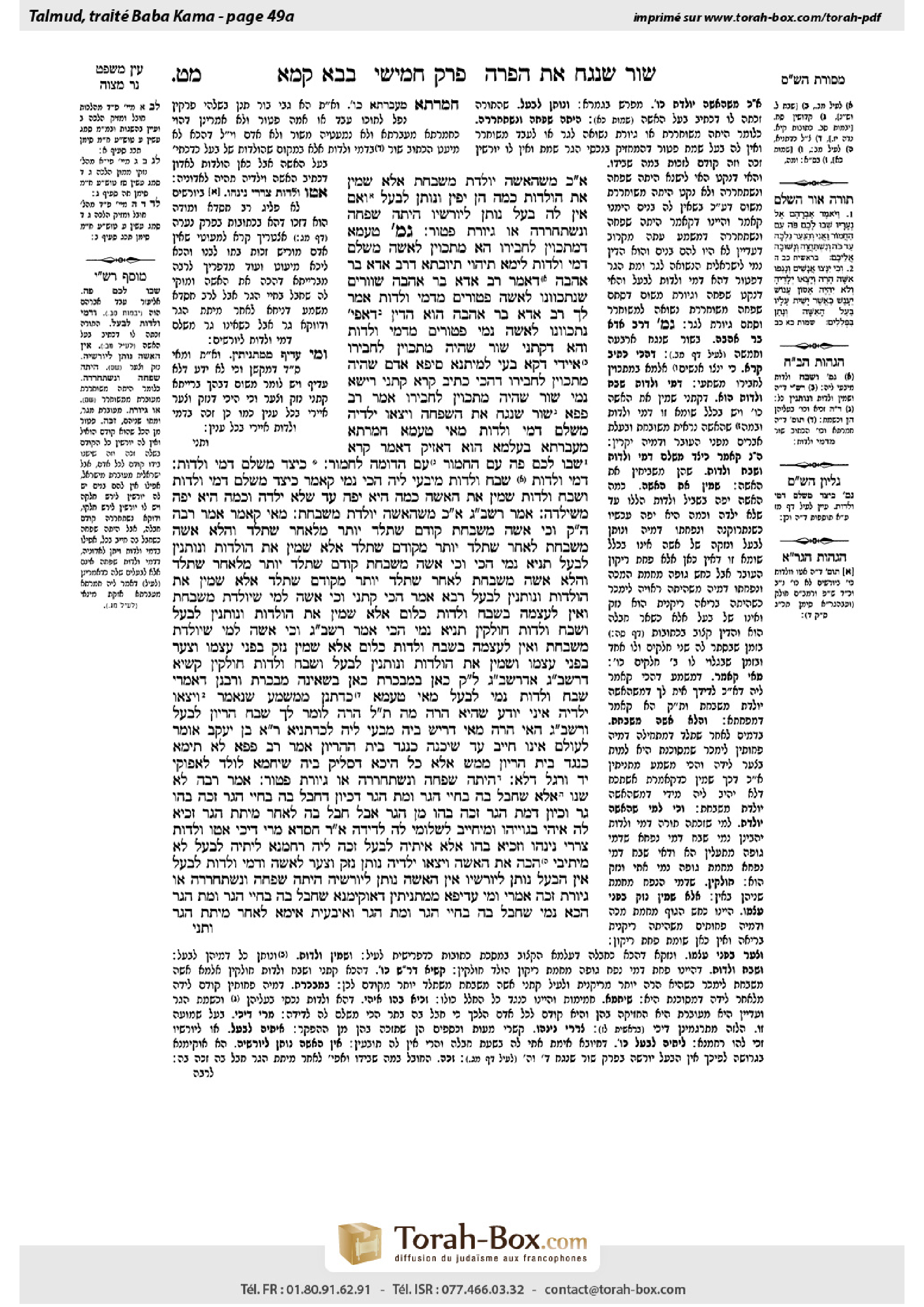
Bava Kamma 49a: Talmud study for Daf Yomi
Study the Talmud for Daf Yomi with scanned pages, Hebrew text, English translations from Sefaria and AI-generated French translations.
Passage selection and English or AI-generated French translation are available where the scan has annotations. Daf Study is independent of Torah-Box and Sefaria.
Browse Bava Kamma · בבא קמא · All tractatesBava Kamma 49a text and translations
This page of Bava Kamma includes the Aramaic text, an English translation and an AI-generated French translation, alongside the scan above.
בבא קמא מ״ט א · Aramaic and Hebrew text
אִם כֵּן, מִשֶּׁהָאִשֶּׁה יוֹלֶדֶת מַשְׁבַּחַת! אֶלָּא שָׁמִין אֶת הַוְּלָדוֹת כַּמָּה הֵן יָפִין, וְנוֹתֵן לַבַּעַל. וְאִם אֵין לַהּ בַּעַל – נוֹתֵן לְיוֹרְשָׁיו.
הָיְתָה שִׁפְחָה וְנִשְׁתַּחְרְרָה, אוֹ גִיּוֹרֶת – פָּטוּר.
גְּמָ׳ טַעְמָא דְּמִתְכַּוֵּין לַחֲבֵירוֹ, הָא מִתְכַּוֵּין לָאִשָּׁה – מְשַׁלֵּם דְּמֵי וְלָדוֹת. לֵימָא תֶּיהְוֵי תְּיוּבְתָּא דְּרַב אַדָּא בַּר אַהֲבָה – דְּאָמַר רַב אַדָּא בַּר אַהֲבָה: שְׁווֹרִים שֶׁנִּתְכַּוְּונוּ לָאִשָּׁה – פְּטוּרִים מִדְּמֵי וְלָדוֹת?
אָמַר לְךָ רַב אַדָּא בַּר אַהֲבָה: הוּא הַדִּין דַּאֲפִילּוּ נִתְכַּוְּונוּ לָאִשָּׁה נָמֵי פְּטוּרִים מִדְּמֵי וְלָדוֹת; וְהָא דְּקָתָנֵי: ״שׁוֹר שֶׁהָיָה מִתְכַּוֵּין לַחֲבֵירוֹ״ – אַיְּידֵי דְּקָא בָּעֵי לְמִיתְנָא סֵיפָא: ״אָדָם שֶׁהָיָה מִתְכַּוֵּין לַחֲבֵירוֹ״ – דְּהָכִי כְּתִיב קְרָא, קָתָנֵי רֵישָׁא נָמֵי: ״שׁוֹר שֶׁהָיָה מִתְכַּוֵּין לַחֲבֵירוֹ״.
אָמַר רַב פָּפָּא: שׁוֹר שֶׁנָּגַח אֶת הַשִּׁפְחָה, וְיָצְאוּ יְלָדֶיהָ – מְשַׁלֵּם דְּמֵי וְלָדוֹת. מַאי טַעְמָא? חֲמָרְתָּא מְעַבַּרְתָּא בְּעָלְמָא הוּא דְּאַזֵּיק, דְּאָמַר קְרָא: ״שְׁבוּ לָכֶם פֹּה עִם הַחֲמוֹר״ – עַם הַדּוֹמֶה לַחֲמוֹר.
כֵּיצַד מְשַׁלֵּם דְּמֵי וְלָדוֹת. ״דְּמֵי וְלָדוֹת״?! ״שְׁבַח וְלָדוֹת״ מִיבְּעֵי לֵיהּ! הָכִי נָמֵי קָאָמַר: כֵּיצַד מְשַׁלֵּם דְּמֵי וְלָדוֹת וּשְׁבַח וְלָדוֹת – שָׁמִין אֶת הָאִשָּׁה כַּמָּה הִיא יָפָה עַד שֶׁלֹּא יָלָדָה, וְכַמָּה הִיא יָפָה מִשֶּׁיָּלָדָה.
אָמַר רַבָּן שִׁמְעוֹן בֶּן גַּמְלִיאֵל: אִם כֵּן, מִשֶּׁהָאִשֶּׁה יוֹלֶדֶת מַשְׁבַּחַת! מַאי קָאָמַר? אָמַר רַבָּה, הָכִי קָאָמַר: וְכִי אִשָּׁה מַשְׁבַּחַת קוֹדֶם שֶׁתֵּלֵד יוֹתֵר מִלְּאַחַר שֶׁתֵּלֵד? וַהֲלֹא אִשָּׁה מַשְׁבַּחַת לְאַחַר שֶׁתֵּלֵד יוֹתֵר מִקּוֹדֶם שֶׁתֵּלֵד! אֶלָּא שָׁמִין אֶת הַוְּלָדוֹת, וְנוֹתְנִין לַבַּעַל.
תַּנְיָא נָמֵי הָכִי: וְכִי אִשָּׁה מַשְׁבַּחַת קוֹדֶם שֶׁתֵּלֵד יוֹתֵר מִלְּאַחַר שֶׁתֵּלֵד? וַהֲלֹא אִשָּׁה מַשְׁבַּחַת לְאַחַר שֶׁתֵּלֵד יוֹתֵר מִקּוֹדֶם שֶׁתֵּלֵד! אֶלָּא שָׁמִין אֶת הַוְּלָדוֹת וְנוֹתְנִין לַבַּעַל.
רָבָא אָמַר, הָכִי קָתָנֵי: וְכִי אִשָּׁה – לְמִי שֶׁיּוֹלֶדֶת מַשְׁבַּחַת, וְאֵין לְעַצְמָהּ בִּשְׁבַח וְלָדוֹת כְּלוּם? אֶלָּא שָׁמִין אֶת הַוְּלָדוֹת וְנוֹתְנִין לַבַּעַל, וּשְׁבַח וְלָדוֹת חוֹלְקִין.
תַּנְיָא נָמֵי הָכִי, אָמַר רַבָּן שִׁמְעוֹן בֶּן גַּמְלִיאֵל: וְכִי אִשָּׁה – לְמִי שֶׁיּוֹלֶדֶת מַשְׁבַּחַת, וְאֵין לְעַצְמָהּ בִּשְׁבַח וְלָדוֹת כְּלוּם? אֶלָּא שָׁמִין נֶזֶק בִּפְנֵי עַצְמוֹ, וְצַעַר בִּפְנֵי עַצְמוֹ; וְשָׁמִין אֶת הַוְּלָדוֹת וְנוֹתְנִין לַבַּעַל, וּשְׁבַח וְלָדוֹת חוֹלְקִין.
קַשְׁיָא דְּרַבָּן שִׁמְעוֹן בֶּן גַּמְלִיאֵל אַדְּרַבָּן שִׁמְעוֹן בֶּן גַּמְלִיאֵל!
לָא קַשְׁיָא; כָּאן בִּמְבַכֶּרֶת, כָּאן בְּשֶׁאֵינָהּ מְבַכֶּרֶת.
וְרַבָּנַן דְּאָמְרִי שְׁבַח וְלָדוֹת נָמֵי לַבַּעַל – מַאי טַעְמָא? כְּדִתְנַן, מִמַּשְׁמַע שֶׁנֶּאֱמַר: ״וְיָצְאוּ יְלָדֶיהָ״ – אֵינִי יוֹדֵעַ שֶׁהִיא הָרָה? מָה תַּלְמוּד לוֹמַר: ״הָרָה״? לוֹמַר לָךְ: שְׁבַח הֵרָיוֹן לַבַּעַל.
וְרַבָּן שִׁמְעוֹן בֶּן גַּמְלִיאֵל, הַאי ״הָרָה״ מַאי דָּרֵישׁ בֵּיהּ? מִבְּעֵי לֵיהּ לְכִדְתַנְיָא, רַבִּי אֱלִיעֶזֶר בֶּן יַעֲקֹב אוֹמֵר: לְעוֹלָם אֵינוֹ חַיָּיב, עַד שֶׁיַּכֶּנָּה כְּנֶגֶד בֵּית הַהֵרָיוֹן. אָמַר רַב פָּפָּא: לָא תֵּימָא כְּנֶגֶד בֵּית הֵרָיוֹן מַמָּשׁ, אֶלָּא כֹּל הֵיכָא דְּסָלֵיק בֵּיהּ שִׁיחְמָא לְוָלָד. לְאַפּוֹקֵי יָד וָרֶגֶל – דְּלָא.
הָיְתָה שִׁפְחָה וְנִשְׁתַּחְרְרָה, אוֹ גִיּוֹרֶת – פָּטוּר. אָמַר רַבָּה: לֹא שָׁנוּ אֶלָּא שֶׁחָבַל בָּהּ בְּחַיֵּי הַגֵּר, וּמֵת הַגֵּר; דְּכֵיוָן דְּחָבַל בָּהּ בְּחַיֵּי הַגֵּר – זְכָה בְּהוּ גֵּר, וְכֵיוָן דְּמֵת הַגֵּר – זְכָה בְּהוּ מִן הַגֵּר. אֲבָל חָבַל בָּהּ לְאַחַר מִיתַת הַגֵּר – זָכְיָא לַהּ אִיהִי בְּגַוַּיְיהוּ, וּמִיחַיַּיב לְשַׁלּוֹמֵי לַהּ לְדִידַהּ.
אָמַר רַב חִסְדָּא: מָרֵי דֵּיכִי! אַטּוּ וְלָדוֹת צְרָרֵי נִינְהוּ – וְזָכְיָא בְּהוּ?! אֶלָּא אִיתֵיהּ לְבַעַל – זְכָה לֵיהּ רַחֲמָנָא, לֵיתֵיהּ לְבַעַל – לָא.
מֵיתִיבִי: הִכָּה אֶת הָאִשָּׁה, וְיָצְאוּ יְלָדֶיהָ – נוֹתֵן נֶזֶק וָצַעַר לָאִשָּׁה, וּדְמֵי וְלָדוֹת לַבַּעַל. אֵין הַבַּעַל – נוֹתֵן לְיוֹרְשָׁיו, אֵין הָאִשָּׁה – נוֹתֵן לְיוֹרְשֶׁיהָ. הָיְתָה שִׁפְחָה וְנִשְׁתַּחְרְרָה, אוֹ גִיּוֹרֶת – זָכָה!
אָמְרִי: וּמִי עֲדִיפָא מִמַּתְנִיתִין – דְּאוֹקֵימְנָא שֶׁחָבַל בָּהּ בְּחַיֵּי הַגֵּר, וּמֵת הַגֵּר? הָכָא נָמֵי – שֶׁחָבַל בָּהּ בְּחַיֵּי הַגֵּר, וּמֵת הַגֵּר. וְאִיבָּעֵית אֵימָא: לְאַחַר מִיתַת הַגֵּר,
Bava Kamma 49a · English translation
If so, the consequences would be absurd, as when a woman gives birth her value increases. Rather, the court appraises how much the offspring are worth, and the one liable for the damage gives that amount to the husband. And if she does not have a husband, e.g., her husband died, he gives the money to his heirs.
If the pregnant woman was a Canaanite maidservant and then she was emancipated, or a convert, and she was married to an emancipated Canaanite slave or to a convert who died without any heirs, the one who caused the damage is exempt from paying compensation for miscarried offspring. This is because this payment is made specifically to the husband, not to the woman.
GEMARA: The first clause of the mishna indicates that the reason the owner is exempt from paying compensation for the offspring when an ox unintentionally gores a pregnant woman is specifically that it was intending to gore another ox. By inference, if it was intending to gore the woman, the owner pays compensation for miscarried offspring. Shall we say that this should be a conclusive refutation of the opinion of Rav Adda bar Ahava, as Rav Adda bar Ahava says: With regard to oxen that intended to gore a woman and then did so, the owners are exempt from paying compensation for miscarried offspring?
The Gemara answers that Rav Adda bar Ahava could have said to you: The same is true, that even if the oxen intended to gore the woman, the owners are also exempt from paying compensation for miscarried offspring. As for that which is taught in the mishna: An ox that was intending to gore another ox, it is taught this way since it wants to teach the latter clause: A person that was intending to injure another person, as this case is written explicitly in the verse: “And if men struggle and hurt a pregnant woman and her offspring emerge” (Exodus 21:22). In the case in the verse, the assailant intended to injure another person but injured the woman instead. Therefore, the mishna also teaches the first clause in that style: An ox that was intending to gore another ox.
Rav Pappa says: In the case of an ox that gored a Canaanite maidservant, and her offspring emerged due to miscarriage, the owner pays compensation for miscarried offspring. What is the reason? The ox injured a mere pregnant donkey. With regard to the matter of compensation for offspring, who would be the property of the master were they to be born, a Canaanite slave is considered property of the master. As the verse states that Abraham addressed Eliezer, who was a Canaanite, by saying: “You remain here with [im] the donkey” (Genesis 22:5), on which the Sages expound that he was alluding to the idea that Eliezer is of a people [am] that is similar to a donkey. Therefore, the case of an ox goring a Canaanite maidservant is not included in the Torah’s exemption from paying compensation for miscarried offspring.
§ The mishna teaches: How does he pay compensation for miscarried offspring? The court appraises how much the value of the woman increased due to the offspring. The Gemara asks: Would this be a correct interpretation of the term: Compensation for miscarried offspring? If this is how the sum is calculated, the mishna should have stated: How does he pay the increase in value due to the offspring? The Gemara answers: That is also what the tanna is saying: How does he pay compensation for miscarried offspring and the increase in value due to the offspring? In other words, apart from evaluating the compensation for the miscarried offspring, the court also appraises the value of the woman by calculating how much she would be worth if sold as a maidservant before giving birth, and how much she would be worth after giving birth.
§ The mishna teaches: Rabban Shimon ben Gamliel said: If so, the consequences would be absurd, as when a woman gives birth her value increases. The Gemara asks: What is Rabban Shimon ben Gamliel saying? Rabba said: This is what he is saying: But is the monetary value of a woman higher before she gives birth than after she gives birth? But isn’t the opposite true, that the monetary value of a woman is higher after giving birth than before giving birth, since the concern for her dying during childbirth, which lowers her monetary value prior to giving birth, is no longer a concern? Rather, the court appraises the value of the fetuses and gives that amount to the husband.
This explanation of Rabban Shimon ben Gamliel’s statement is also taught in a baraita: But is the monetary value of a woman higher before she gives birth than after she gives birth? But isn’t the opposite true, that the monetary value of a woman is higher after giving birth than before giving birth? Rather, the court appraises the value of the fetuses and gives that amount to the husband.
Rava said: This is what Rabban Shimon ben Gamliel is teaching: But is the value of the woman higher only for the one for whom she gives birth, i.e., her husband, and she herself does not have any increase in value at all due to the offspring? A pregnant woman’s monetary value is increased on account of her pregnancy, beyond the monetary value of the offspring. Rather, the court appraises the value of the offspring and gives it to the husband. And in addition, the husband and wife divide the increase in her value due to the offspring.
This explanation of Rabban Shimon ben Gamliel’s opinion is also taught in a baraita: Rabban Shimon ben Gamliel said: But is the value of the woman higher only for the one for whom she gives birth, i.e., her husband, and she herself does not have any increase in value at all due to the offspring? Rather, the court appraises damage by itself and pain by itself, and appraises the value of the offspring and gives it to the husband, and the husband and wife divide the increase in her value due to the offspring.
The Gemara asks: The opinion of Rabban Shimon ben Gamliel in the first baraita, that the woman’s value decreases because of pregnancy, poses a difficulty for that of Rabban Shimon ben Gamliel in the second baraita, that it increases.
The Gemara answers: This is not difficult, since each baraita is referring to a different case: Here, the first baraita, which stated that the woman’s value increases after giving birth, is referring to a woman giving birth to her firstborn. Her value decreases prior to birth out of concern that she might die in childbirth. There, the second baraita, which stated that her value increases due to pregnancy, is referring to a woman who is not giving birth to her firstborn.
The Gemara asks: And what is the reason of the Rabbis in the second baraita, who say: The increase in her value due to the offspring is also given to the husband? The Gemara answers: They derive it from a redundancy in a verse, as we learned in a baraita: The verse states: “And hurt a pregnant woman and her offspring emerge” (Exodus 21:22). From the fact that it is stated: “And her offspring emerge,” don’t I know by inference that she was pregnant? If so, what is the meaning when the verse states: “A pregnant woman,” and not just “a woman”? To inform you that even the increase in her value due to the pregnancy is given to the husband.
The Gemara asks: And what halakha does Rabban Shimon ben Gamliel expound on this extra word “pregnant”? The Gemara answers: He requires it for that which is taught in a baraita: Rabbi Eliezer ben Ya’akov says that one who injures a woman is never liable to pay compensation for miscarried offspring unless he strikes her opposite the womb, i.e., on the abdomen. Rav Pappa said: Do not say that it must be literally opposite the womb. Rather, he is liable if she was struck anywhere that the wound’s impact could reach the offspring, i.e., any part of the torso, to exclude a wound to her hand or foot, for which he is not liable, since it could be argued that it was not the wound to the hand or foot that caused the miscarriage.
§ The mishna teaches: If the pregnant woman was a maidservant and then she was emancipated, or a convert, he is exempt from the payment of damages for miscarried offspring. Rabba says: They taught this halakha only in a case where one injured her during the lifetime of the convert, i.e., her husband, and the convert died before the payment was given. The reason for this is that since the assailant injured her during the lifetime of the convert, the convert acquires the money, although it is still in the possession of the one liable for the damage. And once the convert dies without heirs, the money is ownerless. Therefore, the assailant acquires it from the convert. Since anyone can assume ownership of ownerless property, the assailant, who already possesses the money, becomes the owner. But if he injured her after the convert had died, she acquires the money, and he must pay the woman herself.
Rav Ḥisda said in amazement: Master of this ruling! Is that to say that compensation for the offspring is like bundles of money, and she acquires them when her husband dies? Rabba seems to understand that the pregnant woman assumes ownership of the offspring by virtue of being in possession of them when the husband dies, and therefore has the right to compensation for them. That is not the case. Rather, if the husband is present, the Merciful One grants compensation for the offspring to him, but if the husband is not alive, the Torah does not grant compensation to anyone else.
The Gemara raises an objection against the opinion of Rabba from the following: If the assailant struck the woman and her offspring emerged due to miscarriage, he gives compensation for damage and pain to the woman and compensation for miscarried offspring to the husband. If the husband is not alive, he gives the compensation for the offspring to his heirs. If the woman is not alive, he gives the payment owed to her to her heirs. If she was a maidservant and then she was emancipated, or a convert, the assailant acquires the money. This indicates that if the husband is no longer alive, the woman doesn’t receive anything.
The Sages said in response to this: But is the baraita preferable to the mishna, which we interpreted as referring to a case where he injured her during the lifetime of the convert, and the convert then died? Here also, it must be explained that he injured her during the lifetime of the convert, and the convert then died. And if you wish, say instead that he injured her even after the death of the convert.
Bava Kamma 49a · Traduction française (IA)
Si c'est ainsi, les conséquences seraient absurdes, comme lorsqu'une femme accouche, sa valeur augmente. En réalité, la cour évalue la valeur des enfants, et celui qui est responsable du préjudice verse cette somme au mari. Et si elle n'a pas de mari, par exemple, si son mari est décédé, il verse l'argent à ses héritiers.
Si la femme enceinte était une servante cananéenne et puis elle a été affranchie, ou une convertie, et elle est mariée à un esclave cananéen affranchi ou à un converti décédé sans héritiers, celui qui a causé le préjudice est exempt de payer la compensation pour les enfants mort-nés. Cela est dû au fait que ce paiement est spécifiquement destiné au mari, pas à la femme.
GUEMARA : La première clause de la mitsna indique que la raison pour laquelle le propriétaire est exempt de payer la compensation pour les enfants lorsqu'un bœuf non intentionnellement blesse une femme enceinte est spécifiquement qu'il avait l'intention de blesser un autre bœuf. Par conséquent, si l'intention était de blesser la femme, le propriétaire paie la compensation pour les enfants mort-nés. Devons-nous dire que cela constitue une réfutation définitive de l'opinion de Rav Adda bar Ahava, comme Rav Adda bar Ahava dit : Concernant les bœufs qui avaient l'intention de blesser une femme et l'ont effectivement fait, les propriétaires sont exemptés de payer la compensation pour les enfants mort-nés ?
La Guemara répond que Rav Adda bar Ahava aurait pu dire à vous : La même chose est vraie, c'est-à-dire même si les bœufs avaient l'intention de blesser la femme, les propriétaires sont également exemptés de payer la compensation pour les enfants mort-nés. En ce qui concerne ce qui est enseigné dans la mitsva : Un bœuf qui avait l'intention de blesser un autre bœuf, cela est enseigné ainsi afin de faire comprendre la clause suivante : Une personne qui avait l'intention de blesser une autre personne, comme ce cas est explicitement mentionné dans la parabole : « Et si deux hommes s'empoignent et blessent une femme enceinte et ses enfants naissent » (Exode 21:22). Dans le cas de la parabole, l'agresseur avait l'intention de blesser une autre personne mais a blessé la femme à la place. Par conséquent, la mitsva enseigne également la première clause dans ce style : Un bœuf qui avait l'intention de blesser un autre bœuf.
Rav Pappa dit : Dans le cas d'un bœuf qui a blessé une servante cananéenne, et ses enfants sont nés par avortement, le propriétaire paie la compensation pour les enfants mort-nés. Quelle est la raison ? Le bœuf a blessé un simple âne enceinte. Concernant la question de la compensation pour les enfants, qui serait la propriété du maître s'ils étaient nés, une servante cananéenne est considérée comme la propriété du maître. Comme le texte dit que Abraham a adressé Eliezer, qui était cananéen, en disant : « Reste ici avec [im] le mulet » (Genèse 22:5), sur lequel les Sages expliquent qu'il faisait allusion à l'idée que Eliezer est d'une nation [am] semblable à un mulet. Par conséquent, le cas d'un bœuf blessant une servante cananéenne n'est pas inclus dans l'exemption du Torah de payer la compensation pour les enfants mort-nés.
§ La mitsva enseigne : Comment paie-t-on la compensation pour les enfants mort-nés ? La cour évalue la valeur de la femme qui a augmenté en raison des enfants. La Guemara demande : Serait-ce une interprétation correcte du terme : Compensation pour les enfants mort-nés ? Si c'est ainsi que la somme est calculée, la mitsva aurait dû dire : Comment paie-t-on l'augmentation de valeur en raison des enfants ? La Guemara répond : C'est aussi ce que dit le tanna : Comment paie-t-on la compensation pour les enfants mort-nés et l'augmentation de valeur en raison des enfants ? En d'autres termes, outre l'évaluation de la compensation pour les enfants mort-nés, la cour évalue également la valeur de la femme en calculant combien elle serait valorisée si elle était vendue comme servante avant l'accouchement, et combien elle serait valorisée après l'accouchement.
§ La mitsva enseigne : Rabban Shimon ben Gamliel dit : Si c'est ainsi, les conséquences seraient absurdes, comme lorsqu'une femme accouche, sa valeur augmente. La Guemara demande : Qu'est-ce que Rabban Shimon ben Gamliel dit ? Rabba dit : C'est ce qu'il dit : Mais la valeur monétaire d'une femme est-elle plus élevée avant l'accouchement qu'après ? N'est-ce pas le contraire, que la valeur monétaire d'une femme est plus élevée après l'accouchement qu'avant, puisque la préoccupation de sa mort pendant l'accouchement, qui réduit sa valeur monétaire avant l'accouchement, n'existe plus ? En réalité, la cour évalue la valeur des fœtus et verse cette somme au mari.
Cette explication de l'affirmation de Rabban Shimon ben Gamliel est également enseignée dans une baraïta : Mais la valeur monétaire d'une femme est-elle plus élevée avant l'accouchement qu'après ? N'est-ce pas le contraire, que la valeur monétaire d'une femme est plus élevée après l'accouchement qu'avant ? En réalité, la cour évalue la valeur des fœtus et verse cette somme au mari.
Rava dit : C'est ce que Rabban Shimon ben Gamliel enseigne : Mais la valeur de la femme est-elle plus élevée uniquement pour celui pour qui elle accouche, c'est-à-dire son mari, et elle-même ne subit aucune augmentation de valeur en raison des enfants ? La valeur monétaire d'une femme augmente en raison de sa grossesse, au-delà de la valeur monétaire des enfants. En réalité, la cour évalue la valeur des enfants et la verse au mari. Et en plus, le mari et la femme partagent l'augmentation de sa valeur en raison des enfants.
Cette explication de l'opinion de Rabban Shimon ben Gamliel est également enseignée dans une baraïta : Rabban Shimon ben Gamliel dit : Mais la valeur de la femme est-elle plus élevée uniquement pour celui pour qui elle accouche, c'est-à-dire son mari, et elle-même ne subit aucune augmentation de valeur en raison des enfants ? En réalité, la cour évalue le préjudice par lui-même et la douleur par elle-même, et évalue la valeur des enfants et la verse au mari, et le mari et la femme partagent l'augmentation de sa valeur en raison des enfants.
La Guemara demande : L'opinion de Rabban Shimon ben Gamliel dans la première baraïta, que la valeur de la femme diminue en raison de la grossesse, pose un problème pour celle de Rabban Shimon ben Gamliel dans la seconde baraïta, qui affirme qu'elle augmente.
La Guemara répond : Cela n’est pas difficile, puisque chaque baraïta fait référence à un cas différent : ici, la première baraïta, qui affirmait que la valeur de la femme augmente après l’accouchement, fait référence à une femme qui accouche de son premier enfant. Sa valeur diminue avant l’accouchement en raison de la crainte qu’elle puisse mourir en couches. Là, la seconde baraïta, qui affirmait que sa valeur augmente en raison de la grossesse, fait référence à une femme qui n’accouche pas de son premier enfant.
La Guemara demande : Et quelle est la raison des Rabbins dans la seconde baraïta, qui disent : L’augmentation de la valeur de la femme en raison de l’enfant est également donnée au mari ? La Guemara répond : Ils en déduisent cela d’une répétition dans un verset, comme nous l’avons appris dans une baraïta : Le verset dit : « Et il fait souffrir une femme enceinte et son enfant sortira » (Exode 21:22). Du fait qu’il est dit : « Et son enfant sortira », ne puis-je pas en déduire par analogie qu’elle était enceinte ? Si c’est le cas, quelle est la signification lorsque le verset dit : « Une femme enceinte », et non pas simplement « une femme » ? Pour vous informer que même l’augmentation de sa valeur en raison de la grossesse est donnée au mari.
La Guemara demande : Et quelle halakha Rabban Shimon ben Gamliel expose-t-il à propos de ce mot supplémentaire « enceinte » ? La Guemara répond : Il exige cela pour ce qui est enseigné dans une baraïta : Rabbi Eliezer ben Ya’akov dit que celui qui blesse une femme n’est jamais tenu de payer une compensation pour les fœtus abortés à moins qu’il ne la frappe en face du ventre, c’est-à-dire sur l’abdomen. Rav Pappa dit : Ne dites pas qu’il faut le comprendre littéralement en face du ventre. Plutôt, il est tenu responsable si elle a été frappée n’importe où où l’effet de la blessure pouvait atteindre les fœtus, c’est-à-dire n’importe quelle partie du torse, pour exclure une blessure à la main ou au pied, pour laquelle il n’est pas tenu responsable, car on pourrait argumenter que ce n’est pas la blessure à la main ou au pied qui a causé l’avortement.
§ La mitsna enseigne : Si la femme enceinte était une servante et puis elle a été emancipée, ou une convertie, il est exempt de payer les dommages pour les fœtus abortés. Rabba dit : Ils ont enseigné cette halakha uniquement dans le cas où l’on a blessé elle pendant la vie du converti, c’est-à-dire son mari, et le converti est mort avant que la compensation ne soit payée. La raison de cela est que puisque l’agresseur a blessé elle pendant la vie du converti, le converti acquiert l’argent, même s’il est encore en possession de celui qui est tenu responsable des dommages. Et une fois que le converti est mort sans héritiers, l’argent est sans propriétaire. Par conséquent, l’agresseur acquiert cet argent du converti. Puisque n’importe qui peut acquérir une propriété sans propriétaire, l’agresseur, qui possède déjà l’argent, devient le propriétaire. Mais si l’on a blessé elle après que le converti eut mouru, elle acquiert l’argent, et il doit payer la femme elle-même.
Rav Ḥisda dit avec étonnement : Maître de cette décision ! Est-ce que cela signifie que la compensation pour les fœtus est comme des ballots d’argent, et elle les acquiert lorsqu’elle meurt ? Rabba semble comprendre que la femme enceinte acquiert la propriété des fœtus par le fait d’être en possession d’eux lors de la mort de son mari, et donc a le droit à la compensation. Ce n’est pas le cas. Plutôt, si le mari est présent, l’Éternel accorde la compensation pour les fœtus à lui, mais si le mari n’est plus vivant, la Torah ne donne pas la compensation à quiconque d’autre.
La Guemara soulève une objection contre l’opinion de Rabba, à partir du suivant : Si l’agresseur a frappé la femme et que les fœtus sont sortis à cause d’un avortement, il paie la compensation pour les dommages et la douleur à la femme, et la compensation pour les fœtus abortés au mari. Si le mari n’est plus vivant, il donne la compensation pour les fœtus à ses héritiers. Si la femme n’est plus vivante, il donne la compensation due à elle à ses héritiers. Si elle était une servante et puis elle a été emancipée, ou une convertie, l’agresseur acquiert l’argent. Cela indique que si le mari n’est plus vivant, la femme ne reçoit rien.
Les Sages dirent en réponse à cela : Mais est-ce que la baraïta est préférable à la mitsna, que nous avons interprétée comme faisant référence à un cas où l’on a blessé la femme pendant la vie du converti, et le converti est mort ensuite ? Ici aussi, il faut expliquer qu’il a blessé la femme pendant la vie du converti, et le converti est mort ensuite. Et si vous le souhaitez, dites plutôt qu’il a blessé la femme même après la mort du converti.
Traduction française générée par IA à partir de l’édition anglaise de Sefaria. Vérifie toujours un passage avec le texte source.
Text from Sefaria: William Davidson Edition - Vocalized Aramaic (CC BY NC); William Davidson Edition - English (CC BY NC).