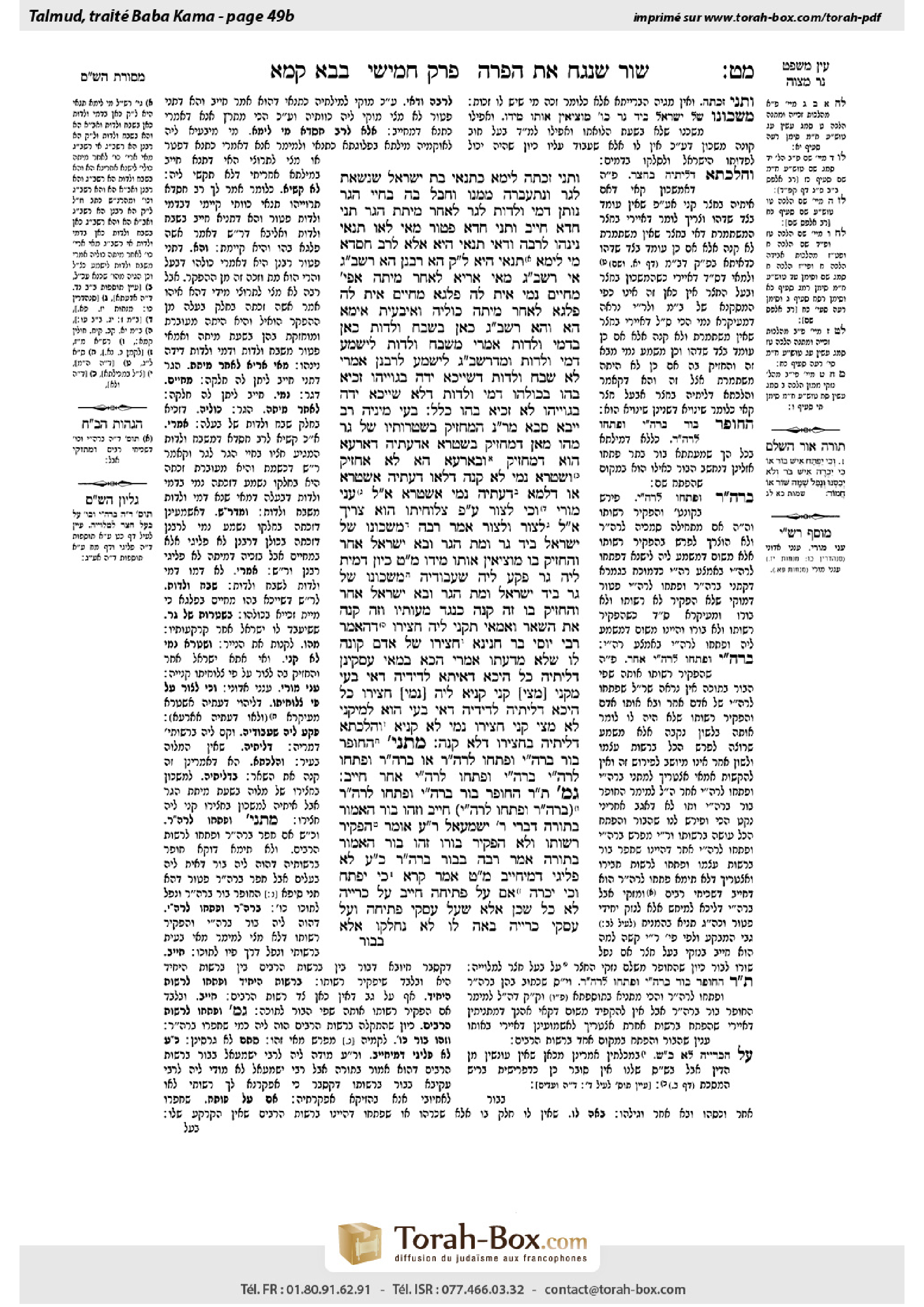
Bava Kamma 49b: Talmud study for Daf Yomi
Study the Talmud for Daf Yomi with scanned pages, Hebrew text, English translations from Sefaria and AI-generated French translations.
Passage selection and English or AI-generated French translation are available where the scan has annotations. Daf Study is independent of Torah-Box and Sefaria.
Browse Bava Kamma · בבא קמא · All tractatesBava Kamma 49b text and translations
This page of Bava Kamma includes the Aramaic text, an English translation and an AI-generated French translation, alongside the scan above.
בבא קמא מ״ט ב · Aramaic and Hebrew text
וּתְנִי: ״זָכְתָה״.
לֵימָא כְּתַנָּאֵי: בַּת יִשְׂרָאֵל שֶׁנִּישֵּׂאת לְגֵר וְנִתְעַבְּרָה מִמֶּנּוּ, וְחָבַל בָּהּ; בְּחַיֵּי הַגֵּר – נוֹתֵן דְּמֵי וְלָדוֹת לַגֵּר. לְאַחַר מִיתַת הַגֵּר – תָּנֵי חֲדָא: חַיָּיב, וְתָנֵי חֲדָא: פָּטוּר. מַאי, לָאו תַּנָּאֵי נִינְהוּ? לְרַבָּה – וַדַּאי תַּנָּאֵי הִיא. אֶלָּא לְרַב חִסְדָּא – מִי לֵימָא תַּנָּאֵי הִיא?
לָא קַשְׁיָא; הָא רַבָּנַן, הָא רַבָּן שִׁמְעוֹן בֶּן גַּמְלִיאֵל.
אִי רַבָּן שִׁמְעוֹן בֶּן גַּמְלִיאֵל, מַאי אִרְיָא לְאַחַר מִיתָה? אֲפִילּוּ מֵחַיִּים נָמֵי אִית לַהּ פַּלְגָא! מֵחַיִּים אִית לַהּ פַּלְגָא, לְאַחַר מִיתָה כּוּלֵּיהּ.
וְאִיבָּעֵית אֵימָא: הָא וְהָא רַבָּן שִׁמְעוֹן בֶּן גַּמְלִיאֵל; כָּאן בִּשְׁבַח וְלָדוֹת, כָּאן בִּדְמֵי וְלָדוֹת.
אָמְרִי: מִשְּׁבַח וְלָדוֹת לִישְׁמַע דְּמֵי וְלָדוֹת, וּמֵרַבָּן שִׁמְעוֹן בֶּן גַּמְלִיאֵל לִישְׁמַע לְרַבָּנַן!
אָמְרִי: לָא; שְׁבַח וְלָדוֹת, דְּשָׁיְיכָא יְדַהּ בְּגַוַּיְיהוּ – זָכְיָא בְּהוּ בְּכוּלְּהוּ; דְּמֵי וְלָדוֹת, לָא שָׁיְיכָא יְדַהּ בְּגַוַּיְיהוּ – לָא זָכְיָא בְּהוּ כְּלָל.
בָּעֵי מִינֵּיהּ רַב יֵיבָא סָבָא מֵרַב נַחְמָן: הַמַּחְזִיק בִּשְׁטָרוֹתָיו שֶׁל גֵּר, מַהוּ? מַאן דְּמַחְזֵיק בִּשְׁטָרָא – אַדַּעְתָּא דְאַרְעָא הוּא מַחְזֵיק, וּבְאַרְעָא הָא לָא אַחְזֵיק; וּשְׁטָרָא נָמֵי לָא קְנָה – דְּלָאו דַּעְתֵּיהּ אַשְּׁטָרָא; אוֹ דִלְמָא, דַּעְתֵּיהּ נָמֵי אַשְּׁטָרָא?
אֲמַר לֵיהּ: עֲנַי מוֹרִי, וְכִי לָצוֹר עַל פִּי צְלוֹחִיתוֹ הוּא צָרִיךְ? אֲמַר לֵיהּ: לָצוֹר וְלָצוֹר.
אָמַר רַבָּה: מַשְׁכּוֹנוֹ שֶׁל יִשְׂרָאֵל בְּיַד גֵּר, וּמֵת הַגֵּר, וּבָא יִשְׂרָאֵל אַחֵר וְהֶחְזִיק בּוֹ – מוֹצִיאִין אוֹתוֹ מִיָּדוֹ. מַאי טַעְמָא? כֵּיוָן דְּמִית לֵיהּ גֵּר – פְּקַע לֵיהּ שִׁעְבּוּדֵיהּ.
מַשְׁכּוֹנוֹ שֶׁל גֵּר בְּיַד יִשְׂרָאֵל, וּמֵת הַגֵּר, וּבָא יִשְׂרָאֵל אַחֵר וְהֶחֱזִיק בּוֹ – זֶה קָנָה כְּנֶגֶד מְעוֹתָיו, וְזֶה קָנָה אֶת הַשְּׁאָר.
וְאַמַּאי? תִּקְנֵי לֵיהּ חֲצֵירוֹ – דְּהָאָמַר רַבִּי יוֹסֵי בַּר חֲנִינָא: חֲצֵירוֹ שֶׁל אָדָם קוֹנָה לוֹ שֶׁלֹּא מִדַּעְתּוֹ!
אָמְרִי: הָכָא בְּמַאי עָסְקִינַן – דְּלֵיתֵיהּ. כֹּל הֵיכָא דְּאִיתֵאּ לְדִידֵיהּ, דְּאִי בָּעֵי מִקְנֵי [מָצֵי] קָנֵי – קָנְיָא לֵיהּ [נָמֵי] חֲצֵירוֹ; כֹּל הֵיכָא דְּלֵיתֵיהּ לְדִידֵיהּ, דְּאִי בָּעֵי הוּא לְמִיקְנֵי לָא מָצֵי קָנֵי – חֲצֵירוֹ נָמֵי לָא קָנְיָא.
וְהִלְכְתָא: דְּלֵיתֵיהּ בַּחֲצֵירוֹ – דְּלֹא קָנָה.
מַתְנִי׳ הַחוֹפֵר בּוֹר בִּרְשׁוּת הַיָּחִיד וּפְתָחוֹ לִרְשׁוּת הָרַבִּים, אוֹ בִּרְשׁוּת הָרַבִּים וּפְתָחוֹ לִרְשׁוּת הַיָּחִיד, בִּרְשׁוּת הַיָּחִיד וּפְתָחוֹ לִרְשׁוּת הַיָּחִיד אַחֵר – חַיָּיב.
גְּמָ׳ תָּנוּ רַבָּנַן: הַחוֹפֵר בּוֹר בִּרְשׁוּת הַיָּחִיד וּפְתָחוֹ לִרְשׁוּת הָרַבִּים; בִּרְשׁוּת הָרַבִּים וּפְתָחוֹ לִרְשׁוּת הַיָּחִיד – חַיָּיב, וְזֶהוּ בּוֹר הָאָמוּר בַּתּוֹרָה; דִּבְרֵי רַבִּי יִשְׁמָעֵאל. רַבִּי עֲקִיבָא אוֹמֵר: הִפְקִיר רְשׁוּתוֹ וְלֹא הִפְקִיר בּוֹרוֹ – זֶהוּ בּוֹר הָאָמוּר בַּתּוֹרָה.
אָמַר רַבָּה: בְּבוֹר בִּרְשׁוּת הָרַבִּים – כּוּלֵּי עָלְמָא לָא פְּלִיגִי דְּמִיחַיַּיב, מַאי טַעְמָא? אָמַר קְרָא: ״כִּי יִפְתַּח״ וְ״כִי יִכְרֶה״ – אִם עַל פְּתִיחָה חַיָּיב, עַל כְּרִיָּיה לֹא כׇּל שֶׁכֵּן?! אֶלָּא שֶׁעַל עִסְקֵי פְּתִיחָה וְעַל עִסְקֵי כְּרִיָּיה בָּאָה לוֹ. לֹא נֶחְלְקוּ אֶלָּא
Bava Kamma 49b · English translation
And as for the expression in the baraita: He acquires, referring to the one who causes the damage, teach: She acquires.
The Gemara suggests: Let us say that the dispute between Rabba and Rav Ḥisda is parallel to a dispute between tanna’im: With regard to a Jewish woman who was married to a convert, and she became pregnant from him, and someone injured her, causing her to miscarry: If this was during the lifetime of the convert, the assailant gives compensation for miscarried offspring to the convert, i.e., her husband. If this was after the death of the convert, it is taught in one baraita that the assailant is liable, and it is taught in one baraita that the assailant is exempt. What, is it not a dispute between tanna’im? The Gemara clarifies: According to the opinion of Rabba, it is certainly a dispute between tanna’im. His opinion does not accord with the second baraita. But according to the opinion of Rav Ḥisda, shall we say that it is a dispute between tanna’im?
This is not necessarily so, as Rav Ḥisda could say that both baraitot are in accordance with his opinion. As for the difference between them, that is not difficult. They can be explained as referring to the increase in the woman’s value due to the offspring, which is subject to dispute in the mishna, rather than referring to the payment of compensation for miscarried offspring. This baraita, which taught that he is exempt, is in accordance with the opinion of the Rabbis, who maintain that the increase in her value on account of the offspring belongs to the husband. That baraita, which taught that he is liable, is in accordance with the opinion of Rabban Shimon ben Gamliel, who maintains that the woman has a share in her increase in value due to pregnancy, and this is paid even if the incident occurred after the husband’s death.
The Gemara asks: If it is in accordance with the opinion of Rabban Shimon ben Gamliel, why state specifically that it occurs after the death of the husband? Even during the husband’s lifetime, she also has a half share, as explained earlier in the discussion. The Gemara answers: While he is alive, she has a half share, but after his death, all of it belongs to her.
And if you wish, say instead that both this baraita and that baraita are in accordance with the opinion of Rabban Shimon ben Gamliel, but they refer to different payments. Here, the baraita that taught that he is liable, is referring to the increase in her value due to the offspring, which belongs partly to the woman, and if the husband dies, she acquires the rights to all of it. By contrast, there, the baraita that taught that he is exempt, is referring to compensation for miscarried offspring, which belongs exclusively to her husband. Since he is a convert, the one liable for damage is exempt after his death.
The Sages said, in questioning this answer: Why is there a difference between the two cases? From the halakha that after the husband’s death the woman acquires his share of the increase in her value due to the offspring, let it be derived that according to the opinion of Rabban Shimon ben Gamliel she also acquires the rights to the compensation for miscarried offspring if she was wounded after his death. Moreover, from the opinion of Rabban Shimon ben Gamliel, let us derive that this is also the opinion of the Rabbis, since there is no dispute between them with regard to the payment of compensation for miscarried offspring.
In response, the Sages said: No, the first assumption is untenable, since with regard to the increase in her value due to the offspring, in which she has a share from the outset, she acquires all of it after her husband’s death. By contrast, with regard to the compensation for miscarried offspring, in which she does not have a share from the outset, she does not acquire the rights to it at all, since she has no greater claim to this than any other individual does.
§ Rav Yeiva the Elder raises a dilemma to Rav Naḥman: With regard to one who takes possession of the documents of a convert, what is the halakha after the death of the convert? On the one hand, it can be argued that one who takes possession of the document takes possession with the intention of acquiring the land that the document states is under lien, and since he did not take possession of the land itself, he also does not acquire the document. This is because he had no intention to acquire the document, but just the property specified in the document. Therefore, since the convert has died, perhaps the lien is canceled and can no longer be collected, or perhaps his intention is also to acquire the document, and the paper on which it is written belongs to him.
Rav Naḥman said to him: Answer this, my Master: Does he need to acquire the document to use as paper to cover the opening of his flask? Why would he want the document if it does not grant him ownership of the land described therein? Rav Yeiva the Elder said to him: Indeed, his intention is even to cover the flask and to cover it with the paper, albeit a mundane purpose.
Rabba says: In a case where the collateral of a Jew was in the possession of a convert who lent him money, and the convert died, and another Jew came and took possession of it, then, since the convert has no heirs, the court appropriates it from his possession and returns it to its owner. What is the reason? Since the convert died, his lien on the property is abrogated. Therefore, the deposit automatically returns to its owner, and no one else has the right to take it.
By contrast, if the collateral of a convert is in the possession of a Jew who lent him money and the convert died, and another Jew came and took possession of it, this one, i.e., the one owed money, acquires a share of the collateral corresponding to the money owed to him by the convert, and that one, i.e., the one who took possession of it, acquires the rest.
The Gemara asks: But why doesn’t the creditor acquire the entire collateral? If it is in his possession, let his courtyard effect acquisition for him, as doesn’t Rabbi Yosei bar Ḥanina say: A person’s courtyard effects acquisition for him even without his knowledge?
The Sages said in response: Here we are dealing with a case where the creditor is not standing next to the courtyard. Anywhere that he is present, next to the collateral, so that if he wants to acquire it he could pick it up and acquire it himself, his courtyard also effects acquisition for him. But anywhere that he is not present, next to the collateral, so that if he wants to acquire it he could not acquire it, his courtyard also does not effect acquisition for him.
The Gemara concludes: And the halakha is that where the creditor is not present in his courtyard, he does not acquire the rest of the collateral.
MISHNA: One who digs part of a pit on private property and opens its entrance in the public domain, or digs a pit in the public domain and opens its entrance on private property, or digs a pit on private property and opens its entrance on another person’s private property, is liable for damage caused by the pit in each case.
GEMARA: The Sages taught in a baraita: One who digs a pit on private property and opens its entrance in the public domain, or who digs a pit in the public domain and opens its entrance on private property is liable, and this is the case of Pit that is stated in the Torah; this is the statement of Rabbi Yishmael. Rabbi Akiva says: With regard to one who renounced ownership of his property but did not renounce ownership of his pit located in the property, this is the case of Pit that is stated in the Torah.
In explanation of this dispute, Rabba says: With regard to a pit that a person digs or opens into the public domain, everyone agrees that he is liable for damage that occurs as a result. What is the reason? The verse states: “And if a man shall open a pit,” and it also states: “If a man shall dig a pit” (Exodus 21:33), which raises the question: If one is liable for opening a pit by removing the cover of a pit that has already been dug, then is it not all the more so obvious that he should be liable for digging a new pit? What, then, does the latter phrase add? Rather, the interpretation of the verse must be that the responsibility for the pit comes to him by engaging in opening the pit and by engaging in digging the pit. Although he does not own the area itself, he is liable for creating a public hazard. They disagree only
Bava Kamma 49b · Traduction française (IA)
Et quant à l'expression dans la baraïta : Il acquiert, faisant référence à celui qui cause le préjudice, enseigne : Elle acquiert.
La Guemara suggère : Disons que le débat entre Rabba et Rav Ḥisda est comparable à un débat entre des tannaïm : En ce qui concerne une femme juive mariée à un converti, et qui a conçu un enfant avec lui, et que quelqu'un l'a blessée, causant un avortement : Si cela s'est produit pendant la vie du converti, l'agresseur paie une compensation pour l'avortement au converti, c'est-à-dire à son époux. Si cela s'est produit après la mort du converti, il est dit dans une baraïta que l'agresseur est responsable, et dans une autre baraïta que l'agresseur est exempt. Qu'est-ce que cela n'est pas un débat entre des tannaïm ? La Guemara clarifie : Selon l'opinion de Rabba, cela est certainement un débat entre des tannaïm. Son opinion ne correspond pas à la deuxième baraïta. Mais selon l'opinion de Rav Ḥisda, devons-nous dire que c'est un débat entre des tannaïm ?
Ce n'est pas nécessairement le cas, car Rav Ḥisda pourrait dire que les deux baraitot sont conformes à son opinion. En ce qui concerne la différence entre elles, cela ne pose pas de difficulté. Elles peuvent être expliquées comme faisant référence à l'augmentation de la valeur de la femme en raison de l'enfant, qui est sujette à débat dans la mishna, plutôt que de faire référence au paiement de compensation pour l'avortement. Cette baraïta, qui a enseigné qu'il est exempt, est conforme à l'opinion des Rabbins, qui maintiennent que l'augmentation de sa valeur en raison de l'enfant appartient à l'époux. Cette baraïta, qui a enseigné qu'il est responsable, est conforme à l'opinion de Rabban Shimon ben Gamliel, qui maintient que la femme a une part dans son augmentation de valeur en raison de la grossesse, et cela est payé même si l'incident s'est produit après la mort de l'époux.
La Guemara pose la question : Si cela est conforme à l'opinion de Rabban Shimon ben Gamliel, pourquoi préciser spécifiquement qu'il s'agit d'après la mort de l'époux ? Même pendant la vie de l'époux, elle a une part, comme expliqué précédemment dans la discussion. La Guemara répond : Tant qu'il est vivant, elle a une part, mais après sa mort, tout appartient à elle.
Et si vous le souhaitez, dites plutôt que cette baraïta et celle-ci sont conformes à l'opinion de Rabban Shimon ben Gamliel, mais qu'elles font référence à des paiements différents. Ici, la baraïta qui a enseigné qu'il est responsable fait référence à l'augmentation de sa valeur en raison de l'enfant, qui appartient partiellement à la femme, et si l'époux meurt, elle acquiert les droits sur tout cela. À l'inverse, là, la baraïta qui a enseigné qu'il est exempt fait référence à la compensation pour l'avortement, qui appartient exclusivement à son époux. Puisque c'est un converti, celui responsable du préjudice est exempt après sa mort.
Les Sages dirent, en questionnant cette réponse : Pourquoi y a-t-il une différence entre les deux cas ? À partir de la halakha selon laquelle après la mort de l'époux la femme acquiert sa part de l'augmentation de sa valeur en raison de l'enfant, qu'on en déduise que selon l'opinion de Rabban Shimon ben Gamliel elle acquiert aussi les droits à la compensation pour l'avortement si elle a été blessée après sa mort. De plus, à partir de l'opinion de Rabban Shimon ben Gamliel, qu'on en déduise que c'est aussi l'opinion des Rabbins, car il n'y a pas de débat entre eux concernant le paiement de la compensation pour l'avortement.
En réponse, les Sages dirent : Non, cette première hypothèse n'est pas tenable, car concernant l'augmentation de sa valeur en raison de l'enfant, dans laquelle elle a une part dès le départ, elle acquiert tout cela après la mort de son époux. À l'inverse, concernant la compensation pour l'avortement, dans laquelle elle n'a pas de part dès le départ, elle n'acquiert aucun droit à cela, car elle n'a pas plus de revendication sur cela qu'un autre individu.
§ Rav Yeiva le Vieux soulève un dilemme à Rav Naḥman : En ce qui concerne celui qui prend possession des documents d'un converti, quelle est la halakha après la mort du converti ? D'un côté, on peut arguer que celui qui prend possession des documents prend possession avec l'intention d'acquérir la terre que les documents indiquent être sous caution, et puisque l'on n'a pas pris possession de la terre elle-même, on n'acquiert pas les documents. Cela est dû au fait qu'il n'avait pas l'intention d'acquérir les documents, mais seulement la propriété spécifiée dans les documents. Ainsi, puisque le converti est mort, peut-être la caution est annulée et ne peut plus être récupérée, ou peut-être son intention est aussi d'acquérir les documents, et le papier sur lequel ils sont écrits lui appartient.
Rav Naḥman dit à lui : Répondez à cela, mon Maître : A-t-il besoin d'acquérir les documents pour les utiliser comme papier pour couvrir l'ouverture de son flacon ? Pourquoi voudrait-il les documents s'ils ne lui donnent pas la propriété de la terre décrite dedans ? Rav Yeiva le Vieux dit à lui : En effet, son intention est même de couvrir le flacon et de le couvrir avec le papier, bien qu'il s'agisse d'une utilisation ordinaire.
Rabba dit : Dans un cas où la garantie d'un Juif était en possession d'un converti qui lui avait prêté de l'argent, et que le converti est mort, et qu'un autre Juif est venu prendre possession de cela, alors, puisque le converti n'a pas d'héritiers, la cour s'empare de cela de sa possession et le rend à son propriétaire. Quelle est la raison ? Puisque le converti est mort, son droit sur la propriété est annulé. Ainsi, la garantie revient automatiquement à son propriétaire, et personne d'autre n'a le droit de le prendre.
À l'inverse, si la garantie d'un converti est en possession d'un Juif qui lui avait prêté de l'argent et que le converti est mort, et qu'un autre Juif est venu prendre possession de cela, celui-ci, c'est-à-dire celui à qui l'argent était dû, acquiert une part de la garantie correspondant à l'argent dû au converti, et celui-là, c'est-à-dire celui qui a pris possession de cela, acquiert le reste.
La Guemara pose la question : Mais pourquoi le créancier ne devient-il pas propriétaire de l'ensemble du garant ? Si l'objet est en son possession, que son cour d'entrée acquière pour lui, comme Rabbi Yosei bar Ḥanina dit : La cour d'une personne acquiert pour elle même sans qu'elle ne le sache ?
Les Sages répondent : Ici, nous sommes en présence d'un cas où le créancier n'est pas à côté du garant. Partout où il est présent, à côté du garant, de sorte qu'il puisse le prendre et l'acquérir s'il le veut, sa cour acquiert pour lui. Mais partout où il n'est pas présent, à côté du garant, de sorte qu'il ne puisse l'acquérir s'il le veut, sa cour n'acquiert pas pour lui non plus.
La Guemara conclut : Et la halakha est que lorsque le créancier n'est pas présent dans sa cour, il ne devient pas propriétaire du reste du garant.
MICHNA : Celui qui creuse une partie d'un puits sur une propriété privée et ouvre son entrée dans le domaine public, ou qui creuse un puits dans le domaine public et ouvre son entrée sur une propriété privée, ou qui creuse un puits sur une propriété privée et ouvre son entrée sur la propriété privée d'une autre personne, est responsable des dommages causés par le puits dans chaque cas.
GUEMARA : Les Sages ont enseigné dans une baraïta : Celui qui creuse un puits sur une propriété privée et ouvre son entrée dans le domaine public, ou celui qui creuse un puits dans le domaine public et ouvre son entrée sur une propriété privée est responsable, et c'est le cas du puits mentionné dans la Torah ; c'est la déclaration de Rabbi Yishmael. Rabbi Akiva dit : En ce qui concerne celui qui a renoncé à la propriété de ses biens mais n'a pas renoncé à la propriété de son puits situé dans les biens, c'est le cas du puits mentionné dans la Torah.
Pour expliquer ce désaccord, Rabba dit : En ce qui concerne un puits que l'on creuse ou qu'on ouvre dans le domaine public, tout le monde convient qu'il est responsable des dommages qui en résultent. Pourquoi ? La Parashah dit : « Et si un homme ouvre un puits », et elle dit aussi : « Si un homme creuse un puits » (Exode 21:33), ce qui soulève la question : Si l'on est responsable d'ouvrir un puits en enlevant le couvercle d'un puits déjà creusé, n'est-ce pas encore plus évident que l'on devrait être responsable de creuser un puits nouveau ? Qu'est-ce alors que l'autre phrase ajoute ? Plutôt, l'interprétation de la Parashah doit être que la responsabilité du puits incombe à celui qui engage dans l'ouverture du puits et dans le creusement du puits. Bien qu'il ne possède pas la zone elle-même, il est responsable de créer un danger public. Ils ne s'entendent que
Traduction française générée par IA à partir de l’édition anglaise de Sefaria. Vérifie toujours un passage avec le texte source.
Text from Sefaria: William Davidson Edition - Vocalized Aramaic (CC BY NC); William Davidson Edition - English (CC BY NC).