Bava Kamma 50a: Talmud study for Daf Yomi
Study the Talmud for Daf Yomi with scanned pages, Hebrew text, English translations from Sefaria and AI-generated French translations.
Passage selection and English or AI-generated French translation are available where the scan has annotations. Daf Study is independent of Torah-Box and Sefaria.
Browse Bava Kamma · בבא קמא · All tractatesBava Kamma 50a text and translations
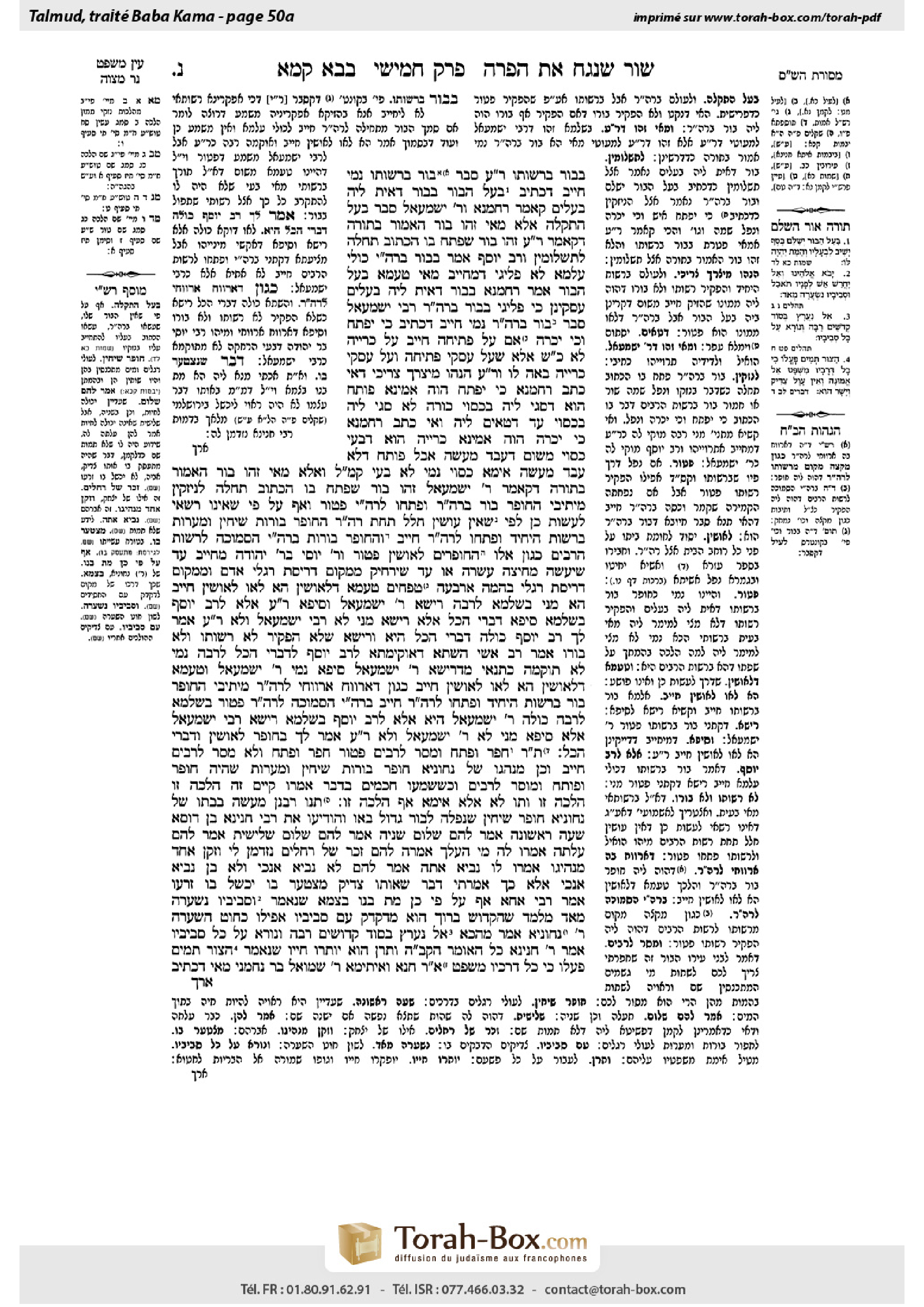
This page of Bava Kamma includes the Aramaic text, an English translation and an AI-generated French translation, alongside the scan above.
בבא קמא נ׳ א · Aramaic and Hebrew text
בְּבוֹר בִּרְשׁוּתוֹ – רַבִּי עֲקִיבָא סָבַר: בּוֹר בִּרְשׁוּתוֹ נָמֵי חַיָּיב, דִּכְתִיב: ״בַּעַל הַבּוֹר״ – בְּבוֹר דְּאִית לֵיהּ בְּעָלִים קָאָמַר רַחֲמָנָא,
וְרַבִּי יִשְׁמָעֵאל סָבַר: בַּעַל הַתַּקָּלָה.
אֶלָּא מַאי ״זֶהוּ בּוֹר הָאָמוּר בַּתּוֹרָה״ דְּקָאָמַר רַבִּי עֲקִיבָא? זֶהוּ בּוֹר שֶׁפָּתַח בּוֹ הַכָּתוּב תְּחִלָּה לְתַשְׁלוּמִין.
וְרַב יוֹסֵף אָמַר: בְּבוֹר בִּרְשׁוּת הַיָּחִיד – כּוּלֵּי עָלְמָא לָא פְּלִיגִי דְּמִחַיַּיב, מַאי טַעְמָא? ״בַּעַל הַבּוֹר״ אָמַר רַחֲמָנָא – בְּבוֹר דְּאִית לֵיהּ בְּעָלִים עָסְקִינַן.
כִּי פְּלִיגִי – בְּבוֹר בִּרְשׁוּת הָרַבִּים; רַבִּי יִשְׁמָעֵאל סָבַר: בּוֹר בִּרְשׁוּת הָרַבִּים נָמֵי חַיָּיב, דִּכְתִיב ״כִּי יִפְתַּח״ וְ״כִי יִכְרֶה״ – אִם עַל פְּתִיחָה חַיָּיב, עַל כְּרִיָּיה לֹא כׇּל שֶׁכֵּן? אֶלָּא שֶׁעַל עִסְקֵי פְתִיחָה וְעַל עִסְקֵי כְרִיָּיה בָּאָה לוֹ.
וְרַבִּי עֲקִיבָא – הָנְהוּ מִיצְרָךְ צְרִיכִי; דְּאִי כְּתַב רַחֲמָנָא ״כִּי יִפְתַּח״ – הֲוָה אָמֵינָא: פּוֹתֵחַ הוּא דְּסַגִּי לֵיהּ בְּכִסּוּי, כּוֹרֶה לָא סַגִּי לֵיהּ בְּכִסּוּי עַד דְּטָאֵים לֵיהּ.
וְאִי כְּתַב רַחֲמָנָא ״כִּי יִכְרֶה״ – הֲוָה אָמֵינָא: כְּרִיָּיה הוּא דְּבָעֵי כִּסּוּי, מִשּׁוּם דַּעֲבַד מַעֲשֶׂה; אֲבָל פּוֹתֵחַ – דְּלָא עֲבַד מַעֲשֶׂה, אֵימָא כִּסּוּי נָמֵי לָא בָּעֵי; קָא מַשְׁמַע לַן.
וְאֶלָּא מַאי ״זֶהוּ בּוֹר הָאָמוּר בַּתּוֹרָה״ דְּקָאָמַר רַבִּי יִשְׁמָעֵאל? זֶהוּ בּוֹר שֶׁפָּתַח בּוֹ הַכָּתוּב תְּחִלָּה לִנְזָקִין.
מֵיתִיבִי: הַחוֹפֵר בּוֹר בִּרְשׁוּת הָרַבִּים, וּפְתָחוֹ לִרְשׁוּת הַיָּחִיד – פָּטוּר; וְאַף עַל פִּי שֶׁאֵינוֹ רַשַּׁאי לַעֲשׂוֹת כֵּן, לְפִי שֶׁאֵין עוֹשִׂין חָלָל תַּחַת רְשׁוּת הָרַבִּים.
הַחוֹפֵר בּוֹרוֹת, שִׁיחִין וּמְעָרוֹת בִּרְשׁוּת הַיָּחִיד, וּפְתָחוֹ לִרְשׁוּת הָרַבִּים – חַיָּיב. וְהַחוֹפֵר בּוֹרוֹת בִּרְשׁוּת הַיָּחִיד הַסְּמוּכָה לִרְשׁוּת הָרַבִּים, כְּגוֹן אֵלּוּ הַחוֹפְרִים לְאוּשִּׁין – פָּטוּר. וְרַבִּי יוֹסֵי בְּרַבִּי יְהוּדָה מְחַיֵּיב עַד שֶׁיַּעֲשֶׂה מְחִיצָה עֲשָׂרָה, אוֹ עַד שֶׁיַּרְחִיק מִמְּקוֹם דְּרִיסַת רַגְלֵי אָדָם וּמִמְּקוֹם דְּרִיסַת רַגְלֵי בְהֵמָה – אַרְבָּעָה טְפָחִים.
טַעְמָא דִּלְאוּשִּׁין, הָא לָאו לְאוּשִּׁין – חַיָּיב;
הָא מַנִּי? בִּשְׁלָמָא לְרַבָּה – רֵישָׁא רַבִּי יִשְׁמָעֵאל, וְסֵיפָא רַבִּי עֲקִיבָא.
אֶלָּא לְרַב יוֹסֵף, בִּשְׁלָמָא סֵיפָא – דִּבְרֵי הַכֹּל; אֶלָּא רֵישָׁא מַנִּי? לָא רַבִּי יִשְׁמָעֵאל, וְלָא רַבִּי עֲקִיבָא!
אָמַר לְךָ רַב יוֹסֵף: כּוּלַּהּ דִּבְרֵי הַכֹּל הִיא, וְרֵישָׁא – שֶׁלֹּא הִפְקִיר לֹא רְשׁוּתוֹ וְלֹא בּוֹרוֹ.
אָמַר רַב אָשֵׁי: הַשְׁתָּא דְּאוֹקֵימְתַּהּ לְרַב יוֹסֵף לְדִבְרֵי הַכֹּל, לְרַבָּה נָמֵי לָא תּוֹקְמַהּ כְּתַנָּאֵי –
מִדְּרֵישָׁא רַבִּי יִשְׁמָעֵאל, סֵיפָא נָמֵי רַבִּי יִשְׁמָעֵאל; וְטַעְמָא דִּלְאוּשִּׁין, הָא לָאו לְאוּשִּׁין חַיָּיב – כְּגוֹן דְּאַרְוַוח אַרְווֹחֵי לִרְשׁוּת הָרַבִּים.
מֵיתִיבִי: הַחוֹפֵר בּוֹר בִּרְשׁוּת הַיָּחִיד, וּפְתָחוֹ לִרְשׁוּת הָרַבִּים – חַיָּיב. בִּרְשׁוּת הַיָּחִיד הַסְּמוּכָה לִרְשׁוּת הָרַבִּים – פָּטוּר. בִּשְׁלָמָא לְרַבָּה, כּוּלַּהּ רַבִּי יִשְׁמָעֵאל הִיא. אֶלָּא לְרַב יוֹסֵף, בִּשְׁלָמָא רֵישָׁא – רַבִּי יִשְׁמָעֵאל, אֶלָּא סֵיפָא מַנִּי? לָא רַבִּי יִשְׁמָעֵאל וְלָא רַבִּי עֲקִיבָא!
אָמַר לָךְ: בְּחוֹפֵר לְאוּשִּׁין, וְדִבְרֵי הַכֹּל.
תָּנוּ רַבָּנַן: חָפַר וּפָתַח וּמָסַר לָרַבִּים – פָּטוּר. חָפַר וּפָתַח וְלֹא מָסַר לָרַבִּים – חַיָּיב, וְכֵן מִנְהָגוֹ שֶׁל נְחוּנְיָא חוֹפֵר בּוֹרוֹת שִׁיחִין וּמְעָרוֹת, שֶׁהָיָה חוֹפֵר וּפוֹתֵחַ וּמוֹסֵר לָרַבִּים. וּכְשֶׁשָּׁמְעוּ חֲכָמִים בַּדָּבָר, אָמְרוּ: קִיֵּים זֶה הֲלָכָה זוֹ. הֲלָכָה זוֹ וְתוּ לָא?! אֶלָּא אֵימָא: אַף הֲלָכָה זוֹ.
תָּנוּ רַבָּנַן: מַעֲשֶׂה בְּבִתּוֹ שֶׁל נְחוּנְיָא חוֹפֵר שִׁיחִין שֶׁנָּפְלָה לְבוֹר גָּדוֹל, בָּאוּ וְהוֹדִיעוּ אֶת רַבִּי חֲנִינָא בֶּן דּוֹסָא. שָׁעָה רִאשׁוֹנָה אָמַר לָהֶם: שָׁלוֹם. שְׁנִיָּה אָמַר לָהֶם: שָׁלוֹם. שְׁלִישִׁית אָמַר לָהֶם: עָלְתָה.
אָמְרוּ לָהּ: מִי הֶעֱלִךְ? אָמְרָה לָהֶם: זָכָר שֶׁל רְחֵלִים נִזְדַּמֵּן לִי, וְזָקֵן אֶחָד מַנְהִיגוֹ. אָמְרוּ לוֹ: נָבִיא אַתָּה? אָמַר לָהֶם: ״לֹא נָבִיא אָנֹכִי, וְלֹא בֶּן נָבִיא אָנֹכִי״, אֶלָּא כָּךְ אָמַרְתִּי: דָּבָר שֶׁאוֹתוֹ צַדִּיק מִצְטַעֵר בּוֹ – יִכָּשֵׁל בּוֹ זַרְעוֹ?
אָמַר רַבִּי אַחָא: אַף עַל פִּי כֵן, מֵת בְּנוֹ בַּצָּמָא. שֶׁנֶּאֱמַר: ״וּסְבִיבָיו נִשְׂעֲרָה מְאֹד״ – מְלַמֵּד שֶׁהַקָּדוֹשׁ בָּרוּךְ הוּא מְדַקְדֵּק עִם סְבִיבָיו אֲפִילּוּ כְּחוּט הַשַּׂעֲרָה. רַבִּי נְחוּנְיָא אָמַר מֵהָכָא: ״אֵל נַעֲרָץ בְּסוֹד קְדֹשִׁים רַבָּה, וְנוֹרָא עַל כׇּל סְבִיבָיו״.
אָמַר רַבִּי חֲנִינָא: כׇּל הָאוֹמֵר הַקָּדוֹשׁ בָּרוּךְ הוּא וַתְּרָן הוּא, יִוָּתְרוּ חַיָּיו, שֶׁנֶּאֱמַר: ״הַצּוּר תָּמִים פׇּעֳלוֹ, כִּי כׇל דְּרָכָיו מִשְׁפָּט״. אָמַר רַבִּי חָנָא וְאִיתֵּימָא רַבִּי שְׁמוּאֵל בַּר נַחְמָנִי, מַאי דִּכְתִיב:
Bava Kamma 50a · English translation
in the case where one dug the pit on his own property and then renounced ownership of the surrounding area. Consequently, the entire area except for the pit is now open to public passage. In this case, Rabbi Akiva maintains that one who digs a pit on his own property is also liable, not only when the pit is located in the public domain, as it is written: “The owner of the pit shall pay” (Exodus 21:34). Clearly, the Merciful One is referring to a pit that has an owner. Therefore, the owner of the pit pays even if it is located on private property.
And Rabbi Yishmael maintains that “the owner of the pit” means that the one responsible for the hazard is liable even if he dug the pit in the public domain and then renounced ownership of it. But one who digs a pit on his own property is not liable.
The Gemara asks: Rather, according to Rabba’s explanation, what is meant by the clause: This is the case of Pit that is stated in the Torah, in reference to digging a pit on one’s property, that Rabbi Akiva states? According to him, one is liable for damage in all cases, including digging in the public domain. The Gemara answers: It means that this is the pit with which the verse initially introduces the subject of compensation for damage caused. In that context, the Torah states: “The owner of the pit shall pay” (Exodus 21:34), indicating that even a pit owned on one’s private property renders one liable.
And Rav Yosef said that one can explain the dispute between Rabbi Yishmael and Rabbi Akiva differently: With regard to one who dug a pit on his private property and then renounced ownership of the property aside from the pit, everyone agrees that he is liable. What is the reason? Since the Merciful One states: “The owner of the pit,” it indicates that we are dealing with a pit that has an owner.
When they disagree, it is in a case where the pit was dug in the public domain. Rabbi Yishmael maintains that one is also liable for a pit dug in the public domain, as it is written: “And if a man shall open a pit,” and: “If a man shall dig a pit” (Exodus 21:33), which raises the question: If he is liable for opening a pit by removing the cover of a pit that has already been dug, then is it not all the more so obvious that he should be liable for digging a new pit? Rather, the verse means that the responsibility for the pit comes to him by engaging in opening the pit and by engaging in digging the pit. Although he does not own the area itself, he is liable for creating a public hazard.
And Rabbi Akiva, by contrast, holds that one is liable only in the case of a pit located on private property, where he renounced ownership of the property aside from the pit, and one cannot derive otherwise from any extraneous phrases. This is because these phrases are necessary, for if the Merciful One wrote only: “If a man shall open a pit” (Exodus 21:33), I would say that it is specifically when one opens the covering of a pit that has already been dug that it is sufficient for him to place a covering on it to absolve himself of responsibility for damage it causes. This is the case where the Torah states: “And not cover it” (Exodus 21:33). But if one actually digs a pit, it would not be sufficient to place a covering on it, and one would not be exempt from damages unless he completely packs it.
And conversely, if the Merciful One had written only: “If a man shall dig,” I would say that it is specifically in a case of digging that a covering is required to exempt one from liability, because he performed an action of creating the pit. But for merely opening it, where one has not performed an action, say that he does not require a covering to absolve him of liability. Therefore, the Torah teaches us that he is liable for damage caused by a pit in both cases, and one should interpret the verse that states: “The owner of the pit” (Exodus 21:34), in its plain sense, i.e., that he is the owner of the pit because it is located on his private property. Accordingly, one would not be liable for a pit dug in the public domain.
The Gemara asks: But rather, according to Rav Yosef’s explanation, what is meant by the clause: This is the case of Pit that is stated in the Torah, in reference to digging a pit in the public domain, that Rabbi Yishmael states? Isn’t one liable for any pit, including one dug on his own property? The Gemara answers: It means that this is the pit with which the verse initially introduces the subject of damage caused by Pit, as explained by Rabbi Yishmael above. Only afterward does it state: “The owner of the pit shall pay,” referring to a pit dug on one’s own property.
The Gemara raises an objection from a baraita: One who digs a pit whose hollow space is in the public domain and then opens its entrance into private property is exempt, and this is the halakha even though he does not have permission to do so. The reason he does not have permission to do so is that one may not create a hollow space under the public domain.
One who digs pits, ditches, and caves on private property and then opens their entrances into the public domain is liable. In addition, one who digs pits on private property that is adjacent to the public domain but not actually located in the public domain itself, such as these people who dig foundations [ushin] for their houses or walls, is exempt. But Rabbi Yosei, son of Rabbi Yehuda, deems one liable even for damage caused by pits made to lay foundations, unless he builds a partition that is ten handbreadths high in front of the pits, or unless he distances them by four handbreadths from the area where pedestrians walk and from the area where animals walk.
The Gemara infers: The reason for the exemption is that one digs for the purpose of foundations, which is the usual and accepted practice, but if he did not dig for the purpose of foundations, he is liable. Although he did so on his own property, he is nevertheless liable, since people walk there.
The Gemara clarifies: In accordance with whose opinion is this baraita? Granted, according to Rabba, the first clause, where one is seemingly exempt for opening a pit onto private property even if he subsequently renounced ownership of the area, can be established in accordance with the opinion of Rabbi Yishmael, and the last clause can be established in accordance with the opinion of Rabbi Akiva, who maintains that one is liable for a pit dug on his own property if it is open to public traffic.
But according to Rav Yosef’s explanation, granted, with regard to the last clause, all agree that this is the halakha. But with regard to the first clause, which exempts one who digs a pit on his own property, in accordance with whose opinion is this? It appears to be neither that of Rabbi Yishmael nor that of Rabbi Akiva, since Rav Yosef explained that both of them maintain that one is liable for a pit on his own property, even if he subsequently renounces ownership of the area.
The Gemara answers that Rav Yosef could have said to you: Everyone agrees with the entire passage. As for the first clause, which exempts one who digs a pit under the public domain and opens it onto his own property, it is referring to a case where one did not renounce ownership of either his property or his pit. This certainly is not included in the category of Pit with regard to damages, and the owner is therefore exempt.
Rav Ashi said: Now that you have interpreted Rav Yosef’s explanation of the baraita as being in accordance with all opinions, then also according to Rabba, you are not required to establish it as a dispute between tanna’im.
Rather, one can say that since the first clause is in accordance with the opinion of Rabbi Yishmael, who exempts one who renounces ownership of his property but not the pit, the last clause can also be explained in accordance with the opinion of Rabbi Yishmael. And it was previously inferred that the reason for the exemption when digging on one’s private property adjacent to the public domain is that one digs to lay foundations. But if it is not to lay foundations, one is liable. For instance, in a case where one widened the pit unnecessarily, extending it into the public domain, he has effectively dug a pit in the public domain itself.
The Gemara raises an objection from a baraita: One who digs a pit on private property and opens it into the public domain is liable. But if he dug it on private property that was adjacent to the public domain, he is exempt. Granted, according to Rabba, this mishna is entirely in accordance with the opinion of Rabbi Yishmael, who does not hold one liable for digging on his own property. But according to Rav Yosef, granted, the first clause works out well in accordance with the opinion of Rabbi Yishmael, who holds one liable even for digging in the public domain, but whose opinion is the latter clause? It appears to be neither that of Rabbi Yishmael nor that of Rabbi Akiva.
The Gemara answers that Rav Yosef could have said to you: The latter clause of this baraita is referring to one who digs to lay foundations, and therefore all agree with the ruling.
§ The Sages taught: If someone dug or opened a well and transferred it to the public for their use, he is exempt from damage caused by the well. If he dug or opened a well and did not transfer it to the public, he is liable. And this was the practice of Neḥunya the digger of pits, ditches, and caves, who would dig, open, and transfer them to the public so that there would be wells of water for public use. When the Sages heard about the matter, they said: This individual has fulfilled this halakha. The Gemara asks: Only this halakha and no more? Isn’t it well known that Neḥunya was a great man? Rather, say: He fulfilled even this halakha and did not forget to transfer the wells to the public.
Having mentioned the deeds of Neḥunya, the Gemara relates that the Sages taught: An incident occurred involving the daughter of Neḥunya the ditchdigger, where she fell into a large cistern and no one could extricate her from it. They came and informed Rabbi Ḥanina ben Dosa so that he would pray on her behalf. When the first hour had passed from the time of her fall, he said to them: She is at peace and unharmed. After the second hour, he said to them: She is at peace. After the third hour, he said to them: She has ascended from the well, and indeed this was the case.
They said to her: Who brought you up out of the well? She said to them: A male sheep, i.e., a ram, happened to come to me, and a certain old man, i.e., Abraham, was leading it, and he pulled me out. They said to Rabbi Ḥanina ben Dosa: Are you a prophet? How did you know she had ascended? Rabbi Ḥanina ben Dosa said to them: “I am no prophet, neither am I a prophet’s son” (Amos 7:14), but this is what I said to myself: Shall the offspring of Neḥunya stumble by means of the very matter which distressed that righteous man?
Rabbi Aḥa says: Although Neḥunya ensured that others would have water, even so, his son died of thirst, fulfilling that which is stated: “And around Him it storms [nisara] mightily” (Psalms 50:3). This teaches that the Holy One, Blessed be He, is scrupulous with those around Him, i.e., the righteous, even to the extent of a hairsbreadth [hasa’ara], so that even minor transgressions elicit a severe punishment. Rabbi Neḥunya says: The same idea may be learned from here, in the following verse: “A God dreaded in the great council of the holy ones, and feared by all those that surround Him” (Psalms 89:8), indicating that God is most careful and exacting with those that surround Him, i.e., the righteous.
Rabbi Ḥanina says: Anyone who states that the Holy One, Blessed be He, is forgiving [vateran] of transgressions, his life will be relinquished [yivatru], as it is stated: “The Rock, His work is perfect, for all His ways are justice” (Deuteronomy 32:4). In other words, God does not waive heavenly justice. Rabbi Ḥana says, and some say that Rabbi Shmuel bar Naḥmani says: What is the meaning of that which is written
Bava Kamma 50a · Traduction française (IA)
Dans le cas où l'on creuse un trou sur sa propriété et ensuite renonce à la propriété des zones environnantes, toute la zone, sauf le trou, est désormais ouverte à la circulation publique. Dans ce cas, Rabbi Akiva maintient que celui qui creuse un trou sur sa propriété est également responsable, non seulement lorsque le trou est situé dans le domaine public, comme il est écrit : « L'homme qui a creusé le trou paiera » (Exode 21:34). Évidemment, l'Éternel fait référence à un trou qui a un propriétaire. Par conséquent, le propriétaire du trou paie même si le trou est situé sur une propriété privée.
Et Rabbi Yishmael maintient que « l'homme qui a creusé le trou » signifie que celui qui est responsable du danger est responsable même s'il a creusé le trou dans le domaine public et ensuite renoncé à sa propriété. Mais celui qui creuse un trou sur sa propriété n'est pas responsable.
La Guemara pose la question : plutôt, selon l'explication de Rabba, à quoi fait référence la clause : « C'est le cas du trou », mentionné dans la Torah, en référence à creuser un trou sur sa propriété, que dit Rabbi Akiva ? Selon lui, on est responsable de tout dommage, y compris lorsqu'on creuse dans le domaine public. La Guemara répond : cela signifie que c'est le trou avec lequel la parabole introduit initialement la question de la compensation des dommages causés. Dans ce contexte, la Torah dit : « L'homme qui a creusé le trou paiera » (Exode 21:34), indiquant que même un trou situé sur sa propriété privée rend responsable.
Et Rav Yosef a dit que l'on peut expliquer différemment le débat entre Rabbi Yishmael et Rabbi Akiva : concernant celui qui a creusé un trou sur sa propriété privée et ensuite renoncé à la propriété, sauf le trou, tout le monde convient qu'il est responsable. Quelle est la raison ? Parce que l'Éternel dit : « L'homme qui a creusé le trou », cela indique que nous sommes en présence d'un trou qui a un propriétaire.
Lorsqu'ils divergent, c'est dans le cas où le trou a été creusé dans le domaine public. Rabbi Yishmael maintient que l'on est également responsable d'un trou creusé dans le domaine public, comme il est écrit : « Et si un homme ouvre un trou », et : « Si un homme creuse un trou » (Exode 21:33), ce qui soulève la question : si l'on est responsable d'ouvrir un trou en enlevant le couvercle d'un trou déjà creusé, n'est-ce pas encore plus évident que l'on devrait être responsable de creuser un nouveau trou ? Plutôt, la parabole signifie que la responsabilité du trou incombe à celui qui engage dans l'ouverture du trou et celui qui engage dans le creusement du trou. Bien qu'il ne possède pas la zone elle-même, il est responsable de créer un danger public.
Et Rabbi Akiva, à l'inverse, considère que l'on est responsable uniquement dans le cas d'un trou situé sur une propriété privée, où il a renoncé à la propriété, sauf le trou, et l'on ne peut déduire autre chose à partir de phrases externes. Cela est dû au fait que ces phrases sont nécessaires, car si l'Éternel avait écrit seulement : « Si un homme ouvre un trou » (Exode 21:33), je dirais que c'est spécifiquement lorsqu'on ouvre le couvercle d'un trou déjà creusé que cela suffit à lui pour placer un couvercle sur celui-ci afin de s'absoudre de la responsabilité des dommages qu'il cause. C'est le cas où la Torah dit : « Et ne le recouvre pas » (Exode 21:33). Mais si l'on creuse effectivement un trou, il ne suffirait pas de placer un couvercle sur celui-ci, et l'on ne serait pas exempt des dommages à moins qu'on ne le remplisse entièrement.
Inversement, si l'Éternel avait écrit seulement : « Si un homme creuse », je dirais que c'est spécifiquement dans le cas de creusement que le couvercle est requis pour s'absoudre de la responsabilité, car il a accompli une action de création du trou. Mais pour simplement ouvrir le trou, où l'on n'a pas accompli d'action, disons qu'il ne faut pas de couvercle pour s'absoudre de la responsabilité. Par conséquent, la Torah nous enseigne que l'on est responsable des dommages causés par un trou dans les deux cas, et l'on doit interpréter la parole qui dit : « L'homme qui a creusé le trou » (Exode 21:34) dans son sens littéral, c'est-à-dire qu'il est le propriétaire du trou parce qu'il est situé sur sa propriété privée. Ainsi, l'on ne serait pas responsable d'un trou creusé dans le domaine public.
La Guemara pose la question : mais plutôt, selon l'explication de Rav Yosef, à quoi fait référence la clause : « C'est le cas du trou », mentionné dans la Torah, en référence à creuser un trou dans le domaine public, que dit Rabbi Yishmael ? N'est-ce pas que l'on est responsable de tout trou, y compris celui creusé sur sa propre propriété ? La Guemara répond : cela signifie que c'est le trou avec lequel la Torah introduit initialement la question des dommages causés par un trou, comme expliqué par Rabbi Yishmael ci-dessus. Seulement ensuite dit-on : « L'homme qui a creusé le trou paiera », faisant référence à un trou creusé sur sa propre propriété.
La Guemara soulève un objet à partir d'une baraïta : celui qui creuse un trou dont l'espace vide est dans le domaine public et ensuite ouvre son entrée dans la propriété privée est exempt, et c'est la halakha même s'il n'a pas le droit de le faire. La raison pour laquelle il n'a pas le droit de le faire est que l'on ne peut pas créer un espace vide sous le domaine public.
Celui qui creuse des trous, des fossés et des grottes sur sa propriété privée et ouvre ensuite leurs entrées dans le domaine public est responsable. De plus, celui qui creuse des trous sur sa propriété privée adjacente au domaine public mais pas réellement situé dans le domaine public lui-même, comme ces gens qui creusent des fondations [ushin] pour leurs maisons ou leurs murs, est exempt. Mais Rabbi Yosei, fils de Rabbi Yehuda, considère que l'on est responsable même des dommages causés par des trous faits pour des fondations, à moins qu'il ne construise un mur de dix tefachim de haut devant les trous, ou qu'il ne les éloigne de quatre tefachim de la zone où les piétons marchent et de la zone où les animaux marchent.
La Guemara déduit que la raison de l'exemption est que l'on creuse à des fins de fondations, ce qui est la pratique habituelle et acceptée, mais si l'on n'a pas creusé à des fins de fondations, l'on est responsable. Bien qu'il l'ait fait sur sa propre propriété, il est néanmoins responsable, car les gens marchent là.
La Guemara clarifie : Selon l'opinion de qui est ce baraïta ? Cela est évident selon Rabba, la première clause, où l'on est apparemment exempt de creuser un puits sur la propriété privée, même si l'on renonce ensuite à la propriété de la zone, peut être établi selon l'opinion de Rabbi Yishmael, et la dernière clause peut être établie selon l'opinion de Rabbi Akiva, qui affirme que l'on est responsable d'un puits creusé sur sa propre propriété si celui-ci est ouvert à la circulation publique.
Mais selon l'explication de Rav Yosef, cela est évident, concernant la dernière clause, tous s'accordent sur cette halakha. Mais concernant la première clause, qui exempt l'individu qui creuse un puits sur sa propre propriété, selon l'opinion de qui est-ce ? Il semble que ce ne soit ni celle de Rabbi Yishmael ni celle de Rabbi Akiva, puisque Rav Yosef a expliqué que les deux maintiennent que l'on est responsable d'un puits sur sa propre propriété, même si l'on renonce ensuite à la propriété de la zone.
La Guemara répond que Rav Yosef aurait pu dire à vous : Tout le passage est d'accord avec tout le monde. En ce qui concerne la première clause, qui exempt l'individu qui creuse un puits sous le domaine public et l'ouvre sur sa propre propriété, il s'agit d'un cas où l'on n'a pas renoncé à la propriété de sa propriété ou de son puits. Cela n'est certainement pas inclus dans la catégorie de puits concernant les dommages, et l'propriétaire est donc exempt.
Rav Ashi dit : Maintenant que vous avez interprété l'explication de Rav Yosef sur le baraïta selon toutes les opinions, alors aussi selon Rabba, vous n'êtes pas tenu de l'établir comme un débat entre les tannaïm.
Plutôt, on peut dire que puisque la première clause est selon l'opinion de Rabbi Yishmael, qui exempt l'individu qui renonce à sa propriété mais pas au puits, la dernière clause peut aussi être expliquée selon l'opinion de Rabbi Yishmael. Et cela a été précédemment inféré que la raison de l'exemption lorsqu'on creuse sur sa propriété privée adjacente au domaine public est que l'on creuse pour poser des fondations. Mais si ce n'est pas pour poser des fondations, l'on est responsable. Par exemple, dans un cas où l'on agrandit le puits de manière inutile, l'étendant dans le domaine public, l'on a effectivement creusé un puits dans le domaine public lui-même.
La Guemara soulève un objet à partir d'un baraïta : Celui qui creuse un puits sur la propriété privée et l'ouvre dans le domaine public est responsable. Mais s'il a creusé sur une propriété privée adjacente au domaine public, il est exempt. Cela est évident selon Rabba, ce mizna est entièrement selon l'opinion de Rabbi Yishmael, qui ne considère pas responsable de creuser sur sa propre propriété. Mais selon Rav Yosef, cela est évident, la première clause s'aligne bien selon l'opinion de Rabbi Yishmael, qui considère responsable de creuser dans le domaine public, mais quelle est l'opinion de la dernière clause ? Il semble que ce ne soit ni celle de Rabbi Yishmael ni celle de Rabbi Akiva.
La Guemara répond que Rav Yosef aurait pu dire à vous : La dernière clause de ce baraïta fait référence à celui qui creuse pour poser des fondations, et donc tout le monde s'accorde sur le jugement.
§ Les Sages enseignèrent : Si quelqu'un a creusé ou ouvert un puits et l'a transféré au public pour leur usage, il est exempt des dommages causés par le puits. Si quelqu'un a creusé ou ouvert un puits et ne l'a pas transféré au public, il est responsable. Et c'était la pratique de Neḥunya, le creuseur de puits, de canaux et de grottes, qui creusait, ouvrait et transférait les puits au public afin qu'il y ait des puits d'eau pour usage public. Lorsque les Sages apprirent cela, ils dirent : Cet individu a accompli cette halakha. La Guemara demande : Seulement cette halakha et pas plus ? N'est-ce pas bien connu que Neḥunya était un grand homme ? Plutôt, disons : Il a accompli même cette halakha et n'a pas oublié de transférer les puits au public.
Ayant mentionné les actes de Neḥunya, la Guemara rapporte que les Sages enseignèrent : Un incident s'est produit concernant la fille de Neḥunya, le creuseur de canaux, où elle est tombée dans un grand cisternes et personne n'a pu la tirer hors de là. Ils sont venus informer Rabbi Ḥanina ben Dosa afin qu'il prie en son nom. Lorsque la première heure avait passé depuis sa chute, il a dit à eux : Elle est en paix et intacte. Après la deuxième heure, il a dit à eux : Elle est en paix. Après la troisième heure, il a dit à eux : Elle est sortie du puits, et effectivement c'était le cas.
Ils lui dirent : Qui t'a sortie du puits ? Elle leur répondit : Un bélier, c'est-à-dire un agneau, est venu vers moi, et un certain vieil homme, c'est-à-dire Abraham, le guidait, et il m'a tirée hors du puits. Ils dirent à Rabbi Ḥanina ben Dosa : Es-tu un prophète ? Comment as-tu su qu'elle était sortie ? Rabbi Ḥanina ben Dosa leur dit : « Je ne suis pas prophète, ni fils de prophète » (Amos 7:14), mais c'est ce que je me suis dit : L'enfant de Neḥunya trébuchera par le même moyen qui a causé la souffrance à ce justicier ?
Rabbi Aḥa dit : Bien que Neḥunya ait assuré que d'autres trouveraient de l'eau, même ainsi, son fils est mort de soif, accomplissant ce qui est dit : « Et autour de Lui il y a un grand tumulte [nisara] » (Psaumes 50:3). Cela enseigne que l'Éternel, béni soit Son Nom, est exigeant avec ceux qui l'entourent, c'est-à-dire les justes, même à un degré infime [hasa’ara], de sorte que même les petites transgressions entraînent une punition sévère. Rabbi Neḥunya dit : La même idée peut être apprise d'ici, dans la suivante verset : « Dieu redouté dans la grande assemblée des saints, et craint par tous ceux qui l'entourent » (Psaumes 89:8), indiquant que Dieu est le plus exigeant et précis avec ceux qui l'entourent, c'est-à-dire les justes.
Le Rabbi Ḥanina dit : Celui qui affirme que le Saint, le Très-Haut, est miséricordieux [vateran] envers les transgressions, sa vie sera abandonnée [yivatru], car il est écrit : « Le Rocher, son œuvre est parfaite, car toutes ses voies sont la justice » (Deutéronome 32:4). En d'autres termes, Dieu ne remet pas en l'air la justice céleste. Le Rabbi Ḥana dit, et certains disent que le Rabbi Shmuel bar Naḥmani dit : Quelle est la signification de ce qui est écrit
Traduction française générée par IA à partir de l’édition anglaise de Sefaria. Vérifie toujours un passage avec le texte source.
Text from Sefaria: William Davidson Edition - Vocalized Aramaic (CC BY NC); William Davidson Edition - English (CC BY NC).