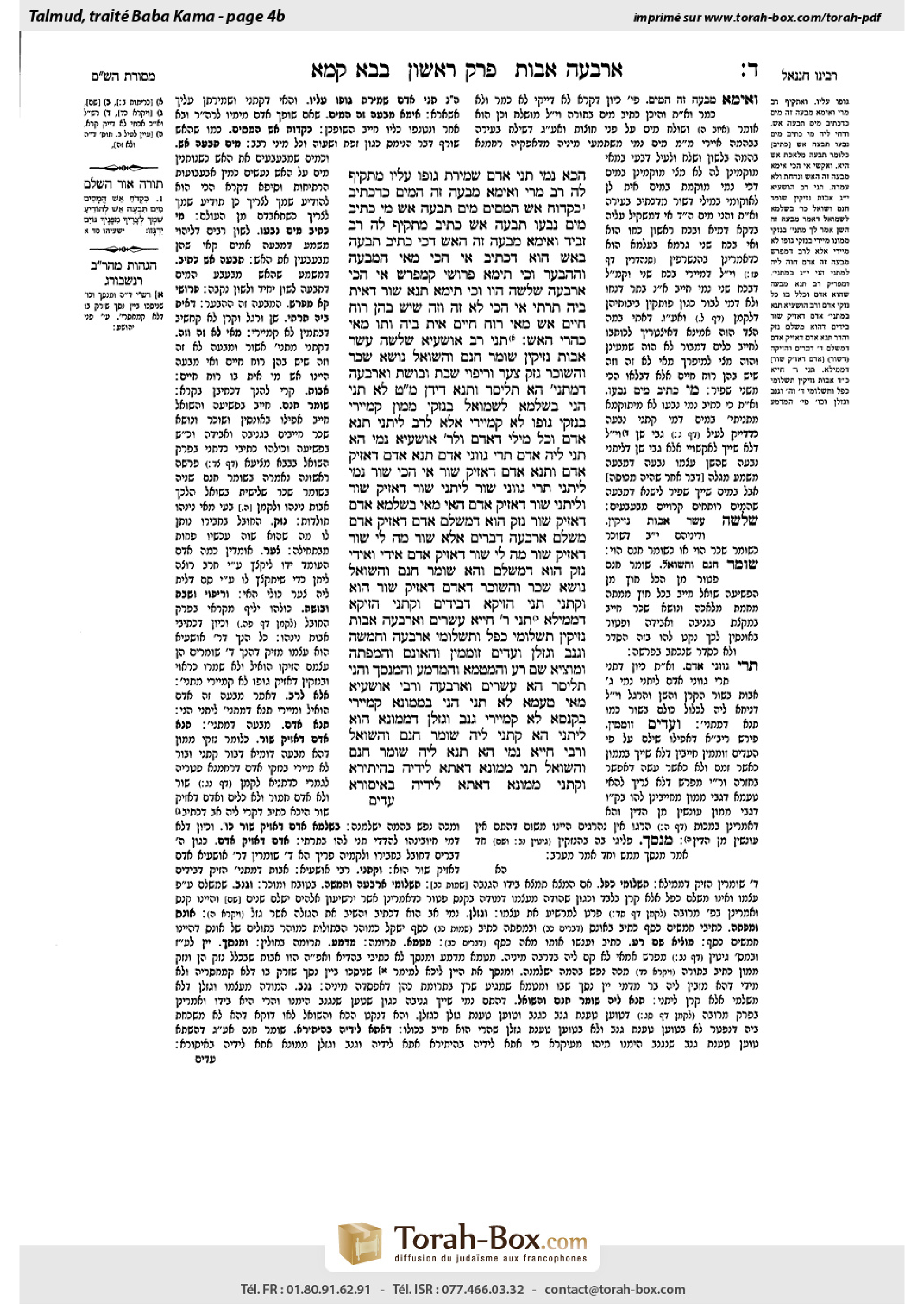
Bava Kamma 4b: Talmud study for Daf Yomi
Study the Talmud for Daf Yomi with scanned pages, Hebrew text, English translations from Sefaria and AI-generated French translations.
Passage selection and English or AI-generated French translation are available where the scan has annotations. Daf Study is independent of Torah-Box and Sefaria.
Browse Bava Kamma · בבא קמא · All tractatesBava Kamma 4b text and translations
This page of Bava Kamma includes the Aramaic text, an English translation and an AI-generated French translation, alongside the scan above.
בבא קמא ד׳ ב · Aramaic and Hebrew text
הָכָא נָמֵי, תְּנִי: אָדָם – שְׁמִירַת גּוּפוֹ עָלָיו.
מַתְקֵיף לַהּ רַב מָרִי, וְאֵימָא ״מַבְעֶה״ זֶה הַמַּיִם, כְּדִכְתִיב: ״כִּקְדֹחַ אֵשׁ הֲמָסִים, מַיִם תִּבְעֶה אֵשׁ״! מִי כְּתִיב ״מַיִם נִבְעוּ״?! ״תִּבְעֶה אֵשׁ״ כְּתִיב.
מַתְקֵיף לַהּ רַב זְבִיד: וְאֵימָא ״מַבְעֶה״ זֶה הָאֵשׁ, דְּכִי כְּתִיב ״תִּבְעֶה״ – בְּאֵשׁ הוּא דִּכְתִיב! אִי הָכִי, מַאי ״הַמַּבְעֶה וְהַהֶבְעֵר״? וְכִי תֵּימָא פָּרוֹשֵׁי קָמְפָרֵשׁ; אִי הָכִי, אַרְבָּעָה?! שְׁלֹשָׁה הָווּ!
וְכִי תֵּימָא, תְּנָא שׁוֹר דְּאִית בֵּיהּ תַּרְתֵּי; אִי הָכִי, ״לָא זֶה וְזֶה שֶׁיֵּשׁ בָּהֶן רוּחַ חַיִּים״ – אֵשׁ מַאי רוּחַ חַיִּים אִית בֵּיהּ? וְתוּ, מַאי ״כַּהֲרֵי הָאֵשׁ״?
תָּנֵי רַבִּי אוֹשַׁעְיָא, שְׁלֹשָׁה עָשָׂר אֲבוֹת נְזִיקִין: שׁוֹמֵר חִנָּם, וְהַשּׁוֹאֵל, נוֹשֵׂא שָׂכָר, וְהַשּׂוֹכֵר; נֶזֶק, צַעַר, וְרִיפּוּי, שֶׁבֶת, וּבוֹשֶׁת; וְאַרְבָּעָה דְמַתְנִיתִין – הָא תְּלֵיסַר.
וְתַנָּא דִּידַן – מַאי טַעְמָא לָא תָּנֵי הָנֵי? בִּשְׁלָמָא לִשְׁמוּאֵל – בְּנִזְקֵי מָמוֹן קָמַיְירֵי, בְּנִזְקֵי גוּפוֹ לָא קָמַיְירֵי; אֶלָּא לְרַב, לִיתְנֵי! תַּנָּא אָדָם – וְכׇל מִילֵּי דְאָדָם.
וּלְרַבִּי אוֹשַׁעְיָא נָמֵי, הָא תָּנֵי לֵיהּ אָדָם! תְּרֵי גַוְונֵי אָדָם; תְּנָא אָדָם דְּאַזֵּיק אָדָם, וְתַנָּא אָדָם דְּאַזֵּיק שׁוֹר.
אִי הָכִי, שׁוֹר נָמֵי, לִיתְנֵי תְּרֵי גַוְונֵי שׁוֹר – לִיתְנֵי שׁוֹר דְּאַזֵּיק שׁוֹר, וְלִיתְנֵי שׁוֹר דְּאַזֵּיק אָדָם!
הַאי מַאי? בִּשְׁלָמָא אָדָם דְּאַזֵּיק שׁוֹר – נֵזֶק הוּא דִּמְשַׁלֵּם, אָדָם דְּאַזֵּיק אָדָם – מְשַׁלֵּם אַרְבָּעָה דְּבָרִים; אֶלָּא שׁוֹר, מָה לִי שׁוֹר דְּאַזֵּיק שׁוֹר, מָה לִי שׁוֹר דְּאַזֵּיק אָדָם; אִידֵּי וְאִידֵּי נֶזֶק הוּא דִּמְשַׁלֵּם.
וְהָא שׁוֹמֵר חִנָּם וְהַשּׁוֹאֵל נוֹשֵׂא שָׂכָר וְהַשּׂוֹכֵר, דְּאָדָם דְּאַזֵּיק שׁוֹר הוּא, וְקָתָנֵי!
תָּנֵי הֶזֵּיקָא דִבְיָדַיִם, וְקָתָנֵי הֶזֵּיקָא דְמִמֵּילָא.
תָּנֵי רַבִּי חִיָּיא, עֶשְׂרִים וְאַרְבָּעָה אֲבוֹת נְזִיקִין: תַּשְׁלוּמֵי כֶפֶל, וְתַשְׁלוּמֵי אַרְבָּעָה וַחֲמִשָּׁה, וְגַנָּב, וְגַזְלָן, וְעֵדִים זוֹמְמִין,
וְהָאוֹנֶס, וְהַמְפַתֶּה, וּמוֹצִיא שֵׁם רַע, וְהַמְטַמֵּא, וְהַמְדַמֵּעַ, וְהַמְנַסֵּךְ; וְהָנֵי תְּלֵיסַר – הָא עֶשְׂרִים וְאַרְבְּעָה.
וְרַבִּי אוֹשַׁעְיָא – מַאי טַעְמָא לָא תָּנֵי הָנֵי? בְּמָמוֹנָא קָמַיְירֵי, בִּקְנָסָא לָא קָמַיְירֵי.
גַּנָּב וְגַזְלָן, דְּמָמוֹנָא הוּא, לִיתְנֵי! הָא קָתָנֵי לֵיהּ שׁוֹמֵר חִנָּם וְהַשּׁוֹאֵל.
וְרַבִּי חִיָּיא נָמֵי, הָא תְּנָא לֵיהּ שׁוֹמֵר חִנָּם וְהַשּׁוֹאֵל! תָּנֵי מָמוֹנָא דַּאֲתָא לִידֵיהּ בְּהֶיתֵּירָא, וְקָתָנֵי מָמוֹנָא דַּאֲתָא לִידֵיהּ בְּאִיסּוּרָא.
Bava Kamma 4b · English translation
here too, teach the mishna: And with regard to man, responsibility for safeguarding his body is incumbent upon him.
§ Rav Mari objects to the Gemara’s initial suggestion that the dispute between Rav and Shmuel with regard to the meaning of Maveh is based on biblical terms with similar etymology. He suggests: But why not say that Maveh, this is the primary category of damage caused by water, as it is written: “As when fire ignites brushwood; fire boils [tiveh] water” (Isaiah 64:1). The terms tiveh and maveh share a common root, and the reference is to water. The Gemara rejects this: Is it written in the verse: Water boils [nivu] from fire, with water, a plural noun in Hebrew, the subject of the intransitive plural verb, nivu? No, “fire boils [tiveh] water” is written, and since tiveh is a transitive singular verb, the subject is fire, which is a singular noun. Therefore, no proof can be adduced from this verse that Maveh refers to an action performed with water.
Rav Zevid objects to the Gemara’s initial suggestion that the dispute between Rav and Shmuel with regard to the meaning of Maveh is based on biblical terms with similar etymology. He suggests: But why not say that Maveh, this is the primary category of Fire, as when the term “tiveh” is written in the verse cited by Rav Mari, it is written with regard to Fire. The Gemara rejects this: If so, what is the meaning when the mishna enumerates the primary categories of damage: The category of Maveh and the category of Fire, indicating that they are two distinct categories? And if you would say that these are not two distinct categories but rather the mishna is explaining the meaning of Maveh, if so, why does the mishna say: There are four primary categories of damage? There are only three.
And if you would say that Maveh is Fire, and there are four categories in the mishna, as the mishna teaches the primary category of Ox, in which there are two primary categories of damage, Eating and Trampling, the mishna remains difficult. If it is so that Maveh in the mishna is referring to Fire, what is the meaning of that which the mishna states with regard to the common denominator of Maveh and Ox: And the defining characteristics of this category of Ox and that category of Maveh, in which there is a living spirit, are not similar to the defining characteristic of the next category in the mishna, in which there is no living spirit. Accordingly, how can Maveh mean Fire; what living spirit is there in Fire? And furthermore, if Maveh is Fire, what is the meaning of the next phrase in the mishna: They are not similar to the defining characteristic of the category of Fire, in which there is no living spirit. Clearly, Maveh is not Fire.
§ Contrary to the mishna, where four primary categories of damage were enumerated, Rabbi Oshaya taught (Tosefta 9:1) that there are thirteen primary categories of damage. The thirteen categories consist of four bailees, five types of indemnity, and the four primary categories listed in the mishna. The four bailees are: The unpaid bailee, who is liable for damage caused by his negligence; and the borrower, who is liable for all damage; the paid bailee, and the renter, who is liable if the object is lost or stolen. The five types of indemnity one is liable to pay for injuring another person are: Damage, i.e., the decrease in the injured party’s value; pain; and medical costs; loss of livelihood; and humiliation that the injured party suffered from the assault. And with the four primary categories enumerated in the mishna, that is a total of thirteen.
The Gemara asks: And what is the reason the tanna of our mishna does not teach these nine categories and enumerates only four? Granted, according to the opinion of Shmuel, who says that Maveh is Eating, it is with regard to the categories of damage caused by one’s property that the tanna of the mishna speaks. With regard to categories of damage caused by one’s body, the tanna of the mishna does not speak, and the additional categories of Rabbi Oshaya are damage caused by one’s body. But according to the opinion of Rav, who says that Maveh is Man, let the tanna of the mishna teach these nine categories as well. The Gemara answers: According to Rav, the mishna teaches the primary category of Man, and included in that category are all matters of damage that are caused by man, among them the categories added by Rabbi Oshaya.
The Gemara asks: And according to Rabbi Oshaya too, doesn’t the mishna teach the primary category of Man? Why then did he enumerate the four bailees and the five types of indemnity? The Gemara answers: In his enumeration, Rabbi Oshaya distinguishes between two types of damage caused by a man: He teaches cases involving a man who injures another person, and he teaches the primary category of Maveh, which involves the cases of a man who damages an ox or damages other property belonging to another person.
The Gemara asks: If so, with regard to Ox as well, let him teach two categories of Ox. Let him teach the case of an ox that damages an ox or other property belonging to another person, and let him teach the case of an ox that injures a person.
The Gemara rejects this suggestion: What is this comparison? Granted, in the case of a man who damages another’s ox or other property, he pays merely for the damage; in the case of a man who injures another person, he pays an additional four types of indemnity payments: Pain, medical costs, loss of livelihood, and humiliation. But with regard to damage caused by an ox, what difference is there to me if it is an ox that damages an ox or other property belonging to another person and what difference is there to me if it is an ox that injures a person? In both this case and that case the owner of the ox pays merely for the damage. Therefore, unlike a case where a person causes the damage, there is no reason to distinguish between cases where an ox causes damage based on the victim of that damage.
With regard to the assertion that Rabbi Oshaya added only cases involving a man who injures another person, the Gemara asks: But aren’t there the categories of the unpaid bailee and the borrower, the paid bailee and the renter, which are categories that describe a man who damages another’s ox or other property, as the cases referred to by Rabbi Oshaya are those where the bailee fails to return the deposit that he was entrusted to safeguard? And yet Rabbi Oshaya teaches each type of bailee as distinct categories and does not include them under the rubric of Man, one of the four categories enumerated in the mishna.
The Gemara answers that the reason why Rabbi Oshaya enumerates Man separately from the bailees is that he teaches one category, Man, referring to damage that is engendered by direct action, e.g., the five types of indemnity payments, and he teaches the four bailees, referring to damage that occurs on its own, e.g., failure of the four bailees to safeguard the deposit.
The Gemara cites a third listing of primary categories of damage. Rabbi Ḥiyya teaches that there are twenty-four primary categories of damage: Payment of double the principal, paid by a thief who is apprehended and convicted based on the testimony of witnesses and who does not admit his crime; and payment of four or five times the principal, paid by a thief who steals an ox or sheep, respectively, and then slaughters or sells it; and payment of the principal, by a thief who admits his crime; and a robber, who steals openly and by force or threat of violence; and conspiring witnesses who pay the individual against whom they falsely testified with regard to a sum that they conspired to cause him to lose.
And the rapist, and the seducer, who seduces an unmarried young woman, who pay a fine of fifty sela; and the defamer, i.e., one who defames his wife by claiming falsely in court that he discovered that she was not a virgin when he consummated the marriage and alleges that she engaged in intercourse with another man while betrothed, who pays a fine of one hundred sela; and one who causes another’s teruma to become ritually impure, rendering it prohibited to partake of that teruma; and one who mixes teruma with another’s non-sacred food, rendering it prohibited for any non-priest to partake of it; and one who pours another’s wine as a libation for idolatry. When one combines the eleven categories enumerated by Rabbi Ḥiyya and these thirteen categories enumerated by Rabbi Oshaya, this totals twenty-four principal categories of damage.
The Gemara asks: And as for Rabbi Oshaya, what is the reason that he did not teach these eleven additional categories? The Gemara answers: It is with regard to cases where one is liable to pay monetary restitution that Rabbi Oshaya speaks. With regard to cases where one is liable to pay a fine, Rabbi Oshaya does not speak.
The Gemara asks: What of the cases of a thief and a robber, which are cases where one is liable to pay monetary restitution? Let Rabbi Oshaya also teach those cases and include them in his list. The Gemara answers: Doesn’t he teach those cases, as he enumerates in his list the unpaid bailee and the borrower? An unpaid bailee who takes a false oath that the deposit was stolen, when in fact it remained in his possession, is liable to pay restitution like a thief.
The Gemara asks: And as for Rabbi Ḥiyya too, doesn’t he teach those cases; as he enumerates in his list the unpaid bailee and the borrower? Why does Rabbi Ḥiyya list them separately? The Gemara answers: Rabbi Ḥiyya makes a distinction between different types of theft: He teaches cases of theft with regard to property that came into one’s possession in a permitted manner, e.g., an unpaid bailee who was entrusted with a deposit and later misappropriated it, and he teaches cases of theft with regard to property that came into one’s possession in a prohibited manner, e.g., the actions of a thief and a robber.
Bava Kamma 4b · Traduction française (IA)
Ici aussi, enseigne la Michna : Et concernant l'homme, la responsabilité de préserver son corps incombe à lui-même.
§ Rav Mari s'oppose à la suggestion initiale de la Guemara selon laquelle le débat entre Rav et Shmuel concernant la signification de Maveh s'appuie sur des termes bibliques ayant une étymologie similaire. Il suggère : Pourquoi ne pas dire que Maveh, c'est la catégorie principale des dommages causés par l'eau, comme il est écrit : « Comme le feu allume les broussailles ; le feu bouillonne [tiveh] l'eau » (Yachout 64:1). Les termes tiveh et maveh partagent une racine commune, et la référence est à l'eau. La Guemara refuse cette suggestion : Est-il écrit dans la versette : « L'eau bouillonne [nivu] du feu », avec l'eau, un nom au pluriel en hébreu, le sujet du verbe intransitif au pluriel, nivu ? Non, « le feu bouillonne [tiveh] l'eau » est écrit, et puisque tiveh est un verbe transitif au singulier, le sujet est le feu, qui est un nom singulier. Ainsi, aucun argument ne peut être tiré de cette versette pour affirmer que Maveh désigne une action accomplie avec l'eau.
Rav Zevid s'oppose à la suggestion initiale de la Guemara selon laquelle le débat entre Rav et Shmuel concernant la signification de Maveh s'appuie sur des termes bibliques ayant une étymologie similaire. Il suggère : Pourquoi ne pas dire que Maveh, c'est la catégorie principale du feu, comme lorsque le terme « tiveh » est écrit dans la versette citée par Rav Mari, il est écrit concernant le feu. La Guemara refuse cette suggestion : Si c'est ainsi, quelle est la signification lorsque la Michna énumère les catégories principales des dommages : La catégorie de Maveh et la catégorie du feu, indiquant qu'elles sont deux catégories distinctes ? Et si vous dites que ces catégories ne sont pas distinctes, mais que la Michna explique la signification de Maveh, si c'est ainsi, pourquoi la Michna dit-elle : Il y a quatre catégories principales de dommages ? Il n'y en a que trois.
Et si l'on disait que Maveh est le feu, et qu'il y a quatre catégories dans la Michna, comme la Michna enseigne la catégorie principale de l'âne, dans laquelle il y a deux catégories principales de dommages, l'alimentation et l'écrasement, la Michna reste difficile. Si c'est ainsi que Maveh dans la Michna désigne le feu, quelle est la signification de ce que la Michna dit concernant le point commun entre Maveh et l'âne : Et les caractéristiques définissantes de cette catégorie d'âne et de celle de Maveh, dans laquelle il y a un esprit vivant, ne sont pas semblables à la caractéristique définissante de la prochaine catégorie de la Michna, dans laquelle il n'y a pas d'esprit vivant. Ainsi, comment Maveh peut-il signifier le feu ; quel esprit vivant y a-t-il dans le feu ? Et de plus, si Maveh est le feu, quelle est la signification de la phrase suivante dans la Michna : Ils ne sont pas semblables à la caractéristique définissante de la catégorie du feu, dans laquelle il n'y a pas d'esprit vivant. Évidemment, Maveh n'est pas le feu.
§ Contrairement à la Michna, où quatre catégories principales de dommages ont été énumérées, Rabbi Oshaya enseigna (Tosefta 9:1) qu'il y a treize catégories principales de dommages. Les treize catégories comprennent quatre baleïs, cinq types de réparation, et les quatre catégories principales listées dans la Michna. Les quatre baleïs sont : Le baleï non rémunéré, qui est responsable des dommages causés par son négligence ; et le prêteur, qui est responsable de tous les dommages ; le baleï rémunéré, et le locataire, qui est responsable si l'objet est perdu ou volé. Les cinq types de réparation que l'on est tenu de payer pour avoir blessé une autre personne sont : Le dommage, c'est-à-dire la baisse de la valeur de la partie blessée ; la douleur ; et les coûts médicaux ; la perte de revenu ; et l'humiliation que la partie blessée a subie à cause de l'agression. Et avec les quatre catégories principales énumérées dans la Michna, cela fait un total de treize.
La Guemara demande : Et quelle est la raison pour laquelle le tanna de notre Michna ne mentionne pas ces neuf catégories et énumère seulement quatre ? Cela est compréhensible, selon l'opinion de Shmuel, qui dit que Maveh est l'alimentation, il s'agit des catégories de dommages causés par ses biens que le tanna de la Michna évoque. Concernant les catégories de dommages causés par son corps, le tanna de la Michna ne parle pas, et les catégories supplémentaires de Rabbi Oshaya sont les dommages causés par son corps. Mais selon l'opinion de Rav, qui dit que Maveh est l'homme, laissez le tanna de la Michna enseigner ces neuf catégories également. La Guemara répond : Selon Rav, la Michna enseigne la catégorie principale de l'homme, et inclus dans cette catégorie sont toutes les questions de dommages causés par l'homme, parmi lesquelles les catégories ajoutées par Rabbi Oshaya.
La Guemara demande : Et selon Rabbi Oshaya également, n'est-ce pas que la Michna enseigne la catégorie principale de l'homme ? Pourquoi alors a-t-il énuméré les quatre baleïs et les cinq types de réparation ? La Guemara répond : Dans son énumération, Rabbi Oshaya distingue deux types de dommages causés par un homme : il enseigne les cas où un homme blesse une autre personne, et il enseigne la catégorie principale de Maveh, qui concerne les cas où un homme endommage un bœuf ou des biens appartenant à un autre.
La Guemara demande : Si c'est ainsi, concernant le bœuf également, laissez-le enseigner deux catégories de bœuf. Laissez-le enseigner le cas d'un bœuf qui endommage un bœuf ou d'autres biens appartenant à un autre, et laissez-le enseigner le cas d'un bœuf qui blesse une personne.
La Guemara rejette cette suggestion : Quel est ce parallèle ? Cela est compréhensible, dans le cas d'un homme qui endommage les biens d'un autre, il paie simplement le dommage ; dans le cas d'un homme qui blesse une autre personne, il paie une réparation supplémentaire de quatre types : la douleur, les coûts médicaux, la perte de revenu et l'humiliation. Mais concernant les dommages causés par un taureau, quelle différence y a-t-il pour moi si c'est un taureau qui endommage un taureau ou d'autres biens appartenant à un autre et quelle différence y a-t-il pour moi si c'est un taureau qui blesse une personne ? Dans les deux cas, l'propriétaire du taureau paie simplement le dommage. Ainsi, contrairement au cas où une personne cause le dommage, il n'y a pas de raison de distinguer entre les cas où un taureau cause des dommages en fonction de la victime de ce dommage.
Concernant l'affirmation selon laquelle le maître Oshaya a ajouté uniquement des cas impliquant un homme qui blesse un autre homme, la Guemara pose la question : Mais ne sont-ce pas les catégories du porteur de charge non rémunéré et du prêteur, du porteur de charge rémunéré et du locataire, qui sont des catégories décrivant un homme qui endommage une vache ou d'autres biens d'un autre, comme les cas mentionnés par le maître Oshaya, qui sont ceux où le porteur de charge ne rend pas le dépôt qu'il était chargé de garder ? Et pourtant, le maître Oshaya enseigne chaque type de porteur de charge comme des catégories distinctes et ne les inclut pas sous la rubrique d'Homme, l'une des quatre catégories énumérées dans la mitsva.
La Guemara répond que la raison pour laquelle le maître Oshaya énumère l'Homme séparément des porteurs de charge est qu'il enseigne une catégorie, l'Homme, faisant référence aux dommages causés par une action directe, par exemple les cinq types de paiements de réparation, et il enseigne les quatre porteurs de charge, faisant référence aux dommages qui surviennent de manière indépendante, par exemple l'échec des quatre porteurs de charge à garder le dépôt.
La Guemara cite une troisième énumération des catégories principales de dommage. Le maître Ḥiyya enseigne qu'il y a vingt-quatre catégories principales de dommage : le paiement du double du principal, payé par un voleur qui est arrêté et condamné sur le témoignage de témoins et qui ne reconnaît pas son crime ; et le paiement de quatre ou cinq fois le principal, payé par un voleur qui vole une vache ou une brebis, respectivement, et ensuite tue ou vend celle-ci ; et le paiement du principal, par un voleur qui reconnaît son crime ; et un voleur, qui vole ouvertement et par la force ou la menace de violence ; et des témoins conjurés qui paient la personne contre laquelle ils ont témoigné faussement concernant une somme qu'ils ont conjuré pour qu'elle perde ;
Et le violateur, et le séducteur, qui séduit une jeune femme non mariée, qui paie une amende de cinquante sela ; et le calomniateur, c'est-à-dire celui qui calomnie sa femme en affirmant faussement en cour qu'il a découvert qu'elle n'était pas vierge lorsqu'il a accompli le mariage et affirme qu'elle a eu des relations sexuelles avec un autre homme pendant la période de fiançage, qui paie une amende de cent sela ; et celui qui rend rituellement impur la terouma, rendant ainsi interdit de consommer cette terouma ; et celui qui mélange la terouma avec les aliments non sacrés d'un autre, rendant ainsi interdit à tout non-prêtre de les consommer ; et celui qui verse le vin d'un autre comme libation pour l'idolâtrie. Lorsqu'on combine les onze catégories énumérées par le maître Ḥiyya et ces treize catégories énumérées par le maître Oshaya, cela fait un total de vingt-quatre catégories principales de dommage.
La Guemara pose la question : Et concernant le maître Oshaya, quelle est la raison pour laquelle il n'a pas enseigné ces onze catégories supplémentaires ? La Guemara répond : C'est concernant les cas où l'on est tenu de payer une réparation monétaire que le maître Oshaya parle. Concernant les cas où l'on est tenu de payer une amende, le maître Oshaya ne parle pas.
La Guemara pose la question : Et concernant les cas du voleur et du pillard, qui sont des cas où l'on est tenu de payer une réparation monétaire ? Pourquoi le maître Oshaya n'enseigne-t-il pas ces cas et ne les inclut-il pas dans sa liste ? La Guemara répond : N'est-ce pas qu'il enseigne ces cas, comme il énumère dans sa liste le porteur de charge non rémunéré et le prêteur ? Un porteur de charge non rémunéré qui jure faussement que le dépôt a été volé, alors que celui-ci restait en son possession, est tenu de payer une réparation comme un voleur.
La Guemara pose la question : Et concernant le maître Ḥiyya également, n'est-ce pas qu'il enseigne ces cas ; comme il énumère dans sa liste le porteur de charge non rémunéré et le prêteur ? Pourquoi le maître Ḥiyya les liste-t-il séparément ? La Guemara répond : Le maître Ḥiyya fait une distinction entre différents types de vol : il enseigne les cas de vol concernant des biens acquis de manière permise, par exemple un porteur de charge non rémunéré qui a été confié un dépôt et qui a ensuite détourné celui-ci, et il enseigne les cas de vol concernant des biens acquis de manière interdite, par exemple les actions du voleur et du cambrioleur.
Traduction française générée par IA à partir de l’édition anglaise de Sefaria. Vérifie toujours un passage avec le texte source.
Text from Sefaria: William Davidson Edition - Vocalized Aramaic (CC BY NC); William Davidson Edition - English (CC BY NC).