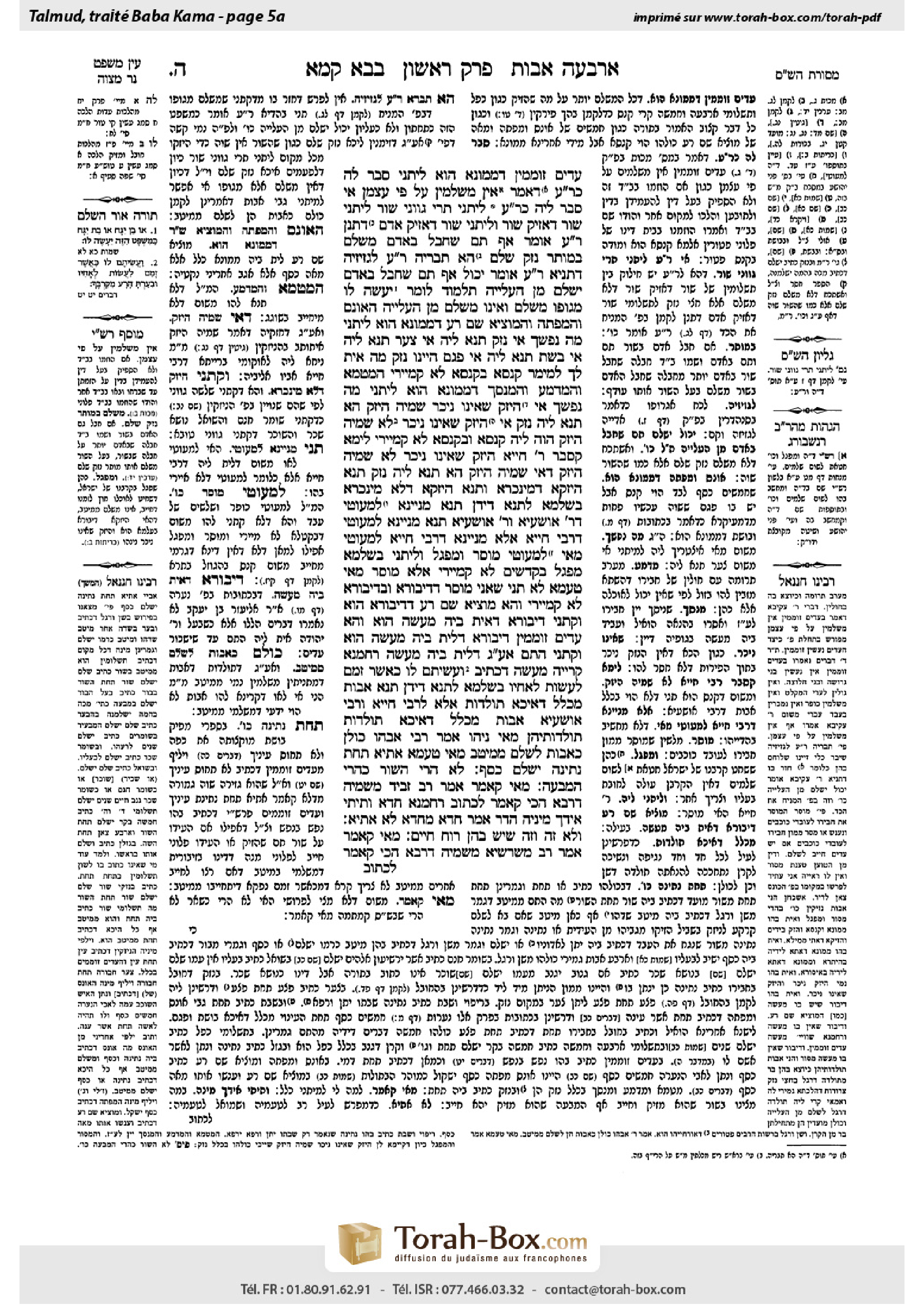
Bava Kamma 5a: Talmud study for Daf Yomi
Study the Talmud for Daf Yomi with scanned pages, Hebrew text, English translations from Sefaria and AI-generated French translations.
Passage selection and English or AI-generated French translation are available where the scan has annotations. Daf Study is independent of Torah-Box and Sefaria.
Browse Bava Kamma · בבא קמא · All tractatesBava Kamma 5a text and translations
This page of Bava Kamma includes the Aramaic text, an English translation and an AI-generated French translation, alongside the scan above.
בבא קמא ה׳ א · Aramaic and Hebrew text
עֵדִים זוֹמְמִין, דְּמָמוֹנָא הוּא, לִיתְנֵי! סָבַר לַהּ כְּרַבִּי עֲקִיבָא, דְּאָמַר: אֵין מְשַׁלְּמִין עַל פִּי עַצְמָן.
אִי סָבַר לֵיהּ כְּרַבִּי עֲקִיבָא, לִיתְנֵי תְּרֵי גַוְונֵי שׁוֹר – לִיתְנֵי שׁוֹר דְּאַזֵּיק שׁוֹר, וְלִיתְנֵי שׁוֹר דְּאַזֵּיק אָדָם;
דִּתְנַן, רַבִּי עֲקִיבָא אוֹמֵר: אַף תָּם שֶׁחָבַל בְּאָדָם – מְשַׁלֵּם בַּמּוֹתָר נֶזֶק שָׁלֵם!
הָא תַּבְרֵיהּ רַבִּי עֲקִיבָא לִגְזִיזֵיהּ; דְּתַנְיָא, רַבִּי עֲקִיבָא אוֹמֵר: יָכוֹל אַף תָּם שֶׁחָבַל בְּאָדָם, יְשַׁלֵּם מִן הָעֲלִיָּיה – תַּלְמוּד לוֹמַר: ״יֵעָשֶׂה לוֹ״ – מִגּוּפוֹ מְשַׁלֵּם, וְאֵינוֹ מְשַׁלֵּם מִן הָעֲלִיָּיה.
הָאוֹנֶס וְהַמְפַתֶּה וְהַמּוֹצִיא שֵׁם רַע, דְּמָמוֹנָא הוּא, לִיתְנֵי!
מָה נַפְשָׁךְ; אִי נֵזֶק – תְּנָא לֵיהּ, אִי צַעַר – תְּנָא לֵיהּ, אִי בּשֶׁת – תְּנָא לֵיהּ, אִי פְּגָם – הַיְינוּ נֵזֶק. מָה אִית לָךְ לְמֵימַר – קְנָסָא? בִּקְנָסָא לָא קָמַיְירֵי.
הַמְטַמֵּא וְהַמְדַמֵּעַ וְהַמְנַסֵּךְ, דְּמָמוֹנָא הוּא, לִיתְנֵי!
מָה נַפְשָׁךְ; אִי הֶיזֵּק שֶׁאֵינוֹ נִיכָּר שְׁמֵיהּ הֶיזֵּק – הָא תְּנָא לֵיהּ נֵזֶק, אִי הֶיזֵּק שֶׁאֵינוֹ נִיכָּר לָא שְׁמֵיהּ הֶיזֵּק – הָוֵה לֵיהּ קְנָסָא, וּבִקְנָסָא לָא קָמַיְירֵי.
לֵימָא קָסָבַר רַבִּי חִיָּיא הֶיזֵּק שֶׁאֵינוֹ נִיכָּר לָא שְׁמֵיהּ הֶיזֵּק? דְּאִי שְׁמֵיהּ הֶיזֵּק, הָא תְּנָא לֵיהּ נֵזֶק! תְּנָא הֶיזֵּקָא דְּמִינַּכְרָא, וּתְנָא הֶיזֵּקָא דְּלָא מִינַּכְרָא.
בִּשְׁלָמָא לְתַנָּא דִּידַן, תְּנָא מִנְיָינָא – לְמַעוֹטֵי דְּרַבִּי אוֹשַׁעְיָא, וְרַבִּי אוֹשַׁעְיָא תְּנָא מִנְיָינָא – לְמַעוֹטֵי דְּרַבִּי חִיָּיא. אֶלָּא מִנְיָינָא דְּרַבִּי חִיָּיא, לְמַעוֹטֵי מַאי?
לְמַעוֹטֵי מוֹסֵר וּמְפַגֵּל.
וְלִיתְנֵי! בִּשְׁלָמָא מְפַגֵּל – בְּקָדָשִׁים לָא קָמַיְירֵי. אֶלָּא מוֹסֵר, מַאי טַעְמָא לָא תָּנֵי? שָׁאנֵי מוֹסֵר – דְּדִיבּוּרָא, וּבְדִיבּוּרָא לָא קָמַיְירֵי.
וְהָא מוֹצִיא שֵׁם רַע, דְּדִיבּוּרָא הוּא, וְקָתָנֵי! דִּיבּוּרָא דְּאִית בֵּיהּ מַעֲשֶׂה הוּא.
וְהָא עֵדִים זוֹמְמִין – דִּיבּוּרָא דְּלֵית בֵּיהּ מַעֲשֶׂה הוּא, וְקָתָנֵי! הָתָם, אַף עַל גַּב דְּלֵית בֵּיהּ מַעֲשֶׂה, רַחֲמָנָא קַרְיֵיהּ מַעֲשֶׂה – דִּכְתִיב: ״וַעֲשִׂיתֶם לוֹ כַּאֲשֶׁר זָמַם לַעֲשׂוֹת לְאָחִיו״.
בִּשְׁלָמָא לְתַנָּא דִּידַן, תַּנָּא ״אָבוֹת״ – מִכְּלָל דְּאִיכָּא תּוֹלְדוֹת; אֶלָּא לְרַבִּי חִיָּיא וְרַבִּי אוֹשַׁעְיָא, ״אָבוֹת״ – מִכְּלָל דְּאִיכָּא תּוֹלְדוֹת?! תּוֹלְדוֹתֵיהֶן מַאי נִיהוּ?
אָמַר רַבִּי אֲבָהוּ: כּוּלָּן כְּאָבוֹת לְשַׁלֵּם מִמֵּיטַב.
מַאי טַעְמָא? אַתְיָא ״תַּחַת״, ״נְתִינָה״, ״יְשַׁלֵּם״, ״כֶּסֶף״.
לֹא הֲרֵי הַשּׁוֹר כַּהֲרֵי הַמַּבְעֶה. מַאי קָאָמַר? אָמַר רַב זְבִיד מִשְּׁמֵיהּ דְּרָבָא: הָכִי קָאָמַר – לִכְתּוֹב רַחֲמָנָא חֲדָא, וְתֵיתֵי אִידַּךְ מִינֵּיהּ; הֲדַר אֲמַר: חֲדָא מֵחֲדָא לָא אָתְיָא.
וְלֹא זֶה וָזֶה שֶׁיֵּשׁ בָּהֶן רוּחַ חַיִּים. מַאי קָאָמַר? אָמַר רַב מְשַׁרְשְׁיָא מִשְּׁמֵיהּ דְּרָבָא: הָכִי קָאָמַר –
Bava Kamma 5a · English translation
The Gemara asks: With regard to the payment made by conspiring witnesses, which is categorized as monetary restitution, as the witnesses pay the precise sum that they conspired to cause the defendant to lose, let Rabbi Oshaya also teach it as one of the categories on his list. The Gemara answers: Rabbi Oshaya holds in accordance with the opinion of Rabbi Akiva, who says that conspiring witnesses do not pay on the basis of their own admission. Evidently, theirs is not a payment of monetary restitution; rather, it is a fine, as only one who was found liable based on the testimony of witnesses pays a fine, not one who was found liable based on his own admission.
The Gemara asks: If Rabbi Oshaya holds in accordance with the opinion of Rabbi Akiva, let him teach two distinct types of categories of damage under the rubric of Ox: Let him teach one category for an ox that damages an ox or other property belonging to another person, and let him also teach the case of an ox that injures a person.
The Gemara explains its question: As we learned in a mishna (33a): In a case where the two parties damaged each other concurrently, Rabbi Akiva says: The owner of the innocuous ox that injured a person also pays the full cost of the damage with regard to the difference between the damage caused by his ox and the damage that the person caused the ox. Rabbi Akiva holds that if an innocuous ox injures a person, the owner pays the full cost of the damage, whereas if an innocuous ox damages another’s property then the owner is liable only for half the cost of the damage. Since the owner’s liability in the two cases is different, each case should be classified as a distinct category, and Rabbi Oshaya should list them separately in his baraita.
The Gemara answers: Didn’t Rabbi Akiva break the force of his fist [gezizeih], i.e., he significantly tempered the force of his statement, as it is taught in a baraita that Rabbi Akiva says: One might have thought that even in the case of an innocuous ox that injured a person, the owner of the ox would pay from his superior-quality property and not merely from the body of his animal, as in the case of an innocuous ox that damages property; therefore, the verse states with regard to an ox that gores a person: “According to this judgment shall it be done to him” (Exodus 21:31), from which it is derived that the owner of the ox pays restitution exclusively from proceeds of the sale of the body of his ox, and he does not pay from his superior-quality property. The mishna states that one pays restitution from his superior-quality property in instances of all primary categories of damage. Since in the case of an innocuous ox that injured a person even Rabbi Akiva concedes that the owner does not pay from his superior-quality property, it should not be included in a list of the primary categories.
The Gemara asks: As for the rapist, and the seducer, and the defamer, all of which are cases in which the offender pays monetary restitution, let Rabbi Oshaya teach them as categories in his list.
The Gemara explains why Rabbi Oshaya did not teach them as separate categories: Whichever way you look at it, they should not be listed. If the payments listed by Rabbi Ḥiyya are for damage caused to the woman’s body, which reduces her value, he already taught it; if the payments are for pain, he already taught it; if the payments are for humiliation, he already taught it; if the payment is for degradation, that too is a payment for damage, which he already taught. What, then, have you to say? What is the nature of the payments paid by the rapist and the seducer mentioned by Rabbi Ḥiyya? In these cases, each payment paid is considered a fine [kenasa], and as explained, with regard to cases in which one is liable to pay a fine, Rabbi Oshaya does not speak.
The Gemara asks further: And one who causes another’s teruma to become ritually impure, and one who mixes teruma with another’s non-sacred food, and one who pours another’s wine as a libation for idolatry, each of which is a case in which the offender must pay monetary restitution to compensate the owner for his loss due to the lowered value of his food or wine, let Rabbi Oshaya teach them as categories in his list.
The Gemara answers: Whichever way you look at it, these cases should not be listed. If Rabbi Oshaya holds that damage that is not evident, i.e., where the object is physically unchanged but its halakhic status is changed, is characterized as damage for which one is liable to pay restitution, Rabbi Oshaya already taught, i.e., included in his list, restitution for damage, and if he holds that damage that is not evident is not characterized as damage for which one is liable to pay restitution, then it is a fine, and, as explained, with regard to cases for which one is liable to pay a fine, Rabbi Oshaya does not speak.
The Gemara suggests: Since Rabbi Ḥiyya lists these cases as distinct categories, let us say that Rabbi Ḥiyya holds that damage that is not evident is not characterized as damage for which one is liable to pay restitution, as, if it were characterized as damage for which one is liable to pay restitution, didn’t he already teach, i.e., include in his list, restitution for damage? The Gemara rejects that suggestion: Even if he holds that damage that is evident is characterized as damage for which one is liable to pay restitution, he distinguishes between different types of damage. He teaches cases of damage that is evident and he teaches cases of damage that is not evident.
The Gemara considers the fact that each of the lists of primary categories is introduced with the number that they total: Granted, according to the tanna of our mishna, he taught the number of four primary categories in introducing his list to exclude those additional categories of Rabbi Oshaya. And similarly, Rabbi Oshaya taught the number of thirteen primary categories to exclude those additional categories of Rabbi Ḥiyya. But what does the number of twenty-four primary categories of Rabbi Ḥiyya serve to exclude?
The Gemara answers: He taught that number in order to exclude the cases of an informer, who provides information to the authorities leading them to confiscate another person’s property; and to exclude the case of a priest who renders an offering piggul by performing the sacrificial rites for one offering with the intent to sacrifice it for the sake of another offering, in which case the person who brought the offering must replace it with another.
The Gemara asks: And let Rabbi Ḥiyya teach these cases. Granted, he did not include the case of a priest who renders an offering piggul. Perhaps, with regard to cases involving consecrated items, Rabbi Ḥiyya does not speak. But with regard to the case of an informer, what is the reason Rabbi Ḥiyya did not teach it and include it in his list of categories? The Gemara answers: The case of an informer is different, as the damage is caused through speech, and with regard to damage caused through speech, Rabbi Ḥiyya does not speak.
The Gemara asks: But isn’t there the case of a defamer, where the damage is caused through speech, and yet Rabbi Ḥiyya teaches it and includes it in his list? The Gemara answers: He includes that case because it is a case of speech that involves an action. One who defames his wife is liable only if he made his allegation after engaging in intercourse with her.
The Gemara asks: But isn’t the case of conspiring witnesses a case of speech that involves no action, as they are liable for their testimony, and Rabbi Ḥiyya teaches it and includes it in his list? The Gemara answers: There, although it involves no action, the Merciful One characterizes it as an action, as it is written: “And you shall do to him as he conspired to do unto his brother” (Deuteronomy 19:19).
The Gemara considers the subcategories of the various primary categories listed: Granted, according to the tanna of our mishna, his terminology is understandable, as he taught primary categories, which, by inference, means that there are also additional forms of damage that are subcategories of those primary categories. But according to Rabbi Ḥiyya and Rabbi Oshaya, why did they employ the terminology they employed? They employed the term primary categories, which, by inference, means that there are subcategories. What are the subcategories of the primary categories they listed? It appears that they enumerated all the various categories of damage.
Rabbi Abbahu says: When Rabbi Ḥiyya and Rabbi Oshaya characterize, as primary categories, the various categories of damage that they listed, it is not to indicate that there are subcategories; rather, it is to indicate that all of them are characterized as primary categories, in the sense that one is liable to pay from one’s best-quality property.
The Gemara asks: What is the reason for this, i.e., from where is it derived? The Gemara explains: It is derived using a verbal analogy from the terms “in place of,” “giving,” “he shall pay,” and “money.” The term “in place of” is written with regard to a forewarned ox that gores (Exodus 21:36); “he shall give” is written with regard to an ox that kills a slave (Exodus 21:32); “he shall pay” is written with regard to the categories of damage of Eating and Trampling (Exodus 22:4); and “money” is written with regard to Pit (Exodus 21:34). The halakha that one must pay from his best-quality property is stated explicitly in each of those four verses. In each of the twenty-four categories listed by Rabbi Ḥiyya one of those four terms is written, so by means of a verbal analogy, the requirement to pay from one’s best-quality property applies to each of them.
§ The mishna states: The defining characteristic of the primary category of Ox is not similar to the defining characteristic of the primary category of Maveh. The Gemara asks: What is the mishna saying? Rav Zevid said in the name of Rava that this is what the mishna is saying: Let the Merciful One write one of the primary categories and derive the other categories from it. Then the tanna says: It is not possible to derive one category from one other category, as each category has its unique characteristics.
The mishna continues: And the defining characteristics of this category of Ox and that category of Maveh, in which there is a living spirit, are not similar to the defining characteristic of the category of Fire, in which there is no living spirit. The Gemara asks: What is the tanna saying? Rav Mesharshiyya said in the name of Rava that this is what the tanna is saying:
Bava Kamma 5a · Traduction française (IA)
La Guemara pose la question : Concernant le paiement effectué par des témoins complices, qui est classé comme restitution monétaire, puisque les témoins paient la somme exacte qu'ils avaient combiné pour faire perdre au défendeur, pourquoi Rabbi Oshaya ne l'aurait-il pas également classé parmi les catégories de sa liste ? La Guemara répond : Rabbi Oshaya suit l'opinion de Rabbi Akiva, qui affirme que les témoins complices ne paient pas sur la base de leur propre aveu. Il est évident que ce n'est pas une restitution monétaire, mais une amende, car seul celui qui est trouvé coupable grâce aux témoins paie une amende, pas celui qui est trouvé coupable grâce à son propre aveu.
La Guemara pose la question : Si Rabbi Oshaya suit l'opinion de Rabbi Akiva, pourquoi ne pas enseigner deux catégories distinctes de dommages sous le rubrique de l'âne : enseigner une catégorie pour un âne qui endommage un autre âne ou des biens appartenant à un autre, et enseigner également le cas d'un âne qui blesse une personne.
La Guemara explique sa question : Comme nous l'avons appris dans une mitsva (33a) : Dans un cas où les deux parties s'indemnisent mutuellement, Rabbi Akiva dit : L'propriétaire de l'âne inoffensif qui a blessé une personne paie également le coût complet du dommage concernant la différence entre le dommage causé par son âne et celui que la personne a causé à l'âne. Rabbi Akiva considère que si un âne inoffensif blesse une personne, l'propriétaire paie le coût complet du dommage, alors que si un âne inoffensif endommage les biens d'un autre, l'propriétaire est seulement tenu pour responsable de la moitié du coût du dommage. Puisque la responsabilité de l'propriétaire diffère dans les deux cas, chaque cas devrait être classé comme une catégorie distincte, et Rabbi Oshaya devrait les lister séparément dans sa baraïta.
La Guemara répond : N’a-t-on pas vu Rabbi Akiva atténuer considérablement la force de son propos [gezizeih], c’est-à-dire qu’il a considérablement modéré l’impact de son déclaration, comme il est enseigné dans une baraïta que Rabbi Akiva dit : On pourrait penser que même dans le cas d’un taureau inoffensif qui a blessé une personne, l’propriétaire du taureau paierait à partir de ses biens de qualité supérieure et non seulement à partir du corps de son animal, comme dans le cas d’un taureau inoffensif qui endommage des biens ; donc, la Sainte Écriture dit concernant un taureau qui blesse une personne : « Selon ce jugement, il sera fait à lui » (Exode 21:31), d’où il est déduit que l’propriétaire du taureau paie la restitution uniquement à partir des revenus de la vente du corps de son taureau, et il ne paie pas à partir de ses biens de qualité supérieure. La mitsna dit que l’on paie la restitution à partir de ses biens de qualité supérieure dans tous les cas de catégories principales de dommages. Puisque dans le cas d’un taureau inoffensif qui a blessé une personne, même Rabbi Akiva reconnaît que l’propriétaire ne paie pas à partir de ses biens de qualité supérieure, ce cas ne devrait pas être inclus dans une liste des catégories principales.
La Guemara pose la question : En ce qui concerne le viol, le séducteur et le calomniateur, tous des cas où l’offenseur paie une restitution monétaire, pourquoi Rabbi Oshaya ne les a-t-il pas enseignés comme des catégories dans sa liste ?
La Guemara explique pourquoi Rabbi Oshaya n'a pas enseigné ces cas comme des catégories distinctes : Quel que soit l'angle sous lequel on les examine, ils ne devraient pas être listés. Si les paiements listés par Rabbi Ḥiyya sont pour les dommages causés au corps de la femme, qui réduit sa valeur, il les a déjà enseignés ; si les paiements sont pour la douleur, il les a déjà enseignés ; si les paiements sont pour l'humiliation, il les a déjà enseignés ; si le paiement est pour la dégradation, cela aussi est un paiement pour un dommage, qu'il a déjà enseigné. Qu'est-ce donc que tu veux dire ? Quelle est la nature des paiements effectués par le violateur et le séducteur mentionnés par Rabbi Ḥiyya ? Dans ces cas, chaque paiement effectué est considéré comme une amende [kenasa], et comme expliqué, concernant les cas où l'on est tenu de payer une amende, Rabbi Oshaya ne parle pas.
La Guemara pose la question : Et celui qui rend la terouma rituellement impure, et celui qui mélange la terouma avec les aliments non sacrés d'un autre, et celui qui verse le vin d'un autre comme libation pour l'idolâtrie, chacun de ces cas est un cas où l'offenseur doit payer une restitution monétaire pour compenser l'propriétaire pour sa perte due à la baisse de valeur de ses aliments ou de son vin, pourquoi Rabbi Oshaya ne les a-t-il pas enseignés comme des catégories dans sa liste.
La Guemara répond : Quel que soit l'angle sous lequel on les examine, ces cas ne devraient pas être listés. Si Rabbi Oshaya considère que les dommages non évidents, c'est-à-dire où l'objet est physiquement inchangé mais son statut halakhique est modifié, sont caractérisés comme des dommages pour lesquels l'on est tenu de payer une restitution, Rabbi Oshaya les a déjà enseignés, c'est-à-dire inclus dans sa liste, la restitution pour les dommages. Et si il considère que les dommages non évidents ne sont pas caractérisés comme des dommages pour lesquels l'on est tenu de payer une restitution, alors il s'agit d'une amende, et comme expliqué, concernant les cas où l'on est tenu de payer une amende, Rabbi Oshaya ne parle pas.
La Guemara suggère : Puisque Rabbi Ḥiyya liste ces cas comme des catégories distinctes, disons que Rabbi Ḥiyya considère que les dommages non évidents ne sont pas caractérisés comme des dommages pour lesquels l'on est tenu de payer une restitution, car, si c'était le cas, n'a-t-il pas déjà enseigné, c'est-à-dire inclus dans sa liste, la restitution pour les dommages ? La Guemara rejette cette suggestion : Même si Rabbi Ḥiyya considère que les dommages évidents sont caractérisés comme des dommages pour lesquels l'on est tenu de payer une restitution, il distingue entre différents types de dommages. Il enseigne les cas de dommages évidents et il enseigne les cas de dommages non évidents.
La Guemara considère le fait que chaque liste des catégories principales est introduite par le nombre total qu'elles représentent : C'est certain, selon le tanna de notre mitsna, il a enseigné le nombre de quatre catégories principales en introduisant sa liste afin d'exclure les catégories supplémentaires de Rabbi Oshaya. De même, Rabbi Oshaya a enseigné le nombre de treize catégories principales afin d'exclure les catégories supplémentaires de Rabbi Ḥiyya. Mais à quoi sert le nombre de vingt-quatre catégories principales de Rabbi Ḥiyya pour exclure quelque chose ?
La Guemara répond : Il a enseigné ce nombre afin d'exclure les cas d'un informateur, qui transmet des informations aux autorités, ce qui conduit celles-ci à confisquer la propriété d'une autre personne ; et afin d'exclure le cas d'un prêtre qui rend un sacrifice piggul en accomplissant les rites sacrificiels pour un sacrifice avec l'intention de le sacrifier pour un autre sacrifice, dans ce cas, la personne qui a apporté le sacrifice doit le remplacer par un autre.
La Guemara demande : Et pourquoi Rabbi Ḥiyya n'a-t-il pas enseigné ces cas ? Bien sûr, il n'a pas inclus le cas du prêtre qui rend un sacrifice piggul. Peut-être, concernant les cas d'objets consacrés, Rabbi Ḥiyya ne parle pas. Mais concernant le cas de l'informateur, quelle est la raison pour laquelle Rabbi Ḥiyya n'a pas enseigné ce cas et ne l'a pas inclus dans sa liste de catégories ? La Guemara répond : Le cas de l'informateur est différent, car le préjudice est causé par la parole, et concernant les préjudices causés par la parole, Rabbi Ḥiyya ne parle pas.
La Guemara demande : Mais n'y a-t-il pas le cas du calomniateur, où le préjudice est causé par la parole, et pourtant Rabbi Ḥiyya l'enseigne et l'inclut dans sa liste ? La Guemara répond : Il inclut ce cas car il s'agit d'une parole qui implique une action. Celui qui calomniera sa femme est responsable uniquement s'il a formulé son allégation après avoir eu des relations sexuelles avec elle.
La Guemara demande : Mais n’y a-t-il pas le cas des témoins complices, un cas de parole qui ne comporte aucune action, car ils sont responsables de leur témoignage, et Rabbi Ḥiyya l’enseigne et l’inclut dans sa liste ? La Guemara répond : Là, bien qu’il ne comporte aucune action, l’Éternel caractérise cela comme une action, car il est écrit : « Et vous ferez à lui ce qu’il a combiné de faire à son frère » (Deutéronome 19:19).
La Guemara examine les sous-catégories des diverses catégories principales listées : Bien sûr, selon le tanna de notre mitsna, son vocabulaire est compréhensible, car il a enseigné des catégories principales, ce qui implique par conséquent qu’il existe également des formes supplémentaires de préjudice qui sont des sous-catégories de ces catégories principales. Mais selon Rabbi Ḥiyya et Rabbi Oshaya, pourquoi ont-ils employé le vocabulaire qu’ils ont employé ? Ils ont employé le terme de catégories principales, ce qui implique par conséquent qu’il existe des sous-catégories. Quelles sont les sous-catégories des catégories principales qu’ils ont listées ? Il semble qu’ils ont énuméré toutes les diverses catégories de préjudice.
Rabbi Abbahu dit : Lorsque Rabbi Ḥiyya et Rabbi Oshaya caractérisent, comme catégories principales, les diverses catégories de préjudice qu’ils ont listées, ce n’est pas pour indiquer qu’il existe des sous-catégories ; plutôt, c’est pour indiquer que toutes ces catégories sont caractérisées comme catégories principales, au sens où l’on est tenu de payer avec ses biens de meilleure qualité.
La Guemara demande : De quelle source provient cela, c'est-à-dire d'où est-il tiré ? La Guemara explique : Cela est tiré par analogie verbale des termes « en lieu et place », « donner », « il devra payer », et « argent ». Le terme « en lieu et place » est écrit concernant un bœuf averti qui tue (Exode 21:36) ; « il devra donner » est écrit concernant un bœuf qui tue un serviteur (Exode 21:32) ; « il devra payer » est écrit concernant les catégories de préjudice d'ingestion et de piétinement (Exode 22:4) ; et « argent » est écrit concernant le trou (Exode 21:34). La halakha selon laquelle l'on doit payer avec ses biens de meilleure qualité est explicitement mentionnée dans chacun de ces quatre versets. Dans chacune des vingt-quatre catégories listées par Rabbi Ḥiyya, l'un de ces quatre termes est écrit, donc par analogie verbale, la nécessité de payer avec ses biens de meilleure qualité s'applique à chacune d'entre elles.
§ La mitsva stipule : La caractéristique définissante de la catégorie principale du bœuf n'est pas semblable à la caractéristique définissante de la catégorie principale du Maveh. La Guemara demande : De quoi la mitsva parle-t-elle ? Rav Zevid, en nom de Rava, dit que c'est ce que la mitsva dit : Que l'Éternel écrive l'une des catégories principales et dérive les autres catégories d'elle. Puis le tanna dit : Il n'est pas possible de dériver une catégorie d'une autre catégorie, car chaque catégorie a ses caractéristiques propres.
La mitsva continue : Et les caractéristiques définissantes de cette catégorie du bœuf et de celle du Maveh, dans lesquelles il y a un esprit vivant, ne sont pas semblables à la caractéristique définissante de la catégorie du feu, dans laquelle il n'y a pas d'esprit vivant. La Guemara demande : De quoi le tanna parle-t-il ? Rav Mesharshiyya, en nom de Rava, dit que c'est ce que le tanna dit :
Traduction française générée par IA à partir de l’édition anglaise de Sefaria. Vérifie toujours un passage avec le texte source.
Text from Sefaria: William Davidson Edition - Vocalized Aramaic (CC BY NC); William Davidson Edition - English (CC BY NC).