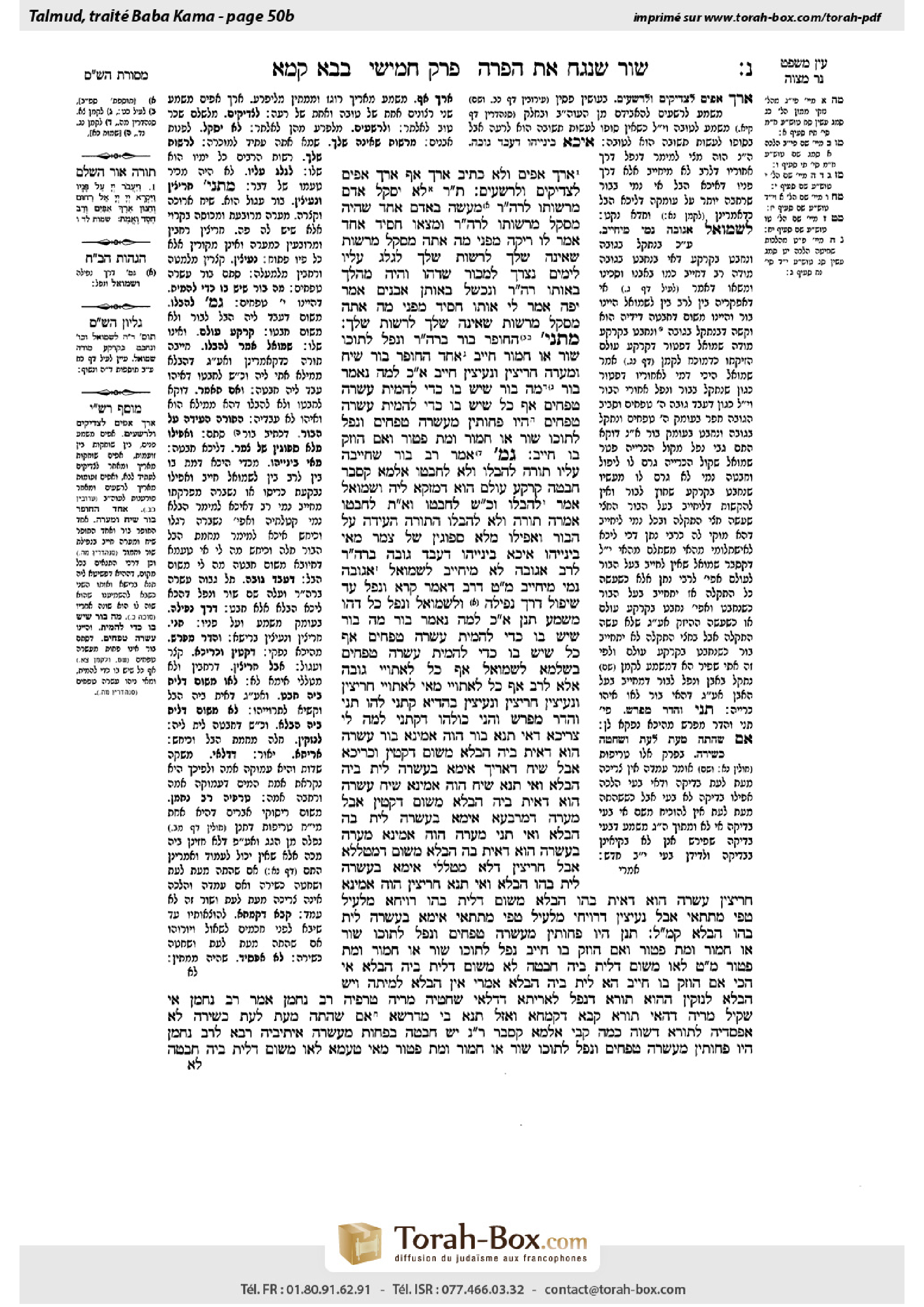
Bava Kamma 50b: Talmud study for Daf Yomi
Study the Talmud for Daf Yomi with scanned pages, Hebrew text, English translations from Sefaria and AI-generated French translations.
Passage selection and English or AI-generated French translation are available where the scan has annotations. Daf Study is independent of Torah-Box and Sefaria.
Browse Bava Kamma · בבא קמא · All tractatesBava Kamma 50b text and translations
This page of Bava Kamma includes the Aramaic text, an English translation and an AI-generated French translation, alongside the scan above.
בבא קמא נ׳ ב · Aramaic and Hebrew text
״אֶרֶךְ אַפַּיִם״ – וְלָא כְּתִיב ״אֶרֶךְ אַף״? אֶרֶךְ אַפַּיִם לַצַּדִּיקִים וְלָרְשָׁעִים.
תָּנוּ רַבָּנַן: לֹא יְסַקֵּל אָדָם מֵרְשׁוּתוֹ לִרְשׁוּת הָרַבִּים. מַעֲשֶׂה בְּאָדָם אֶחָד שֶׁהָיָה מְסַקֵּל מֵרְשׁוּתוֹ לִרְשׁוּת הָרַבִּים, וּמְצָאוֹ חָסִיד אֶחָד. אָמַר לוֹ: רֵיקָה, מִפְּנֵי מָה אַתָּה מְסַקֵּל מֵרְשׁוּת שֶׁאֵינָהּ שֶׁלָּךְ לִרְשׁוּת שֶׁלָּךְ? לִגְלֵג עָלָיו.
לְיָמִים נִצְרַךְ לִמְכּוֹר שָׂדֵהוּ, וְהָיָה מְהַלֵּךְ בְּאוֹתוֹ רְשׁוּת הָרַבִּים, וְנִכְשָׁל בְּאוֹתָן אֲבָנִים; אָמַר: יָפֶה אָמַר לִי אוֹתוֹ חָסִיד – מִפְּנֵי מָה אַתָּה מְסַקֵּל מֵרְשׁוּת שֶׁאֵינָהּ שֶׁלָּךְ לִרְשׁוּת שֶׁלָּךְ.
מַתְנִי׳ הַחוֹפֵר בּוֹר בִּרְשׁוּת הָרַבִּים, וְנָפַל לְתוֹכוֹ שׁוֹר אוֹ חֲמוֹר – חַיָּיב. אֶחָד הַחוֹפֵר בּוֹר, שִׁיחַ וּמְעָרָה, חֲרִיצִין וּנְעִיצִין – חַיָּיב. אִם כֵּן לָמָּה נֶאֱמַר ״בּוֹר״? מָה בּוֹר שֶׁיֵּשׁ בּוֹ כְּדֵי לְהָמִית – עֲשָׂרָה טְפָחִים; אַף כֹּל שֶׁיֵּשׁ בּוֹ כְּדֵי לְהָמִית – עֲשָׂרָה טְפָחִים. הָיוּ פְּחוּתִין מֵעֲשָׂרָה טְפָחִים, וְנָפַל לְתוֹכוֹ שׁוֹר אוֹ חֲמוֹר, וּמֵת – פָּטוּר. וְאִם הוּזַּק בּוֹ – חַיָּיב.
גְּמָ׳ אָמַר רַב: בּוֹר שֶׁחִיְּיבָה עָלָיו תּוֹרָה – לְהֶבְלוֹ, וְלֹא לַחֲבָטוֹ. אַלְמָא קָסָבַר: חֲבָטָה – קַרְקַע עוֹלָם הוּא דְּמַזְּקָא לֵיהּ.
וּשְׁמוּאֵל אָמַר: לְהֶבְלוֹ, וְכׇל שֶׁכֵּן לַחֲבָטוֹ. וְאִם תֹּאמַר: לַחֲבָטוֹ אָמְרָה תּוֹרָה, וְלֹא לְהֶבְלוֹ – הַתּוֹרָה הֵעִידָה עַל הַבּוֹר, וַאֲפִילּוּ מָלֵא סְפוֹגִין שֶׁל צֶמֶר.
מַאי בֵּינַיְיהוּ? אִיכָּא בֵּינַיְיהוּ דַּעֲבַד גּוֹבַהּ בִּרְשׁוּת הָרַבִּים; לְרַב – אַגּוֹבַהּ לָא מִיחַיַּיב, לִשְׁמוּאֵל – אַגּוֹבַהּ נָמֵי מִיחַיַּיב.
מַאי טַעְמָא דְּרַב? דְּאָמַר קְרָא: ״וְנָפַל״ – עַד שֶׁיִּפּוֹל דֶּרֶךְ נְפִילָה. וְלִשְׁמוּאֵל, ״וְנָפַל״ – כֹּל דְּהוּ מַשְׁמַע.
תְּנַן: אִם כֵּן לָמָּה נֶאֱמַר ״בּוֹר״? מָה בּוֹר שֶׁיֵּשׁ בּוֹ כְּדֵי לְהָמִית – עֲשָׂרָה טְפָחִים, אַף כֹּל שֶׁיֵּשׁ בּוֹ כְּדֵי לְהָמִית – עֲשָׂרָה טְפָחִים. בִּשְׁלָמָא לִשְׁמוּאֵל – ״אַף כֹּל״ לְאֵתוֹיֵי גּוֹבַהּ. אֶלָּא לְרַב – ״אַף כֹּל״ לְאֵתוֹיֵי מַאי?
לְאֵתוֹיֵי חֲרִיצִין וּנְעִיצִין. חֲרִיצִין וּנְעִיצִין בְּהֶדְיָא קָתָנֵי לְהוּ! תָּנֵי, וַהֲדַר מְפָרֵשׁ.
וְהָנֵי כּוּלְּהוּ דְּקָתָנֵי – לְמָה לִי? צְרִיכָא; דְּאִי תְּנָא בּוֹר, הֲוָה אָמֵינָא: בּוֹר עֲשָׂרָה – הוּא דְּאִית בֵּיהּ הַבְלָא, מִשּׁוּם דְּקַטִּין וּכְרִיכָא; אֲבָל שִׁיחַ – דַּאֲרִיךְ, אֵימָא: בַּעֲשָׂרָה לֵית בֵּיהּ הַבְלָא.
וְאִי תְּנָא שִׁיחַ, הֲוָה אָמֵינָא: שִׁיחַ עֲשָׂרָה הוּא דְּאִית בֵּיהּ הַבְלָא, מִשּׁוּם דְּקַטִּין; אֲבָל מְעָרָה – דִּמְרַבְּעָא, אֵימָא: בַּעֲשָׂרָה לֵית בַּהּ הַבְלָא.
וְאִי תָּנֵי מְעָרָה, הֲוָה אָמֵינָא: מְעָרָה בַּעֲשָׂרָה הוּא דְּאִית בַּהּ הַבְלָא, מִשּׁוּם דִּמְטַלְּלָא; אֲבָל חֲרִיצִין – דְּלָא מְטַלְּלִי, אֵימָא: בַּעֲשָׂרָה לֵית בְּהוּ הַבְלָא.
וְאִי תְּנָא חֲרִיצִין, הֲוָה אָמֵינָא: חֲרִיצִין עֲשָׂרָה הוּא דְּאִית בְּהוּ הַבְלָא, מִשּׁוּם דְּלֵית בְּהוּ רְוִיחָא מִלְּעֵיל טְפֵי מִתַּתַּאי; אֲבָל נְעִיצִין – דִּרְוִיחִי מִלְּעֵיל טְפֵי מִתַּתַּאי, אֵימָא בַּעֲשָׂרָה לֵית בְּהוּ הַבְלָא; קָא מַשְׁמַע לַן.
תְּנַן: הָיוּ פְּחוּתִין מֵעֲשָׂרָה טְפָחִים, וְנָפַל לְתוֹכוֹ שׁוֹר אוֹ חֲמוֹר, וָמֵת – פָּטוּר. וְאִם הוּזַּק בּוֹ – חַיָּיב. נָפַל לְתוֹכוֹ שׁוֹר אוֹ חֲמוֹר, וּמֵת – פָּטוּר; מַאי טַעְמָא – לָאו מִשּׁוּם דְּלֵית בֵּיהּ חַבְטָה?
לָא, מִשּׁוּם דְּלֵית בֵּיהּ הַבְלָא. אִי הָכִי, אִם הוּזַּק בּוֹ חַיָּיב? הָא לֵית בֵּיהּ הַבְלָא! אָמְרִי: אֵין הַבְלָא לְמִיתָה, וְיֵשׁ הַבְלָא לִנְזָקִין.
הָהוּא תּוֹרָא דִּנְפַל לַאֲרִיתָּא דְּדַלָּאֵי, שַׁחְטֵיהּ מָרֵיהּ. טַרְפֵיהּ רַב נַחְמָן.
אָמַר רַב נַחְמָן: אִי שְׁקֵיל מָרֵיהּ דְּהַאי תּוֹרָא קַבָּא דְקִמְחָא, וַאֲזַל תְּנָא בֵּי מִדְרְשָׁא: אִם שָׁהֲתָה מֵעֵת לְעֵת – כְּשֵׁירָה; לָא אַפְסְדֵיהּ לְתוֹרָא דְּשָׁוֵה כַּמָּה קַבֵּי. אַלְמָא קָסָבַר רַב נַחְמָן: יֵשׁ חֲבָטָה בְּפָחוֹת מֵעֲשָׂרָה.
אֵיתִיבֵיהּ רָבָא לְרַב נַחְמָן: הָיוּ פְּחוּתִין מֵעֲשָׂרָה טְפָחִים, וְנָפַל לְתוֹכוֹ שׁוֹר אוֹ חֲמוֹר, וּמֵת – פָּטוּר. מַאי טַעְמָא? לָאו מִשּׁוּם דְּלֵית בֵּיהּ חַבְטָה?
Bava Kamma 50b · English translation
in the verse that recounts the thirteen attributes of mercy: “Long-suffering [erekh appayim]” (Exodus 34:6), using the plural form, and it is not written as erekh af, in the singular? In order to teach that He is long-suffering for both the righteous and for the wicked and does not punish them immediately for their transgressions.
§ The Sages taught: A person should not throw stones from his property into the public domain. An incident occurred involving a certain individual who was throwing stones from his property into the public domain, and a certain pious man found him. The latter said to him: Lowlife [reika], for what reason are you throwing stones from property that is not yours into your property? The man mocked him, as he did not understand what he meant, as the property from which he was throwing stones was his.
Some days later, he was forced to sell his field from which he had thrown the stones. And he was walking in the same public domain into which he had thrown them, and he stumbled on those same stones. He said: That pious man said it well to me when he said: For what reason are you throwing stones from property that is not yours into your own property, since that property no longer belongs to me, and only the public domain remains mine to use.
MISHNA: In the case of one who digs a pit in the public domain and an ox or a donkey fell into it, he is liable. The halakha is the same for one who digs either a pit; a ditch, which is narrow and long; or a cave, which is rectangular and roofed; trenches and water channels. In all these cases he is liable. If so, why is the verse stated as referring to a pit, as it states: “And if a man shall open a pit” (Exodus 21:33)? To teach that just as a pit that has sufficient depth to cause death when falling into it is at least ten handbreadths deep, so too, any other excavations that have sufficient depth to cause death may be no less than ten handbreadths. If any of the types of excavations were less than ten handbreadths deep, and an ox or a donkey fell into one of them and died, the digger of the excavation is exempt. But if it was injured in it, not killed, he is liable to pay damages.
GEMARA: Rav says: Damage by Pit for which the Torah obligates one to pay is referring specifically to damage caused by the pit’s lethal fumes, i.e., suffocation, but not to damage caused by the impact of hitting the ground, for which the digger of the pit is exempt from paying compensation. The Gemara continues to explain: Apparently, it can be inferred that Rav maintains that with regard to the impact of hitting the bottom of the pit, it is merely the ground that injures him. The digger of the pit does not own the ground, so it is not a case where his property caused damage. Therefore, he does not bear responsibility for the damage.
And Shmuel says: The Torah renders one liable for damage caused by its lethal fumes, and all the more so for damage resulting from the impact. Shmuel adds: And if you say that the Torah spoke only about liability for its impact and not for its lethal fumes, one could respond that the Torah testifies about a pit without specifying for which type of pit one is liable, and this includes even a pit full of woolen sponges [sefogin], which would completely absorb the impact.
The Gemara asks: What is the difference between the opinions of Rav and Shmuel, given that falling into any pit involves injury due to both the lethal fumes and the impact? The Gemara answers: The practical difference between them is in the case where one fashioned a mound with a height of ten handbreadths in the public domain without digging, and an animal fell from this raised platform and died. According to Rav, the one who fashioned the mound is not liable for damage by Pit in the case of a mound, since there are no fumes, as the animal fell to the level ground. By contrast, according to Shmuel, he is also liable for damage by Pit in the case of a mound, since there is nevertheless an impact when hitting the ground.
The Gemara asks: What is the source for the reasoning of Rav, that one is not liable in that case? The Gemara answers: Since the verse states: “And an ox or a donkey fall therein” (Exodus 21:33), indicating that there is no liability for damage by Pit unless the animal falls in the normal manner of falling, but not where it first climbed onto an elevated surface and then fell from there to the level ground. And according to Shmuel, the term: “And an ox or a donkey fall,” indicates any manner of falling, regardless of whether the animal fell into a hole or fell to the ground from an elevated surface.
The Gemara challenges Rav’s opinion: We learned in the mishna: If so, why is the verse stated as referring to a pit, as it states: “And if a man shall open a pit” (Exodus 21:33)? To teach that just as a pit that has sufficient depth to cause death when falling into it is at least ten handbreadths deep, so too, any other excavations that have sufficient depth to cause death may be no less than ten handbreadths. Now, granted that according to Shmuel, the term: So too, any other, serves to include the case where the animal fell from a height of ten handbreadths, in which case the one who fashioned the mound would also be liable. But according to Rav, who exempts him in that case, what does the term: So too, any other, add?
The Gemara answers: According to Rav, it serves to include trenches and water channels. The Gemara asks: But trenches and water channels are explicitly taught in the mishna. Why does the mishna then allude to them again? The Gemara answers: It first teaches the halakha about them and then explains its source in the Torah.
Having mentioned these details, the Gemara asks: And why do I need all these cases that are taught by the mishna? The Gemara answers: They are necessary, for had it taught only the case of a pit, I would say that it is specifically a pit of ten handbreadths that contains lethal fumes, because it is constricted and round. Therefore, this measurement suffices to cause death. But concerning a ditch, which is long, say that in a case where it is ten handbreadths deep, there are no lethal fumes and there is no liability. Therefore, the mishna teaches both the case of a pit and a ditch.
And furthermore, had the mishna taught the case of a ditch in addition to the pit, I would say that it is specifically a ditch of ten handbreadths that contains the necessary lethal fumes, because it is narrow. But concerning a cave, which is rectangular and not narrow, say that in a case where it is ten handbreadths deep, there are no lethal fumes and there is no liability. Therefore, the mishna teaches the case of a cave as well.
And furthermore, had the mishna taught the case of a cave in addition to the previous two, I would say that it is specifically a cave of ten handbreadths that contains lethal fumes, because it is covered. But concerning trenches, which are not covered, say that at a depth of ten handbreadths, there are no lethal fumes and there is no liability. Therefore, the mishna also teaches the case of trenches.
And finally, had the mishna taught the case of trenches in addition to the previous three, I would say that it is specifically trenches of ten handbreadths that contain lethal fumes, since they are no wider at the top than at the bottom. But with regard to channels, which are wider at the top than at the bottom, say that at a depth of ten handbreadths there are no lethal fumes and there is no liability. Therefore, the mishna teaches us the case of channels as well, and each subsequent case listed contains a novel aspect.
The Gemara raises a further challenge from that which we learned in the mishna: If any of the types of excavations were less than ten handbreadths deep, and an ox or a donkey fell into one of them and died, the digger of the excavation is exempt. But if it was injured, not killed, he is liable to pay damages. What is the reason for the ruling of: If an ox or a donkey fell into it and died, he is exempt? Is it not because at this height there is not sufficient impact, although there are lethal fumes?
The Gemara responds: No, he is exempt because there are no lethal fumes. The Gemara challenges this: If that is so, that a pit less than ten handbreadths deep lacks sufficient lethal fumes, why is the one who dug it liable if the animal is injured; but there are no lethal fumes? The Gemara answers: There are not sufficient fumes to cause death, but there are sufficient fumes to cause damage.
The Gemara relates: There was a certain ox that fell into a water channel [la’arita dedala’ei] whose depth was one cubit, i.e., six handbreadths. Because it suffered the impact of the fall, its owner assumed it would die and slaughtered it first, in order to eat the meat. Rav Naḥman, who was concerned that its organs were crushed by the fall, deemed it an animal with a condition that will cause it to die within twelve months [tereifa], which it is prohibited to consume.
Furthermore, Rav Naḥman said: If the owner of this ox had taken a kav of flour to bake into bread to eat instead of slaughtering his animal for its meat, and gone and learned in the study hall that although an ox that falls and hits the ground is considered tereifa if slaughtered immediately, if the animal remained alive for twenty-four hours and is then slaughtered, it is fit to eat, he would not have lost his ox that was worth several kav of flour. The Gemara notes: Apparently, Rav Naḥman maintains that there is an impact caused even by a pit that is less than ten handbreadths, as Rav Naḥman was concerned in this case that its organs were crushed and it was fatally wounded.
Rava raised an objection to the opinion of Rav Naḥman from the mishna: If any of the types of excavations were less than ten handbreadths deep, and an ox or a donkey fell into one of them and died, he is exempt. What is the reason for this? Is it not because there is no significant impact capable of causing death? If so, why is this animal deemed a tereifa?
Bava Kamma 50b · Traduction française (IA)
dans la parabole qui énumère les treize attributs de miséricorde : « Long-souffrance [erekh appayim] » (Exode 34:6), en utilisant la forme plurielle, et ce n'est pas écrit comme erekh af, au singulier ? Afin d'enseigner qu'Il est long-souffrant à la fois pour les justes et pour les méchants et ne les punit pas immédiatement pour leurs transgressions.
§ Les Sages enseignent : Une personne ne doit pas lancer des pierres depuis sa propriété dans le domaine public. Il y a eu un incident concernant un individu qui lançait des pierres depuis sa propriété dans le domaine public, et un homme pieux l'a découvert. Celui-ci lui a dit : « Mauvais homme [reika], à quel titre lances-tu des pierres depuis une propriété qui n'est pas la tienne dans ta propre propriété ? » L'homme l'a moqué, car il ne comprenait pas ce qu'il voulait dire, car la propriété depuis laquelle il lançait des pierres était la sienne.
Quelques jours plus tard, il fut contraint de vendre son champ depuis lequel il avait lancé les pierres. Et il marchait dans le même domaine public dans lequel il avait lancé les pierres, et il trébucha sur ces mêmes pierres. Il a dit : « Cet homme pieux a raison quand il m'a dit : À quel titre lances-tu des pierres depuis une propriété qui n'est pas la tienne dans ta propre propriété, car cette propriété n'appartient plus à moi, et seul le domaine public me reste à utiliser. »
MICHNA : Dans le cas d'une personne qui creuse un puits dans le domaine public et un bœuf ou un âne y tombe, il est responsable. La halakha est la même pour une personne qui creuse soit un puits ; un fossé, qui est étroit et long ; ou une grotte, qui est rectangulaire et toitée ; des tranchées et des canaux d'eau. Dans tous ces cas, il est responsable. Si tel est le cas, pourquoi la parabole mentionne-t-elle spécifiquement un puits, comme il est dit : « Et si un homme ouvre un puits » (Exode 21:33) ? Pour enseigner que tout comme un puits qui a une profondeur suffisante pour causer la mort en y tombant est au moins dix tefachim de profondeur, de même, toute autre excavation qui a une profondeur suffisante pour causer la mort ne peut pas être inférieure à dix tefachim. Si l'une de ces excavations était inférieure à dix tefachim de profondeur, et un bœuf ou un âne y tombait et mourait, le creuseur de l'excavation est exempt. Mais si l'animal y était blessé sans mourir, il est responsable de payer des dommages.
GUEMARA : Rav dit : Le dommage causé par un puits pour lequel la Torah impose de payer est spécifiquement celui causé par les fumées mortelles du puits, c'est-à-dire l'étouffement, mais pas celui causé par l'impact de la chute, pour lequel le creuseur du puits est exempt de payer des dommages. La Guemara continue d'expliquer : Apparemment, on peut en déduire que Rav maintient que concernant l'impact de la chute au fond du puits, c'est simplement le sol qui blesse l'animal. Le creuseur du puits ne possède pas le sol, donc ce n'est pas un cas où sa propriété a causé un dommage. Ainsi, il ne porte pas la responsabilité du dommage.
Et Shmuel dit : La Torah rend responsable du dommage causé par ses fumées mortelles, et encore davantage pour le dommage résultant de l'impact. Shmuel ajoute : Et si vous dites que la Torah parle uniquement de la responsabilité pour l'impact et non pour les fumées mortelles, on pourrait répondre que la Torah témoigne d'un puits sans spécifier pour quel type de puits on est responsable, et cela inclut même un puits rempli de chiffons de laine [sefogin], qui absorberaient entièrement l'impact.
La Guemara pose la question : Quelle est la différence entre les opinions de Rav et de Shmuel, étant donné que tomber dans tout puits implique un dommage à la fois par les fumées mortelles et par l'impact ? La Guemara répond : La différence pratique entre eux est dans le cas où une personne a construit un monticule de dix tefachim de hauteur dans le domaine public sans le creuser, et un animal est tombé de ce monticule et est mort. Selon Rav, la personne qui a construit le monticule n'est pas responsable du dommage causé par le puits, car il n'y a pas de fumées, l'animal est tombé sur le sol plat. En revanche, selon Shmuel, il est également responsable du dommage causé par le puits, car il y a tout de même un impact lors de la chute sur le sol.
La Guemara pose la question : Quelle est la source pour l'argumentation de Rav, selon lequel on n'est pas responsable dans ce cas ? La Guemara répond : Puisque la parabole dit : « Et un bœuf ou un âne y tombent » (Exode 21:33), indiquant qu'il n'y a pas de responsabilité pour le dommage causé par le puits à moins que l'animal tombe normalement, mais pas dans le cas où il montait d'abord sur une surface élevée et tombait ensuite sur le sol plat. Selon Shmuel, le terme : « Et un bœuf ou un âne y tombent » indique toute manière de tomber, indépendamment de ce que l'animal tombe dans un trou ou tombe sur le sol depuis une surface élevée.
La Guemara remet en question l'opinion de Rav : Nous avons appris dans la mishna : Si tel est le cas, pourquoi la parabole mentionne-t-elle spécifiquement un puits, comme il est dit : « Et si un homme ouvre un puits » (Exode 21:33) ? Pour enseigner que tout comme un puits qui a une profondeur suffisante pour causer la mort en y tombant est au moins dix tefachim de profondeur, de même, toute autre excavation qui a une profondeur suffisante pour causer la mort ne peut pas être inférieure à dix tefachim. Maintenant, admettons que selon Shmuel, le terme : De même, toute autre, sert à inclure le cas où l'animal est tombé d'une hauteur de dix tefachim, dans lequel cas la personne qui a construit le monticule serait également responsable. Mais selon Rav, qui exempt de cette responsabilité, à quoi sert le terme : De même, toute autre ?
La Guemara répond : Selon Rav, cela sert à inclure les tranchées et les canaux d'eau. La Guemara pose la question : Mais les tranchées et les canaux d'eau sont explicitement enseignés dans la mishna. Pourquoi alors la mishna les mentionne-t-elle à nouveau ? La Guemara répond : Elle enseigne d'abord la halakha concernant eux et explique ensuite sa source dans la Torah.
Après avoir mentionné ces détails, le Guemara pose la question : Et pourquoi ai-je besoin de tous ces cas enseignés par la Michna ? Le Guemara répond : Ils sont nécessaires, car si elle avait seulement enseigné le cas d'un trou, je dirais qu'il s'agit spécifiquement d'un trou de dix paumes qui contient des vapeurs mortelles, car il est étroit et rond. Ainsi, cette mesure suffit à causer la mort. Mais concernant un fossé, qui est long, on dit que dans le cas où il est de dix paumes de profondeur, il n'y a pas de vapeurs mortelles et il n'y a pas de responsabilité. Ainsi, la Michna enseigne à la fois le cas d'un trou et d'un fossé.
Et de plus, si la Michna avait enseigné le cas d'un fossé en plus du trou, je dirais qu'il s'agit spécifiquement d'un fossé de dix paumes qui contient les vapeurs mortelles nécessaires, car il est étroit. Mais concernant une grotte, qui est rectangulaire et non étroite, on dit que dans le cas où elle est de dix paumes de profondeur, il n'y a pas de vapeurs mortelles et il n'y a pas de responsabilité. Ainsi, la Michna enseigne aussi le cas d'une grotte.
Et de plus, si la Michna avait enseigné le cas d'une grotte en plus des deux précédents, je dirais qu'il s'agit spécifiquement d'une grotte de dix paumes qui contient des vapeurs mortelles, car elle est couverte. Mais concernant les tranchées, qui ne sont pas couvertes, on dit que à une profondeur de dix paumes, il n'y a pas de vapeurs mortelles et il n'y a pas de responsabilité. Ainsi, la Michna enseigne aussi le cas des tranchées.
Et enfin, si la Michna avait enseigné le cas des tranchées en plus des trois précédents, je dirais qu'il s'agit spécifiquement de tranchées de dix paumes qui contiennent des vapeurs mortelles, car elles ne sont pas plus larges en haut qu'en bas. Mais concernant les canaux, qui sont plus larges en haut qu'en bas, on dit qu'à une profondeur de dix paumes, il n'y a pas de vapeurs mortelles et il n'y a pas de responsabilité. Ainsi, la Michna nous enseigne aussi le cas des canaux, et chaque cas suivant évoqué contient un aspect nouveau.
Le Guemara soulève un autre défi à partir de ce que nous avons appris dans la Michna : Si l'un des types d'excavations était moins profond que dix paumes, et qu'un bœuf ou un âne y tombait et mourait, le creuseur de l'excavation est exempt. Mais si l'animal était blessé, pas tué, il est tenu responsable des dommages. Quelle est la raison de la décision : Si un bœuf ou un âne tombe dedans et meurt, il est exempt ? N'est-ce pas parce que à cette hauteur, l'impact n'est pas suffisant, bien qu'il y ait des vapeurs mortelles ?
Le Guemara répond : Non, il est exempt parce qu'il n'y a pas de vapeurs mortelles. Le Guemara soulève un défi : Si c'est ainsi, que l'excavation moins profonde que dix paumes manque de vapeurs mortelles suffisantes, pourquoi est-ce que celui qui l'a creusée est responsable si l'animal est blessé ; mais il n'y a pas de vapeurs mortelles ? Le Guemara répond : Il n'y a pas suffisamment de vapeurs pour causer la mort, mais suffisamment pour causer des dommages.
Le Guemara rapporte : Il y avait un bœuf qui est tombé dans un canal [la’arita dedala’ei] dont la profondeur était d'un cubit, c'est-à-dire six paumes. Parce qu'il a subi l'impact de la chute, son propriétaire a cru qu'il allait mourir et l'a sacrifié d'abord, afin de manger la viande. Rav Naḥman, qui craignait que ses organes fussent écrasés par la chute, considérait que l'animal était tereifa, c'est-à-dire qu'il était malade et mourrait dans les douze mois, ce qui est interdit de consommer.
De plus, Rav Naḥman a dit : Si l'propriétaire de ce bœuf avait pris un kav de farine pour faire du pain à manger au lieu de sacrifier son animal pour sa viande, et s'était rendu dans la salle de étude pour apprendre que bien qu'un bœuf qui tombe et heurte le sol soit considéré comme tereifa s'il est sacrifié immédiatement, si l'animal reste vivant vingt-quatre heures et est ensuite sacrifié, il est propre à manger, il n'aurait pas perdu son bœuf qui valait plusieurs kav de farine. Le Guemara note : Apparemment, Rav Naḥman maintient qu'il y a un impact même dans un trou moins profond que dix paumes, car Rav Naḥman s'inquiétait dans ce cas que ses organes fussent écrasés et qu'il fût gravement blessé.
Rava a soulevé un objet contre l'opinion de Rav Naḥman à partir de la Michna : Si l'un des types d'excavations était moins profond que dix paumes, et qu'un bœuf ou un âne y tombait et mourait, il est exempt. Quelle est la raison de cette décision ? N'est-ce pas parce qu'il n'y a pas d'impact suffisant pour causer la mort ? Si c'est ainsi, pourquoi cet animal est-il considéré comme tereifa ?
Traduction française générée par IA à partir de l’édition anglaise de Sefaria. Vérifie toujours un passage avec le texte source.
Text from Sefaria: William Davidson Edition - Vocalized Aramaic (CC BY NC); William Davidson Edition - English (CC BY NC).