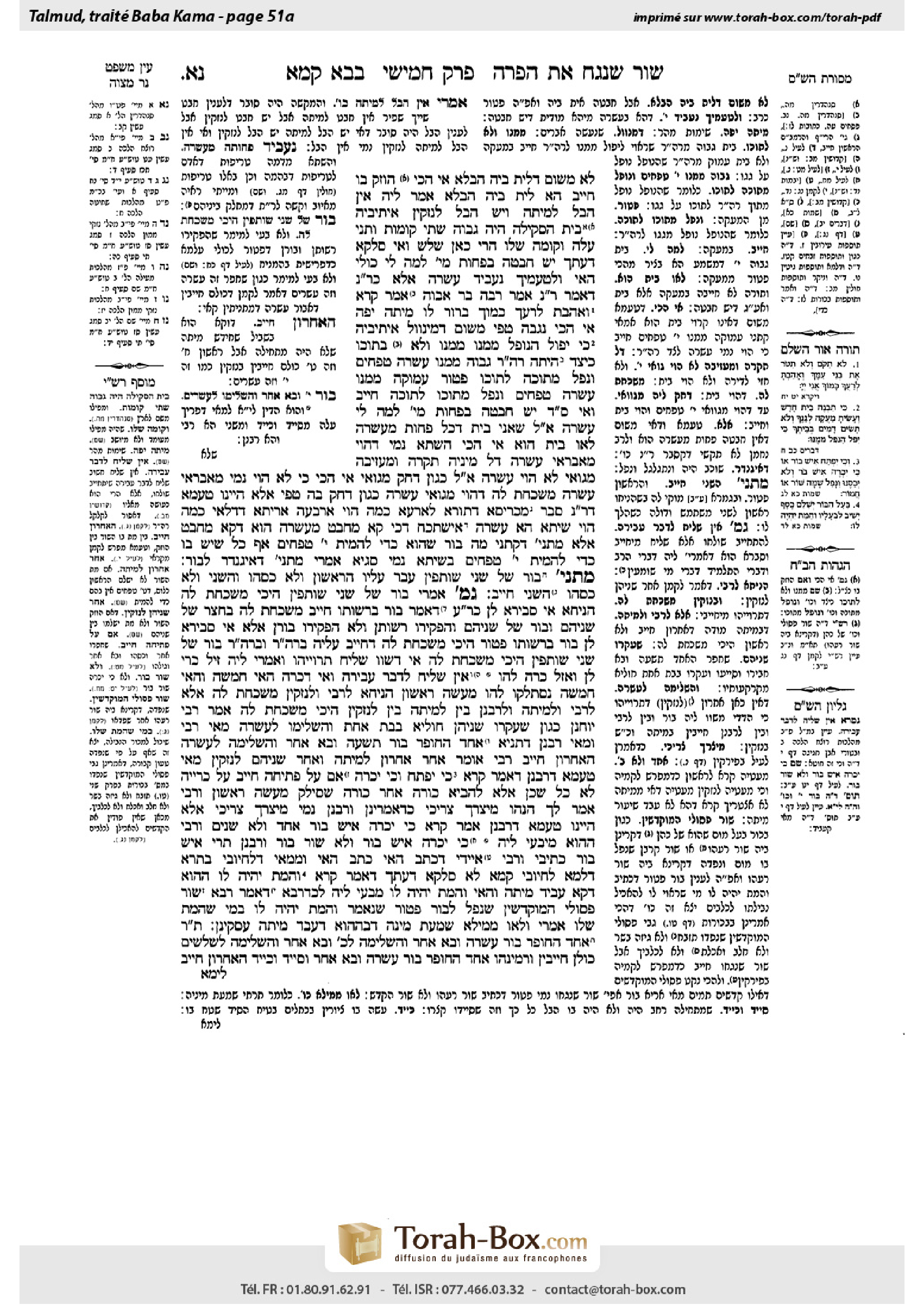
Bava Kamma 51a: Talmud study for Daf Yomi
Study the Talmud for Daf Yomi with scanned pages, Hebrew text, English translations from Sefaria and AI-generated French translations.
Passage selection and English or AI-generated French translation are available where the scan has annotations. Daf Study is independent of Torah-Box and Sefaria.
Browse Bava Kamma · בבא קמא · All tractatesBava Kamma 51a text and translations
This page of Bava Kamma includes the Aramaic text, an English translation and an AI-generated French translation, alongside the scan above.
בבא קמא נ״א א · Aramaic and Hebrew text
לָא, מִשּׁוּם דְּלֵית בֵּיהּ הַבְלָא. אִי הָכִי, הוּזַּק בּוֹ חַיָּיב? הָא לֵית בֵּיהּ הַבְלָא! אֲמַר לֵיהּ: אֵין הֶבֶל לְמִיתָה, וְיֵשׁ הֶבֶל לִנְזָקִין.
אֵיתִיבֵיהּ: בֵּית הַסְּקִילָה הָיָה גָּבוֹהַּ שְׁתֵּי קוֹמוֹת. וְתָנֵי עֲלַהּ: וְקוֹמָה שֶׁלּוֹ – הֲרֵי כָּאן שָׁלֹשׁ. וְאִי סָלְקָא דַּעְתָּךְ יֵשׁ חֲבָטָה בְּפָחוֹת מֵעֲשָׂרָה, לְמָה לִי כּוּלֵּי הַאי?
וּלְטַעְמָיךְ – נַעֲבֵיד עֲשָׂרָה! אֶלָּא כְּרַב נַחְמָן – דְּאָמַר רַב נַחְמָן אָמַר רַבָּה בַּר אֲבוּהּ, אָמַר קְרָא: ״וְאָהַבְתָּ לְרֵעֲךָ כָּמוֹךָ״ – בְּרוֹר לוֹ מִיתָה יָפָה.
אִי הָכִי, נַגְבַּהּ טְפֵי! מִשּׁוּם דְּמִינַּוַּול.
אֵיתִיבֵיהּ: ״כִּי יִפֹּל הַנֹּפֵל מִמֶּנּוּ״; ״מִמֶּנּוּ״ – וְלֹא בְּתוֹכוֹ.
כֵּיצַד? הָיְתָה רְשׁוּת הָרַבִּים גָּבוֹהַּ מִמֶּנּוּ עֲשָׂרָה טְפָחִים, וְנָפַל מִתּוֹכָהּ לְתוֹכוֹ – פָּטוּר. עֲמוּקָּה מִמֶּנּוּ עֲשָׂרָה טְפָחִים, וְנָפַל מִתּוֹכוֹ לְתוֹכָהּ – חַיָּיב.
וְאִי סָלְקָא דַּעְתָּךְ יֵשׁ חֲבָטָה בְּפָחוֹת מֵעֲשָׂרָה, לְמָה לִי עֲשָׂרָה? אֲמַר לֵיהּ: שָׁאנֵי בַּיִת, דְּכׇל פָּחוֹת מֵעֲשָׂרָה – לָאו בַּיִת הוּא.
אִי הָכִי, הַשְׁתָּא נָמֵי דְּהָוֵי מֵאַבָּרַאי עֲשָׂרָה, דַּל מִינֵּיהּ תִּקְרָה וּמַעֲזִיבָה – מִגַּוַּאי לָא הָוֵי עֲשָׂרָה! אֲמַר לֵיהּ: כְּגוֹן דְּחַק מִגַּוַּאי.
אִי הָכִי, כִּי לָא הָוֵי נָמֵי מֵאַבָּרַאי עֲשָׂרָה – מַשְׁכַּחַתְּ לַהּ דְּהָוֵי מִגַּוַּאי עֲשָׂרָה כְּגוֹן דְּחַק בַּהּ טְפֵי!
אֶלָּא הַיְינוּ טַעְמָא דְּרַב נַחְמָן, סָבַר: מִכְּרֵיסָא דְתוֹרָא לְאַרְעָא כַּמָּה הָוֵי – אַרְבְּעָה; אֲרִיתָּא דְּדַלָּאֵי כַּמָּה הָוֵי – שִׁיתָּא; הָא עַשְׂרָה. אִישְׁתְּכַח דְּכִי קָא מִחֲבַט – מֵעֲשָׂרָה הוּא דְּקָא מִחֲבַט.
אֶלָּא מַתְנִיתִין דְּקָתָנֵי: מָה בּוֹר שֶׁהוּא כְּדֵי לְהָמִית – עֲשָׂרָה טְפָחִים, אַף כֹּל שֶׁיֵּשׁ בּוֹ כְּדֵי לְהָמִית – עֲשָׂרָה טְפָחִים; בְּשִׁיתָּא נָמֵי סַגְיָא!
אָמְרִי: מַתְנִיתִין – דְּאִיגַּנְדַּר לְבוֹר.
מַתְנִי׳ בּוֹר שֶׁל שְׁנֵי שׁוּתָּפִין; עָבַר עָלָיו הָרִאשׁוֹן וְלֹא כִּסָּהוּ, וְהַשֵּׁנִי וְלֹא כִּסָּהוּ – הַשֵּׁנִי חַיָּיב.
גְּמָ׳ אָמְרִי: בּוֹר שֶׁל שְׁנֵי שׁוּתָּפִין הֵיכִי מַשְׁכַּחַתְּ לַהּ? הָנִיחָא אִי סְבִירָא לַן כְּרַבִּי עֲקִיבָא, דְּאָמַר: בּוֹר בִּרְשׁוּתוֹ – חַיָּיב; מַשְׁכַּחַתְּ לַהּ בְּחָצֵר שֶׁל שְׁנֵיהֶם וּבוֹר שֶׁל שְׁנֵיהֶם, וְהִפְקִירוּ רְשׁוּתָן וְלֹא הִפְקִירוּ בּוֹרָן.
אֶלָּא אִי סְבִירָא לַן בּוֹר בִּרְשׁוּתוֹ פָּטוּר; הֵיכִי מַשְׁכַּחַתְּ לַהּ דְּחַיָּיב עֲלֵיהּ – בִּרְשׁוּת הָרַבִּים, וּבִרְשׁוּת הָרַבִּים בּוֹר שֶׁל שְׁנֵי שׁוּתָּפִין הֵיכִי מַשְׁכַּחַתְּ לַהּ?
אִי דְּשַׁוּוֹ שָׁלִיחַ תַּרְוַיְיהוּ, וְאָמְרִי לֵיהּ: ״זִיל כְּרִי לַן״, וַאֲזַל כְּרָה לְהוּ – אֵין שָׁלִיחַ לִדְבַר עֲבֵירָה! וְאִי דִּכְרָה הַאי חַמְשָׁה וְהַאי חַמְשָׁה – נִסְתַּלְּקוּ לְהוּ מַעֲשֵׂה רִאשׁוֹן!
הָנִיחָא לְרַבִּי – וְלִנְזָקִין, מַשְׁכַּחַתְּ לַהּ. אֶלָּא לְרַבִּי – וּלְמִיתָה, וּלְרַבָּנַן – בֵּין לְמִיתָה בֵּין לִנְזָקִין; הֵיכִי מַשְׁכַּחַתְּ לַהּ?
אָמַר רַבִּי יוֹחָנָן: כְּגוֹן שֶׁעָקְרוּ שְׁנֵיהֶן חוּלְיָא בְּבַת אַחַת, וְהִשְׁלִימוּ לַעֲשָׂרָה.
מַאי רַבִּי וּמַאי רַבָּנַן? דְּתַנְיָא: אֶחָד הַחוֹפֵר בּוֹר תִּשְׁעָה, וּבָא אַחֵר וְהִשְׁלִימָהּ לַעֲשָׂרָה – הָאַחֲרוֹן חַיָּיב. רַבִּי אוֹמֵר: אַחַר אַחֲרוֹן לְמִיתָה, וְאַחַר שְׁנֵיהֶם לִנְזָקִין.
מַאי טַעְמָא דְּרַבָּנַן? דְּאָמַר קְרָא: ״כִּי יִפְתַּח״ וְ״כִי יִכְרֶה״ – אִם עַל פְּתִיחָה חַיָּיב, עַל כְּרִיָּיה לֹא כׇּל שֶׁכֵּן? אֶלָּא לְהָבִיא כּוֹרֶה אַחַר כּוֹרֶה, שֶׁסִּילֵּק מַעֲשֵׂה רִאשׁוֹן.
וְרַבִּי אָמַר לָךְ: הָנְהוּ מִיצְרָךְ צְרִיכִי, כִּדְאָמְרִינַן. וְרַבָּנַן נָמֵי מִיצְרָךְ צְרִיכִי!
אֶלָּא הַיְינוּ טַעְמָא דְּרַבָּנַן – אָמַר קְרָא: ״כִּי יִכְרֶה אִישׁ בּוֹר״ – אֶחָד וְלֹא שְׁנַיִם.
וְרַבִּי – הָהוּא מִיבְּעֵי לֵיהּ: ״כִּי יִכְרֶה אִישׁ בּוֹר״ – וְלֹא שׁוֹר בּוֹר.
וְרַבָּנַן – תְּרֵי ״אִישׁ בּוֹר״ כְּתִיבִי.
וְרַבִּי – אַיְּידֵי דִּכְתַב הַאי, כְּתַב הַאי.
וּמִמַּאי דִּלְחַיּוֹבֵי בָּתְרָא? דִּלְמָא לְחַיּוֹבֵי קַמָּא!
לָא סָלְקָא דַּעְתָּךְ, דְּאָמַר קְרָא: ״וְהַמֵּת יִהְיֶה לוֹ״ – הַהוּא דְּקָא עָבֵיד מִיתָה.
וְהַאי ״וְהַמֵּת יִהְיֶה לוֹ״ מִבְּעֵי לֵיהּ לְכִדְרָבָא – דְּאָמַר רָבָא: שׁוֹר פְּסוּלֵי הַמּוּקְדָּשִׁין שֶׁנָּפַל לְבוֹר – פָּטוּר, שֶׁנֶּאֱמַר: ״וְהַמֵּת יִהְיֶה לוֹ״ – בְּמִי שֶׁהַמֵּת שֶׁלּוֹ!
אָמְרִי: וְלָאו מִמֵּילָא שָׁמְעַתְּ מִינַּהּ, דִּבְהָהוּא דַּעֲבַד מִיתָה עָסְקִינַן?
תָּנוּ רַבָּנַן: אֶחָד הַחוֹפֵר בּוֹר עֲשָׂרָה, וּבָא אַחֵר וְהִשְׁלִימָהּ לְעֶשְׂרִים, וּבָא אַחֵר וְהִשְׁלִימָהּ לִשְׁלשִׁים – כּוּלָּן חַיָּיבִין. וּרְמִינְהוּ: אֶחָד הַחוֹפֵר בּוֹר עֲשָׂרָה, וּבָא אַחֵר וְסִיֵּיד וְכִיֵּיד – הָאַחֲרוֹן חַיָּיב.
Bava Kamma 51a · English translation
Rav Naḥman responds: No, he is exempt here because there are not sufficient fumes to cause death, in accordance with the opinion of Rav. Nevertheless, the impact from hitting the ground is sufficient to cause death, and therefore an ox that fell into a water channel is suspected of being a tereifa. Rava again challenges him: If so, then how is the statement: If the animal was injured by it, he is liable, to be explained? There are not sufficient fumes? Rav Naḥman said to him: There are not sufficient fumes to cause death, but there are sufficient fumes to cause injury.
Rava raised an objection to the opinion of Rav Naḥman from a mishna (Sanhedrin 45a): The structure from which the punishment of stoning was implemented was a height of two people, and it is taught in that regard in a baraita: When the two-person height of the structure is combined with his height, i.e., the height of the one being stoned, there is a total height equal to that of three people. Rava explains his objection: And if it enters your mind that there is an impact capable of causing death in a pit less than ten handbreadths deep, why do I need all of this height?
Rav Naḥman answered him: And according to your reasoning, let us make the structure a minimal ten handbreadths. Why must it have a height of two people? Rather, no proof can be brought from here, since the reason is in accordance with the opinion of Rav Naḥman, as Rav Naḥman says that Rabba bar Avuh says that the verse states: “And you shall love your fellow as yourself” (Leviticus 19:18), teaching that even with regard to a condemned prisoner, select a good, i.e., a compassionate, death for him. Therefore, the structure used for stoning is constructed sufficiently high that he dies quickly, without any unnecessary suffering.
The Gemara asks: If so, let us raise the structure even more, so that his death will be even less painful. The Gemara answers: This is not done, because if he fell from a greater height, his organs would be crushed and he would become completely disfigured, which is certainly not a way one would prefer to die.
Rava again raised an objection to the opinion of Rav Naḥman: The Torah requires constructing a parapet on the roof of one’s house to prevent anyone from falling to his death, as the verse states (Deuteronomy 22:8): “You shall not bring blood upon your house, if any man falls from it.” The term “from it” teaches that liability exists only for falling from the roof of the house, but not onto the roof of a house.
How is this so? If an area in the public domain was ten handbreadths higher than a private house and the owner did not construct a fence between his house and the public domain, and someone fell from inside the public domain onto the house, the owner of the house is exempt. By contrast, if the public domain was ten handbreadths lower than the house, and the owner did not construct a fence on his roof, and someone fell from the roof of the house into the public domain, he is liable.
And if it enters your mind that there is a sufficiently strong impact to cause death even at a height of less than ten handbreadths, why do I need the roof to be ten handbreadths high for there to be a requirement to construct a parapet? Rav Naḥman said to him: The halakha of the parapet for the roof of a house is different, since any structure less than ten handbreadths is not classified as a house, and only a house requires a parapet.
Rava objects: If that is so, i.e., if the requirement to build a parapet is limited to a house that is ten handbreadths high, then also now, where the house is ten handbreadths higher than the public domain when measured from the outside, remove the height of the ceiling and the plaster, which is an additional layer on top of the ceiling. When measured from the inside in this manner, its height is not ten. According to you, then, it is not classified as a house. Rav Naḥman said to him: It is a case where he hollowed out an extra space inside in the floor of the house so that its height would be ten handbreadths.
Rava challenges him: If so, in a situation where the house is not ten handbreadths from the outside as well, you can find a scenario where it is ten handbreadths from the inside, such as where he hollowed out extra space in the floor, thereby transforming it into a house with the required height. Why, then, would a person be exempt in this case?
The Gemara answers: Rather, the previous explanation must be entirely rejected, and this is the reasoning of Rav Naḥman when he ruled that one must suspect that the ox’s organs were crushed upon falling into the water channel. He maintains the following argument: How far is the distance from the stomach of the ox to the ground? It is four handbreadths. How deep is the water channel? It is six handbreadths. This totals ten handbreadths. Therefore, it transpires that when the ox hits the ground, it is from a height of ten handbreadths that it hits the ground, since it landed on its stomach and not on its feet.
The Gemara asks: But with regard to the mishna, which teaches: Just as a pit that has sufficient depth to cause death when falling into it is at least ten handbreadths deep, so too, any other excavations that have sufficient depth to cause death may be no less than ten handbreadths deep, why not say that a pit with six handbreadths would also be sufficient?
The Sages said in reply: The mishna is referring to a case where the animal rolled into the pit, in which case the pit would be required to have a depth of ten handbreadths. By contrast, if it fell while walking, the extra height from the ground to its stomach is included in calculating the ten handbreadths.
MISHNA: If a pit belonging to two partners was uncovered and the first partner passed by it and did not cover it, and then the second passed by it and did not cover it, the second is liable for any damage caused by means of the pit.
GEMARA: The Sages say: How can you find such a case of a pit belonging to two partners? This works out well if we hold in accordance with the opinion of Rabbi Akiva, who says that one who digs a pit on his own property and then declares the property, but not the pit, ownerless, is liable for damage. According to him, you find such a case where the courtyard belongs to both of them and the pit belongs to both of them, and they renounced ownership of their property but did not renounce ownership of their pit. In that case, both are responsible for any damage caused.
But if we hold that one who digs a pit on his own property and then declares the property, but not the pit, ownerless, is exempt from liability for damage caused, how can you find a case of a pit for which a person is liable? It can only be a case where it is located in the public domain, and how can you find a case of a pit belonging to two partners in the public domain?
If they both jointly appointed an agent and said to him: Go dig a pit for us, and he went and dug a pit for both of them, then neither is liable. This is because there is no agency for transgression, and the digger is solely responsible. And if this partner dug a pit five handbreadths deep and this partner dug five further handbreadths deep, the significance of the initial act of digging performed by the first partner has been removed. Now all responsibility rests with the second partner, who deepened the pit to ten handbreadths, which is the minimum depth for which one is liable for an animal’s death. Therefore, this is also not treated as a jointly owned pit.
The Gemara notes: This works out well according to the opinion of Rabbi Yehuda HaNasi, and you find in a case of damage that both would be liable, as the Gemara will soon explain. Therefore, it qualifies as a case of a pit belonging to two partners. But according to the opinion of Rabbi Yehuda HaNasi, the first partner is not held liable at all in a case where the pit causes an animal’s death; and according to the opinion of the Rabbis, the first partner is not held liable both in a situation where it causes death and in a situation where it merely causes damage. If so, how, can you find an instance of a pit belonging to partners?
Rabbi Yoḥanan says: This is referring to a case where they both extracted a chunk of earth from the bottom of the pit simultaneously, and thereby completed it to a depth of ten handbreadths. This, then, would constitute a pit belonging to both of them.
Having mentioned the dispute between Rabbi Yehuda HaNasi and the Rabbis, the Gemara inquires: What is the opinion of Rabbi Yehuda HaNasi, and what is the opinion of the Rabbis? As it is taught in a baraita: With regard to one who digs a pit nine handbreadths deep, and another person came and completed the digging to a depth of ten handbreadths, the latter individual alone is liable for an injury or death caused by the pit. Rabbi Yehuda HaNasi says: One follows the latter for restitution for death caused by the pit. The latter is solely liable, since only a pit of ten handbreadths renders a person liable for an animal’s death. And one follows both of them for restitution for damage caused by the pit.
The Gemara explains: What is the reason for the opinion of the Rabbis? As the verse states: “If a man shall open a pit, or if a man shall dig a pit” (Exodus 21:33), it raises the question: If he is liable for opening a covered pit that has already been dug, then is it not all the more so that he should be liable for digging a new pit? What, then, does that latter phrase add? Rather, the verse serves to include the case of one person who begins to dig a pit and after he does so, a second person continues to dig. By subsequently stating: “If a man shall dig a pit,” the Torah teaches that a new pit is effectively created by the second digger, whose digging removed, i.e., rendered irrelevant, the action of the first digger and who bears full responsibility for the pit.
And Rabbi Yehuda HaNasi could have said to you: These two clauses in the verse are both necessary, and the second clause cannot serve to teach the halakha of the sole liability of the second digger. The reason they are necessary is as we said earlier (50a), where interpretations were cited according to both Rabbi Yishmael and Rabbi Akiva. The Gemara asks: And don’t the Rabbis also agree that they are necessary for those interpretations? If so, what is the source of their opinion that responsibility for the pit rests solely with the second partner?
Rather, the previous explanation must be rejected, and this is the reason of the Rabbis: The verse states: “If a man shall dig a pit,” indicating that one person is liable, but not two. Therefore, if two people jointly created the pit, the second bears responsibility and not the first.
The Gemara asks: And how does Rabbi Yehuda HaNasi understand the phrase “if a man shall dig a pit”? The Gemara answers: He requires that phrase to teach another halakha. The phrase “if a man shall dig a pit” indicates that a person who digs a pit is liable, but one is not liable if his ox digs a pit.
The Gemara asks: And from where do the Rabbis derive this halakha? The Gemara answers that the combination of words: Man and pit, is written twice: “If a man shall open a pit, or if a man shall dig a pit.” From one phrase, the halakha is derived that a person must do the digging, and not an animal. From the second phrase, the halakha is derived that one person bears responsibility for the damage, and not two people.
The Gemara asks: And what does Rabbi Yehuda HaNasi derive from this repetition? The Gemara answers: In his opinion, since the Torah wrote this first clause using this wording, it similarly wrote this second clause in the same fashion. The repetition is for stylistic reasons, and is not meant to teach a new halakha.
The Gemara continues to ask about the opinion of the Rabbis: And even if they derive from the verse that only one person is liable for damage caused through the pit, from where do they know that the Torah intends to render specifically the latter one liable for the damage? Perhaps it is to render the first one who started the digging liable for the damage.
The Gemara answers: It should not enter your mind to suggest this, since the verse states: “And the carcass shall be for him” (Exodus 21:34). This indicates that it is the one who causes the death, i.e., the second one, who is liable, and not the first. This is because it is the second one who completed digging the necessary depth for causing death, and not the first.
The Gemara asks: But isn’t this clause: “And the carcass shall be for him,” necessary for that which Rava states? As Rava says: With regard to a disqualified consecrated ox that fell into a pit, the pit’s owner is exempt, as it is stated: “And the carcass shall be for him.” Evidently, the verse is stated with regard to a case where the carcass belongs to him. This ox, which was consecrated and subsequently disqualified, does not fully belong to anybody, since its use is restricted. Since this verse serves to teach Rava’s ruling, it cannot serve to teach about the liability of the second digger.
The Sages said in response: And can’t you learn from the words and emphasis of the verse by itself that we are dealing with the one who caused the animal’s death, even if these words are also used to derive Rava’s ruling? Therefore, the verse can serve as a source for both rulings.
On a similar subject, the Sages taught: In a case of one who digs a pit to a depth of ten handbreadths, and another comes and completes the depth to twenty handbreadths by digging an additional ten handbreadths, and another comes and completes it to thirty, they are all liable for any damage caused by this pit. The Gemara comments: And one can raise a contradiction against this from a baraita: In a case of one who digs a pit to a depth of ten handbreadths, and another came and plastered it and cemented [vekhiyyeid] it, the latter is liable for damage, and not the first.
Bava Kamma 51a · Traduction française (IA)
Rav Naḥman répond : Non, il est exempt ici car il n'y a pas assez de fumée pour causer la mort, conformément à l'opinion de Rav. Cependant, l'impact du sol est suffisant pour causer la mort, et donc un bœuf tombant dans un canal d'eau est soupçonné d'être un tereifa. Rava réfute à nouveau son opinion : Si c'est ainsi, alors comment expliquer l'affirmation : Si l'animal a été blessé par cela, il est responsable ? Il n'y a pas assez de fumée ? Rav Naḥman dit à lui : Il n'y a pas assez de fumée pour causer la mort, mais il y a assez de fumée pour causer une blessure.
Rava a soulevé une objection contre l'opinion de Rav Naḥman à partir d'une mitsva (Sanhedrin 45a) : La structure depuis laquelle la peine de pierre était appliquée avait une hauteur de deux personnes, et il est enseigné à ce sujet dans une baraïta : Lorsque la hauteur de la structure de deux personnes est combinée avec la hauteur de celui qui est lapidé, il y a une hauteur totale égale à celle de trois personnes. Rava explique son objection : Et si cela entre dans votre esprit qu'il y a un impact capable de causer la mort dans un puits moins profond de dix paumes, pourquoi ai-je besoin de toute cette hauteur ?
Rav Naḥman a répondu à lui : Et selon votre raisonnement, faisons la structure minimale de dix paumes. Pourquoi doit-elle avoir une hauteur de deux personnes ? Plutôt, aucune preuve ne peut être apportée à partir de là, car la raison est selon l'opinion de Rav Naḥman, comme Rav Naḥman dit que Rabba bar Avuh dit que la parabole dit : « Et tu aimeras ton prochain comme toi-même » (Lévitique 19:18), enseignant que même concernant un condamné, choisis une bonne, c'est-à-dire une mort miséricordieuse, pour lui. Par conséquent, la structure utilisée pour la lapidation est construite suffisamment haute pour qu'il meure rapidement, sans souffrance inutile.
La Guemara demande : Si c'est ainsi, élevons la structure encore davantage, afin que sa mort soit encore moins douloureuse. La Guemara répond : Cela n'est pas fait, car si l'on tombait d'une hauteur supérieure, ses organes seraient écrasés et il deviendrait complètement défiguré, ce qui n'est certainement pas une manière dont on préférerait mourir.
Rava a à nouveau soulevé une objection contre l'opinion de Rav Naḥman : La Torah exige de construire un parapet sur le toit de sa maison pour empêcher quiconque de tomber et de mourir, comme le dit la parabole (Dân 22:8) : « Tu ne dois pas verser du sang sur ta maison, si quelqu'un tombe de là. » Le terme « de là » enseigne que la responsabilité existe uniquement pour tomber du toit de la maison, mais pas sur le toit d'une maison.
Comment cela est-il ainsi ? Si une zone du domaine public était dix paumes plus haute qu'une maison privée et que l'propriétaire n'avait pas construit un mur entre sa maison et le domaine public, et que quelqu'un tombait de l'intérieur du domaine public sur la maison, l'propriétaire de la maison est exempt. En revanche, si le domaine public était dix paumes plus bas que la maison, et que l'propriétaire n'avait pas construit un mur sur son toit, et que quelqu'un tombait du toit de la maison dans le domaine public, il est responsable.
Et si cela entre dans votre esprit qu'il y a un impact suffisamment fort pour causer la mort même à une hauteur inférieure à dix paumes, pourquoi ai-je besoin que le toit soit dix paumes haut pour y avoir une obligation de construire un parapet ? Rav Naḥman dit à lui : La halakha du parapet pour le toit d'une maison est différente, car toute structure inférieure à dix paumes n'est pas considérée comme une maison, et seule une maison nécessite un parapet.
Rava s'oppose : Si c'est ainsi, c'est-à-dire si l'obligation de construire un parapet est limitée à une maison dix paumes haute, alors aussi maintenant, où la maison est dix paumes plus haute que le domaine public lorsqu'elle est mesurée à l'extérieur, retirez la hauteur du plafond et du plâtre, qui est une couche supplémentaire au-dessus du plafond. Lorsqu'elle est mesurée à l'intérieur ainsi, sa hauteur n'est pas dix. Selon vous, alors, elle n'est pas considérée comme une maison. Rav Naḥman dit à lui : C'est un cas où l'on a creusé un espace supplémentaire à l'intérieur du sol de la maison afin que sa hauteur soit dix paumes.
Rava défie : Si c'est ainsi, dans un cas où la maison n'est pas dix paumes à l'extérieur non plus, vous pouvez trouver un cas où elle est dix paumes à l'intérieur, comme dans le cas où l'on a creusé un espace supplémentaire dans le sol, transformant ainsi la maison en une maison ayant la hauteur requise. Pourquoi, alors, un homme serait-il exempt dans ce cas ?
La Guemara répond : Plutôt, l'explication précédente doit être entièrement rejetée, et c'est le raisonnement de Rav Naḥman lorsqu'il a décidé qu'on doit soupçonner que les organes du bœuf ont été écrasés en tombant dans le canal d'eau. Il présente l'argument suivant : Quelle est la distance entre le ventre du bœuf et le sol ? C'est quatre paumes. Quelle est la profondeur du canal d'eau ? C'est six paumes. Cela fait un total de dix paumes. Par conséquent, il s'ensuit que lorsque le bœuf heurte le sol, il le fait depuis une hauteur de dix paumes, car il est tombé sur son ventre et non sur ses pieds.
La Guemara demande : Mais concernant la mitsna, qui enseigne : Comme un puits qui a une profondeur suffisante pour causer la mort lorsqu'on tombe dedans est au moins dix paumes profond, de même, toute autre excavation qui a une profondeur suffisante pour causer la mort peut être au moins dix paumes profonde, pourquoi ne pas dire qu'un puits de six paumes serait suffisant ?
Les Sages ont répondu en réponse : La mitsna fait référence à un cas où l'animal est tombé dans le puits, dans lequel cas le puits devrait avoir une profondeur de dix paumes. En revanche, si l'animal est tombé en marchant, la hauteur supplémentaire du sol jusqu'au ventre de l'animal est incluse dans le calcul des dix paumes.
MICHNA : Si un puits appartenant à deux partenaires a été découvert et que le premier partenaire est passé par là sans le recouvrir, et que le second est passé par là sans le recouvrir, le second est responsable de tout dommage causé par le puits.
GUEMARA : Les Sages disent : Comment pouvez-vous trouver un cas d’un trou appartenant à deux associés ? Cela fonctionne bien si nous suivons l’opinion de Rabbi Akiva, qui dit qu’une personne qui creuse un trou sur sa propriété et déclare ensuite la propriété, mais pas le trou, libre, est responsable des dommages. Selon lui, vous trouvez un cas où la cour intérieure appartient aux deux et le trou appartient aux deux, et ils ont renoncé à la propriété de leur bien mais pas à celle de leur trou. Dans ce cas, les deux sont responsables de tout dommage causé.
Mais si nous suivons l’opinion selon laquelle une personne qui creuse un trou sur sa propriété et déclare ensuite la propriété, mais pas le trou, libre, est exempt de responsabilité pour les dommages causés, comment pouvez-vous trouver un cas de trou pour lequel une personne est responsable ? Il ne peut s’agir que d’un cas où le trou est situé dans le domaine public, et comment pouvez-vous trouver un cas de trou appartenant à deux associés dans le domaine public ?
Si ils ont tous deux désigné un agent commun et lui ont dit : Va creuser un trou pour nous, et il est allé creuser un trou pour les deux, alors aucun n’est responsable. Cela est dû au fait qu’il n’y a pas d’agence pour un transgression, et le creuseur est seul responsable. Et si un associé a creusé un trou de cinq tefachim de profondeur et l’autre a creusé cinq tefachim supplémentaires, l’action initiale de creusement du premier associé a perdu son importance. Maintenant, toute la responsabilité incombe au second associé, qui a approfondi le trou à dix tefachim, qui est la profondeur minimale pour laquelle on est responsable de la mort d’un animal. Ainsi, cela n’est pas traité comme un trou appartenant à deux associés.
La Guemara note : Cela fonctionne bien selon l’opinion de Rabbi Yehuda HaNasi, et vous trouvez un cas de dommage où les deux seraient responsables, comme la Guemara l’expliquera bientôt. Ainsi, cela correspond à un cas de trou appartenant à deux associés. Mais selon l’opinion de Rabbi Yehuda HaNasi, le premier associé n’est pas du tout responsable dans un cas où le trou cause la mort d’un animal ; et selon l’opinion des Rabbins, le premier associé n’est pas responsable à la fois dans un cas où il cause la mort et dans un cas où il cause simplement un dommage. Si tel est le cas, comment pouvez-vous trouver un exemple de trou appartenant à des associés ?
Rabbi Yoḥanan dit : Cela fait référence à un cas où ils ont tous deux extrait un morceau de terre du fond du trou en même temps, et ont ainsi achevé le trou à dix tefachim de profondeur. Ainsi, cela constituerait un trou appartenant aux deux.
Ayant mentionné le débat entre Rabbi Yehuda HaNasi et les Rabbins, la Guemara pose la question : Quelle est l’opinion de Rabbi Yehuda HaNasi, et quelle est l’opinion des Rabbins ? Comme il est enseigné dans une baraïta : Concernant celui qui creuse un trou de neuf tefachim de profondeur, et un autre venu et achevé le creusement à dix tefachim, seul celui-ci est responsable d’une blessure ou d’une mort causée par le trou. Rabbi Yehuda HaNasi dit : On suit celui-ci pour la réparation de la mort causée par le trou. Celui-ci est seul responsable, car seul un trou de dix tefachim rend une personne responsable de la mort d’un animal. Et on suit les deux pour la réparation du dommage causé par le trou.
La Guemara explique : Quelle est la raison de l’opinion des Rabbins ? Comme le verset dit : « Si un homme ouvre un trou, ou si un homme creuse un trou » (Exode 21:33), il se pose la question : Si l’homme est responsable d’un trou couvert déjà creusé, n’est-il pas encore plus responsable de creuser un nouveau trou ? Quel est alors l’ajout de cette dernière phrase ? Plutôt, le verset sert à inclure le cas d’une personne qui commence à creuser un trou et, après qu’elle l’ait fait, une deuxième personne continue à creuser. En indiquant ensuite : « Si un homme creuse un trou », la Torah enseigne que le trou est effectivement créé par le second creuseur, dont l’action a rendu irrélevante celle du premier creuseur et qui supporte pleinement la responsabilité du trou.
Et Rabbi Yehuda HaNasi aurait pu dire : Ces deux clauses du verset sont toutes deux nécessaires, et la seconde ne peut pas enseigner la halakha de la responsabilité unique du second creuseur. La raison pour laquelle elles sont nécessaires est celle que nous avons dit plus tôt (50a), où des interprétations ont été citées selon Rabbi Yishmael et Rabbi Akiva. La Guemara pose la question : Et ne sont-ils pas d’accord les Rabbins sur le fait qu’elles sont nécessaires pour ces interprétations ? Si tel est le cas, quelle est la source de leur opinion selon laquelle la responsabilité du trou incombe uniquement au second associé ?
Plutôt, l’explication précédente doit être rejetée, et c’est la raison des Rabbins : Le verset dit : « Si un homme creuse un trou », indiquant qu’une seule personne est responsable, pas deux. Ainsi, si deux personnes ont créé ensemble le trou, la responsabilité incombe au second et non au premier.
La Guemara pose la question : Et comment Rabbi Yehuda HaNasi comprend-il la phrase « si un homme creuse un trou » ? La Guemara répond : Il exige que cette phrase serve à enseigner une autre halakha. La phrase « si un homme creuse un trou » indique qu’une personne qui creuse un trou est tenue responsable, mais pas si son bœuf creuse un trou.
La Guemara pose la question : Et d’où les Rabbins dérivent-ils cette halakha ? La Guemara répond que la combinaison des mots : homme et trou, est écrite deux fois : « Si un homme ouvre un trou, ou si un homme creuse un trou ». D’une phrase, on dérive la halakha que la personne doit faire le creusement, et non un animal. De la seconde phrase, on dérive la halakha que la responsabilité incombe à une seule personne, et non à deux personnes.
La Guemara pose la question : Et comment Rabbi Yehuda HaNasi comprend-il cette répétition ? La Guemara répond : Selon lui, puisque la Torah a écrit cette première clause avec ce mode de formulation, elle a aussi écrit cette seconde clause de la même façon. La répétition est pour des raisons stylistiques, et n’a pas pour but d’enseigner une nouvelle halakha.
La Guemara continue à poser la question sur l'opinion des Sages : Et même si l'on dérive de la parole que seule une personne est tenue responsable des dommages causés par le trou, d'où sait-on que la Torah vise spécifiquement celui-ci à être tenu responsable des dommages ? Peut-être est-ce pour rendre responsable celui qui a commencé à creuser le trou.
La Guemara répond : Il ne faut pas que cela entre dans votre esprit de suggérer cela, car la parole dit : « Et la carcasse sera pour lui » (Exode 21:34). Cela indique que c'est celui qui cause la mort, c'est-à-dire le second, qui est tenu responsable, et non le premier. Cela est dû au fait que c'est le second qui a achevé de creuser la profondeur nécessaire pour causer la mort, et non le premier.
La Guemara pose la question : Mais n'est-ce pas cette clause : « Et la carcasse sera pour lui », nécessaire pour ce que Rava dit ? Comme Rava dit : En ce qui concerne un bœuf consacré qui est tombé dans un trou, le propriétaire du trou est exempt, car il est dit : « Et la carcasse sera pour lui ». Évidemment, la parole est dite dans un cas où la carcasse appartient à lui. Ce bœuf, qui était consacré et ensuite disqualifié, n'appartient pas entièrement à quelqu'un, car son usage est limité. Puisque cette parole sert à enseigner la décision de Rava, elle ne peut pas servir à enseigner sur la responsabilité du second creuseur.
Les Sages dirent en réponse : Et ne pouvez-vous pas apprendre de la parole et de l'accentuation de la parole elle-même que nous sommes en présence de celui qui a causé la mort de l'animal, même si ces mots sont aussi utilisés pour établir la décision de Rava ? Ainsi, la parole peut servir de source pour les deux décisions.
Sur un sujet similaire, les Sages enseignèrent : Dans un cas où l'on creuse un trou à une profondeur de dix paumes, et un autre vient et complète la profondeur à vingt paumes en creusant dix paumes supplémentaires, et un autre vient et le complète à trente, ils sont tous responsables de tout dommage causé par ce trou. La Guemara commente : Et l'on peut soulever une contradiction contre cela à partir d'une baraïta : Dans un cas où l'on creuse un trou à une profondeur de dix paumes, et un autre vient et le recouvre et le cimente [vekhiyyeid], le second est tenu responsable du dommage, et non le premier.
Traduction française générée par IA à partir de l’édition anglaise de Sefaria. Vérifie toujours un passage avec le texte source.
Text from Sefaria: William Davidson Edition - Vocalized Aramaic (CC BY NC); William Davidson Edition - English (CC BY NC).