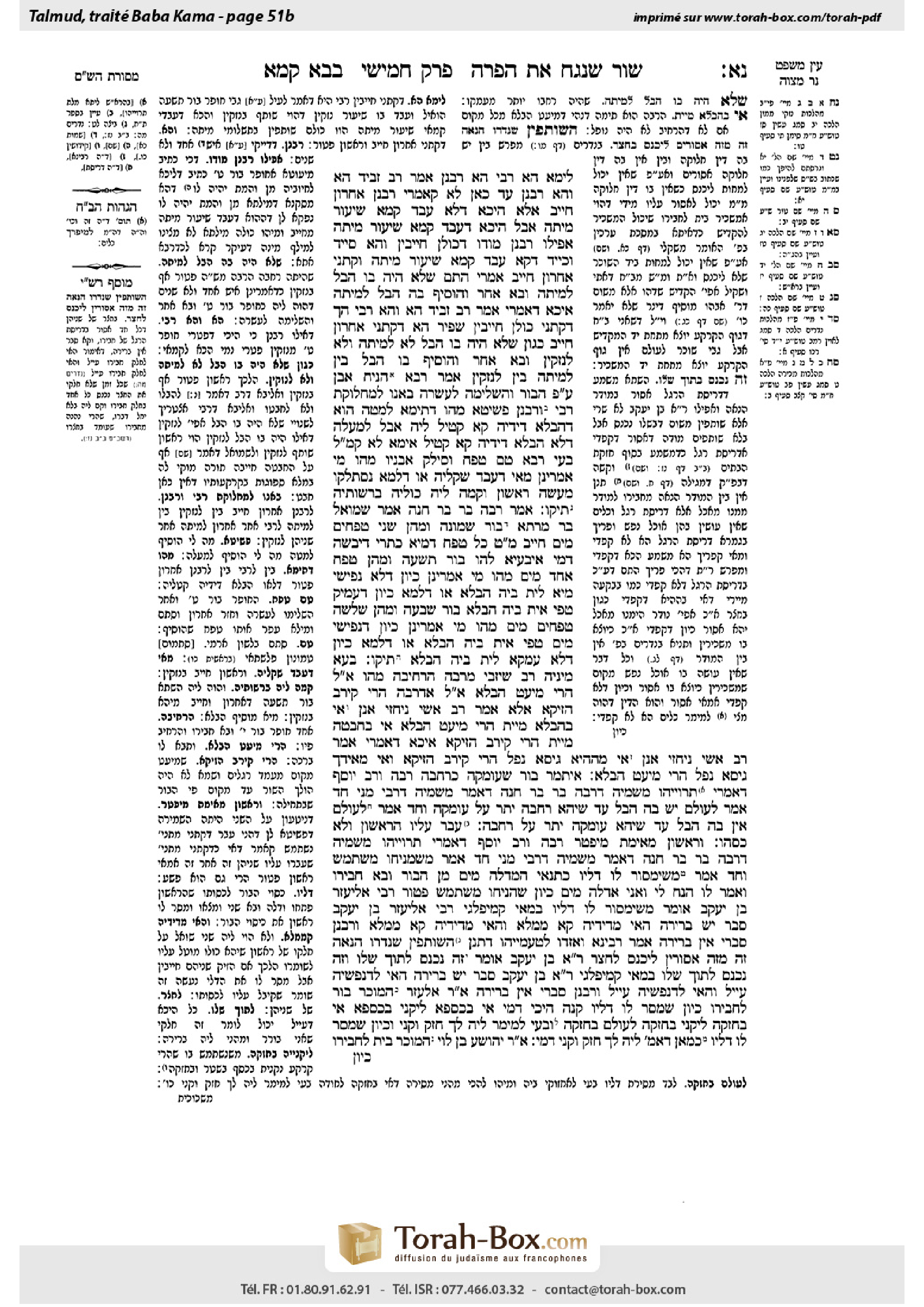
Bava Kamma 51b: Talmud study for Daf Yomi
Study the Talmud for Daf Yomi with scanned pages, Hebrew text, English translations from Sefaria and AI-generated French translations.
Passage selection and English or AI-generated French translation are available where the scan has annotations. Daf Study is independent of Torah-Box and Sefaria.
Browse Bava Kamma · בבא קמא · All tractatesBava Kamma 51b text and translations
This page of Bava Kamma includes the Aramaic text, an English translation and an AI-generated French translation, alongside the scan above.
בבא קמא נ״א ב · Aramaic and Hebrew text
לֵימָא הָא רַבִּי, וְהָא רַבָּנַן?
אָמַר רַב זְבִיד: הָא וְהָא רַבָּנַן; עַד כָּאן לָא קָאָמְרִי רַבָּנַן אַחֲרוֹן חַיָּיב, אֶלָּא הֵיכָא דְּלָא עֲבַד קַמָּא שִׁיעוּר מִיתָה; אֲבָל הֵיכָא דַּעֲבַד קַמָּא שִׁיעוּר מִיתָה – אֲפִילּוּ רַבָּנַן מוֹדוּ דְּכוּלָּן חַיָּיבִין.
וְהָא סִיֵּיד וְכִיֵּיד, דְּקָא עֲבַד קַמָּא שִׁיעוּר מִיתָה, וְקָתָנֵי: אַחֲרוֹן חַיָּיב! אָמְרִי: הָתָם – שֶׁלֹּא הָיָה בּוֹ הֶבֶל לְמִיתָה, וּבָא אַחֵר וְהוֹסִיף בָּהּ הֶבֶל לְמִיתָה.
אִיכָּא דְּאָמְרִי, אָמַר רַב זְבִיד: הָא וְהָא רַבִּי; הָךְ דְּקָתָנֵי: כּוּלָּן חַיָּיבִין – שַׁפִּיר; הָא דְּקָתָנֵי: אַחֲרוֹן חַיָּיב – כְּגוֹן שֶׁלֹּא הָיָה בּוֹ הֶבֶל לֹא לְמִיתָה וְלֹא לִנְזָקִין, וּבָא אַחֵר וְהוֹסִיף בּוֹ הֶבֶל בֵּין לְמִיתָה בֵּין לִנְזָקִין.
אָמַר רָבָא: הִנִּיחַ אֶבֶן עַל פִּי הַבּוֹר, וְהִשְׁלִימָהּ לַעֲשָׂרָה – בָּאנוּ לְמַחְלוֹקֶת רַבִּי וְרַבָּנַן.
פְּשִׁיטָא! מַהוּ דְּתֵימָא, לְמַטָּה הוּא דְּהַבְלָא דִידֵיהּ קָא קָטֵיל לֵיהּ, אֲבָל לְמַעְלָה – דְּלָא הַבְלָא דִידֵיהּ קָא קָטֵיל, אֵימָא לָא; קָא מַשְׁמַע לַן.
בָּעֵי רָבָא: טָם טֶפַח, וְסִילֵּק אֲבָנָיו, מַהוּ? מִי אָמְרִינַן: מַאי דַּעֲבַד – שַׁקְלֵיהּ;
אוֹ דִלְמָא, נִסְתַּלְּקוּ מַעֲשֵׂה רִאשׁוֹן, וְקָמָה לַיהּ כּוּלַּיהּ בִּרְשׁוּתֵיהּ? תֵּיקוּ.
אָמַר רַבָּה בַּר בַּר חָנָה אָמַר שְׁמוּאֵל בַּר מָרְתָּא: בּוֹר שְׁמוֹנָה, וּמֵהֶן שְׁנֵי טְפָחִים מַיִם – חַיָּיב. מַאי טַעְמָא? כֹּל טֶפַח דְּמַיָּא – כִּתְרֵי דְיַבָּשָׁה דָּמֵי.
אִיבַּעְיָא לְהוּ: בּוֹר תִּשְׁעָה וּמֵהֶן טֶפַח אֶחָד מַיִם, מַהוּ? מִי אָמְרִינַן כֵּיוָן דְּלָא נְפִישִׁי מַיָּא – לֵית בֵּיהּ הַבְלָא; אוֹ דִלְמָא, כֵּיוָן דְּעַמִּיק טְפֵי – אִית בֵּיהּ הַבְלָא?
בּוֹר שִׁבְעָה, וּמֵהֶן שְׁלֹשָׁה טְפָחִים מַיִם, מַהוּ? מִי אָמְרִינַן כֵּיוָן דִּנְפִישִׁי מַיִם טְפֵי – אִית בֵּיהּ הַבְלָא; אוֹ דִלְמָא, כֵּיוָן דְּלָא עַמִּקָא – לֵית בֵּיהּ הַבְלָא? תֵּיקוּ.
בְּעָא מִינֵּיהּ רַב שֵׁיזְבִי מֵרַבָּה: הִרְחִיבָהּ מַהוּ? אֲמַר לֵיהּ: הֲרֵי מִיעֵט הַבְלָא. אֲמַר לֵיהּ: אַדְּרַבָּה, הֲרֵי קֵירַב הֶזֵּיקָא!
אֶלָּא אָמַר רַב אָשֵׁי: נִיחְזֵי אֲנַן; אִי בְּהַבְלָא מִיית – הֲרֵי מִיעֵט הַבְלָא, אִי בְּחַבְטָה מִיית – הֲרֵי קֵירַב הֶזֵּיקָא. אִיכָּא דְּאָמְרִי, אָמַר רַב אָשֵׁי: נִיחְזֵי אֲנַן; אִי מֵהַהִיא גִּיסָא נְפַל – הֲרֵי קֵירַב הֶזֵּיקָא, וְאִי מֵאִידַּךְ גִּיסָא נְפַל – הֲרֵי מִיעֵט הַבְלָא.
אִיתְּמַר: בּוֹר שֶׁעוֹמְקָהּ כְּרׇחְבָּהּ – רַבָּה וְרַב יוֹסֵף דְּאָמְרִי תַּרְוַיְיהוּ מִשְּׁמֵיהּ דְּרַבָּה בַּר בַּר חָנָה, דְּאָמַר מִשְּׁמֵיהּ דְּרַבִּי מָנִי – חַד אָמַר: לְעוֹלָם יֵשׁ בָּהּ הֶבֶל, עַד שֶׁיְּהֵא רׇחְבָּהּ יָתֵר עַל עוֹמְקָהּ; וְחַד אָמַר: לְעוֹלָם אֵין בָּהּ הֶבֶל, עַד שֶׁיְּהֵא עוֹמְקָהּ יָתֵר עַל רׇחְבָּהּ.
עָבַר עָלָיו הָרִאשׁוֹן וְלֹא כִּסָּהוּ. וְרִאשׁוֹן מֵאֵימַת מִיפְּטַר? רַבָּה וְרַב יוֹסֵף דְּאָמְרִי תַּרְוַיְיהוּ מִשְּׁמֵיהּ דְּרַבָּה בַּר בַּר חָנָה, דְּאָמַר מִשְּׁמֵיהּ דְּרַבִּי מָנִי – חַד אָמַר: מִשֶּׁמַּנִּיחוֹ מִשְׁתַּמֵּשׁ, וְחַד אָמַר: מִשֶּׁיִּמְסוֹר לוֹ דׇּלְיוֹ.
כְּתַנָּאֵי: הַמְדַלֶּה מַיִם מִן הַבּוֹר, וּבָא חֲבֵירוֹ וְאָמַר לוֹ: הַנַּח לִי, וַאֲנִי אֲדַלֶּה מַיִם; כֵּיוָן שֶׁהִנִּיחוֹ מִשְׁתַּמֵּשׁ – פָּטוּר. רַבִּי אֱלִיעֶזֶר בֶּן יַעֲקֹב אוֹמֵר: מִשֶּׁיִּמְסוֹר לוֹ דׇּלְיוֹ.
בְּמַאי קָמִיפַּלְגִי? רַבִּי אֱלִיעֶזֶר בֶּן יַעֲקֹב סָבַר: יֵשׁ בְּרֵירָה –
הַאי מִדִּידֵיהּ קָא מְמַלֵּא, וְהַאי מִדִּידֵיהּ קָא מְמַלֵּא. וְרַבָּנַן סָבְרִי: אֵין בְּרֵירָה.
אָמַר רָבִינָא: וְאָזְדוּ לְטַעְמַיְיהוּ, דִּתְנַן: הַשּׁוּתָּפִין שֶׁנָּדְרוּ הֲנָאָה זֶה מִזֶּה – אֲסוּרִין לִיכָּנֵס לֶחָצֵר. רַבִּי אֱלִיעֶזֶר בֶּן יַעֲקֹב אוֹמֵר: זֶה נִכְנָס לְתוֹךְ שֶׁלּוֹ, וְזֶה נִכְנָס לְתוֹךְ שֶׁלּוֹ.
בְּמַאי קָמִיפַּלְגִי? רַבִּי אֱלִיעֶזֶר בֶּן יַעֲקֹב סָבַר: יֵשׁ בְּרֵירָה – הַאי לִדְנַפְשֵׁיהּ עָיֵיל, וְהַאי לִדְנַפְשֵׁיהּ עָיֵיל. וְרַבָּנַן סָבְרִי: אֵין בְּרֵירָה.
אָמַר רַבִּי אֶלְעָזָר: הַמּוֹכֵר בּוֹר לַחֲבֵירוֹ, כֵּיוָן שֶׁמָּסַר לוֹ דׇּלְיוֹ – קָנָה. הֵיכִי דָמֵי? אִי בְּכַסְפָּא – לִיקְנֵי בְּכַסְפָּא! אִי בַּחֲזָקָה – לִיקְנֵי בַּחֲזָקָה!
לְעוֹלָם בַּחֲזָקָה, וּבָעֵי לְמֵימַר לֵיהּ: ״לֵךְ חֲזֵק וּקְנֵי״; וְכֵיוָן שֶׁמָּסַר לוֹ דׇּלְיוֹ, כְּמַאן דַּאֲמַר לֵיהּ ״לֵךְ חֲזֵק וּקְנֵי״ דָּמֵי.
אָמַר רַבִּי יְהוֹשֻׁעַ בֶּן לֵוִי: הַמּוֹכֵר בַּיִת לַחֲבֵירוֹ,
Bava Kamma 51b · English translation
Shall we say that this baraita, which teaches that they are all liable, is in accordance with the opinion of Rabbi Yehuda HaNasi, who holds both liable for digging, and this baraita, which holds the latter liable, is in accordance with the opinion of the Rabbis, who hold only the last one liable?
Rav Zevid said: Both this baraita and that baraita are in accordance with the opinion of the Rabbis. The way the first baraita accords with their opinion is that the Rabbis say that the last one is liable only where the first one did not make the pit of sufficient measurement to cause death, but dug less than ten handbreadths. But where the first one made a pit of sufficient measurement to cause death, such as in this case, where the first one dug ten handbreadths himself and it was subsequently deepened further by others, even the Rabbis concede that they are all liable.
The Gemara asks: But in the second baraita, where he plastered and cemented it, the first made a pit of sufficient measurement to cause death, and nevertheless, the baraita teaches that the last person is liable. They said in response: There it is referring to a case where the pit did not have fumes capable of leading to death, since it was very wide. And then the other came, and by narrowing it with plaster and cementing it, he added to it the characteristic of having fumes capable of leading to death.
There are those who say that this is what Rav Zevid said: Both this baraita and that baraita are in accordance with the opinion of Rabbi Yehuda HaNasi. This first baraita, which teaches: They are all liable, fits well with his opinion. That second baraita, which teaches: The last one alone is liable, is referring to a case where the pit did not have sufficient fumes in it that were capable of leading to either death or damage, and then another person came and by narrowing it with plaster and cementing it, he added to it the characteristic of having fumes capable of leading to both death and damage.
Elaborating on this subject, Rava says: With regard to one who placed a stone at the opening of a pit less than ten handbreadths deep and brings the pit to a depth of ten handbreadths by raising the ground next to the opening of the pit, we have arrived at the dispute between Rabbi Yehuda HaNasi and the Rabbis concerning whether only the second or both are responsible for damage caused.
The Gemara asks: Isn’t this obvious? This is precisely the case they are disputing, so what does Rava’s statement add to this? The Gemara answers: Lest you say that there is a distinction between a person deepening a pit at the bottom, in which case it is his lethal fumes that he caused that kill the animal, but if he added to the pit at the top, where it is not his lethal fumes that kill the animal, say that he would not be liable. Rava’s statement teaches us that the last one is liable, and this case is subject to dispute between Rabbi Yehuda HaNasi and the Rabbis as to whether only the last one or both are liable.
Rava raises the following dilemma: If someone dug another handbreadth in a pit that was nine handbreadths deep, so that it reached a depth of ten handbreadths, and subsequently closed up that handbreadth inside the pit, or if he removed his stones that he had placed at the opening of the pit so that the depth of the pit was reduced to less than ten handbreadths, what is the halakha? Do we say that what he did to increase the depth of the pit to ten handbreadths, he has removed, and restored the initial situation that existed before he dug the extra handbreadth, causing responsibility for damage to revert solely to the original digger?
Or perhaps, by closing it up, he removed the action of the first digger, since he has removed the ability of the pit to cause death? If so, it moves entirely into his possession and he now assumes full responsibility for the pit of nine handbreadths. The Gemara concludes: The question shall stand unresolved.
§ Rabba bar bar Ḥana says that Shmuel bar Marta says: With regard to a pit that is eight handbreadths deep and two handbreadths of it contain water, one is liable for it. What is the reason? Each handbreadth of water is like two handbreadths of dry space. Therefore, the pit is effectively ten handbreadths in depth and contains a sufficient quantity of lethal fumes to render its owner liable.
A dilemma was raised before the Sages: If a pit is nine handbreadths deep, and from that measurement, one handbreadth contains water, what is the halakha? Is this case equivalent to the previous one? Do we say that since there is not as large a quantity of water as in the case stated by Rabba bar bar Ḥana, the pit does not have a sufficient quantity of lethal fumes to render the digger liable? Or perhaps it can be argued that since the pit is deeper than the one in the previous case, it does have lethal fumes, despite containing less water?
Similarly, the following question can be raised: What is the halakha if a pit is seven handbreadths deep and three of the handbreadths contain water? Do we say that since there is a much larger quantity of water in this case, it is equivalent to a pit of ten handbreadths and therefore has lethal fumes, or perhaps since it is not as deep, it does not have a sufficient quantity of lethal fumes to render the digger liable? The Gemara concludes: The question shall stand unresolved.
Rav Sheizevi asked the following question of Rabba: If one widened the opening of a pit that was already ten handbreadths deep, what is the halakha? Rabba said to him: By doing so, he has actually reduced the lethal fumes and has not worsened the situation. Therefore, he should not be liable. Rav Sheizevi said to him: On the contrary, by widening the opening of the pit, he has brought the potential for damage closer to an animal that might fall inside.
Rather, Rav Ashi said concerning this question: Let us see: If the animal died because of the lethal fumes, the one who widened the pit should be exempt, since he reduced the lethal fumes. But if the animal died because of the impact, he should be liable, since he has brought the potential for damage closer to it. There are those who say that Rav Ashi said: Let us see: If the animal fell on that side that he widened, then his action has brought the potential for damage closer, and so he should be liable. But if the animal fell on the other side, he should bear no responsibility, since he reduced the lethal fumes.
It was stated: With regard to a pit whose depth is equal to its width, Rabba and Rav Yosef both say a ruling in the name of Rabba bar bar Ḥana, who says it in the name of Rabbi Mani, but each present it differently. One of them says: A pit always contains a quantity of lethal fumes sufficient for liability, unless its width is greater than its depth. Therefore, when they are equal, the digger is liable. And one says: A pit never contains a quantity of lethal fumes sufficient for liability, unless its depth is greater than its width. Consequently, when they are equal, the digger is exempt.
§ The mishna teaches that if the first partner passed by the pit and did not cover it, and then the second also passed by it and did not cover it, the second is liable. The Gemara asks: And from what point is the first exempt from responsibility for the pit? Rabba and Rav Yosef both say a ruling in the name of Rabba bar bar Ḥana, who says it in the name of Rabbi Mani, but each one presents it differently: One says: From the time he leaves the other partner using it, and one says: The first is absolved of responsibility only when he conveys to him his bucket, with which he will draw water from the pit.
The Gemara notes: This dispute is like a dispute between tanna’im, as it is taught in a baraita: With regard to one who draws water from a cistern, and his friend comes and says to him: Leave me and I will draw water, once the first person leaves the second person while the second is using the cistern, the first is now exempt if he did not cover it. Rabbi Eliezer ben Ya’akov says: The first person is not absolved of responsibility until the time when he conveys his bucket to the second person.
The Gemara clarifies the dispute: With regard to what principle do they disagree? Rabbi Eliezer ben Ya’akov maintains that there is a legal concept of designation. According to this principle, a situation in which certain aspects were not initially clearly defined can become clarified retroactively after a certain action or event occurs. The halakha treats all the aspects as being clearly defined and identifiable from the outset.
In this case, the water is considered divided between the partners even before they draw it. When they do draw it, it is treated as if this one were filling from his part, the location of which has now been determined retroactively, and this one were filling from his part. Therefore, as long as the first partner has not conveyed his bucket to the second, he, as an owner of a defined part of the water, has not absolved himself of responsibility for the cistern. And by contrast, the Rabbis maintain that there is no designation and they both have the right to draw water from the cistern. Therefore, as soon as the second partner is left alone to draw water, he is responsible for the cistern and all the water it contains, even without conveying the bucket.
Ravina said: And in this regard, they follow their lines of reasoning in an analogous case, as we learned in a mishna (Nedarim 45b): With regard to the case of partners that vowed not to derive any benefit from each other, it is prohibited for them to enter their jointly owned courtyard, as this would violate their vows. Rabbi Eliezer ben Ya’akov says: It is permitted for them to enter the courtyard, since this one enters into his portion of the courtyard and that one enters into his portion.
The Gemara explains: With regard to what principle do they disagree? Rabbi Eliezer ben Ya’akov maintains that there is retroactive designation, and retroactively the section of the courtyard that each one enters becomes the portion that belongs to him. Therefore, this one enters his part, and that one enters his part. By contrast, the Rabbis maintain that there is no retroactive designation, and each portion of the courtyard belongs jointly to both.
§ Having mentioned this halakha concerning conveying a bucket to transfer responsibility for the pit, the Gemara cites that which Rabbi Elazar says: With regard to one who sells a cistern to another, once the seller conveys his bucket to the buyer for drawing water from the cistern, the buyer acquires the cistern. The Gemara asks: What are the circumstances? How does conveying the bucket serve to effect acquisition of the cistern? If he is acquiring the cistern by means of paying money, let him acquire it with money that he paid. If he is acquiring the cistern by means of taking possession, then let him acquire it by taking possession, which is accomplished by using it.
The Gemara answers: Actually, the case is where the cistern was acquired through taking possession, and in that case, the seller usually must say to him: Go, take possession, and thereby acquire it for yourself. And in this case, when he conveys his bucket to him, he is like one who says to him: Go, take possession, and thereby acquire it. Therefore, once he begins drawing water from the cistern, he has acquired it through taking possession.
The Gemara cites a related ruling: Rabbi Yehoshua ben Levi says: If one sells a house to another,
Bava Kamma 51b · Traduction française (IA)
Devons-nous dire que cette baraïta, qui enseigne qu'ils sont tous responsables, s'accorde avec l'opinion de Rabbi Yehuda HaNasi, qui considère que tous deux sont responsables de l'excavation, et que cette baraïta, qui considère que le dernier est responsable, s'accorde avec l'opinion des Rabbins, qui considèrent que seul le dernier est responsable ?
Rav Zevid a dit : Ces deux baraitas s'accordent avec l'opinion des Rabbins. La manière dont la première baraïta s'accorde avec leur opinion est que les Rabbins disent que le dernier est responsable uniquement dans le cas où le premier n'avait pas creusé un puits suffisamment profond pour causer la mort, mais avait creusé moins de dix paumes. Mais dans le cas où le premier avait creusé un puits suffisamment profond pour causer la mort, comme dans ce cas-ci, où le premier a creusé dix paumes lui-même et qu'il a été ensuite approfondi par d'autres, même les Rabbins reconnaissent qu'ils sont tous responsables.
La Guemara pose la question : Mais dans la deuxième baraïta, où il a enduit et cimenté le puits, le premier avait creusé un puits suffisamment profond pour causer la mort, et pourtant, la baraïta enseigne que le dernier est responsable. Ils répondent : Il s'agit là d'un cas où le puits n'avait pas d'odeurs capables de causer la mort, car il était très large. Et ensuite, un autre vint et, en le resserrant avec de la chaux et en le cimentant, il ajouta à ce puits la caractéristique d'avoir des odeurs capables de causer la mort.
Certains disent que c'est ce que Rav Zevid a dit : Ces deux baraitas s'accordent avec l'opinion de Rabbi Yehuda HaNasi. Cette première baraïta, qui enseigne qu'ils sont tous responsables, s'accorde bien avec son opinion. Cette deuxième baraïta, qui enseigne que seul le dernier est responsable, s'applique à un cas où le puits n'avait pas d'odeurs suffisantes capables de causer la mort ou les dommages, et ensuite un autre vint et, en le resserrant avec de la chaux et en le cimentant, il ajouta à ce puits la caractéristique d'avoir des odeurs capables de causer à la fois la mort et les dommages.
Rava développe ce sujet : Concernant celui qui place une pierre à l'ouverture d'un puits de moins de dix paumes de profondeur et qui amène le puits à dix paumes en élevant le sol à l'ouverture, nous avons atteint le débat entre Rabbi Yehuda HaNasi et les Rabbins concernant si seul le second ou les deux sont responsables des dommages causés.
La Guemara pose la question : N'est-ce pas évident ? C'est précisément le cas qu'ils disputent, donc que rajoute Rava dans son déclaration ? La Guemara répond : Pour éviter que vous disiez qu'il y a une distinction entre celui qui approfondit un puits à la base, dans lequel cas c'est ses odeurs mortelles qui tuent l'animal, mais si il ajoute au puits en haut, où ce n'est pas ses odeurs mortelles qui tuent l'animal, disiez-vous qu'il ne serait pas responsable. La déclaration de Rava nous apprend que le dernier est responsable, et ce cas est sujet au débat entre Rabbi Yehuda HaNasi et les Rabbins concernant si seul le dernier ou les deux sont responsables.
Rava soulève le dilemme suivant : Si quelqu'un creuse un autre paume dans un puits qui est neuf paumes de profondeur, de sorte qu'il atteint une profondeur de dix paumes, et ensuite ferme ce paume à l'intérieur du puits, ou s'il retire les pierres qu'il avait placées à l'ouverture du puits de sorte que la profondeur du puits soit réduite à moins de dix paumes, quelle est la halakha ? Disons-nous que ce qu'il a fait pour augmenter la profondeur du puits à dix paumes, il l'a supprimé, et qu'il a restauré la situation initiale avant qu'il ne creuse le paume supplémentaire, de sorte que la responsabilité pour les dommages revienne uniquement au premier creuseur ?
Ou peut-être, en le fermant, il a supprimé l'action du premier creuseur, car il a supprimé la capacité du puits à causer la mort ? Si c'est le cas, il passe entièrement à son possession et il assume désormais toute la responsabilité du puits de neuf paumes. La Guemara conclut : La question restera sans réponse.
§ Rabba bar bar Ḥana dit que Shmuel bar Marta dit : Concernant un puits de huit paumes de profondeur et deux paumes de lui contenant de l'eau, on est responsable de lui. Quelle est la raison ? Chaque paume d'eau est comme deux paumes d'espace sec. Ainsi, le puits est effectivement de dix paumes de profondeur et contient une quantité suffisante de vapeurs mortelles pour rendre son propriétaire responsable.
Un dilemme a été soulevé devant les Sages : Si un puits est de neuf paumes de profondeur, et à partir de cette mesure, une paume contient de l'eau, quelle est la halakha ? Est-ce équivalent au cas précédent ? Disons-nous que puisque la quantité d'eau n'est pas aussi grande que dans le cas mentionné par Rabba bar bar Ḥana, le puits n'a pas une quantité suffisante d'odeurs mortelles pour rendre le creuseur responsable ? Ou peut-être peut-on argumenter que puisque le puits est plus profond que dans le cas précédent, il a des odeurs mortelles, malgré la quantité d'eau moindre ?
De même, la question suivante peut être soulevée : Quelle est la halakha si un puits est de sept paumes de profondeur et trois paumes contiennent de l'eau ? Disons-nous que puisque la quantité d'eau est beaucoup plus grande dans ce cas, il est équivalent à un puits de dix paumes et donc a des odeurs mortelles, ou peut-être que puisque il n'est pas aussi profond, il n'a pas une quantité suffisante d'odeurs mortelles pour rendre le creuseur responsable ? La Guemara conclut : La question restera sans réponse.
Rav Sheizevi a posé la question suivante à Rabba : Si l'on élargit l'ouverture d'un puits déjà de dix paumes de profondeur, quelle est la halakha ? Rabba lui a répondu : En le faisant, il a en fait réduit les odeurs mortelles et n'a pas aggravé la situation. Ainsi, il ne devrait pas être responsable. Rav Sheizevi lui a répondu : Au contraire, en élargissant l'ouverture du puits, il a rapproché le potentiel de dommage d'un animal qui pourrait tomber à l'intérieur.
Plutôt, Rav Ashi a dit concernant cette question : Voyons : Si l'animal est mort à cause des vapeurs mortelles, celui qui a élargi le trou devrait être exempt, car il a réduit les vapeurs mortelles. Mais si l'animal est mort à cause de l'impact, il devrait être responsable, car il a rapproché le potentiel de dommage. Certains disent que Rav Ashi a dit : Voyons : Si l'animal est tombé du côté qu'il a élargi, alors son action a rapproché le potentiel de dommage, et donc il devrait être responsable. Mais si l'animal est tombé du côté opposé, il ne devrait pas être responsable, car il a réduit les vapeurs mortelles.
Il a été dit : Concernant un trou dont la profondeur est égale à sa largeur, Rabba et Rav Yosef disent tous deux une décision en nom de Rabba bar bar Ḥana, qui dit en nom de Rabbi Mani, mais chacun la présente différemment. L'un dit : Un trou contient toujours une quantité de vapeurs mortelles suffisante pour la responsabilité, sauf si sa largeur est supérieure à sa profondeur. Ainsi, lorsque la profondeur et la largeur sont égales, le creuseur est responsable. L'autre dit : Un trou ne contient jamais une quantité de vapeurs mortelles suffisante pour la responsabilité, sauf si sa profondeur est supérieure à sa largeur. Ainsi, lorsque la profondeur et la largeur sont égales, le creuseur est exempt.
§ La mitsva enseigne que si le premier partenaire a passé devant le trou sans le couvrir, et que le second a également passé devant sans le couvrir, le second est responsable. La Guemara demande : À partir de quel moment le premier est-il exempt de responsabilité pour le trou ? Rabba et Rav Yosef disent tous deux une décision en nom de Rabba bar bar Ḥana, qui dit en nom de Rabbi Mani, mais chacun la présente différemment : L'un dit : À partir du moment où il quitte l'autre partenaire en utilisant le trou, et l'autre dit : Le premier est exempt de responsabilité seulement lorsqu'il transmet à lui son seau, avec lequel il pourra tirer de l'eau du trou.
La Guemara note : Ce débat est comme un débat entre des tannaïm, car il est enseigné dans une baraïta : Concernant celui qui tire de l'eau d'un cistern, et son ami vient lui dire : Laisse-moi et je tirerai de l'eau, une fois que le premier homme quitte le second pendant que le second utilise le cistern, le premier est désormais exempt si n'a pas couvert le cistern. Rabbi Eliezer ben Ya'akov dit : Le premier n'est pas exempt de responsabilité jusqu'au moment où il transmet son seau au second.
La Guemara clarifie le débat : Concernant quel principe s'agit-il ? Rabbi Eliezer ben Ya'akov maintient qu'il existe un concept juridique de désignation. Selon ce principe, une situation où certains aspects n'étaient pas initialement clairement définis peut devenir clairement définie retroactivement après un certain action ou événement. La halakha traite tous les aspects comme clairement définis et identifiables dès le départ.
Dans ce cas, l'eau est considérée comme divisée entre les partenaires même avant qu'ils ne la tirent. Lorsqu'ils la tirent, elle est traitée comme si l'un d'entre eux remplissait de son côté, la localisation duquel a été définie retroactivement, et l'autre remplissait de son côté. Ainsi, tant que le premier partenaire n'a pas transmis son seau au second, il, comme propriétaire d'une partie définie de l'eau, n'a pas exempté lui-même de responsabilité pour le cistern. Par contraste, les Rabbins maintiennent qu'il n'y a pas de désignation et qu'ils ont tous les deux le droit de tirer de l'eau du cistern. Ainsi, dès que le second partenaire est seul pour tirer de l'eau, il est responsable du cistern et de toute l'eau qu'il contient, même sans transmettre le seau.
Ravina a dit : Et concernant cela, ils suivent leurs raisonnements dans un cas analogue, comme nous l'avons appris dans une mitsva (Nedarim 45b) : Concernant le cas de partenaires qui ont juré de ne pas tirer aucun bénéfice l'un de l'autre, il est interdit pour eux d'entrer dans leur cour commune, car cela violerait leurs vœux. Rabbi Eliezer ben Ya'akov dit : Il est permis pour eux d'entrer dans la cour, car celui-ci entre dans sa portion de la cour et celui-là entre dans sa portion.
La Guemara explique : Concernant quel principe s'agit-il ? Rabbi Eliezer ben Ya'akov maintient qu'il existe une désignation retroactive, et retroactivement la section de la cour que chacun entre devient la portion qui lui appartient. Ainsi, celui-ci entre dans sa part, et celui-là entre dans sa part. Par contraste, les Rabbins maintiennent qu'il n'y a pas de désignation retroactive, et chaque portion de la cour appartient conjointement aux deux.
§ Ayant mentionné cette halakha concernant la transmission d'un seau pour transférer la responsabilité pour le trou, la Guemara cite ce que Rabbi Eléazar dit : Concernant celui qui vend un cistern à un autre, une fois que le vendeur transmet son seau à l'acheteur pour tirer de l'eau du cistern, l'acheteur acquiert le cistern. La Guemara demande : Quelles sont les circonstances ? Comment la transmission du seau permet-elle l'acquisition du cistern ? Si il acquiert le cistern par le paiement d'argent, que l'acquière avec l'argent qu'il a payé. Si il acquiert le cistern par la possession, que l'acquière par la possession, ce qui est accompli en l'utilisant.
La Guemara répond : En réalité, le cas est celui où le cistern a été acquis par la possession, et dans ce cas, le vendeur doit généralement dire à lui : Allez, prenez possession, et ainsi l'acquière pour vous-même. Et dans ce cas, lorsque il transmet son seau à lui, il est comme celui qui dit à lui : Allez, prenez possession, et ainsi l'acquière. Ainsi, dès qu'il commence à tirer de l'eau du cistern, il l'a acquis par la possession.
La Guemara cite une décision connexe : Rabbi Yéhoshua ben Levi dit : Si l'on vend une maison à un autre,
Traduction française générée par IA à partir de l’édition anglaise de Sefaria. Vérifie toujours un passage avec le texte source.
Text from Sefaria: William Davidson Edition - Vocalized Aramaic (CC BY NC); William Davidson Edition - English (CC BY NC).