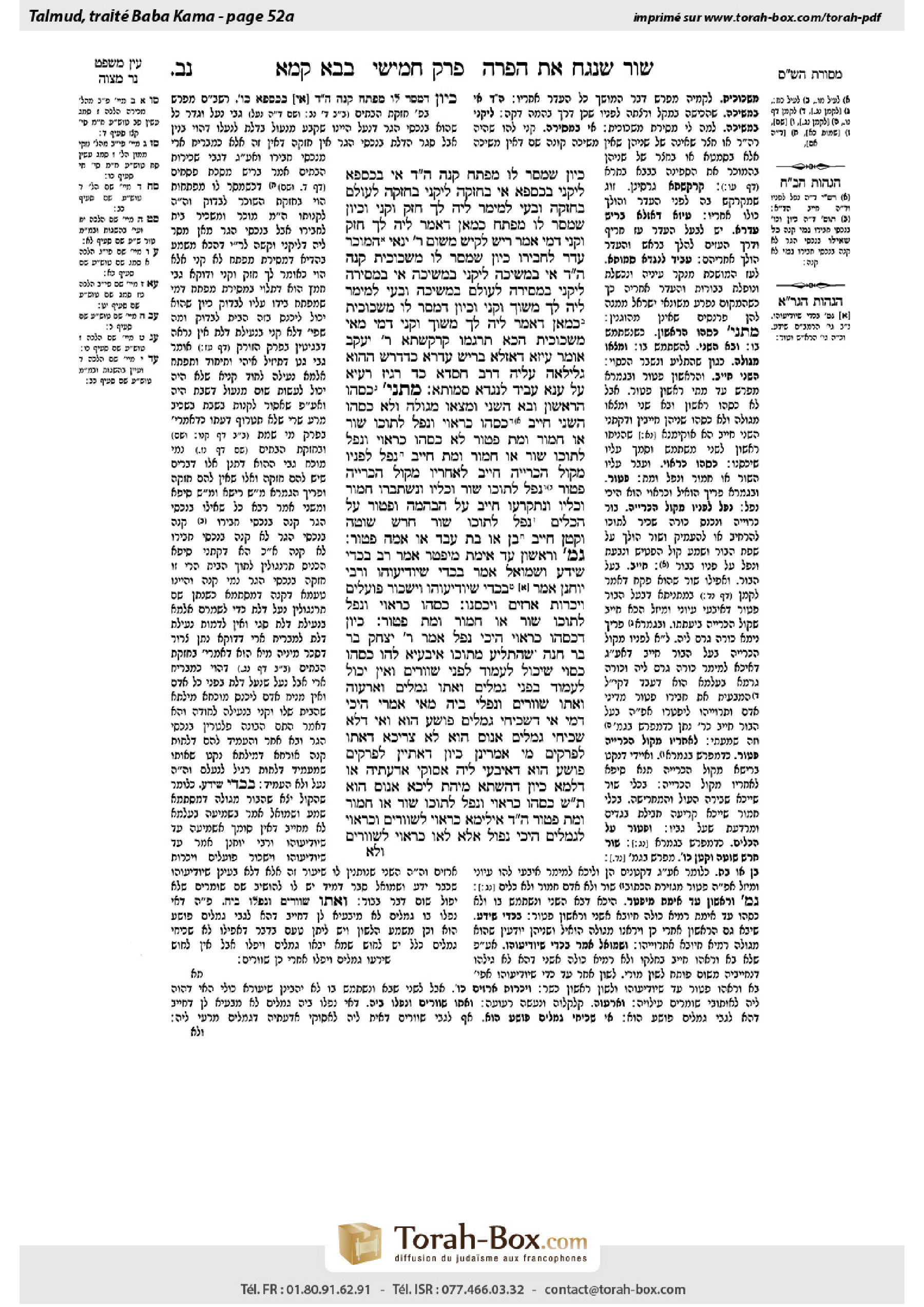
Bava Kamma 52a: Talmud study for Daf Yomi
Study the Talmud for Daf Yomi with scanned pages, Hebrew text, English translations from Sefaria and AI-generated French translations.
Passage selection and English or AI-generated French translation are available where the scan has annotations. Daf Study is independent of Torah-Box and Sefaria.
Browse Bava Kamma · בבא קמא · All tractatesBava Kamma 52a text and translations
This page of Bava Kamma includes the Aramaic text, an English translation and an AI-generated French translation, alongside the scan above.
בבא קמא נ״ב א · Aramaic and Hebrew text
כֵּיוָן שֶׁמָּסַר לוֹ מַפְתֵּחַ – קָנָה.
הֵיכִי דָמֵי? אִי בְּכַסְפָּא – לִיקְנֵי בְּכַסְפָּא! אִי בַּחֲזָקָה – לִיקְנֵי בַּחֲזָקָה! לְעוֹלָם בַּחֲזָקָה, וּבָעֵי לְמֵימַר לֵיהּ ״לֵךְ חֲזֵק וּקְנֵי״; וְכֵיוָן שֶׁמָּסַר לוֹ מַפְתֵּחַ, כְּמַאן דַּאֲמַר לֵיהּ ״לֵךְ חֲזֵק וּקְנֵי״ דָּמֵי.
אָמַר רֵישׁ לָקִישׁ מִשּׁוּם רַבִּי יַנַּאי: הַמּוֹכֵר עֵדֶר לַחֲבֵירוֹ, כֵּיוָן שֶׁמָּסַר לוֹ מַשְׁכּוּכִית – קָנָה.
הֵיכִי דָמֵי? אִי בִּמְשִׁיכָה – לִיקְנֵי בִּמְשִׁיכָה! אִי בִּמְסִירָה – לִיקְנֵי בִּמְסִירָה! לְעוֹלָם בִּמְשִׁיכָה, וּבָעֵי לְמֵימַר לֵיהּ: ״לֵךְ מְשׁוֹךְ וּקְנֵי״, וְכֵיוָן דְּמָסַר לוֹ מַשְׁכּוּכִית – כְּמַאן דְּאָמַר לֵיהּ: ״לֵךְ מְשׁוֹךְ וּקְנֵי״ דָּמֵי.
מַאי מַשְׁכּוּכִית? הָכָא תַּרְגִּמוּ: קַרְקַשְׁתָּא. רַבִּי יַעֲקֹב אוֹמֵר: עִיזָּא דְּאָזְלָא בְּרֵישׁ עֶדְרָא – כְּדִדְרַשׁ הַהוּא גָּלִילָאָה עֲלֵיהּ דְּרַב חִסְדָּא: כַּד רָגֵיז רָעֲיָא עַל עָנָא, עָבֵיד לְנַגָּדָא סַמְוָתָא.
מַתְנִי׳ כִּסָּהוּ הָרִאשׁוֹן, וּבָא הַשֵּׁנִי וּמְצָאוֹ מְגוּלֶּה, וְלֹא כִּסָּהוּ – הַשֵּׁנִי חַיָּיב. כִּסָּהוּ כָּרָאוּי, וְנָפַל לְתוֹכוֹ שׁוֹר אוֹ חֲמוֹר, וָמֵת – פָּטוּר. לֹא כִּסָּהוּ כָּרָאוּי, וְנָפַל לְתוֹכוֹ שׁוֹר אוֹ חֲמוֹר, וָמֵת – חַיָּיב.
נָפַל לְפָנָיו מִקּוֹל הַכְּרִיָּיה – חַיָּיב, לְאַחֲרָיו מִקּוֹל הַכְּרִיָּיה – פָּטוּר.
נָפַל לְתוֹכוֹ שׁוֹר וְכֵלָיו – וְנִשְׁתַּבְּרוּ, חֲמוֹר וְכֵלָיו – וְנִתְקָרְעוּ; חַיָּיב עַל הַבְּהֵמָה, וּפָטוּר עַל הַכֵּלִים.
נָפַל לְתוֹכוֹ שׁוֹר חֵרֵשׁ שׁוֹטֶה וְקָטָן – חַיָּיב. בֵּן אוֹ בַּת, עֶבֶד אוֹ אָמָה – פָּטוּר.
גְּמָ׳ וְרִאשׁוֹן עַד אֵימַת מִיפְּטַר? אָמַר רַב: בִּכְדֵי שֶׁיֵּדַע. וּשְׁמוּאֵל אָמַר: בִּכְדֵי שֶׁיּוֹדִיעוּהוּ. וְרַבִּי יוֹחָנָן אָמַר: בִּכְדִי שֶׁיּוֹדִיעוּהוּ, וְיִשְׂכּוֹר פּוֹעֲלִים, וְיִכְרוֹת אֲרָזִים וִיכַסֶּנּוּ.
כִּסָּהוּ כָּרָאוּי, וְנָפַל לְתוֹכוֹ שׁוֹר אוֹ חֲמוֹר, וָמֵת – פָּטוּר. כֵּיוָן דְּכִסָּהוּ כָּרָאוּי, הֵיכִי נְפַל? אָמַר רַבִּי יִצְחָק בַּר בַּר חָנָה: שֶׁהִתְלִיעַ מִתּוֹכוֹ.
אִיבַּעְיָא לְהוּ: כִּסָּהוּ כִּסּוּי שֶׁיָּכוֹל לַעֲמוֹד לִפְנֵי שְׁווֹרִים, וְאֵין יָכוֹל לַעֲמוֹד בִּפְנֵי גְמַלִּים; וַאֲתוֹ גְּמַלִּים וְאָרְעוּהּ, וְאָתוּ שְׁווֹרִים וְנָפְלִי בֵּיהּ – מַאי? אָמְרִי: הֵיכִי דָמֵי? אִי דִּשְׁכִיחִי גְּמַלִּים – פּוֹשֵׁעַ הוּא! וְאִי דְּלָא שְׁכִיחִי גְּמַלִּים – אָנוּס הוּא!
לָא צְרִיכָא, דַּאֲתוֹ לִפְרָקִים; מִי אָמְרִינַן כֵּיוָן דְּאָתַיִין לִפְרָקִים – פּוֹשֵׁעַ הוּא, דְּאִיבְּעִי לֵיהּ אַסּוֹקֵי אַדַּעְתֵּיהּ; אוֹ דִלְמָא, כֵּיוָן דְּהַשְׁתָּא מִיהַת לֵיכָּא – אָנוּס הוּא?
תָּא שְׁמַע: כִּסָּהוּ כָּרָאוּי, וְנָפַל לְתוֹכוֹ שׁוֹר אוֹ חֲמוֹר, וָמֵת – פָּטוּר. הֵיכִי דָמֵי? אִילֵּימָא כָּרָאוּי לִשְׁווֹרִים וְכָרָאוּי לִגְמַלִּים – הֵיכִי נְפוּל? אֶלָּא לָאו כָּרָאוּי לִשְׁווֹרִים,
Bava Kamma 52a · English translation
once he has conveyed the key to him, he has acquired it.
Here too, the Gemara asks: What are the circumstances involving this sale? If it was a transaction by payment of money, then let him acquire it by paying money. If it was by taking possession of it, let him acquire it by taking possession. What is the significance of transferring the key? The Gemara answers: Actually, the transaction occurred by taking possession, and in that case, the seller usually must say to him: Go, take possession, and thereby acquire it for yourself. And in this case, once he conveys the key to him, he is considered like one who says to him: Go, take possession, and thereby acquire it.
Similarly, Reish Lakish says in the name of Rabbi Yannai: With regard to one who sells a flock of sheep to another, once he conveys the mashkukhit to the buyer, he has acquired the flock.
The Gemara asks: What are the circumstances of this case? If the transaction occurred by pulling the flock into his possession, then let the buyer acquire it by pulling. If it was by conveying it, let the buyer acquire it by the seller conveying it. The Gemara answers: Actually, it was a transaction by pulling, and in that case, the seller usually must say to him: Go, pull it and acquire it for yourself. And in this case, once he conveys the mashkukhit to him, he is like one who says to him: Go, pull it and acquire it.
The Gemara asks: What is this mashkukhit? Here, in Babylonia, they translate it as a bell [karkashta] that the shepherd rings and whose sound the flock follows. Rabbi Ya’akov says: It is referring to the goat that goes at the front of the flock that they follow. The Gemara notes: This explanation of Rabbi Ya’akov is similar to that which a certain Galilean taught in the presence of Rav Ḥisda concerning this goat: When a shepherd is angry with his flock, he renders the goat leading [lenaggada] them, i.e., the mashkukhit, blind. Similarly, when God is angry with the Jewish people, he appoints unsuitable leaders for them.
MISHNA: The mishna lists several halakhot that pertain to damage classified as Pit: In the case of a pit that the first person who passed by covered after using it, and then the second came to use it and found it uncovered after the cover fell off or was damaged, and he did not cover it, the second one is liable for damage caused by the pit. If the owner covered the pit appropriately and an ox or a donkey fell into it and died, he is exempt. If he did not cover the pit appropriately and an ox or a donkey fell into it and died, he is liable.
If a man was digging or widening a pit, and an ox passing by fell forward into it in fright due to the sound of the digging, he is liable. If it fell backward into the pit due to the sound of the digging, he is exempt.
If an ox and its accoutrements, i.e., the vessels it was carrying, fell into the pit and the vessels were broken, or if a donkey and its accoutrements fell in and the accoutrements were torn, the owner of the pit is liable for damage to the animal caused by the pit, but he is exempt from liability for damage caused to the vessels, by Torah edict.
If an ox that was impaired by being deaf, or an ox that was an imbecile, or an ox that was very young fell into the pit, he is liable. If a boy or a girl, a Canaanite slave or a Canaanite maidservant fell in, he is exempt, since there is a Torah edict that the digger of a pit is liable only for damage caused to an animal.
GEMARA: With regard to the first case in the mishna, the Gemara asks: And until when is the first person exempt if the pit is later uncovered? Rav says: He is exempt from liability for the time necessary for him to become aware that it became uncovered. Once this time has passed, he bears responsibility. And Shmuel says: He is exempt for the time necessary for others to realize that the pit is uncovered and inform him. And Rabbi Yoḥanan says: He is exempt for the time necessary for others to inform him that the cover has fallen down and for him to hire workers and cut cedar trees to make a suitable cover and cover it. After this period of time has passed, the first bears responsibility.
§ The mishna teaches: If he covered the pit appropriately and an ox or a donkey fell inside and died, he is exempt. The Gemara asks: Since he covered the pit appropriately, how did it fall in? Rabbi Yitzḥak bar bar Ḥana says: This is a case where the cover rotted from the inside, and he could not have known that the cover was damaged. Therefore, he is not responsible for damage caused as a result.
A dilemma was raised before the Sages: If he covered it with a cover that is able to withstand the weight of oxen but cannot withstand the weight of camels, which are heavier, and camels came and weakened it, and subsequently oxen came and broke the weakened cover and fell into the pit, what is the halakha? The Sages said in response: What are the circumstances? If camels are commonly found there, he is negligent, since he should have constructed the cover suitably for camels as well. And if camels are not commonly found there, then he is a victim of circumstances beyond his control if by chance they did come and weaken the cover.
The Gemara answers: No, it is necessary in a case where camels come occasionally, in which case the question effectively becomes: Do we say that since they come occasionally, he is considered negligent, since he should have anticipated their coming? Or perhaps since now, in any event, there are no camels, he is a victim of circumstances beyond his control.
Come and hear a possible proof from the mishna: If he covered the pit appropriately, and an ox or a donkey fell into it and died, he is exempt. Now what are the circumstances? If we say that he covered it appropriately for oxen and appropriately for camels, then how did they fall in? Rather, is it not the case that he covered it with a covering that was appropriate for oxen
Bava Kamma 52a · Traduction française (IA)
Une fois qu'il lui a remis la clé, il l'a acquis.
Ici aussi, la Guemara pose la question : Quelles sont les circonstances de cette vente ? Si c'était une transaction par paiement d'argent, alors qu'il l'acquière par paiement d'argent. Si c'était par prise de possession, qu'il l'acquière par prise de possession. Quel est le sens de la transmission de la clé ? La Guemara répond : En réalité, la transaction s'est faite par prise de possession, et dans ce cas, le vendeur doit normalement dire à l'acheteur : Va, prends possession, et ainsi l'acquière toi-même. Et dans ce cas, une fois qu'il lui remet la clé, il est considéré comme celui qui dit : Va, prends possession, et ainsi l'acquière.
De même, Reish Lakish dit au nom de Rabbi Yannai : En ce qui concerne celui qui vend un troupeau de moutons à un autre, une fois qu'il lui a transmis le mashkukhit, il l'a acquis.
La Guemara pose la question : Quelles sont les circonstances de ce cas ? Si la transaction s'est faite par la prise en possession du troupeau, alors que l'acheteur l'acquière par la prise en possession. Si c'était par la transmission, que l'acheteur l'acquière par la transmission du vendeur. La Guemara répond : En réalité, c'était une transaction par la prise en possession, et dans ce cas, le vendeur doit normalement dire à l'acheteur : Va, prends possession, et ainsi l'acquière toi-même. Et dans ce cas, une fois qu'il lui transmet le mashkukhit, il est comme celui qui dit : Va, prends possession, et ainsi l'acquière toi-même.
La Guemara pose la question : Qu'est-ce que ce mashkukhit ? Ici, en Babylonie, ils le traduisent comme une cloche [karkashta] que le berger fait sonner et dont le son est suivi par le troupeau. Rabbi Ya'akov dit : Il s'agit du bouc qui marche en tête du troupeau que le troupeau suit. La Guemara note : Cette explication de Rabbi Ya'akov est semblable à celle qu'un certain Galiléen a enseignée en présence de Rav Ḥisda concernant ce bouc : Lorsqu'un berger est en colère contre son troupeau, il rend le bouc qui les guide [lenaggada] aveugle, c'est-à-dire le mashkukhit. De même, lorsque Dieu est en colère contre le peuple juif, il nomme des leaders inadaptés pour eux.
MICHNA : La mishna énumère plusieurs halakhot concernant les dommages classés comme Pit : Dans le cas d'un trou, le premier qui est passé par là l'a recouvert après l'avoir utilisé, et ensuite le second est venu l'utiliser et l'a trouvé découvert après que le couvercle soit tombé ou endommagé, et il n'a pas recouvert le trou, le second est responsable du dommage causé par le trou. Si l'propriétaire a recouvert le trou de manière appropriée et un bœuf ou un âne y sont tombés et sont morts, il est exempt. Si l'propriétaire n'a pas recouvert le trou de manière appropriée et un bœuf ou un âne y sont tombés et sont morts, il est responsable.
Si un homme creusait ou agrandissait un trou, et un bœuf passant par là tomba en avant du trou à cause du bruit du travail, il est responsable. Si il tomba en arrière du trou à cause du bruit du travail, il est exempt.
Si un bœuf et ses accessoires, c'est-à-dire les objets qu'il transportait, tombèrent dans le trou et les objets furent brisés, ou si un âne et ses accessoires tombèrent dans le trou et les accessoires furent déchirés, le propriétaire du trou est responsable du dommage à l'animal causé par le trou, mais il est exempt de responsabilité pour le dommage causé aux objets, par décret de la Torah.
Si un bœuf qui était déficient par la surdité, ou un bœuf qui était un imbécile, ou un bœuf très jeune tomba dans le trou, il est responsable. Si un enfant ou une fille, un esclave cananéen ou une servante cananéenne tomba dedans, il est exempt, car il y a un décret de la Torah selon lequel le creuseur de trou est responsable uniquement du dommage causé à un animal.
GUEMARA : En ce qui concerne le premier cas de la Michna, la Guemara pose la question : Et jusqu'à quand le premier est-il exempt si le trou est plus tard découvert ? Rav dit : Il est exempt de responsabilité pendant le temps nécessaire pour qu'il devienne conscient qu'il est découvert. Une fois que ce temps est passé, il assume la responsabilité. Et Shmuel dit : Il est exempt pendant le temps nécessaire pour que les autres sachent que le trou est découvert et l'informent. Et Rabbi Yoḥanan dit : Il est exempt pendant le temps nécessaire pour que les autres l'informent que le couvercle est tombé et qu'il embauche des ouvriers et coupe des arbres de cèdre pour faire un couvercle approprié et le recouvrir. Après que ce délai ait passé, le premier assume la responsabilité.
§ La Michna enseigne : Si l'on a recouvert le trou de manière appropriée et un bœuf ou un âne y sont tombés et sont morts, il est exempt. La Guemara pose la question : Puisqu'on a recouvert le trou de manière appropriée, comment est-il tombé dedans ? Rabbi Yitzḥak bar bar Ḥana dit : C'est un cas où le couvercle a pourri à l'intérieur, et il ne pouvait pas savoir que le couvercle était endommagé. Par conséquent, il n'est pas responsable du dommage causé en conséquence.
Un dilemme a été soulevé devant les Sages : Si l'on a recouvert le trou avec un couvercle capable de supporter le poids des bœufs mais pas celui des chameaux, qui sont plus lourds, et des chameaux sont venus et ont affaibli le couvercle, et ensuite des bœufs sont venus et ont cassé le couvercle affaibli et sont tombés dans le trou, quelle est la halakha ? Les Sages ont répondu en disant : Quelles sont les circonstances ? Si les chameaux sont courants là, il est négligent, car il aurait dû construire le couvercle de manière appropriée pour les chameaux également. Et si les chameaux ne sont pas courants là, alors il est une victime des circonstances au-delà de son contrôle si par hasard ils sont venus et ont affaibli le couvercle.
La Guemara répond : Non, il est nécessaire dans un cas où les chameaux viennent occasionnellement, dans lequel cas la question devient effectivement : Disons-nous que puisqu'ils viennent occasionnellement, il est considéré comme négligent, car il aurait dû anticiper leur venue ? Ou peut-être que puisque maintenant, en tout cas, il n'y a pas de chameaux, il est une victime des circonstances au-delà de son contrôle.
Venez écouter une preuve possible tirée de la michna : Si l'on a couvert le trou convenablement, et qu'un bœuf ou un âne y tombe et meurt, il est exempt. Maintenant, quels sont les circonstances ? Si nous disons qu'il l'a couvert convenablement pour les bœufs et convenablement pour les chameaux, alors comment sont-ils tombés dedans ? Plutôt, n'est-ce pas le cas que l'on a couvert le trou avec un couvercle convenable pour les bœufs ?
Traduction française générée par IA à partir de l’édition anglaise de Sefaria. Vérifie toujours un passage avec le texte source.
Text from Sefaria: William Davidson Edition - Vocalized Aramaic (CC BY NC); William Davidson Edition - English (CC BY NC).