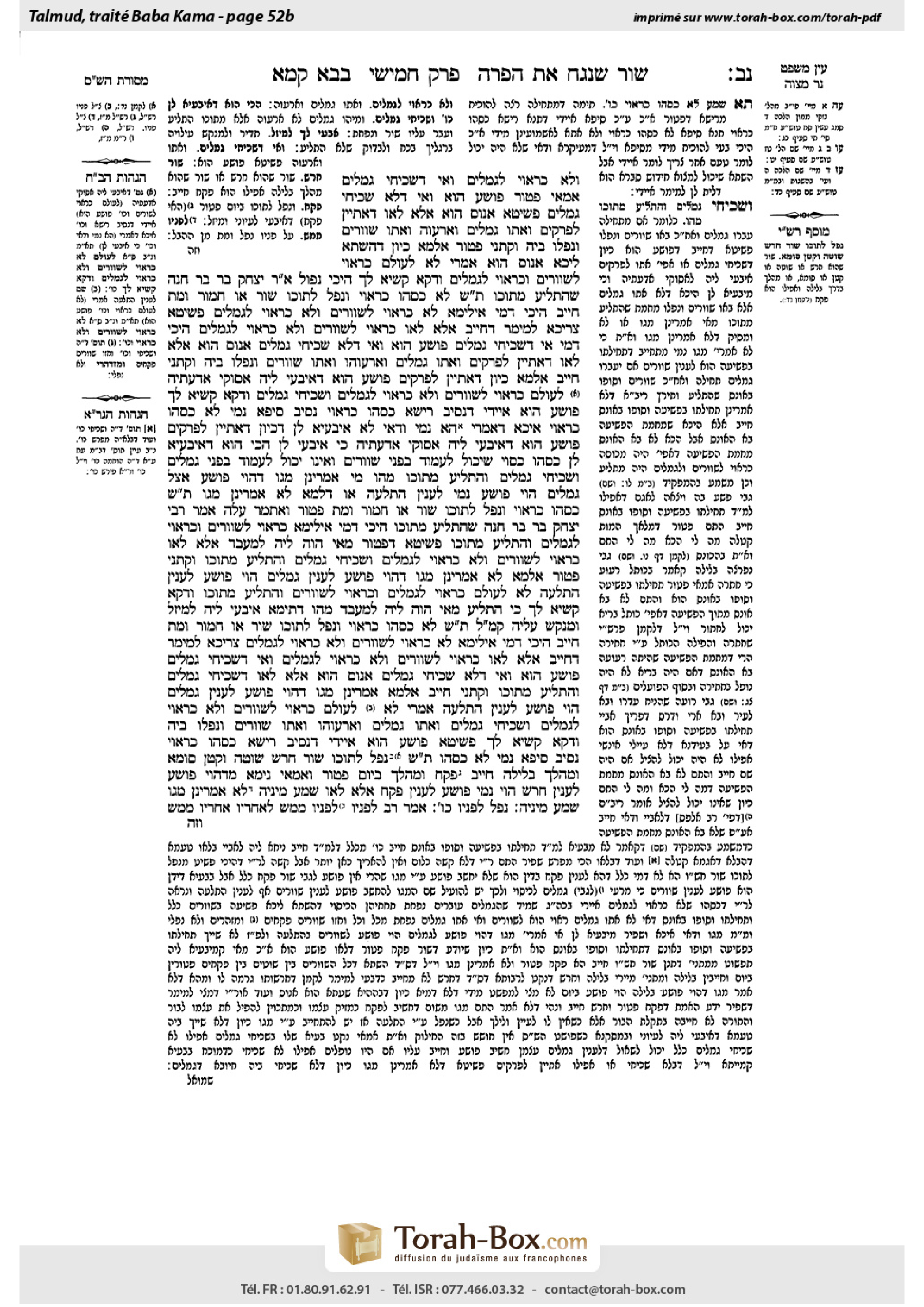
Bava Kamma 52b: Talmud study for Daf Yomi
Study the Talmud for Daf Yomi with scanned pages, Hebrew text, English translations from Sefaria and AI-generated French translations.
Passage selection and English or AI-generated French translation are available where the scan has annotations. Daf Study is independent of Torah-Box and Sefaria.
Browse Bava Kamma · בבא קמא · All tractatesBava Kamma 52b text and translations
This page of Bava Kamma includes the Aramaic text, an English translation and an AI-generated French translation, alongside the scan above.
בבא קמא נ״ב ב · Aramaic and Hebrew text
וְלֹא כָּרָאוּי לִגְמַלִּים? וְאִי דִּשְׁכִיחִי גְּמַלִּים, אַמַּאי פָּטוּר? פּוֹשֵׁעַ הוּא! וְאִי דְּלָא שְׁכִיחִי גְּמַלִּים – פְּשִׁיטָא, אָנוּס הוּא! אֶלָּא לָאו דְּאָתַיִין לִפְרָקִים, וַאֲתוֹ גְּמַלִּים וְאָרְעוּהּ, וַאֲתוֹ שְׁווֹרִים וּנְפַלוּ בֵּיהּ – וְקָתָנֵי פָּטוּר? אַלְמָא, כֵּיוָן דְּהַשְׁתָּא לֵיכָּא – אָנוּס הוּא!
אָמְרִי: לָא, לְעוֹלָם כָּרָאוּי לִשְׁווֹרִים וְכָרָאוּי לִגְמַלִּים; וּדְקָא קַשְׁיָא לָךְ – הֵיכִי נְפוּל? אָמַר רַבִּי יִצְחָק בַּר בַּר חָנָה: שֶׁהִתְלִיעַ מִתּוֹכוֹ.
תָּא שְׁמַע: לֹא כִּסָּהוּ כָּרָאוּי, וְנָפַל לְתוֹכוֹ שׁוֹר אוֹ חֲמוֹר, וָמֵת – חַיָּיב. הֵיכִי דָמֵי? אִילֵּימָא לֹא כָּרָאוּי לִשְׁווֹרִים וְלֹא כָּרָאוּי לִגְמַלִּים, פְּשִׁיטָא – צְרִיכָא לְמֵימַר דְּחַיָּיב?! אֶלָּא לָאו כָּרָאוּי לִשְׁווֹרִים וְלֹא כָּרָאוּי לִגְמַלִּים? הֵיכִי דָמֵי? אִי דִּשְׁכִיחִי גְּמַלִּים – פּוֹשֵׁעַ הוּא! וְאִי דְּלָא שְׁכִיחִי גְּמַלִּים – אָנוּס הוּא!
אֶלָּא לָאו דְּאָתַיִין לִפְרָקִים, וַאֲתוֹ גְּמַלִּים וְאָרְעוּהּ, וַאֲתוֹ שְׁווֹרִים וּנְפַלוּ בֵּיהּ – וְקָתָנֵי חַיָּיב? אַלְמָא כֵּיוָן דְּאָתַיִין לִפְרָקִים – פּוֹשֵׁעַ הוּא, דְּאִיבְּעִי לֵיהּ אַסּוֹקֵי אַדַּעְתֵּיהּ!
לְעוֹלָם כָּרָאוּי לִשְׁווֹרִים וְלֹא כָּרָאוּי לִגְמַלִּים, וּשְׁכִיחִי גְּמַלִּים; וּדְקָא קַשְׁיָא לָךְ – פּוֹשֵׁעַ הוּא! אַיְּידֵי דִּנְסֵיב רֵישָׁא ״כִּסָּהוּ כָּרָאוּי״, נְסֵיב סֵיפָא נָמֵי ״לֹא כִּסָּהוּ כָּרָאוּי״.
אִיכָּא דְאָמְרִי: הָא נָמֵי וַדַּאי לָא אִיבַּעְיָא לַן; דְּכֵיוָן דְּאָתַיִין לִפְרָקִים – פּוֹשֵׁעַ הוּא, דְּאִיבְּעִי לֵיהּ אַסּוֹקֵי אַדַּעְתֵּיהּ;
כִּי אִיבְּעִי לַן – הָכִי הוּא דְּאִיבַּעְיָא לַן: כִּסָּהוּ כִּסּוּי שֶׁיָּכוֹל לַעֲמוֹד בִּפְנֵי שְׁווֹרִים וְאֵינוֹ יָכוֹל לַעֲמוֹד בִּפְנֵי גְמַלִּים, וּשְׁכִיחִי גְּמַלִּים; וְהִתְלִיעַ מִתּוֹכוֹ – מַהוּ? מִי אָמְרִינַן: מִגּוֹ דְּהָוֵי פּוֹשֵׁעַ אֵצֶל גְּמַלִּים, הָוֵי פּוֹשֵׁעַ נָמֵי לְעִנְיַן הַתְלָעָה; אוֹ דִלְמָא לָא אָמְרִינַן מִגּוֹ?
תָּא שְׁמַע: כִּסָּהוּ כָּרָאוּי, וְנָפַל לְתוֹכוֹ שׁוֹר אוֹ חֲמוֹר, וָמֵת – פָּטוּר. וְאִתְּמַר עֲלַהּ, אָמַר רַבִּי יִצְחָק בַּר בַּר חָנָה: שֶׁהִתְלִיעַ מִתּוֹכוֹ. הֵיכִי דָמֵי? אִילֵּימָא כָּרָאוּי לִשְׁווֹרִים וְכָרָאוּי לִגְמַלִּים, וְהִתְלִיעַ מִתּוֹכוֹ – פְּשִׁיטָא דְּפָטוּר, מַאי הֲוָה לֵיהּ לְמֶעְבַּד?
אֶלָּא לָאו כָּרָאוּי לִשְׁווֹרִים וְלֹא כָּרָאוּי לִגְמַלִּים, וּשְׁכִיחִי גְּמַלִּים, וְהִתְלִיעַ מִתּוֹכוֹ – וְקָתָנֵי פָּטוּר? אַלְמָא לָא אָמְרִינַן מִגּוֹ דְּהָוֵי פּוֹשֵׁעַ לְעִנְיַן גְּמַלִּים הָוֵי פּוֹשֵׁעַ לְעִנְיַן הַתְלָעָה!
לָא; לְעוֹלָם כָּרָאוּי לִגְמַלִּים וּכְרָאוּי לִשְׁווֹרִים, וְהִתְלִיעַ מִתּוֹכוֹ. וּדְקָא קַשְׁיָא לָךְ – כִּי הִתְלִיעַ מַאי הֲוָה לֵיהּ לְמֶעְבַּד? מַהוּ דְּתֵימָא: אִיבְּעִי לֵיהּ לְמֵיזַל וּמִנְקַשׁ עֲלֵיהּ; קָא מַשְׁמַע לַן.
תָּא שְׁמַע: לֹא כִּסָּהוּ כָּרָאוּי, וְנָפַל לְתוֹכוֹ שׁוֹר אוֹ חֲמוֹר, וָמֵת – חַיָּיב. הֵיכִי דָמֵי? אִילֵּימָא לֹא כָּרָאוּי לִשְׁווֹרִים וְלֹא כָּרָאוּי לִגְמַלִּים – צְרִיכָא לְמֵימַר דְּחַיָּיב?
אֶלָּא לָאו כָּרָאוּי לִשְׁווֹרִים וְלֹא כָּרָאוּי לִגְמַלִּים? וְאִי דִּשְׁכִיחִי גְּמַלִּים – פּוֹשֵׁעַ הוּא, וְאִי דְּלָא שְׁכִיחִי גְּמַלִּים – אָנוּס הוּא! אֶלָּא לָאו דִּשְׁכִיחִי גְּמַלִּים, וְהִתְלִיעַ מִתּוֹכוֹ – וְקָתָנֵי חַיָּיב? אַלְמָא אָמְרִינַן מִגּוֹ דְּהָוֵי פּוֹשֵׁעַ לְעִנְיַן גְּמַלִּים – הָוֵי פּוֹשֵׁעַ לְעִנְיַן הַתְלָעָה!
אָמְרִי: לָא; לְעוֹלָם כָּרָאוּי לִשְׁווֹרִים וְלֹא כָּרָאוּי לִגְמַלִּים, וּשְׁכִיחִי גְּמַלִּים; וַאֲתוֹ גְּמַלִּים וְאָרְעוּהּ, וַאֲתוֹ שְׁווֹרִים וּנְפַלוּ בֵּיהּ. וּדְקָא קַשְׁיָא לָךְ – פְּשִׁיטָא, פּוֹשֵׁעַ הוּא! אַיְּידֵי דִּנְסֵיב רֵישָׁא ״כִּסָּהוּ כָּרָאוּי״, נְסֵיב סֵיפָא נָמֵי ״לֹא כִּסָּהוּ״.
תָּא שְׁמַע: נָפַל לְתוֹכוֹ שׁוֹר חֵרֵשׁ, שׁוֹטֶה וְקָטָן, סוֹמֵא וּמְהַלֵּךְ בַּלַּיְלָה – חַיָּיב. פִּקֵּחַ וּמְהַלֵּךְ בַּיּוֹם – פָּטוּר. וְאַמַּאי? נֵימָא מִדְּהָוֵי פּוֹשֵׁעַ לְעִנְיַן חֵרֵשׁ, הָוֵי נָמֵי פּוֹשֵׁעַ לְעִנְיַן פִּקֵּחַ! אֶלָּא לָאו שְׁמַע מִינַּהּ – לָא אָמְרִינַן מִגּוֹ? שְׁמַע מִינַּהּ.
נָפַל לְפָנָיו כּוּ׳. אָמַר רַב: ״לְפָנָיו״ – לְפָנָיו מַמָּשׁ, ״לְאַחֲרָיו״ – אַחֲרָיו מַמָּשׁ.
Bava Kamma 52b · English translation
but not appropriate for camels? In this case, the following must be clarified: If it is a location where camels are commonly found, why is he exempt? He is negligent. And if camels are not commonly found there, it is obvious that he is exempt, since he is clearly a victim of circumstances beyond his control. Rather, is it not the case that this is a location where camels come occasionally, and camels came and weakened the covering, after which oxen came and fell into it? And with regard to this case, it teaches that he is exempt. Apparently, since now, in any event, the camels are not there, he is considered a victim of circumstances beyond his control.
They said in reply: No; actually, the scenario is where he covered it appropriately for oxen and appropriately for camels, and as for what was difficult for you to explain: How did they fall? Rabbi Yitzḥak bar bar Ḥana says: It is where the cover rotted from the inside, and so nothing can be derived from here with regard to the question posed above with regard to the camels.
The Gemara suggests: Come and hear a different proof from the mishna: If he did not cover the pit appropriately, and an ox or a donkey fell in and died, he is liable. Now, what are the circumstances? If we say that he did not cover it appropriately for oxen and he did not cover it appropriately for camels, and they fell in, it is obvious. Does it need to be said that he is liable in that case? Rather, is it not referring to a case where he covered it appropriately for oxen but not appropriately for camels? And if this is the case, the following point must be clarified: What are the circumstances? If camels are commonly found there, he is clearly negligent, but if camels are not commonly found there, he is a victim of circumstances beyond his control.
Rather, is it not referring to a case where camels come occasionally, and camels came and weakened it, and subsequently oxen came and fell into it? And in this case, it teaches that he is liable. Apparently, since they do come occasionally, he is considered negligent, since he should have anticipated that they would come.
The Gemara responds: Actually, it is possible that he covered it appropriately for oxen but not appropriately for camels, and camels are commonly found there. And as for what was difficult for you to explain: In such a case he is considered negligent and should be liable, rendering the ruling in the mishna superfluous, one may answer that since the tanna needs to cite the first clause with regard to the halakha if he covered it appropriately, he cites the latter clause as well, with regard to the halakha that if he did not cover it appropriately, he is liable.
There are those who say that the discussion is as follows: With regard to this also we certainly did not raise the dilemma, because since they occasionally come, he is considered negligent, as he should have anticipated this possibility.
When we raised the dilemma, this is the dilemma that we raised: He covered it with a cover that is able to withstand the presence of oxen but is unable to withstand the presence of camels, and camels are commonly found in that location. What actually transpired was that the cover rotted from the inside. In this case, what is the halakha? Do we say: Since he was negligent concerning camels, he is considered negligent also concerning the rotting? Or perhaps we do not say that since he was negligent concerning camels he is considered negligent concerning rotting, and since in practice he is not to blame for the incident, he is not held liable?
The Gemara suggests: Come and hear a proof from the mishna: If he covered the pit appropriately and an ox or a donkey fell into it and died, he is exempt. And it was stated with regard to this that Rabbi Yitzḥak bar bar Ḥana says: This halakha applies where the cover rotted from the inside. The Gemara clarifies: What are the circumstances? If we say that it is referring to where he covered it in a manner appropriate for oxen and appropriate for camels and it rotted from the inside, isn’t it obvious that he is exempt? Being unaware of this, what should he have done?
Rather, is it not referring to a case where he covered it appropriately for oxen but not appropriately for camels, and camels are commonly found in that location? And the strength of the cover vis-à-vis oxen and camels is not relevant to the halakha here because the cover rotted from the inside. And the mishna teaches that he is exempt. Apparently, we do not say that since he is considered negligent concerning camels, he is also considered negligent with regard to the rotting.
The Gemara rejects this: No; actually, the case is where the cover was appropriate for camels and appropriate for oxen, and it rotted from the inside. And as for what was difficult for you to explain: When it rotted from the inside, what should he have done, and shouldn’t he be exempt? There is, nevertheless, a novelty in this ruling: It is necessary lest you say that he should have gone and knocked on the covering to ensure it was not hollow on the inside. Therefore, the mishna teaches us that he is not required to check to this extent.
The Gemara suggests: Come and hear a proof from the continuation of the mishna: If he did not cover the pit appropriately and an ox or a donkey fell into it and died, he is liable. The Gemara clarifies: What are the circumstances? If we say that it is referring to where he did not cover it appropriately for oxen and did not cover it appropriately for camels, does it need to be said that he is liable?
Rather, is it not a case where he covered it appropriately for oxen but not appropriately for camels? In this case, the following point needs clarification: If camels are commonly found there, he is negligent and should be liable. And if camels are not commonly found there, he is a victim of circumstances beyond his control. Rather, is it not a case where camels are commonly found there, and it rotted from the inside, and the mishna teaches that he is liable? Apparently, we do say that since he is negligent concerning the camels, he is considered negligent concerning the rotting, and he is therefore liable.
They said in response: No; actually it is referring to where he covered the pit appropriately for oxen but not appropriately for camels; and camels are commonly found there, and camels came and weakened the cover. And, subsequently, oxen came and fell in. And as for what was difficult for you to explain: It is obvious that he is liable, since he is clearly negligent, so what novelty is being introduced? The answer is that since he needs to cite the first clause of the mishna, i.e., where he covered the pit appropriately, he therefore cites the latter clause as well, i.e., where he did not cover it.
The Gemara suggests: Come and hear a different proof from a baraita: With regard to an ox that was impaired by being deaf, or an ox that was an imbecile, or an ox that was very young, or a blind ox, or an ox that is walking at night and unable to see, if it fell into the pit, he is liable. If the ox was of standard intelligence for its species and was walking in the day, the owner of the pit is exempt, since the ox should have been aware of the pit. The Gemara asks: But why is he exempt? Let us say that since he is considered negligent concerning a deaf ox, he is also negligent concerning an ox of standard intelligence. Rather, is it not correct to conclude the following principle from here: We do not say that since he is negligent with regard to one matter, it is also considered negligence with regard to another matter, but he is held liable only for the damage actually attributable to his negligence? The Gemara affirms: Yes, conclude from the mishna that this is so.
§ The mishna teaches: If a man was digging or widening a pit, and an ox passing by fell forward into it in fright due to the sound of the digging, he is liable. If it fell backward into the pit due to the sound of the digging, he is exempt. Rav says: The term forward means literally forward, and the term backward means literally backward,
Bava Kamma 52b · Traduction française (IA)
mais pas adapté aux chameaux ? Dans ce cas, il faut clarifier : Si c'est un lieu où les chameaux sont fréquemment présents, pourquoi est-il exempt ? Il est négligent. Et si les chameaux ne sont pas fréquemment présents là, c'est évident qu'il est exempt, car il est clairement victime de circonstances hors de son contrôle. En réalité, n'est-ce pas un lieu où les chameaux viennent occasionnellement, et les chameaux sont venus et ont affaibli la couverture, après quoi des bœufs sont venus et sont tombés dedans ? Et concernant ce cas, il enseigne qu'il est exempt. Apparemment, puisque maintenant, en tout cas, les chameaux ne sont plus là, il est considéré comme victime de circonstances hors de son contrôle.
Ils dirent en réponse : Non ; en réalité, la situation est celle où il a couvert correctement pour les bœufs et correctement pour les chameaux, et concernant ce que vous aviez de difficile à expliquer : comment sont-ils tombés ? Rabbi Yitzḥak bar bar Ḥana dit : C'est là où la couverture s'est détériorée à l'intérieur, et donc rien ne peut être déduit d'ici concernant la question posée ci-dessus concernant les chameaux.
Le Guemara suggère : Viens écouter une autre preuve à partir de la mitsva : Si il n'a pas couvert le trou correctement, et un bœuf ou un âne est tombé dedans et est mort, il est responsable. Maintenant, quels sont les circonstances ? Si nous disons qu'il n'a pas couvert correctement pour les bœufs et qu'il n'a pas couvert correctement pour les chameaux, et qu'ils sont tombés dedans, c'est évident. A-t-il besoin de dire qu'il est responsable dans ce cas ? En réalité, n'est-ce pas un cas où il a couvert correctement pour les bœufs mais pas pour les chameaux ? Et si c'est le cas, il faut clarifier : Quelles sont les circonstances ? Si les chameaux sont fréquemment présents là, il est clairement négligent, mais si les chameaux ne sont pas fréquemment présents là, il est considéré comme victime de circonstances hors de son contrôle.
En réalité, n'est-ce pas un cas où les chameaux viennent occasionnellement, et les chameaux sont venus et ont affaibli la couverture, et ensuite les bœufs sont venus et sont tombés dedans ? Et dans ce cas, il enseigne qu'il est responsable. Apparemment, puisque les chameaux viennent occasionnellement, il est considéré comme négligent, car il aurait dû anticiper qu'ils viendraient.
Le Guemara répond : En réalité, il est possible qu'il ait couvert correctement pour les bœufs mais pas pour les chameaux, et les chameaux sont fréquemment présents là. Et concernant ce que vous aviez de difficile à expliquer : dans ce cas, il est considéré comme négligent et doit être responsable, ce qui rend la décision de la mitsna superflue, on peut répondre que puisque le tanna a besoin de citer la première clause concernant la halakha si il a couvert correctement, il cite aussi la seconde clause concernant la halakha que s'il n'a pas couvert correctement, il est responsable.
Certains disent que la discussion est la suivante : Concernant cela aussi, nous n'avons certainement pas soulevé le dilemme, car puisque les chameaux viennent occasionnellement, il est considéré comme négligent, car il aurait dû anticiper cette possibilité.
Quand nous avons soulevé le dilemme, voici le dilemme que nous avons soulevé : Il a couvert le trou avec une couverture capable de résister à la présence des bœufs mais incapable de résister à la présence des chameaux, et les chameaux sont fréquemment présents dans ce lieu. Qu'est-ce qui s'est réellement produit ? La couverture s'est détériorée à l'intérieur. Dans ce cas, quelle est la halakha ? Disons-nous : Puisqu'il était négligent concernant les chameaux, il est considéré comme négligent aussi concernant la détérioration ? Ou peut-être ne disons-nous pas que puisqu'il était négligent concernant les chameaux, il est considéré comme négligent concernant la détérioration, et puisque dans la pratique il n'est pas responsable de l'incident, il n'est pas tenu responsable ?
Le Guemara suggère : Viens écouter une preuve tirée de la mitsna : Si il a couvert le trou de manière appropriée et qu'un bœuf ou un âne tombe dedans et meurt, il est exempt. Et il a été dit à propos de cela que Rabbi Yitzḥak bar bar Ḥana dit : Cette halakha s'applique là où la couverture s'est détériorée à l'intérieur. Le Guemara précise : Quelles sont les circonstances ? Si nous disons qu'il s'agit de là où il l'a couvert de manière appropriée pour les bœufs et pour les chameaux et qu'elle s'est détériorée à l'intérieur, n'est-ce pas évident qu'il est exempt ? Ne sachant pas cela, qu'aurait-il dû faire ?
En réalité, n'est-ce pas un cas où il a couvert de manière appropriée pour les bœufs mais pas pour les chameaux, et les chameaux sont fréquemment présents dans ce lieu ? Et la résistance de la couverture vis-à-vis des bœufs et des chameaux n'est pas pertinente pour la halakha ici car la couverture s'est détériorée à l'intérieur. Et la mitsna enseigne qu'il est exempt. Apparemment, nous ne disons pas que puisqu'il est considéré comme négligent concernant les chameaux, il est aussi considéré comme négligent concernant la détérioration.
Le Guemara rejette cela : Non ; en réalité, le cas est celui où la couverture était appropriée pour les chameaux et pour les bœufs, et elle s'est détériorée à l'intérieur. Et concernant ce que vous aviez de difficile à expliquer : quand elle s'est détériorée à l'intérieur, qu'aurait-il dû faire, et ne devrait-il pas être exempt ? Il y a toutefois une nouveauté dans cette décision : il est nécessaire afin que vous ne disiez pas qu'il aurait dû aller frapper la couverture pour vérifier qu'elle n'était pas creuse à l'intérieur. Ainsi, la mitsva nous enseigne qu'il n'est pas tenu de vérifier à ce point-là.
Le Guemara suggère : Viens écouter une preuve à partir de la continuation de la mitsva : Si on n'a pas couvert le trou correctement et un bœuf ou un âne est tombé dedans et est mort, il est responsable. Le Guemara clarifie : Quelles sont les circonstances ? Si nous disons qu'il s'agit de là où on n'a pas couvert correctement pour les bœufs et on n'a pas couvert correctement pour les chameaux, a-t-il besoin de dire qu'il est responsable ?
Plutôt, n'est-ce pas un cas où il a recouvert le trou convenablement pour les bœufs mais pas convenablement pour les chameaux ? Dans ce cas, il faut clarifier le point suivant : Si les chameaux sont courants là-bas, il est négligent et doit être tenu responsable. Et si les chameaux ne sont pas courants là-bas, il est victime de circonstances hors de son contrôle. Plutôt, n'est-ce pas un cas où les chameaux sont courants là-bas, et le trou a pourri à l'intérieur, et la mitsva enseigne qu'il est responsable ? Apparemment, nous disons que puisque son négligence concernant les chameaux, il est considéré comme négligent concernant la pourriture, et il est donc responsable.
Ils dirent en réponse : Non ; en réalité, il s'agit d'un cas où il a recouvert le trou convenablement pour les bœufs mais pas convenablement pour les chameaux ; et les chameaux sont courants là-bas, et les chameaux sont venus et ont affaibli le recouvrement. Et par la suite, les bœufs sont venus et sont tombés dedans. Et concernant ce qui vous semblait difficile à expliquer : Il est évident qu'il est responsable, puisqu'il est clairement négligent, alors qu'est-ce qui est nouveau ? La réponse est que puisqu'il doit invoquer la première clause de la mitsva, c'est-à-dire le cas où il a recouvert le trou convenablement, il invoque donc aussi la seconde clause, c'est-à-dire le cas où il n'a pas recouvert le trou.
La Guemara suggère : Viens écouter une autre preuve tirée d'une baraïta : Concernant un bœuf qui a été altéré par la surdité, ou un bœuf qui est un imbécile, ou un bœuf très jeune, ou un bœuf aveugle, ou un bœuf marchant la nuit et incapable de voir, si celui-ci est tombé dans le trou, il est responsable. Si le bœuf était d'intelligence normale pour sa race et marchait de jour, l'propriétaire du trou est exempt, puisque le bœuf aurait dû être conscient du trou. La Guemara demande : Mais pourquoi est-il exempt ? Disons que puisque son négligence concernant un bœuf surdoué, il est aussi négligent concernant un bœuf d'intelligence normale. Plutôt, n'est-ce pas correct de conclure le principe suivant d'ici : Nous ne disons pas que puisque son négligence concernant une chose, cela est aussi considéré comme négligence concernant une autre chose, mais il est tenu responsable uniquement pour le dommage réellement attribuable à sa négligence ? La Guemara affirme : Oui, concluez de la mitsna que c'est ainsi.
§ La mitsna enseigne : Si un homme creusait ou agrandissait un trou, et un bœuf passant par là tomba dedans par peur du bruit du travail, il est responsable. Si le bœuf tomba dedans par le bruit du travail en arrière, il est exempt. Rav dit : Le terme « avant » signifie littéralement avant, et le terme « arrière » signifie littéralement arrière,
Traduction française générée par IA à partir de l’édition anglaise de Sefaria. Vérifie toujours un passage avec le texte source.
Text from Sefaria: William Davidson Edition - Vocalized Aramaic (CC BY NC); William Davidson Edition - English (CC BY NC).