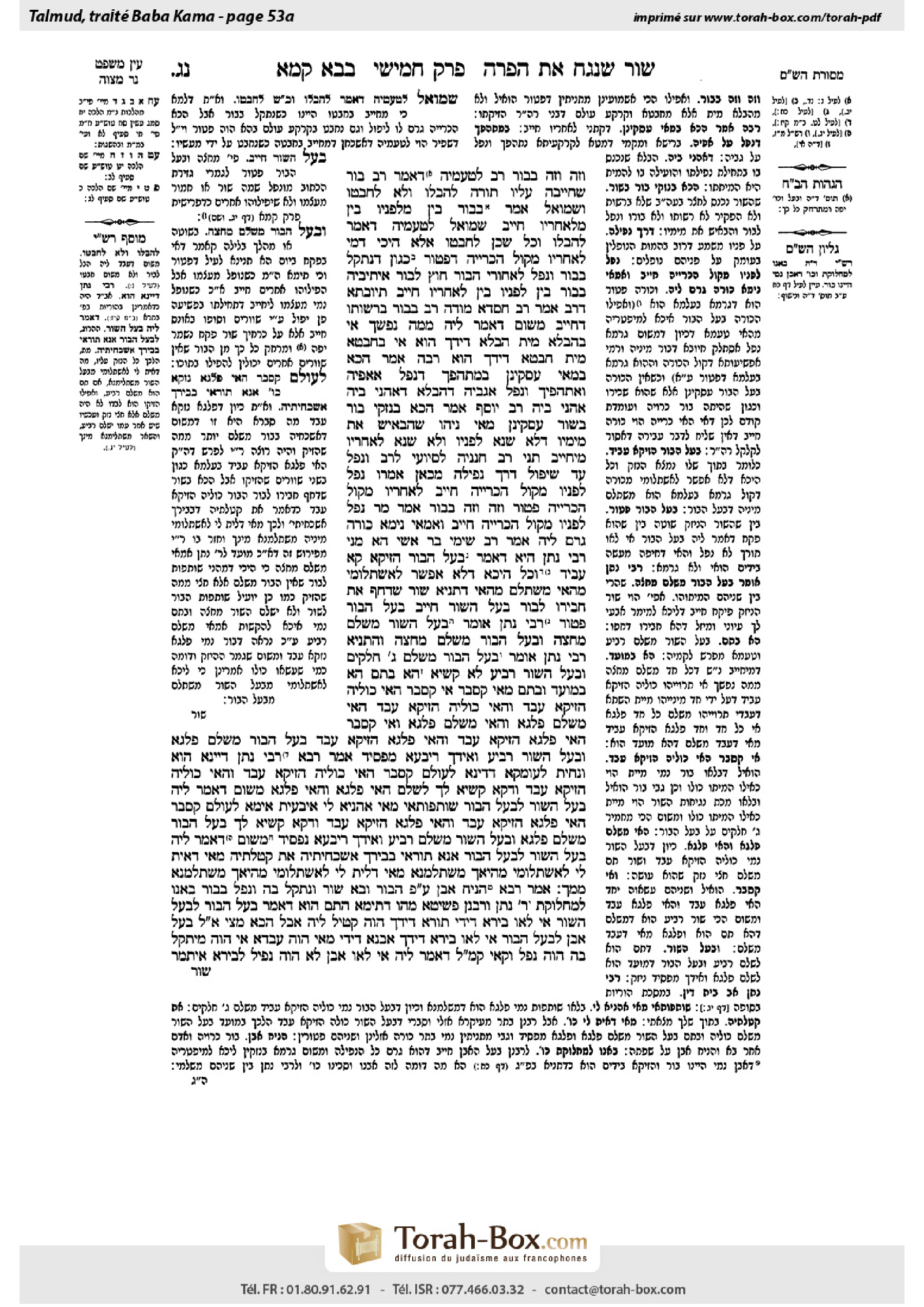
Bava Kamma 53a: Talmud study for Daf Yomi
Study the Talmud for Daf Yomi with scanned pages, Hebrew text, English translations from Sefaria and AI-generated French translations.
Passage selection and English or AI-generated French translation are available where the scan has annotations. Daf Study is independent of Torah-Box and Sefaria.
Browse Bava Kamma · בבא קמא · All tractatesBava Kamma 53a text and translations
This page of Bava Kamma includes the Aramaic text, an English translation and an AI-generated French translation, alongside the scan above.
בבא קמא נ״ג א · Aramaic and Hebrew text
וְזֶה וָזֶה בְּבוֹר.
רַב לְטַעְמֵיהּ – דְּאָמַר רַב: בּוֹר שֶׁחִיְּיבָה עָלָיו תּוֹרָה – לְהֶבְלוֹ, וְלֹא לַחֲבָטוֹ.
וּשְׁמוּאֵל אָמַר: בְּבוֹר – בֵּין מִלְּפָנָיו בֵּין מִלְּאַחֲרָיו, חַיָּיב.
שְׁמוּאֵל לְטַעְמֵיהּ, דְּאָמַר: לְהֶבְלוֹ – וְכׇל שֶׁכֵּן לַחֲבָטוֹ. אֶלָּא הֵיכִי דָּמֵי לְאַחֲרָיו מִקּוֹל הַכְּרִיָּיה – דְּפָטוּר? כְּגוֹן דְּנִתְקַל בַּבּוֹר, וְנָפַל לַאֲחוֹרֵי הַבּוֹר חוּץ לַבּוֹר.
אֵיתִיבֵיהּ: בְּבוֹר – בֵּין לְפָנָיו בֵּין לְאַחֲרָיו, חַיָּיב. תְּיוּבְתָּא דְּרַב!
אָמַר רַב חִסְדָּא: מוֹדֶה רַב בְּבוֹר בִּרְשׁוּתוֹ – דְּחַיָּיב, מִשּׁוּם דְּאָמַר לֵיהּ: מִמָּה נַפְשָׁךְ? אִי בְּהַבְלָא מִית – הַבְלָא דִּידָךְ הוּא, אִי בְּחַבְטָא מִית – חַבְטָא דִּידָךְ הוּא.
רַבָּה אָמַר: הָכָא בְּמַאי עָסְקִינַן – בְּמִתְהַפֵּךְ, דִּנְפַל אַאַפֵּיהּ וְאִתְהֲפִיךְ וּנְפַל אַגַּבֵּיהּ; דְּהַבְלָא דְּאַהֲנִי בֵּיהּ, אַהֲנִי בֵּיהּ.
רַב יוֹסֵף אָמַר: הָכָא בְּנִזְקֵי בוֹר בְּשׁוֹר עָסְקִינַן – מַאי נִיהוּ? שֶׁהִבְאִישׁ אֶת מֵימָיו; דְּלָא שְׁנָא לְפָנָיו וְלָא שְׁנָא לְאַחֲרָיו – מִיחַיַּיב.
תָּנֵי רַב חֲנַנְיָה לְסַיּוֹעֵי לְרַב: ״וְנָפַל״ – עַד שֶׁיִּפּוֹל דֶּרֶךְ נְפִילָה. מִכָּאן אָמְרוּ: נָפַל לְפָנָיו מִקּוֹל הַכְּרִיָּיה – חַיָּיב, לְאַחֲרָיו מִקּוֹל הַכְּרִיָּיה – פָּטוּר. וְזֶה וָזֶה בְּבוֹר.
אָמַר מָר: נָפַל לְפָנָיו מִקּוֹל הַכְּרִיָּיה – חַיָּיב. וְאַמַּאי? נֵימָא כּוֹרֶה גְּרַם לֵיהּ! אָמַר רַב שִׁימִי בַּר אָשֵׁי: הָא מַנִּי – רַבִּי נָתָן הִיא, דְּאָמַר: בַּעַל הַבּוֹר הֶזֵּיקָא קָא עָבֵיד, וְכֹל הֵיכָא דְּלָא אֶפְשָׁר לְאִשְׁתַּלּוֹמֵי מֵהַאי – מִשְׁתַּלֵּם מֵהַאי;
דְּתַנְיָא: שׁוֹר שֶׁדָּחַף אֶת חֲבֵירוֹ לְבוֹר – בַּעַל הַשּׁוֹר חַיָּיב, בַּעַל הַבּוֹר פָּטוּר. רַבִּי נָתָן אוֹמֵר: בַּעַל הַשּׁוֹר מְשַׁלֵּם מֶחֱצָה, וּבַעַל הַבּוֹר מְשַׁלֵּם מֶחֱצָה.
וְהָתַנְיָא, רַבִּי נָתָן אוֹמֵר: בַּעַל הַבּוֹר מְשַׁלֵּם שְׁלֹשָׁה חֲלָקִים, וּבַעַל הַשּׁוֹר רְבִיעַ! לָא קַשְׁיָא; הָא בְּתָם, הָא בְּמוּעָד.
וּבְתָם מַאי קָסָבַר? אִי קָסָבַר: הַאי כּוּלֵּיהּ הֶזֵּיקָא עֲבַד וְהַאי כּוּלֵּיהּ הֶזֵּיקָא עֲבַד – הַאי מְשַׁלֵּם פַּלְגָא, וְהַאי מְשַׁלֵּם פַּלְגָא!
וְאִי קָסָבַר: הַאי פַּלְגָא הֶזֵּיקָא עֲבַד, וְהַאי פַּלְגָא הֶזֵּיקָא עֲבַד – בַּעַל הַבּוֹר מְשַׁלֵּם פַּלְגָא וּבַעַל הַשּׁוֹר רְבִיעַ, וְאִידַּךְ רִיבְעָא מַפְסִיד?
אָמַר רָבָא: רַבִּי נָתָן דַּיָּינָא הוּא, וְנָחֵית לְעוּמְקָא דְּדִינָא; לְעוֹלָם קָסָבַר: הַאי כּוּלֵּיהּ הֶזֵּיקָא עֲבַד, וְהַאי כּוּלֵּיהּ הֶזֵּיקָא עֲבַד; וּדְקָא קַשְׁיָא לָךְ לְשַׁלֵּם הַאי פַּלְגָא וְהַאי פַּלְגָא, מִשּׁוּם דְּאָמַר לֵיהּ בַּעַל הַשּׁוֹר לְבַעַל הַבּוֹר: שׁוּתָּפוּתַאי מַאי אַהַנְיָא לִי?
אִיבָּעֵית אֵימָא, לְעוֹלָם קָסָבַר: הַאי פַּלְגָא הֶזֵּיקָא עֲבַד, וְהַאי פַּלְגָא הֶזֵּיקָא עֲבַד; וּדְקָא קַשְׁיָא לָךְ: בַּעַל הַבּוֹר מְשַׁלֵּם פַּלְגָא וּבַעַל הַשּׁוֹר מְשַׁלֵּם רְבִיעַ, וְאִידָּךְ רִיבְעָא נַפְסֵיד – מִשּׁוּם דַּאֲמַר לֵיהּ בַּעַל הַשּׁוֹר לְבַעַל הַבּוֹר: אֲנָא תּוֹרַאי בְּבֵירָךְ אַשְׁכְּחִיתֵיהּ – אַתְּ קְטַלְתֵּיהּ; מַאי דְּאִית לִי לְאִשְׁתַּלּוֹמֵי מֵהַיְאךְ – מִשְׁתַּלַּמְנָא, מַאי דְּלֵית לִי לְאִשְׁתַּלּוֹמֵי מֵהַיְאךְ – מִשְׁתַּלַּמְנָא מִמָּךְ.
אָמַר רָבָא: הִנִּיחַ אֶבֶן עַל פִּי הַבּוֹר, וּבָא שׁוֹר וְנִתְקַל בָּהּ, וְנָפַל בַּבּוֹר – בָּאנוּ לְמַחְלוֹקֶת רַבִּי נָתָן וְרַבָּנַן. פְּשִׁיטָא!
מַהוּ דְּתֵימָא, הָתָם הוּא דְּאָמַר בַּעַל הַבּוֹר לְבַעַל הַשּׁוֹר: ״אִי לָאו בֵּירָא דִּידִי – תּוֹרָא דִּידָךְ הֲוָה קָטֵיל לֵיהּ״; אֲבָל הָכָא, מָצֵי אָמַר לֵיהּ בַּעַל אֶבֶן לְבַעַל הַבּוֹר: ״אִי לָאו בֵּירָא דִּידָךְ, אַבְנָא דִּידִי מַאי הֲוָה עָבְדָא? אִי הֲוָה מִיתְּקֵל בָּהּ – הֲוָה נָפֵל וְקָאֵי!״ קָא מַשְׁמַע לַן, דַּאֲמַר לֵיהּ: ״אִי לָאו אֶבֶן – לָא הֲוָה נָפֵיל לְבֵירָא״.
אִיתְּמַר:
Bava Kamma 53a · English translation
and both this and that refer to where it fell into the pit itself, but nevertheless if it fell backward, he is exempt.
The Gemara notes: Rav conforms to his line of reasoning, as Rav says: Damage classified as Pit for which the Torah obligates him to pay is referring specifically to damage caused by the pit’s lethal fumes, such as if an animal suffocates inside it, but not to damage caused by the impact of hitting the ground, for which he is exempt from paying compensation. Since the ox in this case fell backward on its back, the owner of the pit is exempt from paying compensation, as the ox wasn’t killed by the lethal fumes of the pit, but by the impact of the fall.
And Shmuel says: If the ox fell into the pit, whether it fell forward or whether it fell backward, he is liable.
The Gemara notes: Shmuel conforms to his line of reasoning, as Shmuel says: With regard to damage classified as Pit, the Torah holds one liable for damage caused by its lethal fumes, and all the more so for damage resulting from the impact of the fall. The Gemara asks: But according to Shmuel, what are the circumstances concerning which the mishna stated that if the ox fell backward into the pit due to the sound of the digging that one is exempt? The Gemara answers: This applies, for example, where the ox stumbled on the pit, and then fell behind the pit and was injured outside the pit.
The Sages raised an objection to the opinion of Rav from a baraita: With regard to an animal that fell into a pit, whether it fell in forward or whether it fell in backward, he is liable. This constitutes a conclusive refutation of Rav.
Rav Ḥisda said in explanation of how Rav’s opinion could accord with the baraita: Rav concedes in the case of a pit on his own property that a person is liable even if the animal fell backward, because the owner of the animal can say to the owner of the pit: Whichever way you look at it, you are liable. If my animal died due to the lethal fumes, these are your lethal fumes. If it died on account of the impact, this is the impact of your land, and not the impact of land in the public domain, which is the typical case of Pit.
Rabba said that this is how the baraita should be explained according to Rav: Here we are dealing with where the animal tumbled, i.e., where it began to fall on its face, and afterward tumbled and continued to fall on its back. In this case, he is liable because the lethal fumes, which were effective in injuring the animal, were also effective in killing it.
Rav Yosef said: Here, in this baraita, we are dealing with damage to the pit that is caused by the ox. And what is the damage? The damage is that it contaminated the water in the pit, in which case the baraita states that it makes no difference if the animal fell forward and it makes no difference if it fell backward, since he is liable either way.
Rav Ḥananya taught a baraita in support of the opinion of Rav: The verse states with regard to damage caused by a pit to an animal: “And an ox or a donkey fall therein” (Exodus 21:33), which is interpreted to mean that one is not liable unless the animal falls in the usual manner of falling. From here the Sages stated that if it fell forward due to the sound of the digging, he is liable, but if it fell backward due to the sound of the digging, he is exempt, and both this case and that case refer to damage by a pit.
§ The Master said in the mishna: If it fell forward due to the sound of the digging, he is liable. The Gemara asks: But why is this so? Let us say that it is the sound of the digger that caused the animal to fall, and not the pit itself. The Gemara answers that Rav Shimi bar Ashi said: In accordance with whose opinion is this? It is in accordance with the opinion of Rabbi Natan, who says: The owner of the pit causes the damage by his digging, and anywhere that it is not possible to collect payment from this one who caused the fall, i.e., the digger, payment is collected from that one, i.e., the owner of the pit. This is because in any event, he bears responsibility for the hazard he created.
As it is taught in a baraita: With regard to an ox that pushed another ox into a pit, the owner of the first ox is liable, and the owner of the pit is exempt. Rabbi Natan says: The owner of the first ox pays half the amount, and the owner of the pit pays half the amount.
The Gemara clarifies Rabbi Natan’s opinion: But isn’t it taught in a baraita that Rabbi Natan says: If an ox pushed another ox into a pit, the owner of the pit pays three-quarters, and the owner of the first ox pays one-quarter? The Gemara resolves the contradiction: This is not difficult, as this second baraita is referring to an innocuous ox that pushed the second ox. Therefore, the owner of the ox that caused damage pays only one-quarter of the cost of the damage, which is half of the half for which he is responsible. By contrast, that other baraita is referring to a forewarned ox that pushed a second ox. Consequently, the owner of the forewarned ox pays the full amount for which he is responsible, i.e., half the value of the total damage.
The Gemara asks: And with regard to an innocuous ox, what does Rabbi Natan hold as to why this person pays one-quarter and the owner of the pit pays three-quarters? If he holds that this one, i.e., the ox, performed all the damage and the other, i.e., the pit, performed all the damage, then he should have ruled that this one pays half and that one pays half, since they are both fully responsible. Although the ox was innocuous, the owner is still liable to pay half the cost of the damage, as that is the liability incurred for an act of damaging by an innocuous ox.
And if Rabbi Natan holds that this one, i.e., the owner of the ox, performed half the damage, and that one, i.e., the owner of the pit, performed half the damage, then the owner of the pit should pay half of the amount for which he is responsible, i.e., half the cost of the damage, and the owner of the innocuous ox should pay only one-quarter, which is half the amount for which he is responsible. As for the other remaining quarter, the injured party has no recourse to claim it, and loses it. Why, then, does Rabbi Natan hold that the owner of the pit pays for three-quarters of the damage?
Rava said: Rabbi Natan is a judge and has plumbed the full depths of the halakha. Actually, he holds that this one performed all of the damage and that one performed all of the damage. And as for your difficulty, that this one should pay half and that one should pay half, that is not difficult. The owner of the ox pays only one-quarter, because the owner of the ox can say to the owner of the pit: How did my partnership with you in this situation help me? Even if my ox caused all the damage and none of the damage was caused by the pit, I would be required to pay only half the cost of the damage. Therefore, as we are partners in this situation, I should pay half of what I should have paid, which is one-quarter. You should pay the other half of what I should have paid, in addition to your share, since you would have had to pay full damages.
The Gemara adds: If you wish, say instead a different explanation: Actually, Rabbi Natan maintains that this one performed half the damage and that one performed half the damage. As for your difficulty with the fact that the owner of the pit should pay half and the owner of the ox should pay one-quarter, and the injured party loses the other remaining quarter, that is not difficult. This is because the owner of the killed ox can say to the owner of the pit: I found my ox in your pit. Consequently, I am assuming that you killed it. Therefore, concerning that portion of the payment that I can receive from the other, i.e., the owner of the damaging ox, I will receive it. Concerning that portion that I am unable to receive from the other individual, I will receive it from you.
On the same subject, Rava says: If one left a stone at the opening of a pit belonging to another person, and an ox came and stumbled on it and fell into the pit, we have arrived at the dispute between Rabbi Natan and the Rabbis concerning the division of responsibility between them. The Gemara asks: Isn’t this obvious, since what is the difference whether the ox fell into the pit due to another ox pushing it or due to the stone?
The Gemara answers: This ruling needed to be stated explicitly, lest you say that only there the owner of the pit can say to the owner of the ox who was responsible for the damage: If not for my pit, your ox would have killed the second ox anyway, in which case my pit was not the cause of the damage, but here, the owner of the stone can say to the owner of the pit: If not for your pit, what would my stone have done? If the ox would have stumbled on it, it would have simply fallen and gotten up, and I should be exempt. Therefore, Rava teaches us that this claim is not a valid one, because the owner of the pit can say in response to the owner of the stone: If not for your stone, the ox would not have fallen into the pit in the first place.
§ It was stated:
Bava Kamma 53a · Traduction française (IA)
et ce qui est dit ici et ce qui est dit là se réfère à où il est tombé dans le puits lui-même, mais néanmoins, s'il est tombé à l'envers, il est exempt.
La Guemara note : Rav suit sa ligne de raisonnement, car Rav dit : Le dommage classé comme puits pour lequel la Torah impose de payer est spécifiquement celui causé par les fumées mortelles du puits, tel que si un animal suffoque à l'intérieur, mais pas celui causé par l'impact de la chute au sol, pour lequel il est exempt de payer une compensation. Puisque l'âne dans ce cas est tombé à l'envers sur le dos, le propriétaire du puits est exempt de payer une compensation, car l'âne n'est pas mort des fumées mortelles du puits, mais de l'impact de la chute.
Et Shmuel dit : Si l'âne est tombé dans le puits, qu'il ait tombé en avant ou qu'il ait tombé à l'envers, il est responsable.
La Guemara note que Shmuel suit sa ligne de raisonnement, car Shmuel dit : En ce qui concerne un dommage classé comme puits, la Torah tient compte de la responsabilité pour le dommage causé par ses fumées mortelles, et encore davantage pour celui résultant de l'impact de la chute. La Guemara pose la question : Mais selon Shmuel, quels sont les cas concernant lesquels la michna a dit que si l'animal est tombé à l'envers dans le puits en raison du bruit de la fouille, on est exempt ? La Guemara répond : Cela s'applique, par exemple, dans le cas où l'animal a trébuché sur le puits, puis est tombé derrière le puits et a été blessé en dehors du puits.
Les Sages ont soulevé une objection contre l'opinion de Rav d'après une baraïta : En ce qui concerne un animal tombé dans un puits, qu'il ait tombé en avant ou qu'il ait tombé à l'envers, il est responsable. Cela constitue une réfutation définitive de Rav.
Rav Ḥisda a dit pour expliquer comment l'opinion de Rav peut s'accorder avec la baraïta : Rav reconnaît le cas d'un puits sur sa propre propriété, où une personne est responsable même si l'animal est tombé à l'envers, car le propriétaire de l'animal peut dire au propriétaire du puits : Quel que soit le point de vue, vous êtes responsable. Si mon animal est mort à cause des fumées mortelles, ce sont vos fumées mortelles. Si il est mort à cause de l'impact, c'est l'impact de votre terrain, et non l'impact du terrain du domaine public, qui est le cas typique de puits.
Rabba a dit que c'est ainsi que la baraïta devrait être expliquée selon l'opinion de Rav : Ici, nous parlons du lieu où l'animal a basculé, c'est-à-dire où il a commencé à tomber sur le ventre, puis a basculé et a continué à tomber sur le dos. Dans ce cas, il est responsable car les fumées mortelles, qui étaient efficaces pour blesser l'animal, étaient également efficaces pour le tuer.
Rav Yosef a dit : Ici, dans cette baraïta, nous parlons de dommage causé au puits par l'animal. Et quel est ce dommage ? Le dommage est que l'animal a contaminé l'eau du puits, dans ce cas la baraïta dit que cela n'a pas d'importance si l'animal est tombé en avant et cela n'a pas d'importance si l'animal est tombé à l'envers, car il est responsable dans les deux cas.
Rav Ḥananya a enseigné une baraïta en soutien de l'opinion de Rav : La parabrase dit concernant le dommage causé par un puits à un animal : « Et un bœuf ou un âne tombe là-dedans » (Exode 21:33), ce qui est interprété pour signifier qu'on n'est pas responsable à moins que l'animal tombe dans le mode habituel de tomber. D'où les Sages ont dit que si l'animal est tombé en avant en raison du bruit de la fouille, il est responsable, mais si l'animal est tombé à l'envers en raison du bruit de la fouille, il est exempt, et ces deux cas se réfèrent à un dommage causé par un puits.
§ Le Maître a dit dans la michna : Si l'animal est tombé en avant en raison du bruit de la fouille, il est responsable. La Guemara pose la question : Mais pourquoi est-ce ainsi ? Disons que c'est le bruit du fouilleur qui a causé la chute de l'animal, et non le puits lui-même. La Guemara répond que Rav Shimi bar Ashi a dit : Selon l'opinion de qui est-ce ? C'est selon l'opinion de Rabbi Natan, qui dit : Le propriétaire du puits cause le dommage par sa fouille, et partout où il n'est pas possible de recouvrer le paiement de celui qui a causé la chute, c'est-à-dire le fouilleur, le paiement est recouvré auprès de celui-là, c'est-à-dire le propriétaire du puits. Cela est ainsi car, en tout cas, il assume la responsabilité du danger qu'il a créé.
Comme il est enseigné dans une baraïta : En ce qui concerne un bœuf qui a poussé un autre bœuf dans un puits, le propriétaire du premier bœuf est responsable, et le propriétaire du puits est exempt. Rabbi Natan dit : Le propriétaire du premier bœuf paie la moitié de la somme, et le propriétaire du puits paie la moitié de la somme.
La Guemara clarifie l'opinion de Rabbi Natan : Mais n'est-il pas enseigné dans une baraïta que Rabbi Natan dit : Si un bœuf a poussé un autre bœuf dans un puits, le propriétaire du puits paie trois-quarts, et le propriétaire du premier bœuf paie un quart ? La Guemara résout la contradiction : Ce n'est pas difficile, car cette deuxième baraïta fait référence à un bœuf inoffensif qui a poussé le second bœuf. Ainsi, le propriétaire du bœuf qui a causé le dommage paie seulement un quart du coût du dommage, ce qui est la moitié du quart pour lequel il est responsable. En revanche, cette autre baraïta fait référence à un bœuf averti qui a poussé un second bœuf. Par conséquent, le propriétaire du bœuf averti paie la totalité de la somme pour laquelle il est responsable, c'est-à-dire la moitié de la valeur totale du dommage.
La Guemara pose la question : Et en ce qui concerne un bœuf inoffensif, quelle est l'opinion de Rabbi Natan concernant le fait que cette personne paie un quart et que le propriétaire du puits paie trois-quarts ? Si Rabbi Natan maintient que ce dernier, c'est-à-dire le bœuf, a accompli tout le dommage et que l'autre, c'est-à-dire le puits, a accompli tout le dommage, alors il devrait avoir décidé que ce dernier paie la moitié et que l'autre paie la moitié, car ils sont tous deux pleinement responsables. Bien que le bœuf fût inoffensif, le propriétaire est toujours responsable de payer la moitié du coût du dommage, car c'est la responsabilité encourue pour un acte de dommage causé par un bœuf inoffensif.
Et si le maître Natan affirme que celui-ci, c'est-à-dire l'propriétaire de l'âne, a causé la moitié des dommages, et celui-là, c'est-à-dire l'propriétaire du trou, a causé la moitié des dommages, alors l'propriétaire du trou devrait payer la moitié de la somme pour laquelle il est responsable, c'est-à-dire la moitié du coût des dommages, et l'propriétaire de l'âne sans danger devrait payer seulement un quart, ce qui est la moitié de la somme pour laquelle il est responsable. Quant à la autre quart restant, la partie blessée n'a pas de recours pour le revendiquer et le perd. Pourquoi, alors, le maître Natan affirme-t-il que l'propriétaire du trou paie les trois-quarts des dommages ?
Rava dit : Le maître Natan est un juge et a pénétré dans les profondeurs de la halakha. En réalité, il affirme que celui-ci a causé tous les dommages et celui-là a causé tous les dommages. Et quant à votre difficulté, que celui-ci doive payer la moitié et celui-là la moitié, cela n'est pas difficile. L'propriétaire de l'âne paie seulement un quart, car l'propriétaire de l'âne peut dire à l'propriétaire du trou : Comment mon partenariat avec toi dans cette situation m'a-t-il aidé ? Même si mon âne a causé tous les dommages et aucun des dommages n'a été causé par le trou, je serais tenu de payer seulement la moitié du coût des dommages. Par conséquent, comme nous sommes partenaires dans cette situation, je devrais payer la moitié de ce que j'aurais dû payer, ce qui est un quart. Vous devriez payer l'autre moitié de ce que j'aurais dû payer, en plus de votre part, puisque vous auriez dû payer les dommages complets.
La Guemara ajoute : Si vous le souhaitez, proposez plutôt une autre explication : En réalité, le maître Natan maintient que celui-ci a causé la moitié des dommages et celui-là la moitié des dommages. Quant à votre difficulté avec le fait que l'propriétaire du trou doive payer la moitié et l'propriétaire de l'âne doive payer un quart, et que la partie blessée perde la autre quart restant, cela n'est pas difficile. C'est parce que l'propriétaire de l'âne tué peut dire à l'propriétaire du trou : J'ai trouvé mon âne dans votre trou. Par conséquent, je suppose que vous l'avez tué. Ainsi, concernant cette partie du paiement que je peux recevoir de l'autre, c'est-à-dire l'propriétaire de l'âne nuisible, je le recevrai. Concernant cette partie que je ne peux pas recevoir de l'autre individu, je le recevrai de vous.
Sur le même sujet, Rava dit : Si l'un a laissé une pierre à l'entrée d'un trou appartenant à un autre, et un âne est venu et est tombé dessus et est tombé dans le trou, nous sommes arrivés à la dispute entre le maître Natan et les Rabbins concernant la division de la responsabilité entre eux. La Guemara demande : N'est-ce pas évident, puisque quelle est la différence si l'âne est tombé dans le trou en raison d'un autre âne qui l'a poussé ou en raison de la pierre ?
La Guemara répond : Cette décision devait être formulée explicitement, afin que vous ne disiez pas que seulement là l'propriétaire du trou peut dire à l'propriétaire de l'âne responsable des dommages : Si ce n'était pas pour mon trou, votre âne aurait tué l'autre âne de toute façon, dans ce cas mon trou n'était pas la cause des dommages, mais ici, l'propriétaire de la pierre peut dire à l'propriétaire du trou : Si ce n'était pas pour votre trou, que ma pierre aurait-elle fait ? Si l'âne était tombé dessus, il aurait simplement chuté et se serait relevé, et je devrais être exempt. Par conséquent, Rava nous enseigne que cette revendication n'est pas valable, car l'propriétaire du trou peut répondre à l'propriétaire de la pierre : Si ce n'était pas pour votre pierre, l'âne n'aurait pas tombé dans le trou d'abord.
§ Il a été dit :
Traduction française générée par IA à partir de l’édition anglaise de Sefaria. Vérifie toujours un passage avec le texte source.
Text from Sefaria: William Davidson Edition - Vocalized Aramaic (CC BY NC); William Davidson Edition - English (CC BY NC).