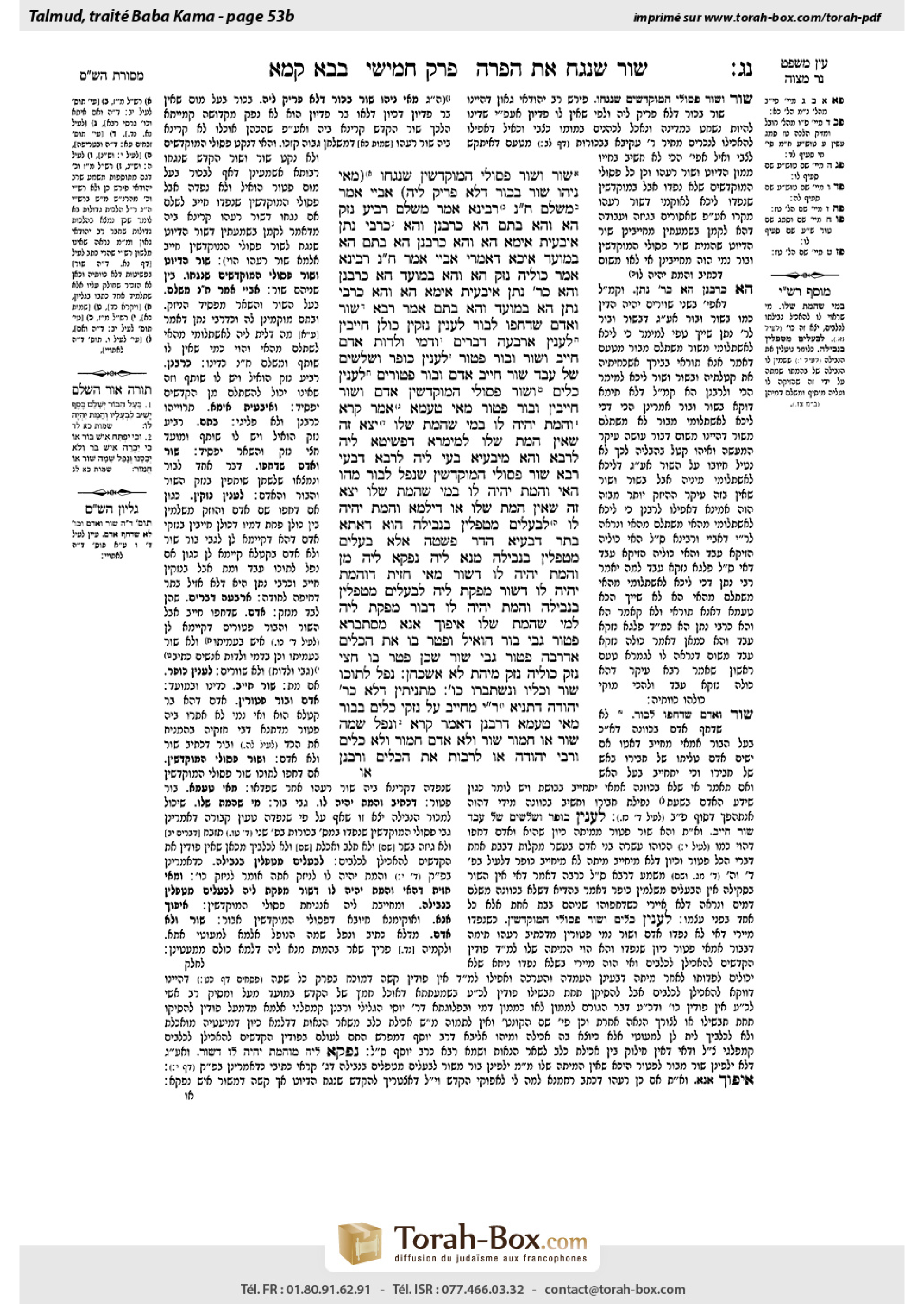
Bava Kamma 53b: Talmud study for Daf Yomi
Study the Talmud for Daf Yomi with scanned pages, Hebrew text, English translations from Sefaria and AI-generated French translations.
Passage selection and English or AI-generated French translation are available where the scan has annotations. Daf Study is independent of Torah-Box and Sefaria.
Browse Bava Kamma · בבא קמא · All tractatesBava Kamma 53b text and translations
This page of Bava Kamma includes the Aramaic text, an English translation and an AI-generated French translation, alongside the scan above.
בבא קמא נ״ג ב · Aramaic and Hebrew text
שׁוֹר וְשׁוֹר פְּסוּלֵי הַמּוּקְדָּשִׁין שֶׁנָּגְחוּ – מַאי נִיהוּ? שׁוֹר בְּכוֹר, דְּלָא פָּרֵיק לֵיהּ; אַבָּיֵי אָמַר: מְשַׁלֵּם חֲצִי נֶזֶק, רָבִינָא אָמַר: מְשַׁלֵּם רְבִיעַ נֶזֶק.
הָא וְהָא בְּתָם; הָא כְּרַבָּנַן, וְהָא כְּרַבִּי נָתָן.
אִיבָּעֵית אֵימָא: הָא וְהָא כְּרַבָּנַן; הָא בְּתָם, הָא בְּמוּעָד.
אִיכָּא דְּאָמְרִי – אַבָּיֵי אָמַר: חֲצִי נֶזֶק, רָבִינָא אָמַר: כּוּלֵּיהּ נֶזֶק. הָא וְהָא בְּמוּעָד; הָא כְּרַבָּנַן, וְהָא כְּרַבִּי נָתָן.
אִיבָּעֵית אֵימָא: הָא וְהָא כְּרַבִּי נָתָן; הָא בְּמוּעָד, וְהָא בְּתָם.
אָמַר רָבָא: שׁוֹר וְאָדָם שֶׁדָּחֲפוּ לְבוֹר, לְעִנְיַן נְזָקִין – כּוּלָּן חַיָּיבִין. לְעִנְיַן אַרְבָּעָה דְּבָרִים וּדְמֵי וְלָדוֹת – אָדָם חַיָּיב, וְשׁוֹר וּבוֹר פָּטוּר.
לְעִנְיַן כּוֹפֶר וּשְׁלֹשִׁים שֶׁל עֶבֶד – שׁוֹר חַיָּיב, אָדָם וּבוֹר פְּטוּרִים. לְעִנְיַן כֵּלִים וְשׁוֹר פְּסוּלֵי הַמּוּקְדָּשִׁין – אָדָם וְשׁוֹר חַיָּיבִין, וּבוֹר פָּטוּר.
מַאי טַעְמָא? אָמַר קְרָא: ״וְהַמֵּת יִהְיֶה לוֹ״ – בְּמִי שֶׁהַמֵּת שֶׁלּוֹ, יָצָא זֶה שֶׁאֵין הַמֵּת שֶׁלּוֹ.
לְמֵימְרָא דִּפְשִׁיטָא לֵיהּ לְרָבָא? וְהָא מִיבַּעְיָא בָּעֵי לֵיהּ לְרָבָא – דְּבָעֵי רָבָא: שׁוֹר פְּסוּלֵי הַמּוּקְדָּשִׁין שֶׁנָּפַל לַבּוֹר, מַהוּ? הַאי ״וְהַמֵּת יִהְיֶה לוֹ״ – בְּמִי שֶׁהַמֵּת שֶׁלּו, יָצָא זֶה שֶׁאֵין הַמֵּת שֶׁלּוֹ; אוֹ דִילְמָא, ״וְהַמֵּת יִהְיֶה לוֹ״ – לִבְעָלִים מִטַּפְּלִין בַּנְּבֵילָה הוּא דַּאֲתָא?
בָּתַר דְּבַעְיַהּ, הֲדַר פַּשְׁטַהּ.
אֶלָּא בְּעָלִים מִטַּפְּלִין בִּנְבֵילָה – מְנָא לֵיהּ? נָפְקָא לֵיהּ מִן ״וְהַמֵּת יִהְיֶה לוֹ״ דְּשׁוֹר. מַאי חָזֵית דִּ״וְהַמֵּת יִהְיֶה לוֹ״ דְּשׁוֹר – מַפְּקַתְּ לֵיהּ לִבְעָלִים מִטַּפְּלִין בִּנְבֵילָה, ״וְהַמֵּת יִהְיֶה לוֹ״ דְּבוֹר – מַפְּקַתְּ לֵיהּ לְמִי שֶׁהַמֵּת שֶׁלּוֹ? אֵיפוֹךְ אֲנָא!
מִסְתַּבְּרָא פְּטוּר גַּבֵּי בוֹר – הוֹאִיל וּפָטַר בּוֹ אֶת הַכֵּלִים. אַדְּרַבָּה, פְּטוּר גַּבֵּי שׁוֹר – שֶׁכֵּן פָּטַר בּוֹ חֲצִי נֶזֶק! כּוּלֵּיהּ נֶזֶק מִיהַת לָא אַשְׁכְּחַן.
נָפַל לְתוֹכוֹ שׁוֹר וְכֵלָיו, וְנִשְׁתַּבְּרוּ כּוּ׳. מַתְנִיתִין דְּלָא כְּרַבִּי יְהוּדָה – דְּתַנְיָא: רַבִּי יְהוּדָה מְחַיֵּיב עַל נִזְקֵי כֵלִים בְּבוֹר.
מַאי טַעְמָא דְּרַבָּנַן? דְּאָמַר קְרָא: ״וְנָפַל שָׁמָּה שּׁוֹר אוֹ חֲמוֹר״; ״שׁוֹר״ – וְלֹא אָדָם, ״חֲמוֹר״ – וְלֹא כֵּלִים. וְרַבִּי יְהוּדָה – ״אוֹ״, לְרַבּוֹת אֶת הַכֵּלִים. וְרַבָּנַן –
Bava Kamma 53b · English translation
There is a dispute with regard to a case of an ordinary innocuous ox and a disqualified consecrated ox that gored another ox together. What is this case of an ox that was consecrated and disqualified? It is a firstborn ox that became blemished and was consequently disqualified as an offering. Nevertheless, its initial consecration remains, and therefore it may not be redeemed. Consequently, the priest in possession of it is not liable to pay damages, since it is not classified as: The ox of another, as its status is not that of a non-sacred ox belonging to a person. Given this background, what is the liability of the owner of the non-sacred ox that gored together with it? Abaye says: He pays half the cost of the damage, whereas Ravina says: He pays one-quarter of the cost of the damage.
The Gemara explains the dispute: Both this one, Abaye, and that one, Ravina, refer to a case where the ordinary ox was innocuous. This opinion stated by Ravina is in accordance with the opinion of the Rabbis that each party is responsible for only half the damage. Since the non-sacred ox was innocuous, its owner pays half the cost of the damage for which he is responsible, i.e., one-quarter of the total. And that opinion stated by Abaye is in accordance with the opinion of Rabbi Natan that each party in turn is responsible for all the damage. Consequently, since the non-sacred ox is innocuous, its owner pays half the total amount.
If you wish, say instead that there is no dispute, and that both this one, Abaye, and that one, Ravina, state their opinions in accordance with the opinion of the Rabbis. This one, Ravina, is referring to where the non-sacred ox is innocuous, and so its owner pays half of a half, and that one, Abaye, is referring to where the non-sacred ox is forewarned, so its owner pays his entire share, i.e., half the total damage.
There are those who say that there was another version of this dispute: Abaye says that he pays half the cost of the damage, and Ravina says: He pays the full cost of the damage. The Gemara explains their reasoning: Both this one and that one are referring to where the ox was forewarned. This one, Abaye, holds in accordance with the opinion of the Rabbis, that each one is responsible for half the damage, and so he pays his share of half the total cost of the damage. And that one, Ravina, holds in accordance with the opinion of Rabbi Natan, that each one is fully responsible for the damage, and when one perpetrator of the damage is exempt from payment, such as this case, the entire amount is collected from the other.
If you wish, say instead that there is no dispute, and that both this one and that one hold in accordance with the opinion of Rabbi Natan. This one, Ravina, is referring to where the ox was forewarned and the owner pays the full cost of the damage, and that one, Abaye, is referring to an innocuous ox, for which only half the cost of the damage is paid.
§ Rava says: With regard to an ox and a person that push a person or animal into a pit, then concerning the damage that they caused, they, i.e., the man who pushed the person or animal, the owner of the ox, and the owner of the pit, are all liable to pay the indemnity of damage. Concerning the four additional types of indemnity, which are loss of livelihood, pain, medical costs, and humiliation, and also with regard to the compensation for miscarried offspring, the person who pushed is liable, and the owner of the ox and the owner of the pit are exempt, since the Torah did not impose any obligation on them to pay these payments.
With regard to the payment of ransom if it was a person who was pushed and killed, and also concerning the thirty shekels paid for a Canaanite slave who was killed, the owner of the ox is liable, and the man who did the pushing and the owner of the pit are exempt. With regard to vessels and a disqualified consecrated ox that fell into the pit, the man who did the pushing and the owner of the ox are liable, and the owner of the pit is exempt.
Rava explains: What is the reason that the owner of the pit is exempt from liability for damage caused to a disqualified consecrated ox? Since the verse states with regard to a pit: “And the carcass shall be for him” (Exodus 21:34), it teaches that the obligation to pay damages is imposed only on the one to whom the carcass subsequently belongs, thereby excluding this case of a disqualified consecrated ox, where the carcass does not belong to him. In this case, it is prohibited to sell the carcass. The owner of the pit cannot derive benefit from it, and it no longer belongs to anyone, so the conditions written in the verse are not in effect.
The Gemara asks: Is this to say that this matter was obvious to Rava? Is it not a dilemma that was already raised by Rava, as Rava asked: What is the halakha with regard to a disqualified consecrated ox that fell into a pit? Is this verse: “And the carcass shall be for him,” referring to the one to whom the carcass belongs, i.e., the owner of the pit, excluding this case where the carcass does not belong to him, and therefore the owner is exempt from paying for it? Or perhaps the verse “And the carcass shall be for him” comes to teach that the owner of the animal attends to, i.e., retains ownership of, the carcass, and the perpetrator of the damage pays him the difference?
The Gemara answers: Initially, Rava was in doubt about the matter, but after he raised the dilemma, he then resolved it and concluded that the verse imposes liability for the cost of damage only on a person to whom the carcass belongs, excluding the case of a disqualified consecrated ox.
The Gemara asks: Rather, from where does he derive the halakha that the owner attends to the animal carcass? The Gemara answers: He derives it from the verse: “And the carcass shall be for him” (Exodus 21:36), stated with regard to Ox. The Gemara asks further: What did you see to determine that from the verse “And the carcass shall be for him,” stated with regard to Ox, you derive from it the halakha that the owner of the dead ox attends to the carcass, and from the verse “And the carcass belongs to him,” stated with regard to Pit, you derive from it the halakha that only the one to whom the carcass belongs pays damages? Why can’t I reverse the derivations from each verse and say the opposite?
The Gemara answers: It is reasonable that the exemption applies to the verse stated with regard to Pit, since the Torah also exempts one from paying for damage classified as Pit caused to vessels that fall into it and break. The Gemara challenges this answer: On the contrary, one could claim that the exemption applies to the verse stated with regard to Ox, since the Torah also exempted the owner from half the cost of the damage in the case of an innocuous ox. The Gemara responds: In any event, we do not find that the owner of the ox is exempt from compensation for the full cost of damage. By contrast, with regard to Pit, there are certain items for which a person is not liable at all. Therefore, it is logical to conclude that the Torah is more lenient in cases of Pit than of Ox.
§ The mishna teaches: If an ox and its accoutrements, i.e., the vessels it was carrying, fell into the pit and the vessels were broken, or if a donkey and its accoutrements fell in and the accoutrements were torn, the owner of the pit is liable for damage to the animal caused by the pit, but he is exempt from liability for damage caused to the vessels, by Torah edict. The Gemara notes: The mishna is not in accordance with the opinion of Rabbi Yehuda, as it is taught in a baraita: Rabbi Yehuda obligates a person to pay for damage caused to vessels in cases of Pit.
The Gemara explains: What is the reasoning of the Rabbis? Since the verse states: “And an ox or a donkey fall therein” (Exodus 21:33), it is inferred that it is specifically an ox, but not a person, for whose death the owner of the pit is liable. Moreover, one is liable for a donkey, but not vessels. By contrast, Rabbi Yehuda expounds the word “or” in the expression “an ox or a donkey” to include vessels. The Gemara asks: And how do the Rabbis explain the word “or”?
Bava Kamma 53b · Traduction française (IA)
Il y a un désaccord concernant un cas d'un taureau ordinaire inoffensif et d'un taureau consacré mais disqualifié qui a blessé un autre taureau ensemble. Quel est ce cas d'un taureau consacré mais disqualifié ? Il s'agit d'un taureau premier-né devenu blemi et donc disqualifié comme offrande. Cependant, sa consécration initiale demeure, et par conséquent il ne peut être racheté. Ainsi, le prêtre en possession de ce taureau n'est pas tenu de payer des dommages, car il n'est pas considéré comme : Le taureau d'autrui, car son statut n'est pas celui d'un taureau non sacré appartenant à une personne. Ainsi, dans ce contexte, quelle est la responsabilité de l'owner du taureau non sacré qui a blessé ensemble avec lui ? Abaye dit : Il paie la moitié du coût des dommages, tandis que Ravina dit : Il paie un quart du coût des dommages.
La Guemara explique le désaccord : à la fois ce dernier, Abaye, et celui-là, Ravina, font référence à un cas où le taureau ordinaire était inoffensif. Cette opinion exprimée par Ravina s'inscrit dans la position des Rabbins selon laquelle chaque partie est responsable de la moitié des dommages. Puisque le taureau non sacré était inoffensif, son propriétaire paie la moitié du coût des dommages pour lesquels il est responsable, c'est-à-dire un quart du total. Et cette opinion exprimée par Abaye s'inscrit dans la position de Rabbi Natan selon laquelle chaque partie est pleinement responsable des dommages. Ainsi, puisque le taureau non sacré est inoffensif, son propriétaire paie la moitié du montant total.
Si vous le souhaitez, dites plutôt qu'il n'y a pas de désaccord, et que les deux, Abaye et Ravina, expriment leurs opinions dans le cadre de la position des Rabbins. Ce dernier, Ravina, fait référence à un cas où le taureau non sacré est inoffensif, et donc son propriétaire paie la moitié d'une moitié, et celui-là, Abaye, fait référence à un cas où le taureau non sacré est averti, donc son propriétaire paie sa part entière, c'est-à-dire la moitié du coût total des dommages.
Certains disent qu'il existait une autre version de ce désaccord : Abaye dit qu'il paie la moitié du coût des dommages, et Ravina dit : il paie le coût total des dommages. La Guemara explique leur raisonnement : à la fois ce dernier et celui-là font référence à un cas où le taureau était averti. Ce dernier, Abaye, adopte la position des Rabbins selon laquelle chaque partie est responsable de la moitié des dommages, et donc il paie sa part de la moitié du coût total des dommages. Et celui-là, Ravina, adopte la position de Rabbi Natan selon laquelle chaque partie est pleinement responsable des dommages, et lorsque l'un des auteurs des dommages est exempt de paiement, comme dans ce cas, l'intégralité du montant est recueillie de l'autre.
Si vous le souhaitez, dites plutôt qu'il n'y a pas de désaccord, et que les deux, Abaye et Ravina, adoptent la position de Rabbi Natan. Ce dernier, Ravina, fait référence à un cas où le taureau était averti et l'propriétaire paie le coût total des dommages, et celui-là, Abaye, fait référence à un taureau inoffensif, pour lequel seul la moitié du coût des dommages est payée.
§ Rava dit : concernant un taureau et une personne qui poussent une personne ou un animal dans un puits, concernant les dommages qu'ils ont causés, ils, c'est-à-dire la personne qui a poussé la personne ou l'animal, le propriétaire du taureau et le propriétaire du puits, sont tous responsables de payer l'indemnité de dommages. Concernant les quatre autres types d'indemnité, qui sont la perte de revenus, la souffrance, les frais médicaux et l'humiliation, ainsi que la compensation pour les fœtus abortés, la personne qui a poussé est responsable, et le propriétaire du taureau et le propriétaire du puits sont exemptés, car la Torah n'a pas imposé de responsabilité à ces personnes de payer ces paiements.
Concernant le paiement de rançon si c'était une personne qui a été poussée et tuée, ainsi que concernant les trente sicles payés pour un esclave cananéen tué, le propriétaire du taureau est responsable, et la personne qui a poussé et le propriétaire du puits sont exemptés. Concernant les objets et un taureau consacré mais disqualifié tombé dans le puits, la personne qui a poussé et le propriétaire du taureau sont responsables, et le propriétaire du puits est exempt.
Rava explique : Quelle est la raison pour laquelle le propriétaire du puits est exempt de responsabilité concernant les dommages causés à un taureau consacré mais disqualifié ? Puisque la versette stipule concernant un puits : « Et la carcasse sera pour lui » (Exode 21:34), elle enseigne que l'obligation de payer des dommages est imposée uniquement à celui à qui la carcasse appartient ultérieurement, excluant ainsi ce cas d'un taureau consacré mais disqualifié, où la carcasse n'appartient pas à lui. Dans ce cas, il est interdit de vendre la carcasse. Le propriétaire du puits ne peut pas en tirer profit, et la carcasse n'appartient plus à personne, donc les conditions écrites dans la versette ne s'appliquent pas.
La Guemara pose la question : Est-ce que cela signifie que cette question était évidente pour Rava ? N'est-ce pas un dilemme déjà soulevé par Rava, comme Rava a demandé : Quelle est la halakha concernant un taureau consacré mais disqualifié tombé dans un puits ? Cette versette : « Et la carcasse sera pour lui » fait-elle référence à celui à qui la carcasse appartient, c'est-à-dire le propriétaire du puits, excluant ce cas où la carcasse n'appartient pas à lui, et donc le propriétaire est exempt de payer ? Ou bien cette versette « Et la carcasse sera pour lui » vise à enseigner que le propriétaire de l'animal s'occupe de la carcasse, c'est-à-dire qu'il garde la propriété de la carcasse, et que le responsable des dommages lui paie la différence ?
La Guemara répond : Initialement, Rava était en doute sur cette question, mais après avoir soulevé le dilemme, il a résolu le problème et conclu que la versette impose la responsabilité du coût des dommages uniquement à une personne à qui la carcasse appartient, excluant le cas d'un taureau consacré mais disqualifié.
La Guemara pose la question : Plutôt, d'où tire-t-on la halakha selon laquelle l'owner s'occupe du cadavre de l'animal ? La Guemara répond : On tire cela de la parole : « Et le cadavre sera pour lui » (Exode 21:36), dite en référence à l'ox. La Guemara pose ensuite la question : Qu'est-ce qui a permis de déduire de la parole « Et le cadavre sera pour lui », dite en référence à l'ox, la halakha selon laquelle l'owner du bœuf mort s'occupe du cadavre, et de la parole « Et le cadavre appartient à lui », dite en référence au trou, la halakha selon laquelle seul celui à qui appartient le cadavre paie les dommages ? Pourquoi ne pas inverser les déductions issues de chaque verset et dire l'opposé ?
La Guemara répond : Il est raisonnable que l'exemption s'applique à la parole dite en référence au trou, puisque la Torah exempt également de la réparation des dommages classés comme trou causés à des objets tombant dedans et se brisant. La Guemara conteste cette réponse : Au contraire, on pourrait affirmer que l'exemption s'applique à la parole dite en référence à l'ox, puisque la Torah a également exempté l'owner de la moitié du coût des dommages dans le cas d'un bœuf inoffensif. La Guemara répond : En tout cas, on ne trouve pas que l'owner du bœuf soit exempt de la réparation du coût complet des dommages. À l'inverse, en ce qui concerne le trou, il existe certains objets pour lesquels une personne n'est pas tenue responsable du tout. Par conséquent, il est logique de conclure que la Torah est plus clémente dans les cas de trou que dans ceux d'ox.
§ La Michna enseigne : Si un bœuf et ses accessoires, c'est-à-dire les objets qu'il transportait, tombèrent dans le trou et les objets furent brisés, ou si un âne et ses accessoires tombèrent dedans et les accessoires furent déchirés, l'propriétaire du trou est tenu responsable des dommages causés à l'animal par le trou, mais il est exempt de responsabilité pour les dommages causés aux objets, selon l'édit de la Torah. La Guemara note : La Michna ne correspond pas à l'opinion de Rabbi Yéhuda, car il est enseigné dans une baraïta : Rabbi Yéhuda impose à une personne de payer les dommages causés aux objets dans le cas d'un trou.
La Guemara explique : Quel est le raisonnement des Rabbins ? Puisque la parole dit : « Et un bœuf ou un âne tombent dedans » (Lévitique 21:33), on en déduit qu'il s'agit spécifiquement d'un bœuf, mais pas d'une personne, pour la mort de laquelle l'propriétaire du trou est tenu responsable. De plus, on est tenu responsable d'un âne, mais pas des objets. À l'inverse, Rabbi Yéhuda interprète le mot « ou » dans l'expression « un bœuf ou un âne » pour inclure les objets. La Guemara pose la question : Et comment les Rabbins expliquent-ils le mot « ou » ?
Traduction française générée par IA à partir de l’édition anglaise de Sefaria. Vérifie toujours un passage avec le texte source.
Text from Sefaria: William Davidson Edition - Vocalized Aramaic (CC BY NC); William Davidson Edition - English (CC BY NC).