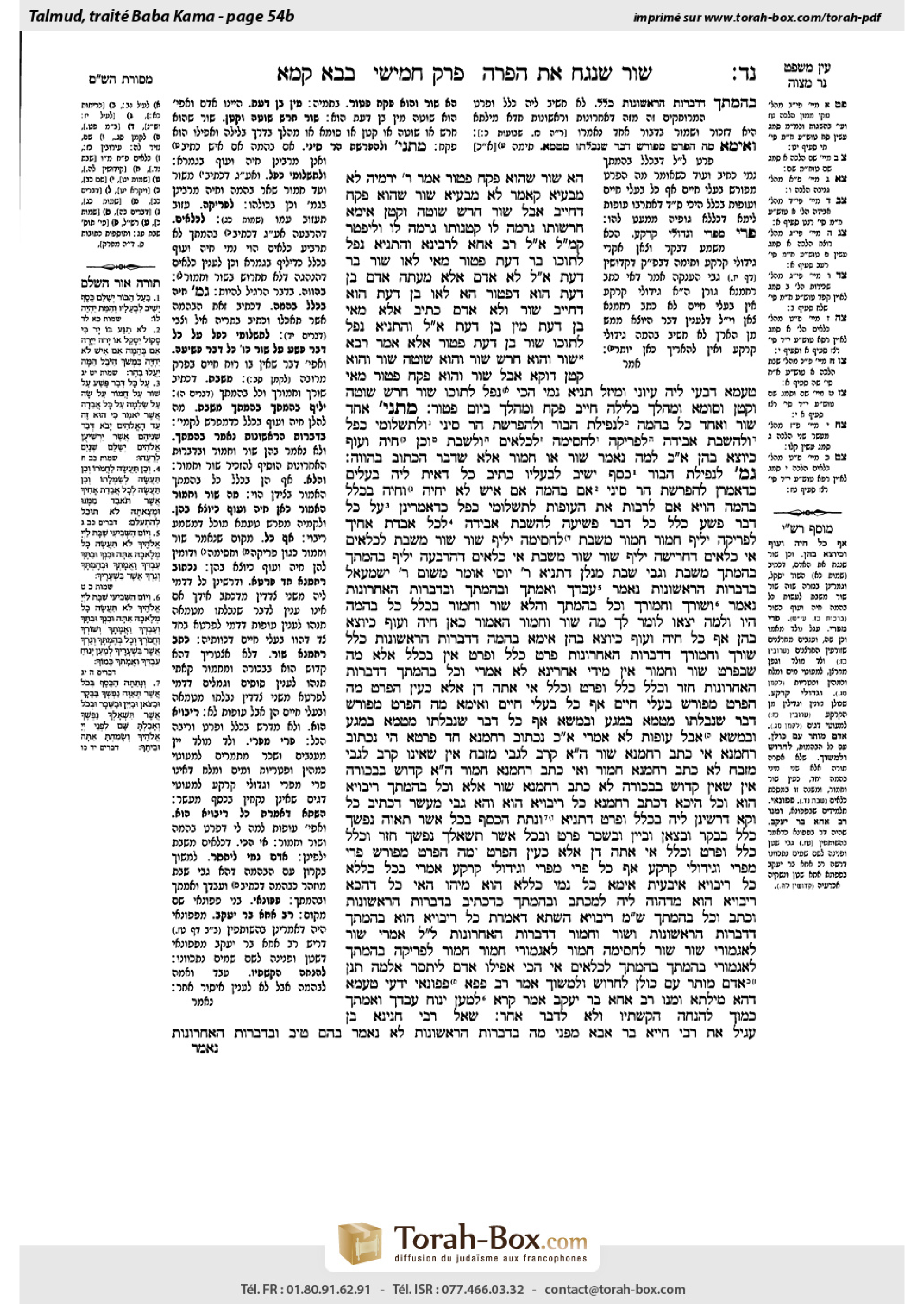
Bava Kamma 54b: Talmud study for Daf Yomi
Study the Talmud for Daf Yomi with scanned pages, Hebrew text, English translations from Sefaria and AI-generated French translations.
Passage selection and English or AI-generated French translation are available where the scan has annotations. Daf Study is independent of Torah-Box and Sefaria.
Browse Bava Kamma · בבא קמא · All tractatesBava Kamma 54b text and translations
This page of Bava Kamma includes the Aramaic text, an English translation and an AI-generated French translation, alongside the scan above.
בבא קמא נ״ד ב · Aramaic and Hebrew text
הָא שׁוֹר שֶׁהוּא פִּקֵּחַ – פָּטוּר?
אָמַר רַבִּי יִרְמְיָה: לָא מִיבַּעְיָא קָאָמַר; לָא מִבַּעְיָא שׁוֹר שֶׁהוּא פִּקֵּחַ – דְּחַיָּיב; אֲבָל שׁוֹר חֵרֵשׁ שׁוֹטֶה וְקָטָן, אֵימָא חֵרְשׁוּתוֹ גָּרְמָה לוֹ, קַטְנוּתוֹ גָּרְמָה לוֹ, וְלִיפְּטַר; קָא מַשְׁמַע לַן.
אֲמַר לֵיהּ רַב אַחָא לְרָבִינָא, וְהָתַנְיָא: נָפַל לְתוֹכוֹ בַּר דַּעַת – פָּטוּר. מַאי, לָאו שׁוֹר בַּר דַּעַת? אָמַר לֵיהּ: לָא, אָדָם. אֶלָּא מֵעַתָּה, אָדָם בֶּן דַּעַת הוּא דְּפָטוּר, הָא לָאו בֶּן דַּעַת הוּא – דְּחַיָּיב? ״שׁוֹר״ – וְלֹא אָדָם כְּתִיב!
אֶלָּא מַאי ״בֶּן דַּעַת״ – מִין בֶּן דַּעַת. אֲמַר לֵיהּ, וְהָתַנְיָא: נָפַל לְתוֹכוֹ שׁוֹר בֶּן דַּעַת – פָּטוּר!
אֶלָּא אָמַר רָבָא: שׁוֹר וְהוּא חֵרֵשׁ, שׁוֹר וְהוּא שׁוֹטֶה, שׁוֹר וְהוּא קָטָן – דַּוְקָא; אֲבָל שׁוֹר וְהוּא פִּקֵּחַ – פָּטוּר. מַאי טַעְמָא? דְּבָעֵי לֵיהּ עַיּוֹנֵי וּמֵיזַל. תַּנְיָא נָמֵי הָכִי: נָפַל לְתוֹכוֹ שׁוֹר חֵרֵשׁ, שׁוֹטֶה, וְקָטָן, וְסוֹמֵא, וּמְהַלֵּךְ בַּלַּיְלָה – חַיָּיב. פִּקֵּחַ וּמְהַלֵּךְ בַּיוֹם – פָּטוּר.
מַתְנִי׳ אֶחָד שׁוֹר וְאֶחָד כׇּל בְּהֵמָה – לִנְפִילַת הַבּוֹר, וּלְהַפְרָשַׁת הַר סִינַי, וּלְתַשְׁלוּמֵי כֶפֶל, וְלַהֲשָׁבַת אֲבֵידָה, לִפְרִיקָה, לַחֲסִימָה, לַכִּלְאַיִם, וְלַשַּׁבָּת.
וְכֵן חַיָּה וָעוֹף כַּיּוֹצֵא בָּהֶן. אִם כֵּן, לָמָּה נֶאֱמַר ״שׁוֹר אוֹ חֲמוֹר״? אֶלָּא שֶׁדִּבֵּר הַכָּתוּב בַּהוֹוֶה.
גְּמָ׳ לִנְפִילַת הַבּוֹר – ״כֶּסֶף יָשִׁיב לִבְעָלָיו״ כְּתִיב – כֹּל דְּאִית לֵיהּ בְּעָלִים, כְּדַאֲמַרַן. לְהַפְרָשַׁת הַר סִינַי – ״אִם בְּהֵמָה אִם אִישׁ לֹא יִחְיֶה״, וְחַיָּה בִּכְלַל בְּהֵמָה הָוְיָא; ״אִם״ – לְרַבּוֹת אֶת הָעוֹפוֹת.
לְתַשְׁלוּמֵי כֶפֶל – כִּדְאָמְרִינַן: ״עַל כׇּל דְּבַר פֶּשַׁע״ – כָּלַל כֹּל דְּבַר פְּשִׁיעָה. לַהֲשָׁבַת אֲבֵידָה – ״לְכׇל אֲבֵדַת אָחִיךָ״. לִפְרִיקָה – יָלֵיף ״חֲמוֹר״–״חֲמוֹר״ מִשַּׁבָּת.
לַחֲסִימָה – יָלֵיף ״שׁוֹר״–״שׁוֹר״ מִשַּׁבָּת.
לְכִלְאַיִם – אִי כִּלְאַיִם דַּחֲרִישָׁה, יָלֵיף ״שׁוֹר״–״שׁוֹר״ מִשַּׁבָּת;
אִי כִּלְאַיִם דְּהַרְבָּעָה, יָלֵיף ״בְּהֶמְתְּךָ״–״בְּהֶמְתֶּךָ״ מִשַּׁבָּת.
וְגַבֵּי שַׁבָּת מְנָלַן? דְּתַנְיָא: רַבִּי יוֹסֵי אוֹמֵר מִשּׁוּם רַבִּי יִשְׁמָעֵאל, בְּדִבְּרוֹת הָרִאשׁוֹנוֹת נֶאֱמַר: ״עַבְדְּךָ וַאֲמָתְךָ וּבְהֶמְתֶּךָ״, וּבְדִבְּרוֹת הָאַחֲרוֹנוֹת נֶאֱמַר: ״וְשׁוֹרְךָ וַחֲמֹרְךָ וְכׇל בְּהֶמְתֶּךָ״. וַהֲלֹא שׁוֹר וַחֲמוֹר בִּכְלַל כׇּל בְּהֵמָה הָיוּ, וְלָמָּה יָצְאוּ? לוֹמַר לָךְ: מָה שׁוֹר וַחֲמוֹר הָאָמוּר כָּאן – חַיָּה וָעוֹף כַּיּוֹצֵא בָּהֶן, אַף כֹּל חַיָּה וָעוֹף כַּיּוֹצֵא בָּהֶן.
אֵימָא: ״בְּהֵמָה״ דְּדִבְּרוֹת הָרִאשׁוֹנוֹת – כָּלַל, ״שׁוֹרְךָ וַחֲמֹרְךָ״ דְּדִבְּרוֹת הָאַחֲרוֹנוֹת – פָּרַט; כְּלָל וּפְרָט – אֵין בַּכְּלָל אֶלָּא מַה שֶּׁבַּפְּרָט; שׁוֹר וַחֲמוֹר – אִין, מִידֵּי אַחֲרִינָא – לָא!
אָמְרִי: ״וְכׇל בְּהֶמְתֶּךָ״ דְּדִבְּרוֹת הָאַחֲרוֹנוֹת – חָזַר וְכָלַל. כְּלָל וּפְרָט וּכְלָל – אִי אַתָּה דָן אֶלָּא כְּעֵין הַפְּרָט; מָה הַפְּרָט מְפוֹרָשׁ – בַּעֲלֵי חַיִּים, אַף כֹּל בַּעֲלֵי חַיִּים.
וְאֵימָא: מָה הַפְּרָט מְפוֹרָשׁ – דָּבָר שֶׁנִּבְלָתוֹ מְטַמְּאָ[ה] בְּמַגָּע וּבְמַשָּׂא, אַף כׇּל דָּבָר שֶׁנְּבָלָתוֹ מְטַמְּאָ[ה] בְּמַגָּע וּבְמַשָּׂא; אֲבָל עוֹפוֹת – לֹא!
אָמְרִי: אִם כֵּן, נִכְתּוֹב רַחֲמָנָא חַד פְּרָטָא! הֵי נִכְתּוֹב רַחֲמָנָא? אִי כְּתַב רַחֲמָנָא ״שׁוֹר״, הֲוָה אָמֵינָא: קָרֵב לְגַבֵּי מִזְבֵּחַ – אִין, שֶׁאֵינוֹ קָרֵב לְגַבֵּי מִזְבֵּחַ – לָא; כְּתַב רַחֲמָנָא ״חֲמוֹר״. וְאִי כְּתַב רַחֲמָנָא ״חֲמוֹר״, הֲוָה אָמֵינָא: קָדוֹשׁ בִּבְכוֹרָה – אִין, שֶׁאֵין קָדוֹשׁ בִּבְכוֹרָה – לָא; כְּתַב רַחֲמָנָא ״שׁוֹר״.
אֶלָּא ״וְכׇל בְּהֶמְתֶּךָ״ – רִיבּוּיָא הוּא.
וְכֹל הֵיכָא דִּכְתַב רַחֲמָנָא ״כֹּל״ – רִיבּוּיָא הוּא?! וְהָא גַּבֵּי מַעֲשֵׂר דִּכְתִיב ״כֹּל״, וְקָא דָרְשִׁינַן לֵיהּ בִּכְלָל וּפְרָט!
דְּתַנְיָא: ״וְנָתַתָּה הַכֶּסֶף בְּכֹל אֲשֶׁר תְּאַוֶּה נַפְשְׁךָ״ – כָּלַל, ״בַּבָּקָר וּבַצֹּאן וּבַיַּיִן וּבַשֵּׁכָר״ – פָּרַט, ״וּבְכֹל אֲשֶׁר תִּשְׁאׇלְךָ נַפְשֶׁךָ״ – חָזַר וְכָלַל;
כְּלָל וּפְרָט וּכְלָל – אִי אַתָּה דָן אֶלָּא כְּעֵין הַפְּרָט, מָה הַפְּרָט מְפוֹרָשׁ – פְּרִי מִפְּרִי וְגִידּוּלֵי קַרְקַע, אַף כֹּל פְּרִי מִפְּרִי וְגִידּוּלֵי קַרְקַע!
אָמְרִי: ״בְּכֹל״ – כְּלָלָא, ״כֹּל״ – רִיבּוּיָא. אִיבָּעֵית אֵימָא: ״כֹּל״ נָמֵי כְּלָלָא הוּא, מִיהוּ הַאי ״כֹּל״ דְּהָכָא – רִיבּוּיָא הוּא; מִדַּהֲוָה לֵיהּ לְמִכְתַּב: ״וּבְהֶמְתֶּךָ״ כְּדִכְתִיב בְּדִבְּרוֹת הָרִאשׁוֹנוֹת, וּכְתַב: ״וְכׇל בְּהֶמְתְּךָ״ – שְׁמַע מִינַּהּ רִיבּוּיָא.
הַשְׁתָּא דְּאָמְרַתְּ: ״כֹּל״ – רִיבּוּיָא הוּא; ״בְּהֶמְתֶּךָ״ דְּדִבְּרוֹת הָרִאשׁוֹנוֹת, וְ״שׁוֹר וַחֲמוֹר״ דְּדִבְּרוֹת הָאַחֲרוֹנוֹת – לְמָה לִי?
אָמְרִי: ״שׁוֹר״ – לְאַגְמוֹרֵי ״שׁוֹר״–״שׁוֹר״ לַחֲסִימָה,
״חֲמוֹר״ – לְאַגְמוֹרֵי ״חֲמוֹר״–״חֲמוֹר״ לִפְרִיקָה,
״בְּהֶמְתֶּךָ״ – לְאַגְמוֹרֵי ״בְּהֶמְתֶּךָ״–״בְּהֶמְתְּךָ״ לְכִלְאַיִם.
אִי הָכִי, אֲפִילּוּ אָדָם לִיתְּסַר! אַלְּמָה תְּנַן: אָדָם מוּתָּר עִם כּוּלָּן לַחְרוֹשׁ וְלִמְשׁוֹךְ?
אָמַר רַב פָּפָּא: פַּפּוּנָאֵי יָדְעִי טַעְמָא דְּהָא מִילְּתָא – וּמַנּוּ? רַב אַחָא בַּר יַעֲקֹב; אָמַר קְרָא: ״לְמַעַן יָנוּחַ עַבְדְּךָ וַאֲמָתְךָ כָּמוֹךָ״ – לְהַנָּחָה הִקַּשְׁתִּיו, וְלֹא לְדָבָר אַחֵר.
שָׁאַל רַבִּי חֲנִינָא בֶּן עָגֵיל אֶת רַבִּי חִיָּיא בַּר אַבָּא: מִפְּנֵי מָה בְּדִבְּרוֹת הָרִאשׁוֹנוֹת לֹא נֶאֱמַר בָּהֶם ״טוֹב״, וּבְדִבְּרוֹת הָאַחֲרוֹנוֹת
Bava Kamma 54b · English translation
The Gemara asks: But can it be inferred that if an ox that is of standard intelligence fell into a pit, the owner of the pit would be exempt?
Rabbi Yirmeya said: The mishna is speaking utilizing the style of: It is not necessary, and should be understood as follows: It is not necessary to state that if an ox that is of standard intelligence fell into a pit, that the pit’s owner is liable. But with regard to an ox that is deaf, an imbecile, or very young, say that it was not due to the pit alone that it fell in, but its deafness caused it to fall in or its young age caused it to fall in, and the owner of the pit should be exempt. Therefore, it teaches us that he is liable in these cases as well.
Rav Aḥa said to Ravina: But isn’t it taught in a baraita: If a living being that is mentally competent fell into a pit, the owner is exempt. What, is it not referring to an ox that is mentally competent? Ravina said to him: No, it is referring to a person. Rav Aḥa challenges this response: If that is so, you should then infer that it is only for the injuries of a person who is mentally competent that he is exempt, but if one is not mentally competent, is the halakha that he would be liable? But the term “an ox” is written in the Torah as causing liability, and not a person.
Rava responded to Rav Aḥa: Rather, what does the term mentally competent mean? It is referring to a species that is mentally competent, and thereby includes all humans in the exemption from liability. Rav Aḥa said to him: But isn’t it taught in a baraita: If an ox that was mentally competent fell inside it, he is exempt.
Rather, Rava said that Rabbi Yirmeya’s explanation should be rejected, and the mishna is referring specifically to an ox that is deaf, an ox that is an imbecile, and an ox that is very young, for which he is liable; but for an ox that is of standard intelligence, he is exempt. What is the reason? The reason is that the ox should have looked carefully while walking. If it did not, it is responsible for its own injury. The Gemara notes: That idea is also taught in a baraita: With regard to an ox that is deaf, an imbecile, or very young, blind, or that is walking at night and unable to see, if it fell into a pit, the pit’s owner is liable. But if the ox is of standard intelligence and is walking during the day, the pit’s owner is exempt, since normal behavior for oxen is that, ordinarily, they watch where they are going and avoid pits.
MISHNA: The halakha is the same whether concerning an ox or whether concerning any other animal with regard to liability for falling into a pit, and with regard to keeping its distance from Mount Sinai at the time of the receiving of the Torah, when it was forbidden for any animal to ascend the mountain, and with regard to the payment of double the principal by a thief, and with regard to the mitzva of returning a lost item, and with regard to unloading its burden, and with regard to the prohibition of muzzling it while threshing, and with regard to the prohibition of diverse kinds, and with regard to the prohibition against its working on Shabbat.
And similarly, undomesticated animals and birds are subject to the same halakhot as domesticated animals. If so, why are all of the above halakhot stated in the Torah only in reference to an ox or a donkey? Rather, the reason is that the verse speaks of a common scenario, from which the other cases may be derived.
GEMARA: The Gemara explains the sources for all of the halakhot enumerated in the mishna that apply to all animals. With regard to falling into a pit, it is written: “He shall recompense money to its owners” (Exodus 21:34), which means that any animal that has owners is included, as we mentioned (see 54a). With regard to the requirement that animals keep their distance from Mount Sinai before the giving of the Torah, this is derived from the verse: “Whether it be animal or person, it shall not live” (Exodus 19:13), and an undomesticated animal [ḥayya] is also included in the term animal [behema]. In addition, the word “whether” serves to include birds.
With regard to the double payment of a thief, it is as we say in a halakhic exegesis of the verse: “For any matter of trespass” (Exodus 22:8), that it is a general statement which includes any matter of negligence. With regard to the mitzva of returning a lost item, the verse states comprehensively: “For every lost thing of your brother” (Deuteronomy 22:3). With regard to the halakha of unloading a burden, derive it from a verbal analogy from the context of Shabbat, as the word donkey is employed in the context of unloading a burden (see Exodus 23:5), and the word donkey is employed in the context of the prohibition against having one’s animal perform labor on Shabbat (see Deuteronomy 5:14), and that verse is clearly referring to any animal.
With regard to the prohibition against muzzling an animal, mentioned in the verse: “You shall not muzzle an ox while it is threshing” (Deuteronomy 25:4), derive it from a verbal analogy from the context of Shabbat, as the word “ox” is employed in the context of muzzling, and the word “ox” is employed in the context of the prohibition against having one’s animal perform labor on Shabbat (see Deuteronomy 5:14), and that verse is clearly referring to any animal.
With regard to the prohibition of diverse kinds, if it is referring to the prohibition against using diverse kinds for plowing, due to which it is forbidden to plow with an ox and a donkey together (see Deuteronomy 22:10), derive it from a verbal analogy from the context of Shabbat, as the word “ox” is employed in the context of plowing with diverse kinds, and the word “ox” is employed in the context of the prohibition against having one’s animal perform labor on Shabbat (see Deuteronomy 5:14), and that verse is clearly referring to any animal.
If it is referring to the prohibition of diverse kinds for crossbreeding, derive it from a verbal analogy from the context of Shabbat, as the term “your cattle” is employed in the context of crossbreeding animals (see Leviticus 19:19), and the term “your cattle” is employed in the context of the prohibition against having one’s animal perform labor on Shabbat (see Exodus 20:10), and that verse is clearly referring to any animal.
The Gemara asks: And from where do we derive concerning Shabbat itself that the words “ox” and “donkey” are referring to all types of animals? As it is taught in a baraita: Rabbi Yosei says in the name of Rabbi Yishmael: In the first version of the Ten Commandments it is stated: “Your manservant, your maidservant, nor your cattle” (Exodus 20:10), whereas in the second version of the Ten Commandments it is stated: “Nor your ox, nor your donkey, nor any of your cattle” (Deuteronomy 5:14). Now, aren’t an ox and a donkey already included in the category of: All animals, which are included in the term “cattle”? Why, then, were they specified? To teach you that just as with regard to the terms ox and donkey that are stated here, undomesticated animals and birds have the same halakha as them, so too, everywhere that an ox and donkey are mentioned, all types of undomesticated animals and birds have the same halakha as them.
The Gemara asks: But why not say that the verses be expounded as follows: The term “cattle” used in the first version of the Ten Commandments is a generalization, and the phrase “your ox and your donkey” used in the latter version of the Ten Commandments is a detail. In the case of a generalization and a detail, the principles of halakhic exegesis dictate that the generalization includes only what is specified in the detail. Therefore, with regard to this subject, an ox and a donkey should indeed be included, but anything else should not be included.
The Sages said in reply: In the phrase “nor any of your cattle” stated in the latter version of the Ten Commandments following the phrase “your ox and your donkey,” it then generalized again. Therefore, the verse is structured as a generalization, and a detail, and a generalization. According to the principles of halakhic exegesis, you may deduce that the verse is referring only to items similar to the detail. Consequently, just as the items mentioned in the detail are clearly defined as animals, so too, all items included in the general term must be animals.
The Gemara challenges the answer: But say instead that just as the items mentioned in the detail are clearly defined as an item, i.e., an animal, whose carcass renders a person ritually impure through contact or through carrying, so too, all items whose carcass renders a person ritually impure through contact or through carrying should be included. But birds, whose carcasses do not render one impure through contact or through carrying, should not be included.
The Sages said in reply: If so, let the Merciful One write only one detail from which this could be derived. The Gemara asks: Which detail should the Merciful One write? If the Merciful One writes only an ox, I would say: An animal that is sacrificed on the altar, such as an ox, indeed renders the owner of the pit liable, whereas an animal that is not sacrificed on the altar does not render him liable. And if the Merciful One writes only a donkey, I would say: An animal whose firstborn is sanctified, such as a donkey, as described in the Torah (Exodus 13:13), does indeed render him liable, but an animal whose firstborn is not sanctified does not render him liable. Therefore, the Merciful One writes both an ox and a donkey.
Consequently, there is no redundancy, and each detail is required for correctly deriving other halakhot. If so, the previous question resurfaces: Why are the verses not expounded such that the prohibition does not include birds? Rather, the term: “Nor any [vekhol] of your cattle,” should be understood as an amplification, encompassing any item that is even partially similar to the detail.
The Gemara asks: But is it the case that anywhere that the Merciful One states the word “any [kol]” it is intended as an amplification? But concerning tithes, where it is written “any [kol],” and yet we expound the verses with the method of a generalization and a detail, rather than using the method of amplification and restriction.
This is as it is taught in a baraita concerning second-tithe money brought to Jerusalem: The verse states: “And you shall give the money for anything [bekhol] your soul desires” (Deuteronomy 14:26), which is a generalization, followed by: “For oxen, or for sheep, or for wine, or for strong drink,” which is a detail, and concludes with: “Or for anything [uvkhol] your soul asks of you,” where it then generalized again.
Therefore, the verse is structured as a generalization, and a detail, and a generalization. According to the principles of halakhic exegesis, you may deduce that the verse is referring only to items similar to the detail. Consequently, just as the items mentioned in the detail are clearly defined as produce of produce, i.e., they grow from a parent organism, such as agricultural produce or animals, and they are grown from the ground, i.e., their sustenance comes from the ground, so too, it includes all things that are the produce of produce and are grown from the ground. It is evident from here that the method of a generalization and a detail is used in connection with the term “kol,” as opposed to interpreting it as an amplification.
The Sages said in response: A distinction may be drawn between the term: “For anything [bekhol],” which is a generalization, and the term “any [kol],” as in: “Any of your cattle,” which is an amplification. And if you wish, say instead that the word “any [kol]” is a generalization as well, in addition to “for anything [bekhol].” But this word “any,” written here, is an amplification. This is the case since it could have written: And your cattle, as it is written in the first version of the Ten Commandments, and instead it writes: “Nor any of your cattle.” Learn from this that it is an amplification and encompasses other animals as well.
The Gemara continues to analyze this matter: Now that you have said that the term “any [kol]” is an amplification, why do I need the words “your cattle,” stated in the first version of the Ten Commandments, and the terms “an ox or a donkey,” stated in the latter version of the Ten Commandments? The phrase “and any of your cattle” already includes any animal.
The Sages said in response: Each of these terms is required. The term “ox” can be used to derive the halakha with regard to the prohibition against muzzling, as the word “ox” is employed in the context of muzzling, and the word “ox” is employed in the context of the prohibition against having one’s animal perform labor on Shabbat.
The term “donkey” can be used to derive the halakha with regard to the halakha of unloading a burden, as the word “donkey” is employed in the context of unloading a burden (see Exodus 23:5), and the word “donkey” is employed in the context of the prohibition against having one’s animal perform labor on Shabbat (see Deuteronomy 5:14).
The term “your cattle” can be used to derive the halakha with regard to the prohibition of diverse kinds, as the term “your cattle” is employed in the context of crossbreeding animals (see Leviticus 19:19), and the term “your cattle” is employed in the context of the prohibition against having one’s animal perform labor on Shabbat (see Exodus 20:10).
The Gemara asks: If so, that this redundancy is the source for extending the prohibition of diverse kinds, then it should be prohibited even for a person to plow together with an ox or another animal. Why, then, did we learn in a mishna (Kilayim 8:6): It is permitted for a person to plow and pull with any of them, indicating that the prohibition relates only to animals?
Rav Pappa said: The Sages of Paphunya know the reason for this matter, and who are these Sages? Rav Aḥa bar Ya’akov, who resided in Paphunya. The reason is that the verse states: “You shall not perform any labor, neither you, your son, your daughter, your slave, your maidservant, your ox, your donkey, any of your animals, or the stranger residing within your city gates, that your manservant and your maidservant may rest as well as you” (Deuteronomy 5:14), as if to say: I have equated people with animals only concerning resting on Shabbat, but not with regard to another matter.
Having discussed some differences between the two versions of the Ten Commandments, the Gemara now discusses a related matter: Rabbi Ḥanina ben Agil asked Rabbi Ḥiyya bar Abba: For what reason is the word good not stated in the first version of the Ten Commandments, whereas in the latter version of the Ten Commandments,
Bava Kamma 54b · Traduction française (IA)
La Guemara pose la question : Mais peut-on en déduire que si un bœuf normal tombe dans un puits, l'propriétaire du puits serait exempt ?
Rabbi Yirmeya dit : La mitsna est formulée dans le style suivant : Il n'est pas nécessaire, et il faut le comprendre ainsi : Il n'est pas nécessaire de dire que si un bœuf normal tombe dans un puits, l'propriétaire du puits est responsable. Mais concernant un bœuf sourd, un imbécile ou très jeune, on dit qu'il n'était pas uniquement à cause du puits qu'il est tombé, mais à cause de sa surdité ou de son jeune âge, et l'propriétaire du puits devrait être exempt. Ainsi, elle nous apprend que dans ces cas-là il est responsable également.
Rav Acha dit à Ravina : Mais n'est-il pas enseigné dans une baraïta : Si un être raisonnable tombe dans un puits, l'propriétaire est exempt. Qu'est-ce que cela signifie, n'est-ce pas en référence à un bœuf raisonnable ? Ravina répondit à lui : Non, il s'agit d'une personne. Rav Acha conteste cette réponse : Si c'est ainsi, on devrait alors en déduire que c'est seulement pour les blessures d'une personne raisonnable qu'il est exempt, mais si l'on n'est pas raisonnable, la halakha est-elle qu'il est responsable ? Mais le terme « bœuf » est écrit dans la Torah comme cause de responsabilité, et non une personne.
Rava répondit à Rav Aḥa : Plutôt, que signifie le terme « raisonnable » ? Il s'agit d'une espèce raisonnable, et donc il inclut tous les humains dans l'exemption de responsabilité. Rav Aḥa dit à lui : Mais n'est-il pas enseigné dans une baraïta : Si un bœuf raisonnable tombe à l'intérieur, il est exempt.
Plutôt, Rava dit que l'explication de Rabbi Yirmeya devrait être rejetée, et la mitsna est spécifiquement en référence à un bœuf sourd, un bœuf imbécile et un bœuf très jeune, pour lesquels il est responsable ; mais pour un bœuf normal, il est exempt. Quelle est la raison ? La raison est que le bœuf devrait avoir pris garde en marchant. S'il n'a pas fait cela, il est responsable de sa propre blessure. La Guemara note : Cette idée est également enseignée dans une baraïta : Concernant un bœuf sourd, un imbécile ou très jeune, aveugle, ou marchant la nuit et incapable de voir, si celui-ci tombe dans un puits, l'propriétaire du puits est responsable. Mais si le bœuf est normal et marche pendant la journée, l'propriétaire du puits est exempt, car la normale pour les bœufs est de surveiller où ils vont et d'éviter les puits.
MITSVA : La halakha est la même concernant un bœuf ou concernant tout autre animal en ce qui concerne la responsabilité pour tomber dans un puits, et concernant la distance à maintenir de la montagne de Sinaï à l'époque de la réception de la Torah, lorsque c'était interdit à tout animal d'ascendre la montagne, et concernant le paiement double par un voleur, et concernant la mitsva de rendre un objet perdu, et concernant le déchargement de son fardeau, et concernant l'interdiction de lui mettre un bâillon pendant le battage, et concernant l'interdiction des espèces diverses, et concernant l'interdiction de le faire travailler le Shabbat.
Et de même, les animaux sauvages et les oiseaux sont soumis aux mêmes halakhot que les animaux domestiques. Si c'est ainsi, pourquoi toutes les halakhot ci-dessus sont-elles mentionnées dans la Torah uniquement en référence à un bœuf ou un âne ? Plutôt, la raison est que le verset parle d'une situation commune, d'où l'on peut déduire les autres cas.
GUEMARA : La Guemara explique les sources de toutes les halakhot énumérées dans la mitsna qui s'appliquent à tous les animaux. Concernant tomber dans un puits, il est écrit : « Il devra réparer l'argent à ses propriétaires » (Exode 21:34), ce qui signifie que tout animal ayant des propriétaires est inclus, comme nous l'avons mentionné (voir 54a). Concernant la nécessité que les animaux maintiennent une distance de la montagne de Sinaï avant la réception de la Torah, cela est dérivé du verset : « Qu'il soit animal ou personne, il ne vivra pas » (Exode 19:13), et un animal sauvage [ḥayya] est également inclus dans le terme animal [behema]. En outre, le mot « qu'il soit » sert à inclure les oiseaux.
Concernant le paiement double du voleur, nous disons comme nous l'avons dit dans une exégèse halakhique du verset : « Pour toute affaire de vol » (Exode 22:8), que c'est une déclaration générale qui inclut toute affaire de négligence. Concernant la mitsva de rendre un objet perdu, le verset stipule de manière générale : « Pour tout objet perdu de votre frère » (Deutéronome 22:3). Concernant la halakha du déchargement d'un fardeau, elle est dérivée d'une analogie verbale du contexte du Shabbat, comme le mot « âne » est utilisé dans le contexte du déchargement d'un fardeau (voir Exode 23:5), et le mot « âne » est utilisé dans le contexte de l'interdiction de faire travailler son animal le Shabbat (voir Deutéronome 5:14), et ce verset est clairement en référence à tout animal.
Concernant l'interdiction de bâiller un animal, mentionné dans le verset : « Vous ne boucherez pas le museau d'un bœuf pendant qu'il bat » (Deutéronome 25:4), il est dérivé d'une analogie verbale du contexte du Shabbat, car le mot « bœuf » est utilisé dans le contexte de bâiller, et le mot « bœuf » est utilisé dans le contexte de l'interdiction de faire travailler son animal le Shabbat (voir Deutéronome 5:14), et ce verset fait clairement référence à tout animal.
Concernant l'interdiction des espèces diverses, si cela fait référence à l'interdiction d'utiliser des espèces diverses pour la moisson, en raison de laquelle il est interdit de moissonner avec un bœuf et un âne ensemble (voir Deutéronome 22:10), il est dérivé d'une analogie verbale du contexte du Shabbat, car le mot « bœuf » est utilisé dans le contexte de moissonner avec des espèces diverses, et le mot « bœuf » est utilisé dans le contexte de l'interdiction de faire travailler son animal le Shabbat (voir Deutéronome 5:14), et ce verset fait clairement référence à tout animal.
Si l'on fait référence à l'interdiction de mélanger des espèces pour produire des croisements, on en déduit cela par analogie verbale à partir du contexte du Sabbat, car le terme « vos bêtes » est utilisé dans le contexte des croisements d'animaux (cf. Lévitique 19:19), et le terme « vos bêtes » est utilisé dans le contexte de l'interdiction de faire travailler son animal le Sabbat (cf. Exode 20:10), et cette versette fait clairement référence à tout animal.
Le Guemara demande : D'où donc déduit-on concernant le Sabbat lui-même que les termes « bœuf » et « âne » font référence à tous les types d'animaux ? Comme il est enseigné dans une baraïta : Rabbi Yosei, en nom de Rabbi Yishmael, dit : Dans la première version des Dix Commandements, il est écrit : « Vos serviteurs, vos servantes, ni vos bêtes » (Exode 20:10), tandis que dans la seconde version des Dix Commandements, il est écrit : « Ni votre bœuf, ni votre âne, ni aucune de vos bêtes » (Deutéronome 5:14). Maintenant, ne sont-ce pas un bœuf et un âne déjà inclus dans la catégorie de : Tous les animaux, qui sont inclus dans le terme « bêtes » ? Pourquoi donc les a-t-on spécifiés ? Pour enseigner que tout comme les termes « bœuf » et « âne » qui sont mentionnés ici, les animaux sauvages et les oiseaux ont la même halakha qu'eux, de même, partout où des « bœufs » et des « ânes » sont mentionnés, tous les types d'animaux sauvages et d'oiseaux ont la même halakha qu'eux.
Le Guemara demande : Mais pourquoi ne pas dire que les versets sont interprétés ainsi : Le terme « bêtes » utilisé dans la première version des Dix Commandements est une généralisation, et la phrase « votre bœuf et votre âne » utilisée dans la seconde version est un détail. Dans le cas d'une généralisation et d'un détail, les principes d'exégèse halakhique indiquent que la généralisation inclut uniquement ce qui est spécifié dans le détail. Ainsi, concernant cette matière, un bœuf et un âne devraient effectivement être inclus, mais tout autre chose ne devrait pas être inclus.
Les Sages répondent : Dans la phrase « ni aucune de vos bêtes » mentionnée dans la seconde version des Dix Commandements, qui suit la phrase « votre bœuf et votre âne », il y a une généralisation à nouveau. Ainsi, le verset est structuré comme une généralisation, un détail, et une généralisation. Selon les principes d'exégèse halakhique, on peut déduire que le verset fait référence uniquement aux choses similaires au détail. Ainsi, tout comme les choses mentionnées dans le détail sont clairement définies comme des animaux, de même, toutes les choses incluses dans le terme général doivent être des animaux.
Le Guemara conteste cette réponse : Mais disons plutôt que tout comme les choses mentionnées dans le détail sont clairement définies comme une chose, c'est-à-dire un animal, dont la carcasse rend rituellement impur par contact ou par portée, de même, toutes les choses dont la carcasse rend rituellement impur par contact ou par portée devraient être incluses. Mais les oiseaux, dont la carcasse ne rend pas impur par contact ou par portée, ne devraient pas être inclus.
Les Sages répondent : Si c'est ainsi, que le Très Miséricordieux écrive seulement un détail à partir duquel cela pourrait être déduit. Le Guemara demande : Quel détail le Très Miséricordieux devrait-il écrire ? Si le Très Miséricordieux écrit seulement un bœuf, je dirais : Un animal sacrifié sur l'autel, comme un bœuf, rend effectivement le propriétaire du trou en responsabilité, tandis qu'un animal non sacrifié sur l'autel ne le rend pas en responsabilité. Et si le Très Miséricordieux écrit seulement un âne, je dirais : Un animal dont le premier-né est sanctifié, comme un âne, tel que décrit dans la Torah (Exode 13:13), rend effectivement en responsabilité, mais un animal dont le premier-né n'est pas sanctifié ne le rend pas en responsabilité. Ainsi, le Très Miséricordieux écrit à la fois un bœuf et un âne.
Ainsi, il n'y a pas de redondance, et chaque détail est nécessaire pour déduire correctement d'autres halakhot. Si c'est ainsi, la question précédente resurgit : Pourquoi les versets ne sont-ils pas interprétés de sorte que l'interdiction ne comprenne pas les oiseaux ? Plutôt, le terme : « Ni aucune [vekhol] de vos bêtes », devrait être compris comme une amplification, englobant toute chose même partiellement similaire au détail.
Le Guemara demande : Mais est-ce que partout où le Très Miséricordieux dit le mot « tout [kol] », il l'intend comme une amplification ? Mais concernant les dîmes, où il est écrit « tout [kol] », et pourtant nous interprétons les versets avec la méthode d'une généralisation et d'un détail, plutôt que d'utiliser la méthode d'amplification et de restriction.
C'est ce qui est enseigné dans une baraïta concernant l'argent de la deuxième dîme apporté à Jérusalem : Le verset dit : « Et tu donneras l'argent pour toute chose [bekhol] que ton âme désire » (Deutéronome 14:26), qui est une généralisation, suivi de : « Pour des bœufs, ou pour des brebis, ou pour du vin, ou pour du vin fort », qui est un détail, et se termine par : « Ou pour toute chose [uvkhol] que ton âme te demande », où il généralise à nouveau.
Ainsi, le verset est structuré comme une généralisation, un détail et une généralisation. Selon les principes d'exégèse halakhique, on peut déduire que le verset fait référence uniquement aux choses similaires au détail. Ainsi, tout comme les choses mentionnées dans le détail sont clairement définies comme des produits de produits, c'est-à-dire qu'ils proviennent d'un organisme parent, comme les produits agricoles ou les animaux, et qu'ils sont cultivés à partir du sol, c'est-à-dire que leur nourriture provient du sol, de même, il inclut toutes les choses qui sont des produits de produits et cultivés à partir du sol. Il est évident d'ici que la méthode d'une généralisation et d'un détail est utilisée en lien avec le terme « kol », contrairement à l'interprétation d'une amplification.
Les Sages ont répondu : On peut distinguer entre le terme « pour toute chose [bekhol] », qui est une généralisation, et le terme « toute [kol] », comme dans « toute votre bête », qui est une amplification. Et si vous le souhaitez, dites plutôt que le terme « toute [kol] » est également une généralisation, en plus de « pour toute chose [bekhol] ». Mais ce terme « toute », écrit ici, est une amplification. C'est le cas car il aurait pu écrire : « et vos bêtes », comme il est écrit dans la première version des Dix Commandements, et au lieu de cela, il écrit : « ni toute votre bête ». Apprenez-en que c'est une amplification et qu'il englobe également d'autres animaux ainsi que les bêtes.
Le Guemara continue d'analyser cette question : Maintenant que vous avez dit que le terme « toute [kol] » est une amplification, pourquoi ai-je besoin des mots « vos bêtes », mentionnés dans la première version des Dix Commandements, et des termes « un bœuf ou un âne », mentionnés dans la version ultérieure des Dix Commandements ? La phrase « et toute votre bête » inclut déjà toute sorte d'animal.
Les Sages ont répondu : Chacun de ces termes est nécessaire. Le terme « bœuf » peut être utilisé pour déduire la halakha concernant l'interdiction de boucher un animal, car le terme « bœuf » est utilisé dans le contexte de la bouchère, et le terme « bœuf » est utilisé dans le contexte de l'interdiction de faire travailler son animal le sabbat.
Le terme « âne » peut être utilisé pour déduire la halakha concernant la halakha de décharger un fardeau, car le terme « âne » est utilisé dans le contexte de la décharge d'un fardeau (voir Exode 23:5), et le terme « âne » est utilisé dans le contexte de l'interdiction de faire travailler son animal le sabbat (voir Deutéronome 5:14).
Le terme « vos bêtes » peut être utilisé pour déduire la halakha concernant l'interdiction de mélanger des espèces, car le terme « vos bêtes » est utilisé dans le contexte de l'interdiction de croiser des animaux (voir Lévitique 19:19), et le terme « vos bêtes » est utilisé dans le contexte de l'interdiction de faire travailler son animal le sabbat (voir Exode 20:10).
Le Guemara pose une question : Si ainsi, cette redondance est la source pour étendre l'interdiction de mélanger des espèces, alors elle devrait être interdite même à une personne de labourer avec un bœuf ou un autre animal. Pourquoi, alors, avons-nous appris dans une mitsva (Kilayim 8:6) : Il est permis à une personne de labourer et de tirer avec n'importe lequel d'entre eux, indiquant que l'interdiction concerne uniquement les animaux ?
Rav Pappa a dit : Les Sages de Paphunya connaissent la raison de cette question, et qui sont ces Sages ? Rav Acha bar Ya'akov, qui résidait à Paphunya. La raison est que la Parashah dit : « Vous ne ferez aucun travail, ni vous, ni votre fils, ni votre fille, ni votre serviteur, ni votre servante, ni votre bœuf, ni votre âne, ni toute votre bête, ni l'étranger qui demeure dans vos portes, afin que votre serviteur et votre servante reposent aussi bien que vous » (Deutéronome 5:14), comme si on disait : J'ai égalisé les gens aux animaux uniquement concernant le repos du sabbat, mais pas concernant une autre question.
Ayant discuté de certaines différences entre les deux versions des Dix Commandements, le Guemara discute maintenant d'une question liée : Rabbi Ḥanina ben Agil a demandé à Rabbi Ḥiyya bar Abba : Pour quelle raison le mot « bon » n'est pas mentionné dans la première version des Dix Commandements, alors que dans la version ultérieure des Dix Commandements,
Traduction française générée par IA à partir de l’édition anglaise de Sefaria. Vérifie toujours un passage avec le texte source.
Text from Sefaria: William Davidson Edition - Vocalized Aramaic (CC BY NC); William Davidson Edition - English (CC BY NC).