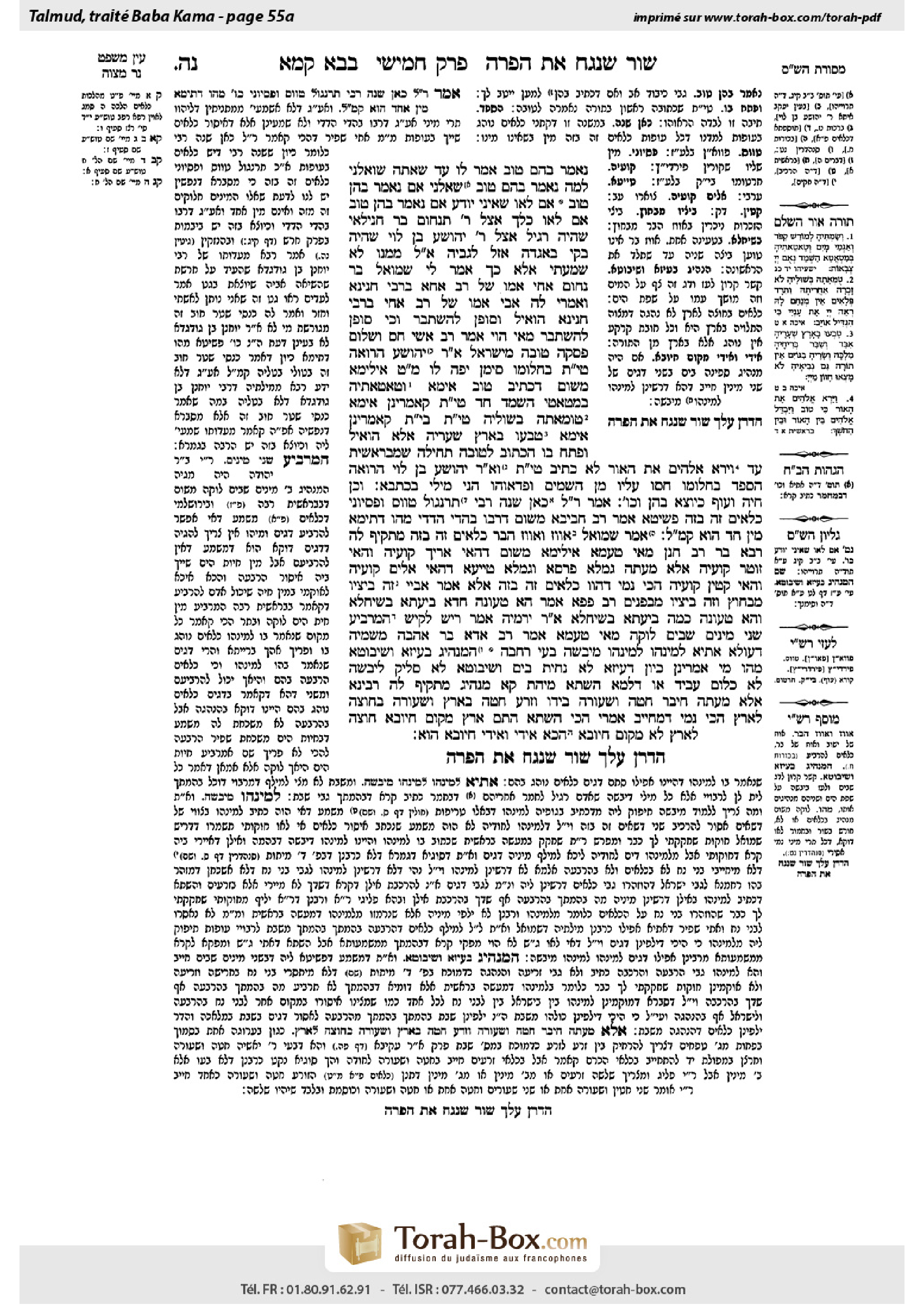
Bava Kamma 55a: Talmud study for Daf Yomi
Study the Talmud for Daf Yomi with scanned pages, Hebrew text, English translations from Sefaria and AI-generated French translations.
Passage selection and English or AI-generated French translation are available where the scan has annotations. Daf Study is independent of Torah-Box and Sefaria.
Browse Bava Kamma · בבא קמא · All tractatesBava Kamma 55a text and translations
This page of Bava Kamma includes the Aramaic text, an English translation and an AI-generated French translation, alongside the scan above.
בבא קמא נ״ה א · Aramaic and Hebrew text
נֶאֱמַר בָּהֶם ״טוֹב״? אָמַר לוֹ: עַד שֶׁאַתָּה שׁוֹאֲלֵנִי לָמָּה נֶאֱמַר בָּהֶם ״טוֹב״, שְׁאָלֵנִי אִם נֶאֱמַר בָּהֶן ״טוֹב״ אִם לָאו – שֶׁאֵינִי יוֹדֵעַ אִם נֶאֱמַר בָּהֶן ״טוֹב״ אִם לָאו; כְּלָךְ אֵצֶל רַבִּי תַּנְחוּם בַּר חֲנִילַאי, שֶׁהָיָה רָגִיל אֵצֶל רַבִּי יְהוֹשֻׁעַ בֶּן לֵוִי – שֶׁהָיָה בָּקִי בְּאַגָּדָה.
אֲזַל לְגַבֵּיהּ. אֲמַר לֵיהּ: מִמֶּנּוּ לֹא שָׁמַעְתִּי, אֶלָּא כָּךְ אָמַר לִי שְׁמוּאֵל בַּר נַחוּם אֲחִי אִמּוֹ שֶׁל רַב אַחָא בְּרַבִּי חֲנִינָא, וְאָמְרִי לַהּ אֲבִי אִמּוֹ שֶׁל רַב אַחַי בְּרַבִּי חֲנִינָא: הוֹאִיל וְסוֹפָן לְהִשְׁתַּבֵּר.
וְכִי סוֹפָן לְהִשְׁתַּבֵּר מַאי הָוֵי? אָמַר רַב אָשֵׁי: חַס וְשָׁלוֹם, פָּסְקָה טוֹבָה מִיִּשְׂרָאֵל.
אָמַר רַבִּי יְהוֹשֻׁעַ: הָרוֹאֶה טֵית בַּחֲלוֹמוֹ – סִימָן יָפֶה לוֹ. מַאי טַעְמָא? אִילֵּימָא מִשּׁוּם דִּכְתִיב ״טוֹב״, אֵימָא: ״וְטֵאטֵאתִיהָ בְּמַטְאֲטֵא הַשְׁמֵד״! חַד טֵית קָאָמְרִינַן.
אֵימָא: ״טֻמְאָתָהּ בְּשׁוּלֶיהָ״! טֵית בֵּית קָאָמְרִינַן. אֵימָא: ״טָבְעוּ בָּאָרֶץ שְׁעָרֶיהָ״!
אֶלָּא הוֹאִיל וּפָתַח בּוֹ הַכָּתוּב לְטוֹבָה תְּחִילָּה – שֶׁמִּ״בְּרֵאשִׁית״ עַד ״וַיַּרְא אֱלֹהִים אֶת הָאוֹר״, לָא כְּתִיב טֵית.
וְאָמַר רַבִּי יְהוֹשֻׁעַ בֶּן לֵוִי: הָרוֹאֶה הֶסְפֵּד בַּחֲלוֹמוֹ – חָסוּ עָלָיו מִן הַשָּׁמַיִם, וּפְדָאוּהוּ. הָנֵי מִילֵּי בִּכְתָבָא.
וְכֵן חַיָּה וָעוֹף כַּיּוֹצֵא בָּהֶן וְכוּ׳. אָמַר רֵישׁ לָקִישׁ, כָּאן שָׁנָה רַבִּי: תַּרְנְגוֹל, טַוּוֹס וּפַסְיוֹנִי – כִּלְאַיִם זֶה בָּזֶה.
פְּשִׁיטָא! אָמַר רַב חֲבִיבָא: מִשּׁוּם דְּרָבוּ בַּהֲדֵי הֲדָדֵי – מַהוּ דְּתֵימָא: מִין חַד הוּא; קָא מַשְׁמַע לַן.
אָמַר שְׁמוּאֵל: אַוּוֹז וְאַוּוֹז הַבָּר – כִּלְאַיִם זֶה בָּזֶה. מַתְקֵיף לַהּ רָבָא בַּר רַב חָנָן: מַאי טַעְמָא? אִילֵּימָא מִשּׁוּם דְּהַאי אֲרִיךְ קוֹעֵיהּ וְהַאי זוּטַר קוֹעֵיהּ; אֶלָּא מֵעַתָּה, גַּמְלָא פָּרְסָא וְגַמְלָא טַיָּיעָא, דְּהַאי אַלִּים קוֹעֵיהּ וְהַאי קַטִּין קוֹעֵיהּ, הָכִי נָמֵי דְּהָווּ כִּלְאַיִם זֶה בָּזֶה?!
אֶלָּא אָמַר אַבָּיֵי: זֶה בֵּיצָיו מִבַּחוּץ, וְזֶה בֵּיצָיו מִבִּפְנִים. רַב פָּפָּא אָמַר: הָא טְעוּנָה חֲדָא בֵּיעֲתָא בְּשִׁיחְלָא, וְהָא טְעוּנָה כַּמָּה בֵּיעָתָא בְּשִׁיחְלָא.
אָמַר רַבִּי יִרְמְיָה אָמַר רֵישׁ לָקִישׁ: הַמַּרְבִּיעַ שְׁנֵי מִינִים שֶׁבַּיָּם – לוֹקֶה. מַאי טַעְמָא? אָמַר רַב אַדָּא בַּר אַהֲבָה מִשְּׁמֵיהּ דְּעוּלָּא: אָתְיָא ״לְמִינֵהוּ״–״לְמִינֵהוּ״ מִיַּבָּשָׁה.
בָּעֵי רַחֲבָה: הַמַּנְהִיג בְּעִיזָּא וְשִׁיבּוּטָא, מַהוּ? מִי אָמְרִינַן: כֵּיוָן דְּעִיזָּא לָא נָחֵית בַּיָּם, וְשִׁיבּוּטָא לָא סָלֵיק לַיַּבָּשָׁה – לֹא כְּלוּם עָבֵיד; אוֹ דִלְמָא, הַשְׁתָּא מִיהַת קָא מַנְהֵיג?
מַתְקֵיף לַהּ רָבִינָא: אֶלָּא מֵעַתָּה, חִיבֵּר חִטָּה וּשְׂעוֹרָה בְּיָדוֹ, וְזָרַע חִטָּה בָּאָרֶץ וּשְׂעוֹרָה בְּחוּצָה לָאָרֶץ, הָכִי נָמֵי דְּמִחַיַּיב?
אָמְרִי: הָכִי הַשְׁתָּא?! הָתָם – אֶרֶץ מְקוֹם חִיּוּבָא, חוּצָה לָאָרֶץ לָא מְקוֹם חִיּוּבָא; הָכָא – אִידֵּי וְאִידֵּי חִיּוּבָא הוּא.
הֲדַרַן עֲלָךְ שׁוֹר שֶׁנָּגַח אֶת הַפָּרָה
Bava Kamma 55a · English translation
in the context of the mitzva to honor one’s parents, the word good is stated there: “In order that it shall be good for you” (Deuteronomy 5:16)? Rabbi Ḥiyya bar Abba said to him: Before you ask me why the word good is stated, ask me if the word good is actually stated there or not, since I am not sufficiently proficient in my knowledge of the biblical verses to remember the precise wording, and I do not know if the word good is stated there or not. Go to Rabbi Tanḥum bar Ḥanilai, who was commonly found at the academy of Rabbi Yehoshua ben Levi, who was an expert in aggada. Perhaps he heard something from him on this matter and can answer your question.
Rabbi Ḥanina ben Agil went to him and asked him. Rabbi Tanḥum said to him: I did not hear anything on this matter from Rabbi Yehoshua ben Levi himself. But this is what Shmuel bar Naḥum, the brother of the mother of Rav Aḥa, son of Rabbi Ḥanina, said to me, and some say it was the father of the mother of Rav Aḥai, son of Rabbi Ḥanina: It does not mention the word good in the first tablets, since they were ultimately destined to be broken after the Jews made the Golden Calf.
The Gemara asks: And even if it had mentioned the term good, and they were ultimately destined to break, what of it? Rav Ashi said: If this term had been mentioned in the first tablets, all good would have, God forbid, ceased from Israel once they were broken. Therefore, only the second version, which was written after the breaking of the tablets, contains the word good, so that there would always be good for the Jewish people.
Rabbi Yehoshua says: If one sees the letter tet in his dream, it is a good sign for him. The Gemara asks: What is the reason? If we say that it is because the word good [tov] is written in the Torah and begins with the letter tet, then one could say instead that it is an allusion to the verse: “And I will sweep it with the broom [vetetetiha bemate’ateh] of destruction” (Isaiah 14:23), which also contains the letter tet several times but is referring to punishment. The Gemara answers: We mean that when someone sees one tet in his dream, it is a good sign, but this latter verse contains several.
The Gemara asks: This latter statement is problematic, as even according to this explanation, one can say that a single letter tet alludes to the verse: “Her filthiness [tumatah] is in her skirts” (Lamentations 1:9), which begins with the letter tet. The Gemara answers: We mean that when one sees the letter tet together with the letter bet in his dream, it is a good sign for him, as the word tov is written with both. The Gemara asks further: According to this, say that it alludes to the verse: “Her gates are sunk [tave’u] into the ground” (Lamentations 2:9), which begins with the letter tet followed by the letter bet.
Rather, it is not merely because it is the first letter of the word good [tov] that it is considered a good omen. Since the Torah initially introduces the letter tet in a context of good, with the word good [tov] itself, it is a good omen. As from the word bereshit, the first word in the Torah, until the verse: “And God saw that the light was good [tov]” (Genesis 1:4), the letter tet is not written anywhere.
And Rabbi Yehoshua ben Levi says: If one sees a eulogy [hesped] in his dream, it is an allusion that in Heaven they had pity [ḥasu] on him and saved him [peda’uhu] from actually being eulogized. The Gemara notes: This statement applies specifically when he actually saw the word: Eulogy [hesped], in writing.
§ The mishna teaches: And similarly, undomesticated animals and birds are subject to the same halakhot as domesticated animals. Reish Lakish says: Here Rabbi Yehuda HaNasi taught a ruling from the Tosefta that illustrates the statement that birds and undomesticated animals are also subject to the prohibition of diverse kinds: A cock, a peacock [tavvas], and a pheasant [ufasyonei] are diverse kinds with respect to each other, since this halakha applies to birds as well.
The Gemara asks: Isn’t this obvious; what novelty is stated here? Rav Ḥaviva said: The novelty here is because they are reared together. Lest you say: Since they are reared together, they are essentially one species, and not considered diverse kinds. Therefore, it teaches us that they are actually separate species, and the halakhot of diverse kinds do apply to them.
Following the discussion of the prohibition of diverse kinds as it relates to birds, Shmuel says: The domestic goose and the wild goose are diverse kinds with respect to each other and are not one species. Rava bar Rav Ḥanan objects to this: What is the reason? If we say it is because the beak of this one is long and the beak of that one is short, if that is so, then with regard to a Persian camel and an Arabian camel, where the neck of this one is thick and the neck of that one is thin, they should indeed be considered diverse kinds with respect to one another. Clearly, though, the camels are in fact two variants of a single species.
Rather, Abaye says: That is not the reason, but rather another difference exists between the domestic goose and the wild goose, concerning the male: With regard to this type, i.e., the wild goose, its testicles are visible from the outside, and with regard to that one, i.e., the domestic goose, its testicles are inside. Rav Pappa said that another difference exists between them, concerning the female: This one, i.e., the wild goose, releases only one egg in its ovary and later releases another, and that one, i.e., the domestic goose, releases several eggs at once in its ovary. Consequently, they are not considered to be the same species.
In connection with the prohibition of diverse kinds, Rabbi Yirmeya says that Reish Lakish says: One who crossbreeds two species of creatures that live in the sea is flogged for transgressing the prohibition of crossbreeding diverse kinds. The Gemara asks: What is the reason, i.e., where is there an allusion to this in the Torah? Rav Adda bar Ahava said in the name of Ulla: It is derived from a verbal analogy between the term: “According to its species [leminehu]” (Genesis 1:21), referring to animals living on dry land, and the same term: “According to its species [leminehu]” (Genesis 1:25), referring to sea creatures. In the same way that the former may not be crossbred, similarly, the latter may not be crossbred.
The Sage Raḥava raises a dilemma: With regard to one who drives a wagon on the seashore with a goat and a shibbuta, a certain species of fish, together, pulled by the goat on land and the fish at sea, what is the halakha? Has he violated the prohibition against performing labor with diverse kinds, in the same way that one does when plowing with an ox and a donkey together, or not? The two sides of the question are as follows: Do we say that since the goat does not descend into the sea and the shibbuta does not ascend onto the land, they are not working together at all, and so he has not done anything forbidden? Or perhaps, since in any event, he is now driving the wagon with both of them, he thereby transgresses the prohibition?
Ravina objects to this: But if that is so that one is liable, then if a person joined wheat and barley together in his hand and sowed the wheat in Eretz Yisrael and the barley outside of Eretz Yisrael, where the prohibition of diverse kinds does not apply to seeds, so too he should be liable. Clearly, however, they are two distinct regions, and the seeds are not considered to be mixed together.
The Sages said in response to this objection: How can these cases be compared? There, in the case of planting diverse kinds of seeds, it is specifically Eretz Yisrael that is the location subject to this obligation, whereas outside of Eretz Yisrael is not a location subject to this obligation. Here, by contrast, in the case of the person driving a wagon, both this location, i.e., the land, and that location, i.e., the sea, are locations subject to this obligation. Consequently, if one works together two different species either on the land or in the sea, he is liable. Therefore, the question is a valid one.
Bava Kamma 55a · Traduction française (IA)
Dans le contexte de la mitsva d'honorer ses parents, le mot « bon » est mentionné là : « Afin que cela soit bon pour toi » (Deutéronome 5:16). Rabbi Ḥiyya bar Abba dit à lui : Avant de me demander pourquoi le mot « bon » est mentionné, demande-moi si le mot « bon » est effectivement mentionné là ou non, car je ne suis pas suffisamment compétent dans mes connaissances des versets bibliques pour me souvenir du texte exact, et je ne sais pas si le mot « bon » est mentionné là ou non. Va à Rabbi Tanḥum bar Ḥanilai, qui était souvent présent à l'académie de Rabbi Yehoshua ben Levi, qui était un expert en aggada. Peut-être l'a-t-il entendu de lui-même sur cette question et peut-il répondre à ta question.
Rabbi Ḥanina ben Agil est allé le voir et lui a posé la question. Rabbi Tanḥum lui a répondu : Je n'ai pas entendu de cette question directement de la part de Rabbi Yehoshua ben Levi lui-même. Mais c'est ce que Shmuel bar Naḥum, le frère de la mère de Rav Aḥa, fils de Rabbi Ḥanina, m'a dit, et certains disent que c'était le père de la mère de Rav Aḥai, fils de Rabbi Ḥanina : Le mot « bon » n'est pas mentionné dans les premières tables, car elles étaient finalement destinées à être brisées après que les Juifs aient fait le Veau d'or.
La Guemara pose la question : Et même si le terme « bon » avait été mentionné là, et qu'elles étaient finalement destinées à être brisées, qu'y a-t-il de particulier ? Rav Ashi a dit : Si ce terme avait été mentionné dans les premières tables, tout ce qui est bon aurait, Dieu ne le permette, cessé pour Israël une fois qu'elles auraient été brisées. Par conséquent, seule la seconde version, qui a été écrite après la brisade des tables, contient le mot « bon », afin qu'il y ait toujours du bon pour le peuple juif.
Rabbi Yehoshua dit : Si l'on voit la lettre tet dans son rêve, c'est un bon présage. La Guemara pose la question : Quelle est la raison ? Si nous disons que c'est parce que le mot « bon » [tov] est écrit dans la Torah et commence par la lettre tet, alors on pourrait dire à l'inverse que c'est une allusion au verset : « Et je le balayerai avec la pelle [vetetetiha bemate’ateh] de destruction » (Yachout 14:23), qui contient également la lettre tet plusieurs fois mais fait référence à une punition. La Guemara répond : Nous voulons dire que lorsque l'on voit une seule lettre tet dans son rêve, c'est un bon présage, mais ce dernier verset contient plusieurs.
La Guemara pose la question : Cette dernière déclaration est problématique, car même selon cette explication, on pourrait dire qu'une seule lettre tet fait allusion au verset : « Sa souillure [tumatah] est dans ses jupes » (Lamentations 1:9), qui commence par la lettre tet. La Guemara répond : Nous voulons dire que lorsque l'on voit la lettre tet accompagnée de la lettre bet dans son rêve, c'est un bon présage pour lui, car le mot « bon » est écrit avec les deux. La Guemara pose ensuite la question : Selon cela, disons qu'il fait allusion au verset : « Ses portes sont enfoncées [tave’u] dans le sol » (Lamentations 2:9), qui commence par la lettre tet suivie de la lettre bet.
Plutôt, ce n'est pas seulement parce que c'est la première lettre du mot « bon » [tov] que cela est considéré comme un bon présage. Puisque la Torah introduit initialement la lettre tet dans un contexte de bon, avec le mot « bon » lui-même, c'est un bon présage. Depuis le mot « bereshit », le premier mot de la Torah, jusqu'au verset : « Et Dieu vit que la lumière était bonne [tov] » (Genèse 1:4), la lettre tet n'est nulle part écrite.
Et Rabbi Yehoshua ben Levi dit : Si l'on voit un panégyrique [hesped] dans son rêve, c'est une allusion au fait que les Cieux ont pitié [ḥasu] de lui et l'ont sauvé [peda’uhu] de devoir être panégyrique. La Guemara note : Cette déclaration s'applique spécifiquement lorsqu'il a effectivement vu le mot : Panégyrique [hesped], écrit.
§ La mitsna enseigne : De même, les animaux sauvages et les oiseaux sont soumis aux mêmes halakhot que les animaux domestiques. Reish Lakish dit : Ici, Rabbi Yehuda HaNasi a enseigné une décision tirée de la Tosefta qui illustre l'affirmation que les oiseaux et les animaux sauvages sont également soumis à l'interdiction des espèces différentes : un coq, un paon [tavvas], et un perdreau [ufasyonei] sont des espèces différentes les uns par rapport aux autres, car cette halakha s'applique aux oiseaux également.
La Guemara pose la question : N'est-ce pas évident ? Quelle nouveauté est mentionnée ici ? Rav Ḥaviva a dit : La nouveauté ici est parce qu'ils sont élevés ensemble. De peur que tu dises : Puisque ils sont élevés ensemble, ils sont essentiellement de la même espèce, et ne sont pas considérés comme des espèces différentes. Par conséquent, elle nous enseigne que ce sont en fait des espèces distinctes, et les halakhot des espèces différentes s'appliquent à elles.
Suite à la discussion de l'interdiction des espèces différentes en ce qui concerne les oiseaux, Shmuel dit : Le canard domestique et le canard sauvage sont des espèces différentes les uns par rapport aux autres et ne sont pas de la même espèce. Rava bar Rav Ḥanan s'oppose à cela : Quelle est la raison ? Si nous disons que c'est parce que le bec de celui-ci est long et le bec de celui-là est court, si c'est ainsi, alors concernant un chameau perse et un chameau arabe, où le cou de celui-ci est épais et le cou de celui-là est fin, ils devraient être considérés comme des espèces différentes les uns par rapport aux autres. Évidemment, cependant, les chameaux sont en fait deux variétés d'une même espèce.
Plutôt, Abaye dit : Ce n'est pas la raison, mais plutôt un autre différences existe entre le canard domestique et le canard sauvage, concernant le mâle : Concernant ce type, c'est-à-dire le canard sauvage, ses testicules sont visibles à l'extérieur, et concernant celui-ci, c'est-à-dire le canard domestique, ses testicules sont à l'intérieur. Rav Pappa a dit que d'autres différences existent entre eux, concernant la femelle : Ce dernier, c'est-à-dire le canard sauvage, libère un seul œuf dans son ovaire et ensuite un autre, et celui-ci, c'est-à-dire le canard domestique, libère plusieurs œufs à la fois dans son ovaire. Par conséquent, ils ne sont pas considérés comme étant de la même espèce.
En ce qui concerne l'interdiction de mélanger des espèces différentes, le Rabbi Yirmeya dit que Reish Lakish dit : celui qui croise deux espèces d'animaux vivant dans la mer est fouetté pour avoir transgressé l'interdiction de croiser des espèces différentes. La Guemara pose la question : Quel est le fondement, c'est-à-dire où y a-t-il une allusion à cela dans la Torah ? Rav Adda bar Ahava, dans le nom d'Ulla, dit : cela est déduit d'une analogie verbale entre la formule : « Selon son espèce [leminehu] » (Genèse 1:21), concernant les animaux vivant sur terre ferme, et la même formule : « Selon son espèce [leminehu] » (Genèse 1:25), concernant les créatures marines. De la même manière que l'un ne peut être croisé, de même l'autre ne peut être croisé.
Le Sage Raḥava soulève un dilemme : concernant celui qui conduit un chariot sur la côte avec un bouc et un shibbuta, une espèce de poisson, tiré par le bouc sur terre et le poisson dans la mer, quelle est la halakha ? A-t-il violé l'interdiction de travailler avec des espèces différentes, de la même manière que lorsqu'on plante avec un bœuf et un âne ensemble, ou non ? Les deux côtés de la question sont les suivants : disons-nous que puisque le bouc ne descend pas dans la mer et que le shibbuta ne monte pas sur terre, ils ne travaillent pas ensemble du tout, et donc il n'a pas commis d'interdiction ? Ou bien, disons-nous que puisque, en tout cas, il conduit le chariot avec les deux, il enfreint l'interdiction ?
Ravina s'oppose à cela : mais si c'est ainsi que l'on est puni, alors si une personne a mélangé du blé et de l'orge dans sa main et a semé le blé en Terre d'Israël et l'orge en dehors de Terre d'Israël, où l'interdiction des espèces différentes ne s'applique pas aux semences, il devrait être puni de la même manière. Cependant, clairement, ce sont deux régions distinctes, et les semences ne sont pas considérées comme mélangées ensemble.
Les Sages répondent à cette objection en disant : comment peuvent ces cas être comparés ? Là, dans le cas de la plantation d'espèces différentes de semences, c'est spécifiquement la Terre d'Israël qui est la localité soumise à cette obligation, tandis que l'extérieur de la Terre d'Israël n'est pas une localité soumise à cette obligation. Ici, par contraste, dans le cas de la personne qui conduit un chariot, à la fois cette localité, c'est-à-dire la terre, et celle-ci, c'est-à-dire la mer, sont des localités soumises à cette obligation. Ainsi, si l'on travaille avec deux espèces différentes soit sur la terre soit dans la mer, l'on est puni. Par conséquent, cette question est valable.
Traduction française générée par IA à partir de l’édition anglaise de Sefaria. Vérifie toujours un passage avec le texte source.
Text from Sefaria: William Davidson Edition - Vocalized Aramaic (CC BY NC); William Davidson Edition - English (CC BY NC).