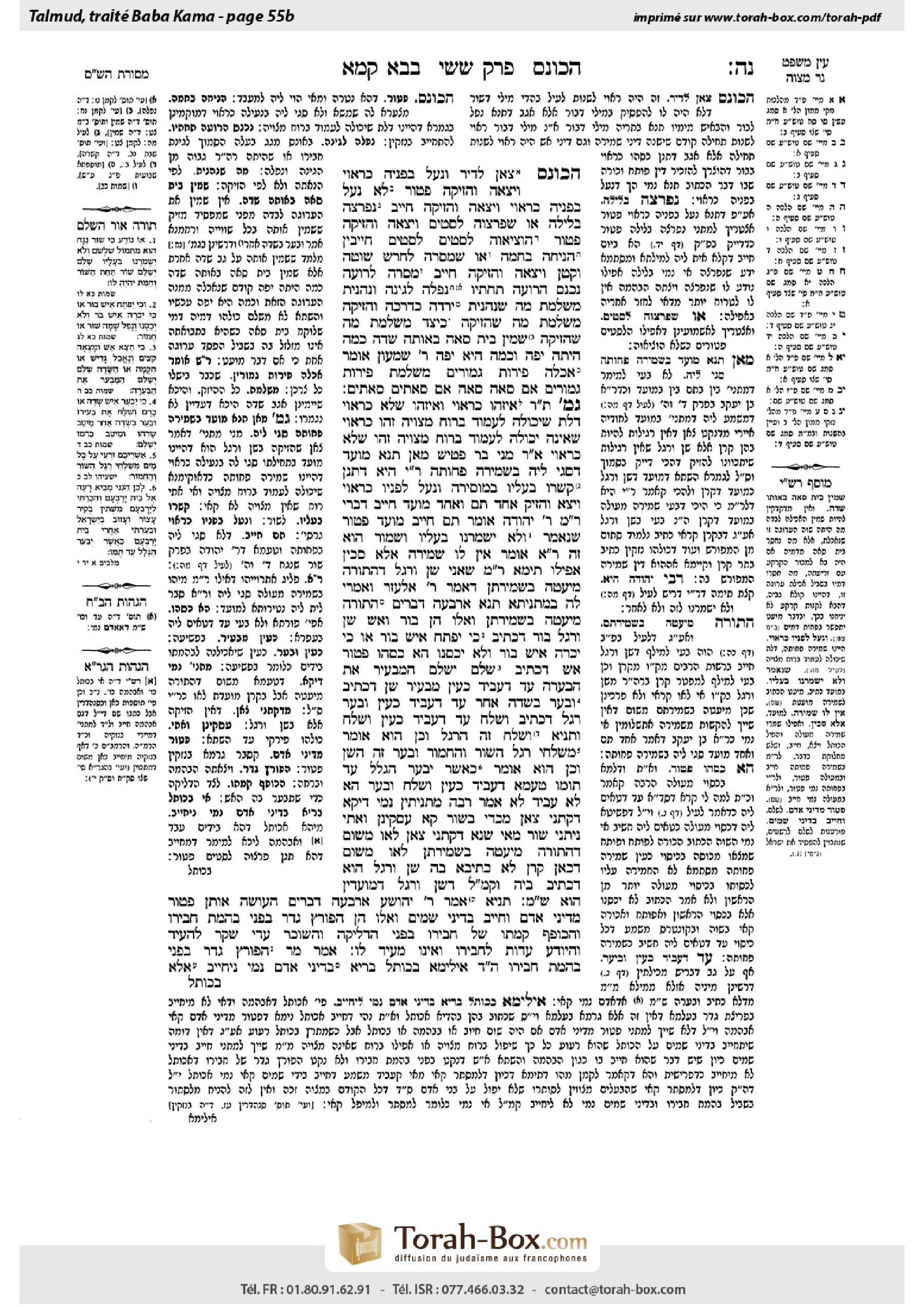
Bava Kamma 55b: Talmud study for Daf Yomi
Study the Talmud for Daf Yomi with scanned pages, Hebrew text, English translations from Sefaria and AI-generated French translations.
Passage selection and English or AI-generated French translation are available where the scan has annotations. Daf Study is independent of Torah-Box and Sefaria.
Browse Bava Kamma · בבא קמא · All tractatesBava Kamma 55b text and translations
This page of Bava Kamma includes the Aramaic text, an English translation and an AI-generated French translation, alongside the scan above.
בבא קמא נ״ה ב · Aramaic and Hebrew text
מַתְנִי׳ הַכּוֹנֵס צֹאן לַדִּיר, וְנָעַל בְּפָנֶיהָ כָּרָאוּי, וְיָצְאָה וְהִזִּיקָה – פָּטוּר. לֹא נָעַל בְּפָנֶיהָ כָּרָאוּי, וְיָצְאָה וְהִזִּיקָה – חַיָּיב.
נִפְרְצָה בַּלַּיְלָה אוֹ שֶׁפְּרָצוּהָ לִסְטִים, וְיָצְאָה וְהִזִּיקָה – פָּטוּר. הוֹצִיאוּהָ לִסְטִים – לִסְטִים חַיָּיבִין.
הִנִּיחָה בַּחַמָּה, אוֹ שֶׁמְּסָרָהּ לְחֵרֵשׁ שׁוֹטֶה וְקָטָן, וְיָצְאָה וְהִזִּיקָה – חַיָּיב.
מְסָרָהּ לְרוֹעֶה – נִכְנַס הָרוֹעֶה תַּחְתָּיו.
נָפְלָה לְגִינָּה וְנֶהֱנֵית – מְשַׁלֶּמֶת מַה שֶּׁנֶּהֱנֵית. יָרְדָה כְּדַרְכָּהּ וְהִזִּיקָה – מְשַׁלֶּמֶת מַה שֶּׁהִזִּיקָה. כֵּיצַד מְשַׁלֶּמֶת מַה שֶּׁהִזִּיקָה? שָׁמִין בֵּית סְאָה בְּאוֹתָהּ שָׂדֶה – כַּמָּה הָיְתָה יָפָה, וְכַמָּה הִיא יָפָה.
רַבִּי שִׁמְעוֹן אוֹמֵר: אָכְלָה פֵּירוֹת גְּמוּרִים – מְשַׁלֶּמֶת פֵּירוֹת גְּמוּרִים. אִם סְאָה – סְאָה, אִם סָאתַיִם – סָאתַיִם.
גְּמָ׳ תָּנוּ רַבָּנַן: אֵיזֶהוּ ״כָּרָאוּי״, וְאֵיזֶהוּ ״שֶׁלֹּא כָּרָאוּי״? דֶּלֶת שֶׁיְּכוֹלָה לַעֲמוֹד בְּרוּחַ מְצוּיָה – זֶהוּ כָּרָאוּי. שֶׁאֵינָהּ יְכוֹלָה לַעֲמוֹד בְּרוּחַ מְצוּיָה – זֶהוּ שֶׁלֹּא כָּרָאוּי.
אָמַר רַבִּי מָנִי בַּר פַּטִּישׁ: מַאן תַּנָּא מוּעָד דְּסַגִּי לֵיהּ בִּשְׁמִירָה פְּחוּתָה – רַבִּי יְהוּדָה הִיא, דִּתְנַן: קְשָׁרוֹ בְּעָלָיו בְּמוֹסֵירָה, וְנָעַל לְפָנָיו כָּרָאוּי, וְיָצָא וְהִזִּיק – אֶחָד תָּם וְאֶחָד מוּעָד, חַיָּיב; דִּבְרֵי רַבִּי מֵאִיר.
רַבִּי יְהוּדָה אוֹמֵר: תָּם – חַיָּיב, מוּעָד – פָּטוּר; שֶׁנֶּאֱמַר: ״וְלֹא יִשְׁמְרֶנּוּ בְּעָלָיו״ – וְשָׁמוּר הוּא זֶה. רַבִּי אֱלִיעֶזֶר אוֹמֵר: אֵין לוֹ שְׁמִירָה אֶלָּא סַכִּין.
אֲפִילּוּ תֵּימָא רַבִּי מֵאִיר, שָׁאנֵי שֵׁן וָרֶגֶל – דְּהַתּוֹרָה מִיעֲטָה בִּשְׁמִירָתָן. דְּאָמַר רַבִּי אֶלְעָזָר, וְאָמְרִי לַהּ בְּמַתְנִיתָא תָּנָא: אַרְבָּעָה דְּבָרִים הַתּוֹרָה מִיעֲטָה בִּשְׁמִירָתָן, וְאֵלּוּ הֵן: בּוֹר, וָאֵשׁ, שֵׁן, וָרֶגֶל.
בּוֹר – דִּכְתִיב: ״כִּי יִפְתַּח אִישׁ בּוֹר אוֹ כִּי יִכְרֶה אִישׁ בֹּר, וְלֹא יְכַסֶּנּוּ״, הָא כִּסָּהוּ – פָּטוּר.
אֵשׁ – דִּכְתִיב: ״שַׁלֵּם יְשַׁלֵּם הַמַּבְעִר אֶת הַבְּעֵרָה״ – עַד דְּעָבֵיד כְּעֵין מַבְעִיר.
שֵׁן – דִּכְתִיב: ״וּבִעֵר בִּשְׂדֵה אַחֵר״ – עַד דְּעָבֵיד כְּעֵין ״וּבִעֵר״.
רֶגֶל – דִּכְתִיב: ״וְשִׁלַּח״ – עַד דְּעָבֵיד כְּעֵין וְשִׁלַּח.
וְתַנְיָא: ״וְשִׁלַּח״ – זֶה הָרֶגֶל, וְכֵן הוּא אוֹמֵר: ״מְשַׁלְּחֵי רֶגֶל הַשּׁוֹר וְהַחֲמוֹר״. ״וּבִעֵר״ – זֶה הַשֵּׁן, וְכֵן הוּא אוֹמֵר: ״כַּאֲשֶׁר יְבַעֵר הַגָּלָל עַד תֻּמּוֹ״.
טַעְמָא דְּעָבֵיד כְּעֵין ״וְשִׁלַּח״ ״וּבִעֵר״, הָא לָא עָבֵיד – לָא.
אָמַר רַבָּה: מַתְנִיתִין נָמֵי דַּיְקָא, דְּקָתָנֵי ״צֹאן״ – מִכְּדֵי בְּשׁוֹר קָא עָסְקִינַן וְאָתֵי, נִיתְנֵי ״שׁוֹר״! מַאי שְׁנָא דְּקָתָנֵי ״צֹאן״? לָאו מִשּׁוּם דְּהַתּוֹרָה מִיעֲטָה בִּשְׁמִירָתָן?
לָאו; מִשּׁוּם דְכָאן קֶרֶן לָא כְּתִיבָא בַּהּ, שֵׁן וָרֶגֶל הוּא דִּכְתִיב בֵּיהּ; וְקָא מַשְׁמַע לַן דְּשֵׁן וָרֶגֶל – דְּמוּעָדִין הוּא. שְׁמַע מִינַּהּ.
תַּנְיָא, אָמַר רַבִּי יְהוֹשֻׁעַ: אַרְבָּעָה דְּבָרִים הָעוֹשֶׂה אוֹתָן פָּטוּר מִדִּינֵי אָדָם, וְחַיָּיב בְּדִינֵי שָׁמַיִם. וְאֵלּוּ הֵן: הַפּוֹרֵץ גָּדֵר בִּפְנֵי בֶּהֱמַת חֲבֵירוֹ, וְהַכּוֹפֵף קָמָתוֹ שֶׁל חֲבֵירוֹ בִּפְנֵי הַדְּלֵיקָה, וְהַשּׂוֹכֵר עֵדֵי שֶׁקֶר לְהָעִיד, וְהַיּוֹדֵעַ עֵדוּת לַחֲבֵירוֹ וְאֵינוֹ מֵעִיד לוֹ.
אָמַר מָר: הַפּוֹרֵץ גָּדֵר בִּפְנֵי בֶּהֱמַת חֲבֵירוֹ. הֵיכִי דָמֵי? אִילֵּימָא בְּכוֹתֶל בָּרִיא – בְּדִינֵי אָדָם נָמֵי נִיחַיַּיב! אֶלָּא
Bava Kamma 55b · English translation
MISHNA: In the case of one who brought his flock of sheep into the pen and locked the door before it in a manner that is appropriate, and despite this sheep went out and caused damage in another person’s field by eating produce or trampling it, the owner is exempt, since he safeguarded the animals appropriately. If he did not lock the door before the sheep in a manner that is appropriate, and sheep went out and caused damage, the owner is liable, since his negligence led to the damage.
If the owner locked the door appropriately but the wall of the pen was breached at night, or bandits breached it, and sheep subsequently went out and caused damage by eating or trampling, the owner of the sheep is exempt from liability. If the bandits themselves took the sheep out of the pen and the animals subsequently caused damage, the bandits are liable.
If the owner left the animal in the sun, causing it to suffer, or if he conveyed it to a deaf-mute, an imbecile, or a minor, who are not able to safeguard it, and the animal went out and caused damage, the owner is liable because he was negligent.
If the owner conveyed the animal to a shepherd to care for it, the shepherd enters in his place and is responsible for the damage.
If the animal fell into a garden and derives benefit from produce there, its owner pays for the benefit that it derives and not for other damage caused. If the animal descended into the garden in its usual manner and caused damage there, its owner pays for what it damaged. How does the court appraise the value of the damage when the owner pays for what it damaged? The court appraises a large piece of land with an area required for sowing one se’a of seed [beit se’a] in that field, including the garden bed in which the damage took place. This appraisal includes how much it was worth before the animal damaged it and how much is it worth now, and the owner must pay the difference. The court appraises not only the garden bed that was eaten or trampled, rather the depreciation in value of the bed as part of the surrounding area. This results in a smaller payment, as the damage appears less significant in the context of a larger area.
Rabbi Shimon says: This principle of appraisal applies only in a case where the animal ate unripe produce; but if it ate ripe produce, the owner pays the value of the ripe produce. Therefore, if it ate one se’a of produce, he pays for one se’a, and if it ate two se’a, he pays for two se’a.
GEMARA: The Gemara clarifies the definition of locking the door in a manner that is appropriate. The Sages taught: What is considered locking in a manner that is appropriate, and what is considered locking in a manner that is not appropriate? If one locked the door such that it is able to withstand a typical wind without collapsing or opening, this is considered a manner that is appropriate, whereas if he locked the door such that it is unable to withstand a typical wind, this is considered a manner that is not appropriate.
Rabbi Mani bar Patish said: Who is the tanna who taught with regard to animals that are forewarned that it is sufficient for the owner to provide only reduced safeguarding? Since the mishna deals with damage categorized as Eating or Trampling, for which all animals are considered forewarned, it must be in accordance with the opinion of Rabbi Yehuda, as we learned in a mishna (45b): If the owner of an ox tied it with reins to a fence or locked the gate before it in a manner that is appropriate, but nevertheless the ox went out and caused damage, whether the animal is innocuous or forewarned the owner is liable because this is not considered sufficient precaution to prevent damage; this is the statement of Rabbi Meir.
The mishna continues: Rabbi Yehuda says that if the ox is innocuous the owner is liable even if he safeguarded it appropriately, since the Torah does not limit the required safeguarding for an innocuous animal. But if the ox is forewarned, the owner is exempt from payment of damages, as it is stated in the verse describing the liability for damage caused by a forewarned animal: “And the owner has not secured it” (Exodus 21:36), and this ox that was tied with reins or behind a locked gate was secured. Rabbi Eliezer says: A forewarned ox has no sufficient safeguarding at all other than slaughtering it with a knife. According to this mishna, only Rabbi Yehuda maintains that reduced safeguarding is sufficient to render exempt from liability the owner of an ox that is forewarned.
The Gemara answers: You can even say that the mishna is in accordance with the opinion of Rabbi Meir, who holds that the owner of a forewarned ox is liable even if he provides only reduced safeguarding. Although animals are considered forewarned with regard to Eating and Trampling, one cannot apply to them a halakha stated with regard to an animal that is forewarned with regard to Goring. The halakha is different with regard to Eating and Trampling since the Torah limited the required standard of safeguarding for them. As the amora Rabbi Elazar says, and some say it was taught in a baraita: There are four matters for which the Torah limited their required standard of safeguarding, and these are: Pit, and Fire, Eating, and Trampling.
Where does the Torah limit the required standard of safeguarding with regard to the category of Pit? As it is written: “If a man shall open a pit, or if a man shall dig a pit and not cover it, and an ox or a donkey fall therein, the owner of the pit shall pay” (Exodus 21:33). One can infer: But if he covered it, he is exempt from liability, even though it is possible that the pit would become uncovered in the future.
Where does the Torah limit the required standard of safeguarding with regard to the category of Fire? As it is written: “The one who kindled the fire shall pay compensation” (Exodus 22:5), which is interpreted to mean that one is exempt from liability unless he acts in a manner that is similar to actively kindling the fire in another’s property by being negligent.
Where does the Torah limit the required standard of safeguarding with regard to the category of Eating? As it is written: “If a man causes a field or vineyard to be eaten, and he set his animal loose, and it feed [uvi’er] in the field of another” (Exodus 22:4). This indicates that the owner does not bear liability unless he acts in a manner that is similar to causing his animal to feed there, by being negligent.
Where does the Torah limit the required standard of safeguarding with regard to the category of Trampling? As it is written: “If a man causes a field or vineyard to be eaten, and he set his animal loose [veshilaḥ], and it feed in the field of another” (Exodus 22:4). This indicates that the owner is not liable unless he acts in a manner that is similar to setting his animal loose.
And it is taught in a baraita: With regard to the term veshilaḥ: This is referring to damage by Trampling, and similarly, the verse states: “That send forth [meshaleḥei] the feet of the ox and the donkey” (Isaiah 32:20). With regard to the term uvi’er: This is referring to damage by Eating, and similarly, the verse states: “As one consumes with the tooth, until it be all gone” (I Kings 14:10).
Evidently, the reason for the owner’s liability is specifically that he acted in a manner that is similar to setting the animal loose or causing it to feed. One can infer: But if he did not act in such a manner, even if he provided only reduced safeguarding, he is not liable.
Rabba said: The wording of the mishna is also precise, as it taught the halakha specifically with regard to sheep. This raises the question: Since we have been dealing with cases involving an ox in all the previous mishnayot, then let this mishna also teach the halakha with regard to an ox. What is different in this mishna that it teaches the case of sheep? Is it not because the Torah limited its requirements specifically with regard to the safeguarding against damage that is more likely to be caused by sheep, i.e., caused by Eating and Trampling, since sheep are unlikely to gore? If so, the wording of the mishna is in accordance with the opinion of Rabbi Meir, who holds that a reduced level of supervision is sufficient only with regard to Eating and Trampling, but not Goring.
The Gemara rejects this: One can not necessarily derive from the wording of the mishna that it is in accordance with the opinion of Rabbi Meir. Perhaps the mishna specifically uses the case of sheep to teach the opinion of Rabbi Yehuda, because if it would have used an example of an ox here, one might have thought that it also includes damage caused by Goring, about which it is not written in the Torah that reduced supervision is sufficient. Therefore, the mishna specifically uses the example of sheep, to indicate damage caused by Eating and Trampling, about which it is written that reduced supervision is sufficient. And it teaches us that only with regard to Eating and Trampling, for which animals are considered forewarned from the outset, is reduced supervision sufficient according to the opinion of Rabbi Yehuda. The Gemara concludes that this is a valid reading of the mishna and one may learn from it that the mishna may even be in accordance with the opinion of Rabbi Yehuda.
§ It is taught in a baraita that Rabbi Yehoshua said: There are four matters in which one who commits an offense concerning them is exempt from liability according to human laws but liable according to the laws of Heaven and it would be proper for him to pay compensation, and the cases are as follows: One who breaches a fence that stood before another’s animal, thereby allowing the animal to escape; and one who bends another’s standing grain before a fire so that it catches fire; and one who hires false witnesses to testify; and one who knows testimony in support of another but does not testify on his behalf.
The Gemara clarifies each of the cases listed in the baraita. The Master says: With regard to the case of one who breaches a fence that stood before another’s animal, what are the circumstances? If we say it is speaking of a stable wall that would not have fallen by itself, the one who breached it should also be liable according to human laws, at least for the damage caused to the wall. Rather, here
Bava Kamma 55b · Traduction française (IA)
MICHNA : Dans le cas d'une personne qui a amené son troupeau de moutons dans l'enclos et a verrouillé la porte de manière appropriée, et malgré cela un mouton est sorti et a causé des dommages dans un champ d'autrui en mangeant des récoltes ou en piétinant, le propriétaire est exempt, car il a mis les animaux en sécurité. Si, en revanche, il n'a pas verrouillé la porte de manière appropriée et que les moutons sont sortis et ont causé des dommages, le propriétaire est responsable, car son négligence a entraîné les dommages.
Si le propriétaire a verrouillé la porte de manière appropriée mais que la paroi de l'enclos a été percée la nuit, ou que des voleurs l'ont percée, et que les moutons sont ensuite sortis et ont causé des dommages en mangeant ou en piétinant, le propriétaire des moutons est exempt de responsabilité. Si les voleurs eux-mêmes ont sorti les moutons de l'enclos et que les animaux ont ensuite causé des dommages, les voleurs sont responsables.
Si le propriétaire a laissé l'animal au soleil, causant ainsi son malaise, ou s'il l'a confié à un sourd-muet, un imbécile ou un mineur, qui ne peuvent pas le garder en sécurité, et que l'animal est sorti et a causé des dommages, le propriétaire est responsable, car il a été négligent.
Si le propriétaire a confié l'animal à un berger pour qu'il le garde, le berger est tenu responsable des dommages, et c'est lui qui entre en lieu et place du propriétaire.
Si l'animal est tombé dans un jardin et en a tiré un bénéfice, son propriétaire paie le bénéfice qu'il a tiré et non les autres dommages causés. Si l'animal est descendu dans le jardin selon son habitude et a causé des dommages, son propriétaire paie ce qu'il a endommagé. Comment la cour évalue-t-elle la valeur des dommages lorsque le propriétaire paie ce qu'il a endommagé ? La cour évalue une grande parcelle de terre nécessitant une surface suffisante pour semer une se'a de grain [beit se'a] dans ce champ, y compris le lit du jardin où les dommages ont eu lieu. Cette évaluation inclut combien la parcelle valait avant que l'animal n'ait causé les dommages et combien elle vaut maintenant, et le propriétaire doit payer la différence. La cour évalue non seulement le lit du jardin qui a été mangé ou piétiné, mais aussi la dépréciation de valeur du lit en tant que partie de l'ensemble de la parcelle. Cela entraîne un paiement plus faible, car les dommages apparaissent moins importants dans le contexte d'une plus grande surface.
Rabbi Shimon dit : Ce principe d'évaluation s'applique uniquement dans le cas où l'animal a mangé des fruits non mûrs ; mais si l'animal a mangé des fruits mûrs, le propriétaire paie la valeur des fruits mûrs. Ainsi, si l'animal a mangé une se'a de récolte, il paie pour une se'a, et si l'animal a mangé deux se'a, il paie pour deux se'a.
GUEMARA : La Guemara clarifie la définition de verrouiller la porte de manière appropriée. Les Sages ont enseigné : Qu'est-ce qui est considéré comme verrouiller de manière appropriée, et qu'est-ce qui est considéré comme verrouiller de manière inappropriée ? Si l'on verrouille la porte de manière à ce qu'elle puisse résister à un vent normal sans s'effondrer ou s'ouvrir, cela est considéré comme une manière appropriée, tandis que si l'on verrouille la porte de manière à ce qu'elle ne puisse pas résister à un vent normal, cela est considéré comme une manière inappropriée.
Rabbi Mani bar Patish a dit : Qui est le tanna qui a enseigné concernant les animaux avertis que suffit à l'propriétaire de fournir une protection réduite ? Puisque la mishna traite des dommages classés comme Manger ou Piétiner, pour lesquels tous les animaux sont considérés comme avertis, il doit être selon l'opinion de Rabbi Yehuda, comme nous l'avons appris dans une mishna (45b) : Si l'propriétaire d'un bœuf l'a lié avec des rênes à un mur ou l'a verrouillé de manière appropriée, mais que néanmoins le bœuf est sorti et a causé des dommages, que l'animal soit inoffensif ou averti, l'propriétaire est responsable, car cela n'est pas considéré comme une précaution suffisante pour prévenir les dommages ; c'est l'opinion de Rabbi Meir.
La Michna continue : Rabbi Yehuda dit que si l'animal est inoffensif, l'propriétaire est responsable même s'il l'a mis en sécurité de manière appropriée, car la Torah ne limite pas la protection requise pour un animal inoffensif. Mais si l'animal est averti, l'propriétaire est exempt de paiement des dommages, car il est dit dans la verset décrivant la responsabilité pour les dommages causés par un animal averti : « Et l'propriétaire n'a pas sécurisé l'animal » (Exode 21:36), et cet animal lié avec des rênes ou derrière une porte verrouillée a été sécurisé. Rabbi Eliezer dit : Un animal averti n'a pas de protection suffisante autre que de le tuer avec un couteau. Selon cette Michna, seul Rabbi Yehuda maintient que la protection réduite est suffisante pour rendre exempt de responsabilité l'propriétaire d'un bœuf averti.
La Guemara répond : On peut même dire que la Michna est selon l'opinion de Rabbi Meir, qui considère que l'propriétaire d'un bœuf averti est responsable même s'il fournit une protection réduite. Bien que les animaux soient considérés comme avertis concernant le Manger et le Piétiner, on ne peut pas appliquer à eux une halakha établie concernant un animal averti concernant le Bêl. La halakha est différente concernant le Manger et le Piétiner, car la Torah a limité le standard de protection requis pour eux. Comme l'a dit l'amora Rabbi Elazar, et certains disent qu'il a été enseigné dans une baraïta : Il y a quatre choses pour lesquelles la Torah a limité le standard de protection requis, et ce sont : Le trou, le feu, le Manger, et le Piétiner.
Où la Torah limite-t-elle le standard de protection requis concernant la catégorie du trou ? Comme il est écrit : « Si un homme ouvre un trou, ou si un homme creuse un trou et ne le recouvre pas, et un bœuf ou un âne tombe dedans, l'propriétaire du trou paie » (Exode 21:33). On peut en déduire : Mais s'il l'a recouvert, il est exempt de responsabilité, même si il est possible que le trou devienne découvert à l'avenir.
Où la Torah limite-t-elle le niveau de protection requis concernant la catégorie du feu ? Comme il est écrit : « Celui qui a allumé le feu paie la réparation » (Exode 22:5), ce qui signifie que l'on est exempt de responsabilité à moins qu'on n'agisse de manière similaire à l'allumage actif du feu dans la propriété d'autrui par négligence.
Où la Torah limite-t-elle le niveau de précaution requis concernant la catégorie de l'alimentation ? Comme il est écrit : « Si un homme fait entrer un champ ou un vignoble dans l'abîme, et il laisse libre son bétail, et il s'alimente [uvi’er] dans le champ d'autrui » (Exode 22:4). Cela indique que le propriétaire n'est pas responsable à moins qu'il agisse de manière similaire à ce qui cause son bétail à s'alimenter là, par négligence.
Où la Torah limite-t-elle le niveau de précaution requis concernant la catégorie de l'écrasement ? Comme il est écrit : « Si un homme fait entrer un champ ou un vignoble dans l'abîme, et il laisse libre son bétail [veshilaḥ], et il s'alimente dans le champ d'autrui » (Exode 22:4). Cela indique que le propriétaire n'est pas responsable à moins qu'il agisse de manière similaire à ce qui cause son bétail à s'alimenter là.
Et il est enseigné dans une baraïta : Concernant le terme veshilaḥ : cela fait référence à un dommage par écrasement, et de même, le verset dit : « Qui envoie [meshaleḥei] les pieds de l'âne et du bœuf » (Yachout 32:20). Concernant le terme uvi’er : cela fait référence à un dommage par alimentation, et de même, le verset dit : « Comme l'on dévore avec les dents, jusqu'à ce qu'il ne reste plus rien » (I Rois 14:10).
Évidemment, la raison de la responsabilité du propriétaire est spécifiquement qu'il a agi de manière similaire à celui qui libère l'animal ou qui le fait manger. On peut en déduire : mais s'il n'a pas agi ainsi, même s'il a fourni une surveillance réduite, il n'est pas responsable.
Rabba dit : Le texte de la mishna est aussi précis, car elle a enseigné la halakha spécifiquement concernant les brebis. Cela soulève la question : puisque nous avons traité des cas impliquant un bœuf dans tous les mishnayot précédents, alors ce mishna devrait aussi enseigner la halakha concernant un bœuf. Qu'est-ce qui diffère dans ce mishna qui enseigne le cas des brebis ? N'est-ce pas parce que la Torah a limité ses exigences spécifiquement concernant la précaution contre les dommages plus probables à cause des brebis, c'est-à-dire causés par l'alimentation et l'écrasement, puisque les brebis sont peu susceptibles de blesser ? Si c'est le cas, le texte de la mishna est en conformité avec l'opinion de Rabbi Meir, qui considère que le niveau réduit de surveillance est suffisant uniquement concernant l'alimentation et l'écrasement, mais pas le blesser.
La Guemara rejette cela : On ne peut pas nécessairement déduire du texte de la Michna qu'il est en conformité avec l'opinion de Rabbi Meir. Peut-être que la Michna utilise spécifiquement le cas des brebis pour enseigner l'opinion de Rabbi Yéhuda, car si elle avait utilisé un exemple d'ox ici, on pourrait penser qu'elle inclut aussi les dommages causés par le blesser, à propos desquels il n'est pas écrit dans la Torah que le niveau réduit de surveillance est suffisant. Ainsi, la Michna utilise spécifiquement l'exemple des brebis pour indiquer les dommages causés par l'alimentation et l'écrasement, à propos desquels il est écrit que le niveau réduit de surveillance est suffisant. Et elle nous enseigne que seul concernant l'alimentation et l'écrasement, pour lesquels les animaux sont considérés comme avertis dès le départ, le niveau réduit de surveillance est suffisant selon l'opinion de Rabbi Yéhuda. La Guemara conclut que c'est une lecture valide de la Michna et qu'on peut en tirer que la Michna peut même être en conformité avec l'opinion de Rabbi Yéhuda.
§ Il est enseigné dans une baraïta que Rabbi Yéhoshua dit : Il y a quatre choses concernant lesquelles celui qui commet un délit est exempt de responsabilité selon les lois humaines mais responsable selon les lois du Ciel et il serait approprié qu'il paie une compensation, et les cas sont les suivants : celui qui détruit un mur qui était devant l'animal d'autrui, permettant ainsi à l'animal de s'échapper ; et celui qui plie les épis d'autrui devant un feu afin qu'ils s'embrasent ; et celui qui embauche des témoins faux ; et celui qui connaît un témoignage en faveur d'autrui mais ne témoigne pas en son nom.
La Guemara clarifie chaque cas mentionné dans la baraïta. Le Maître dit : Concernant le cas de celui qui détruit un mur qui était devant l'animal d'autrui, quelles sont les circonstances ? Si nous disons qu'il s'agit d'un mur de stabul qui ne tomberait pas tout seul, celui qui l'a détruit devrait aussi être responsable selon les lois humaines, au moins pour le dommage causé au mur. Plutôt, ici
Traduction française générée par IA à partir de l’édition anglaise de Sefaria. Vérifie toujours un passage avec le texte source.
Text from Sefaria: William Davidson Edition - Vocalized Aramaic (CC BY NC); William Davidson Edition - English (CC BY NC).