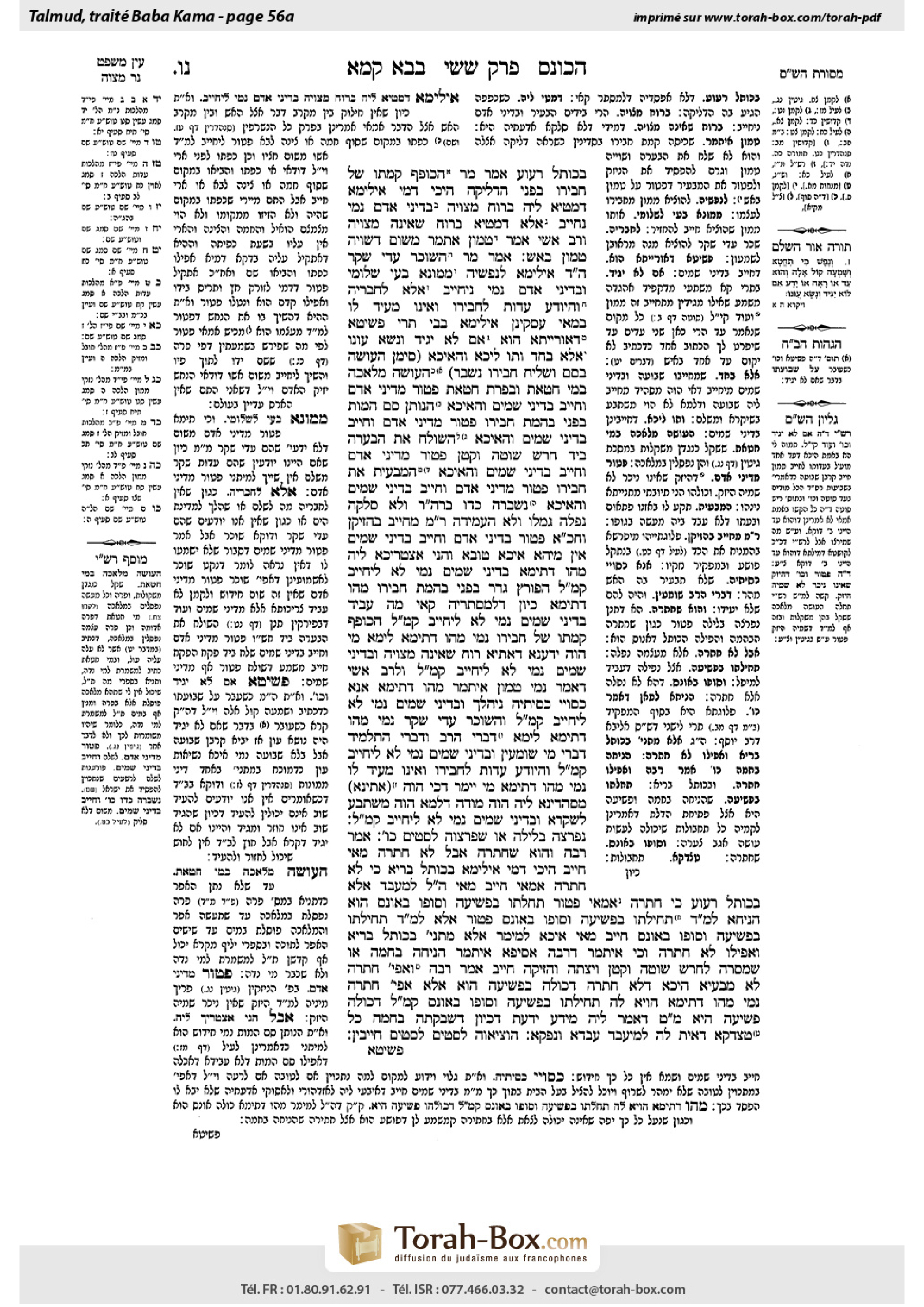
Bava Kamma 56a: Talmud study for Daf Yomi
Study the Talmud for Daf Yomi with scanned pages, Hebrew text, English translations from Sefaria and AI-generated French translations.
Passage selection and English or AI-generated French translation are available where the scan has annotations. Daf Study is independent of Torah-Box and Sefaria.
Browse Bava Kamma · בבא קמא · All tractatesBava Kamma 56a text and translations
This page of Bava Kamma includes the Aramaic text, an English translation and an AI-generated French translation, alongside the scan above.
בבא קמא נ״ו א · Aramaic and Hebrew text
בְּכוֹתֶל רָעוּעַ.
אָמַר מָר: הַכּוֹפֵף קָמָתוֹ שֶׁל חֲבֵירוֹ בִּפְנֵי הַדְּלֵיקָה. הֵיכִי דָמֵי? אִילֵּימָא דְּמָטְיָא לֵיהּ בְּרוּחַ מְצוּיָה, בְּדִינֵי אָדָם נָמֵי נִחַיַּיב! אֶלָּא דְּמָטְיָא בְּרוּחַ שֶׁאֵינָהּ מְצוּיָה.
וְרַב אָשֵׁי אָמַר: טָמוּן אִתְּמַר, מִשּׁוּם דְּשַׁוְּיַהּ טָמוּן בָּאֵשׁ.
אָמַר מָר: הַשּׂוֹכֵר עֵדֵי שֶׁקֶר. הֵיכִי דָמֵי? אִילֵּימָא לְנַפְשֵׁיהּ – מָמוֹנָא בָּעֵי שַׁלּוֹמֵי, וּבְדִינֵי אָדָם נָמֵי נִיחַיַּיב! אֶלָּא לְחַבְרֵיהּ.
וְהַיּוֹדֵעַ עֵדוּת לַחֲבֵירוֹ וְאֵינוֹ מֵעִיד לוֹ. בְּמַאי עָסְקִינַן? אִילֵימָא בְּבֵי תְרֵי – פְּשִׁיטָא! דְּאוֹרָיְיתָא הוּא – ״אִם לוֹא יַגִּיד, וְנָשָׂא עֲוֹנוֹ״!
אֶלָּא בְּחַד.
וְתוּ לֵיכָּא? וְהָאִיכָּא (סִימָן: הָעוֹשֶׂה, בְּסַם, וּשְׁלִיחַ, חֲבֵירוֹ, נִשְׁבַּר.) הָעוֹשֶׂה מְלָאכָה בְּמֵי חַטָּאת וּבְפָרַת חַטָּאת – פָּטוּר מִדִּינֵי אָדָם, וְחַיָּיב בְּדִינֵי שָׁמַיִם!
וְהָאִיכָּא הַנּוֹתֵן סַם הַמָּוֶת בִּפְנֵי בֶּהֱמַת חֲבֵירוֹ – פָּטוּר מִדִּינֵי אָדָם, וְחַיָּיב בְּדִינֵי שָׁמַיִם!
וְהָאִיכָּא הַשּׁוֹלֵחַ אֶת הַבְּעֵרָה בְּיַד חֵרֵשׁ שׁוֹטֶה וְקָטָן – פָּטוּר מִדִּינֵי אָדָם, וְחַיָּיב בְּדִינֵי שָׁמַיִם!
וְהָאִיכָּא הַמַּבְעִית אֶת חֲבֵירוֹ – פָּטוּר מִדִּינֵי אָדָם, וְחַיָּיב בְּדִינֵי שָׁמַיִם!
וְהָאִיכָּא נִשְׁבְּרָה כַּדּוֹ בִּרְשׁוּת הָרַבִּים וְלֹא סִילְּקָהּ, נָפְלָה גְּמַלּוֹ וְלֹא הֶעֱמִידָהּ – רַבִּי מֵאִיר מְחַיֵּיב בְּהֶזֵּיקָן, וַחֲכָמִים אוֹמְרִים: פָּטוּר בְּדִינֵי אָדָם, וְחַיָּיב בְּדִינֵי שָׁמַיִם!
אִין, מִיהָא אִיכָּא טוּבָא; וְהָנֵי אִצְטְרִיכָא לֵיהּ – מַהוּ דְּתֵימָא בְּדִינֵי שָׁמַיִם נָמֵי לָא לִיחַיַּיב, קָא מַשְׁמַע לַן.
הַפּוֹרֵץ גָּדֵר בִּפְנֵי בֶּהֱמַת חֲבֵירוֹ – מַהוּ דְּתֵימָא: כֵּיוָן דִּלְמִסְתְּרֵיהּ קָאֵי, מָה עָבֵיד? בְּדִינֵי שָׁמַיִם נָמֵי לָא לִיחַיַּיב; קָא מַשְׁמַע לַן.
הַכּוֹפֵף קָמָתוֹ שֶׁל חֲבֵירוֹ נָמֵי – מַהוּ דְּתֵימָא, לֵימָא: מִי הֲוָה יָדַעְנָא דְּאָתְיָא רוּחַ שֶׁאֵינָהּ מְצוּיָה? וּבְדִינֵי שָׁמַיִם נָמֵי לָא לִיחַיַּיב; קָא מַשְׁמַע לַן.
וּלְרַב אָשֵׁי – דְּאָמַר נָמֵי טָמוּן אִיתְּמַר, מַהוּ דְּתֵימָא: ״אֲנָא כַּסּוֹיֵי כַּסִּיתֵיהּ נִיהֲלָךְ״, וּבְדִינֵי שָׁמַיִם נָמֵי לָא לִיחַיַּיב; קָא מַשְׁמַע לַן.
וְהַשּׂוֹכֵר עֵדֵי שֶׁקֶר נָמֵי – מַהוּ דְּתֵימָא, לֵימָא: דִּבְרֵי הָרַב וְדִבְרֵי הַתַּלְמִיד, דִּבְרֵי מִי שׁוֹמְעִין? וּבְדִינֵי שָׁמַיִם נָמֵי לָא לִיחַיַּיב; קָא מַשְׁמַע לַן.
וְהַיּוֹדֵעַ עֵדוּת לַחֲבֵירוֹ וְאֵינוֹ מֵעִיד לוֹ, נָמֵי – מַהוּ דְּתֵימָא: ״מִי יֵימַר דְּכִי הֲוָה אָתֵינָא מַסְהֵדְינָא לֵיהּ הֲוָה מוֹדֵה, דִּלְמָא הֲוָה מִשְׁתְּבַע לְשִׁקְרָא״, וּבְדִינֵי שָׁמַיִם נָמֵי לָא לִיחַיַּיב; קָא מַשְׁמַע לַן.
נִפְרְצָה בַּלַּיְלָה אוֹ שֶׁפְּרָצוּהָ לִסְטִים כּוּ׳. אָמַר רַבָּה: וְהוּא שֶׁחָתְרָה.
אֲבָל לֹא חָתְרָה מַאי, חַיָּיב?! הֵיכִי דָמֵי? אִילֵּימָא בְּכוֹתֶל בָּרִיא – כִּי לֹא חָתְרָה אַמַּאי חַיָּיב? מַאי הֲוָה לֵיהּ לְמֶעְבַּד? אֶלָּא בְּכוֹתֶל רָעוּעַ – כִּי חָתְרָה אַמַּאי פָּטוּר? תְּחִלָּתוֹ בִּפְשִׁיעָה וְסוֹפוֹ בְּאוֹנֶס הוּא!
הָנִיחָא לְמַאן דְּאָמַר: תְּחִילָּתוֹ בִּפְשִׁיעָה וְסוֹפוֹ בְּאוֹנֶס פָּטוּר; אֶלָּא לְמַאן דְּאָמַר: תְּחִילָּתוֹ בִּפְשִׁיעָה וְסוֹפוֹ בְּאוֹנֶס חַיָּיב – מַאי אִיכָּא לְמֵימַר?
אֶלָּא מַתְנִיתִין בְּכוֹתֶל בָּרִיא, וַאֲפִילּוּ לֹא חָתְרָה. וְכִי אִיתְּמַר דְּרַבָּה – אַסֵּיפָא אִיתְּמַר: הַנִּיחָה בַּחַמָּה, אוֹ שֶׁמְּסָרָהּ לְחֵרֵשׁ שׁוֹטֶה וְקָטָן, וְיָצְתָה וְהִזִּיקָה – חַיָּיב. אָמַר רַבָּה: וַאֲפִילּוּ חָתְרָה.
לָא מִבַּעְיָא הֵיכָא דְּלָא חָתְרָה – דְּכוּלַּהּ בִּפְשִׁיעָה הוּא, אֶלָּא אֲפִילּוּ חָתְרָה נָמֵי. מַהוּ דְּתֵימָא: הָוְיָא לַהּ תְּחִילָּתוֹ בִּפְשִׁיעָה וְסוֹפוֹ בְּאוֹנֶס; קָא מַשְׁמַע לַן דְּכוּלַּהּ פְּשִׁיעָה הִיא,
מַאי טַעְמָא? דַּאֲמַר לֵיהּ: מִידָּע יָדְעַתְּ דְּכֵיוָן דִּשְׁבַקְתַּהּ בְּחַמָּה – כֹּל טַצְדְּקָא דְּאִית לַהּ לְמִיעְבַּד עָבְדָא וְנָפְקָא.
הוֹצִיאוּהָ לִסְטִים – לִסְטִים חַיָּיבִין.
Bava Kamma 56a · English translation
the baraita is speaking of an unstable wall that was about to fall and break in any event, and so his action did not actually cause any loss to the owner.
The Master says: With regard to the case mentioned in the baraita of one who bends another’s standing grain before a fire, what are the circumstances? If we say that the baraita is referring to a case where the fire would reach the bent grain in a typical wind, let him also be liable for the damage according to human laws. Rather, it must be a case where the fire could reach the bent grain only in an atypical wind. Therefore, he is exempt according to human laws, and, since the grain was destroyed due to his action, he is liable according to the laws of Heaven.
And Rav Ashi offered an alternative explanation and said: The baraita was stated in the case of a concealed item; in other words, this person did not bend the grain toward the fire but bent it over another item in order to conceal it. One is not liable to pay restitution for concealed items damaged by fire. Therefore, when this person bent the grain over an item, he caused indirect damage to the owner of that item because he made it into a concealed item that was subsequently damaged by fire, and the owner cannot reclaim his loss.
The Master says: With regard to the case mentioned in the baraita of one who hires false witnesses, what are the circumstances? If we say that he hired them for his own benefit, in order to extract payment from another, he is required to reimburse that person with money, and he is liable according to human laws for receiving money under false circumstances. Rather, the case is one where he hired false witnesses for the benefit of another. In such a case the injured party cannot sue the other litigant, since the latter did not hire the witnesses, nor can he sue the person who hired them, since that person received no personal benefit.
The baraita teaches: And one who knows testimony in support of another but does not testify on his behalf is exempt from liability according to human laws but liable according to the laws of Heaven. With what circumstances are we dealing? If we say that the case involves two people who could testify, and their evidence would render the other party liable to pay, it is obvious that each of them is liable according to the laws of Heaven; he has committed a transgression by Torah law: “If he does not utter it, then he shall bear his iniquity” (Leviticus 5:1). Therefore, it is unnecessary for the baraita to mention this case.
Rather, the case of the baraita concerns a single witness, whose testimony is not sufficient to render another liable, and to which the transgression of Torah law consequently does not apply. Nevertheless, a litigant can be forced to take an oath based on the testimony of a single witness, and refusal to take this oath would obligate the litigant to pay. Therefore, the witness has caused an indirect loss and is liable according to the laws of Heaven.
The Gemara asks: And is there nothing else, i.e., is there no other case in which one is exempt according to human laws but liable according to the laws of Heaven? But there is such a case. And before citing several cases that are not written in the baraita the Gemara presents a mnemonic device: One who performs; with poison; and an agent; another; is broken. The Gemara returns to the first case: One who performs labor with water of purification, which was meant to be used to purify one rendered ritually impure by a corpse, thereby rendering the water unfit for use, or who performs labor with the red heifer of purification, invalidating the animal for use as an element of the purification ritual, is exempt according to human laws, since the damage he caused is not evident, but liable according to the laws of Heaven, as he caused a financial loss.
The Gemara adds: But there is the following halakha: With regard to one who places poison before another’s animal, and the animal eats it and dies, he is exempt according to human laws, since the animal caused its own death, but liable according to the laws of Heaven.
The Gemara adds: But there is the case of one who sends an exposed flame in the hand of a deaf-mute, an imbecile, or a minor, and the fire spreads, causing damage; he is exempt according to human laws but liable according to the laws of Heaven.
The Gemara adds: But there is the case of one who frightens another without touching him, but causes him injury; he is exempt according to human laws but liable according to the laws of Heaven.
The Gemara adds: But there is the case of one whose jug broke in the public domain and he did not remove the broken pieces, or one whose camel fell and he did not stand it up again. Rabbi Meir deems the owner of jug or of the camel liable for the damage thereby caused to others, and the Rabbis say that he is exempt according to human laws but liable according to the laws of Heaven. Since there are so many other cases, why did Rabbi Yehoshua claim in the baraita that there are only four cases when one is exempt according to human laws but liable according to the laws of Heaven?
The Gemara answers: Yes, there are, in any event, many other cases, but Rabbi Yehoshua held that it was necessary for him to state the halakha of these four cases. The reason he stated them is lest you say that in these cases one should not be liable even according to the laws of Heaven. Therefore, Rabbi Yehoshua teaches us that in these cases one is liable according to the laws of Heaven.
The Gemara explains why one might have thought that there is no liability at all for each case in the baraita: Rabbi Yehoshua taught that one who breaches a fence that stood before another’s animal, thereby allowing the animal to escape, is liable according to the laws of Heaven, lest you say: Since the fence is about to collapse even without this person’s intervention, what did he really do? Based on that logic, one might have thought that he should not be liable even according to the laws of Heaven. Therefore, Rabbi Yehoshua teaches us that in such a case he is liable according to the laws of Heaven.
Rabbi Yehoshua taught that one who bends another’s standing grain is liable according to the laws of Heaven, lest you say: Let the one who bent the grain say to the owner: Did I know that an atypical wind would come and cause the fire to spread? Based on that logic, one might have thought that he should not be liable even according to the laws of Heaven. Therefore, Rabbi Yehoshua teaches us that in such a case he is liable according to the laws of Heaven.
And according to Rav Ashi, who said that Rabbi Yehoshua’s ruling was stated with regard to the case of a concealed item, Rabbi Yehoshua mentioned liability according to the laws of Heaven lest you say that the one who concealed the item could say: I covered it for you in order to protect it from the fire. Based on that logic, one might have thought that he should not be liable even according to the laws of Heaven. Therefore, Rabbi Yehoshua teaches us that in such a case he is liable according to the laws of Heaven.
And Rabbi Yehoshua taught that there is liability also in the case of one who hires false witnesses, lest you say: Let the one who hired them say: If the witnesses hear the statement of the teacher, i.e., God, Who prohibited giving false testimony, and the statement of the student, i.e., the one who hired them, to whose statement should they listen? Although the one who hired them encouraged these witnesses to sin, ultimately it was they who transgressed by not adhering to the instructions of God. And based on this logic one might have thought that he should not be liable even according to the laws of Heaven. Therefore, Rabbi Yehoshua teaches us that in such a case he is liable according to the laws of Heaven.
Finally, Rabbi Yehoshua taught that one who knows testimony in support of another but does not testify on his behalf is liable according to the laws of Heaven, lest you say that the witness could claim: Who says that had I come forward and testified on behalf of one litigant, the other litigant would admit liability? Perhaps he would have chosen to take a false oath and absolve himself. Based on that logic one might have thought that he should not be liable even according to the laws of Heaven. Therefore, Rabbi Yehoshua teaches us that in such a case he is liable according to the laws of Heaven.
§ The mishna teaches: If the pen was breached at night, or bandits breached it, and sheep subsequently went out and caused damage, the owner of the sheep is exempt. Rabba says: And this first instance of a pen that was breached is referring specifically to a case where the animal tunneled under the wall of the pen and by doing so caused the wall to collapse. In that case, the owner is completely blameless and therefore exempt from liability for any damage that ensues.
The Gemara asks: But if the animal did not tunnel under the wall, what is the halakha? Would the owner be liable? What are the circumstances? If we say that the pen had a stable wall, then even if the animal did not tunnel, why is the owner liable? What should he have done? Clearly, he cannot be held liable for the damage. Rather, the pen had an unstable wall. The Gemara asks: Even if the animal tunneled under the wall and knocked it down, why is he exempt? The damage in this case is initially through negligence and ultimately by accident.
This works out well according to the one who said that in any case of damage that is initially through negligence and ultimately by accident, he is exempt from liability, since the ultimate cause of the damage was not his fault. But according to the one who says that in any case of damage that is initially through negligence and ultimately by accident he is liable, as even without the accident his negligence could have caused damage, what is there to say?
Rather, the case of the mishna concerns a stable wall, and even if the animal did not tunnel under the wall the owner is exempt. And when the statement of Rabba was stated, it was stated with regard to the latter clause of the mishna that says: If the owner left the animal in the sun or conveyed it to a deaf-mute, an imbecile, or a minor, and the animal went out and caused damage, the owner is liable. Concerning this Rabba stated: And the owner is liable even if the animal tunneled its way out under the wall of the pen.
The Gemara explains: It is not necessary for the mishna to mention the case where the animal did not tunnel its way out. In that case the owner is clearly liable, since the entire incident occurred due to his negligence of leaving the animal in the sun, thereby causing it distress and leading it to attempt escape by any possible means. But even if the animal tunneled its way out, the owner is liable, and this is the novelty in this ruling: Lest you say that this is a case of damage that is initially through negligence and ultimately by accident, because animals do not typically tunnel their way out of a pen, the mishna teaches us that it is considered as though the entire damage resulted from the owner’s negligence.
What is the reason that the owner is liable? It is that the one who suffered the damage can say to the owner of the sheep: You should have known that since you left it in the sun, it would utilize any means [tatzdeka] available for it to use and it would escape, so you are ultimately responsible for the damage.
§ The mishna teaches: If the bandits themselves took the sheep out, the bandits are liable.
Bava Kamma 56a · Traduction française (IA)
la baraïta parle d'un mur instable qui était sur le point de tomber et de se briser de toute façon, et donc son action n'a pas réellement causé de préjudice à l'propriétaire.
Le Maître dit : En ce qui concerne le cas mentionné dans la baraïta d'une personne qui courbe le blé d'un autre avant un feu, quelles sont les circonstances ? Si nous disons que la baraïta fait référence à un cas où le feu pourrait atteindre le blé courbé dans un vent normal, il devrait être tenu responsable du préjudice selon les lois humaines. En revanche, il doit s'agir d'un cas où le feu pourrait atteindre le blé courbé uniquement dans un vent inhabituel. Ainsi, il est exempt selon les lois humaines, et puisque le blé a été détruit en raison de son action, il est responsable selon les lois du Ciel.
Et Rav Ashi a proposé une autre explication et a dit : La baraïta a été formulée dans le cas d'un objet caché ; autrement dit, cette personne n'a pas courbé le blé vers le feu, mais l'a courbé sur un autre objet afin de le cacher. On n'est pas tenu de réparer les objets cachés endommagés par le feu. Ainsi, lorsque cette personne a courbé le blé sur un objet, il a causé un préjudice indirect à l'propriétaire de cet objet, car il l'a rendu caché et ensuite endommagé par le feu, et l'propriétaire ne peut récupérer son préjudice.
Le Maître dit : En ce qui concerne le cas mentionné dans la baraïta d'une personne qui embauche des témoins faux, quelles sont les circonstances ? Si nous disons qu'il les a embauchés à son propre bénéfice, afin d'extorquer un paiement à un autre, il doit indemniser cette personne avec de l'argent, et il est responsable selon les lois humaines pour avoir reçu de l'argent dans des circonstances fausses. En revanche, le cas est celui où il a embauché des témoins faux au bénéfice d'un autre. Dans ce cas, la partie blessée ne peut pas poursuivre l'autre partie en justice, car celle-ci n'a pas embauché les témoins, ni ne peut-elle poursuivre la personne qui les a embauchés, car celle-ci n'a pas reçu de bénéfice personnel.
La baraïta enseigne : Celui qui connaît un témoignage en faveur d’un autre mais ne témoigne pas en son nom est exempt de responsabilité selon les lois humaines mais responsable selon les lois du Ciel. Quelles sont les circonstances ? Si nous disons que le cas implique deux personnes qui pourraient témoigner, et que leurs témoignages rendraient l’autre partie responsable de payer, il est évident que chacun d’eux est responsable selon les lois du Ciel ; il a commis une transgression selon la loi de la Torah : « Si il ne l’exprime pas, alors il portera sa faute » (Lévitique 5:1). Ainsi, il n’est pas nécessaire que la baraïta mentionne ce cas.
En revanche, le cas de la baraïta concerne un seul témoin, dont le témoignage n'est pas suffisant pour rendre l'autre partie responsable, et la transgression selon la loi de la Torah ne s'applique donc pas à cela. Néanmoins, un litige peut être contraint de prendre un serment sur la base du témoignage d'un seul témoin, et le refus de prendre ce serment obligera le litige à payer. Ainsi, le témoin a causé un préjudice indirect et est responsable selon les lois du Ciel.
La Guemara demande : Et n'y a-t-il pas autre chose, c'est-à-dire n'y a-t-il pas d'autre cas où l'on est exempt selon les lois humaines mais responsable selon les lois du Ciel ? Mais il y a un tel cas. Et avant de citer plusieurs cas qui ne sont pas mentionnés dans la baraïta, la Guemara présente un dispositif mnémotechnique : Celui qui agit ; avec un poison ; et un agent ; un autre ; est brisé. La Guemara revient au premier cas : Celui qui exerce un travail avec l'eau de purification, qui était destinée à purifier une personne rendue impure rituellement par un cadavre, rendant ainsi l'eau inutilisable, ou qui exerce un travail avec la vache rouge de purification, invalidant l'animal pour son utilisation dans le rituel de purification, est exempt selon les lois humaines, car le préjudice qu'il a causé n'est pas évident, mais responsable selon les lois du Ciel, car il a causé un préjudice financier.
La Guemara ajoute : Mais il y a la halakha suivante : En ce qui concerne celui qui place un poison devant l'animal d'autrui, et l'animal le mange et meurt, il est exempt selon les lois humaines, car l'animal a causé sa propre mort, mais responsable selon les lois du Ciel.
La Guemara ajoute : Mais il y a le cas de celui qui envoie une flamme exposée dans la main d'un sourd-muet, d'un imbécile ou d'un mineur, et la flamme se propage, causant un préjudice ; il est exempt selon les lois humaines mais responsable selon les lois du Ciel.
La Guemara ajoute : Mais il y a le cas de celui qui effraie un autre sans le toucher, mais cause un préjudice ; il est exempt selon les lois humaines mais responsable selon les lois du Ciel.
La Guemara ajoute : Mais il y a le cas de celui dont un jarre s'est brisé dans le domaine public et qui n'a pas retiré les morceaux brisés, ou celui dont un chameau est tombé et qui n'a pas relevé le chameau. Rabbi Meïr considère que l'propriétaire du jarre ou du chameau est responsable du préjudice causé à autrui, et les Rabbins disent qu'il est exempt selon les lois humaines mais responsable selon les lois du Ciel. Puisque il y a tant d'autres cas, pourquoi Rabbi Yéhoshua a-t-il affirmé dans la baraïta qu'il n'y a que quatre cas où l'on est exempt selon les lois humaines mais responsable selon les lois du Ciel ?
La Guemara répond : Oui, il y en a, en tout cas, beaucoup d'autres cas, mais Rabbi Yéhoshua considérait qu'il était nécessaire de mentionner ces quatre cas. La raison pour laquelle il les a mentionnés est afin que l'on ne dise pas que dans ces cas l'on ne devrait pas être responsable même selon les lois du Ciel. Ainsi, Rabbi Yéhoshua nous enseigne que dans ces cas l'on est responsable selon les lois du Ciel.
La Guemara explique pourquoi on aurait pu penser qu'il n'y a aucune responsabilité dans chaque cas du baraïta : Rabbi Yéhoshua enseignait que celui qui détruit un mur qui était devant l'animal d'autrui, permettant ainsi à l'animal de s'échapper, est responsable selon les lois du Ciel, afin de ne pas dire : Puisque le mur risque de s'effondrer même sans l'intervention de cette personne, qu'a-t-il vraiment fait ? Selon cette logique, on aurait pu penser qu'il ne devrait pas être responsable même selon les lois du Ciel. Ainsi, Rabbi Yéhoshua nous enseigne que dans ce cas, il est responsable selon les lois du Ciel.
Rabbi Yéhoshua enseignait que celui qui courbe le blé d'autrui est responsable selon les lois du Ciel, afin de ne pas dire : Que l'homme qui a courbé le blé dise à l'propriétaire : Savais-je qu'un vent inhabituel viendrait et provoquerait la propagation du feu ? Selon cette logique, on aurait pu penser qu'il ne devrait pas être responsable même selon les lois du Ciel. Ainsi, Rabbi Yéhoshua nous enseigne que dans ce cas, il est responsable selon les lois du Ciel.
Et selon Rav Ashi, qui affirmait que la décision de Rabbi Yéhoshua était formulée concernant le cas d'un objet caché, Rabbi Yéhoshua mentionnait la responsabilité selon les lois du Ciel afin de ne pas dire que celui qui avait caché l'objet pouvait affirmer : J'ai couvert cela pour vous afin de le protéger du feu. Selon cette logique, on aurait pu penser qu'il ne devrait pas être responsable même selon les lois du Ciel. Ainsi, Rabbi Yéhoshua nous enseigne que dans ce cas, il est responsable selon les lois du Ciel.
Et Rabbi Yéhoshua enseignait que la responsabilité existe également dans le cas de celui qui embauche des témoins faux, afin de ne pas dire : Que celui qui a embauché les témoins dise : Si les témoins entendent la déclaration du maître, c'est-à-dire Dieu, qui interdit de témoigner faux, et la déclaration du disciple, c'est-à-dire celui qui a embauché les témoins, à quelle déclaration devraient-ils écouter ? Bien que celui qui a embauché les témoins ait encouragé ces témoins à pécher, finalement, c'est eux qui ont transgressé en ne suivant pas les instructions de Dieu. Et selon cette logique, on aurait pu penser qu'il ne devrait pas être responsable même selon les lois du Ciel. Ainsi, Rabbi Yéhoshua nous enseigne que dans ce cas, il est responsable selon les lois du Ciel.
Enfin, Rabbi Yéhoshua enseignait que celui qui connaît un témoignage en faveur d'autrui mais ne témoigne pas en son nom est responsable selon les lois du Ciel, afin de ne pas dire que le témoin pourrait affirmer : Qui dit que si j'avais été en avant et témoigné en faveur d'un des parties, l'autre partie aurait admis la responsabilité ? Peut-être aurait-il choisi de prendre un faux serment et de s'absoudre. Selon cette logique, on aurait pu penser qu'il ne devrait pas être responsable même selon les lois du Ciel. Ainsi, Rabbi Yéhoshua nous enseigne que dans ce cas, il est responsable selon les lois du Ciel.
§ La mitsna enseigne : Si le mur a été percé la nuit, ou des bandits l'ont percé, et les brebis sont ensuite sorties et ont causé des dommages, le propriétaire des brebis est exempt. Rabba dit : Et ce premier cas de mur percé fait référence spécifiquement à un cas où l'animal a creusé sous le mur du poulaillier et, en le faisant, a provoqué l'effondrement du mur. Dans ce cas, le propriétaire est entièrement blanchi et donc exempt de responsabilité pour tout dommage subséquent.
La Guemara pose la question : Mais si l'animal n'a pas creusé sous le mur, quelle est la halakha ? Le propriétaire est-il responsable ? Quelles sont les circonstances ? Si nous disons que le mur était stable, alors même si l'animal n'a pas creusé, pourquoi le propriétaire est-il responsable ? Qu'aurait-il dû faire ? Évidemment, il ne peut être tenu responsable du dommage. Plutôt, le mur était instable. La Guemara pose la question : Même si l'animal a creusé sous le mur et l'a fait s'effondrer, pourquoi est-il exempt ? Le dommage dans ce cas est initialement par négligence et finalement par accident.
Cela s'aligne bien selon celui qui dit que dans tout cas de dommage qui est initialement par négligence et finalement par accident, il est exempt de responsabilité, car la cause finale du dommage n'était pas de sa faute. Mais selon celui qui dit que dans tout cas de dommage qui est initialement par négligence et finalement par accident il est responsable, car même sans l'accident, sa négligence aurait pu causer un dommage, qu'est-ce à dire ?
Plutôt, le cas de la Michna concerne un mur stable, et même si l'animal n'a pas creusé sous le mur, le propriétaire est exempt. Et lorsque la déclaration de Rabba a été formulée, elle a été formulée concernant la seconde partie de la Michna qui dit : Si le propriétaire a laissé l'animal au soleil ou l'a confié à un sourd-muet, un imbécile ou un mineur, et l'animal est sorti et a causé des dommages, le propriétaire est responsable. Concernant cela, Rabba a dit : Et le propriétaire est responsable même si l'animal a creusé son chemin hors du poulaillier.
La Guemara explique : Il n'est pas nécessaire que la Michna mentionne le cas où l'animal n'a pas creusé son chemin. Dans ce cas, le propriétaire est clairement responsable, puisque l'incident s'est produit en raison de sa négligence de laisser l'animal au soleil, provoquant ainsi son malaise et l'incitation à s'échapper par tous les moyens possibles. Mais même si l'animal a creusé son chemin, le propriétaire est responsable, et c'est la nouveauté de cette décision : Afin de ne pas dire que c'est un cas de dommage qui est initialement par négligence et finalement par accident, car les animaux ne creusent généralement pas hors d'un poulaillier, la Michna nous enseigne que cela est considéré comme si le dommage entier résultait de la négligence du propriétaire.
Quelle est la raison pour laquelle le propriétaire est responsable ? C'est que celui qui a subi le dommage peut dire au propriétaire des brebis : Tu aurais dû savoir que, puisque tu as laissé l'animal au soleil, il utiliserait tout moyen [tatzdeka] disponible pour s'échapper et il s'échapperait, donc tu es finalement responsable du dommage.
§ La Michna enseigne : Si les bandits eux-mêmes ont sorti le mouton, les bandits sont responsables.
Traduction française générée par IA à partir de l’édition anglaise de Sefaria. Vérifie toujours un passage avec le texte source.
Text from Sefaria: William Davidson Edition - Vocalized Aramaic (CC BY NC); William Davidson Edition - English (CC BY NC).