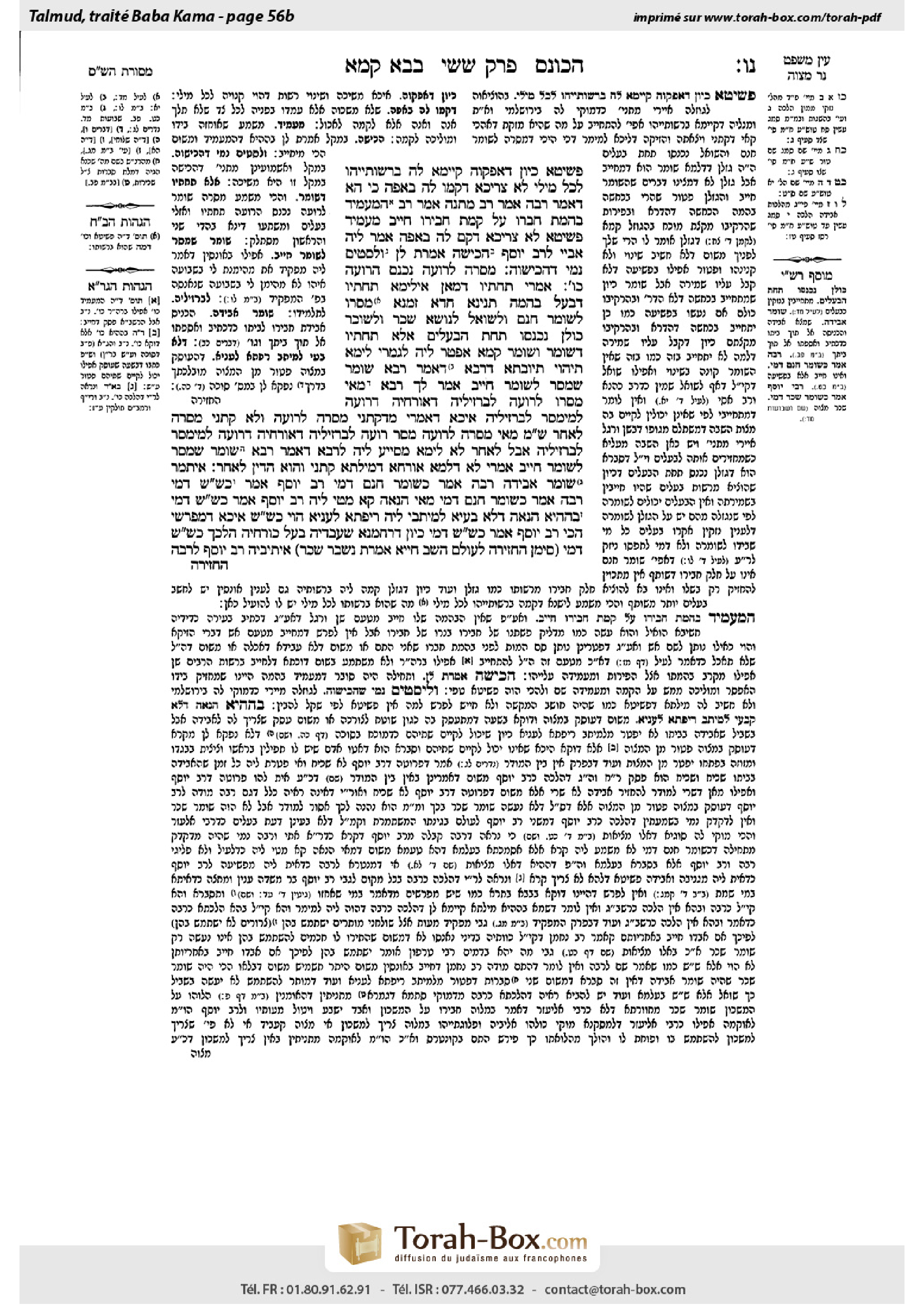
Bava Kamma 56b: Talmud study for Daf Yomi
Study the Talmud for Daf Yomi with scanned pages, Hebrew text, English translations from Sefaria and AI-generated French translations.
Passage selection and English or AI-generated French translation are available where the scan has annotations. Daf Study is independent of Torah-Box and Sefaria.
Browse Bava Kamma · בבא קמא · All tractatesBava Kamma 56b text and translations
This page of Bava Kamma includes the Aramaic text, an English translation and an AI-generated French translation, alongside the scan above.
בבא קמא נ״ו ב · Aramaic and Hebrew text
פְּשִׁיטָא! כֵּיוָן דְּאַפְּקוּהָ – קָיְימָא לַהּ בִּרְשׁוּתַיְיהוּ לְכֹל מִילֵּי!
לָא צְרִיכָא, דְּקָמוּ לַהּ בְּאַפַּהּ. כִּי הָא דְּאָמַר רַבָּה אָמַר רַב מַתְנָה אָמַר רַב: הַמַּעֲמִיד בֶּהֱמַת חֲבֵרוֹ עַל קָמַת חֲבֵירוֹ – חַיָּיב. מַעֲמִיד – פְּשִׁיטָא! לָא צְרִיכָא, דְּקָם לַהּ בְּאַפַּהּ.
אֲמַר לֵיהּ אַבָּיֵי לְרַב יוֹסֵף: הִכִּישָׁהּ אֲמַרְתְּ לַן, וְלִסְטִים נָמֵי דְּהִכִּישׁוּהָ.
מְסָרָהּ לְרוֹעֶה – נִכְנַס הָרוֹעֶה כּוּ׳. אָמְרִי: תַּחְתָּיו דְּמַאן? אִילֵימָא תַּחְתָּיו דְּבַעַל בְּהֵמָה – תְּנֵינָא חֲדָא זִמְנָא: מְסָרוֹ לְשׁוֹמֵר חִנָּם, וּלְשׁוֹאֵל, לְנוֹשֵׂא שָׂכָר, וּלְשׂוֹכֵר – כּוּלָּן נִכְנְסוּ תַּחַת הַבְּעָלִים! אֶלָּא תַּחְתָּיו דְּשׁוֹמֵר.
וְשׁוֹמֵר קַמָּא אִפְּטַר לֵיהּ לִגְמָרֵי? לֵימָא תֶּיהְוֵי תְּיוּבְתָּא דְרָבָא – דְּאָמַר רָבָא: שׁוֹמֵר שֶׁמָּסַר לְשׁוֹמֵר – חַיָּיב?
אָמַר לָךְ רָבָא: מַאי ״מְסָרוֹ לְרוֹעֶה״ – לְבַרְזִילֵיהּ, דְּאוֹרְחֵיהּ דְּרוֹעֶה לְמִימְסַר לְבַרְזִילֵיהּ.
אִיכָּא דְּאָמְרִי: מִדְּקָתָנֵי ״מְסָרָהּ לְרוֹעֶה״ וְלָא קָתָנֵי ״מְסָרָהּ לְאַחֵר״, שְׁמַע מִינַּהּ מַאי ״מְסָרָהּ לְרוֹעֶה״ – מְסַר רוֹעֶה לְבַרְזִילֵיהּ, דְּאוֹרְחֵיהּ דְּרוֹעֶה לְמִימְסַר לְבַרְזִילֵיה; אֲבָל לְאַחֵר – לָא.
לֵימָא מְסַיַּיע לֵיהּ לְרָבָא – דְּאָמַר רָבָא: שׁוֹמֵר שֶׁמָּסַר לְשׁוֹמֵר חַיָּיב? אָמְרִי: לָא; דִּלְמָא אוֹרְחָא דְמִילְּתָא קָתָנֵי, וְהוּא הַדִּין לְאַחֵר.
אִיתְּמַר: שׁוֹמֵר אֲבֵידָה – רַבָּה אָמַר: כְּשׁוֹמֵר חִנָּם דָּמֵי, רַב יוֹסֵף אָמַר: כְּשׁוֹמֵר שָׂכָר דָּמֵי.
רַבָּה אָמַר כְּשׁוֹמֵר חִנָּם דָּמֵי – מַאי הֲנָאָה קָא מָטֵי לֵיהּ? רַב יוֹסֵף אָמַר כְּשׁוֹמֵר שָׂכָר דָּמֵי – בְּהַהִיא הֲנָאָה דְּלָא בָּעֲיָא לְמִיתַּבי לֵיהּ רִיפְתָּא לְעַנְיָא, הָוֵי כְּשׁוֹמֵר שָׂכָר.
אִיכָּא דִּמְפָרְשִׁי הָכִי: רַב יוֹסֵף אָמַר כְּשׁוֹמֵר שָׂכָר דָּמֵי – כֵּיוָן דְּרַחֲמָנָא שַׁעְבְּדֵיהּ בְּעַל כּוּרְחֵיהּ, הִלְכָּךְ כְּשׁוֹמֵר שָׂכָר דָּמֵי.
(סִימָן: הֶחְזִירָהּ, לְעוֹלָם, הָשֵׁב, חִיָּיא, אָמַרְתָּ, נִשְׁבַּר, שָׂכָר.)
אֵיתִיבֵיהּ רַב יוֹסֵף לְרַבָּה:
Bava Kamma 56b · English translation
The Gemara questions the need for this ruling: It is obvious that this is the halakha, as once they removed the animal, it is now in their custody for all purposes, including responsibility for any ensuing damage.
The Gemara answers: No, this statement is necessary in a case where they stood before the animal and encouraged it to leave the enclosure but did not lead it out directly. This case is like the case in this statement that Rabba says that Rav Mattana says that Rav says: With regard to one who stands another’s animal near a third person’s standing grain, and the animal eats the grain, he is liable. The Gemara asks: If he stands the animal there, isn’t it obvious that he is liable? The Gemara answers: No, this ruling is necessary in a case where one stood before the animal and encouraged it to go toward the grain without leading it, and he is nevertheless liable.
Abaye said to Rav Yosef: You told us when explaining the statement of Rav Mattana in the name of Rav that it is referring to a case where he hit the animal with a stick, and similarly, the mishna can also be explained as referring to a case where the bandits hit it with a stick and did not lead it.
§ The mishna teaches that if the owner conveyed the animal to a shepherd to care for it, the shepherd enters in his place and is responsible for all damage. The Sages say in clarification: The shepherd enters in place of whom? If we say that the shepherd is in place of the owner of the animal, didn’t we already learn on one occasion in a mishna (44b): If the owner conveyed his animal to an unpaid bailee, or to a borrower, to a paid bailee, or to a renter, they all enter into the responsibilities and liabilities in place of the owner. What novelty is there in stating that the responsibility now lies with the shepherd to whom the owner conveyed the animal? Rather, it means that the shepherd enters in place of a bailee to whom the owner conveyed the animal, who is no longer liable once he conveys the animal to a shepherd.
The Gemara asks: If so, this mishna indicates that the first bailee exempts himself completely by conveying the sheep to a shepherd, the second bailee, and he bears no further responsibility. Shall we say that mishna is a conclusive refutation of the ruling of Rava, as Rava says: A bailee who conveyed the deposit to another bailee nevertheless remains liable?
The Gemara answers: Rava could say to you in response: What does the mishna mean when it states: He conveyed it to a shepherd? It is referring to a shepherd who conveyed the animal to the shepherd’s assistant, as it is the typical manner of a shepherd to convey animals in his charge to his assistant. Therefore, anyone who gives his animal to a shepherd understands that the shepherd’s assistant may also care for the animal, and it is not a violation of the terms of his assignment for the shepherd to convey it to his assistant. Consequently, this mishna does not refute Rava’s opinion.
There are those who say the same answer in a similar manner: From the fact that the mishna teaches the case using the expression: He conveyed it to a shepherd, and does not teach it using the less specific expression: He conveyed it to another, conclude from it that what it means by: He conveyed it to a shepherd, is that the shepherd conveyed it to his assistant, as it is the typical manner of a shepherd to convey an animal to his assistant. But if the shepherd conveyed it to another to care for it in his place, the mishna does not rule that the other person enters in his place.
The Gemara suggests: Let us say that the wording of the mishna therefore supports Rava’s opinion, as Rava says: A bailee who conveyed the deposit to another bailee remains liable. The Sages say in rejection of that suggestion: No, one cannot infer from the wording of the mishna that it is referring specifically to a shepherd conveying the animal to his assistant, since perhaps it teaches the matter in the manner in which it typically occurs, but the same is true even if the shepherd conveyed the animal to another. Therefore, no support can be brought from here for Rava’s opinion.
§ It was stated that there is a dispute between amora’im concerning the following issue: With regard to one who is safeguarding a lost item that he has not yet returned, what level of responsibility does he bear? Rabba said: He is considered to be like an unpaid bailee, whereas Rav Yosef said: He is considered to be like a paid bailee.
Their respective opinions are explained: Rabba said that he is considered to be like an unpaid bailee because what benefit comes to him through safeguarding it? Therefore, he is just like any unpaid bailee. Rav Yosef said that he is considered to be like a paid bailee on account of the benefit that he is not required to give bread to a poor person while looking after the lost item, since one who is engaged in one mitzva is exempt from performing another. Consequently, since there is some benefit involved in looking after the lost item, he is considered to be like a paid bailee.
This is one interpretation, whereas there are those who explain like this: Rav Yosef said that he is considered to be like a paid bailee. Once the Merciful One obligates him against his will to look after lost items, the Torah presumably imposes the high standard of safeguarding on him. Therefore, he is considered to be like a paid bailee.
The Gemara presents a mnemonic device for the halakhot and difficulties to be discussed: He returned it, always, returned, Ḥiyya, you say, breaks, payment.
Rav Yosef raised an objection to the opinion of Rabba from that which is taught in a baraita:
Bava Kamma 56b · Traduction française (IA)
La Guemara questionne la nécessité de cette décision : Il est évident que c'est la halakha, car une fois qu'ils ont retiré l'animal, il est désormais en leur possession pour tous les usages, y compris la responsabilité en cas de dommages ultérieurs.
La Guemara répond : Non, cette déclaration est nécessaire dans le cas où ils se tenaient devant l'animal et l'encourageaient à sortir de l'enclos mais ne le conduisaient pas directement. Ce cas est semblable à celui mentionné dans cette déclaration que Rabba rapporte en nom de Rav Mattana, qui rapporte en nom de Rav : Concernant celui qui place l'animal d'un autre près des grains d'une personne, et l'animal mange les grains, il est responsable. La Guemara pose la question : Si l'on place l'animal là, n'est-ce pas évident qu'il est responsable ? La Guemara répond : Non, cette décision est nécessaire dans le cas où l'on se tenait devant l'animal et l'encourageait à aller vers les grains sans le conduire, et il est néanmoins responsable.
Abaye dit à Rav Yosef : Vous nous avez dit, lors de l'explication de la déclaration de Rav Mattana en nom de Rav, qu'il s'agit d'un cas où l'on frappe l'animal avec un bâton, et de même, la mitsna peut être expliquée comme désignant un cas où les bandits frappent l'animal avec un bâton et ne le conduisent pas.
§ La mitsna enseigne que si l'propriétaire confie l'animal à un berger pour le garder, le berger entre à sa place et est responsable de tous les dommages. Les Sages expliquent en clarifiant : Le berger entre à la place de qui ? Si nous disons que le berger est à la place de l'propriétaire de l'animal, n'avons-nous pas déjà appris une fois dans une mitsna (44b) : Si l'propriétaire confie son animal à un gardien non rémunéré, ou à un prêteur, à un gardien rémunéré, ou à un locataire, ils entrent tous dans les responsabilités et les obligations à la place de l'propriétaire. Quel est l'originalité dans l'affirmation que la responsabilité est désormais celle du berger à qui l'propriétaire a confié l'animal ? Plutôt, cela signifie que le berger entre à la place d'un gardien à qui l'propriétaire a confié l'animal, qui n'est plus responsable une fois que l'animal est confié à un berger.
La Guemara pose la question : Si c'est ainsi, cette mitsna indique que le premier gardien s'exonère totalement en confiant l'animal à un berger, le second gardien, et il ne supporte plus aucune responsabilité. Devons-nous dire que cette mitsna est une réfutation définitive de la décision de Rava, comme Rava dit : Un gardien qui a confié le dépôt à un autre gardien reste néanmoins responsable ?
La Guemara répond : Rava pourrait répondre à cela en disant : Que signifie la mitsna lorsqu'elle dit : Il a confié l'animal à un berger ? Elle fait référence à un berger qui a confié l'animal à son assistant, car c'est la manière habituelle d'un berger de confier les animaux sous sa charge à son assistant. Ainsi, toute personne qui confie son animal à un berger comprend que l'assistant du berger peut également s'en occuper, et il n'y a pas violation des termes de sa charge si le berger le confie à son assistant. Par conséquent, cette mitsna ne contredit pas l'opinion de Rava.
Certains disent la même réponse de manière similaire : À partir du fait que la mitsna enseigne le cas en utilisant l'expression : Il a confié l'animal à un berger, et ne l'enseigne pas en utilisant l'expression moins spécifique : Il a confié l'animal à un autre, on conclut que ce que la mitsna entend par : Il a confié l'animal à un berger, est que le berger a confié l'animal à son assistant, car c'est la manière habituelle d'un berger de confier un animal à son assistant. Mais si le berger a confié l'animal à un autre pour s'en occuper à sa place, la mitsna ne considère pas que la personne autre entre à sa place.
La Guemara suggère : Disons que le texte de la mitsna soutient ainsi l'opinion de Rava, comme Rava dit : Un gardien qui a confié le dépôt à un autre gardien reste responsable. Les Sages rejettent cette suggestion en disant : Non, on ne peut pas inférer du texte de la mitsna qu'il s'agit spécifiquement d'un berger qui confie l'animal à son assistant, car peut-être la mitsna enseigne la chose dans la manière dont elle se produit habituellement, mais c'est pareil même si le berger confiait l'animal à un autre. Par conséquent, aucun soutien ne peut être apporté ici pour l'opinion de Rava.
§ Il a été dit qu'il y a un désaccord entre des amoraïm concernant la question suivante : Concernant celui qui garde un objet perdu qu'il n'a pas encore rendu, quel niveau de responsabilité porte-t-il ? Rabba a dit : Il est considéré comme un gardien non rémunéré, tandis que Rav Yosef a dit : Il est considéré comme un gardien rémunéré.
Leurs opinions respectives sont expliquées : Rabba a dit qu'il est considéré comme un gardien non rémunéré car quel bénéfice lui vient-il de garder cet objet ? Par conséquent, il est considéré comme n'importe quel gardien non rémunéré. Rav Yosef a dit qu'il est considéré comme un gardien rémunéré en raison du bénéfice qu'il n'est pas tenu de donner du pain à un pauvre pendant qu'il garde l'objet perdu, car celui qui est engagé dans une mitsva est exempt d'accomplir une autre. Par conséquent, puisque quelque bénéfice est impliqué dans la garde de l'objet perdu, il est considéré comme un gardien rémunéré.
C'est une interprétation, tandis que certains expliquent ainsi : Rav Yosef a dit qu'il est considéré comme un gardien rémunéré. Une fois que l'Éternel l'oblige contre sa volonté à garder les objets perdus, la Torah impose probablement le haut standard de garde sur lui. Par conséquent, il est considéré comme un gardien rémunéré.
La Guemara présente un dispositif mnémotechnique pour les halakhot et les difficultés à être discutées : Il l'a rendu, toujours, il l'a rendu, Ḥiyya, vous dites, brise, paiement.
Rav Yosef a soulevé une objection contre l'opinion de Rabba en se basant sur ce qui est enseigné dans une baraïta :
Traduction française générée par IA à partir de l’édition anglaise de Sefaria. Vérifie toujours un passage avec le texte source.
Text from Sefaria: William Davidson Edition - Vocalized Aramaic (CC BY NC); William Davidson Edition - English (CC BY NC).