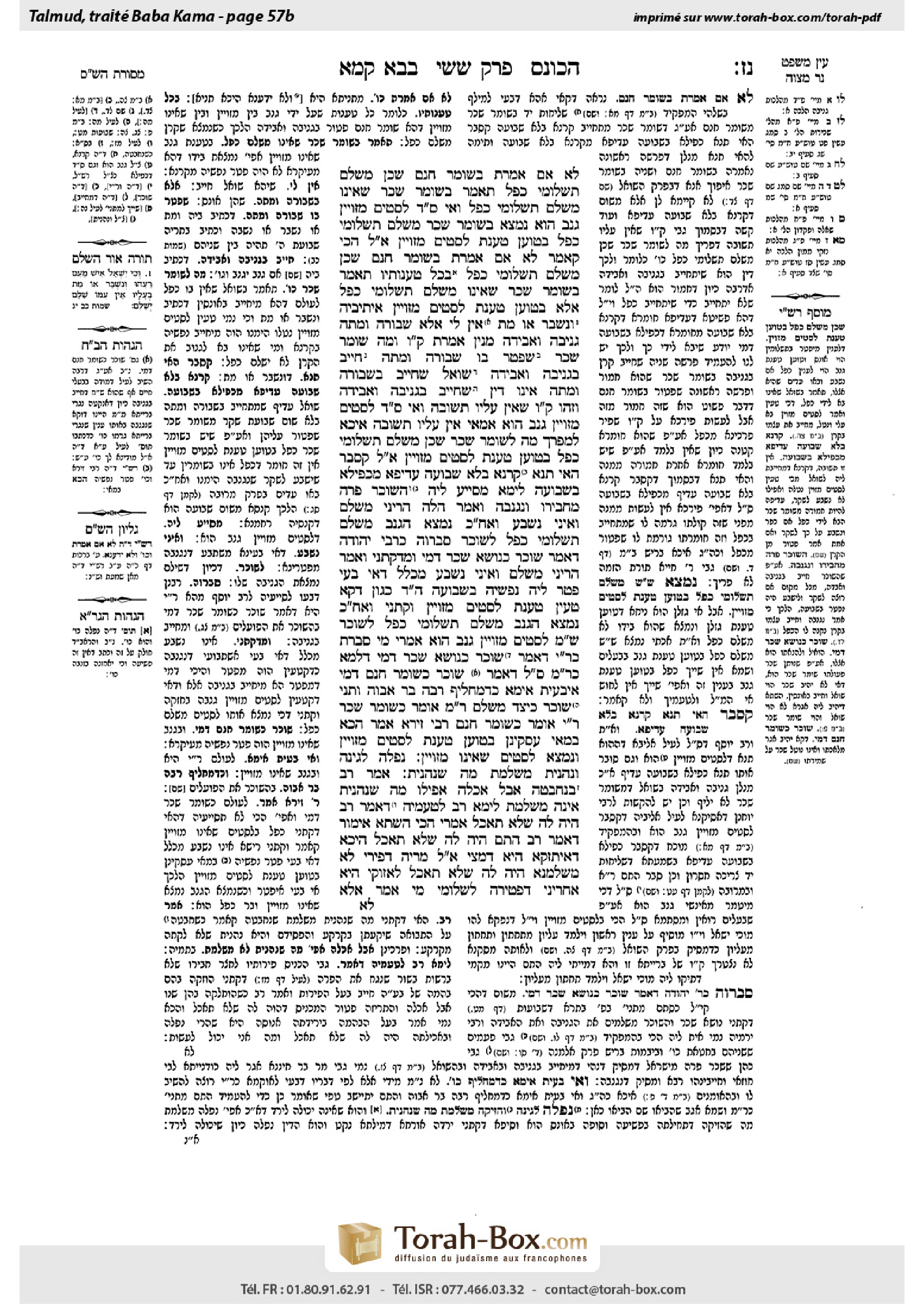
Bava Kamma 57b: Talmud study for Daf Yomi
Study the Talmud for Daf Yomi with scanned pages, Hebrew text, English translations from Sefaria and AI-generated French translations.
Passage selection and English or AI-generated French translation are available where the scan has annotations. Daf Study is independent of Torah-Box and Sefaria.
Browse Bava Kamma · בבא קמא · All tractatesBava Kamma 57b text and translations
This page of Bava Kamma includes the Aramaic text, an English translation and an AI-generated French translation, alongside the scan above.
בבא קמא נ״ז ב · Aramaic and Hebrew text
לֹא; אִם אָמַרְתָּ בְּשׁוֹמֵר חִנָּם – שֶׁכֵּן מְשַׁלֵּם תַּשְׁלוּמֵי כֶפֶל, תֹּאמַר בְּשׁוֹמֵר שָׂכָר – שֶׁאֵינוֹ מְשַׁלֵּם תַּשְׁלוּמֵי כֶפֶל?
וְאִי סָלְקָא דַעְתָּךְ לִסְטִים מְזוּיָּין גַּנָּב הוּא, נִמְצָא בְּשׁוֹמֵר שָׂכָר מְשַׁלֵּם תַּשְׁלוּמֵי כֶפֶל – בְּטוֹעֵן טַעֲנַת לִסְטִים מְזוּיָּין!
אֲמַר לֵיהּ, הָכִי קָאָמַר: לֹא; אִם אָמַרְתָּ בְּשׁוֹמֵר חִנָּם – שֶׁכֵּן מְשַׁלֵּם תַּשְׁלוּמֵי כֶפֶל בְּכׇל טַעֲנוֹתָיו, תֹּאמַר בְּשׁוֹמֵר שָׂכָר – שֶׁאֵינוֹ מְשַׁלֵּם תַּשְׁלוּמֵי כֶפֶל אֶלָּא בְּטוֹעֵן טַעֲנַת לִסְטִים מְזוּיָּין.
אֵיתִיבֵיהּ: ״וְנִשְׁבַּר אוֹ מֵת״ – אֵין לִי אֶלָּא שְׁבוּרָה וּמֵתָה, גְּנֵיבָה וַאֲבֵידָה מִנַּיִן? אָמַרְתָּ קַל וָחוֹמֶר – וּמָה שׁוֹמֵר שָׂכָר, שֶׁפָּטַר בּוֹ שְׁבוּרָה וּמֵתָה, חַיָּיב בִּגְנֵיבָה וַאֲבֵידָה; שׁוֹאֵל, שֶׁחַיָּיב בִּשְׁבוּרָה וּמֵתָה – אֵינוֹ דִּין שֶׁחַיָּיב בִּגְנֵיבָה וַאֲבֵידָה? וְזֶהוּ קַל וְחוֹמֶר שֶׁאֵין עָלָיו תְּשׁוּבָה.
וְאִי סָלְקָא דַּעְתָּךְ לִסְטִים מְזוּיָּין גַּנָּב הוּא, אַמַּאי אֵין עָלָיו תְּשׁוּבָה? אִיכָּא לְמִפְרַךְ: מָה לְשׁוֹמֵר שָׂכָר – שֶׁכֵּן מְשַׁלֵּם תַּשְׁלוּמֵי כֶפֶל בְּטוֹעֵן טַעֲנַת לִסְטִים מְזוּיָּין!
אֲמַר לֵיהּ, קָסָבַר הַאי תַּנָּא: קַרְנָא בְּלֹא שְׁבוּעָה עֲדִיפָא מִכְּפֵילָא בִּשְׁבוּעָה.
לֵימָא מְסַיַּיע לֵיהּ: הַשּׂוֹכֵר פָּרָה מֵחֲבֵירוֹ, וְנִגְנְבָה, וְאָמַר הַלָּה: ״הֲרֵינִי מְשַׁלֵּם וְאֵינִי נִשְׁבָּע״, וְאַחַר כָּךְ נִמְצָא הַגַּנָּב – מְשַׁלֵּם תַּשְׁלוּמֵי כֶפֶל לַשּׂוֹכֵר.
סַבְרוּהָ – כְּרַבִּי יְהוּדָה, דְּאָמַר: שׂוֹכֵר כְּנוֹשֵׂא שָׂכָר דָּמֵי; וּמִדְּקָתָנֵי: וְאָמַר ״הֲרֵינִי מְשַׁלֵּם וְאֵינִי נִשְׁבָּע״ – מִכְּלָל דְּאִי בָּעֵי, פָּטַר (לֵיהּ) נַפְשֵׁיהּ בִּשְׁבוּעָה.
הֵיכִי דָּמֵי – כְּגוֹן דְּקָא טָעֵין טַעֲנַת לִסְטִים מְזוּיָּין; וְקָתָנֵי: וְאַחַר כָּךְ נִמְצָא הַגַּנָּב – מְשַׁלֵּם תַּשְׁלוּמֵי כֶפֶל לַשּׂוֹכֵר; שְׁמַע מִינַּהּ: לִסְטִים מְזוּיָּין גַּנָּב הוּא!
אָמְרִי, מִי סָבְרַתְּ כְּרַבִּי יְהוּדָה – דְּאָמַר: שׂוֹכֵר כְּנוֹשֵׂא שָׂכָר דָּמֵי? דִּלְמָא כְּרַבִּי מֵאִיר סְבִירָא לֵיהּ, דְּאָמַר: שׂוֹכֵר כְּשׁוֹמֵר חִנָּם דָּמֵי.
אִיבָּעֵית אֵימָא, כִּדְמַחְלֵיף רַבָּה בַּר אֲבוּהּ וְתָנֵי: שׂוֹכֵר כֵּיצַד מְשַׁלֵּם? רַבִּי מֵאִיר אוֹמֵר: כְּשׁוֹמֵר שָׂכָר, רַבִּי יְהוּדָה אוֹמֵר: כְּשׁוֹמֵר חִנָּם.
רַבִּי זֵירָא אָמַר: הָכָא בְּמַאי עָסְקִינַן – בְּטוֹעֵן טַעֲנַת לִסְטִים מְזוּיָּין, וְנִמְצָא לִסְטִים שֶׁאֵינוֹ מְזוּיָּין.
נָפְלָה לְגִינָּה וְנֶהֱנֵית – מְשַׁלֶּמֶת מַה שֶּׁנֶּהֱנֵית. אָמַר רַב: בְּנֶחְבְּטָה;
אֲבָל אָכְלָה – אֲפִילּוּ מַה שֶּׁנֶּהֱנֵית אֵינָהּ מְשַׁלֶּמֶת. לֵימָא רַב לְטַעְמֵיהּ, דַּאֲמַר רַב: הָיָה לַהּ שֶׁלֹּא תֹּאכַל?
אָמְרִי: הָכִי הַשְׁתָּא?! אֵימוֹר דְּאָמַר רַב הָתָם ״הָיָה לַהּ שֶׁלֹּא תֹּאכַל״ – הֵיכָא דְּאִיתַּזְקָא הִיא, דְּמָצֵי אֲמַר לֵיהּ מָרֵיהּ דְּפֵירֵי: ״לָא מְשַׁלַּמְנָא, הָיָה לַהּ שֶׁלֹּא תֹּאכַל״; לְאַזּוֹקֵי הִיא אַחֲרִינֵי, דִּפְטִירָה לְשַׁלּוֹמֵי, מִי אָמַר?!
אֶלָּא
Bava Kamma 57b · English translation
No, if you say that this is the halakha with regard to an unpaid bailee, who pays a double payment, shall you also say that this is the case with regard to a paid bailee, who does not pay a double payment?
Abaye states his objection: And if it enters your mind to say that an armed bandit is considered like a thief, it turns out that there is a case where a paid bailee pays a double payment, and it is when he states the claim that the deposit was taken by an armed bandit.
Rav Yosef said to him: This is what the baraita is saying: No, if you say that this is the halakha with regard to an unpaid bailee, who pays a double payment for any claim that he makes concerning the theft of the item if he is subsequently found to be lying, shall you also say that this is the case with regard to a paid bailee, who pays a double payment for a false claim only when he states the claim that the deposit was taken by an armed bandit.
Abaye raised an objection to the opinion of Rav Yosef from that which is taught in another baraita: The Torah states with regard to a case where one borrows an object or an animal from another: “And it breaks or dies, he shall pay restitution [shalem yeshalem]” (Exodus 22:13). I have derived only that the borrower is liable in a case where the object or animal breaks or dies; but from where do I derive that he is also liable if it was stolen or lost? You can state the following a fortiori inference: And just as a paid bailee, whom the Torah rendered exempt in a case where the item breaks or dies, is nevertheless liable for a case of theft or loss, then with regard to a borrower, who is liable even if the item breaks or dies, is not it logical that he is liable for theft or loss? And this is an a fortiori inference that has no refutation.
And if it enters your mind to say that an armed bandit is considered like a thief, why is this an argument that has no refutation? It can be refuted as follows: What is notable about a paid bailee? He is notable in that he pays double payment if he states the claim that the deposit was taken by an armed bandit, whereas a borrower does not pay double in such a case, but only the principal amount.
Rav Yosef said to him: This tanna holds that the requirement of a borrower to pay the principal without having the option to exempt himself by taking an oath is stricter than the requirement of a paid bailee to pay the double payment when claiming that it was stolen by an armed bandit, as this obligation is in effect only where he took an oath. Therefore, this doubled payment pertaining to a paid bailee cannot be used as a refutation of the a fortiori inference.
The Gemara asks: Let us say that the following baraita supports Rav Yosef’s opinion: In the case of one who rents a cow from another and it is stolen, and this renter says: I will pay for it and I am not taking an oath that the cow was stolen, since I do not wish to take an oath, and afterward the thief is found, the thief pays the double payment to the renter and not to the owner.
The Gemara notes: The Sages who sought to use that baraita to support Rav Yosef’s opinion assumed that the baraita is in accordance with the opinion of Rabbi Yehuda, who says: A renter is like a paid bailee and is liable for theft or loss, but from the fact that it teaches: And he said: I will pay for it and I am not taking an oath that the cow was stolen, one can learn by inference that if the renter wants, he can exempt himself from payment by taking an oath.
The Gemara clarifies: What are the circumstances? Is it not a case where the renter states a claim that the item was taken by an armed bandit, in which case, as a paid bailee, he does not bear liability? And despite this, the baraita teaches: And if afterward the thief was found, the thief pays the double payment to the renter. Conclude from it that an armed bandit is considered like a thief.
The Gemara says in rejection of this proof: Do you maintain that this baraita is in accordance with the opinion of Rabbi Yehuda, who says that a renter is considered like a paid bailee? Perhaps this tanna holds in accordance with the opinion of Rabbi Meir, who says that a renter is considered like an unpaid bailee, and on account of that he is absolved of responsibility even if he claimed it was a regular theft.
Alternatively, if you wish, say that the baraita is referring to an unarmed bandit and is in accordance with the opinion of Rabba bar Avuh, who reversed the opinions and teaches as follows: How does a renter pay? Rabbi Meir says he has the same liability as a paid bailee, whereas Rabbi Yehuda says he has the same liability as an unpaid bailee. Therefore, even if this baraita is in accordance with the opinion of Rabbi Yehuda, it does not provide support for Rav Yosef’s opinion.
Rabbi Zeira said: Even without reversing the opinions, it is possible to explain that the baraita does not provide support for Rav Yosef’s opinion by saying as follows: With what are we dealing here? We are dealing with a case where the renter states the claim that the deposit was taken by an armed bandit, and so he could have absolved himself by taking an oath, but afterward it is found that it was stolen by an unarmed bandit. On account of this, the bandit pays the double payment to the renter. No conclusive proof is brought as to whether one who found a lost item has the status of a paid or unpaid bailee.
§ The mishna teaches: If the animal fell into a garden and derives benefit, the owner pays for the benefit that it derives. Rav says: This is referring to a case where the vegetables softened the impact of striking the ground, and the owner pays for this benefit of the animal being saved from injury.
The Gemara comments: This statement of Rav indicates that the owner pays only for what occurred while the animal landed, but if the animal then ate from the garden, the owner is not required to pay even for the benefit that the animal derives. Shall we say that Rav conforms to his standard line of reasoning? As Rav says that in a case where one placed his produce in the courtyard of another without permission, and an animal belonging to the owner of the courtyard ate the produce and was sickened thereby, the owner of the produce is not liable, as he can claim: The animal should not have eaten it. Similarly, here the owner of the animal can say: This animal fell through no fault of mine, and so it is not my fault that it ate.
The Sages of the Gemara say: How can these cases be compared? One could say that Rav said there that the animal should not have eaten the produce. This claim is relevant where the animal itself was injured by eating another’s produce, because the owner of the produce can say: I will not pay, because the animal should not have eaten. This is a claim to exempt the owner of the produce from paying the owner of the animal. Did Rav say that when the animal causes damage to another’s produce, the owner can exempt himself from paying the owner of the produce by stating this claim?
Rather,
Bava Kamma 57b · Traduction française (IA)
Non, si vous dites que c'est la halakha concernant un bailee non rémunéré, qui paie un double paiement, voudriez-vous aussi dire que c'est le cas concernant un bailee rémunéré, qui ne paie pas un double paiement ?
Abaye formule son objection : Et si cela entre dans votre esprit de dire qu'un bandit armé est considéré comme un voleur, il ressort qu'il y a un cas où un bailee rémunéré paie un double paiement, et c'est lorsqu'il formule la réclamation que le dépôt a été volé par un bandit armé.
Rav Yosef dit à lui : C'est ce que dit la baraïta : Non, si vous dites que c'est la halakha concernant un bailee non rémunéré, qui paie un double paiement pour toute réclamation qu'il formule concernant le vol de l'objet, si ensuite il est trouvé menteur, voudriez-vous aussi dire que c'est le cas concernant un bailee rémunéré, qui paie un double paiement pour une réclamation fausse uniquement lorsqu'il formule la réclamation que le dépôt a été volé par un bandit armé.
Abaye soulève une objection contre l'opinion de Rav Yosef à partir de ce qui est enseigné dans une autre baraïta : La Torah dit concernant un cas où l'on emprunte un objet ou un animal à un autre : « Et s'il se brise ou meurt, il paiera la réparation [shalem yeshalem] » (Exode 22:13). J'ai déduit seulement que le prêteur est responsable dans le cas où l'objet ou l'animal se brise ou meurt ; mais d'où déduis-je que le prêteur est également responsable si l'objet a été volé ou perdu ? Vous pouvez établir une inférence a fortiori comme suit : Et justement, un bailee rémunéré, dont la Torah rend l'exemption dans le cas où l'objet se brise ou meurt, est néanmoins responsable dans le cas de vol ou de perte, alors, concernant un prêteur, qui est responsable même si l'objet se brise ou meurt, n'est-il pas logique qu'il soit responsable du vol ou de la perte ? Et c'est une inférence a fortiori qui n'a pas d'objection.
Et si cela entre dans votre esprit de dire qu'un bandit armé est considéré comme un voleur, pourquoi cette argumentation n'a-t-elle pas d'objection ? Elle peut être réfutée comme suit : Qu'est-ce qui est notable concernant un bailee rémunéré ? Il est notable dans le cas où il formule la réclamation que le dépôt a été volé par un bandit armé, il paie un double paiement, alors que le prêteur ne paie pas un double paiement dans ce cas, mais seulement la somme principale.
Rav Yosef dit à lui : Ce tanna affirme que la responsabilité du prêteur de payer la somme principale sans avoir l'option de s'écarter en prenant un serment est plus stricte que la responsabilité du bailee rémunéré de payer un double paiement lorsqu'il formule la réclamation qu'il a été volé par un bandit armé, car cette obligation est en vigueur uniquement lorsqu'il a pris un serment. Par conséquent, ce double paiement concernant le bailee rémunéré ne peut pas être utilisé comme une réfutation de l'inférence a fortiori.
La Guemara pose la question : Supposons que la baraïta suivante soutienne l'opinion de Rav Yosef : Dans le cas où l'on loue un taureau à un autre et qu'il est volé, et que ce loueur dit : Je paierai pour cela et je ne veux pas prendre un serment que le taureau a été volé, et ensuite le voleur est trouvé, le voleur paie le double paiement au loueur et non à l'propriétaire.
La Guemara note : Les Sages qui ont cherché à utiliser cette baraïta pour soutenir l'opinion de Rav Yosef ont supposé que la baraïta est en conformité avec l'opinion de Rabbi Yehuda, qui dit : Le loueur est comme un bailee rémunéré et est responsable du vol ou de la perte, mais du fait qu'elle dit : Et il dit : Je paierai pour cela et je ne veux pas prendre un serment que le taureau a été volé, on peut en déduire par inférence que si le loueur le veut, il peut s'écarter de la responsabilité en prenant un serment.
La Guemara clarifie : Quelles sont les circonstances ? N'est-ce pas un cas où le loueur formule une réclamation que l'objet a été volé par un bandit armé, dans lequel cas, comme un bailee rémunéré, il ne porte pas de responsabilité ? Et malgré cela, la baraïta enseigne : Et si ensuite le voleur est trouvé, le voleur paie le double paiement au loueur. Concluez-en qu'un bandit armé est considéré comme un voleur.
La Guemara réfute cette preuve : Maintenez-vous que cette baraïta s'inspire de l'opinion de Rabbi Yéhuda, qui affirme qu'un locataire est considéré comme un bailee rémunéré ? Peut-être que ce tanna suit l'opinion de Rabbi Méir, qui considère le locataire comme un bailee non rémunéré, et à cause de cela, il est exempté de responsabilité même s'il affirme que c'est un vol ordinaire.
Alternativement, si vous le souhaitez, dites que la baraïta fait référence à un voleur non armé et s'inspire de l'opinion de Rabba bar Avoua, qui a inversé les opinions et enseigne comme suit : Comment un locataire paie-t-il ? Rabbi Méir dit qu'il a la même responsabilité qu'un bailee rémunéré, tandis que Rabbi Yéhuda dit qu'il a la même responsabilité qu'un bailee non rémunéré. Par conséquent, même si cette baraïta s'inspire de l'opinion de Rabbi Yéhuda, elle ne fournit pas de soutien à l'opinion de Rav Yosef.
Rabbi Zéira dit : Même sans inverser les opinions, il est possible d'expliquer que la baraïta ne fournit pas de soutien à l'opinion de Rav Yosef en disant comme suit : De quoi sommes-nous en train de parler ? Nous parlons d'un cas où le locataire formule la réclamation que le dépôt a été volé par un voleur armé, et donc il aurait pu s'écarter de la responsabilité en prenant un serment, mais ensuite il est découvert que l'objet a été volé par un voleur non armé. À cause de cela, le voleur paie le double au locataire. Il n'y a pas de preuve concluante concernant le statut d'une personne qui a trouvé un objet perdu, qu'il soit un bailee rémunéré ou non.
§ La mitsva enseigne : Si l'animal tombe dans un jardin et en tire un bénéfice, l'propriétaire paie pour le bénéfice qu'il en tire. Rav dit : Cela fait référence à un cas où les légumes ont atténué l'impact de la chute, et l'propriétaire paie pour ce bénéfice de l'animal ayant été sauvé d'une blessure.
La Guemara commente : Cette déclaration de Rava indique que le propriétaire paie uniquement pour ce qui s'est produit pendant que l'animal est tombé, mais si l'animal a ensuite mangé dans le jardin, le propriétaire n'est pas tenu de payer même pour le bénéfice que l'animal a tiré. Devons-nous dire que Rava suit sa ligne de raisonnement habituelle ? Comme Rava dit qu'en cas où l'on place ses produits dans le courtil d'autrui sans permission, et qu'un animal appartenant au propriétaire du courtil mange les produits et s'empoisonne, le propriétaire des produits n'est pas responsable, car il peut affirmer : L'animal ne devrait pas avoir mangé les produits. De même, ici, le propriétaire de l'animal peut dire : Cet animal est tombé sans faute de ma part, et donc ce n'est pas ma faute s'il a mangé.
Les Sages de la Guemara disent : Comment peuvent ces cas être comparés ? On pourrait dire que Rava a dit là que l'animal ne devrait pas avoir mangé les produits. Cette affirmation est pertinente dans le cas où l'animal lui-même a été blessé en mangeant les produits d'autrui, car le propriétaire des produits peut dire : Je ne paierai pas, car l'animal ne devrait pas avoir mangé. C'est une revendication pour exempter le propriétaire des produits de payer au propriétaire de l'animal. Rava a-t-il dit que lorsqu'un animal cause des dommages aux produits d'autrui, le propriétaire peut s'émanciper de payer au propriétaire des produits en affirmant cette revendication ?
Plutôt,
Traduction française générée par IA à partir de l’édition anglaise de Sefaria. Vérifie toujours un passage avec le texte source.
Text from Sefaria: William Davidson Edition - Vocalized Aramaic (CC BY NC); William Davidson Edition - English (CC BY NC).