Bava Kamma 58a: Talmud study for Daf Yomi
Study the Talmud for Daf Yomi with scanned pages, Hebrew text, English translations from Sefaria and AI-generated French translations.
Passage selection and English or AI-generated French translation are available where the scan has annotations. Daf Study is independent of Torah-Box and Sefaria.
Browse Bava Kamma · בבא קמא · All tractatesBava Kamma 58a text and translations
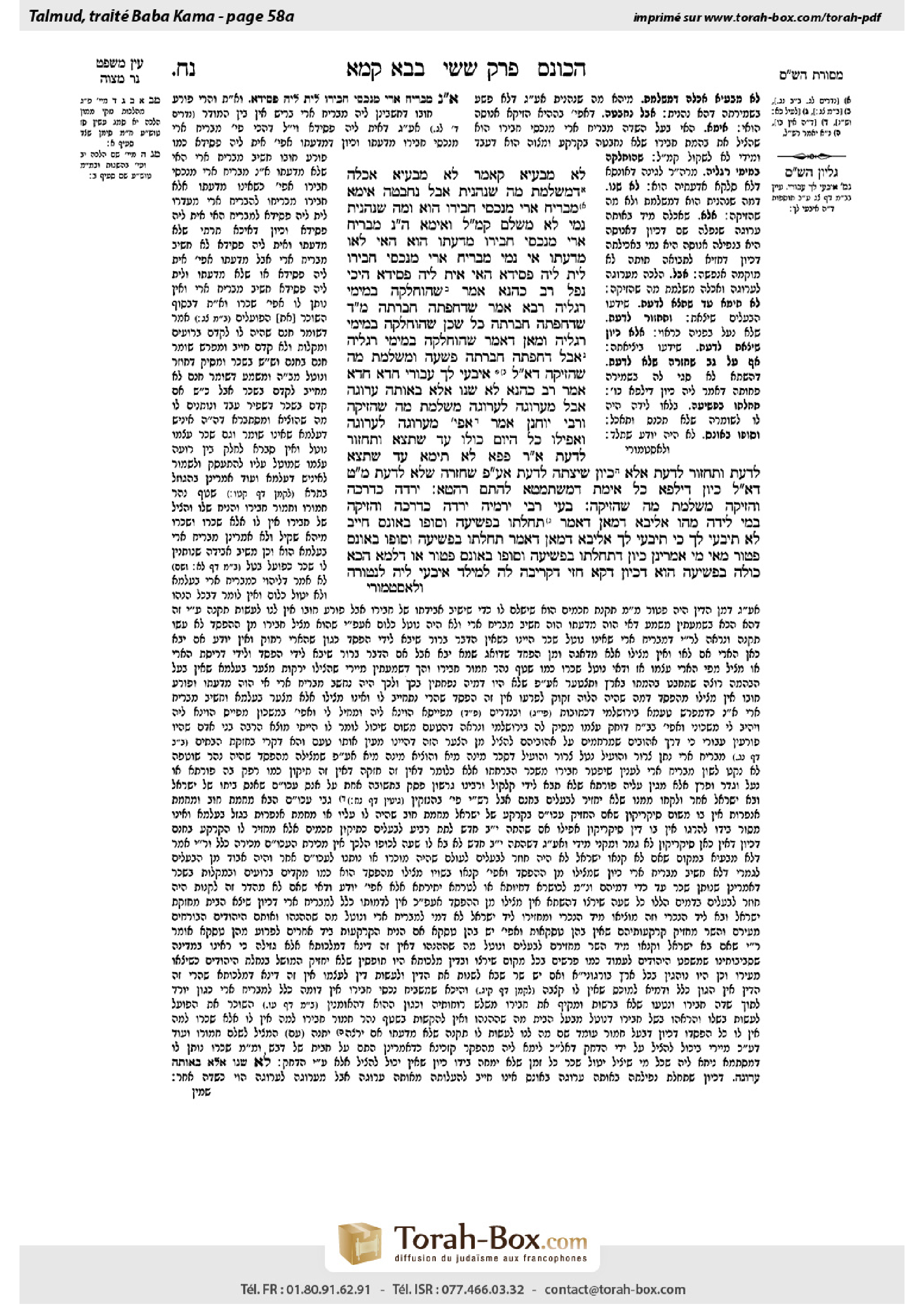
This page of Bava Kamma includes the Aramaic text, an English translation and an AI-generated French translation, alongside the scan above.
בבא קמא נ״ח א · Aramaic and Hebrew text
״לָא מִבַּעְיָא״ קָאָמַר: לָא מִבַּעְיָא אָכְלָה – דִּמְשַׁלֶּמֶת מַה שֶּׁנֶּהֱנֵית; אֲבָל נֶחְבְּטָה – אֵימָא מַבְרִיחַ אֲרִי מִנִּכְסֵי חֲבֵירוֹ הוּא, וּמַה שֶּׁנֶּהֱנֵית נָמֵי לָא מְשַׁלֵּם; קָא מַשְׁמַע לַן.
וְאֵימָא הָכִי נָמֵי!
מַבְרִיחַ אֲרִי מִנִּכְסֵי חֲבֵירוֹ – מִדַּעְתּוֹ הוּא, הַאי – לָאו מִדַּעְתּוֹ. אִי נָמֵי, מַבְרִיחַ אֲרִי מִנִּכְסֵי חֲבֵירוֹ – לֵית לֵיהּ פְּסֵידָא, הַאי – אִית לֵיהּ פְּסֵידָא.
הֵיכִי נָפַל? רַב כָּהֲנָא אָמַר: שֶׁהוּחְלְקָה בְּמֵימֵי רַגְלֶיהָ, רָבָא אָמַר: שֶׁדְּחָפַתָּה חֲבֶרְתָּהּ.
מַאן דְּאָמַר שֶׁדְּחָפַתָּה חֲבֶרְתָּהּ – כׇּל שֶׁכֵּן שֶׁהוּחְלְקָה בְּמֵימֵי רַגְלֶיהָ. וּמַאן דְּאָמַר שֶׁהוּחְלְקָה בְּמֵימֵי רַגְלֶיהָ – אֲבָל דְּחָפַתָּה חֲבֶרְתָּהּ, פָּשְׁעָה, וּמְשַׁלֶּמֶת מַה שֶּׁהִזִּיקָה; דַּאֲמַר לֵיהּ: אִיבְּעִי לָךְ עַבּוֹרֵי חֲדָא חֲדָא.
אָמַר רַב כָּהֲנָא: לֹא שָׁנוּ אֶלָּא בְּאוֹתָהּ עֲרוּגָה, אֲבָל מֵעֲרוּגָה לַעֲרוּגָה – מְשַׁלֶּמֶת מַה שֶּׁהִזִּיקָה. וְרַבִּי יוֹחָנָן אָמַר: אֲפִילּוּ מֵעֲרוּגָה לַעֲרוּגָה, וַאֲפִילּוּ כׇּל הַיּוֹם כּוּלּוֹ – עַד שֶׁתֵּצֵא וְתַחֲזוֹר לְדַעַת.
אָמַר רַב פָּפָּא: לָא תֵּימָא עַד שֶׁתֵּצֵא לְדַעַת וְתַחֲזוֹר לְדַעַת, אֶלָּא כֵּיוָן שֶׁיָּצְתָה לְדַעַת – אַף עַל פִּי שֶׁחָזְרָה שֶׁלֹּא לְדַעַת. מַאי טַעְמָא? דַּאֲמַר לֵיהּ: כֵּיוָן דְּיָלְפָא, כֹּל אֵימַת דְּמִשְׁתַּמְטָא – לְהָתָם רָהֲטָא.
יָרְדָה כְּדַרְכָּהּ וְהִזִּיקָה – מְשַׁלֶּמֶת מַה שֶּׁהִזִּיקָה. בָּעֵי רַבִּי יִרְמְיָה: יָרְדָה כְּדַרְכָּהּ וְהִזִּיקָה בְּמֵי לֵידָה, מַהוּ?
אַלִּיבָּא דְּמַאן דְּאָמַר תְּחִלָּתוֹ בִּפְשִׁיעָה וְסוֹפוֹ בְּאוֹנֶס חַיָּיב, לָא תִּיבְּעֵי לָךְ; כִּי תִּיבְּעֵי לָךְ – אַלִּיבָּא דְּמַאן דְּאָמַר תְּחִלָּתוֹ בִּפְשִׁיעָה וְסוֹפוֹ בְּאוֹנֶס פָּטוּר; מַאי?
מִי אָמְרִינַן: כֵּיוָן דִּתְחִלָּתוֹ בִּפְשִׁיעָה וְסוֹפוֹ בְּאוֹנֶס – פָּטוּר; אוֹ דִלְמָא, הָכָא כּוּלַּהּ בִּפְשִׁיעָה הוּא – דְּכֵיוָן דְּקָא חָזֵי דִּקְרִיבָה לַהּ לְמֵילַד, אִיבְּעִי לֵיהּ לְנָטוֹרַהּ
Bava Kamma 58a · English translation
one cannot make such an inference from Rav’s statement. Rav is speaking utilizing the style of: It is not necessary, and this is how to understand his statement: It is not necessary to state that if the animal fell into the garden and ate from its produce, that the owner pays for the benefit that it derives. But if the produce softened the blow of striking the ground and thereby the animal avoided injury, one might say that the owner of the animal should not pay, on the grounds that the owner of the garden may be viewed, analogously, to one who repels a lion from another’s property. In such a case, although the latter benefited from his action, he is not obligated to pay for it. Similarly in this case, one might think that the owner of the animal does not pay even for the benefit that the animal derived. For this reason Rav teaches us that the owner of the animal must pay for this benefit as well.
The Gemara asks: But why not say that this is indeed the halakha, and the owner of the animal should be exempt for paying for the benefit of his animal not being injured?
The Gemara answers: One who repels a lion from another’s property does so with intent, knowing that he would be ineligible for payment. By contrast, this owner of the garden did not act with intent and would have preferred for the incident not to have happened. Alternatively, one could say that one who repels a lion from another’s property does not thereby have any loss himself. By contrast, this owner of the garden has a loss, in that his produce is damaged.
The Gemara asks: How did the animal fall? In which case does this halakha apply? Rav Kahana says: It slipped on its own urine. Rava says: Another animal belonging to the same owner pushed it, causing it to fall there.
The Gemara explains: Rava, the one who says that the mishna is referring to a case where another animal pushed it, in which case the owner pays only for the benefit that the animal derived and is exempt from paying for the damage caused, holds that all the more so this halakha would apply in a case where it slipped on its urine, which is beyond the owner’s control. But Rav Kahana, the one who says that the mishna is referring to a case where the animal slipped on its urine, holds that if, however, another animal pushed it, this indicates that the owner was negligent and should have prevented this happening. Therefore, in such a case, the owner pays for what his animal damaged, since the owner of the garden can say to the owner of the animal: You should have led your animals across one by one, so that they would not be able to push each other.
Rav Kahana says: They taught only that the owner pays for the benefit that it derives in the same garden bed into which it fell, but if it went from one garden bed to another garden bed and ate from that one, the owner pays for what it damaged. And Rabbi Yoḥanan says: Even if the animal goes from one garden bed to another garden bed and eats, and even if the animal continues going from one bed to another and eating for the entire day, the owner pays only for the benefit that the animal derived and not for what it damaged, unless it leaves the garden entirely and returns with the owner’s knowledge.
Rav Pappa said, explaining Rabbi Yoḥanan’s statement: Do not say this means: Unless the animal leaves with the owner’s knowledge and returns with his knowledge; rather, once it leaves the garden with the owner’s knowledge, even if it returned without his knowledge, the owner is liable to pay for what it damaged. What is the reason for this? It is that the owner of the garden can say to the owner of the animal: Since the animal has now learned that the garden is there with food to eat, every time it strays it will run to there.
§ The mishna teaches: If the animal descended into the garden in its usual manner and caused damage there, the owner pays for what it damaged. Rabbi Yirmeya asks: If the animal descended in its usual manner and gave birth to a calf there and damaged the produce with amniotic fluid, what is the halakha? Does the owner of the animal have to pay for this damage?
The Gemara clarifies Rabbi Yirmeya’s question: Do not raise the dilemma in accordance with the opinion of the one who says that one is liable in a case of damage that is initially through negligence and ultimately by accident, since in this case the owner was negligent in allowing the animal to enter another person’s courtyard, although the actual causing of the damage was ultimately by accident. When should you raise this dilemma? Raise it in accordance with the opinion of the one who says that one is exempt in a case that is initially through negligence and ultimately by accident. What is the halakha in this case?
The two sides of the question are as follows: Do we say that, since this case is initially through negligence and ultimately by accident, he is exempt from liability? Or perhaps here, in this case, it is entirely due to his negligence; since he saw that the animal was close to giving birth, he should have safeguarded it adequately
Bava Kamma 58a · Traduction française (IA)
On ne peut pas tirer une telle conclusion de la déclaration de Rav. Rav parle en utilisant le style suivant : Il n'est pas nécessaire, et c'est ainsi qu'on doit comprendre sa déclaration : Il n'est pas nécessaire de préciser que si l'animal est tombé dans le jardin et a mangé de ses récoltes, l'propriétaire paie le bénéfice que l'animal a tiré. Mais si les récoltes ont atténué la violence du coup porté au sol et que l'animal a ainsi évité la blessure, on pourrait dire que l'propriétaire de l'animal ne doit pas payer, sur la base du fait que l'propriétaire du jardin peut être comparé à celui qui repousse un lion d'une propriété d'autrui. Dans ce cas, bien que l'autre ait bénéficié de son action, il n'est pas tenu de payer. De même, dans ce cas, on pourrait penser que l'propriétaire de l'animal ne paie pas non plus pour le bénéfice que l'animal a tiré. C'est pourquoi Rav nous enseigne que l'propriétaire de l'animal doit payer pour ce bénéfice également.
La Guemara demande : Mais pourquoi ne pas dire que c'est effectivement la halakha, et que l'propriétaire de l'animal est exempt de payer pour le bénéfice de son animal n'ayant pas été blessé ?
La Guemara répond : Celui qui repousse un lion d'une propriété d'autrui le fait avec l'intention, sachant qu'il ne serait pas éligible à une réparation. À l'inverse, l'propriétaire du jardin n'a pas agi avec l'intention et aurait préféré que l'incident ne se produise pas. Une autre possibilité est que celui qui repousse un lion d'une propriété d'autrui n'a pas subi de perte lui-même. À l'inverse, l'propriétaire du jardin a subi une perte, en ce que ses récoltes sont endommagées.
La Guemara demande : Comment l'animal est-il tombé ? Dans quel cas cette halakha s'applique-t-elle ? Rav Kahana dit : Il a glissé sur son propre urine. Rava dit : Un autre animal appartenant au même propriétaire l'a poussé, ce qui a causé sa chute.
La Guemara explique : Rava, celui qui dit que la mitsna fait référence à un cas où un autre animal l'a poussé, dans lequel cas l'propriétaire paie uniquement pour le bénéfice que l'animal a tiré et est exempt de payer pour les dommages causés, considère que cette halakha s'applique encore plus dans un cas où l'animal a glissé sur son urine, ce qui est au-delà du contrôle de l'propriétaire. Mais Rav Kahana, celui qui dit que la mitsna fait référence à un cas où l'animal a glissé sur son urine, considère que si, cependant, un autre animal l'a poussé, cela indique que l'propriétaire a été négligent et aurait dû empêcher cela. Ainsi, dans ce cas, l'propriétaire paie pour les dommages causés par son animal, car l'propriétaire du jardin peut dire à l'propriétaire de l'animal : Vous auriez dû faire traverser vos animaux un par un, afin qu'ils ne puissent pas pousser les uns les autres.
Rav Kahana dit : Ils ont enseigné seulement que l'propriétaire paie pour le bénéfice que l'animal a tiré dans le même lit de jardin où il est tombé, mais si l'animal est passé d'un lit de jardin à un autre et a mangé de celui-ci, l'propriétaire paie pour les dommages causés. Et Rabbi Yoḥanan dit : Même si l'animal passe d'un lit de jardin à un autre et mange, et même s'il continue à passer d'un lit à un autre et à manger toute la journée, l'propriétaire paie uniquement pour le bénéfice que l'animal a tiré et non pour les dommages causés, sauf s'il quitte le jardin entièrement et revient avec la connaissance de l'propriétaire.
Rav Pappa a dit, expliquant la déclaration de Rabbi Yoḥanan : Ne dis pas cela signifie : Sauf si l'animal quitte avec la connaissance de l'propriétaire et revient avec sa connaissance ; plutôt, une fois que l'animal a quitté le jardin avec la connaissance de l'propriétaire, même s'il est revenu sans sa connaissance, l'propriétaire est tenu de payer pour les dommages causés. Quelle est la raison de cela ? C'est que l'propriétaire du jardin peut dire à l'propriétaire de l'animal : Puisque l'animal a maintenant appris que le jardin est là avec de la nourriture à manger, chaque fois qu'il s'éloigne, il ira là.
§ La mitsna enseigne : Si l'animal est descendu dans le jardin selon son habitude et a causé des dommages là, l'propriétaire paie pour les dommages causés. Rabbi Yirmeya demande : Si l'animal est descendu selon son habitude et a donné naissance à un veau là et a causé des dommages avec le liquide amniotique, quelle est la halakha ? L'propriétaire de l'animal doit-il payer pour ce dommage ?
La Guemara clarifie la question de Rabbi Yirmeya : Ne posez pas cette question selon l'opinion de celui qui dit qu'on est tenu responsable d'un dommage qui est d'abord par négligence et finalement par accident, car dans ce cas, l'propriétaire a été négligent en permettant à l'animal d'entrer dans la cour d'autrui, bien que le dommage ait été finalement causé par accident. Quand devriez-vous poser cette question ? Posez-la selon l'opinion de celui qui dit qu'on est exempt d'un cas qui est d'abord par négligence et finalement par accident. Quelle est la halakha dans ce cas ?
Les deux côtés de la question sont les suivants : Disons-nous que, puisque ce cas est d'abord par négligence et finalement par accident, il est exempt de responsabilité ? Ou peut-être ici, dans ce cas, c'est entièrement dû à sa négligence ; puisque l'propriétaire a vu que l'animal était proche de donner naissance, il aurait dû le garder convenablement
Traduction française générée par IA à partir de l’édition anglaise de Sefaria. Vérifie toujours un passage avec le texte source.
Text from Sefaria: William Davidson Edition - Vocalized Aramaic (CC BY NC); William Davidson Edition - English (CC BY NC).