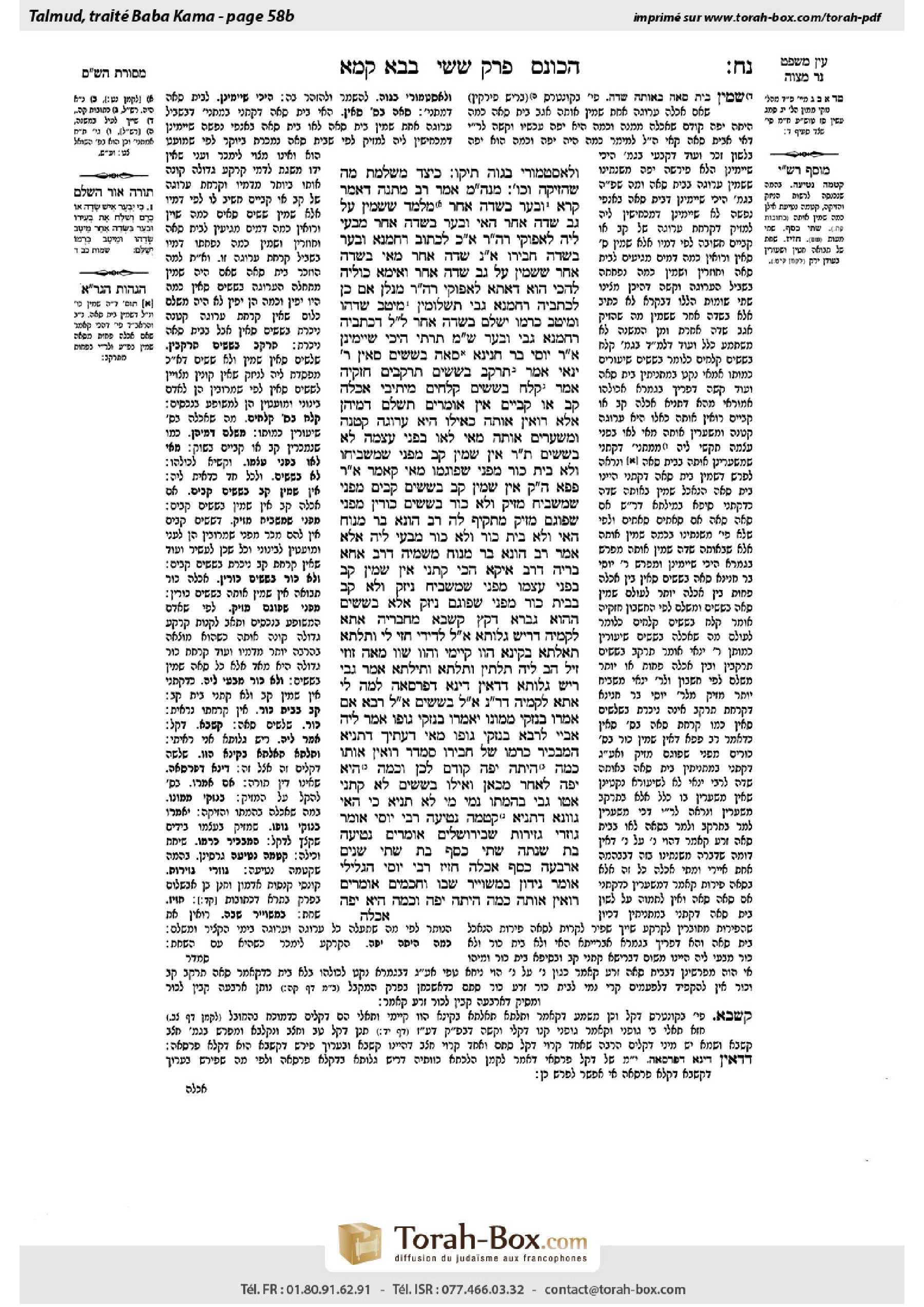
Bava Kamma 58b: Talmud study for Daf Yomi
Study the Talmud for Daf Yomi with scanned pages, Hebrew text, English translations from Sefaria and AI-generated French translations.
Passage selection and English or AI-generated French translation are available where the scan has annotations. Daf Study is independent of Torah-Box and Sefaria.
Browse Bava Kamma · בבא קמא · All tractatesBava Kamma 58b text and translations
This page of Bava Kamma includes the Aramaic text, an English translation and an AI-generated French translation, alongside the scan above.
בבא קמא נ״ח ב · Aramaic and Hebrew text
וּלְאִסְתַּמּוֹרֵי בְּגַוַּהּ? תֵּיקוּ.
כֵּיצַד מְשַׁלֶּמֶת מַה שֶּׁהִזִּיקָה וְכוּ׳. מְנָא הָנֵי מִילֵּי?
אָמַר רַב מַתְנָה, דְּאָמַר קְרָא: ״וּבִעֵר בִּשְׂדֵה אַחֵר״ – מְלַמֵּד שֶׁשָּׁמִין עַל גַּב שָׂדֶה אַחֵר.
הַאי ״וּבִעֵר בִּשְׂדֵה אַחֵר״ מִבְּעֵי לֵיהּ לְאַפּוֹקֵי רְשׁוּת הָרַבִּים!
אִם כֵּן, לִכְתּוֹב רַחֲמָנָא ״וּבִעֵר בִּשְׂדֵה חֲבֵירוֹ״, אִי נָמֵי ״שְׂדֵה אַחֵר״! מַאי ״בִּשְׂדֵה אַחֵר״? שֶׁשָּׁמִין עַל גַּב שָׂדֶה אַחֵר.
וְאֵימָא כּוּלֵּיהּ לְהָכִי הוּא דַּאֲתָא; לְאַפּוֹקֵי רְשׁוּת הָרַבִּים מְנָלַן?
אִם כֵּן, לִכְתְּבֵיהּ רַחֲמָנָא גַּבֵּי תַשְׁלוּמִין – ״מֵיטַב שָׂדֵהוּ וּמֵיטַב כַּרְמוֹ יְשַׁלֵּם בִּשְׂדֵה אַחֵר״! לְמָה לִי דְּכַתְבֵיהּ רַחֲמָנָא גַּבֵּי ״וּבִעֵר״? שְׁמַע מִינַּהּ תַּרְתֵּי.
הֵיכִי שָׁיְימִינַן? אָמַר רַבִּי יוֹסֵי בַּר חֲנִינָא: סְאָה בְּשִׁשִּׁים סְאִין. רַבִּי יַנַּאי אָמַר: תַּרְקַב בְּשִׁשִּׁים תַּרְקַבִּים. חִזְקִיָּה אָמַר: קֶלַח בְּשִׁשִּׁים קְלָחִים.
מֵיתִיבִי: אָכְלָה קַב אוֹ קַבַּיִים – אֵין אוֹמְרִים תְּשַׁלֵּם דְּמֵיהֶן, אֶלָּא רוֹאִין אוֹתָהּ כְּאִילּוּ הִיא עֲרוּגָה קְטַנָּה, וּמְשַׁעֲרִים אוֹתָהּ. מַאי, לָאו בִּפְנֵי עַצְמָהּ?
לָא, בְּשִׁשִּׁים.
תָּנוּ רַבָּנַן: אֵין שָׁמִין קַב – מִפְּנֵי שֶׁמַּשְׁבִּיחוֹ, וְלֹא בֵּית כּוֹר – מִפְּנֵי שֶׁפּוֹגְמוֹ.
מַאי קָאָמַר? אָמַר רַב פָּפָּא, הָכִי קָאָמַר: אֵין שָׁמִין קַב בְּשִׁשִּׁים קַבִּים – מִפְּנֵי שֶׁמַּשְׁבִּיחַ מַזִּיק, וְלֹא כּוֹר בְּשִׁשִּׁים כּוֹרִין – מִפְּנֵי שֶׁפּוֹגֵם מַזִּיק.
מַתְקֵיף לַהּ רַב הוּנָא בַּר מָנוֹחַ: הַאי ״וְלֹא בֵּית כּוֹר״?! ״וְלֹא כּוֹר״ מִבְּעֵי לֵיהּ!
אֶלָּא אָמַר רַב הוּנָא בַּר מָנוֹחַ מִשְּׁמֵיהּ דְּרַב אַחָא בְּרֵיהּ דְּרַב אִיקָא, הָכִי קָתָנֵי: אֵין שָׁמִין קַב בִּפְנֵי עַצְמוֹ – מִפְּנֵי שֶׁמַּשְׁבִּיחַ נִיזָּק, וְלֹא קַב בְּבֵית כּוֹר – מִפְּנֵי שֶׁפּוֹגֵם נִיזָּק; אֶלָּא בְּשִׁשִּׁים.
הָהוּא גַּבְרָא דְּקַץ קַשְׁבָּא מֵחַבְרֵיהּ. אֲתָא לְקַמֵּיהּ דְּרֵישׁ גָּלוּתָא, אֲמַר לֵיהּ: לְדִידִי חֲזֵי לִי, וּתְלָתָא תָּאלָתָא בְּקִינָּא הֲווֹ קָיְימִי, וַהֲווֹ שָׁווּ מְאָה זוּזֵי. זִיל הַב לֵיהּ תְּלָתִין וּתְלָתָא וְתִילְתָּא. אָמַר: גַּבֵּי רֵישׁ גָּלוּתָא דְּדָאֵין דִּינָא דְּפָרְסָאָה, לְמָה לִי? אֲתָא לְקַמֵּיהּ דְּרַב נַחְמָן, אֲמַר לֵיהּ: בְּשִׁשִּׁים.
אֲמַר לֵיהּ רָבָא: אִם אָמְרוּ בְּנִזְקֵי מָמוֹנוֹ, יֹאמְרוּ בְּנִזְקֵי גוּפוֹ?!
אֲמַר לֵיהּ אַבָּיֵי לְרָבָא: בְּנִזְקֵי גוּפוֹ מַאי דַּעְתָּיךְ – דְּתַנְיָא: הַמַּבְכִּיר כַּרְמוֹ שֶׁל חֲבֵירוֹ סְמָדַר – רוֹאִין אוֹתוֹ כַּמָּה הָיָה יָפֶה קוֹדֶם לָכֵן, וְכַמָּה הוּא יָפֶה לְאַחַר מִכָּאן; וְאִילּוּ בְּשִׁשִּׁים לָא קָתָנֵי?
אַטּוּ גַּבֵּי בְהֶמְתּוֹ נָמֵי מִי לָא תַּנְיָא כִּי הַאי גַוְונָא?! דְּתַנְיָא: קָטְמָה נְטִיעָה – רַבִּי יוֹסֵי אוֹמֵר, גּוֹזְרֵי גְזֵירוֹת שֶׁבִּירוּשָׁלַיִם אוֹמְרִים: נְטִיעָה בַּת שְׁנָתָהּ – שְׁתֵּי כֶּסֶף, בַּת שְׁתֵּי שָׁנִים – אַרְבָּעָה כֶּסֶף. אָכְלָה חֲזִיז – רַבִּי יוֹסֵי הַגְּלִילִי אוֹמֵר: נִידּוֹן בַּמְשׁוּיָּיר שֶׁבּוֹ, וַחֲכָמִים אוֹמְרִים: רוֹאִין אוֹתָהּ כַּמָּה הָיְתָה יָפָה, וְכַמָּה הִיא יָפָה.
Bava Kamma 58b · English translation
and taken care of it, and he bears responsibility for failing to do so. The dilemma shall stand unresolved.
§ The mishna teaches: How does the court appraise the value of the damage when the owner pays for what it damaged? The court appraises a large piece of land with an area required for sowing one se’a of seed [beit se’a] in that field, including the garden bed in which the damage took place, it appraises how much it was worth before the animal damaged it and how much is it worth now, and the owner must pay the difference. The Gemara asks: From where are these matters derived?
Rav Mattana says: As the verse states: “And it feed in another field [uvi’er bisde aḥer]” (Exodus 22:4). This teaches that the court appraises the damage relative to another field, i.e., relative to the damaged field as a whole and not an appraisal of only the specific garden bed that was damaged.
The Gemara asks: But this phrase: “Uvi’er bisde aḥer,” can be understood as meaning: “And it feed in another’s field,” and accordingly, is necessary to teach that the owner is not liable unless it was a field with an owner, to exclude damage caused by an animal in the public domain, for which the owner is not liable.
The Gemara answers: If so, if this was the sole intention of the verse, let the Merciful One write in the Torah: And it feed in a field belonging to another [uvi’er bisde ḥaveiro], or alternatively, let it write: And it consume another field [sedeh aḥer].” What is conveyed by the particular expression: “In another field [bisde aḥer]”? It is to teach that the court appraises the damage relative to another field.
But why not say that this verse comes entirely for this purpose, i.e., to teach that the court appraises the damage relative to another field? And in that case, from where do we derive the exclusion of liability for damage by Eating in the public domain?
The Gemara answers: If it is so that the verse was referring solely to the method of appraising the damage, the Merciful One should have written this in the Torah in the context of payment, as follows: His best-quality field and the best quality of his vineyard he shall pay in another field (see Exodus 22:4), thereby adding the term: In another field, and, by extension, the directive concerning how the damage is appraised, to the verse discussing payment. Why do I need the Merciful One to write it in the context of the act of damaging, in the verse: “And it feed in another field”? Conclude two conclusions from it: The verse is referring to both the place where the damage occurred and the method by which the damage is appraised.
§ The Gemara asks: How do we, the court, appraise the value of the damage? Rabbi Yosei bar Ḥanina says: The court appraises the value of an area required for sowing one se’a of seed [beit se’a] relative to an area required for sowing sixty se’a of seed, and according to this calculation determines the value of the damage. Rabbi Yannai says: The court appraises each tarkav, equivalent to half a beit se’a, relative to an area of sixty tarkav. Ḥizkiyya says: The court appraises the value of each stalk eaten relative to sixty stalks.
The Gemara raises an objection from a baraita: If an animal ate one kav or two kav, the court does not say that the owner pays compensation according to their value, i.e., the value of the actual damage; rather, they view it as if it were a small garden bed and evaluate it accordingly. What, is it not that this means that the court evaluates that garden bed according to what it would cost if sold by itself, which contradicts all the previous explanations?
The Gemara rejects this interpretation: No, it means that the court appraises the value in relation to an area sixty times greater.
The Sages taught: When appraising the damage, the court does not appraise it based on an area of a beit kav, because doing so enhances his position, and they also do not appraise it relative to an area of a beit kor, equivalent to the area in which one can plant thirty se’a of seed, because this weakens his position.
The Gemara asks: What is this baraita saying? Rav Pappa said: This is what the baraita is saying: The court does not appraise the value of one kav relative to an area of sixty kav, which, being too large for an individual but too small for a trader, is always sold in the market at a lower price, because that would enhance the position of the one liable for damage. Conversely, the court does not appraise the value of a kor relative to an area of sixty kor, an area so large that it is purchased only by a person with a specific need and therefore for a high price, because that would weaken the position of the one liable for damage.
Rav Huna bar Manoaḥ objects to this: According to this interpretation, this term employed by the baraita: And they also do not appraise it relative to an area of a beit kor, is imprecise. According to the explanation of Rav Pappa, the baraita should have said: And they also do not appraise it relative to a kor, to parallel the term in the previous clause: A kav.
Rather, Rav Huna bar Manoaḥ said in the name of Rav Aḥa, son of Rav Ika, that this is what the baraita is teaching: The court does not appraise a kav by itself, because that would enhance the position of the injured party, nor does the court appraise a kav as one part of a beit kor, because that would weaken the position of the injured party, since damage inside such a large area is insignificant. Rather, the court appraises the damage in relation to an area sixty times greater than the area that was damaged.
§ The Gemara relates: There was a certain man who cut down a date palm [kashba] belonging to another. The latter came with the perpetrator for arbitration before the Exilarch. The Exilarch said to the perpetrator: I personally saw that place where the date palm was planted, and it actually contained three date palms [talata] standing together in a cluster, growing out of a single root, and they were worth altogether one hundred dinars. Consequently, since you, the perpetrator, cut down one of the three, go and give him thirty-three and one-third dinars, one third of the total value. The perpetrator rejected this ruling and said: Why do I need to be judged by the Exilarch, who rules according to Persian law? He came before Rav Naḥman for judgment in the same case, who said to him: The court appraises the damage in relation to an area sixty times greater than the damage caused. This amount is much less than thirty-three and one-third dinars.
Rava said to Rav Naḥman: If the Sages said that the court appraises damage caused by one’s property, such as his animal, relative to an area sixty times greater, would they also say that the court appraises damage relative to an area sixty times greater even for direct damage caused by one’s body?
Abaye said to Rava: With regard to damage caused by one’s body, what is your opinion? Are you basing your opinion on the following, as it is taught in a baraita: If one destroys the vineyard of another while the grapes are budding [semadar], the court views how much the vineyard was worth before he destroyed it, and how much it is worth afterward. Abaye states the inference: Whereas, the method of appraising one part in sixty is not taught. Is the basis of your ruling the fact that in this baraita that discusses damage caused directly by a person, the method of appraising one part in sixty is not mentioned?
Abaye continued: Is that to say that with regard to damage caused by an animal it is not taught in a mishna or baraita without mentioning the method of appraising one part in sixty like this case? But this is not so, as it is taught in a baraita: If an animal broke down a sapling that had not yet borne fruit, Rabbi Yosei says: Those who issue decrees in Jerusalem say that the damages are determined based on a fixed formula: If the sapling was in its first year, the owner of the animal pays two pieces of silver; if the sapling was two years old, he pays four pieces of silver. If the animal ate unripe blades of grain used for pasture, Rabbi Yosei HaGelili says: It is judged according to what remains of it, i.e., the court waits until the rest of the field ripens and then appraises the value of what was previously eaten. And the Rabbis say: The court views how much the field was worth before he destroyed it, and how much it is worth now.
Bava Kamma 58b · Traduction française (IA)
et il s'en occupe, et il est responsable de ne pas l'avoir fait. Le dilemme restera sans solution.
§ La mitsva enseigne : Comment la cour évalue-t-elle la valeur du préjudice lorsque l'owner paie pour ce qu'il a endommagé ? La cour évalue un grand morceau de terre dont l'aire est nécessaire pour semer une se'a de grain [beit se'a] dans ce champ, y compris le lit de culture où le préjudice s'est produit, elle évalue combien il valait avant que l'animal ne le dégrade et combiende il vaut maintenant, et l'owner doit payer la différence. La Guemara demande : D'où sont dérivés ces enseignements ?
Rav Mattana dit : Comme le texte saint dit : « Et il paît dans un autre champ [uvi’er bisde aḥer] » (Exode 22:4). Cela enseigne que la cour évalue le préjudice par rapport à un autre champ, c'est-à-dire par rapport au champ entier endommagé et non par rapport à l'évaluation spécifique du lit de culture qui a été endommagé.
La Guemara demande : Mais cette expression : « Uvi’er bisde aḥer », peut être interprétée comme signifiant : « Et il paît dans un champ d'autrui », et ainsi, il est nécessaire d'enseigner que l'propriétaire n'est pas responsable à moins que ce ne soit un champ appartenant à quelqu'un, afin d'exclure les dommages causés par un animal dans le domaine public, pour lesquels l'propriétaire n'est pas responsable.
La Guemara répond : Si c'est ainsi, si c'était l'intention unique du texte, que le Très Miséricordieux ait écrit dans la Torah : « Et il paît dans un champ d'autrui [uvi’er bisde ḥaveiro] », ou alternativement, qu'il ait écrit : « Et il consume un autre champ [sedeh aḥer] ». Qu'exprime-t-on par l'expression particulière : « Dans un autre champ [bisde aḥer] » ? C'est pour enseigner que la cour évalue le préjudice par rapport à un autre champ.
Mais pourquoi ne pas dire que ce texte vient entièrement à cette fin, c'est-à-dire pour enseigner que la cour évalue le préjudice par rapport à un autre champ ? Et dans ce cas, d'où dérive-t-on l'exclusion de la responsabilité pour les dommages causés par la consommation dans le domaine public ?
La Guemara répond : Si c'est ainsi que le texte faisait référence uniquement à la méthode d'évaluation du préjudice, le Très Miséricordieux aurait dû écrire cela dans la Torah dans le contexte du paiement, comme suit : « Il paiera son meilleur champ et la meilleure qualité de son vignoble dans un autre champ (voir Exode 22:4) », en ajoutant le terme : « Dans un autre champ », et, par extension, la directive concernant la manière dont le préjudice est évalué, au texte parlant du paiement. Pourquoi ai-je besoin que le Très Miséricordieux écrive cela dans le contexte de l'acte de dommage, dans le texte : « Et il paît dans un autre champ » ? Conclure deux conclusions à partir de cela : le texte fait référence à la fois au lieu où le préjudice s'est produit et à la méthode d'évaluation du préjudice.
§ La Guemara demande : Comment apprécions-nous, la cour, la valeur du préjudice ? Rabbi Yosei bar Ḥanina dit : La cour évalue la valeur d'une aire nécessaire pour semer une se'a de grain [beit se'a] par rapport à une aire nécessaire pour semer soixante se'a de grain, et selon ce calcul détermine la valeur du préjudice. Rabbi Yannai dit : La cour évalue chaque tarkav, équivalent à la moitié d'un beit se'a, par rapport à une aire de soixante tarkav. Ḥizkiyya dit : La cour évalue la valeur de chaque tige mangée par rapport à soixante tiges.
La Guemara soulève une objection à partir d'une baraïta : Si un animal a mangé un kav ou deux kav, la cour ne dit pas que l'propriétaire paie une compensation selon leur valeur, c'est-à-dire la valeur du préjudice réel ; plutôt, elle considère cela comme si c'était un petit lit de culture et l'évalue ainsi. Qu'est-ce que cela signifie, ne serait-ce pas que cela signifie que la cour évalue ce lit de culture selon ce qu'il coûterait s'il était vendu seul, ce qui contredit toutes les explications précédentes ?
La Guemara rejette cette interprétation : Non, cela signifie que la cour évalue la valeur par rapport à une surface soixante fois plus grande.
Les Sages enseignèrent : Lors de l'évaluation du préjudice, la cour ne l'évalue pas en fonction d'une surface de beit kav, car cela renforcerait la position de l'individu, et ils ne l'évaluent pas non plus par rapport à une surface de beit kor, équivalente à la surface dans laquelle on peut planter trente se'a de grain, car cela affaiblirait la position de l'individu responsable.
La Guemara demande : Qu'est-ce que cette baraïta dit ? Rav Pappa dit : C'est ce que la baraïta dit : La cour ne détermine pas la valeur d'un kav par rapport à une surface de soixante kav, qui, étant trop grande pour un individu mais trop petite pour un marchand, est toujours vendue sur le marché à un prix inférieur, car cela renforcerait la position de celui responsable du préjudice. À l'inverse, la cour ne détermine pas la valeur d'un kor par rapport à une surface de soixante kor, une surface si grande qu'elle est achetée uniquement par une personne ayant un besoin spécifique et donc à un prix élevé, car cela affaiblirait la position de celui responsable du préjudice.
Rav Huna bar Manoaḥ s'oppose à cette interprétation : Selon cette interprétation, le terme employé par la baraïta : « Et ils ne l'évaluent pas par rapport à une aire de beit kor » est imprecis. Selon l'explication de Rav Pappa, la baraïta aurait dû dire : « Et ils ne l'évaluent pas par rapport à un kor », pour correspondre au terme de la phrase précédente : « Un kav ».
Plutôt, Rav Huna bar Manoaḥ dit en nom de Rav Aḥa, fils de Rav Ika, que c'est ce que la baraïta enseigne : La cour ne détermine pas la valeur d'un kav par lui-même, car cela renforcerait la position de la partie blessée, ni ne détermine la valeur d'un kav comme une partie d'un beit kor, car cela affaiblirait la position de la partie blessée, puisque le préjudice à l'intérieur d'une telle grande aire est insignifiant. Plutôt, la cour détermine le préjudice par rapport à une aire soixante fois plus grande que l'aire endommagée.
§ La Guemara rapporte : Il y avait un homme qui a coupé un palmier dattier [kashba] appartenant à un autre. Celui-ci est venu avec l'agresseur pour une médiation devant l'Exilarch. L'Exilarch a dit à l'agresseur : Je suis moi-même passé par l'endroit où le palmier dattier était planté, et il contenait effectivement trois palmiers dattiers [talata] plantés ensemble en un groupe, poussant depuis une seule racine, et leur valeur totale était de cent drachmes. Par conséquent, puisque vous, l'agresseur, avez coupé l'un des trois, allez lui donner trente-trois et un tiers drachmes, un tiers de la valeur totale. L'agresseur a refusé cette décision et a dit : Pourquoi dois-je être jugé par l'Exilarch, qui applique la loi perse ? Il est venu devant Rav Naḥman pour être jugé dans le même cas, et celui-ci a dit : Le tribunal évalue les dommages en rapport avec une surface soixante fois plus grande que le dommage causé. Cette somme est bien inférieure à trente-trois et un tiers drachmes.
Rava a dit à Rav Naḥman : Si les Sages disent que le tribunal évalue les dommages causés par la propriété d'une personne, comme son animal, par rapport à une surface soixante fois plus grande, diraient-ils aussi que le tribunal évalue les dommages par rapport à une surface soixante fois plus grande même pour les dommages directs causés par le corps d'une personne ?
Abaye a dit à Rava : En ce qui concerne les dommages causés par le corps d'une personne, quelle est votre opinion ? Vous basez-vous sur le suivant, comme il est enseigné dans une baraïta : Si l'on détruit le domaine de quelqu'un pendant que les raisins sont en épanouissement [semadar], le tribunal considère combien le domaine valait avant qu'il ne soit détruit et combien il vaut maintenant. Abaye énonce l'inférence : Alors que la méthode d'évaluation d'une part sur soixante n'est pas enseignée. La base de votre décision est-elle le fait que dans cette baraïta qui discute des dommages directs causés par une personne, la méthode d'évaluation d'une part sur soixante n'est pas mentionnée ?
Abaye continua : Est-ce que cela signifie que, concernant les dommages causés par un animal, il n'est pas enseigné dans une mitsva ou une baraïta sans mentionner la méthode d'évaluation d'une part sur soixante comme dans ce cas ? Mais cela n'est pas vrai, car il est enseigné dans une baraïta : Si un animal a abattu un jeune arbre qui n'avait pas encore porté de fruits, Rabbi Yosei dit : Ceux qui édictent des décrets à Jérusalem disent que les dommages sont déterminés selon une formule fixe : Si l'arbre était en son premier an, l'owner de l'animal paie deux pièces d'argent ; si l'arbre était âgé de deux ans, il paie quatre pièces d'argent. Si l'animal a mangé des tiges non mûres de céréales utilisées pour l'herbe, Rabbi Yosei HaGelili dit : Il est jugé selon ce qui reste, c'est-à-dire que le tribunal attend que le reste du champ mûrisse et évalue alors la valeur de ce qui a été mangé. Et les Rabbins disent : Le tribunal considère combien le champ valait avant qu'il ne soit détruit et combien il vaut maintenant.
Traduction française générée par IA à partir de l’édition anglaise de Sefaria. Vérifie toujours un passage avec le texte source.
Text from Sefaria: William Davidson Edition - Vocalized Aramaic (CC BY NC); William Davidson Edition - English (CC BY NC).