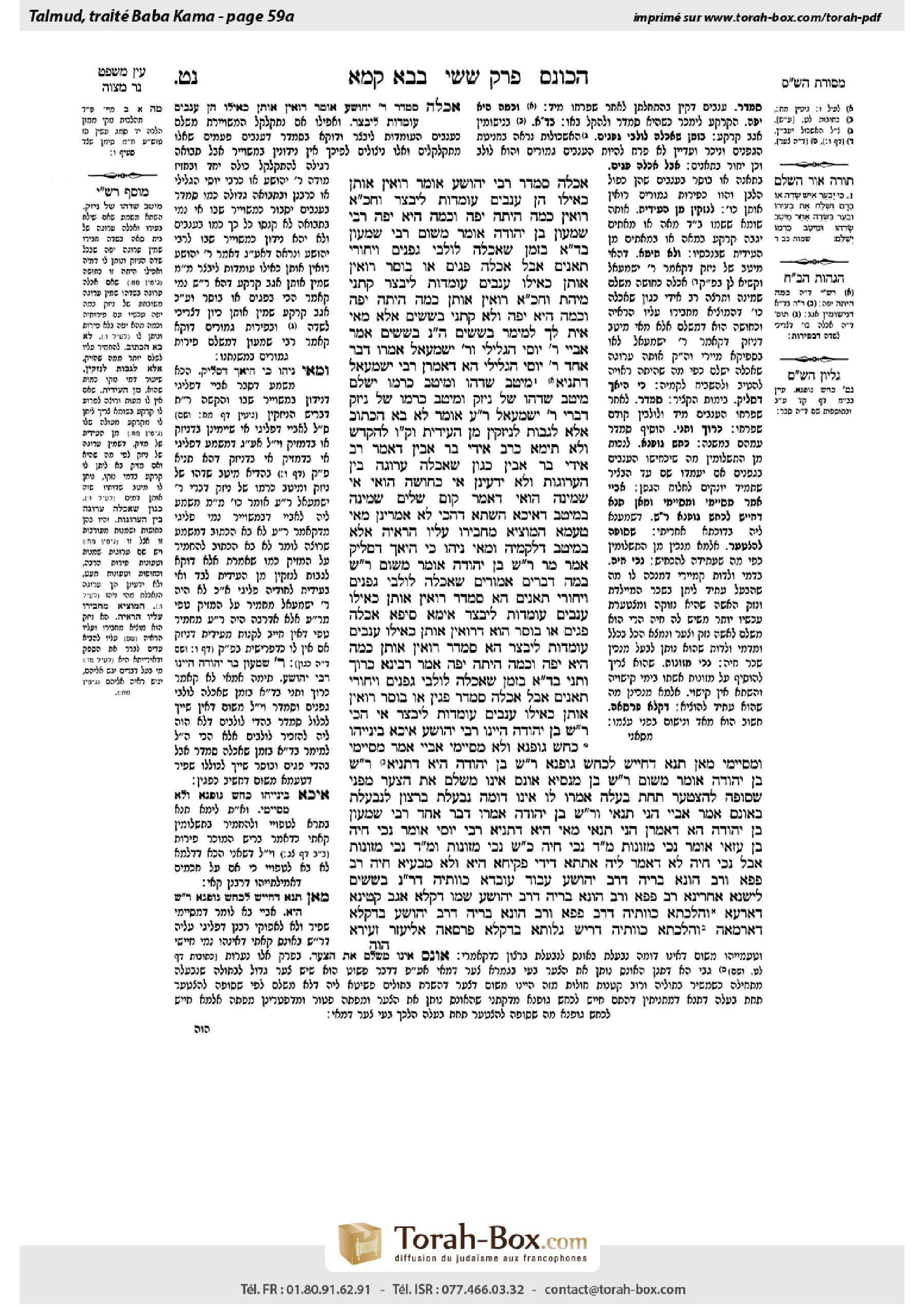
Bava Kamma 59a: Talmud study for Daf Yomi
Study the Talmud for Daf Yomi with scanned pages, Hebrew text, English translations from Sefaria and AI-generated French translations.
Passage selection and English or AI-generated French translation are available where the scan has annotations. Daf Study is independent of Torah-Box and Sefaria.
Browse Bava Kamma · בבא קמא · All tractatesBava Kamma 59a text and translations
This page of Bava Kamma includes the Aramaic text, an English translation and an AI-generated French translation, alongside the scan above.
בבא קמא נ״ט א · Aramaic and Hebrew text
אָכְלָה סְמָדַר – רַבִּי יְהוֹשֻׁעַ אוֹמֵר: רוֹאִין אוֹתָן כְּאִילּוּ הֵן עֲנָבִים עוֹמְדוֹת לִיבָּצֵר, וַחֲכָמִים אוֹמְרִים: רוֹאִין כַּמָּה הָיְתָה יָפָה וְכַמָּה הִיא יָפָה. רַבִּי שִׁמְעוֹן בֶּן יְהוּדָה אוֹמֵר מִשּׁוּם רַבִּי שִׁמְעוֹן: בַּמֶּה דְּבָרִים אֲמוּרִים – בִּזְמַן שֶׁאָכְלָה לוּלְבֵי גְפָנִים וְיִחוּרֵי תְאֵנִים, אֲבָל אָכְלָה פַּגִּים אוֹ בוֹסֶר – רוֹאִין אוֹתָן כְּאִילּוּ עֲנָבִים עוֹמְדוֹת לִיבָּצֵר.
קָתָנֵי מִיהַת, וַחֲכָמִים אוֹמְרִים: רוֹאִין אוֹתָן כַּמָּה הָיְתָה יָפָה, וְכַמָּה הִיא יָפָה – וְלָא קָתָנֵי בְּשִׁשִּׁים!
אֶלָּא מַאי אִית לָךְ לְמֵימַר – בְּשִׁשִּׁים; הָכָא נָמֵי בְּשִׁשִּׁים.
אָמַר אַבָּיֵי: רַבִּי יוֹסֵי הַגְּלִילִי וְרַבִּי יִשְׁמָעֵאל אָמְרוּ דָּבָר אֶחָד.
רַבִּי יוֹסֵי הַגְּלִילִי – הָא דַּאֲמַרַן.
רַבִּי יִשְׁמָעֵאל – דְּתַנְיָא: ״מֵיטַב שָׂדֵהוּ וּמֵיטַב כַּרְמוֹ יְשַׁלֵּם״ – מֵיטַב שָׂדֵהוּ שֶׁל נִיזָּק, וּמֵיטַב כַּרְמוֹ שֶׁל נִיזָּק; דִּבְרֵי רַבִּי יִשְׁמָעֵאל. רַבִּי עֲקִיבָא אוֹמֵר: לֹא בָּא הַכָּתוּב אֶלָּא לִגְבּוֹת לַנִּיזָּקִין מִן הָעִידִּית, וְקַל וָחוֹמֶר לַהֶקְדֵּשׁ.
וְלָא תֵּימָא כְּרַב אִידִי בַּר אָבִין – דְּאָמַר רַב אִידִי בַּר אָבִין: כְּגוֹן שֶׁאָכְלָה עֲרוּגָה בֵּין הָעֲרוּגוֹת, וְלָא יָדְעִינַן אִי כְּחוּשָׁה הֲוַאי אִי שְׁמֵינָה הֲוַאי, דְּאָמַר: קוּם שַׁלֵּים שְׁמֵינָה בְּמֵיטַב דְּאִיכָּא הַשְׁתָּא; דְּהָכִי לָא אָמְרִינַן.
מַאי טַעְמָא? הַמּוֹצִיא מֵחֲבֵירוֹ עָלָיו הָרְאָיָה. אֶלָּא בְּמֵיטַב דִּלְקַמֵּיהּ, וּמַאי נִיהוּ – כִּי הַיְאךְ דְּסָלֵיק.
אָמַר מָר, רַבִּי שִׁמְעוֹן בֶּן יְהוּדָה אוֹמֵר מִשּׁוּם רַבִּי שִׁמְעוֹן: בַּמֶּה דְּבָרִים אֲמוּרִים – שֶׁאָכְלָה לוּלְבֵי גְפָנִים וְיִחוּרֵי תְאֵנִים. הָא סְמָדַר – רוֹאִין אוֹתָן כְּאִילּוּ עֲנָבִים עוֹמְדוֹת לִיבָּצֵר. אֵימָא סֵיפָא: אָכְלָה פַּגִּים אוֹ בוֹסֶר הוּא דְּרוֹאִין אוֹתָן כְּאִילּוּ עֲנָבִים עוֹמְדוֹת לִיבָּצֵר, הָא סְמָדַר – רוֹאִין אוֹתָן כַּמָּה הִיא יָפָה וְכַמָּה הָיְתָה יָפָה!
אָמַר רָבִינָא, כְּרוֹךְ וּתְנִי: בַּמֶּה דְּבָרִים אֲמוּרִים – בִּזְמַן שֶׁאָכְלָה לוּלְבֵי גְפָנִים וְיִחוּרֵי תְאֵנִים, אֲבָל אָכְלָה סְמָדַר פַּגִּין אוֹ בוֹסֶר – רוֹאִין אוֹתָן כְּאִילּוּ עֲנָבִים עוֹמְדוֹת לִיבָּצֵר.
אִי הָכִי, רַבִּי שִׁמְעוֹן בֶּן יְהוּדָה הַיְינוּ רַבִּי יְהוֹשֻׁעַ!
אִיכָּא בֵּינַיְיהוּ כְּחַשׁ גּוּפְנָא; וְלָא מְסַיְּימִי.
אַבָּיֵי אָמַר: מְסַיְּימִי וּמְסַיְּימִי! מַאן תַּנָּא דְּחָיֵישׁ לִכְחַשׁ גּוּפְנָא – רַבִּי שִׁמְעוֹן בֶּן יְהוּדָה הִיא, דְּתַנְיָא, רַבִּי שִׁמְעוֹן בֶּן יְהוּדָה אוֹמֵר מִשּׁוּם רַבִּי שִׁמְעוֹן בֶּן מְנַסְיָא: אוֹנֵס אֵינוֹ מְשַׁלֵּם אֶת הַצַּעַר, מִפְּנֵי שֶׁסּוֹפָהּ לְהִצְטַעֵר תַּחַת בַּעְלָהּ. אָמְרוּ לוֹ: אֵינוֹ דּוֹמֶה נִבְעֶלֶת בְּרָצוֹן לְנִבְעֶלֶת בְּאוֹנֶס.
אָמַר אַבָּיֵי: הָנֵי תַּנָּאֵי, וְרַבִּי שִׁמְעוֹן בֶּן יְהוּדָה, אָמְרוּ דָּבָר אֶחָד. רַבִּי שִׁמְעוֹן בֶּן יְהוּדָה – הָא דַּאֲמַרַן. הָנֵי תַּנָּאֵי מַאי הִיא –
דְּתַנְיָא, רַבִּי יוֹסֵי אוֹמֵר: נְכֵי חַיָּה. בֶּן עַזַּאי אוֹמֵר: נְכֵי מְזוֹנוֹת.
מַאן דְּאָמַר נְכֵי חַיָּה, כׇּל שֶׁכֵּן נְכֵי מְזוֹנוֹת. וּמַאן דְּאָמַר נְכֵי מְזוֹנוֹת, אֲבָל נְכֵי חַיָּה – לָא, דְּאָמַר לֵיהּ: אִתְּתָא דִּידִי פְּקִיחָא הִיא, וְלָא מִבַּעְיָא חַיָּה.
רַב פָּפָּא וְרַב הוּנָא בְּרֵיהּ דְּרַב יְהוֹשֻׁעַ עֲבוּד עוֹבָדָא כְּווֹתֵיהּ דְּרַב נַחְמָן בְּשִׁשִּׁים.
לִישָּׁנָא אַחֲרִינָא: רַב פָּפָּא וְרַב הוּנָא בְּרֵיהּ דְּרַב יְהוֹשֻׁעַ שָׁמוּ דִּקְלָא אַגַּב קַטִּינָא דְאַרְעָא.
וְהִלְכְתָא כְּווֹתֵיהּ דְּרַב פָּפָּא וְרַב הוּנָא בְּרֵיהּ דְּרַב יְהוֹשֻׁעַ בְּדִקְלָא (דַ)אֲרַמָּאָה, וְהִלְכְתָא כְּווֹתֵיהּ דְּרֵישׁ גָּלוּתָא בְּדִקְלָא פָרְסָאָה.
אֱלִיעֶזֶר זְעֵירָא
Bava Kamma 59a · English translation
If the animal ate the grapes while they were in the budding stage, Rabbi Yehoshua says: The court views the grapes that were damaged as if they were grapes about to be picked, and appraise the damage based on this. And the Rabbis say: The court views how much the vineyard was worth before the animal ate the grapes, and how much it is worth now. Rabbi Shimon ben Yehuda says in the name of Rabbi Shimon: In what case is this statement, that the court appraises the vineyard or group of trees that were damaged, said? It is when the animal ate young branches [lulevei gefanim] of vines or shoots of fig trees, but where it ate unripe figs or unripe grapes, the court views them and appraises them as if they were grapes ready to be picked.
Abaye continues: In any event, it teaches that the Rabbis say: The court views how much the vineyard was worth before the animal ate the produce and how much it is worth now, and it does not teach that the court appraises the damage relative to an area sixty times greater.
Rather, what have you to say? You must say that the wording employed by the baraita is to be understood to mean that the court appraises the damage relative to an area sixty times greater, so here too, in the baraita dealing with one who himself causes damage, the wording is to be understood to mean that the damage is valued relative to an area sixty times greater.
Abaye said: Rabbi Yosei HaGelili and Rabbi Yishmael both said the same thing. They are of the same opinion that the appraisal for damages is based on the value of the produce remaining in the field once it ripens.
The opinion of Rabbi Yosei HaGelili is this that we stated above in the baraita, i.e., that the damages paid for an animal eating unripe grain are assessed according to what remains of the grain.
The opinion of Rabbi Yishmael is as it is taught in a baraita: The verse states: “The best of his field and the best of his vineyard he shall pay” (Exodus 22:4), which means he must pay according to the best-quality field of the injured party or the best-quality vineyard of the injured party. This is the statement of Rabbi Yishmael. Rabbi Akiva says: The verse comes only to allow injured parties to collect compensation from the superior-quality land of the one liable to pay for the damage, and by an a fortiori inference it is derived that this applies to consecrated property. Compensation for damaging consecrated property is paid from one’s best-quality assets.
And do not say that Rabbi Yishmael’s statement should be interpreted in accordance with the opinion of Rav Idi bar Avin, as Rav Idi bar Avin says: Here it concerns a case where the animal ate the produce of one garden bed from among several garden beds, but we do not know whether the garden bed it ate from was lean or choice. Therefore, the verse says to the owner of the animal: Arise and pay choice land, equivalent to the best-quality land that there is now remaining, and the court does not assume that the animal ate produce from the lesser-quality garden bed, as we do not say this.
What is the reason that Rabbi Yishmael does not hold in accordance with the opinion of Rav Idi bar Avin? It is because he accepts the principle that the burden of proof rests upon the claimant; without such proof, the owner of the animal pays only the value of a lesser-quality garden bed. Rather, Rabbi Yishmael interprets the Torah’s expression “the best of his field” as requiring payment with the best-quality land before him, and what is this? It is that which remained in the field and subsequently sprouted, and the compensation is based on the value of this.
The Gemara examines the baraita. The Master said: Rabbi Shimon ben Yehuda says in the name of Rabbi Shimon: In what case is this statement that the court appraises the vineyard or group of trees that were damaged said? It is when the animal ate young branches of vines or shoots of fig trees. The Gemara comments: This indicates that if the animal ate budding grapes the court views them and appraises them as if they were grapes ready to be picked. But say, and try to explain accordingly, the latter clause of the baraita, which teaches that if the animal ate unripe figs or half-ripe grapes, that is where the court views them as if they were grapes ready to be picked, indicating that if the animal ate the grapes in the budding stage, the court views how much the vineyard was worth before the animal ate them and how much it is worth now. Therefore, the two clauses of the baraita appear to be contradictory.
Ravina said: Bind them together and teach them as a single statement, as follows: In what case is this statement said that the court appraises how much the field was worth when the animal ate from it? It is said in a case when the animal ate young branches of vines or shoots of fig trees. But if it ate grapes in the budding stage, unripe figs, or half-ripe grapes, the court views them and appraises them as if they were grapes ready to be picked.
The Gemara asks: If so, the opinion of Rabbi Shimon ben Yehuda is identical to the opinion of Rabbi Yehoshua with regard to grapes in the budding stage. Why would the mishna state their opinions separately?
The Gemara answers: There is a difference between them with regard to the weakening of the vine. A vine is weakened by the grapes growing on it, as they draw nutrients from the roots and branches. Now that the grapes have been eaten, the vine is no longer weakened. Therefore, according to one opinion, the court takes into consideration this reduction of the weakening of the vine, and that amount is deducted when calculating the damages, whereas according to the other opinion, the court does not take this into account. But their respective opinions are not defined, and it is not clear which tanna takes this weakening into account and which does not.
Abaye said: Their respective opinions are certainly defined, and it is possible to know which Sage held which opinion, since who is the tanna who is concerned for the weakening of the vine? It is Rabbi Shimon ben Yehuda, as it is taught in a baraita: Rabbi Shimon ben Yehuda says in the name of Rabbi Shimon ben Menasya: With regard to the indemnity payments that a rapist must pay his victim, who had been a virgin, he does not pay compensation for the pain caused by the rape. This is due to the fact that she will ultimately suffer the same pain during her first act of sexual intercourse with her husband when she marries. The Rabbis said to him: The pain of a woman who has intercourse willingly is not comparable to the pain of a woman who has intercourse by rape. Rabbi Shimon ben Yehuda considers future pain when considering payment of damages, and similarly, he considers the reduced weakening of the vine.
Abaye said: These tanna’im following and Rabbi Shimon ben Yehuda said the same thing concerning this matter. Rabbi Shimon ben Yehuda said this ruling that we said with regard to the case of rape and the case of the vine. As to these other tanna’im, what is the case about which they gave a similar ruling?
This is as it is taught in a baraita concerning the halakha of one who injured a pregnant woman, thereby causing her to miscarry, for which the Torah holds him liable to pay her husband compensation. Rabbi Yosei says: The court appraises the compensation for the miscarried offspring and deducts the amount they would have paid for a midwife. Since she miscarried, the husband no longer has to pay for a midwife, so that is deducted from the compensation. Ben Azzai says: The court deducts the value of the extra sustenance the husband would have been required to provide for his pregnant wife.
The one who says that the court appraises the compensation for the miscarried offspring less the amount they would have paid for a midwife would all the more so concede that the appraisal is less the value of the extra sustenance. But the one who says that the appraisal is less the value of the extra sustenance does not necessarily hold that the court appraises the compensation for the miscarried offspring less the money they would have paid for a midwife, since the husband can say to the assailant: My wife is capable and does not require a midwife to assist her when giving birth.
Returning to the discussion of the appraisal of compensation for damage, the Gemara relates: Rav Pappa and Rav Huna, son of Rav Yehoshua, acted in accordance with the opinion of Rav Naḥman and appraised a damaged date palm relative to an area sixty times greater than the particular area where the tree was standing.
A different version of this halakha is also stated: Rav Pappa and Rav Huna, son of Rav Yehoshua, appraised the damage caused to a date palm relative to the assessment of the patch of land where the tree stood, i.e., how much it was worth with the tree and how much it was worth without it.
The Gemara concludes: And the halakha is in accordance with the opinion of Rav Pappa and Rav Huna, son of Rav Yehoshua, with regard to an Aramean date palm, i.e., one of lesser quality, and it is assessed relative to the land, but the halakha is in accordance with the opinion of the Exilarch with regard to a Persian date palm, as they are of higher quality and each one is valuable, and it is not assessed relative to the land.
The Gemara relates: Eliezer Ze’eira
Bava Kamma 59a · Traduction française (IA)
Si l'animal a mangé les raisins pendant qu'ils étaient en phase de bourgeonnement, Rabbi Yéhoshua dit : Le tribunal considère les raisins endommagés comme s'ils étaient des raisins prêts à être récoltés, et évalue le préjudice en fonction de cela. Les Rabbins disent : Le tribunal considère la valeur du domaine avant que l'animal n'ait mangé les fruits et la valeur qu'il a maintenant. Rabbi Shim'on ben Yéhuda dit en nom de Rabbi Shim'on : Dans quel cas cette déclaration, selon laquelle le tribunal évalue le domaine ou le groupe d'arbres endommagés, est-elle formulée ? C'est lorsque l'animal a mangé les jeunes branches des vigne ou les pousses des figuiers, mais lorsque l'animal a mangé des figues non mûres ou des raisins non mûrs, le tribunal considère ces fruits et les évalue comme s'ils étaient des raisins prêts à être récoltés.
Abaye continue : En tout cas, cela enseigne que les Rabbins disent : Le tribunal considère la valeur du domaine avant que l'animal n'ait mangé les produits et la valeur qu'il a maintenant, et cela ne signifie pas que le tribunal évalue le préjudice par rapport à une surface soixante fois plus grande.
Plutôt, que dis-tu ? Tu dois dire que la formulation employée par la baraïta doit être interprétée comme signifiant que le tribunal évalue le préjudice par rapport à une surface soixante fois plus grande, donc ici aussi, dans la baraïta concernant celui qui cause lui-même un préjudice, la formulation doit être interprétée comme signifiant que le préjudice est évalué par rapport à une surface soixante fois plus grande.
Abaye dit : Rabbi Yosei HaGelili et Rabbi Yishmael ont dit la même chose. Ils partagent l'opinion que l'évaluation des dommages est basée sur la valeur des produits restants dans le champ une fois mûrs.
L'opinion de Rabbi Yosei HaGelili est celle que nous avons évoquée ci-dessus dans la baraïta, c'est-à-dire que les dommages causés par un animal mangeant des grains non mûrs sont évalués selon ce qui reste des grains.
L'opinion de Rabbi Yishmael est celle qui est enseignée dans une baraïta : La Parashah dit : « Il paiera la meilleure partie de son champ et la meilleure partie de son vignoble » (Exode 22:4), ce qui signifie qu'il doit payer selon la meilleure terre du propriétaire blessé ou la meilleure vignoble du propriétaire blessé. C'est l'opinion de Rabbi Yishmael. Rabbi Akiva dit : La Parashah est donnée uniquement pour permettre aux parties blessées de réclamer une compensation à partir des terres de meilleure qualité du responsable, et par une déduction a fortiori, on en déduit qu'il en va de même pour les biens consacrés. La compensation pour avoir endommagé des biens consacrés est payée à partir des meilleurs biens de la personne responsable.
Et ne dis pas que la déclaration de Rabbi Yishmael doit être interprétée selon l'opinion de Rav Idi bar Avin, car Rav Idi bar Avin dit : Il s'agit d'un cas où l'animal a mangé les produits d'un lit de jardin parmi plusieurs lits de jardin, mais nous ne savons pas si le lit de jardin qu'il a mangé était pauvre ou de qualité. Par conséquent, la Parashah dit au propriétaire de l'animal : Lève-toi et paie une terre de qualité, équivalente à la meilleure terre qui reste maintenant, et le tribunal ne suppose pas que l'animal a mangé des produits d'un lit de jardin de moindre qualité, car nous ne disons pas cela.
Quelle est la raison pour laquelle Rabbi Yishmael ne suit pas l'opinion de Rav Idi bar Avin ? C'est parce qu'il accepte le principe selon lequel la charge de la preuve incombe au plaignant ; sans preuve, le propriétaire de l'animal paie seulement la valeur d'un lit de jardin de moindre qualité. Plutôt, Rabbi Yishmael interprète l'expression de la Torah « la meilleure partie de son champ » comme exigeant un paiement avec la meilleure terre devant lui, et que veux-tu dire ? C'est ce qui restait dans le champ et qui a ensuite germé, et la compensation est basée sur la valeur de cela.
La Guemara examine la baraïta. Le Maître dit : Rabbi Shim'on ben Yéhuda dit en nom de Rabbi Shim'on : Dans quel cas cette déclaration, selon laquelle le tribunal évalue le domaine ou le groupe d'arbres endommagés, est-elle formulée ? C'est lorsque l'animal a mangé les jeunes branches des vigne ou les pousses des figuiers. La Guemara commente : Cela indique que si l'animal a mangé des raisins en phase de bourgeonnement, le tribunal considère ces raisins et les évalue comme s'ils étaient des raisins prêts à être récoltés. Mais dis, et essaie d'expliquer ainsi, la dernière partie de la baraïta, qui enseigne que si l'animal a mangé des figues non mûres ou des raisins demi-mûrs, c'est là que le tribunal considère ces fruits comme s'ils étaient des raisins prêts à être récoltés, indiquant que si l'animal a mangé des raisins en phase de bourgeonnement, le tribunal considère la valeur du domaine avant qu'il n'ait mangé les raisins et la valeur qu'il a maintenant. Ainsi, les deux clauses de la baraïta semblent être contradictoires.
Ravina dit : Relie-les et enseigne-les comme une seule déclaration, comme suit : Dans quel cas cette déclaration est-elle formulée, selon laquelle le tribunal évalue la valeur du domaine lorsque l'animal en a mangé ? C'est lorsque l'animal a mangé les jeunes branches des vigne ou les pousses des figuiers. Mais si l'animal a mangé des raisins en phase de bourgeonnement, des figues non mûres ou des raisins demi-mûrs, le tribunal considère ces fruits et les évalue comme s'ils étaient des raisins prêts à être récoltés.
La Guemara pose la question : Si c'est ainsi, l'opinion de Rabbi Shim'on ben Yéhuda est identique à celle de Rabbi Yéhoshua concernant les raisins en phase de bourgeonnement. Pourquoi alors la mitsva énonce-t-elle leurs opinions séparément ?
La Guemara répond : Il y a une différence entre eux concernant l'affaiblissement de la vigne. Une vigne est affaiblie par les raisins qui y poussent, car ils prennent des nutriments aux racines et aux branches. Maintenant que les raisins ont été mangés, la vigne n'est plus affaiblie. Par conséquent, selon une opinion, le tribunal tient compte de cette réduction de l'affaiblissement de la vigne et déduit cette quantité lors du calcul des dommages, tandis que selon l'autre opinion, le tribunal ne tient pas compte de cela. Mais leurs opinions respectives ne sont pas définies et il n'est pas clair quel tanna tient compte de cet affaiblissement et quel n'en tient pas.
Abaye a dit : Leurs opinions respectives sont certainement définies, et il est possible de savoir quel sage a défendu quelle opinion, car qui est le tanna qui s'occupe de la faiblesse de la vigne ? C'est Rabbi Shim'on ben Yéhuda, comme il est enseigné dans une baraïta : Rabbi Shim'on ben Yéhuda dit au nom de Rabbi Shim'on ben Menasséa : En ce qui concerne les indemnités que doit payer un violateur à sa victime, qui était vierge, il ne paie pas de compensation pour la douleur causée par le viol. Cela est dû au fait qu'elle souffrira finalement la même douleur lors de son premier acte sexuel avec son mari lorsqu'elle se mariera. Les Rabbins lui dirent : La douleur d'une femme qui a des relations sexuelles volontairement n'est pas comparable à la douleur d'une femme qui a des relations sexuelles par viol. Rabbi Shim'on ben Yéhuda considère la douleur future lorsqu'il évalue les dommages, et de même, il considère la réduction de la faiblesse de la vigne.
Abaye a dit : Ces tannaïm qui suivent et Rabbi Shim'on ben Yéhuda ont dit la même chose concernant cette affaire. Rabbi Shim'on ben Yéhuda a dit cette décision que nous avons dite concernant le cas de viol et celui de la vigne. En ce qui concerne ces autres tannaïm, à propos de quelle affaire ont-ils donné une décision similaire ?
C'est ce qui est enseigné dans une baraïta concernant la halakha d'une personne qui a blessé une femme enceinte, causant ainsi un avortement, pour lequel la Torah le tient responsable de payer à son époux une compensation. Rabbi Yosei dit : Le tribunal évalue la compensation pour l'enfant avorté et déduit le montant qu'ils auraient dû payer pour une sage-femme. Puisque la femme a avorté, l'époux n'a plus besoin de payer pour une sage-femme, donc cela est déduit de la compensation. Ben Azzai dit : Le tribunal déduit la valeur de la nourriture supplémentaire que l'époux aurait dû fournir à sa femme enceinte.
Celui qui dit que le tribunal évalue la compensation pour l'enfant avorté moins le montant qu'ils auraient dû payer pour une sage-femme accepterait encore davantage que l'évaluation soit moins la valeur de la nourriture supplémentaire. Mais celui qui dit que l'évaluation est moins la valeur de la nourriture supplémentaire ne tient pas nécessairement que le tribunal évalue la compensation pour l'enfant avorté moins le montant qu'ils auraient dû payer pour une sage-femme, car l'époux peut dire à l'agresseur : Ma femme est capable et n'a pas besoin d'une sage-femme pour l'aider lors de l'accouchement.
En revenant à la discussion sur l'évaluation de la compensation pour les dommages, le Guemara rapporte : Rav Pappa et Rav Huna, fils de Rav Yéhoshua, ont suivi l'opinion de Rav Naḥman et ont évalué un palmier abîmé par rapport à une surface soixante fois plus grande que la surface particulière où l'arbre était planté.
Une autre version de cette halakha est également rapportée : Rav Pappa et Rav Huna, fils de Rav Yéhoshua, ont évalué les dommages causés à un palmier par rapport à l'évaluation de la parcelle de terre où l'arbre était planté, c'est-à-dire combien il valait avec l'arbre et combien il valait sans lui.
Le Guemara conclut : Et la halakha suit l'opinion de Rav Pappa et de Rav Huna, fils de Rav Yéhoshua, concernant un palmier araméen, c'est-à-dire un palmier de moindre qualité, et il est évalué par rapport à la terre, mais la halakha suit l'opinion de l'Exilarch concernant un palmier perse, car ils sont de meilleure qualité et chacun est précieux, et il n'est pas évalué par rapport à la terre.
Le Guemara rapporte : Eliezer Ze’eira
Traduction française générée par IA à partir de l’édition anglaise de Sefaria. Vérifie toujours un passage avec le texte source.
Text from Sefaria: William Davidson Edition - Vocalized Aramaic (CC BY NC); William Davidson Edition - English (CC BY NC).