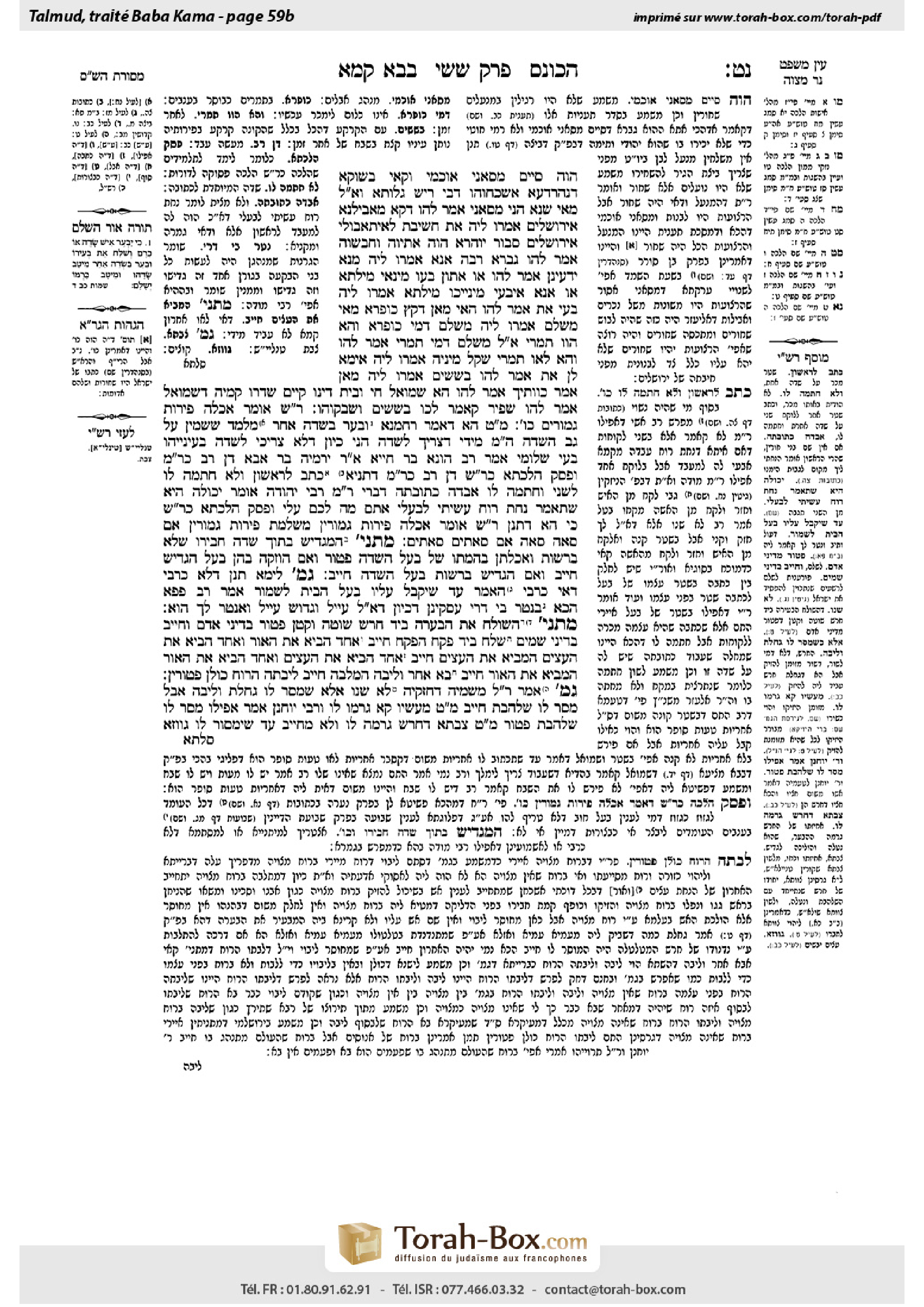
Bava Kamma 59b: Talmud study for Daf Yomi
Study the Talmud for Daf Yomi with scanned pages, Hebrew text, English translations from Sefaria and AI-generated French translations.
Passage selection and English or AI-generated French translation are available where the scan has annotations. Daf Study is independent of Torah-Box and Sefaria.
Browse Bava Kamma · בבא קמא · All tractatesBava Kamma 59b text and translations
This page of Bava Kamma includes the Aramaic text, an English translation and an AI-generated French translation, alongside the scan above.
בבא קמא נ״ט ב · Aramaic and Hebrew text
הֲוָה סָיֵים מְסָאנֵי אוּכָּמֵי, וְקָאֵי בְּשׁוּקָא דִנְהַרְדְּעָא. אַשְׁכְּחוּהּ דְּבֵי רֵישׁ גָּלוּתָא וַאֲמַרוּ לֵיהּ: מַאי שְׁנָא הָנֵי מְסָאנֵי? אֲמַר לְהוּ: דְּקָא מִאֲבִילְנָא אַיְּרוּשָׁלַיִם. אֲמַרוּ לֵיהּ: אַתְּ חֲשִׁיבַתְּ לְאִיתְאֲבוֹלֵי אַיְּרוּשָׁלַיִם? סְבוּר יוּהֲרָא הֲוָה, אַתְיוּהּ וְחַבְשׁוּהּ.
אֲמַר לְהוּ: גַּבְרָא רַבָּה אֲנָא. אֲמַרוּ לֵיהּ: מְנָא יָדְעִינַן? אֲמַר לְהוּ: אוֹ אַתּוּן בְּעוֹ מִינַּאי מִילְּתָא, אוֹ אֲנָא אִיבְעֵי מִינַּיְיכוּ מִילְּתָא. אֲמַרוּ לֵיהּ: בְּעִי אַתְּ.
אֲמַר לְהוּ: הַאי מַאן דְּקַץ כּוּפְרָא, מַאי מְשַׁלֵּם? אֲמַרוּ לֵיהּ: מְשַׁלֵּם דְּמֵי כוּפְרָא. וְהָא הֲווֹ תַּמְרֵי! אֲמַרוּ לֵיהּ: מְשַׁלֵּם דְּמֵי תַמְרֵי. אֲמַר לְהוּ: וְהָא לָאו תַּמְרֵי שְׁקַל מִינֵּיהּ!
אֲמַרוּ לֵיהּ: אֵימָא לַן אַתְּ. אֲמַר לְהוּ: בְּשִׁשִּׁים. אֲמַרוּ לֵיהּ: מַאן אָמַר כְּווֹתָיךְ? אֲמַר לְהוּ: הָא שְׁמוּאֵל חַי וּבֵית דִּינוֹ קַיָּים. שַׁדַּרוּ קַמֵּיהּ דִּשְׁמוּאֵל, אָמַר לְהוּ: שַׁפִּיר קָאָמַר לְכוּ בְּשִׁשִּׁים, וְשַׁבְקוּהּו.
רַבִּי שִׁמְעוֹן אוֹמֵר: אָכְלָה פֵּירוֹת גְּמוּרִים כּוּ׳. מַאי טַעְמָא? הָא דְּאָמַר רַחֲמָנָא ״וּבִעֵר בִּשְׂדֵה אַחֵר״ – מְלַמֵּד שֶׁשָּׁמִין עַל גַּב הַשָּׂדֶה, הָנֵי מִילֵּי מִידֵּי דִּצְרִיךְ לְשָׂדֶה; הָנֵי, כֵּיוָן דְּלָא צְרִיכִי לְשָׂדֶה – בְּעֵינַיְיהוּ בָּעֵי שַׁלּוֹמֵי.
אָמַר רַב הוּנָא בַּר חִיָּיא אָמַר רַבִּי יִרְמְיָה בַּר אַבָּא: דָּן רַב כְּרַבִּי מֵאִיר, וּפְסַק הִלְכְתָא כְּרַבִּי שִׁמְעוֹן.
דָּן רַב כְּרַבִּי מֵאִיר – דְּתַנְיָא: כָּתַב לָרִאשׁוֹן וְלֹא חָתְמָה לוֹ, לַשֵּׁנִי וְחָתְמָה לוֹ – אִבְּדָה כְּתוּבָּתָהּ, דִּבְרֵי רַבִּי מֵאִיר. רַבִּי יְהוּדָה אוֹמֵר, יְכוֹלָה הִיא שֶׁתֹּאמַר: נַחַת רוּחַ עָשִׂיתִי לְבַעְלִי, אַתֶּם מָה לָכֶם עָלַי.
וּפְסַק הִלְכְתָא כְּרַבִּי שִׁמְעוֹן – כִּי הָא דִּתְנַן, רַבִּי שִׁמְעוֹן אוֹמֵר: אָכְלָה פֵּירוֹת גְּמוּרִין – מְשַׁלֶּמֶת פֵּירוֹת גְּמוּרִין; אִם סְאָה – סְאָה, אִם סָאתַיִם – סָאתַיִם.
מַתְנִי׳ הַמַּגְדִּישׁ בְּתוֹךְ שְׂדֵה חֲבֵירוֹ שֶׁלֹּא בִּרְשׁוּת, וַאֲכָלָתַן בְּהֶמְתּוֹ שֶׁל בַּעַל הַשָּׂדֶה – פָּטוּר. וְאִם הוּזְּקָה בָּהֶן – בַּעַל הַגָּדִישׁ חַיָּיב. וְאִם הִגְדִּישׁ בִּרְשׁוּת – בַּעַל הַשָּׂדֶה חַיָּיב.
גְּמָ׳ לֵימָא תְּנַן דְּלָא כְּרַבִּי? דְּאִי כְּרַבִּי, הָאָמַר: עַד שֶׁיְּקַבֵּל עָלָיו בַּעַל הַבַּיִת לִשְׁמוֹר! אָמַר רַב פָּפָּא: הָכָא – בְּנָטַר בֵּי דָרֵי עָסְקִינַן, דְּכֵיוָן דַּאֲמַר לֵיהּ: ״עַיֵּיל וּגְדוֹשׁ״ – ״עַיֵּיל וְאֶנְטַר לָךְ״ הוּא.
מַתְנִי׳ הַשּׁוֹלֵחַ אֶת הַבְּעֵרָה בְּיַד חֵרֵשׁ שׁוֹטֶה וְקָטָן – פָּטוּר בְּדִינֵי אָדָם, וְחַיָּיב בְּדִינֵי שָׁמַיִם. שִׁלַּח בְּיַד פִּקֵּחַ – הַפִּקֵּחַ חַיָּיב.
אֶחָד הֵבִיא אֶת הָאוּר וְאֶחָד הֵבִיא אֶת הָעֵצִים – הַמֵּבִיא אֶת הָעֵצִים חַיָּיב. אֶחָד הֵבִיא אֶת הָעֵצִים וְאֶחָד הֵבִיא אֶת הָאוּר – הַמֵּבִיא אֶת הָאוּר חַיָּיב.
בָּא אַחֵר וְלִיבָּה – הַמְלַבֶּה חַיָּיב. לִיבְּתָה הָרוּחַ – כּוּלָּן פְּטוּרִין.
גְּמָ׳ אָמַר רֵישׁ לָקִישׁ מִשְּׁמֵיהּ דְּחִזְקִיָּה: לֹא שָׁנוּ אֶלָּא שֶׁמָּסַר לוֹ גַּחֶלֶת וְלִיבָּהּ, אֲבָל מָסַר לוֹ שַׁלְהֶבֶת – חַיָּיב, מַאי טַעְמָא? מַעֲשָׂיו קָא גָרְמוּ לוֹ.
וְרַבִּי יוֹחָנָן אָמַר: אֲפִילּוּ מָסַר לוֹ שַׁלְהֶבֶת – פָּטוּר, מַאי טַעְמָא? צְבָתָא דְחֵרֵשׁ גָּרְמָה לוֹ. וְלָא מִחַיַּיב עַד שֶׁיִּמְסוֹר לוֹ גְּווֹזָא,
Bava Kamma 59b · English translation
was wearing black shoes, unlike the Jewish custom of that time, and standing in the market of Neharde’a. Officials of the house of the Exilarch found him and said to him: What is different about you that causes you to wear these shoes? He said to them: I am wearing them because I am in mourning over the destruction of the Temple and Jerusalem, and so I wear black shoes, as is the custom of mourners. They said to him: Are you a man of such importance to publicly mourn over Jerusalem? They thought that it was simply presumptuousness on his part. Since he was acting against the prevalent Jewish custom, they brought him to the prison and incarcerated him.
Eliezer Ze’eira said to them: I am a great man, a scholar, and it is fitting for me to mourn publicly over the destruction of Jerusalem. They said to him: How do we know that you are a scholar? He said to them: Either you ask of me a matter of halakha and I will answer you, or I will ask you a matter of halakha and you will answer me. They said to him: You ask.
He said to them: With regard to one who cuts a cluster of flowers on the stem of a date palm belonging to another, what is he required to pay? They said to him: He pays the value of the date stem. He said to them: But ultimately they will become ripe dates, which are worth more. They said to him: If so, he pays the value of the future dates. He said to them: But he did not take ripe dates from the other person, so how can the court obligate him to pay for damage that he did not cause?
They said to Eliezer Ze’eira: You tell us the correct appraisal for the date stem. He said to them: The court appraises the damage relative to a similar piece of land sixty times the size. They said to him: Who says an opinion as you do, so that you can prove you are correct? He said to them: Shmuel is alive and his court exists; you can ask him. They sent the question before Shmuel, together with the ruling of Eliezer Ze’eira. Shmuel said to them: He is saying well to you, because the halakha is as he says; the appraisal is relative to an area sixty times greater. Upon hearing this, the officials of the Exilarch realized that he was a great man and they released him.
§ The mishna (55b) teaches that Rabbi Shimon says: If the animal ate ripe produce, the owner pays the value of the ripe produce eaten. What is the reason for Rabbi Shimon’s opinion? This that the Merciful One states in the Torah: “And it feed in another’s field” (Exodus 22:4), which teaches that the court appraises the damage relative to another field, this statement applies specifically with regard to produce that requires a field to grow. For one’s animal eating this produce, which do not require the field in order to ripen further, the animal’s owner must pay their value as they are.
Rav Huna bar Ḥiyya says that Rabbi Yirmeya bar Abba says: Rav judged a practical halakha on a certain issue in accordance with the opinion of Rabbi Meir, despite the fact that in general the halakha is not in accordance with his opinion. And furthermore, he ruled that the halakha is in accordance with the opinion of Rabbi Shimon, even though in that case his was a minority opinion.
Rav Huna bar Ḥiyya explains: Rav judged a practical halakha in accordance with the opinion of Rabbi Meir, as it is taught in a baraita: In the case of a field designated by its owner as a lien for his wife’s marriage contract, which he subsequently wants to sell, if he wrote a document of sale to a first buyer, but his wife did not sign for him to endorse the sale, and subsequently the husband wrote a document of sale to a second buyer, and his wife signed for him, she thereby loses the lien of her marriage contract, since the sale is effective and she can no longer collect from this field; this is the statement of Rabbi Meir. Rabbi Yehuda says that she can say: I did it only to please my husband, but I did not mean it and never intended to forgo my rights. What claim do you, the purchasers, have against me? Therefore, the lien is still in effect. Rav judged a case in accordance with the opinion of Rabbi Meir.
And Rav ruled that the halakha is in accordance with the opinion of Rabbi Shimon, as we learned in the mishna: Rabbi Shimon says: If one’s animal ate ripe produce, the owner pays the value of ripe produce eaten. Therefore, if it ate one se’a of produce, he pays the value of one se’a of produce, and if it ate two se’a, he pays for two se’a. Although Rabbi Shimon’s opinion is the minority one, Rav ruled in accordance with it.
MISHNA: In a case of one who stacks his produce in another’s field without permission from the owner of that field, and an animal belonging to the owner of the field eats the produce, the owner of the field is exempt. And if the animal is injured by the produce, the owner of the stack is liable. But if he stacked them in that field with permission, the owner of the field is liable for damage caused to the produce.
GEMARA: The Gemara asks: Shall we say that that which we learned in the mishna is not in accordance with the opinion of Rabbi Yehuda HaNasi? As, if the mishna were in accordance with the opinion of Rabbi Yehuda HaNasi, doesn’t he say: A homeowner who gives another permission to bring items into his courtyard is not responsible for them unless the homeowner accepts on himself to safeguard them? The mishna does not mention any such acceptance of responsibility. Rav Pappa said: Here we are dealing with the supervisor of the threshing floors, to whom people would entrust their produce. As, since the supervisor says to the owner of the produce: Bring it in and stack it, it is as though he had said to him: Bring it in and I will supervise it for you.
MISHNA: One who sends a fire, i.e., places a burning object, in the hand of a deaf-mute, an imbecile, or a minor is exempt for any damage later caused by the fire according to human laws but liable according to the laws of Heaven. If he sent it in the hand of a halakhically competent person, the halakhically competent person is liable, not the one who sent him.
If one person brought the fire, and one other person subsequently brought the wood, causing the fire to spread, the one who brought the wood is liable for any damage caused. Conversely, if one person first brought the wood, and subsequently one other person brought the fire, the one who brought the fire is liable, since it was he who actually kindled the wood.
If another came and fanned the flame, and as a result the fire spread and caused damage, the one who fanned it is liable, since he is the proximate cause of the damage. If the wind fanned the flames, all the people involved are exempt, since none of them actually caused the damage.
GEMARA: Reish Lakish says in the name of Ḥizkiyya: They taught that one who sends fire in the hand of a deaf-mute, an imbecile, or a minor is exempt only when he conveyed to him a glowing coal and one of these people fanned it himself and set it alight. But if one conveyed a torch to a deaf-mute, imbecile, or minor, the one who gave it to him is liable. What is the reason for this halakha? The action of the one who gave it to him directly caused the fire to spread.
And Rabbi Yoḥanan says: Even if he conveyed a torch to him, he is exempt. What is the reason? It is the tongs of the deaf-mute that caused the damage, since torches do not cause fires on their own. And the one who gives dangerous objects to a deaf-mute is not rendered liable for the damage caused, unless he conveys branches [gavza] to him
Bava Kamma 59b · Traduction française (IA)
Il portait des chaussures noires, contrairement à la coutume juive de l'époque, et se tenait au marché de Neharde’a. Des fonctionnaires de la maison de l'Exilarch le trouvèrent et lui dirent : Quel est ce qui te distingue à ce point pour que tu portes ces chaussures ? Il leur répondit : Je les porte car je suis en deuil de la destruction du Temple et de Jérusalem, et je porte des chaussures noires, comme c'est la coutume des veufs. Ils lui dirent : Es-tu une personne d'une telle importance pour pleurer publiquement Jérusalem ? Ils pensaient que c'était simplement de la présomption de sa part. Puisqu'il agissait contre la coutume juive dominante, ils le conduisirent en prison et le mirent en détention.
Eliezer Ze’eira leur dit : Je suis un homme important, un savant, et il est convenable que je pleure publiquement la destruction de Jérusalem. Ils lui dirent : Comment savons-nous que tu es un savant ? Il leur répondit : Soit tu me poses une question de halakha et je te répondrai, soit je te poserai une question de halakha et tu me répondras.
Il leur dit : Concernant celui qui coupe un bouquet de fleurs sur le tronc d'un palmier à dattes appartenant à un autre, à quel montant doit-il verser ? Ils lui dirent : Il verse la valeur du tronc de dattes. Il leur dit : Mais finalement, ces dattes mûres deviendront des dattes, qui sont plus précieuses. Ils lui dirent : Si c'est ainsi, il verse la valeur des dattes futures. Il leur dit : Mais il n'a pas pris des dattes mûres à l'autre personne, donc comment peut-on obliger le tribunal à lui faire payer un préjudice qu'il n'a pas causé ?
Ils dirent à Eliezer Ze’eira : Dis-nous la juste estimation de la tige de date. Il leur dit : Le tribunal évalue le préjudice par rapport à un terrain similaire soixante fois plus grand. Ils lui dirent : Qui dit une opinion telle que la tienne, afin que tu puisses prouver que tu as raison ? Il leur dit : Shmuel est vivant et son tribunal existe ; vous pouvez lui poser la question. Ils envoyèrent la question devant Shmuel, accompagnée de la décision d'Eliezer Ze’eira. Shmuel leur dit : Tu dis bien, car la halakha est telle qu'il le dit ; l'évaluation est par rapport à un terrain soixante fois plus grand. À l'entente de cela, les fonctionnaires de l'Exilarch réalisèrent qu'il était un homme important et ils le relâchèrent.
§ La mitsna (55b) enseigne que Rabbi Shimon dit : Si l'animal a mangé des produits mûrs, l'propriétaire paie la valeur des produits mûrs mangés. Quelle est la raison de l'opinion de Rabbi Shimon ? Cela que l'Éternel dit dans la Torah : « Et il se nourrit dans un autre champ » (Exode 22:4), ce qui enseigne que le tribunal évalue le préjudice par rapport à un autre champ, cette déclaration s'applique spécifiquement aux produits nécessitant un champ pour mûrir. Pour un animal mangeant ces produits, qui n'ont pas besoin du champ pour mûrir davantage, l'propriétaire de l'animal doit payer leur valeur.
Rav Huna bar Ḥiyya dit que Rabbi Yirmeya bar Abba dit : Rav a jugé une halakha pratique sur une question spécifique selon l'opinion de Rabbi Meir, malgré le fait que, dans l'ensemble, la halakha n'est pas selon son opinion. Et de plus, il a décidé que la halakha est selon l'opinion de Rabbi Shimon, même si, dans ce cas, c'était une opinion minoritaire.
Rav Huna bar Ḥiyya explique : Rav a jugé une halakha pratique selon l'opinion de Rabbi Meir, comme il est enseigné dans une baraïta : Dans le cas d'un champ désigné par son propriétaire comme un droit de garantie pour le contrat de mariage de sa femme, qui veut ensuite le vendre, si le propriétaire a écrit un document de vente à un premier acheteur, mais sa femme n'a pas signé pour qu'il endosse la vente, et ensuite le mari a écrit un document de vente à un second acheteur, et sa femme a signé pour lui, elle perd alors le droit de garantie de son contrat de mariage, car la vente est efficace et elle ne peut plus récupérer ce champ ; c'est l'opinion de Rabbi Meir. Rabbi Yehuda dit qu'elle peut dire : J'ai fait cela uniquement pour plaire à mon mari, mais je n'avais pas l'intention de renoncer à mes droits. Quel droit avez-vous, vous les acheteurs, contre moi ? Donc, le droit de garantie est encore en vigueur. Rav a jugé un cas selon l'opinion de Rabbi Meir.
Et Rav a décidé que la halakha est selon l'opinion de Rabbi Shimon, comme nous l'avons appris dans la mitsna : Rabbi Shimon dit : Si l'animal d'une personne a mangé des produits mûrs, l'propriétaire paie la valeur des produits mûrs mangés. Donc, si l'animal a mangé un se'a de produits, il paie la valeur d'un se'a de produits, et si l'animal a mangé deux se'a, il paie pour deux se'a. Bien que l'opinion de Rabbi Shimon soit minoritaire, Rav a décidé selon elle.
MITSNA : Dans le cas d'une personne qui empile ses produits dans le champ d'autrui sans l'autorisation du propriétaire de ce champ, et un animal appartenant au propriétaire de ce champ mange les produits, le propriétaire du champ est exempt. Et si l'animal est blessé par les produits, le propriétaire de l'empilement est responsable. Mais si il a empilé les produits dans ce champ avec l'autorisation, le propriétaire du champ est responsable du préjudice causé aux produits.
GUEMARA : La Guemara demande : Devons-nous dire que ce que nous avons appris dans la Michna n'est pas selon l'opinion de Rabbi Yehuda HaNasi ? Car, si la Michna était selon l'opinion de Rabbi Yehuda HaNasi, ne dit-il pas : Un propriétaire qui donne à un autre la permission d'amener des objets dans son cour d'honneur n'est pas responsable d'eux à moins qu'il ne s'engage lui-même à les protéger ? La Michna ne mentionne pas une telle acceptation de responsabilité. Rav Pappa dit : Ici nous sommes en présence du surveillant des fours à meuler, à qui les gens confiaient leurs produits. Car, puisque le surveillant dit au propriétaire des produits : Apporte-le et empile-le, c'est comme s'il avait dit à lui : Apporte-le et je t'en ferai la surveillance.
MICHNA : Celui qui envoie un feu, c'est-à-dire place un objet brûlant, dans la main d'un sourd-muet, d'un imbécile ou d'un mineur est exempt de tout préjudice causé par ce feu selon les lois humaines mais responsable selon les lois du Ciel. Si il l'a envoyé dans la main d'une personne compétente selon la halakha, la personne compétente selon la halakha est responsable, pas celui qui l'a envoyé.
Si une personne a allumé le feu et une autre a ensuite apporté du bois, causant l'extension du feu, celle qui a apporté le bois est responsable de tout dommage causé. À l'inverse, si une personne a d'abord apporté le bois et qu'une autre a ensuite allumé le feu, c'est celle qui a allumé le feu qui est responsable, car c'est elle qui a effectivement allumé le bois.
Si quelqu'un est venu et a soufflé sur le feu, et que par conséquent le feu s'est étendu et a causé un dommage, celui qui a soufflé est responsable, car il est la cause directe du dommage. Si le vent a soufflé sur les flammes, tous les personnes impliquées sont exemptés, car aucun d'entre eux n'a réellement causé le dommage.
GUEMARA : Reish Lakish dit au nom de Ḥizkiyya : Ils enseignent que celui qui envoie du feu à la main d'un sourd-muet, d'un imbécile ou d'un mineur est exempt seulement lorsqu'il lui a transmis une braise et que l'une de ces personnes l'a elle-même soufflé et allumé. Mais si l'on transmet une torche à un sourd-muet, un imbécile ou un mineur, celui qui lui a donné la torche est responsable. Quelle est la raison de cette halakha ? L'action de celui qui lui a donné la torche a directement causé l'extension du feu.
Et Rabbi Yoḥanan dit : Même s'il lui a transmis une torche, il est exempt. Quelle est la raison ? Ce sont les pinces du sourd-muet qui ont causé le dommage, car les torches ne provoquent pas elles-mêmes des incendies. Et celui qui donne des objets dangereux à un sourd-muet n'est pas rendu responsable du dommage causé, sauf s'il lui transmet des branches [gavza]
Traduction française générée par IA à partir de l’édition anglaise de Sefaria. Vérifie toujours un passage avec le texte source.
Text from Sefaria: William Davidson Edition - Vocalized Aramaic (CC BY NC); William Davidson Edition - English (CC BY NC).