Bava Kamma 60a: Talmud study for Daf Yomi
Study the Talmud for Daf Yomi with scanned pages, Hebrew text, English translations from Sefaria and AI-generated French translations.
Passage selection and English or AI-generated French translation are available where the scan has annotations. Daf Study is independent of Torah-Box and Sefaria.
Browse Bava Kamma · בבא קמא · All tractatesBava Kamma 60a text and translations
This page of Bava Kamma includes the Aramaic text, an English translation and an AI-generated French translation, alongside the scan above.
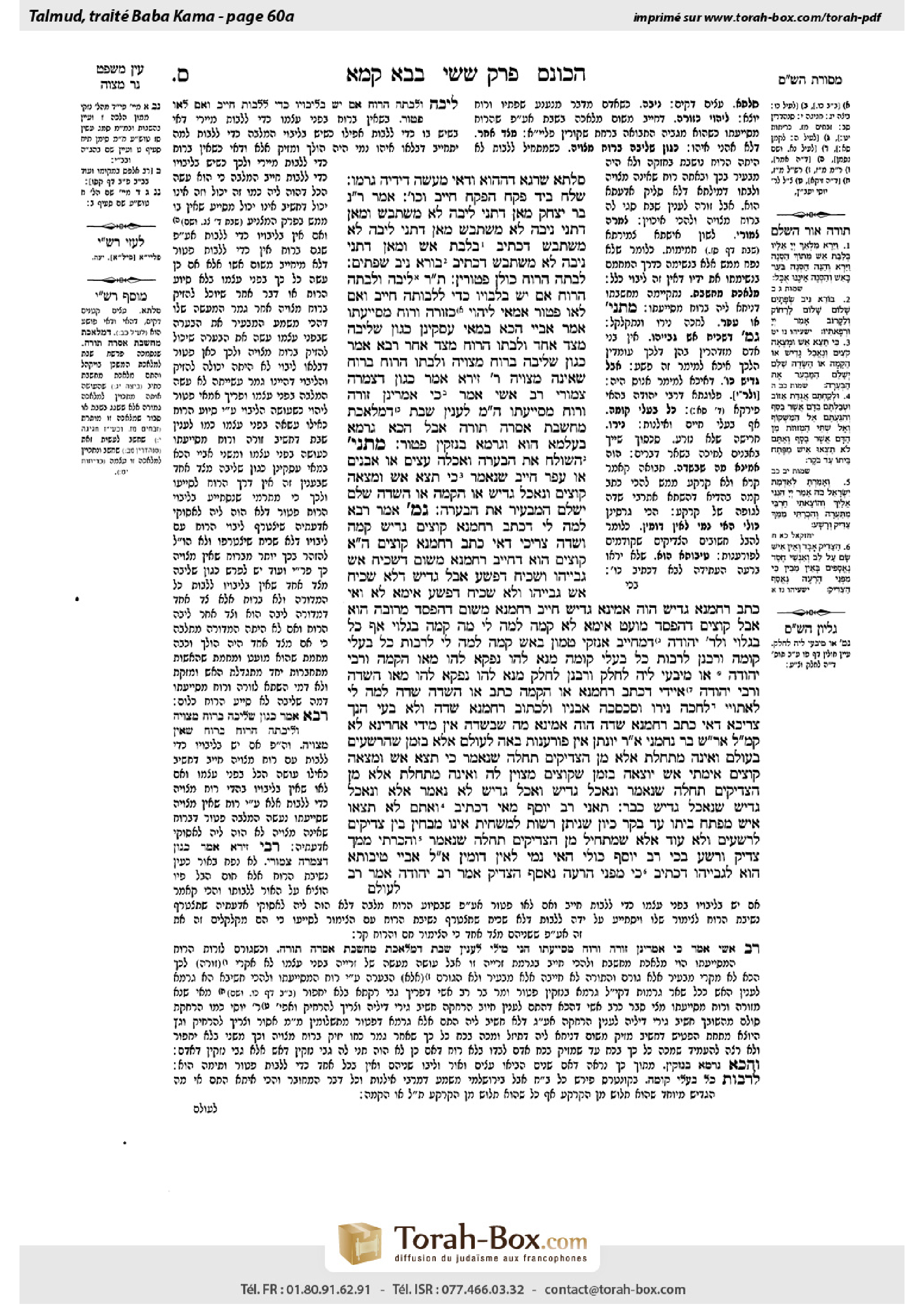
בבא קמא ס׳ א · Aramaic and Hebrew text
סִלְתָּא, שְׁרָגָא, דְּהָהוּא וַדַּאי מַעֲשֵׂה דִידֵיהּ גָּרְמוּ.
שִׁלַּח בְּיַד פִּקֵּחַ – הַפִּקֵּחַ חַיָּיב וְכוּ׳. אָמַר רַב נַחְמָן בַּר יִצְחָק: מַאן דְּתָנֵי ״לִיבָּה״ לָא מִשְׁתַּבַּשׁ, וּמַאן דְּתָנֵי ״נִיבָּה״ לָא מִשְׁתַּבַּשׁ.
מַאן דְּתָנֵי ״לִיבָּה״ לָא מִשְׁתַּבַּשׁ – דִּכְתִיב: ״בְּלַבַּת אֵשׁ״. וּמַאן דְּתָנֵי ״נִיבָּה״ לָא מִשְׁתַּבַּשׁ – דִּכְתִיב: ״בּוֹרֵא נִיב שְׂפָתָיִם״.
לִבְּתָה הָרוּחַ – כּוּלָּן פְּטוּרִין. תָּנוּ רַבָּנַן: לִיבָּה וְלִבְּתָה הָרוּחַ, אִם יֵשׁ בְּלִבּוּיוֹ כְּדֵי לְלַבּוֹתָהּ – חַיָּיב, וְאִם לָאו – פָּטוּר.
אַמַּאי? לֶיהֱוֵי כְּזוֹרֶה וְרוּחַ מְסַיַּיעְתּוֹ!
אָמַר אַבָּיֵי: הָכָא בְּמַאי עָסְקִינַן – כְּגוֹן שֶׁלִּיבָּה מִצַּד אֶחָד, וְלִבַּתּוּ הָרוּחַ מִצַּד אַחֵר. רָבָא אָמַר: כְּגוֹן שֶׁלִּיבָּה בְּרוּחַ מְצוּיָה, וְלִבַּתּוּ הָרוּחַ בְּרוּחַ שֶׁאֵינָהּ מְצוּיָה. רַבִּי זֵירָא אָמַר: כְּגוֹן דְּצַמְּרַהּ צַמּוֹרֵי.
רַב אָשֵׁי אָמַר: כִּי אָמְרִינַן זוֹרֶה וְרוּחַ מְסַיַּיעְתּוֹ – הָנֵי מִילֵּי לְעִנְיַן שַׁבָּת, דִּמְלֶאכֶת מַחְשֶׁבֶת אָסְרָה תּוֹרָה; אֲבָל הָכָא – גְּרָמָא בְּעָלְמָא הוּא, וּגְרָמָא בִּנְזָקִין פָּטוּר.
מַתְנִי׳ הַשּׁוֹלֵחַ אֶת הַבְּעֵרָה, וְאָכְלָה עֵצִים אוֹ אֲבָנִים אוֹ עָפָר – חַיָּיב; שֶׁנֶּאֱמַר: ״כִּי תֵצֵא אֵשׁ וּמָצְאָה קֹצִים, וְנֶאֱכַל גָּדִישׁ אוֹ הַקָּמָה אוֹ הַשָּׂדֶה, שַׁלֵּם יְשַׁלֵּם הַמַּבְעִר אֶת הַבְּעֵרָה״.
גְּמָ׳ אָמַר רָבָא: לְמָה לִי דִּכְתַב רַחֲמָנָא ״קוֹצִים״, ״גָּדִישׁ״, ״קָמָה״ וְ״שָׂדֶה״?
צְרִיכִי; דְּאִי כְּתַב רַחֲמָנָא ״קוֹצִים״, הֲוָה אָמֵינָא: קוֹצִים הוּא דְּחַיַּיב רַחֲמָנָא – מִשּׁוּם דִּשְׁכִיחַ אֵשׁ גַּבַּיְיהוּ, וּשְׁכִיחַ דְּפָשַׁע; אֲבָל גָּדִישׁ – דְּלָא שְׁכִיחַ אֵשׁ גַּבַּיְיהוּ, וְלָא שְׁכִיחַ דְּפָשַׁע, אֵימָא לָא. וְאִי כְּתַב רַחֲמָנָא ״גָּדִישׁ״, הֲוָה אָמֵינָא: גָּדִישׁ חַיַּיב רַחֲמָנָא – מִשּׁוּם דְּהֶפְסֵד מְרוּבֶּה הוּא; אֲבָל קוֹצִים – דְּהֶפְסֵד מוּעָט, אֵימָא לָא.
״קָמָה״ לְמָה לִי? מָה קָמָה בְּגָלוּי – אַף כֹּל בְּגָלוּי.
וּלְרַבִּי יְהוּדָה דִּמְחַיֵּיב אַנִּזְקֵי טָמוּן בָּאֵשׁ, ״קָמָה״ לְמָה לִי? לְרַבּוֹת כׇּל בַּעֲלֵי קוֹמָה. וְרַבָּנַן, לְרַבּוֹת כׇּל בַּעֲלֵי קוֹמָה מְנָא לְהוּ? נָפְקָא לְהוּ מֵ״אוֹ הַקָּמָה״.
וְרַבִּי יְהוּדָה – ״אוֹ״ מִיבְּעֵי לֵיהּ לְחַלֵּק. וְרַבָּנַן לְחַלֵּק מְנָא לְהוּ? נָפְקָא לְהוּ מֵ״אוֹ הַשָּׂדֶה״.
וְרַבִּי יְהוּדָה – אַיְּידֵי דִּכְתַב רַחֲמָנָא ״אוֹ הַקָּמָה״, כְּתַב ״אוֹ הַשָּׂדֶה״.
״שָׂדֶה״ לְמָה לִי? לְאֵתוֹיֵי לִחֲכָה נִירוֹ וְסִכְסְכָה אֲבָנָיו. וְלִכְתּוֹב רַחֲמָנָא ״שָׂדֶה״, וְלָא בָּעֵי הָנָךְ! צְרִיכָא; דְּאִי כְּתַב רַחֲמָנָא ״שָׂדֶה״, הֲוָה אָמֵינָא: מַה שֶּׁבַּשָּׂדֶה – אִין, מִידֵּי אַחֲרִינָא – לָא; קָא מַשְׁמַע לַן.
אָמַר רַבִּי שְׁמוּאֵל בַּר נַחְמָנִי אָמַר רַבִּי יוֹנָתָן: אֵין פּוּרְעָנוּת בָּאָה לָעוֹלָם אֶלָּא בִּזְמַן שֶׁהָרְשָׁעִים בָּעוֹלָם, וְאֵינָהּ מַתְחֶלֶת אֶלָּא מִן הַצַּדִּיקִים תְּחִלָּה, שֶׁנֶּאֱמַר: ״כִּי תֵצֵא אֵשׁ וּמָצְאָה קֹצִים״ – אֵימָתַי אֵשׁ יוֹצְאָה? בִּזְמַן שֶׁקּוֹצִים מְצוּיִין לָהּ. וְאֵינָהּ מַתְחֶלֶת אֶלָּא מִן הַצַּדִּיקִים תְּחִלָּה, שֶׁנֶּאֱמַר: ״וְנֶאֱכַל גָּדִישׁ״; ״וְאָכַל גָּדִישׁ״ לֹא נֶאֱמַר, אֶלָּא ״וְנֶאֱכַל גָּדִישׁ״ – שֶׁנֶּאֱכַל גָּדִישׁ כְּבָר.
תָּאנֵי רַב יוֹסֵף, מַאי דִּכְתִיב: ״וְאַתֶּם לֹא תֵצְאוּ אִישׁ מִפֶּתַח בֵּיתוֹ עַד בֹּקֶר״? כֵּיוָן שֶׁנִּיתַּן רְשׁוּת לַמַּשְׁחִית, אֵינוֹ מַבְחִין בֵּין צַדִּיקִים לִרְשָׁעִים. וְלֹא עוֹד, אֶלָּא שֶׁמַּתְחִיל מִן הַצַּדִּיקִים תְּחִלָּה, שֶׁנֶּאֱמַר: ״וְהִכְרַתִּי מִמֵּךְ צַדִּיק וְרָשָׁע״.
בָּכֵי רַב יוֹסֵף: כּוּלֵּי הַאי נָמֵי לְאַיִן דּוֹמִין. אֲמַר לֵיהּ אַבָּיֵי: טֵיבוּתָא הוּא לְגַבַּיְיהוּ, דִּכְתִיב: ״כִּי מִפְּנֵי הָרָעָה נֶאֱסַף הַצַּדִּיק״.
אָמַר רַב יְהוּדָה אָמַר רַב:
Bava Kamma 60a · English translation
of thin wood and a candle [sheraga], since in that case his own action, i.e., that of the one who sent the flame, definitely caused the fire to spread.
The mishna teaches that if one sent a fire in the hand of a halakhically competent person, the halakhically competent person is liable…If another came and fanned the flame the one who fanned it is liable. Rav Naḥman bar Yitzḥak says with regard to the correct text of the mishna: The one who teaches it using the word fanned [libba] is not mistaken, and the one who teaches it using the word blew [nibba] is not mistaken.
Rav Naḥman explained: The one who teaches using the word fanned [libba] is not mistaken, as it is written: “With a flame [belabbat] of fire” (Exodus 3:2), and the one who teaches using the word blew [nibba] is not mistaken, as it is written: “He creates the fruit [niv] of the lips” (Isaiah 57:19), which can be interpreted as referring to the breath of the lips.
§ The mishna teaches: If the wind fanned the flames, all the people involved are exempt, indicating that even if one fanned the fire at the same time that the wind was blowing he is exempt. The Gemara cites a baraita in which the Sages taught the same idea explicitly: In a case where one fanned the flame and at the same time the wind fanned it, if his fanning has sufficient strength by itself to fan the flames, he is liable for damage caused by the fire, since even without the wind the fire would have spread. But if his fanning alone was not sufficient, he is exempt.
The Gemara asks: Why is he exempt if his fanning is not sufficient? Let it be the same halakha as the case of one who winnows grain on Shabbat by throwing it into the air, and the wind assists him by separating the chaff from the grain. In such a case he is liable for desecrating Shabbat, despite the fact that without the assistance of the wind he would not have been able to winnow the grain.
Abaye said: With what are we dealing here? We are dealing with a case where he fanned the fire from one side and the wind fanned it from the other side, and the fire was blown in the direction the wind was blowing. Therefore, it is clear that his fanning did not help the fire spread, so he is exempt. Rava says: We are dealing with a case where he fanned it along with a typical wind, and this was not sufficient to cause the fire to spread, and suddenly an atypical wind came and fanned it. Therefore, he is exempt since he could not have anticipated this. Rabbi Zeira said: We are dealing with a case where he only heated [detzamera tzamurei] the fire by breathing on it, rather than fanning it properly.
Rav Ashi said: When we say that one is liable in a case where he winnows and the wind assists him, this statement applies with regard to the halakhot of Shabbat. With regard to Shabbat, the principle is that the Torah prohibited planned, constructive labor. The primary consideration is that his objective is accomplished, even if he did not perform the entire act of labor. But here, in the context of damages, he is considered to have caused damage merely through indirect action, and one who causes damage through indirect action is exempt.
MISHNA: If one sends forth a fire, i.e., allows it to escape, and it consumes wood, or stones, or earth, he is liable, as it is stated: “If a fire breaks out, and catches in thorns, so that a stack of grain, or standing grain, or the field, is consumed, the one who kindled the fire shall pay compensation” (Exodus 22:5), which teaches that he is liable also for destroying the field itself.
GEMARA: With regard to the verse cited in the mishna, Rava says: Why do I need the Merciful One to write in the Torah all of these terms: “Thorns,” “a stack of grain,” “standing grain,” and “field,” which seem to be redundant?
Rava explains: All the terms are necessary, because if the Merciful One had written only “thorns” in the Torah, I would say that it is specifically thorns for which the Merciful One renders one liable, because it is common for fire to be near them, and it is common that one is negligent. But with regard to a stack of grain, with regard to which it is not common for fire to be near it, as grain is valuable, so one keeps it out of harm’s way, and it is not common that one is negligent in allowing it to catch fire, I would say that he should not be liable. And if the Merciful One had written only: “A stack of grain,” I would say that it is specifically for such a stack that the Merciful One renders him liable, because it involves a substantial financial loss. But with regard to thorns, which involve only a minimal loss, I would say that he should not be liable. Therefore, the verse teaches that he is liable for damage to thorns as well.
Why do I need the Torah to state the term “standing grain”? It is in order to teach that just as standing grain is exposed, so too, one is liable only for damage caused by fire for all items that are exposed. One is exempt from liability for damage to items that are concealed.
The Gemara asks: And according to the opinion of Rabbi Yehuda, who deems one liable for a concealed article damaged by a fire, why do I need the Torah to state the term: “Standing grain”? The Gemara answers: The term serves to include all items that have stature, i.e., trees and animals, and not only produce. The Gemara asks: And according to the opinion of the Rabbis, who derive the halakha of concealed articles from the term “standing grain,” from where do they derive that all items that have stature are included? The Gemara answers: They derive it from the term: “Or standing grain,” since the additional word “or” is an inclusive term.
The Gemara asks: And what does Rabbi Yehuda derive from the additional word “or”? The Gemara answers: He requires the word “or” to divide the terms, i.e., to teach that one is liable for damage to any one of the items listed, and not only where the fire burned all of them together. The Gemara then asks: And from where do the Rabbis derive the halakha to divide the terms so that one is liable for damage to each one independently? The Gemara answers: They derive it from the second instance of the word “or,” as the verse states: “Or the field.”
The Gemara asks: And what does Rabbi Yehuda derive from the phrase “or the field”? The Gemara answers: Since the Merciful One wrote in the Torah: “Or standing grain,” He also wrote: “Or the field,” for stylistic consistency, but no additional halakha may be derived from this term.
Rava continues to elaborate on the different terms in the verse: And why do I need the word “field” in the verse? It serves to include liability for damage in a case when the flames licked a plowed field and charred its stones. The Gemara asks: But let the Merciful One write only the term “field,” and then it would not require all these other terms. If one is liable for damage to a field, which is not totally destroyed by the fire, he is certainly liable for damage to other items that are completely destroyed. The Gemara answers: It is necessary to write the other terms as well, because if the Merciful One had written only “field,” I would say that for what is in the field, yes, one is liable, but for anything else, no, one is not liable. Therefore, it teaches us that one is liable for any damage caused by fire.
§ The Gemara cites an aggadic midrash based on this verse: Rabbi Shmuel bar Naḥmani says that Rabbi Yonatan says: Calamity befalls the world only when wicked people are in the world, but the calamity begins only with the righteous first, as it is stated in the verse: “If a fire breaks out, and catches in thorns, so that a stack of grain, or standing grain, or the field, is consumed” (Exodus 22:5). When does the fire, i.e., calamity, emerge? At a time when the thorns, i.e., the wicked, are found with it. But calamity begins only from the righteous first, as it is stated in the continuation of the verse: “And a stack of grain is consumed [vene’ekhal].” It is not stated: If a fire breaks out, and catches in thorns, and consumes [ve’akhal] the stack of grain; rather, it states: “A stack of grain is consumed,” meaning that the stack, i.e., the righteous, has already been consumed before the thorns.
Rav Yosef taught a baraita: What is the meaning of that which is written with regard to the plague of the firstborn: “And none of you shall go out of the opening of his house until the morning” (Exodus 12:22)? If the plague was not decreed upon the Jewish people, why were they not permitted to leave their homes? Once permission is granted to the destroyer to kill, it does not distinguish between the righteous and the wicked. And not only that, but it begins with the righteous first, as it is stated in the verse: “And will cut off from you the righteous and the wicked” (Ezekiel 21:8), where mention of the righteous precedes the wicked.
Rav Yosef cried and said: Are all these righteous people also compared to nothing when calamity strikes? Abaye said to him: It is goodness for the righteous that they die first, as it is written: “The righteous is taken away because of the evil to come” (Isaiah 57:1), so that he will not have to endure the suffering that will befall the people.
Rav Yehuda says that Rav says:
Bava Kamma 60a · Traduction française (IA)
de bois léger et une bougie [sheraga], car dans ce cas, son propre acte, c'est-à-dire celui de celui qui a envoyé la flamme, a certainement provoqué la propagation du feu.
La mitsva enseigne que si l'on envoie un feu entre les mains d'une personne halakhiquement compétente, la personne halakhiquement compétente est responsable... Si un autre vient et alimente la flamme, celui qui alimente la flamme est responsable. Rav Naḥman bar Yitzḥak dit concernant la version correcte de la mitsva : celui qui la transmet en utilisant le mot « alimenté » [libba] n'a pas tort, et celui qui la transmet en utilisant le mot « soufflé » [nibba] n'a pas tort.
Rav Naḥman explique : celui qui la transmet en utilisant le mot « alimenté » [libba] n'a pas tort, car il est écrit : « Avec une flamme [belabbat] de feu » (Exode 3:2), et celui qui la transmet en utilisant le mot « soufflé » [nibba] n'a pas tort, car il est écrit : « Il crée le fruit [niv] des lèvres » (Yachout 57:19), ce qui peut être interprété comme faisant référence au souffle des lèvres.
§ La mitsna enseigne : si le vent alimente la flamme, toutes les personnes impliquées sont exemptes, indiquant que même si l'on alimente le feu en même temps que le vent souffle, on est exempt. La Guemara cite une baraïta dans laquelle les Sages enseignent explicitement cette idée : dans un cas où l'on alimente la flamme et que le vent l'alimente en même temps, si son alimentation est suffisante par elle-même pour alimenter la flamme, il est responsable des dommages causés par le feu, car même sans le vent, le feu aurait pu se propager. Mais si son alimentation seule n'était pas suffisante, il est exempt.
La Guemara pose la question : pourquoi est-il exempt si son alimentation n'est pas suffisante ? Que ce soit la même halakha que le cas d'une personne qui sépare le blé le sabbat en le lançant en l'air, et que le vent l'aide à séparer la paille du blé. Dans ce cas, il est responsable de la violation du sabbat, malgré le fait que sans l'aide du vent, il n'aurait pas pu séparer le blé.
Abaye dit : avec quels cas sommes-nous en train de traiter ? Nous sommes en train de traiter d'un cas où l'on a alimenté le feu d'un côté et le vent l'a alimenté de l'autre côté, et le feu a été soufflé dans la direction que le vent soufflait. Par conséquent, il est clair que son alimentation n'a pas aidé la propagation du feu, donc il est exempt. Rava dit : nous sommes en train de traiter d'un cas où l'on a alimenté le feu avec un vent normal, et cela n'était pas suffisant pour provoquer la propagation du feu, et soudain un vent inhabituel est venu l'alimenter. Par conséquent, il est exempt car il n'avait pas pu anticiper cela. Rabbi Zeira dit : nous sommes en train de traiter d'un cas où l'on a seulement chauffé [detzamera tzamurei] le feu en soufflant dessus, plutôt que d'alimenter correctement le feu.
Rav Ashi dit : lorsque nous disons qu'une personne est responsable dans un cas où l'on sépare le blé et que le vent l'aide, cette déclaration s'applique concernant les halakhot du sabbat. Concernant le sabbat, le principe est que la Torah interdit le travail planifié et constructif. La considération principale est que son objectif est accompli, même si l'on n'a pas accompli l'ensemble de l'acte de travail. Mais ici, dans le contexte des dommages, on considère qu'il a causé des dommages uniquement par une action indirecte, et celui qui cause des dommages par une action indirecte est exempt.
MICHNA : Si l'on envoie un feu, c'est-à-dire le permet, et qu'il consume du bois, ou des pierres, ou de la terre, il est responsable, car il est dit : « Si un feu éclate et consume des épines, de sorte qu'une pile de blé, ou du blé debout, ou le champ, est consumé, celui qui a allumé le feu doit réparer le préjudice » (Exode 22:5), ce qui enseigne qu'il est responsable également pour la destruction du champ lui-même.
GUEMARA : Concernant la verset cité dans la mitsva, Rava dit : pourquoi ai-je besoin que le Miséricordieux ait écrit dans la Torah tous ces termes : « épines », « une pile de blé », « du blé debout », et « champ », qui semblent redondants ?
Rava explique : tous les termes sont nécessaires, car si le Miséricordieux avait écrit seulement « épines » dans la Torah, je dirais que c'est spécifiquement les épines pour lesquelles le Miséricordieux rend responsable, car c'est commun que le feu soit près d'elles, et c'est commun que l'on soit négligent. Mais concernant une pile de blé, concernant laquelle il n'est pas commun que le feu soit près d'elle, car le blé est précieux, donc on le garde à l'abri, et il n'est pas commun que l'on soit négligent en la laissant prendre feu, je dirais qu'il ne devrait pas être responsable. Et si le Miséricordieux avait écrit seulement : « une pile de blé », je dirais que c'est spécifiquement pour une telle pile que le Miséricordieux rend responsable, car cela implique une perte financière importante. Mais concernant les épines, qui impliquent une perte minimale, je dirais qu'il ne devrait pas être responsable. Par conséquent, le verset enseigne qu'il est responsable pour les dommages causés aux épines aussi.
Pourquoi ai-je besoin de la Torah pour énoncer le terme « blé debout » ? C'est afin d'enseigner que tout comme le blé debout est exposé, ainsi, on est responsable uniquement des dommages causés par le feu pour tous les objets exposés. On est exempt de responsabilité pour les dommages causés aux objets cachés.
La Guemara pose la question : et selon l'opinion de Rabbi Yehuda, qui considère que l'on est responsable pour un objet caché endommagé par un feu, pourquoi ai-je besoin de la Torah pour énoncer le terme : « blé debout » ? La Guemara répond : ce terme sert à inclure tous les objets qui ont une stature, c'est-à-dire les arbres et les animaux, et non seulement les produits. La Guemara pose la question : et selon l'opinion des Rabbins, qui dérivent la halakha des objets cachés du terme « blé debout », d'où dérivent-ils que tous les objets qui ont une stature sont inclus ? La Guemara répond : ils dérivent cela du terme : « ou blé debout », car le mot supplémentaire « ou » est un terme inclusif.
Le Guemara pose la question : Et que déduit Rabbi Yéhuda de l'expression supplémentaire « ou » ? Le Guemara répond : Il exige le mot « ou » pour séparer les termes, c'est-à-dire pour enseigner que l'on est responsable des dommages causés à tout objet mentionné, et non seulement lorsqu'un feu a brûlé tous ensemble. Le Guemara pose alors la question : Et d'où les Rabbins déduisent-ils la halakha de séparer les termes afin qu'on soit responsable des dommages causés à chaque objet indépendamment ? Le Guemara répond : Ils en déduisent cela de la seconde occurrence du mot « ou », comme le texte dit : « Ou le champ. »
Le Guemara pose la question : Et que déduit Rabbi Yéhuda de l'expression « ou le champ » ? Le Guemara répond : Puisque l'Éternel a écrit dans la Torah : « Ou le blé en épis », Il a aussi écrit : « Ou le champ », pour cohérence stylistique, mais aucune halakha supplémentaire ne peut être déduite de ce terme.
Rava continue d'explorer les différents termes du texte : Et pourquoi ai-je besoin du mot « champ » dans le texte ? Il sert à inclure la responsabilité en cas où les flammes ont léché un champ labouré et carbonisé ses pierres. Le Guemara pose alors la question : Mais que l'Éternel écrive seulement le mot « champ », et alors il ne nécessiterait pas tous ces autres termes. Si l'on est responsable des dommages causés à un champ, qui n'a pas été totalement détruit par le feu, on est certainement responsable des dommages causés à d'autres objets complètement détruits. Le Guemara répond : Il est nécessaire d'écrire les autres termes également, car si l'Éternel avait écrit seulement « champ », je dirais que pour ce qui est dans le champ, oui, on est responsable, mais pour tout autre objet, non, on n'est pas responsable. Ainsi, cela nous enseigne que l'on est responsable de tout dommage causé par le feu.
§ Le Guemara cite un midrash aggadique basé sur cette versette : Rabbi Shmuel bar Naḥmani dit que Rabbi Yonatan dit : La calamité frappe le monde seulement lorsque les gens mauvais sont présents dans le monde, mais la calamité commence seulement avec les justes en premier, comme il est dit dans la versette : « Si un feu éclate et prend feu aux buissons, de sorte qu'une pile de blé, ou du blé en épis, ou le champ soit consumé » (Exode 22:5). Quand le feu, c'est-à-dire la calamité, émerge-t-il ? À un moment où les buissons, c'est-à-dire les gens mauvais, sont présents. Mais la calamité commence seulement avec les justes en premier, comme il est dit dans la continuation de la versette : « Et la pile de blé est consumée [vene’ekhal] ». Il n'est pas dit : Si un feu éclate et prend feu aux buissons, et consume [ve’akhal] la pile de blé ; plutôt, il dit : « La pile de blé est consumée », ce qui signifie que la pile, c'est-à-dire les justes, a déjà été consumée avant les buissons.
Rav Yosef enseignait une baraïta : Quelle est la signification de ce qui est écrit concernant la plaie des premiers-nés : « Et aucun de vous ne doit sortir de l'ouverture de sa maison jusqu'au matin » (Exode 12:22) ? Si la plaie n'était pas décrétée sur le peuple juif, pourquoi étaient-ils interdits de sortir de leurs maisons ? Une fois que la permission est donnée au destructeur de tuer, il ne distingue pas entre les justes et les méchants. Et non seulement cela, mais cela commence avec les justes en premier, comme il est dit dans la versette : « Et il coupera de vous le juste et le méchant » (Ezéchiel 21:8), où la mention des justes précède celle des méchants.
Rav Yosef pleura et dit : Les justes sont-ils tous comparés à rien lorsqu'une calamité frappe ? Abaye lui répondit : C'est une bonté pour les justes qu'ils meurent d'abord, comme il est écrit : « Le juste est emporté à cause de la malédiction à venir » (Yachout 57:1), afin qu'il ne doive pas endurer la souffrance qui frappera le peuple.
Rav Yéhuda dit que Rav dit :
Traduction française générée par IA à partir de l’édition anglaise de Sefaria. Vérifie toujours un passage avec le texte source.
Text from Sefaria: William Davidson Edition - Vocalized Aramaic (CC BY NC); William Davidson Edition - English (CC BY NC).