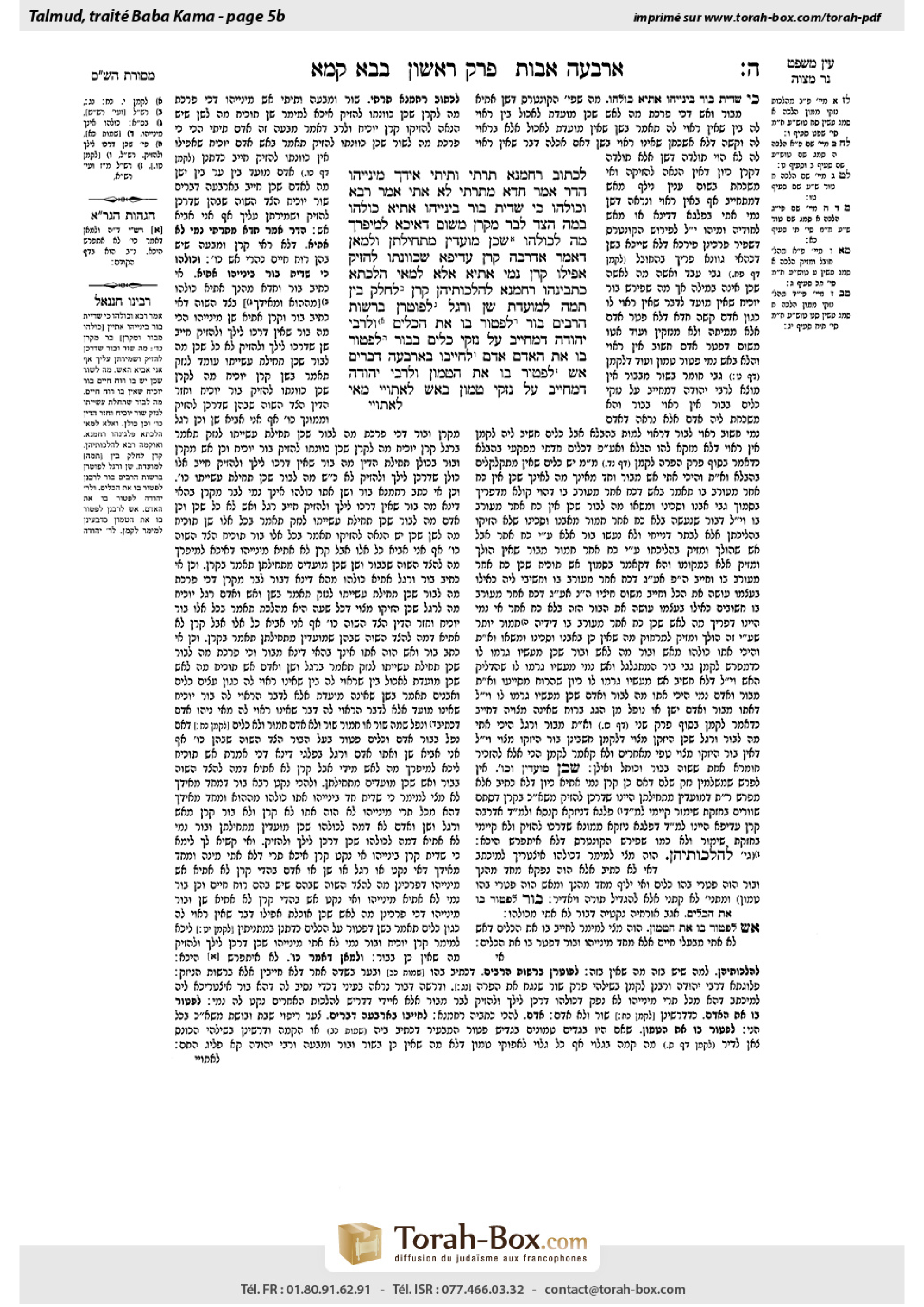
Bava Kamma 5b: Talmud study for Daf Yomi
Study the Talmud for Daf Yomi with scanned pages, Hebrew text, English translations from Sefaria and AI-generated French translations.
Passage selection and English or AI-generated French translation are available where the scan has annotations. Daf Study is independent of Torah-Box and Sefaria.
Browse Bava Kamma · בבא קמא · All tractatesBava Kamma 5b text and translations
This page of Bava Kamma includes the Aramaic text, an English translation and an AI-generated French translation, alongside the scan above.
בבא קמא ה׳ ב · Aramaic and Hebrew text
לִכְתּוֹב רַחֲמָנָא תַּרְתֵּי, וְתֵיתֵי אִידַּךְ מִינַּיְיהוּ; הֲדַר אָמַר: חֲדָא מִתַּרְתֵּי לָא אָתֵי.
אָמַר רָבָא: וְכוּלְּהוּ כִּי שָׁדֵית בּוֹר בֵּינַיְיהוּ – אָתְיָא כּוּלְּהוּ בַּמֶּה הַצַּד, לְבַר מִקֶּרֶן; מִשּׁוּם דְּאִיכָּא לְמִיפְרַךְ, מָה לְכוּלְּהוּ שֶׁכֵּן מוּעָדִין מִתְּחִילָּתָן.
וּלְמַאן דְּאָמַר: אַדְּרַבָּה, קֶרֶן עֲדִיפָא – שֶׁכַּוּוֹנָתוֹ לְהַזִּיק; אֲפִילּוּ קֶרֶן נָמֵי אָתְיָא.
אֶלָּא לְמַאי הִלְכְתָא כַּתְבִינְהוּ רַחֲמָנָא? לְהִלְכוֹתֵיהֶן.
קֶרֶן – לְחַלֵּק בֵּין תַּמָּה לְמוּעֶדֶת.
שֵׁן וָרֶגֶל – לְפוֹטְרָן בִּרְשׁוּת הָרַבִּים.
בּוֹר – לִפְטוֹר בּוֹ אֶת הַכֵּלִים. וּלְרַבִּי יְהוּדָה דִּמְחַיֵּיב עַל נִזְקֵי כֵלִים בְּבוֹר – לִפְטוֹר בּוֹ אֶת הָאָדָם.
אָדָם – לְחַיְּיבוֹ בְּאַרְבָּעָה דְּבָרִים.
אֵשׁ – לִפְטוֹר בּוֹ אֶת הַטָּמוּן. וּלְרַבִּי יְהוּדָה דִּמְחַיֵּיב עַל נִזְקֵי טָמוּן בָּאֵשׁ, לְאֵתוֹיֵי מַאי?
Bava Kamma 5b · English translation
Let the Merciful One write only two of the primary categories and derive the other categories from them. Then the tanna says: It is not possible to derive one category from two other categories, as each category has its own unique characteristics, which prevent the derivation of a new category even from a combination of two categories.
Rava said: And with regard to all of the primary categories in the mishna, when you cast the primary category of Pit among them, all of the rest of them can then be derived through an analogy based on the common factor of two categories. This is the case with all of the categories except for Goring, due to the fact that there is room to refute the analogy to teach the halakha of Goring with the following contention: What is notable about all of the other categories? They are notable in that they are forewarned from their outset. Since it is the typical manner of the animal to trample and eat, and the typical manner of fire to burn, and the typical manner of a pit to serve as an obstacle, the owner is always forewarned with regard to safeguarding against damage and is liable to pay full damages for his failure to prevent the damage even the first time. With regard to Goring, the animal is innocuous for the first three instances of damage and only thereafter is the animal forewarned, rendering its owner liable to pay full damages.
And according to the one who says: On the contrary, Goring is superior in the sense that one’s liability in a case of Goring is more apparent, as the objective of the ox’s action is to cause damage, even Goring can be derived from the common factor of two sources.
The Gemara asks: But if all the categories can be derived from another category and Pit, for the purpose of deriving what halakha did the Merciful One write all the primary categories explicitly? The Gemara answers: It is in order to derive their unique halakhot that apply exclusively to each category.
Goring is written explicitly in order to distinguish between the halakhot of damage caused by an innocuous animal and damage caused by a forewarned animal.
Eating and Trampling are written explicitly in order to exempt from liability those whose animals perform the actions in these categories in a public domain.
Pit is written explicitly in order to exempt one from liability for damage to vessels caused when they fall into a pit. The Gemara adds: And according to the opinion of Rabbi Yehuda, who deems one liable even for damage to vessels caused when they fall into a pit, Pit was written in order to exempt one from liability for the death of a person who was killed by falling into a pit. Rabbi Yehuda concedes that the possessor of the pit is exempt because the person who ultimately fell into the pit was capable of avoiding it.
Man is written explicitly in order to render him liable for four additional types of indemnity, beyond the payment of damages for the diminution in value caused when one injures a person.
Fire is written explicitly in order to exempt one from liability for damage caused to a concealed object, e.g., one hidden by grain, that was consumed by fire. The Gemara asks: And according to Rabbi Yehuda, who deems one liable even for damage done to a concealed object damaged by fire, to add what halakha does the Torah mention the category of Fire explicitly?
Bava Kamma 5b · Traduction française (IA)
Que le Miséricordieux écrive seulement deux des catégories principales et dérive les autres à partir d'elles. Puis le tanna dit : Il n'est pas possible de dériver une catégorie à partir de deux autres catégories, car chaque catégorie a ses propres caractéristiques uniques, ce qui empêche la dérivation d'une nouvelle catégorie même à partir de la combinaison de deux catégories.
Rava dit : Et concernant toutes les catégories principales mentionnées dans la mitsna, lorsque l'on introduit la catégorie de la fosse parmi elles, toutes les autres peuvent alors être dérivées par analogie grâce au facteur commun de deux catégories. C'est le cas pour toutes les catégories sauf la bête qui déchire, car il y a de la place pour contester cette analogie afin d'enseigner la halakha de la bête qui déchire avec l'argument suivant : Qu'est-ce qui est notable dans toutes les autres catégories ? Elles sont notables car elles sont prévenues dès le début. Puisque c'est la manière habituelle de l'animal de piétiner et de manger, et la manière habituelle du feu de brûler, et la manière habituelle d'une fosse de servir d'obstacle, le propriétaire est toujours prévenu concernant la protection contre les dommages et est tenu responsable de payer les dommages complets pour son échec à empêcher le dommage même la première fois. En ce qui concerne la bête qui déchire, l'animal est inoffensif pendant les trois premiers cas de dommage et n'est prévenu qu'ensuite, ce qui rend son propriétaire responsable de payer les dommages complets.
Et selon celui qui dit : Au contraire, la bête qui déchire est supérieure dans le sens où la responsabilité dans le cas de la bête qui déchire est plus évidente, car l'objectif de l'action de l'animal est de causer un dommage, même la bête qui déchire peut être dérivée à partir du facteur commun de deux sources.
Le Guemara demande : Mais si toutes les catégories peuvent être dérivées d'une autre catégorie et de Pit, à quel titre le Miséricordieux a-t-il écrit explicitement toutes les catégories principales ? Le Guemara répond : C'est afin de dériver leurs halakhot uniques qui s'appliquent exclusivement à chaque catégorie.
Le déchirement est écrit explicitement afin de distinguer entre les halakhot du dommage causé par un animal inoffensif et celui causé par un animal prévenu.
L'ingestion et le piétinement sont écrits explicitement afin d'exonérer de responsabilité ceux dont les animaux accomplissent les actions de ces catégories dans un domaine public.
La fosse est mentionnée explicitement afin d'exonérer de responsabilité le dommage causé aux objets lorsqu'ils tombent dans une fosse. La Guemara ajoute : Et selon l'opinion de Rabbi Yehuda, qui considère que l'on est tenu responsable même pour le dommage causé aux objets lorsqu'ils tombent dans une fosse, la fosse a été mentionnée explicitement afin d'exonérer de responsabilité le meurtre d'une personne qui est morte en tombant dans une fosse. Rabbi Yehuda reconnaît que le possesseur de la fosse est exempt car la personne qui est tombée dans la fosse était capable d'éviter le dommage.
L'homme est mentionné explicitement afin de le rendre responsable de quatre types supplémentaires d'indemnité, au-delà du paiement des dommages pour la diminution de valeur causée lorsqu'on blesse une personne.
Le feu est mentionné explicitement afin d'exonérer de responsabilité le dommage causé à un objet caché, par exemple un objet caché sous des céréales, qui a été consumé par le feu. La Guemara demande : Et selon Rabbi Yehuda, qui considère que l'on est tenu responsable même pour le dommage causé à un objet caché par le feu, à quoi ajoute-t-il que la Torah mentionne explicitement la catégorie du feu ?
Traduction française générée par IA à partir de l’édition anglaise de Sefaria. Vérifie toujours un passage avec le texte source.
Text from Sefaria: William Davidson Edition - Vocalized Aramaic (CC BY NC); William Davidson Edition - English (CC BY NC).