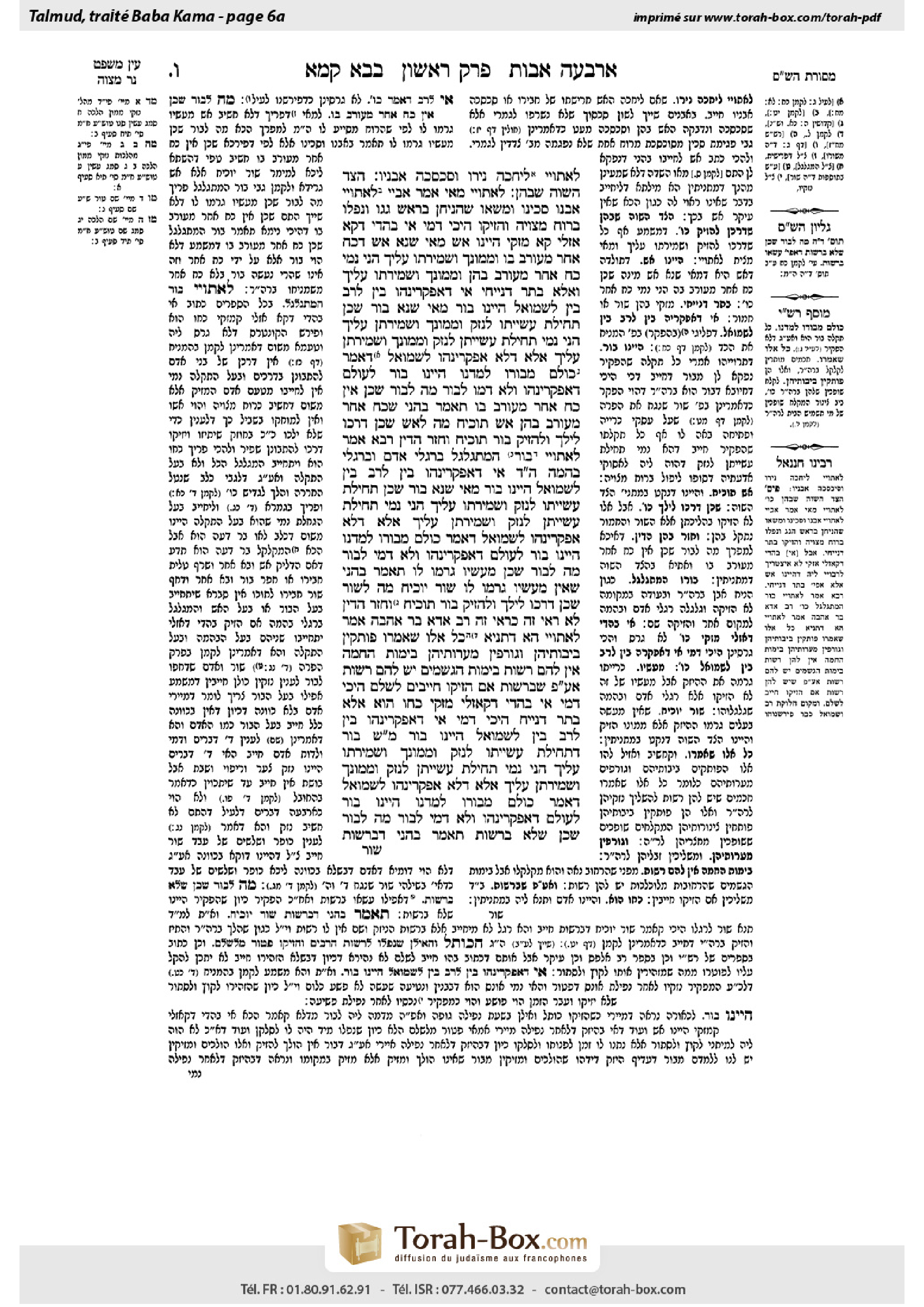
Bava Kamma 6a: Talmud study for Daf Yomi
Study the Talmud for Daf Yomi with scanned pages, Hebrew text, English translations from Sefaria and AI-generated French translations.
Passage selection and English or AI-generated French translation are available where the scan has annotations. Daf Study is independent of Torah-Box and Sefaria.
Browse Bava Kamma · בבא קמא · All tractatesBava Kamma 6a text and translations
This page of Bava Kamma includes the Aramaic text, an English translation and an AI-generated French translation, alongside the scan above.
בבא קמא ו׳ א · Aramaic and Hebrew text
לְאֵתוֹיֵי לִיחֲכָה נִירוֹ וְסִכְסְכָה אֲבָנָיו.
הַצַּד הַשָּׁוֶה שֶׁבָּהֶן. לְאֵתוֹיֵי מַאי? אָמַר אַבָּיֵי: לְאֵתוֹיֵי אַבְנוֹ סַכִּינוֹ וּמַשָּׂאוֹ שֶׁהִנִּיחָן בְּרֹאשׁ גַּגּוֹ, וְנָפְלוּ בְּרוּחַ מְצוּיָה וְהִזִּיקוּ.
הֵיכִי דָּמֵי? אִי בַּהֲדֵי דְּקָא אָזְלִי קָא מַזְּקִי – הַיְינוּ אֵשׁ!
מַאי שְׁנָא אֵשׁ – דְּכֹחַ אַחֵר מְעוֹרָב בּוֹ, וּמָמוֹנְךָ וּשְׁמִירָתוֹ עָלֶיךָ; הָנֵי נָמֵי, כֹּחַ אַחֵר מְעוֹרָב בָּהֶן, וּמָמוֹנְךָ וּשְׁמִירָתוֹ עָלֶיךָ!
וְאֶלָּא בָּתַר דְּנָיְיחִי. אִי דְּאַפְקְרִינְהוּ – בֵּין לְרַב בֵּין לִשְׁמוּאֵל, הַיְינוּ בּוֹר!
מַאי שְׁנָא בּוֹר – שֶׁכֵּן תְּחִילַּת עֲשִׂיָּיתוֹ לְנֵזֶק, וּמָמוֹנְךָ וּשְׁמִירָתָן עָלֶיךָ; הָנֵי נָמֵי, תְּחִילַּת עֲשִׂיָּיתָן לְנֵזֶק, וּמָמוֹנְךָ וּשְׁמִירָתָן עָלֶיךָ!
אֶלָּא דְּלָא אַפְקְרִינְהוּ? לִשְׁמוּאֵל, דְּאָמַר: כּוּלָּם מִבּוֹרוֹ לָמַדְנוּ, הַיְינוּ בּוֹר!
לְעוֹלָם דְּאַפְקְרִינְהוּ; וְלָא דָּמוּ לְבוֹר, מָה לְבוֹר – שֶׁכֵּן אֵין כֹּחַ אַחֵר מְעוֹרָב בּוֹ; תֹּאמַר בְּהָנֵי, שֶׁכֹּחַ אַחֵר מְעוֹרָב בָּהֶן.
אֵשׁ תּוֹכִיחַ!
מָה לְאֵשׁ – שֶׁכֵּן דַּרְכּוֹ לֵילֵךְ וּלְהַזִּיק.
בּוֹר תּוֹכִיחַ! וְחָזַר הַדִּין.
רָבָא אָמַר: לְאֵתוֹיֵי בּוֹר הַמִּתְגַּלְגֵּל בְּרַגְלֵי אָדָם וּבְרַגְלֵי בְּהֵמָה.
הֵיכִי דָּמֵי? אִי דְּאַפְקְרִינְהוּ – בֵּין לְרַב בֵּין לִשְׁמוּאֵל, הַיְינוּ בּוֹר;
מַאי שְׁנָא בּוֹר – שֶׁכֵּן תְּחִילַּת עֲשִׂיָּיתוֹ לְנֵזֶק, וּשְׁמִירָתוֹ עָלֶיךָ; הָנֵי נָמֵי – תְּחִילַּת עֲשִׂיָּיתָן לְנֵזֶק, וּשְׁמִירָתָן עָלֶיךָ!
אֶלָּא דְּלָא אַפְקְרִינְהוּ? לִשְׁמוּאֵל, דְּאָמַר כּוּלָּם מִבּוֹרוֹ לָמַדְנוּ – הַיְינוּ בּוֹר!
לְעוֹלָם דְּאַפְקְרִינְהוּ; וְלָא דָּמֵי לְבוֹר – מָה לְבוֹר, שֶׁכֵּן מַעֲשָׂיו גָּרְמוּ לוֹ; תֹּאמַר בְּהָנֵי, שֶׁאֵין מַעֲשָׂיו גָּרְמוּ לוֹ.
שׁוֹר יוֹכִיחַ!
מָה לְשׁוֹר, שֶׁכֵּן דַּרְכּוֹ לֵילֵךְ וּלְהַזִּיק. בּוֹר תּוֹכִיחַ!
וְחָזַר הַדִּין, לֹא רְאִי זֶה כִרְאִי זֶה.
רַב אַדָּא בַּר אַהֲבָה אָמַר, לְאֵתוֹיֵי הָא דְּתַנְיָא: כׇּל אֵלּוּ שֶׁאָמְרוּ פּוֹתְקִין בִּיבוֹתֵיהֶן וְגוֹרְפִין מְעָרוֹתֵיהֶן; בִּימוֹת הַחַמָּה – אֵין לָהֶם רְשׁוּת, בִּימוֹת הַגְּשָׁמִים – יֵשׁ לָהֶם רְשׁוּת. אַף עַל פִּי שֶׁבִּרְשׁוּת, אִם הִזִּיקוּ – חַיָּיבִים לְשַׁלֵּם.
הֵיכִי דָּמֵי? אִי בַּהֲדֵי דְּקָאָזְלִי מַזְּקִי, כֹּחוֹ הוּא!
אֶלָּא בָּתַר דְּנָיַיח. הֵיכִי דָּמֵי? אִי דְּאַפְקְרִינְהוּ – בֵּין לְרַב בֵּין לִשְׁמוּאֵל הַיְינוּ בּוֹר; מַאי שְׁנָא בּוֹר – דִּתְחִילַּת עֲשִׂיָּיתוֹ לְנֵזֶק, וּמָמוֹנְךָ וּשְׁמִירָתוֹ עָלֶיךָ; הָנֵי נָמֵי – תְּחִילַּת עֲשִׂיָּיתָן לְנֵזֶק, וּמָמוֹנְךָ וּשְׁמִירָתָן עָלֶיךָ!
אֶלָּא דְּלָא אַפְקְרִינְהוּ? לִשְׁמוּאֵל – דְּאָמַר: כּוּלָּם מִבּוֹרוֹ לָמַדְנוּ, הַיְינוּ בּוֹר!
לְעוֹלָם דְּאַפְקְרִינְהוּ; וְלָא דָּמֵי לְבוֹר – מָה לְבוֹר שֶׁכֵּן שֶׁלֹּא בִּרְשׁוּת, תֹּאמַר בְּהָנֵי דְּבִרְשׁוּת.
Bava Kamma 6a · English translation
The Gemara answers: It serves to add cases where the fire scorched another’s plowed field and cases in which it singed his stones. Even though the damaged object remains intact and is not consumed by the fire, one is still liable to pay for the damage caused.
§ The mishna teaches: The common denominator of the components in all these categories is that it is their typical manner to cause damage. The Gemara asks: In order to add what halakha is this statement cited in the mishna? Abaye said: The stating of the common denominator in the mishna serves to add that one is liable in a case of his stone, his knife, or his load, where he placed them on top of his roof, and they fell off the roof by means of a common wind and caused damage.
The Gemara asks: What are the circumstances in which one would be liable for the damage that was caused? If it is a case where those items cause damage as they are moving through the air propelled by the wind, that is a subcategory of Fire.
Therefore, one could claim: If so, what is different about Fire that defines it as a unique category? It is that another force is involved with it in causing damage, as it is the wind that causes the fire to spread and cause damage; and the entity propelled by the wind is your property, and responsibility for its safeguarding, to prevent it from causing damage, is incumbent upon you. In these cases, too, another force is involved with them in causing damage; and the objects are your property, and responsibility for their safeguarding, to prevent them from causing damage, is incumbent upon you. Perforce, there is no need for the common denominator in the mishna to teach the case of an object that causes damage when propelled off a roof by the wind. That case is included in the primary category of Fire that is explicitly mentioned in the mishna.
Rather, perhaps the common denominator serves to teach the halakha that one is liable when after those objects fall from the roof they come to rest on the ground, and they cause damage as an obstacle on which a person or an animal stumbles. The mishna teaches that the one who placed them on the roof is liable. The Gemara questions this explanation: What are the circumstances in which one is liable? If it is a case where one declared them ownerless, both according to Rav and according to Shmuel, this is a subcategory of Pit.
Therefore, one could claim: What is different about Pit that defines it as a unique category? It is that its initial formation, i.e., the digging of the pit, is done in a manner that can result in damage, and it is your property, and responsibility for its safeguarding, to prevent it from causing damage to others, is incumbent upon you. With regard to these items he had placed on the roof, too, their initial formation, i.e., when they are placed in the public domain, is done in a manner that can result in damage, and they are your property, and responsibility for their safeguarding, to prevent them from causing damage, is incumbent upon you. Perforce, there is no need for the common denominator in the mishna to teach the case where the objects fell from the roof, came to rest in the public domain, and were declared ownerless. That case is included in the primary category of Pit that is explicitly mentioned in the mishna.
Rather, perhaps the common denominator serves to teach the halakha that one is liable even in a case where one did not declare them ownerless. The Gemara asks: According to Shmuel, who says: We learned that one is liable to pay for damage caused by all obstacles that one places in a public domain, whether or not he declares them ownerless, from the halakhot with regard to one’s pit; this is a subcategory of Pit. The question remains: What halakha does the common denominator in the mishna teach?
The Gemara answers: Actually, the mishna teaches one’s liability in a case where one declared the objects ownerless, and even if he declared them ownerless, those objects are not similar to the primary category of Pit. What is notable about the primary category of Pit? It is notable in that there is no other force involved with it in causing the damage. Will you say the same with regard to these cases, where there is another force involved with it in causing the damage, i.e., the wind that propelled them from the roof to rest on the ground?
The Gemara suggests: If one attempts to challenge the derivation from Pit in this manner, it is possible to respond: The halakha of the primary category of Fire will prove that this factor, that there is another force involved with the object in causing the damage, is not a reason to exempt one from paying restitution for the damage, as although there is another force involved in the spreading of a fire, one is liable for the damage the fire causes, so the halakha with regard to these objects can be derived from that of Fire.
The Gemara questions the derivation from Fire: What is notable about Fire? It is notable in that its typical manner is to proceed from one place to another and cause damage. Will you say the same with regard to these objects propelled by the wind into the public domain, where it is not their typical manner to proceed and cause damage? Accordingly, how can one learn the halakha in this case from that of Fire?
The Gemara suggests: If one attempts to challenge the derivation from Fire in this manner, it is possible to respond: The halakha of the primary category of Pit will prove that the lack of this characteristic, of a typical manner being to proceed and cause damage, is not a reason to exempt the owner of the objects from paying restitution for the damage, as that is the nature of Pit, and one is liable for damage caused by his pit. The Gemara notes: And as Pit and Fire each prove that the defining characteristic of the other is not decisive in establishing liability or exemption, the derivation has reverted to its starting point, and liability in these cases is derived from the common denominator of Pit and Fire. This is the halakha added by the common denominator stated in the mishna.
Rava said: The stating of the common denominator in the mishna serves to add the halakha that one is liable in a case of Pit where an object is rolled by the feet of a person or the hooves of an animal. This is a case where one placed an obstacle in a public domain and the obstacle caused no damage where it was placed, but subsequently was kicked by passersby to a different location where it caused damage.
The Gemara asks: What are the circumstances in which one is liable for damage in that case? If it is a case where one declared the objects ownerless, both according to Rav and according to Shmuel this is a subcategory of Pit.
Therefore, one could claim: What is different about Pit that it is defined as a unique category? It is that its initial formation, i.e., the digging of the pit, is done in a manner that can result in damage, and responsibility for its safeguarding, to prevent it from causing damage to others, is incumbent upon you. With regard to these objects, too, their initial formation, i.e., when the obstacle reaches the in the public domain, is done in a manner that can result in damage, and responsibility for their safeguarding, to prevent them from causing damage, is incumbent upon you. Perforce, there is no need for the mishna to state their common denominator to teach the halakha in the case where the objects came to rest and are declared ownerless. That case is included in the primary category of Pit that is explicitly mentioned in the mishna.
Rather, perhaps the common denominator serves to teach the halakha that one is liable even in a case where one did not declare the objects ownerless. The Gemara asks: According to Shmuel, who says: We learned that one is liable for damage caused by all obstacles that one places in a public domain, whether or not he declares them ownerless, from the halakhot with regard to one’s pit, this is a subcategory of Pit. What halakha does the common denominator in the mishna teach?
The Gemara answers: Actually, the mishna teaches one’s liability in a case where one declared the objects ownerless, and even if he declared them ownerless, those objects are not similar to the primary category of Pit. What is notable about the primary category of Pit? It is notable in that one’s actions, the digging of the pit, cause the damage. Will you say the same with regard to these cases, where one’s actions do not cause damage? Rather, it is the feet of the passersby that caused the damage, by rolling the object to a different location where it caused damage.
The Gemara suggests: If one attempts to challenge the derivation from Pit in this manner, it is possible to respond: The halakha of the primary category of Ox will prove that this fact, that one’s actions do not cause the damage, is not a reason to exempt one from paying restitution for the damage, as although the owner’s actions do not cause the ox to cause damage, one is liable for the damage caused by his ox.
The Gemara questions the derivation from Ox: What is notable about Ox? It is notable in that it is the typical manner of the animals in these categories to proceed from one place to another and cause damage. By contrast, in the case of the obstacle kicked by passersby to a different location where it caused damage, it is not its typical manner to proceed and cause damage. Accordingly, how can one learn the halakha in this case from the primary category of Ox? The Gemara suggests: The primary category of Pit will prove that this fact, that the typical manner of a category’s components is not to proceed and cause damage, is not a reason to exempt one from paying restitution for the damage, as that is the nature of Pit, and one is liable for damage caused by his pit.
The Gemara notes: And as Pit and Ox each proves that the defining characteristic of the other is not decisive in establishing one’s liability or exemption, the derivation has reverted to its starting point, which is that the defining characteristic of this primary category of Ox is not similar to the defining characteristic of that category of Pit, and liability in these cases is derived from the common denominator of Pit and Ox. This is the halakha added by the common denominator stated in the mishna.
Rav Adda bar Ahava said: The stating of the common denominator in the mishna serves to add the halakha that one is liable to pay damages in this case that is taught in a baraita: With regard to all those people who engage in activities that the Sages stated are permitted, i.e., those who open their gutters and drain the sewage from their houses into the public domain, and those who flush out the water from their caves, where foul-smelling water was stored, into the public domain, during the summer they do not have permission to do so, while during the rainy season they have permission to do so, since the street is rained upon in any event and thereby washed. And although all these people perform their actions with permission, if they cause damage they are liable to pay for it.
The Gemara asks: What are the circumstances in which one is liable for damage caused by the sewage? If the sewage causes damage as it is moving, after he poured it into the public domain, it is damage caused by his own direct action, and it is no different from any other damage caused by a person. According to Rav, it is under the rubric of Maveh in the mishna. According to Shmuel it appears in the next mishna, and it is not derived from the common denominator mentioned in the mishna.
Rather, it is in a case where the damage was caused after the sewage came to rest on the floor, e.g., a passerby slipped on it. The Gemara asks: What are the circumstances? If it is a case where one declared the sewage ownerless, both according to Rav and according to Shmuel, this is a subcategory of Pit. What is different about Pit that it is defined as a unique category? It is that its initial formation, i.e., the digging of the pit, is done in a manner that can result in damage, and it is your property, and responsibility for its safeguarding, to prevent it from causing damage to others, is incumbent upon you. With regard to this sewage, too, its initial formation, i.e., the placement of the sewage in the public domain, is done in a manner that can result in damage, and it is your property, and responsibility for its safeguarding, to prevent it from causing damage, is incumbent upon you.
Rather, perhaps the common denominator serves to teach the halakha that one is liable even in a case where he did not declare the sewage ownerless. The Gemara asks: According to Shmuel, who says: We learned that one is liable for damage caused by all obstacles that one places in a public domain, whether or not he declares them ownerless, from the halakhot with regard to one’s pit, this is a subcategory of Pit. The question remains: What halakha does the common denominator in the mishna teach?
The Gemara answers: Actually, the mishna teaches one’s liability in a case where he declared the sewage ownerless, and even if he declared it ownerless, it is not similar to the primary category of Pit. What is notable about the primary category of Pit? It is notable in that the pit was dug in the public domain without permission. Will you say the same with regard to these cases where the sewage was channeled into the public domain with permission?
Bava Kamma 6a · Traduction française (IA)
La Guemara répond : Cela sert à ajouter des cas où le feu a brûlé un champ labouré par un autre et des cas où il a carbonisé ses pierres. Même si l'objet endommagé reste intact et n'a pas été consumé par le feu, l'individu reste néanmoins responsable de l'indemnité pour le dommage causé.
§ La Michna enseigne : Le point commun des composants de toutes ces catégories est qu'ils sont typiquement capables de causer un dommage. La Guemara demande : Pourquoi cette déclaration est-elle citée dans la Michna ? Abaye dit : L'indication du point commun dans la Michna sert à ajouter que l'on est responsable dans le cas d'une pierre, d'un couteau ou d'une charge que l'on a placés sur son toit, et qui sont tombés du toit grâce à un vent commun, causant un dommage.
La Guemara demande : Quelles sont les circonstances où l'on est responsable du dommage causé ? Si c'est un cas où ces objets causent un dommage en se déplaçant à travers l'air propulsés par le vent, c'est une sous-catégorie du feu.
Par conséquent, on pourrait dire : Si c'est ainsi, en quoi le feu est-il différent pour définir une catégorie unique ? C'est que l'effet du dommage est causé par une autre force, à savoir le vent qui propage le feu et cause le dommage ; et l'objet propulsé par le vent est votre propriété, et la responsabilité de son gardiennage, pour empêcher qu'il ne cause un dommage, incombe à vous. Dans ces cas également, une autre force est impliquée dans la cause du dommage ; et les objets sont votre propriété, et la responsabilité de leur gardiennage, pour empêcher qu'ils ne causent un dommage, incombe à vous. Par conséquent, il n'est pas nécessaire que le point commun dans la mitsva enseigne le cas d'un objet qui cause un dommage lorsqu'il est propulsé du toit par le vent. Ce cas est inclus dans la catégorie principale du feu mentionné explicitement dans la mitsva.
Plutôt, peut-être le point commun sert à enseigner la halakha selon laquelle l'on est responsable lorsqu'après que ces objets sont tombés du toit, ils se sont reposés sur le sol et ont causé un dommage en tant qu'obstacle sur lequel une personne ou un animal trébuche. La mitsva enseigne que celui qui les a placés sur le toit est responsable. La Guemara questionne cette explication : Quelles sont les circonstances où l'on est responsable ? Si c'est un cas où l'on a déclaré ces objets comme propriété étrangère, à la fois selon Rav et selon Shmuel, c'est une sous-catégorie du trou.
Par conséquent, on pourrait dire : En quoi le trou est-il différent pour définir une catégorie unique ? C'est que sa formation initiale, c'est-à-dire le creusement du trou, est faite d'une manière qui peut causer un dommage, et c'est votre propriété, et la responsabilité de son gardiennage, pour empêcher qu'il ne cause un dommage à autrui, incombe à vous. Concernant ces objets placés sur le toit également, leur formation initiale, c'est-à-dire lorsqu'ils sont placés dans le domaine public, est faite d'une manière qui peut causer un dommage, et ils sont votre propriété, et la responsabilité de leur gardiennage, pour empêcher qu'ils ne causent un dommage, incombe à vous. Par conséquent, il n'est pas nécessaire que le point commun dans la mitsva enseigne le cas où les objets sont tombés du toit, se sont reposés dans le domaine public et ont été déclarés comme propriété étrangère. Ce cas est inclus dans la catégorie principale du trou mentionnée explicitement dans la mitsva.
Plutôt, peut-être le point commun sert à enseigner la halakha selon laquelle l'on est responsable même dans le cas où l'on n'a pas déclaré ces objets comme propriété étrangère. La Guemara demande : Selon Shmuel, qui dit : Nous avons appris que l'on est responsable de payer le dommage causé par tous les obstacles que l'on place dans le domaine public, qu'ils soient déclarés comme propriété étrangère ou non, à partir des halakhot concernant son trou ; c'est une sous-catégorie du trou. La question reste : Quelle halakha le point commun dans la mitsna enseigne-t-il ?
La Guemara répond : En réalité, la mitsna enseigne la responsabilité dans le cas où l'on a déclaré les objets comme propriété étrangère, et même si l'on les a déclarés comme propriété étrangère, ces objets ne sont pas semblables à la catégorie principale du trou. Qu'est-ce qui est notable dans la catégorie principale du trou ? C'est notable en ce que l'effet du dommage n'est pas causé par une autre force. Direz-vous la même chose concernant ces cas, où une autre force est impliquée dans la cause du dommage, c'est-à-dire le vent qui les a propulsés du toit jusqu'à ce qu'ils se reposent sur le sol ?
La Guemara suggère : Si l'on tente de contester la dérivation du trou de cette manière, il est possible de répondre : La halakha de la catégorie principale du feu prouvera que ce facteur, que l'effet du dommage est causé par une autre force, n'est pas une raison d'exonérer l'individu de payer l'indemnité pour le dommage, car même si une autre force est impliquée dans la propagation du feu, l'individu est responsable du dommage causé par le feu, donc la halakha concernant ces objets peut être dérivée de celle du feu.
La Guemara questionne la dérivation du feu : Qu'est-ce qui est notable dans le feu ? C'est notable en ce que sa manière typique est de se propager d'un lieu à un autre et de causer un dommage. Direz-vous la même chose concernant ces objets propulsés par le vent dans le domaine public, où il n'est pas leur manière typique de se propager et de causer un dommage ? Ainsi, comment peut-on apprendre la halakha dans ce cas à partir de celle du feu ?
La Guemara suggère : Si l'on tente de contester la dérivation du feu de cette manière, il est possible de répondre : La halakha de la catégorie principale du trou prouvera que l'absence de ce caractère, d'une manière typique de se propager et de causer un dommage, n'est pas une raison d'exonérer l'propriétaire des objets de payer l'indemnité pour le dommage, car c'est la nature du trou, et l'individu est responsable du dommage causé par son trou. La Guemara note : Et comme le trou et le feu prouvent l'un l'autre que le caractère définissant n'est pas décisif pour établir la responsabilité ou l'exonération, la dérivation est retournée à son point de départ, et la responsabilité dans ces cas est dérivée du point commun du trou et du feu. C'est la halakha ajoutée par le point commun mentionné dans la mitsna.
Rava a dit : L'indication du dénominateur commun dans la mitsva sert à ajouter la halakha selon laquelle l'on est tenu responsable dans le cas d'un pit où un objet est poussé par les pieds d'une personne ou par les sabots d'un animal. C'est un cas où l'on a placé un obstacle dans un domaine public et où l'obstacle n'a causé aucun dommage à l'endroit où il était placé, mais ensuite a été renversé par des passants vers un autre endroit où il a causé un dommage.
La Guemara pose la question : Quelles sont les circonstances dans lesquelles l'on est tenu responsable du dommage dans ce cas ? Si c'est un cas où l'on a déclaré les objets sans propriétaire, à la fois selon Rav et selon Shmuel, cela constitue une sous-catégorie de pit.
Par conséquent, on pourrait dire : Qu'est-ce qui rend pit différent de sorte qu'il est défini comme une catégorie unique ? C'est que sa formation initiale, c'est-à-dire le creusement du pit, est faite d'une manière pouvant entraîner un dommage, et la responsabilité de sa protection, afin de prévenir qu'il ne cause pas de dommage à autrui, incombe à vous. Concernant ces objets également, leur formation initiale, c'est-à-dire lorsque l'obstacle atteint le domaine public, est faite d'une manière pouvant entraîner un dommage, et la responsabilité de leur protection, afin de prévenir qu'ils ne causent pas de dommage, incombe à vous. Par conséquent, il n'est pas nécessaire que la mitsva indique leur dénominateur commun pour enseigner la halakha dans le cas où les objets se sont arrêtés et ont été déclarés sans propriétaire. Ce cas est inclus dans la catégorie principale de pit mentionnée explicitement dans la mitsva.
Plutôt, peut-être le dénominateur commun sert à enseigner la halakha selon laquelle l'on est tenu responsable même dans le cas où l'on n'a pas déclaré les objets sans propriétaire. La Guemara pose la question : Selon Shmuel, qui dit : Nous avons appris que l'on est tenu responsable du dommage causé par tous les obstacles que l'on place dans un domaine public, qu'ils soient ou non déclarés sans propriétaire, à partir des halakhot concernant son pit, qui constitue une sous-catégorie de pit. Quelle halakha le dénominateur commun dans la mitsna enseigne-t-il ?
La Guemara répond : En réalité, la mitsna enseigne la responsabilité dans le cas où l'on a déclaré les objets sans propriétaire, et même si l'on a déclaré les objets sans propriétaire, ces objets ne sont pas semblables à la catégorie principale de pit. Qu'est-ce qui rend la catégorie principale de pit remarquable ? C'est que ses actions, le creusement du pit, causent le dommage. Direz-vous la même chose concernant ces cas, où les actions ne causent pas de dommage ? Plutôt, c'est les pieds des passants qui ont causé le dommage, en poussant l'objet vers un autre endroit où il a causé un dommage.
La Guemara suggère : Si l'on tente de contester la dérivation à partir de pit de cette manière, il est possible de répondre : La halakha de la catégorie principale d'ox prouvera que ce fait, que les actions de l'homme ne causent pas le dommage, n'est pas une raison d'exonérer l'homme de payer la réparation du dommage, car bien que les actions de l'propriétaire ne causent pas l'ox à causer le dommage, l'homme est tenu responsable du dommage causé par son ox.
La Guemara questionne la dérivation à partir de l'ox : Qu'est-ce qui rend l'ox remarquable ? C'est qu'il est la manière typique des animaux de ces catégories de se déplacer d'un endroit à un autre et de causer un dommage. À l'inverse, dans le cas de l'obstacle renversé par les passants vers un autre endroit où il a causé un dommage, ce n'est pas sa manière typique de se déplacer et de causer un dommage. Ainsi, comment peut-on apprendre la halakha dans ce cas à partir de la catégorie principale d'ox ? La Guemara suggère : La catégorie principale de Pit prouvera que ce fait, que la manière typique des composants d'une catégorie n'est pas de se déplacer et de causer un dommage, n'est pas une raison d'exonérer l'homme de payer la réparation du dommage, car c'est la nature du Pit, et l'homme est tenu responsable du dommage causé par son Pit.
La Guemara note : Et comme le Pit et l'ox prouvent l'un l'autre que la caractéristique définissante de l'autre n'est pas décisive pour établir la responsabilité ou l'exonération, la dérivation est retournée à son point de départ, qui est que la caractéristique définissante de cette catégorie principale d'ox n'est pas semblable à celle de la catégorie de Pit, et la responsabilité dans ces cas est dérivée du dénominateur commun du Pit et de l'ox. C'est la halakha ajoutée par le dénominateur commun mentionné dans la mitsna.
Rav Adda bar Ahava a dit : L'indication du dénominateur commun dans la Michna sert à ajouter la halakha selon laquelle l'on est tenu de payer les dommages dans ce cas enseigné dans une baraïta : Concernant tous ceux qui s'engagent dans des activités que les Sages ont déclarées permises, c'est-à-dire ceux qui ouvrent leurs gouttières et drainent les eaux de leurs maisons dans le domaine public, et ceux qui évacuent l'eau de leurs grottes, où de l'eau malodorante était stockée, dans le domaine public, pendant l'été ils n'ont pas le droit de le faire, tandis que pendant la saison des pluies ils ont le droit de le faire, car la rue est inondée de toute façon et donc nettoyée. Et bien que tous ces gens accomplissent leurs actions avec le droit, s'ils causent un dommage, ils sont tenu de le payer.
La Guemara pose la question : Quelles sont les circonstances dans lesquelles l'on est tenu responsable du dommage causé par les eaux usées ? Si les eaux usées causent un dommage en se déplaçant, après qu'on les a versées dans le domaine public, c'est un dommage causé par ses propres actions directes, et cela n'est pas différent d'un autre dommage causé par une personne. Selon Rav, cela relève de Maveh dans la Michna. Selon Shmuel, cela apparaît dans la Michna suivante, et il n'est pas dérivé du dénominateur commun mentionné dans la Michna.
Plutôt, il s'agit d'un cas où le dommage a été causé après que les eaux usées eurent trouvé leur repos au sol, par exemple, un passant a glissé dessus. La Guemara pose la question : Quelles sont les circonstances ? Si c'est un cas où l'on a déclaré les eaux usées sans propriétaire, à la fois selon Rav et selon Shmuel, cela constitue une sous-catégorie du trou. Qu'est-ce qui distingue le trou de sorte qu'il est défini comme une catégorie unique ? C'est que sa formation initiale, c'est-à-dire le creusement du trou, est faite d'une manière pouvant entraîner un dommage, et c'est votre propriété, et votre responsabilité de la garder en sécurité pour empêcher qu'elle ne cause un dommage à autrui, qui incombe à vous. En ce qui concerne ces eaux usées également, sa formation initiale, c'est-à-dire la mise en place des eaux usées dans le domaine public, est faite d'une manière pouvant entraîner un dommage, et c'est votre propriété, et votre responsabilité de la garder en sécurité pour empêcher qu'elle ne cause un dommage, qui incombe à vous.
Plutôt, peut-être le point commun sert à enseigner la halakha selon laquelle l'on est responsable même dans un cas où l'on n'a pas déclaré les eaux usées sans propriétaire. La Guemara pose la question : Selon Shmuel, qui dit : Nous avons appris que l'on est responsable du dommage causé par tous les obstacles que l'on place dans le domaine public, qu'ils soient ou non déclarés sans propriétaire, à partir des halakhot concernant son trou, cette sous-catégorie du trou. La question reste : quelle halakha enseigne le point commun mentionné dans la mitsna ?
La Guemara répond : En réalité, la mitsna enseigne la responsabilité dans le cas où l'on a déclaré les eaux usées sans propriétaire, et même si l'on les a déclarées sans propriétaire, cela n'est pas comparable à la catégorie principale du trou. Qu'est-ce qui est notable dans la catégorie principale du trou ? C'est notable dans le fait que le trou a été creusé dans le domaine public sans autorisation. Direz-vous la même chose concernant ces cas où les eaux usées ont été canalisées dans le domaine public avec l'autorisation ?
Traduction française générée par IA à partir de l’édition anglaise de Sefaria. Vérifie toujours un passage avec le texte source.
Text from Sefaria: William Davidson Edition - Vocalized Aramaic (CC BY NC); William Davidson Edition - English (CC BY NC).