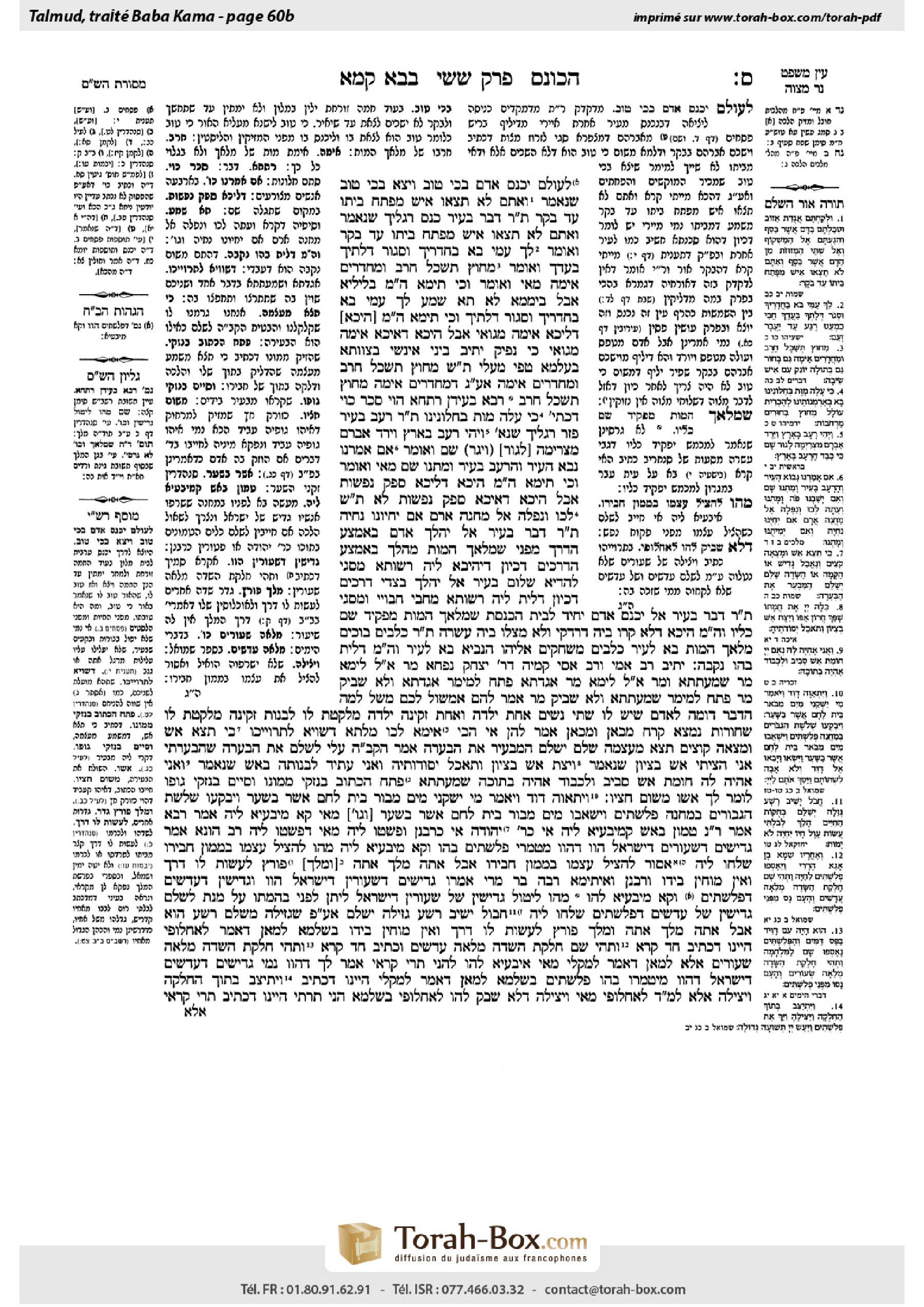
Bava Kamma 60b: Talmud study for Daf Yomi
Study the Talmud for Daf Yomi with scanned pages, Hebrew text, English translations from Sefaria and AI-generated French translations.
Passage selection and English or AI-generated French translation are available where the scan has annotations. Daf Study is independent of Torah-Box and Sefaria.
Browse Bava Kamma · בבא קמא · All tractatesBava Kamma 60b text and translations
This page of Bava Kamma includes the Aramaic text, an English translation and an AI-generated French translation, alongside the scan above.
בבא קמא ס׳ ב · Aramaic and Hebrew text
לְעוֹלָם יִכָּנֵס אָדָם בְּ״כִי טוֹב״ וְיֵצֵא בְּ״כִי טוֹב״, שֶׁנֶּאֱמַר: ״וְאַתֶּם לֹא תֵצְאוּ אִישׁ מִפֶּתַח בֵּיתוֹ עַד בֹּקֶר״.
תָּנוּ רַבָּנַן: דֶּבֶר בָּעִיר – כַּנֵּס רַגְלֶיךָ, שֶׁנֶּאֱמַר: ״וְאַתֶּם לֹא תֵצְאוּ אִישׁ מִפֶּתַח בֵּיתוֹ עַד בֹּקֶר״. וְאוֹמֵר: ״לֵךְ עַמִּי בֹּא בַחֲדָרֶיךָ, וּסְגוֹר דְּלָתְךָ בַּעֲדֶךָ״. וְאוֹמֵר: ״מִחוּץ תְּשַׁכֶּל חֶרֶב, וּמֵחֲדָרִים אֵימָה״.
מַאי ״וְאוֹמֵר״? וְכִי תֵּימָא: הָנֵי מִילֵּי בְּלֵילְיָא, אֲבָל בִּימָמָא לָא; תָּא שְׁמַע: ״לֵךְ עַמִּי בֹּא בַחֲדָרֶיךָ, וּסְגוֹר דְּלָתְךָ״.
וְכִי תֵּימָא: הָנֵי מִילֵּי [הֵיכָא] דְּלֵיכָּא אֵימָה מִגַּוַּאי, אֲבָל הֵיכָא דְּאִיכָּא אֵימָה מִגַּוַּאי – כִּי נָפֵיק יָתֵיב בֵּינֵי אִינָשֵׁי בְּצַוְותָּא בְּעָלְמָא, טְפֵי מְעַלֵּי; תָּא שְׁמַע: ״מִחוּץ תְּשַׁכֶּל חֶרֶב וּמֵחֲדָרִים אֵימָה״ – אַף עַל גַּב דְּמֵחֲדָרִים אֵימָה, מִחוּץ תְּשַׁכֶּל חֶרֶב.
רָבָא, בְּעִידָּן רִתְחָא הֲוָה סָכַר כַּוֵּי, דִּכְתִיב: ״כִּי עָלָה מָוֶת בְּחַלּוֹנֵינוּ״.
תָּנוּ רַבָּנַן: רָעָב בָּעִיר – פַּזֵּר רַגְלֶיךָ, שֶׁנֶּאֱמַר: ״וַיְהִי רָעָב בָּאָרֶץ, וַיֵּרֶד אַבְרָם מִצְרַיְמָה [לָגוּר] (וַיָּגׇר) שָׁם״. וְאוֹמֵר: ״אִם אָמַרְנוּ נָבוֹא הָעִיר וְהָרָעָב בָּעִיר, וָמַתְנוּ שָׁם״.
מַאי ״וְאוֹמֵר״? וְכִי תֵּימָא: הָנֵי מִילֵּי הֵיכָא דְּלֵיכָּא סְפֵק נְפָשׁוֹת, אֲבָל הֵיכָא דְּאִיכָּא סְפֵק נְפָשׁוֹת – לָא; תָּא שְׁמַע: ״לְכוּ וְנִפְּלָה אֶל מַחֲנֵה אֲרָם, אִם יְחַיֻּנוּ נִחְיֶה״.
תָּנוּ רַבָּנַן: דֶּבֶר בָּעִיר – אַל יְהַלֵּךְ אָדָם בְּאֶמְצַע הַדֶּרֶךְ, מִפְּנֵי שֶׁמַּלְאַךְ הַמָּוֶת מְהַלֵּךְ בְּאֶמְצַע הַדְּרָכִים. דְּכֵיוָן דִּיהִיבָא לֵיהּ רְשׁוּתָא, מְסַגֵּי לְהֶדְיָא. שָׁלוֹם בָּעִיר – אַל יְהַלֵּךְ בְּצִדֵּי דְרָכִים. דְּכֵיוָן דְּלֵית לֵיהּ רְשׁוּתָא, מִחַבֵּי חַבּוֹיֵי וּמְסַגֵּי.
תָּנוּ רַבָּנַן: דֶּבֶר בָּעִיר – אַל יִכָּנֵס אָדָם יָחִיד לְבֵית הַכְּנֶסֶת, שֶׁמַּלְאַךְ הַמָּוֶת מַפְקִיד שָׁם כֵּלָיו. וְהָנֵי מִילֵּי הֵיכָא דְּלָא קָרוּ בֵּיהּ דַּרְדְּקֵי, וְלָא מְצַלּוּ בֵּיהּ עֲשָׂרָה.
תָּנוּ רַבָּנַן: כְּלָבִים בּוֹכִים – מַלְאַךְ הַמָּוֶת בָּא לָעִיר. כְּלָבִים מְשַׂחֲקִים – אֵלִיָּהוּ הַנָּבִיא בָּא לָעִיר. וְהָנֵי מִילֵּי דְּלֵית בְּהוּ נְקֵבָה.
יָתֵיב רַב אַמֵּי וְרַב אַסִּי קַמֵּיהּ דְּרַבִּי יִצְחָק נַפָּחָא. מָר אֲמַר לֵיהּ: לֵימָא מָר שְׁמַעְתְּתָא, וּמָר אֲמַר לֵיהּ: לֵימָא מָר אַגָּדְתָּא. פָּתַח לְמֵימַר אַגָּדְתָּא – וְלָא שָׁבֵיק מָר, פָּתַח לְמֵימַר שְׁמַעְתָּתָא – וְלָא שָׁבֵיק מָר.
אָמַר לָהֶם: אֶמְשׁוֹל לָכֶם מָשָׁל, לְמָה הַדָּבָר דּוֹמֶה? לְאָדָם שֶׁיֵּשׁ לוֹ שְׁתֵּי נָשִׁים, אַחַת יַלְדָּה וְאַחַת זְקֵינָה. יַלְדָּה מְלַקֶּטֶת לוֹ לְבָנוֹת, זְקֵינָה מְלַקֶּטֶת לוֹ שְׁחוֹרוֹת. נִמְצָא קֵרֵחַ מִכָּאן וּמִכָּאן.
אָמַר לָהֶן: אִי הָכִי, אֵימָא לְכוּ מִלְּתָא דְּשָׁוְיָא לְתַרְוַיְיכוּ: ״כִּי תֵצֵא אֵשׁ וּמָצְאָה קֹצִים״ – ״תֵּצֵא״ מֵעַצְמָהּ, ״שַׁלֵּם יְשַׁלֵּם הַמַּבְעִר אֶת הַבְּעֵרָה״. אָמַר הַקָּדוֹשׁ בָּרוּךְ הוּא: עָלַי לְשַׁלֵּם אֶת הַבְּעֵרָה שֶׁהִבְעַרְתִּי –
אֲנִי הִצַּיתִּי אֵשׁ בְּצִיּוֹן, שֶׁנֶּאֱמַר: ״וַיַּצֶּת אֵשׁ בְּצִיּוֹן, וַתֹּאכַל יְסוֹדוֹתֶיהָ״; וַאֲנִי עָתִיד לִבְנוֹתָהּ בָּאֵשׁ, שֶׁנֶּאֱמַר: ״וַאֲנִי אֶהְיֶה לָהּ חוֹמַת אֵשׁ סָבִיב, וּלְכָבוֹד אֶהְיֶה בְתוֹכָהּ״.
שְׁמַעְתְּתָא – פָּתַח הַכָּתוּב בְּנִזְקֵי מָמוֹנוֹ, וְסִיֵּים בְּנִזְקֵי גּוּפוֹ; לוֹמַר לָךְ: אִשּׁוֹ מִשּׁוּם חִצָּיו.
״וַיִּתְאַוֶּה דָוִד וַיֹּאמַר: מִי יַשְׁקֵנִי מַיִם מִבֹּאר בֵּית לֶחֶם אֲשֶׁר בַּשָּׁעַר. וַיִּבְקְעוּ שְׁלֹשֶׁת הַגִּבּוֹרִים בְּמַחֲנֵה פְלִשְׁתִּים, וַיִּשְׁאֲבוּ מַיִם מִבֹּאר בֵּית לֶחֶם אֲשֶׁר בַּשַּׁעַר [וְגוֹ׳]״.
מַאי קָא מִיבַּעְיָא לֵיהּ? אָמַר רָבָא אָמַר רַב נַחְמָן: טָמוּן בָּאֵשׁ קָמִיבַּעְיָא לֵיהּ, אִי כְּרַבִּי יְהוּדָה אִי כְּרַבָּנַן, וּפְשַׁטוּ לֵיהּ מַאי דִּפְשַׁטוּ לֵיהּ.
רַב הוּנָא אָמַר: גְּדִישִׁים דִּשְׂעוֹרִים דְּיִשְׂרָאֵל הֲווֹ, דַּהֲווֹ מִטַּמְּרִי פְּלִשְׁתִּים בְּהוּ, וְקָא מִיבַּעְיָא לֵיהּ: מַהוּ לְהַצִּיל עַצְמוֹ בְּמָמוֹן חֲבֵירוֹ?
שְׁלַחוּ לֵיהּ: אָסוּר לְהַצִּיל עַצְמוֹ בְּמָמוֹן חֲבֵירוֹ; אֲבָל אַתָּה מֶלֶךְ אַתָּה, [וּמֶלֶךְ] פּוֹרֵץ לַעֲשׂוֹת לוֹ דֶּרֶךְ וְאֵין מוֹחִין בְּיָדוֹ.
וְרַבָּנַן וְאִיתֵּימָא רַבָּה בַּר מָרִי אָמְרוּ: גְּדִישִׁים דִּשְׂעוֹרִין דְּיִשְׂרָאֵל הֲווֹ, וּגְדִישִׁין דַּעֲדָשִׁים דִּפְלִשְׁתִּים; וְקָא מִיבַּעְיָא לְהוּ: מַהוּ לִיטּוֹל גְּדִישִׁין שֶׁל שְׂעוֹרִין דְּיִשְׂרָאֵל לִיתֵּן לִפְנֵי בְּהֶמְתּוֹ, עַל מְנָת לְשַׁלֵּם גְּדִישִׁין שֶׁל עֲדָשִׁים דִּפְלִשְׁתִּים?
שְׁלַחוּ לֵיהּ: ״חֲבֹל יָשִׁיב רָשָׁע, גְּזֵלָה יְשַׁלֵּם״ – אַף עַל פִּי שֶׁגְּזֵילָה מְשַׁלֵּם, רָשָׁע הוּא. אֲבָל אַתָּה מֶלֶךְ אַתָּה, וּמֶלֶךְ פּוֹרֵץ לַעֲשׂוֹת לוֹ דֶּרֶךְ וְאֵין מוֹחִין בְּיָדוֹ.
בִּשְׁלָמָא לְמַאן דְּאָמַר לְאַחְלוֹפֵי – הַיְינוּ דִּכְתִיב חַד קְרָא: ״וַתְּהִי שָׁם חֶלְקַת הַשָּׂדֶה מְלֵאָה עֲדָשִׁים״, וּכְתִיב חַד קְרָא: ״וַתְּהִי חֶלְקַת הַשָּׂדֶה מְלֵאָה שְׂעוֹרִים״;
אֶלָּא לְמַאן דְּאָמַר לְמִקְלֵי, מַאי אִיבַּעְיָא לְהוּ לְהָנֵי תְּרֵי קְרָאֵי? אָמַר לָךְ: דַּהֲווֹ נָמֵי גְּדִישִׁים דַּעֲדָשִׁים דְּיִשְׂרָאֵל, דַּהֲווֹ מִיטַּמְּרוּ בְּהוּ פְּלִשְׁתִּים.
בִּשְׁלָמָא לְמַאן דְּאָמַר לְמִקְלֵי – הַיְינוּ דִּכְתִיב: ״וַיִּתְיַצֵּב בְּתוֹךְ הַחֶלְקָה וַיַּצִּילֶהָ״; אֶלָּא לְמַאן דְּאָמַר לְאַחְלוֹפֵי, מַאי ״וַיַּצִּילֶהָ״?
דְּלָא שְׁבַק לְהוּ לְאַחְלוֹפֵי.
בִּשְׁלָמָא הָנֵי תַּרְתֵּי, הַיְינוּ דִּכְתִיב תְּרֵי קְרָאֵי;
Bava Kamma 60b · English translation
A person should always enter an unfamiliar city at a time of good, i.e., while it is light, as the Torah uses the expression “It is good” with regard to the creation of light (see Genesis 1:4). This goodness is manifest in the sense of security one feels when it is light. And likewise, when one leaves a city he should leave at a time of good, meaning after sunrise the next morning, as it is stated in the verse: “And none of you shall go out of the opening of his house until the morning” (Exodus 12:22).
§ The Sages taught: If there is plague in the city, gather your feet, i.e., limit the time you spend out of the house, as it is stated in the verse: “And none of you shall go out of the opening of his house until the morning.” And it says in another verse: “Come, my people, enter into your chambers, and shut your doors behind you; hide yourself for a little moment, until the anger has passed by” (Isaiah 26:20). And it says: “Outside the sword will bereave, and in the chambers terror” (Deuteronomy 32:25).
The Gemara asks: What is the reason for citing the additional verses introduced with the term: And it says? The first verse seems sufficient to teach the principle that one should not emerge from one’s house when there is a plague. The Gemara answers: And if you would say that this matter, the first verse that states that none of you shall go out until morning, applies only at night, but in the day one may think that the principle does not apply, for this reason the Gemara teaches: Come and hear: “Come, my people, enter into your chambers, and shut your doors behind you.”
And if you would say that this matter applies only where there is no fear inside, which explains why it is preferable to remain indoors, but where there is fear inside, one might think that when he goes out and sits among people in general company it is better, therefore, the Gemara introduces the third verse and says: Come and hear: “Outside the sword will bereave, and in the chambers terror.” This means that although there is terror in the chambers, outside the sword will bereave, so it is safer to remain indoors.
At a time when there was a plague, Rava would close the windows of his house, as it is written: “For death is come up into our windows” (Jeremiah 9:20).
The Sages taught: If there is famine in the city, spread your feet, i.e., leave the city, as it is stated in the verse: “And there was a famine in the land; and Abram went down into Egypt to sojourn there” (Genesis 12:10). And it says: “If we say: We will enter into the city, then the famine is in the city, and we shall die there; and if we sit here, we die also, now come, and let us fall unto the host of the Arameans; if they save us alive, we shall live; and if they kill us, we shall but die” (II Kings 7:4).
What is the reason for citing the second verse, introduced with the term: And it says? And if you would say that this matter, the principle of leaving the city, applies only where there is no uncertainty concerning a life-threatening situation, but where there is uncertainty concerning a life-threatening situation this principle does not apply, come and hear: “Come, and let us fall unto the host of the Arameans; if they save us alive, we shall live; and if they kill us, we shall but die.”
The Sages taught: If there is a plague in the city, a person should not walk in the middle of the road, due to the fact that the Angel of Death walks in the middle of the road, as, since in Heaven they have given him permission to kill within the city, he goes openly in the middle of the road. By contrast, if there is peace and quiet in the city, do not walk on the sides of the road, as, since the Angel of Death does not have permission to kill within the city, he hides himself and walks on the side of the road.
The Sages taught: If there is a plague in the city, a person should not enter the synagogue alone, as the Angel of Death leaves his utensils there, and for this reason it is a dangerous place. And this matter, the danger in the synagogue, applies only when there are no children learning in the synagogue, and there are not ten men praying in it. But if there are children learning or ten men praying there, it is not a dangerous place.
The Sages taught: If the dogs in a certain place are crying for no reason, it is a sign that they feel the Angel of Death has come to the city. If the dogs are playing, it is a sign that they feel that Elijah the prophet has come to the city. These matters apply only if there is no female dog among them. If there is a female dog nearby, their crying or playing is likely due to her presence.
§ Rav Ami and Rav Asi sat before Rabbi Yitzḥak Nappaḥa. One Sage said to Rabbi Yitzḥak Nappaḥa: Let the Master say words of halakha, and the other Sage said to Rabbi Yitzḥak Nappaḥa: Let the Master say words of aggada. Rabbi Yitzḥak Nappaḥa began to say words of aggada but one Sage did not let him, so he began to say words of halakha but the other Sage did not let him.
Rabbi Yitzḥak Nappaḥa said to them: I will relate a parable. To what can this be compared? It can be compared to a man who has two wives, one young and one old. The young wife pulls out his white hairs, so that her husband will appear younger. The old wife pulls out his black hairs so that he will appear older. And it turns out that he is bald from here and from there, i.e., completely bald, due to the actions of both of his wives.
Rabbi Yitzḥak Nappaḥa continued and said to them: If so, I will say to you a matter that is appropriate to both of you, which contains both halakha and aggada. In the verse that states: “If a fire breaks out, and catches in thorns” (Exodus 22:5), the term “breaks out” indicates that it breaks out by itself. Yet, the continuation of the verse states: “The one who kindled the fire shall pay compensation,” which indicates that he must pay only if the fire spread due to his negligence. The verse can be explained allegorically: The Holy One, Blessed be He, said that although the fire broke out in the Temple due to the sins of the Jewish people, it is incumbent upon Me to pay restitution for the fire that I kindled.
I, God, kindled a fire in Zion, as it is stated: “The Lord has accomplished His fury, He has poured out His fierce anger; and He has kindled a fire in Zion, which has devoured its foundations” (Lamentations 4:11). And I will build it with fire in the future, as it is stated: “For I, says the Lord, will be for her a wall of fire round about; and I will be the glory in her midst” (Zechariah 2:9).
There is a halakha that can be learned from the verse in Exodus, as the verse begins with damage caused through one’s property: “If a fire breaks out,” and concludes with damage caused by one’s body: “The one who kindled the fire.” This indicates that when damage is caused by fire, it is considered as though the person who kindled the fire caused the damage directly with his body. That serves to say to you that the liability for his fire damage is due to its similarity to his arrows. Just as one who shoots an arrow and causes damage is liable because the damage was caused directly through his action, so too, one who kindles a fire that causes damage is liable because it is considered as though the damage were caused directly by his actions.
§ The Gemara continues with another statement of aggada on a related topic: The verse states: “And David longed, and said: Oh, that one would give me water to drink of the well of Bethlehem, which is by the gate! And the three mighty men broke through the host of the Philistines, and drew water out of the well of Bethlehem, that was by the gate, and took it, and brought it to David; but he would not drink it, but poured it out to the Lord” (II Samuel 23:15–16). The Sages understood that David was not simply asking for water, but was using the term as a metaphor referring to Torah, and he was raising a halakhic dilemma.
What is the dilemma that David is raising? Rava says that Rav Naḥman says: He was asking about the halakha with regard to a concealed article damaged by a fire. He wanted to know whether the halakha is in accordance with the opinion of Rabbi Yehuda, who holds that one is liable to pay for such damage, or whether the halakha is in accordance with the opinion of the Rabbis, who hold that one is exempt from liability for damage by fire to concealed articles. And the Sages in Bethlehem answered him what they answered him.
Rav Huna stated a different explanation of the verse: There were stacks of barley belonging to Jews in which the Philistines were hiding, and David wanted to burn down the stacks to kill the Philistines and save his own life. He raised the dilemma: What is the halakha? Is it permitted to save oneself by destroying the property of another?
They sent the following answer to him: It is prohibited to save oneself by destroying the property of another. But you are king, and a king may breach the fence of an individual in order to form a path for himself, and none may protest his action, i.e., the normal halakhot of damage do not apply to you since you are king.
The Rabbis, and some say that it was Rabba bar Mari, give an alternative explanation of the dilemma and said: The stacks of barley belonged to Jews, and there were stacks of lentils belonging to the Philistines. David needed barley to feed his animals. And David raised the following dilemma: What is the halakha? I know that I may take the lentils belonging to a gentile to feed my animals, but is it permitted to take a stack of barley belonging to a Jew, to place before one’s animal for it to consume, with the intent to pay the owner of the barley with the stacks of lentils belonging to the Philistines?
The Sages of Bethlehem sent the following reply to him: “If the wicked restore the pledge, give back that which he had taken by robbery, walk in the statutes of life, committing no iniquity; he shall surely live, he shall not die” (Ezekiel 33:15). This verse teaches that even though the robber repays the value of the stolen item, he is nevertheless considered to be wicked, and is described as such in the verse, and a commoner would not be allowed to act as you asked. But you are king, and a king may breach the fence of an individual in order to form a path for himself, and none may protest his action.
The Gemara discusses the different explanations: Granted, according to the one who says that David was asking whether he could take the stacks of barley and exchange them, i.e., repay the owners of the barley, with stacks of lentils, this is as it is written in one verse: “And the Philistines were gathered together into a troop, where was a plot of ground full of lentils; and the people fled from the Philistines” (II Samuel 23:11), and it is written in one other verse: “He was with David at Pas Dammim, and there the Philistines were gathered together to battle, where was a plot of ground full of barley; and the people fled from before the Philistines” (I Chronicles 11:13). This apparent contradiction can be reconciled by saying that there were two fields, one of barley and one of lentils.
But according to Rav Huna, the one who says that David’s question was asked because he wanted to burn the stacks of barley, for what purpose does he require these two verses? How does he explain this contradiction? Rav Huna could have said to you that there were also stacks of lentils belonging to Jews, inside which the Philistines were hiding.
Granted, according to the one who says that David asked his question because he wanted to burn the stacks, this is as it is written in the following verse with regard to David: “But he stood in the midst of the plot, and saved it, and slew the Philistines; and the Lord performed a great victory” (II Samuel 23:12). But according to the one who says that David’s question was asked with regard to exchanging the lentils for the barley, what is the meaning of the phrase: “And saved it”?
The Rabbis answer that David saved it in that he did not permit them to exchange the value of the barley with the lentils.
Granted, according to both of these two opinions, this is as it is written in two distinct verses, one describing the field of lentils and one describing the field of barley.
Bava Kamma 60b · Traduction française (IA)
Une personne doit toujours entrer dans une ville inconnue à un moment de bien, c'est-à-dire pendant que c'est encore clair, car la Torah utilise l'expression « C'est bon » en ce qui concerne la création de la lumière (voir Genèse 1:4). Ce bien se manifeste par le sentiment de sécurité que l'on ressent quand il fait jour. De même, lorsqu'on quitte une ville, on doit le faire à un moment de bien, c'est-à-dire après le lever du soleil le lendemain, car il est dit dans la parole : « Et aucun de vous ne doit sortir de l'ouverture de sa maison jusqu'au matin » (Exode 12:22).
§ Les Sages enseignent : Si une épidémie existe dans la ville, limitez le temps que vous passez en dehors de la maison, c'est-à-dire réduisez vos déplacements, car il est dit dans la parole : « Et aucun de vous ne doit sortir de l'ouverture de sa maison jusqu'au matin. » Et il est dit dans une autre parole : « Viens, mon peuple, entre dans tes chambres, et ferme tes portes derrière toi ; cache-toi un petit moment, jusqu'à ce que la colère ait passé » (Isaïe 26:20). Et il est dit : « Dehors, la guerre dévastera, et dans les chambres, la terreur » (Deutéronome 32:25).
Le Guemara demande : Quel est le motif de citer les versets supplémentaires introduits par le terme : Et il est dit ? Le premier verset semble suffisant pour enseigner le principe selon lequel on ne doit pas sortir de chez soi lors d'une épidémie. Le Guemara répond : Et si tu dis que cette affaire, le premier verset qui stipule que personne ne doit sortir jusqu'au matin, s'applique uniquement la nuit, mais le jour on pourrait penser que ce principe ne s'applique pas, pour cette raison le Guemara enseigne : Viens et écoute : « Viens, mon peuple, entre dans tes chambres, et ferme tes portes derrière toi. »
Et si tu dis que cette affaire s'applique uniquement là où il n'y a pas de peur à l'intérieur, ce qui explique pourquoi il est préférable de rester à l'intérieur, mais là où il y a de la peur à l'intérieur, on pourrait penser que lorsqu'on sort et qu'on s'assoit parmi les gens en général, c'est mieux, donc le Guemara introduit le troisième verset et dit : Viens et écoute : « Dehors, la guerre dévastera, et dans les chambres, la terreur. » Cela signifie que bien qu'il y ait de la terreur dans les chambres, dehors la guerre dévastera, donc il est plus sûr de rester à l'intérieur.
Lorsqu'il y avait une épidémie, Rava fermait les fenêtres de sa maison, car il est écrit : « La mort est montée par nos fenêtres » (Jérémie 9:20).
Les Sages enseignent : Si la ville souffre d'une famine, étends tes pas, c'est-à-dire quitte la ville, car il est dit dans la parole : « Il y avait une famine dans la terre ; et Abram descendit en Égypte pour y séjourner » (Genèse 12:10). Et il est dit : « Si nous disons : Nous entrerons dans la ville, alors la famine est dans la ville, et nous mourrons là ; et si nous restons ici, nous mourons aussi, maintenant viens, et laissons-nous tomber au sein du peuple des Araméens ; s'ils nous sauvent vivants, nous vivrons ; et s'ils nous tuent, nous mourrons seulement » (II Rois 7:4).
Quel est le motif de citer le second verset, introduit par le terme : Et il est dit ? Et si tu penses que cette affaire, le principe de quitter la ville, s'applique uniquement là où il n'y a pas d'incertitude concernant une situation menaçant la vie, mais là où il y a une incertitude concernant une situation menaçant la vie, ce principe ne s'applique pas, viens et écoute : « Viens, et laissons-nous tomber au sein du peuple des Araméens ; s'ils nous sauvent vivants, nous vivrons ; et s'ils nous tuent, nous mourrons seulement. »
Les Sages enseignent : Si une épidémie existe dans la ville, une personne ne doit pas marcher au milieu de la route, car l'Ange de la Mort marche au milieu de la route, car, puisque dans le Ciel on lui a donné la permission de tuer à l'intérieur de la ville, il marche ouvertement au milieu de la route. En revanche, si la ville est en paix et en sécurité, ne marchez pas aux côtés de la route, car, puisque l'Ange de la Mort n'a pas la permission de tuer à l'intérieur de la ville, il se cache et marche aux côtés de la route.
Les Sages enseignent : Si une épidémie existe dans la ville, une personne ne doit pas entrer seul dans la synagogue, car l'Ange de la Mort y laisse ses ustensiles, et pour cette raison c'est un lieu dangereux. Et cette affaire, le danger dans la synagogue, s'applique uniquement lorsqu'il n'y a pas d'enfants qui apprennent dans la synagogue et qu'il n'y a pas dix hommes qui prient dedans. Mais si des enfants apprennent ou dix hommes prient dedans, ce n'est pas un lieu dangereux.
Les Sages enseignent : Si les chiens d'une certaine place hurlent sans raison, c'est un signe qu'ils sentent que l'Ange de la Mort est venu dans la ville. Si les chiens jouent, c'est un signe qu'ils sentent que l'Élie le prophète est venu dans la ville. Ces affaires s'appliquent uniquement si aucun chien femelle n'est parmi eux. Si une chienne est présente, leurs hurlements ou leurs jeux sont probablement dus à sa présence.
§ Rav Ami et Rav Asi étaient présents devant Rabbi Yitzḥak Nappaḥa. Un Sage dit à Rabbi Yitzḥak Nappaḥa : Fais des paroles de halakha, et l'autre Sage dit à Rabbi Yitzḥak Nappaḥa : Fais des paroles d'aggada. Rabbi Yitzḥak Nappaḥa commença à faire des paroles d'aggada, mais un Sage ne le laissa pas, donc il commença à faire des paroles de halakha, mais l'autre Sage ne le laissa pas.
Rabbi Yitzḥak Nappaḥa dit à eux : Je vais rapporter une comparaison. À quoi peut-on comparer cela ? Cela peut être comparé à un homme qui a deux épouses, une jeune et une vieille. La jeune épouse arrache les cheveux blancs de son mari, afin qu'il ait l'air plus jeune. La vieille épouse arrache les cheveux noirs de son mari, afin qu'il ait l'air plus âgé. Et il se trouve que le mari est complètement chauve, à cause des actions des deux épouses.
Rabbi Yitzḥak Nappaḥa continua et dit à ceux-ci : Si c'est ainsi, je dirai à vous une affaire qui convient à tous les deux, qui contient à la fois halakha et aggada. Dans la versette qui dit : « Si un feu s'élance et consume des buissons » (Exode 22:5), le terme « s'élance » indique qu'il s'élance tout seul. Cependant, la continuation de la versette dit : « Celui qui a allumé le feu devra réparer », ce qui indique qu'il doit réparer uniquement si le feu s'est propagé en raison de son négligence. La versette peut être expliquée allégoriquement : Le Saint, le Très Haut, a dit que bien que le feu s'élance dans le Temple en raison des péchés du peuple juif, il est tenu de réparer le feu que j'ai allumé.
Je, l'Éternel, ai allumé un feu à Sion, comme il est dit : « L'Éternel a accompli sa colère, il a versé sa fureur ardente ; et il a allumé un feu à Sion, qui a dévoré ses fondations » (Lamentations 4:11). Et je le reconstruirai avec le feu à l'avenir, comme il est dit : « Car moi, dit l'Éternel, je serai pour elle un rempart de feu autour ; et je serai la gloire en son milieu » (Zacharie 2:9).
Il y a une halakha que l'on peut apprendre de la versette d'Exode, car la versette commence par un dommage causé par la propriété d'une personne : « Si un feu s'élance », et se termine par un dommage causé par le corps d'une personne : « Celui qui a allumé le feu ». Cela indique que lorsqu'un dommage est causé par un feu, il est considéré comme si la personne qui a allumé le feu avait causé le dommage directement avec son corps. Cela sert à vous dire que la responsabilité pour ce dommage de feu est due à sa similitude avec ses flèches. Aussi bien que celui qui tire une flèche et cause un dommage est tenu responsable car le dommage a été causé directement par son action, de même celui qui allume un feu qui cause un dommage est tenu responsable car il est considéré comme si le dommage avait été causé directement par ses actions.
§ Le Guemara poursuit avec une autre déclaration d'aggada sur un sujet connexe : La versette dit : « Et David avait grand soif, et dit : Oh, que l'on me donne à boire de la source de Béthléhem, qui est à la porte ! Et les trois hommes puissants pénétrèrent dans la troupe des Philistins, et tirèrent de la source de Béthléhem, qui était à la porte, et l'apportèrent à David ; mais il ne voulut pas boire, mais il le versa au Seigneur » (II Samuel 23:15–16). Les Sages comprirent que David ne demandait pas simplement de l'eau, mais utilisait le terme comme une métaphore faisant référence à la Torah, et il soulevait un dilemme halakhique.
Quel est le dilemme que David soulève ? Rava dit que Rav Naḥman dit : Il demandait à propos de la halakha concernant un objet caché endommagé par un feu. Il voulait savoir si la halakha suit l'opinion de Rabbi Yehuda, qui considère que l'on est tenu de réparer un tel dommage, ou si la halakha suit l'opinion des Rabbins, qui considèrent que l'on est exempt de responsabilité pour un dommage causé par un feu à un objet caché. Et les Sages de Béthléhem répondirent à lui ce qu'ils lui répondirent.
Rav Huna donna une autre explication de la versette : Il y avait des tas de blé appartenant aux Juifs dans lesquels les Philistins se cachaient, et David voulait brûler les tas pour tuer les Philistins et sauver sa propre vie. Il souleva le dilemme : Quelle est la halakha ? Est-il permis de sauver sa vie en détruisant la propriété d'autrui ?
Ils envoyèrent la suivante réponse à lui : Il est interdit de sauver sa vie en détruisant la propriété d'autrui. Mais vous êtes roi, et un roi peut briser le mur d'un individu afin de former un chemin pour lui-même, et personne ne peut protester son action, c'est-à-dire que les halakhot normales concernant les dommages ne s'appliquent pas à vous puisque vous êtes roi.
Les Rabbins, et certains disent que c'était Rabba bar Mari, donnèrent une autre explication du dilemme et dirent : Les tas de blé appartenaient aux Juifs, et il y avait des tas de lentilles appartenant aux Philistins. David avait besoin de blé pour nourrir ses bêtes. Et David souleva le suivant dilemme : Quelle est la halakha ? Je sais que je peux prendre les lentilles appartenant à un non-Juif pour nourrir mes bêtes, mais est-il permis de prendre un tas de blé appartenant à un Juif, de le placer devant mon animal pour qu'il le consume, avec l'intention de rétribuer l'propriétaire du blé avec les tas de lentilles appartenant aux Philistins ?
Les Sages de Béthléhem envoyèrent la suivante réponse à lui : « Si le méchant rend le cautionnement, rends-lui ce qu'il a volé, marche dans les statuts de la vie, ne commet pas d'iniquité ; il vivra certainement, il ne mourra pas » (Ezechiel 33:15). Cette versette enseigne que même si le voleur répare la valeur de l'objet volé, il est néanmoins considéré comme méchant, et décrit ainsi dans la versette, et un homme ordinaire ne serait pas autorisé à agir comme vous l'avez demandé. Mais vous êtes roi, et un roi peut briser le mur d'un individu afin de former un chemin pour lui-même, et personne ne peut protester son action.
Le Guemara discute des différentes explications : Admettons, selon celui qui dit que David posait la question sur le fait de prendre les tas de blé et d'échanger, c'est-à-dire de rétribuer les propriétaires du blé, avec les tas de lentilles, cela est comme il est écrit dans une seule versette : « Et les Philistins se rassemblèrent en un groupe, où il y avait un terrain plein de lentilles ; et le peuple s'échappa des Philistins » (II Samuel 23:11), et il est écrit dans une autre versette : « Il était avec David à Pas Dammim, et là les Philistins se rassemblèrent pour l'engagement, où il y avait un terrain plein de blé ; et le peuple s'échappa devant les Philistins » (I Chroniques 11:13). Ce paradoxe apparent peut être résolu en disant qu'il y avait deux champs, un de blé et un de lentilles.
Mais selon Rav Huna, celui qui dit que la question de David était posée parce qu'il voulait brûler les tas de blé, à quel but a-t-il besoin de ces deux versettes ? Comment explique-t-il ce paradoxe ? Rav Huna aurait pu vous dire que les tas de lentilles appartenant aux Juifs étaient aussi présents, dans lesquels les Philistins se cachaient.
Cela est vrai selon celui qui dit que David a posé sa question parce qu'il voulait brûler les tas, comme il est écrit dans la versette suivante concernant David : « Mais il se tint au milieu du champ, et il le sauva, et il tua les Philistins ; et l'Éternel eut une grande victoire » (II Samuel 23:12). Mais selon celui qui dit que la question de David était liée à l'échange des lentilles contre le blé, quelle est la signification de la phrase : « Et il le sauva » ?
Les Sages répondent que David le sauva en ne permettant pas l'échange de la valeur du blé contre les lentilles.
Cela est vrai selon les deux opinions, comme il est écrit dans deux versets distincts, l'un décrivant le champ des lentilles et l'autre celui du blé.
Traduction française générée par IA à partir de l’édition anglaise de Sefaria. Vérifie toujours un passage avec le texte source.
Text from Sefaria: William Davidson Edition - Vocalized Aramaic (CC BY NC); William Davidson Edition - English (CC BY NC).