Bava Kamma 61a: Talmud study for Daf Yomi
Study the Talmud for Daf Yomi with scanned pages, Hebrew text, English translations from Sefaria and AI-generated French translations.
Passage selection and English or AI-generated French translation are available where the scan has annotations. Daf Study is independent of Torah-Box and Sefaria.
Browse Bava Kamma · בבא קמא · All tractatesBava Kamma 61a text and translations
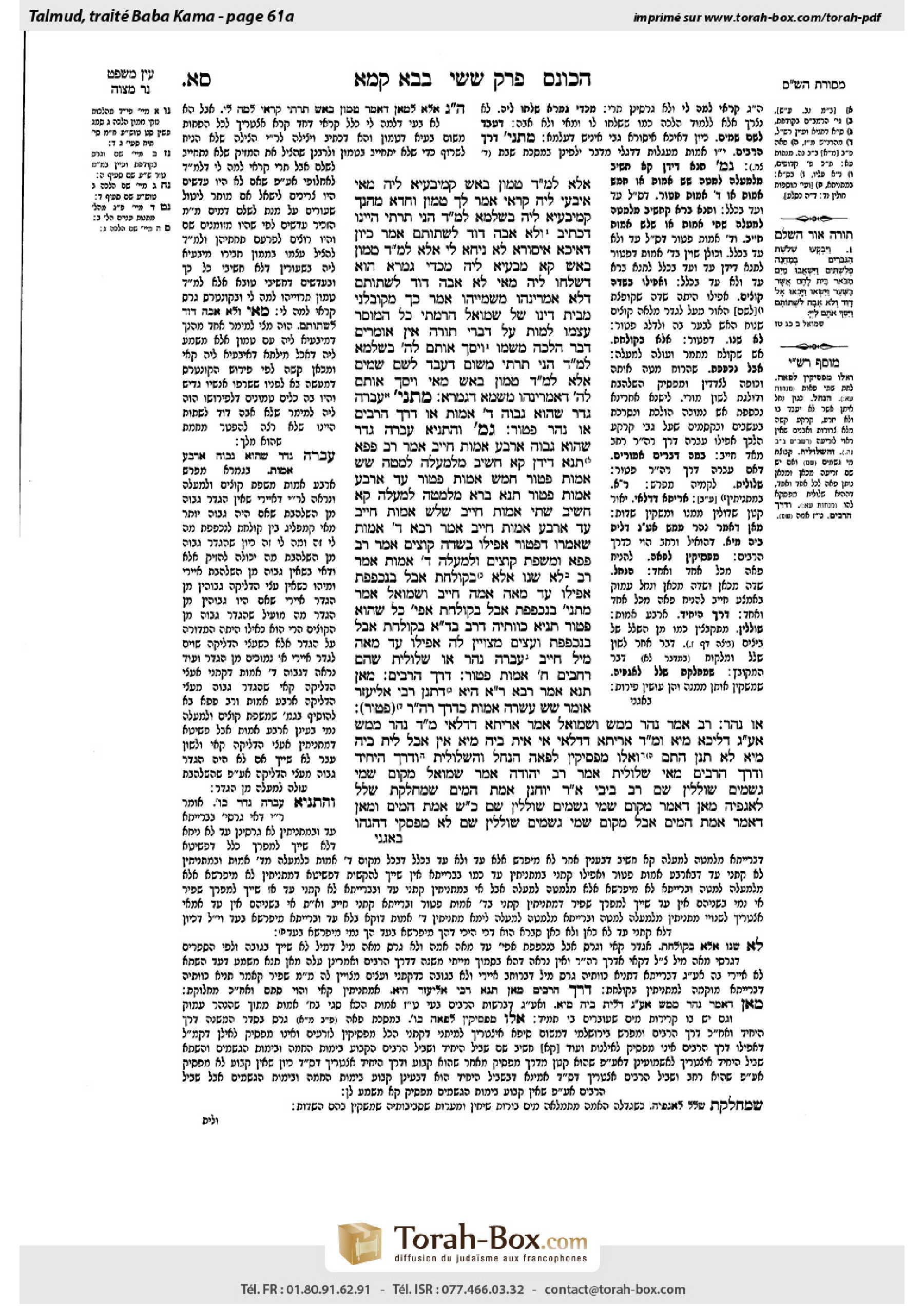
This page of Bava Kamma includes the Aramaic text, an English translation and an AI-generated French translation, alongside the scan above.
בבא קמא ס״א א · Aramaic and Hebrew text
אֶלָּא לְמַאן דְּאָמַר טָמוּן בָּאֵשׁ קָמִיבַּעְיָא לֵיהּ, מַאי אִיבְּעִי לֵיהּ קְרָאֵי? אָמַר לָךְ: טָמוּן וַחֲדָא מֵהָנָךְ קָמִיבַּעְיָא לֵיהּ.
בִּשְׁלָמָא לְמַאן דְּאָמַר הָנֵי תַּרְתֵּי, הַיְינוּ דִּכְתִיב: ״וְלֹא אָבָה (דָּוִד) לִשְׁתוֹתָם״ – אֲמַר: כֵּיוָן דְּאִיכָּא אִיסּוּרָא, לָא נִיחָא לִי. אֶלָּא לְמַאן דְּאָמַר טָמוּן בָּאֵשׁ קָא מִבַּעְיָא לֵיהּ – מִכְּדִי גְּמָרָא הוּא דִּשְׁלַחוּ לֵיהּ, מַאי ״לֹא אָבָה (דָּוִד) לִשְׁתוֹתָם״?
דְּלָא אַמְרִינְהוּ מִשְּׁמַיְיהוּ. אָמַר, כָּךְ מְקוּבְּלַנִי מִבֵּית דִּינוֹ שֶׁל שְׁמוּאֵל הָרָמָתִי: כׇּל הַמּוֹסֵר עַצְמוֹ לָמוּת עַל דִּבְרֵי תוֹרָה – אֵין אוֹמְרִים דְּבַר הֲלָכָה מִשְּׁמוֹ.
״וַיַּסֵּךְ אֹתָם לַה׳״ – בִּשְׁלָמָא לְמַאן דְּאָמַר הָנֵי תַּרְתֵּי, מִשּׁוּם דַּעֲבַד לְשֵׁם שָׁמַיִם. אֶלָּא לְמַאן דְּאָמַר טָמוּן בָּאֵשׁ, מַאי ״וַיַּסֵּךְ אֹתָם לַה׳״? דְּאַמְרִינְהוּ מִשְּׁמָא דִגְמָרָא.
מַתְנִי׳ עָבְרָה גָּדֵר שֶׁהוּא גָּבוֹהַּ אַרְבַּע אַמּוֹת, אוֹ דֶרֶךְ הָרַבִּים, אוֹ נָהָר – פָּטוּר.
גְּמָ׳ וְהָתַנְיָא: עָבְרָה גָּדֵר שֶׁהוּא גָּבוֹהַּ אַרְבַּע אַמּוֹת – חַיָּיב!
אָמַר רַב פָּפָּא: תַּנָּא דִּידַן קָא חָשֵׁיב מִלְּמַעְלָה לְמַטָּה: שֵׁשׁ אַמּוֹת – פָּטוּר, חָמֵשׁ אַמּוֹת – פָּטוּר, עַד אַרְבַּע אַמּוֹת – פָּטוּר. תַּנָּא בָּרָא מִלְּמַטָּה לְמַעְלָה קָא חָשֵׁיב: שְׁתֵּי אַמּוֹת – חַיָּיב, שָׁלֹשׁ אַמּוֹת – חַיָּיב, עַד אַרְבַּע אַמּוֹת – חַיָּיב.
אָמַר רָבָא: אַרְבַּע אַמּוֹת שֶׁאָמְרוּ דְּפָטוּר – אֲפִילּוּ בִּשְׂדֵה קוֹצִים. אָמַר רַב פָּפָּא: וּמִשְּׂפַת קוֹצִים וּלְמַעְלָה אַרְבַּע אַמּוֹת.
אָמַר רַב: לֹא שָׁנוּ אֶלָּא בְּקוֹלַחַת, אֲבָל בְּנִכְפֶּפֶת – אֲפִילּוּ עַד מֵאָה אַמָּה חַיָּיב. וּשְׁמוּאֵל אָמַר: מַתְנִיתִין בְּנִכְפֶּפֶת, אֲבָל בְּקוֹלַחַת – אֲפִילּוּ כׇּל שֶׁהוּא פָּטוּר.
תַּנְיָא כְּווֹתֵיהּ דְּרַב: בַּמֶּה דְּבָרִים אֲמוּרִים – בְּקוֹלַחַת, אֲבָל בְּנִכְפֶּפֶת וְעֵצִים מְצוּיִין לָהּ – אֲפִילּוּ עַד מֵאָה מִיל חַיָּיב. עָבְרָה נָהָר אוֹ שְׁלוּלִית שֶׁהֵם רְחָבִים שְׁמוֹנֶה אַמּוֹת – פָּטוּר.
דֶּרֶךְ הָרַבִּים. מַאן תַּנָּא? אָמַר רָבָא: רַבִּי אֱלִיעֶזֶר הִיא – דִּתְנַן, רַבִּי אֱלִיעֶזֶר אוֹמֵר: שֵׁשׁ עֶשְׂרֵה אַמּוֹת כְּדֶרֶךְ רְשׁוּת הָרַבִּים (פָּטוּר).
אוֹ נָהָר. רַב אָמַר: נָהָר מַמָּשׁ, וּשְׁמוּאֵל אָמַר: אֲרִיתָּא דְּדַלָּאֵי.
מַאן דְּאָמַר נְהַר מַמָּשׁ, אַף עַל גַּב דְּלֵיכָּא מַיָּא; וּמַאן דְּאָמַר אֲרִיתָּא דְּדַלָּאֵי, אִי אִית בֵּיהּ מַיָּא – אִין, אֲבָל לֵית בֵּיהּ מַיָּא – לָא.
תְּנַן הָתָם: וְאֵלּוּ מַפְסִיקִין לַפֵּאָה – הַנַּחַל, וְהַשְּׁלוּלִית, וְדֶרֶךְ הַיָּחִיד, וְדֶרֶךְ הָרַבִּים.
מַאי שְׁלוּלִית? אָמַר רַב יְהוּדָה אָמַר שְׁמוּאֵל: מְקוֹם שֶׁמֵּי גְשָׁמִים שׁוֹלְלִין שָׁם. רַב בִּיבִי אָמַר רַבִּי יוֹחָנָן: אַמַּת הַמַּיִם שֶׁמְּחַלֶּקֶת שָׁלָל לַאֲגַפֶּיהָ.
מַאן דְּאָמַר מְקוֹם שֶׁמֵּי גְשָׁמִים שׁוֹלְלִין שָׁם – כׇּל שֶׁכֵּן אַמַּת הַמַּיִם; וּמַאן דְּאָמַר אַמַּת הַמַּיִם – אֲבָל מְקוֹם שֶׁמֵּי גְשָׁמִים שׁוֹלְלִין שָׁם לָא מַפְסְקִי, דְּהָנְהוּ
Bava Kamma 61a · English translation
But according to Rava, who cited Rav Naḥman, the one who says that David asked with regard to the halakha of a concealed article damaged by a fire, for what purpose does he require the two verses that describe a field of lentils and a field of barley? Rav Naḥman could have said to you that David was asking both about concealed articles damaged by a fire and one of these other two dilemmas.
Granted, according to the one who says one of these two explanations, that David was asking either about repaying barley with lentils or burning the stacks of barley, this is as it is written of David: “But he would not drink it” (II Samuel 23:16). David said to himself: Since there is a prohibition involved in this action, it is not satisfactory to me to act in this manner, even though technically it is permitted for a king. But according to the one who says that David was raising a dilemma with regard to the halakha of a concealed article damaged by a fire, since they sent him an answer that was a tradition with regard to the halakha, what is the meaning of: “But he would not drink it”?
The Gemara answers: This means that he did not say the halakha in their names. He did not transmit the ruling in the name of those who went in the time of battle to ask the Sages what the halakha is. David said to himself: This is the tradition that I received from the court of Samuel of Rama: With regard to anyone who hands himself over to die for the sake of words of Torah, the Sages do not say a matter of halakha in his name, so that others will not follow this ruling and endanger their lives.
The Gemara asks another question: The verse states: “He poured it out to the Lord” (II Samuel 23:16), which indicates that David acted stringently and did not rely on the lenient ruling that he received. Granted, according to the one who says either of these two explanations, that David asked either about burning the stacks of barley or about replacing their value with lentils, he poured out the water to God due to the fact that he acted for the sake of Heaven and did not rely on the lenient ruling he had received. But according to the one who says that David asked about a concealed article damaged by a fire, what is the reason that he poured out the water to the Lord? The Gemara answers: The reason is that they said this halakha in the name of the tradition, without associating it with any specific individual.
MISHNA: If one kindled a fire that crossed a fence that is four cubits high, or if the fire crossed the public thoroughfare, or if the fire crossed a river, and in each case it caused damage on the other side, he is exempt from liability.
GEMARA: The Gemara asks: But isn’t it taught in a baraita that if a fire crossed a fence that is four cubits in height, the one who kindled the fire is liable? This appears to contradict the mishna.
Rav Pappa said: There is no dispute between the tanna of the mishna and the tanna of the baraita; there is merely a difference of how they stated their rulings. The tanna of our mishna counts downward from above to below. In other words, if the fire crossed a fence six cubits high, the one who kindled the fire is exempt; if it crossed a fence five cubits high, he is exempt; and this is the halakha until the fire crosses a fence of a minimum of four cubits high, where the one who kindled the fire is still exempt. Conversely, the tanna of the baraita counts up from below to above. The meaning is that if the fire crossed a fence two cubits high, the one who kindled the fire is liable; if the fire crossed a fence three cubits high, he is liable; and this is the halakha until the fire crosses a fence of a maximum of four cubits high, where the one who kindled the fire is still liable. Accordingly, there is no contradiction between the mishna and the baraita.
§ Rava says: When they said in the mishna with regard to a fire crossing a fence four cubits high that the one who kindled the fire is exempt, this is even in a field of thorns. Rav Pappa says: And Rava’s statement is referring to a case where the height of the fence is four cubits counting from above the upper limit of the thorns.
Rav says: They taught in the mishna that one is exempt from liability if the fire crosses a public thoroughfare only in a case where the flame blazes high [bekolaḥat]. But in a case where the flame blazes low [benikhpefet] and therefore spreads easily along the ground, the one who kindled the fire is liable even if the space that the fire crossed was up to one hundred cubits. And Shmuel said: The mishna exempts one from liability if the fire crosses a public thoroughfare in a case where the flame blazes low, but in a case where the flame blazes high, even any minimal gap between where the fire was kindled and where it caused damage renders the one who kindled the fire exempt.
It is taught in a baraita in accordance with the opinion of Rav: In what case is this statement said that one is exempt if the fire crosses a public thoroughfare? It is in a case where the flame blazes high. But in a case where the flame blazes low and there is wood to keep it burning, one is liable even if it causes damage at a distance of up to one hundred mil. If the fire crossed a river or a pool [shelulit] of water that is eight cubits wide, he is exempt from paying for the damage caused, regardless of whether the fire blazed high or low.
§ The mishna teaches: If the fire crossed the public thoroughfare, he is exempt. The Gemara asks: Who is the tanna who holds this opinion? Rava said: It is Rabbi Eliezer, as we learned in a mishna (61b) that Rabbi Eliezer says: One is liable up to a distance of sixteen cubits, like the width of the public domain. By inference, one is exempt if a fire crosses a greater distance, i.e., across a public thoroughfare.
The mishna teaches: Or if the fire crossed a river, he is exempt. Rav says: The term stream means an actual river. And Shmuel says: This term means a water channel.
The Gemara explains their dispute: The one who says that it is referring to an actual river, Rav, deems exempt one whose fire crosses a riverbed even when there is no water in it, since it is sufficiently deep and wide to prevent a typical fire from crossing it. But the one who says that it is referring to a water channel, Shmuel, holds that if the fire crosses a water channel that has water in it, yes, the one who kindled the fire is exempt. But if the fire crosses a water channel that does not have water in it, he is not exempt.
We learned in a mishna elsewhere (Pe’a 2:1): And these, the following list of features, divide a field for the purpose of pe’a, i.e., it is no longer considered a single field, but instead pe’a must be given from each separate section: A stream, a shelulit, a private road, and a public thoroughfare.
The Gemara asks: What is a shelulit? Rav Yehuda says that Shmuel says: It is a place where rainwater gathers [sholelin]. Rav Beivai says that Rabbi Yoḥanan says: It is a water channel that distributes its spoils [shalal] to its banks, since the water spreads to the adjacent cisterns.
The Gemara points out that according to the one who says that it means a place where rainwater gathers, Shmuel, since gathered rainwater divides a field, all the more so does a water channel, which is both larger and permanent, divide a field. But according to the one who says that only a water channel divides a field, Rabbi Yoḥanan, he holds that only that divides a field, but a place where rainwater gathers does not divide the field, since these
Bava Kamma 61a · Traduction française (IA)
Mais selon Rava, qui cite Rav Naḥman, celui qui dit que David posait une question concernant la halakha d’un objet caché endommagé par un feu, à quel propos a-t-il besoin des deux versets qui décrivent un champ de lentilles et un champ de blé ? Rav Naḥman aurait pu te dire que David posait une question à la fois sur les objets cachés endommagés par un feu et l’un de ces deux autres dilemmes.
Admettons, selon celui qui dit l’une de ces deux explications, que David posait une question soit sur le remplacement du blé par des lentilles soit sur la combustion des tas de blé, c’est ainsi qu’il est écrit à propos de David : « Mais il ne le buvait pas » (II Samuel 23:16). David se disait : Puisque cette action implique une interdiction, il ne me semble pas satisfaisant d’agir ainsi, même si techniquement cela est permis pour un roi. Mais selon celui qui dit que David soulevait un dilemme concernant la halakha d’un objet caché endommagé par un feu, puisqu’ils lui avaient envoyé une réponse qui était une tradition concernant la halakha, quelle est la signification de : « Mais il ne le buvait pas » ?
La Guemara répond : Cela signifie qu’il n’a pas dit la halakha en leur nom. Il n’a pas transmis la décision en nom de ceux qui sont allés en guerre pour demander aux Sages quelle est la halakha. David se disait : C’est la tradition que j’ai reçue du tribunal de Samuel de Rama : Concernant celui qui se livre à la mort pour des paroles de Torah, les Sages ne disent pas une affaire de halakha en son nom, afin que les autres ne suivent pas cette décision et ne mettent leur vie en danger.
La Guemara pose une autre question : Le verset dit : « Il le versa à l’Eternel » (II Samuel 23:16), ce qui indique que David agissait avec stricte rigueur et ne s’appuyait pas sur la décision leniente qu’il avait reçue. Admettons, selon celui qui dit l’une de ces deux explications, que David posait une question soit sur la combustion des tas de blé soit sur le remplacement de leur valeur par des lentilles, il versa l’eau à l’Eternel en raison du fait qu’il agissait pour le Ciel et ne s’appuyait pas sur la décision leniente qu’il avait reçue. Mais selon celui qui dit que David posait une question concernant un objet caché endommagé par un feu, quelle est la raison pour laquelle il versa l’eau à l’Eternel ? La Guemara répond : La raison est qu’ils dirent cette halakha en nom de la tradition, sans l’associer à un individu spécifique.
MICHNA : Si l’on alluma un feu qui traversa un mur de quatre cubits de haut, ou si le feu traversa la rue publique, ou si le feu traversa un fleuve, et dans chaque cas il causa un préjudice de l’autre côté, il est exempt de responsabilité.
GUEMARA : La Guemara pose une question : N’est-il pas enseigné dans une baraïta que si un feu traversa un mur de quatre cubits de haut, l’allumeur est responsable ? Cela semble contredire la mishna.
Rav Pappa dit : Il n’y a pas de désaccord entre le tanna de la Michna et le tanna de la baraïta ; il n’y a qu’une différence dans la manière dont ils ont formulé leurs décisions. Le tanna de notre Michna compte en descendant du haut vers le bas. En d’autres termes, si le feu a traversé un mur de six cubits de haut, l’allumeur est exempt ; si le feu a traversé un mur de cinq cubits de haut, il est exempt ; et c’est la halakha jusqu’à ce que le feu traverse un mur d’un minimum de quatre cubits de haut, où l’allumeur est encore exempt. À l’inverse, le tanna de la baraïta compte en montant du bas vers le haut. Cela signifie que si le feu a traversé un mur de deux cubits de haut, l’allumeur est responsable ; si le feu a traversé un mur de trois cubits de haut, il est responsable ; et c’est la halakha jusqu’à ce que le feu traverse un mur d’un maximum de quatre cubits de haut, où l’allumeur est encore responsable. Ainsi, il n’y a pas de contradiction entre la Michna et la baraïta.
§ Rava dit : Lorsqu’ils ont dit dans la Michna concernant un feu traversant un mur de quatre cubits de haut que l’allumeur est exempt, cela est même dans un champ de buissons. Rav Pappa dit : Et la déclaration de Rava fait référence à un cas où la hauteur du mur est de quatre cubits en comptant à partir du haut de la limite des buissons.
Rav dit : Ils ont enseigné dans la mishna que l’on est exempt de responsabilité si le feu traverse une rue publique uniquement dans le cas où la flamme brûle haut [bekolaḥat]. Mais dans le cas où la flamme brûle bas [benikhpefet] et se propage facilement à terre, l’allumeur est responsable même si la distance que le feu a traversée est jusqu’à cent cubits. Et Shmuel dit : La mishna exempt l’allumeur de responsabilité si le feu traverse une rue publique dans le cas où la flamme brûle bas, mais dans le cas où la flamme brûle haut, même une distance minimale entre l’endroit où le feu a été allumé et l’endroit où il a causé un préjudice rend l’allumeur exempt.
Il est enseigné dans une baraïta selon l’opinion de Rav : Dans quel cas cette déclaration est-elle faite que l’on est exempt si le feu traverse une voie publique ? C’est dans le cas où la flamme brûle haut. Mais dans le cas où la flamme brûle bas et qu’il y a du bois pour le maintenir allumé, l’allumeur est responsable même si le préjudice est causé à une distance de jusqu’à cent mil. Si le feu traverse un fleuve ou un bassin [shelulit] d’eau de huit cubits de large, il est exempt de payer pour le préjudice causé, qu’il brûle haut ou bas.
§ La mishna enseigne : Si le feu traverse une voie publique, il est exempt. La Guemara pose une question : Quel est le tanna qui adopte cette opinion ? Rava dit : C’est Rabbi Eliezer, comme nous l’avons appris dans une mishna (61b) que Rabbi Eliezer dit : L’allumeur est responsable jusqu’à une distance de seize cubits, comme la largeur du domaine public. Par conséquent, on est exempt si le feu traverse une distance plus grande, c’est-à-dire une voie publique.
La Michna enseigne : Ou si le feu traversa un fleuve, il est exempt. Rav dit : Le terme « rivière » signifie une véritable rivière. Et Shmuel dit : Ce terme signifie un canal d’eau.
La Guemara explique leur débat : Celui qui affirme qu'il s'agit d'un fleuve réel, Rav, considère comme exempt celui dont le feu traverse une rivière même s'il n'y a pas d'eau, puisque celle-ci est suffisamment profonde et large pour empêcher un feu normal de la traverser. Mais celui qui affirme qu'il s'agit d'un canal d'eau, Shmuel, considère que si le feu traverse un canal d'eau qui contient de l'eau, oui, celui qui a allumé le feu est exempt. Mais si le feu traverse un canal d'eau qui ne contient pas d'eau, il n'est pas exempt.
Nous avons appris dans une mitsva ailleurs (Pe’a 2:1) : Et ces caractéristiques suivantes divisent un champ à l'effet de la pe’a, c'est-à-dire qu'il n'est plus considéré comme un seul champ, mais plutôt la pe’a doit être donnée de chaque section séparée : Un fleuve, un shelulit, une route privée et une grande voie publique.
La Guemara demande : Qu'est-ce qu'un shelulit ? Rav Yéhuda dit que Shmuel dit : C'est un lieu où l'eau de pluie s'accumule [sholelin]. Rav Béivai dit que Rabbi Yochanan dit : C'est un canal d'eau qui distribue ses richesses [shalal] à ses rives, puisque l'eau s'étend vers les citernes adjacentes.
La Guemara souligne que selon celui qui affirme qu'il s'agit d'un lieu où l'eau de pluie s'accumule, Shmuel, puisque l'eau de pluie accumulée divise un champ, encore plus un canal d'eau, qui est plus grand et plus durable, divise un champ. Mais selon celui qui affirme que seul un canal d'eau divise un champ, Rabbi Yochanan, il considère que seul celui-ci divise un champ, mais un lieu où l'eau de pluie s'accumule ne divise pas le champ, puisque ces
Traduction française générée par IA à partir de l’édition anglaise de Sefaria. Vérifie toujours un passage avec le texte source.
Text from Sefaria: William Davidson Edition - Vocalized Aramaic (CC BY NC); William Davidson Edition - English (CC BY NC).