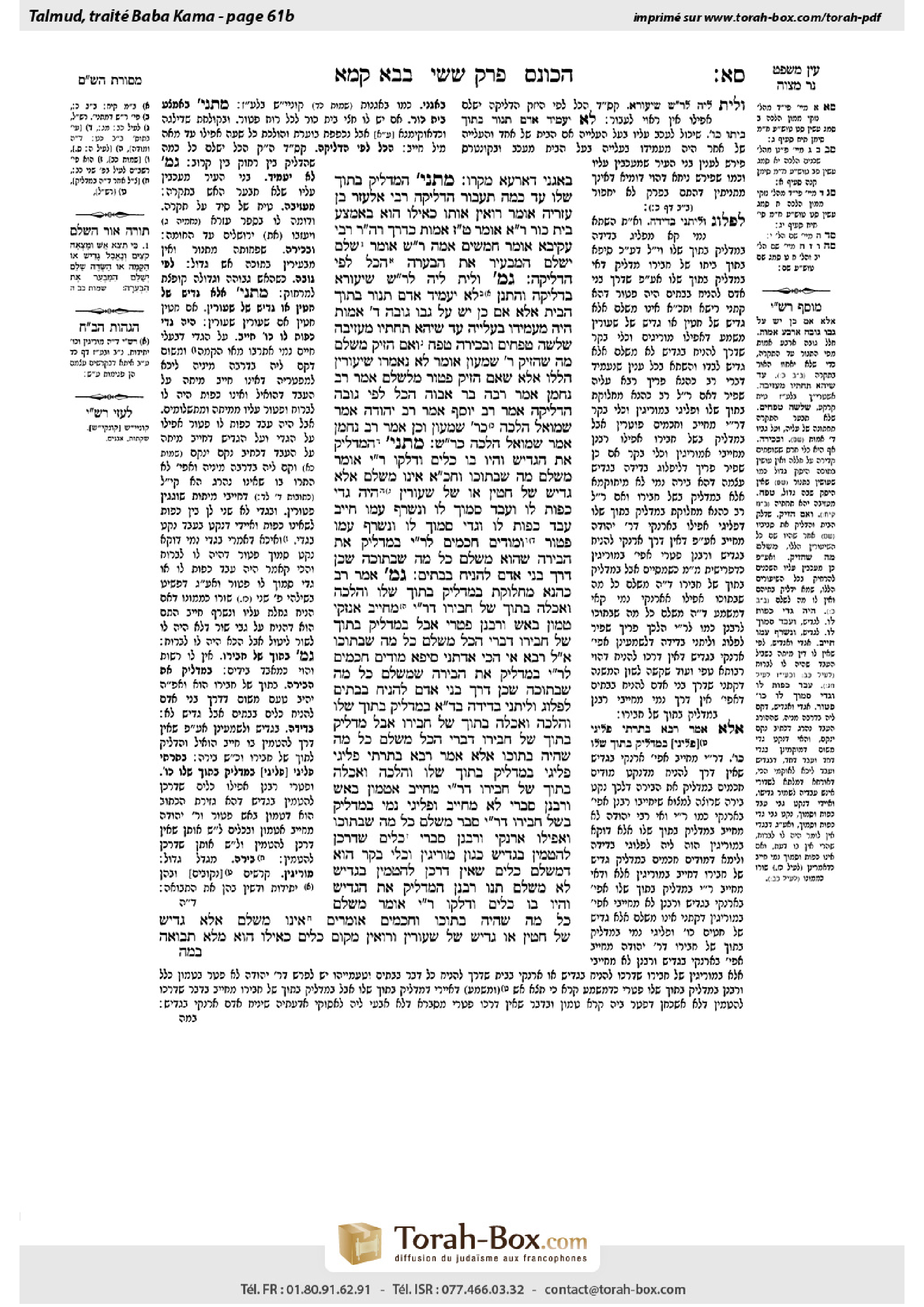
Bava Kamma 61b: Talmud study for Daf Yomi
Study the Talmud for Daf Yomi with scanned pages, Hebrew text, English translations from Sefaria and AI-generated French translations.
Passage selection and English or AI-generated French translation are available where the scan has annotations. Daf Study is independent of Torah-Box and Sefaria.
Browse Bava Kamma · בבא קמא · All tractatesBava Kamma 61b text and translations
This page of Bava Kamma includes the Aramaic text, an English translation and an AI-generated French translation, alongside the scan above.
בבא קמא ס״א ב · Aramaic and Hebrew text
בָּאגָנֵי דְאַרְעָא מִקְּרוּ.
מַתְנִי׳ הַמַּדְלִיק בְּתוֹךְ שֶׁלּוֹ, עַד כַּמָּה תַּעֲבוֹר הַדְּלֵיקָה? רַבִּי אֶלְעָזָר בֶּן עֲזַרְיָה אוֹמֵר: רוֹאִין אוֹתוֹ כְּאִילּוּ הוּא בְּאֶמְצַע בֵּית כּוֹר. רַבִּי אֱלִיעֶזֶר אוֹמֵר: שֵׁשׁ עֶשְׂרֵה אַמּוֹת, כְּדֶרֶךְ רְשׁוּת הָרַבִּים. רַבִּי עֲקִיבָא אוֹמֵר: חֲמִשִּׁים אַמָּה. רַבִּי שִׁמְעוֹן אוֹמֵר: ״שַׁלֵּם יְשַׁלֵּם הַמַּבְעִר אֶת הַבְּעֵרָה״ – הַכֹּל לְפִי הַדְּלֵיקָה.
גְּמָ׳ וְלֵית לֵיהּ לְרַבִּי שִׁמְעוֹן שִׁיעוּרָא בִּדְלֵיקָה?
וְהָתְנַן: לֹא יַעֲמִיד אָדָם תַּנּוּר בְּתוֹךְ הַבַּיִת, אֶלָּא אִם כֵּן יֵשׁ עַל גַּבּוֹ גּוֹבַהּ דְּאַרְבַּע אַמּוֹת. הָיָה מַעֲמִידוֹ בַּעֲלִיָּיה – עַד שֶׁיְּהֵא תַּחְתָּיו מַעֲזִיבָה שְׁלֹשָׁה טְפָחִים. וּבַכִּירָה – טֶפַח. וְאִם הִזִּיק – מְשַׁלֵּם מַה שֶּׁהִזִּיק.
רַבִּי שִׁמְעוֹן אוֹמֵר: לֹא נֶאֶמְרוּ שִׁיעוּרִין הַלָּלוּ, אֶלָּא שֶׁאִם הִזִּיק – פָּטוּר מִלְּשַׁלֵּם!
אָמַר רַב נַחְמָן אָמַר רַבָּה בַּר אֲבוּהּ: הַכֹּל לְפִי גּוֹבַהּ הַדְּלֵיקָה.
אָמַר רַב יוֹסֵף אָמַר רַב יְהוּדָה אָמַר שְׁמוּאֵל: הֲלָכָה כְּרַבִּי שִׁמְעוֹן. וְכֵן אָמַר רַב נַחְמָן אָמַר שְׁמוּאֵל: הֲלָכָה כְּרַבִּי שִׁמְעוֹן.
מַתְנִי׳ הַמַּדְלִיק אֶת הַגָּדִישׁ, וְהָיוּ בּוֹ כֵּלִים וְדָלְקוּ, רַבִּי יְהוּדָה אוֹמֵר: מְשַׁלֵּם מַה שֶּׁבְּתוֹכוֹ, וַחֲכָמִים אוֹמְרִים: אֵינוֹ מְשַׁלֵּם אֶלָּא גָּדִישׁ שֶׁל חִטִּין אוֹ שֶׁל שְׂעוֹרִין.
הָיָה גְּדִי כָּפוּת לוֹ, וְעֶבֶד סָמוּךְ לוֹ וְנִשְׂרַף עִמּוֹ – חַיָּיב. עֶבֶד כָּפוּת לוֹ, וּגְדִי סָמוּךְ לוֹ וְנִשְׂרַף עִמּוֹ – פָּטוּר.
וּמוֹדִים חֲכָמִים לְרַבִּי יְהוּדָה בְּמַדְלִיק אֶת הַבִּירָה, שֶׁהוּא מְשַׁלֵּם כׇּל מַה שֶּׁבְּתוֹכָהּ; שֶׁכֵּן דֶּרֶךְ בְּנֵי אָדָם לְהַנִּיחַ בַּבָּתִּים.
גְּמָ׳ אָמַר רַב כָּהֲנָא: מַחֲלוֹקֶת בְּמַדְלִיק בְּתוֹךְ שֶׁלּוֹ וְהָלְכָה וְאָכְלָה בְּתוֹךְ שֶׁל חֲבֵירוֹ – דְּרַבִּי יְהוּדָה מְחַיַּיב אַנִּזְקֵי טָמוּן בָּאֵשׁ, וְרַבָּנַן פָּטְרִי; אֲבָל בְּמַדְלִיק בְּתוֹךְ שֶׁל חֲבֵירוֹ – דִּבְרֵי הַכֹּל מְשַׁלֵּם כׇּל מַה שֶּׁבְּתוֹכוֹ.
אֲמַר לֵיהּ רָבָא: אִי הָכִי, אַדְּתָנֵי סֵיפָא: מוֹדִים חֲכָמִים לְרַבִּי יְהוּדָה בְּמַדְלִיק אֶת הַבִּירָה – שֶׁמְּשַׁלֵּם כׇּל מַה שֶּׁבְּתוֹכָהּ, שֶׁכֵּן דֶּרֶךְ בְּנֵי אָדָם לְהַנִּיחַ בַּבָּתִּים; לִפְלוֹג וְלִיתְנֵי בְּדִידַהּ: בַּמֶּה דְּבָרִים אֲמוּרִים – בְּמַדְלִיק בְּתוֹךְ שֶׁלּוֹ, וְהָלְכָה וְאָכְלָה בְּתוֹךְ שֶׁל חֲבֵירוֹ; אֲבָל מַדְלִיק בְּתוֹךְ שֶׁל חֲבֵירוֹ – דִּבְרֵי הַכֹּל מְשַׁלֵּם כׇּל מַה שֶּׁהָיָה בְּתוֹכוֹ!
אֶלָּא אָמַר רָבָא: בְּתַרְתֵּי פְּלִיגִי; פְּלִיגִי בְּמַדְלִיק בְּתוֹךְ שֶׁלּוֹ וְהָלְכָה וְאָכְלָה בְּתוֹךְ שֶׁל חֲבֵירוֹ – דְּרַבִּי יְהוּדָה מְחַיַּיב אַטָּמוּן בָּאֵשׁ, וְרַבָּנַן סָבְרִי לָא מִחַיַּיב. וּפְלִיגִי נָמֵי בְּמַדְלִיק בְּשֶׁל חֲבֵירוֹ – דְּרַבִּי יְהוּדָה סָבַר: מְשַׁלֵּם כׇּל מַה שֶּׁבְּתוֹכוֹ, וַאֲפִילּוּ אַרְנְקִי, וְרַבָּנַן סָבְרִי: כֵּלִים שֶׁדַּרְכָּן לְהַטְמִין בְּגָדִישׁ, כְּגוֹן מוֹרִיגִּין וּכְלֵי בָּקָר – הוּא דִּמְשַׁלֵּם; כֵּלִים שֶׁאֵין דַּרְכָּן לְהַטְמִין בְּגָדִישׁ – לָא מְשַׁלֵּם.
תָּנוּ רַבָּנַן: הַמַּדְלִיק אֶת הַגָּדִישׁ, וְהָיוּ בּוֹ כֵּלִים וְדָלְקוּ, רַבִּי יְהוּדָה אוֹמֵר: מְשַׁלֵּם כׇּל מַה שֶּׁהָיָה בְּתוֹכוֹ, וַחֲכָמִים אוֹמְרִים: אֵינוֹ מְשַׁלֵּם אֶלָּא גָּדִישׁ שֶׁל חִטִּין אוֹ גָדִישׁ שֶׁל שְׂעוֹרִין. וְרוֹאִין מְקוֹם כֵּלִים כְּאִילּוּ הוּא מָלֵא תְּבוּאָה.
Bava Kamma 61b · English translation
are simply called pools of the land, and are not considered significant enough to divide the field.
MISHNA: In a case of one who kindles a fire on his own premises, up to what distance may the fire travel within his property for him to still bear liability for damage caused? Rabbi Elazar ben Azaria says: The court views his location where he kindled the fire as if it were in the center of a beit kor. Therefore, if the fire spreads and causes damage farther away than half a beit kor, the one who kindled the fire is exempt, since he could not anticipate that the fire would spread so far. Rabbi Eliezer says: One is liable up to a distance of sixteen cubits, like the width of a public thoroughfare. Rabbi Akiva says: One is liable up to a distance of fifty cubits. Rabbi Shimon says: The verse states: “The one who kindled the fire shall pay [shallem yeshallem] compensation” (Exodus 22:5), to teach that everything is according to the fire.
GEMARA: Rabbi Shimon appears to hold that there is no maximum distance which would exempt one from liability for the spreading of a fire. The Gemara asks: But isn’t Rabbi Shimon of the opinion that there is a maximum limit concerning liability for a fire, beyond which one is exempt?
But didn’t we learn in a mishna (Bava Batra 20b): A person may not stand an oven inside the house unless there is a height of four cubits to the ceiling above it, out of concern that the ceiling might catch fire. Similarly, if he stood it in the attic, he should not do so unless there is plaster [ma’aziva] underneath it, above the ceiling of the floor below, three handbreadths in thickness, out of concern that the floor might catch fire. And in the case of a stove, which is smaller and does not reach temperatures as high as those of an oven, a thickness of one handbreadth is sufficient. And even though he may place his oven or stove in this manner, if the fire from the oven or stove causes damage, he must pay for what it damaged.
The mishna continues: Rabbi Shimon says: These measurements were stated only to teach that if the fire from the oven or stove causes damage after the owner takes these precautions, he is exempt from paying compensation. Evidently, Rabbi Shimon does have a maximum distance beyond which one is not liable for fire.
Rav Naḥman says that Rabba bar Avuh says: This is how Rabbi Shimon’s statement in the mishna should be understood: Everything is according to the height of the fire he initially kindled. If it was a small fire he is not liable to pay for damage caused by it if it traveled far, whereas if he started a large fire, he is liable even if it traveled a great distance.
Rav Yosef says that Rav Yehuda says that Shmuel says: The halakha is in accordance with the opinion of Rabbi Shimon. And so Rav Naḥman says that Shmuel says: The halakha is in accordance with the opinion of Rabbi Shimon.
MISHNA: With regard to one who kindles a stack of wheat or barley and there were vessels concealed inside the stack and they caught fire and burned together with the stack, Rabbi Yehuda says: The one who kindled the fire also pays compensation for what was inside the stack, but the Rabbis say: He pays compensation only for the stack of wheat or barley, as the case may be, and he is not responsible for that which was concealed within it.
If there was a goat tied to the stack of grain, and there was a Canaanite slave nearby who was not tied to it, and both the goat and the slave were burned together with the stack and killed, the one who kindled the fire is liable to pay compensation for both. Conversely, if the slave was tied to the stack and there was a goat nearby that was not tied to it, and they were both burned together with it, the one who kindled the fire is exempt from payment for damage because he is liable to receive capital punishment for murder, and he is punished only for the greater transgression.
And the Rabbis, who disagree with Rabbi Yehuda and exempt one from payment for vessels concealed inside the stack in the field, concede to Rabbi Yehuda that if one sets fire to a building, he pays compensation for everything that was burned inside it, since it is the normal way of people to place items in houses.
GEMARA: Rav Kahana says: This dispute between the Rabbis and Rabbi Yehuda concerning vessels concealed in a stack is referring specifically to a case where one kindled a fire on his own premises and the fire spread and consumed the stack on another’s property. In that case, Rabbi Yehuda deems the one who kindled the fire liable for damage to concealed articles damaged by a fire, but the Rabbis exempt him. But in a case of one who kindles a fire on another’s premises, all agree that he pays compensation for everything that is contained within it.
Rava said to him: If so, that the Rabbis concede to Rabbi Yehuda in the case of one who kindles the fire on the premises of another, then rather than teaching the latter clause that states: The Rabbis concede to Rabbi Yehuda that if one sets fire to a building he pays compensation for everything that was burned inside it, since it is the normal way of people to place items in houses, let the tanna instead distinguish and teach the concession of the Rabbis in the context of the same case of one setting fire to a stack: In what case is this statement said? It is said in a case where he kindled the fire on his own premises and it spread and consumed a stack on the premises of another. But if he kindled the fire on property belonging to another, all agree that he pays compensation for everything that was contained within it. Since the mishna is not worded in this manner, it seems that this is not the opinion of the Rabbis.
Rather, Rava said that the Rabbis and Rabbi Yehuda disagree with regard to two issues: They disagree with regard to the case of one who kindles a fire on his own premises and it then spreads and consumes a stack on property belonging to another, as Rabbi Yehuda deems him liable even for a concealed article damaged by a fire, but the Rabbis hold that he is not liable. And they disagree also in the case of one who kindles a fire on premises belonging to another, as Rabbi Yehuda holds that he must pay compensation for everything within it, even a purse of money if it was concealed within the stack, but the Rabbis hold that it is only for vessels that are typically concealed inside a stack, such as threshing tools or yokes for cattle, that he must pay compensation, but for vessels or other items that are not typically concealed inside a stack he is not liable to pay compensation.
The Sages taught: With regard to one who kindles a stack and there were vessels inside it that were burned, Rabbi Yehuda says: The one who kindled the fire pays compensation for everything that was inside it, but the Rabbis say: He pays compensation only for the value of a stack of wheat or a stack of barley, and he does not pay compensation for the vessels. And the court views the place where the vessels were as if it were filled with grain, and calculates the amount of compensation accordingly.
Bava Kamma 61b · Traduction française (IA)
Ce sont simplement des étangs du sol, et ne sont pas considérés comme suffisamment importants pour diviser le champ.
MICHNA : Dans le cas d'une personne qui allume un feu sur ses terres, jusqu'à quelle distance ce feu peut-il se propager dans sa propriété pour qu'il reste responsable des dommages causés ? Rabbi Elazar ben Azaria dit : Le tribunal considère le lieu où il a allumé le feu comme si c'était au centre d'un beit kor. Ainsi, si le feu se propage et cause des dommages à une distance supérieure à la moitié d'un beit kor, la personne qui a allumé le feu est exemptée, car elle ne pouvait pas anticiper que le feu se propagerait aussi loin. Rabbi Eliezer dit : On est responsable jusqu'à une distance de seize coudées, comme la largeur d'une rue publique. Rabbi Akiva dit : On est responsable jusqu'à une distance de cinquante coudées. Rabbi Shimon dit : La parabrase stipule : « Celui qui a allumé le feu paiera [shallem yeshallem] la réparation » (Exode 22:5), pour enseigner que tout est selon le feu.
GUEMARA : Rabbi Shimon semble considérer qu'il n'y a pas de distance maximale qui exempterait une personne de responsabilité en cas de propagation d'un feu. La Guemara pose la question : N'est-ce pas que Rabbi Shimon pense qu'il existe une limite maximale concernant la responsabilité en cas de feu, au-delà de laquelle on est exempt ?
Mais n'avons-nous pas appris dans une mishna (Bava Batra 20b) : Une personne ne peut pas placer une cheminée à l'intérieur de sa maison sans qu'il y ait une hauteur de quatre coudées au-dessus du plafond, par crainte que le plafond ne prenne feu. De même, s'il la place dans l'atelier, il ne doit pas le faire sans qu'il y ait un plâtre [ma'aziva] sous elle, au-dessus du plafond du niveau inférieur, d'une épaisseur de trois tefachim, par crainte que le plancher ne prenne feu. Et dans le cas d'une cuisinière, qui est plus petite et ne produit pas de température aussi élevée qu'une cheminée, une épaisseur d'un tefach est suffisante. Et même s'il peut placer sa cheminée ou sa cuisinière ainsi, si le feu de la cheminée ou de la cuisinière cause des dommages, il doit payer pour ce qu'il a endommagé.
La mishna continue : Rabbi Shimon dit : Ces mesures ont été énoncées uniquement pour enseigner que si le feu de la cheminée ou de la cuisinière cause des dommages après que l'propriétaire ait pris ces précautions, il est exempt de payer la réparation. Évidemment, Rabbi Shimon a tout de même une distance maximale au-delà de laquelle on n'est pas responsable du feu.
Rav Naḥman dit que Rabba bar Avuh dit : C'est ainsi que la déclaration de Rabbi Shimon dans la mishna doit être comprise : Tout est selon la hauteur du feu qu'il a allumé initialement. Si c'était un feu petit, il n'est pas responsable des dommages causés s'il s'est éloigné, tandis que s'il a allumé un feu grand, il est responsable même si le feu s'est éloigné beaucoup.
Rav Yosef dit que Rav Yehuda dit que Shmuel dit : La halakha suit l'opinion de Rabbi Shimon. Et ainsi Rav Naḥman dit que Shmuel dit : La halakha suit l'opinion de Rabbi Shimon.
MICHNA : En ce qui concerne une personne qui allume un tas de blé ou de froment et qu'il y avait des récipients cachés à l'intérieur du tas et qu'ils ont pris feu et brûlé ensemble avec le tas, Rabbi Yehuda dit : La personne qui a allumé le feu paie la réparation pour ce qui était à l'intérieur du tas, mais les Rabbins disent : Il paie la réparation uniquement pour le tas de blé ou de froment, comme il convient, et il n'est pas responsable de ce qui était caché à l'intérieur.
Si un bouc était attaché au tas de céréales et qu'il y avait un esclave cananéen à côté qui n'était pas attaché, et que le bouc et l'esclave avaient brûlé ensemble avec le tas et étaient morts, la personne qui avait allumé le feu est responsable de la réparation pour les deux. À l'inverse, si l'esclave était attaché au tas et qu'il y avait un bouc à côté qui n'était pas attaché, et qu'ils avaient brûlé ensemble avec lui, la personne qui avait allumé le feu est exempté de la réparation des dommages, car il est responsable de recevoir la peine de mort pour meurtre, et il est puni uniquement pour la transgression plus grave.
Et les Rabbins, qui s'opposent à Rabbi Yehuda et exemptent une personne de la réparation des récipients cachés dans le tas dans le champ, reconnaissent à Rabbi Yehuda que si l'on allume un feu dans un bâtiment, il paie la réparation pour tout ce qui a brûlé à l'intérieur, car c'est la manière normale de placer des objets dans les maisons.
GUEMARA : Rav Kahana dit : Ce débat entre les Rabbins et Rabbi Yehuda concernant les récipients cachés dans un tas fait référence spécifiquement à un cas où l'on allume un feu sur ses terres et que le feu se propage et consume le tas sur les terres d'autrui. Dans ce cas, Rabbi Yehuda considère que la personne qui a allumé le feu est responsable des dommages causés aux objets cachés, mais les Rabbins l'exemptent. Mais dans le cas d'une personne qui allume un feu sur les terres d'autrui, tous s'accordent à ce qu'il paie la réparation pour tout ce qui est contenu à l'intérieur.
Rava dit à lui : Si c'est ainsi, que les Rabbins reconnaissent à Rabbi Yehuda dans le cas d'une personne qui allume le feu sur les terres d'autrui, alors plutôt que d'enseigner cette dernière clause qui stipule : Les Rabbins reconnaissent à Rabbi Yehuda que si l'on allume un feu dans un bâtiment, il paie la réparation pour tout ce qui a brûlé à l'intérieur, car c'est la manière normale de placer des objets dans les maisons, faites plutôt que le tanna distingue et enseigne la concession des Rabbins dans le contexte même du cas d'une personne allumant un feu dans un tas : Dans quel cas cette déclaration est-elle faite ? Elle est faite dans un cas où il a allumé le feu sur ses terres et que le feu s'est propagé et a consommé un tas sur les terres d'autrui. Mais s'il allume le feu sur les terres d'autrui, tous s'accordent à ce qu'il paie la réparation pour tout ce qui est contenu à l'intérieur. Puisque la mishna n'est pas formulée ainsi, cela semble ne pas être l'opinion des Rabbins.
En réalité, Rava a dit que les Sages et Rabbi Yéhuda divergent sur deux points : ils divergent concernant le cas d'une personne qui allume un feu sur ses propres terres et ce feu s'étend ensuite pour consumer un tas appartenant à un autre, car Rabbi Yéhuda considère qu'il est responsable même pour un objet caché endommagé par le feu, mais les Sages pensent qu'il n'en est pas ainsi. Et ils divergent également concernant le cas d'une personne qui allume un feu sur les terres d'autrui, car Rabbi Yéhuda affirme qu'il doit indemniser tout ce qui se trouve à l'intérieur, même un sac d'argent s'il était caché dans le tas, mais les Sages pensent qu'il doit indemniser uniquement les objets habituellement cachés dans un tas, tels que les outils de meunier ou les jougs pour les bêtes, mais pas les objets ou autres articles qui ne sont pas habituellement cachés dans un tas, pour lesquels il n'est pas responsable d'indemniser.
Les Sages ont enseigné : concernant une personne qui allume un tas et qu'il y avait des objets à l'intérieur qui ont été brûlés, Rabbi Yéhuda dit : celui qui a allumé le feu doit indemniser tout ce qui était à l'intérieur, mais les Sages disent : il doit indemniser uniquement la valeur d'un tas de blé ou d'un tas d'orge, et il ne doit pas indemniser les objets. Et la cour considère la place où se trouvaient les objets comme si elle était remplie de grains, et calcule l'indemnité en conséquence.
Traduction française générée par IA à partir de l’édition anglaise de Sefaria. Vérifie toujours un passage avec le texte source.
Text from Sefaria: William Davidson Edition - Vocalized Aramaic (CC BY NC); William Davidson Edition - English (CC BY NC).