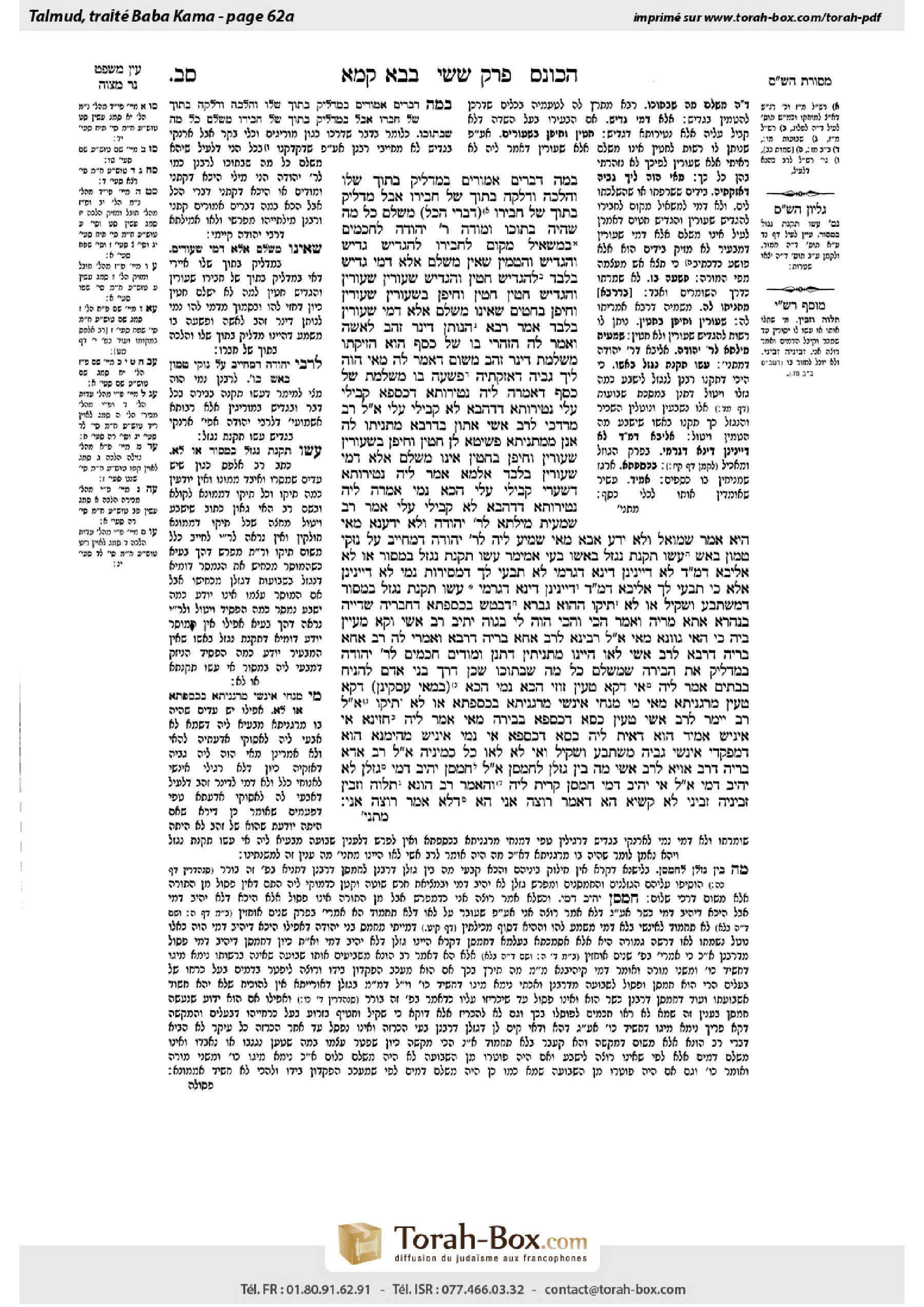
Bava Kamma 62a: Talmud study for Daf Yomi
Study the Talmud for Daf Yomi with scanned pages, Hebrew text, English translations from Sefaria and AI-generated French translations.
Passage selection and English or AI-generated French translation are available where the scan has annotations. Daf Study is independent of Torah-Box and Sefaria.
Browse Bava Kamma · בבא קמא · All tractatesBava Kamma 62a text and translations
This page of Bava Kamma includes the Aramaic text, an English translation and an AI-generated French translation, alongside the scan above.
בבא קמא ס״ב א · Aramaic and Hebrew text
בַּמֶּה דְּבָרִים אֲמוּרִים – בְּמַדְלִיק בְּתוֹךְ שֶׁלּוֹ וְהָלְכָה וְדָלְקָה בְּתוֹךְ שֶׁל חֲבֵירוֹ, אֲבָל מַדְלִיק בְּתוֹךְ שֶׁל חֲבֵירוֹ – דִּבְרֵי הַכֹּל מְשַׁלֵּם כׇּל מַה שֶּׁהָיָה בְּתוֹכוֹ.
וּמוֹדֶה רַבִּי יְהוּדָה לַחֲכָמִים בְּמַשְׁאִיל מָקוֹם לַחֲבֵירוֹ לְהַגְדִּישׁ גָּדִישׁ, וְהִגְדִּישׁ וְהִטְמִין, שֶׁאֵין מְשַׁלֵּם אֶלָּא דְּמֵי גָדִישׁ בִּלְבָד. לְהַגְדִּישׁ חִטִּין וְהִגְדִּישׁ שְׂעוֹרִין; שְׂעוֹרִין וְהִגְדִּישׁ חִטִּין; חִטִּין וְחִיפָּן בִּשְׂעוֹרִין; שְׂעוֹרִין וְחִיפָּן בְּחִטִּים – שֶׁאֵינוֹ מְשַׁלֵּם אֶלָּא דְּמֵי שְׂעוֹרִין בִּלְבָד.
אָמַר רָבָא: הַנּוֹתֵן דִּינַר זָהָב לְאִשָּׁה, וְאָמַר לָהּ: ״הִזָּהֲרִי בּוֹ, שֶׁל כֶּסֶף הוּא״; הִזִּיקַתּוּ – מְשַׁלֶּמֶת דִּינַר זָהָב, מִשּׁוּם דְּאָמַר לַהּ: מַאי הֲוָה לִיךְ גַּבֵּיהּ דְּאַזַּקְתֵּיהּ. פָּשְׁעָה בּוֹ – מְשַׁלֶּמֶת שֶׁל כֶּסֶף, דְּאָמְרָה לֵיהּ: נְטִירוּתָא דְכַסְפָּא קַבֵּילִי עֲלַי, נְטִירוּתָא דְּדַהֲבָא לָא קַבֵּילִי עֲלַי.
אֲמַר לֵיהּ רַב מָרְדֳּכַי לְרַב אָשֵׁי: אַתּוּן – בִּדְרָבָא מַתְנִיתוּ לַהּ; אֲנַן – מִמַּתְנִיתָא פְּשִׁיטָא לַן: חִטִּין וְחִיפָּן בִּשְׂעוֹרִין, שְׂעוֹרִין וְחִיפָּן בְּחִטִּין – אֵינוֹ מְשַׁלֵּם אֶלָּא דְּמֵי שְׂעוֹרִין בִּלְבָד. אַלְמָא אֲמַר לֵיהּ: ״נְטִירוּתָא דִשְׂעָרֵי קַבֵּילִי עֲלַי״, הָכָא נָמֵי אֲמַרָה לֵיהּ: ״נְטִירוּתָא דְּדַהֲבָא לָא קַבֵּילִי עֲלַי״.
אָמַר רַב: שְׁמַעִית מִילְּתָא לְרַבִּי יְהוּדָה, וְלָא יָדַעְנָא מַאי הִיא. אָמַר שְׁמוּאֵל: וְלָא יָדַע אַבָּא מַאי שְׁמִיעַ לֵיהּ? לְרַבִּי יְהוּדָה, דִּמְחַיֵּיב עַל נִזְקֵי טָמוּן בָּאֵשׁ – עָשׂוּ תַּקָּנַת נִגְזָל בְּאִשּׁוֹ.
בָּעֵי אַמֵּימָר: עָשׂוּ תַּקָּנַת נִגְזָל בְּמָסוֹר, אוֹ לָא? אַלִּיבָּא דְּמַאן דְּאָמַר לָא דָּיְינִינַן דִּינָא דִגְרָמֵי – לָא תִּבְּעֵי לָךְ, דְּמָסוֹרוֹת נָמֵי לָא דָּיְינִינַן;
אֶלָּא כִּי תִּבְּעֵי לָךְ, אַלִּיבָּא דְּמַאן דְּאָמַר דָּיְינִינַן דִּינָא דִגְרָמֵי – עָשׂוּ תַּקָּנַת נִגְזָל בְּמָסוֹר, דְּמִשְׁתְּבַע וְשָׁקֵיל, אוֹ לָא? תֵּיקוּ.
הָהוּא גַּבְרָא דִּבְטַשׁ בְּכַסְפְּתָא דְחַבְרֵיהּ, שַׁדְיַיהּ בְּנַהֲרָא. אֲתָא מָרֵיהּ וְאָמַר: הָכִי וְהָכִי הֲוָה לִי בְּגַוַּהּ. יָתֵיב רַב אָשֵׁי וְקָא מְעַיֵּין בֵּיהּ: כִּי הַאי גַוְונָא מַאי?
אֲמַר לֵיהּ רָבִינָא לְרַב אַחָא בְּרֵיהּ דְּרָבָא, וְאָמְרִי לַהּ רַב אַחָא בְּרֵיהּ דְּרָבָא לְרַב אָשֵׁי: לָאו הַיְינוּ מַתְנִיתִין? דִּתְנַן: וּמוֹדִים חֲכָמִים לְרַבִּי יְהוּדָה בְּמַדְלִיק אֶת הַבִּירָה, שֶׁמְּשַׁלֵּם כׇּל מַה שֶּׁבְּתוֹכוֹ; שֶׁכֵּן דֶּרֶךְ בְּנֵי אָדָם לְהַנִּיחַ בַּבָּתִּים.
אֲמַר לֵיהּ: אִי דְּקָא טָעֵין זוּזֵי – הָכָא נָמֵי, הָכָא בְּמַאי עָסְקִינַן – דְּקָא טָעֵין מַרְגָּנִיתָא. מַאי? מִי מַנְּחִי אִינָשֵׁי מַרְגָּנִיתָא בְּכַסְפְּתָא, אוֹ לָא? תֵּיקוּ.
אֲמַר לֵיהּ רַב יֵימַר לְרַב אָשֵׁי: טָעֵין כָּסָא דְכַסְפָּא בְּבִירָה, מַאי? אֲמַר לֵיהּ: (חָזֵינָא) [חָזֵינַן], אִי אִינִישׁ אֲמִיד הוּא – דְּאִית לֵיהּ כָּסָא דְכַסְפָּא, אִי נָמֵי אִינִישׁ מְהֵימְנָא הוּא – דְּמַפְקְדִי אִינָשֵׁי גַּבֵּיהּ; מִשְׁתְּבַע וְשָׁקֵיל. וְאִי לָא, לָאו כֹּל כְּמִינֵּיהּ.
אֲמַר לֵיהּ רַב אַדָּא בְּרֵיהּ דְּרַב אַוְיָא לְרַב אָשֵׁי: מָה בֵּין גַּזְלָן לְחַמְסָן? אֲמַר לֵיהּ: חַמְסָן – יָהֵיב דְּמֵי, גַּזְלָן – לָא יָהֵיב דְּמֵי.
אֲמַר לֵיהּ: אִי יָהֵיב דְּמֵי – חַמְסָן קָרֵית לֵיהּ?! וְהָאָמַר רַב הוּנָא: תְּלוּהּ וְזַבֵּין – זְבִינֵיהּ זְבִינֵי! לָא קַשְׁיָא, הָא דְּאָמַר ״רוֹצֶה אֲנִי״, הָא דְּלָא אָמַר ״רוֹצֶה אֲנִי״.
Bava Kamma 62a · English translation
In what case is this statement said? It is in a case where one kindled a fire on his premises and the fire spread and burned items in premises belonging to another. But with regard to one who kindles a fire on premises belonging to another that destroys a stack of wheat, all agree that he pays compensation for everything that was inside the stack.
And Rabbi Yehuda concedes to the Rabbis that in a case where one lends space to another in his field to stack grain, and this person stacked grain in the field and concealed items inside the stack, if the owner of the field causes the stack to be burned down, he pays compensation for the stack alone, since the other person did not have permission to conceal items inside his stack. Similarly, if one received permission to stack wheat in the field of another and he stacked barley; or conversely, if he received permission to stack barley and he stacked wheat; or similarly, if he stacked wheat and covered the stack with barley, or stacked barley and covered the stack with wheat, in all these cases, Rabbi Yehuda concedes that he pays compensation for the barley alone, which is less than the value of wheat.
§ Rava says: With regard to one who gives a gold dinar to a woman for safekeeping and says to her: Be careful with this dinar because it is made of silver, if she herself damaged the dinar, she must pay compensation for the value of a gold dinar. This is because he can say to her: What business did you have damaging it? If she was negligent and it was lost or stolen, she pays as compensation only the value of a silver dinar, since she can say to him: I undertook to safeguard only a silver dinar, but I did not undertake to safeguard a gold dinar.
Rav Mordekhai said to Rav Ashi: You teach this halakha as a statement of Rava, but for us this halakha is obvious from the baraita that taught: If one stacked wheat and covered the stack with barley, or stacked barley and covered the stack with wheat, the one responsible for the fire pays compensation for the barley alone. Evidently, the one who kindled the fire can say to the owner of the stack: I undertook to safeguard a stack of barley but not a stack of wheat. Here too, in the case of a golden dinar presented as a silver dinar, the woman can say to him: I did not undertake to safeguard a gold dinar.
§ Rav said: I heard a halakhic matter in connection with Rabbi Yehuda’s opinion in the mishna but I do not know what it is. Shmuel said: And does Abba, which was Rav’s name, really not know what he heard? This is the statement that he heard: According to the opinion of Rabbi Yehuda, who deems one liable for concealed articles damaged by a fire, the Sages applied the ordinance of a robbery victim to one whose concealed items are damaged by his fire. Just as the Sages instituted an ordinance that a robbery victim can take an oath as to what was stolen from him and the robber must repay him accordingly, similarly, according to Rabbi Yehuda the owner of the stack can take an oath that certain items were inside the stack, and the one responsible for the fire must pay compensation for them.
Ameimar asks: Did they apply this ordinance of a robbery victim in the case of an informer who causes another person’s property to be confiscated by the gentile authorities, or not? The question is clarified: According to the opinion of the one who says that we do not judge cases of liability for damage caused by indirect action, do not ask the question, as according to that opinion we also do not judge cases of liability for informers who cause indirect damage.
Rather, when you ask this question, it is in accordance with the opinion of the one who said that we judge cases of liability for damage caused by indirect action, and the question is: Did the Sages apply the ordinance of a robbery victim to one whose items were taken due to an informer, meaning that the victim can take an oath to support his claim with regard to what was taken and take this amount in compensation, or not? No conclusion was reached about this, and the dilemma shall stand unresolved.
An incident was related about a certain man who kicked a safe belonging to another, sending it flying into the river. The owner of the safe came to court and said: I had such and such inside it. Rav Ashi sat and was investigating the question: In a case like this, what is the halakha? Does the court believe the claimant or not?
Ravina said to Rav Aḥa, son of Rava, and some say that Rav Aḥa, son of Rava, said to Rav Ashi: Is this not identical to the case of the mishna, as we learned in the mishna: And the Rabbis concede to Rabbi Yehuda that if one sets fire to a building, he pays compensation for everything that was burned inside it, since it is the normal way of people to place items in houses? Similarly, it is the normal way of people to place money in a safe, and the court should rely on the claim of the victim.
Rav Ashi said to him: If the claimant were to claim that there were coins in the safe, this ruling would apply here also. But with what are we dealing here? We are dealing with a case where the claimant claims that there was a pearl [marganita] in the safe. What is the halakha? Do people typically place pearls in a safe, in which case he should be believed, or not? The dilemma shall stand unresolved.
Rav Yeimar said to Rav Ashi: If the one whose home was burned by the fire were to claim that he had, among other items, a silver goblet in the building, what is the halakha? Is he believed or not? Rav Ashi said to him: We view his situation. If he is a wealthy person, who would typically have a silver goblet, or alternatively, if he is a trustworthy person with whom people entrust valuable items, he can take an oath that this is what he had and take compensation according to his claim. But if he is not such a person, it is not in his power to be believed in such a claim.
§ Rav Adda, son of Rav Avya, said to Rav Ashi: Concerning two terms used to describe those who take another’s property against his will, a gazlan and a ḥamsan, what is the difference between them? Rav Ashi said to him: A ḥamsan gives money for the article that he takes from its owner, albeit against the owner’s will, whereas a gazlan does not give money.
Rav Adda was puzzled by this response and said to him: If he gives money, do you still call him a ḥamsan? Since he pays money for it, he acquires it lawfully, despite the fact that its owner did not sell it voluntarily. But doesn’t Rav Huna say: If one was strung up so that another could coerce him to sell a certain item, and he sold it, his sale is a valid sale. This indicates that a sale under duress is considered a valid sale. Rav Ashi answered: This is not difficult. This case, where the sale under duress is legally considered to be a sale, is referring to a case where he eventually says: I want to sell the item, despite having been forced. By contrast, in that case, where the sale is invalid, he did not say: I want to sell the item.
Bava Kamma 62a · Traduction française (IA)
Dans quel cas cette déclaration est-elle émise ? C'est dans le cas où une personne allume un feu sur ses terres et que ce feu s'étend et brûle des objets appartenant à un autre. Cependant, concernant celui qui allume un feu sur les terres d'autrui et détruit un tas de blé, tous s'accordent à ce qu'il doive indemniser tout ce qui était à l'intérieur du tas.
Et Rabbi Yéhuda reconnaît la position des Sages dans le cas où une personne prête un espace dans son champ à un autre pour y empiler des céréales, et que cette personne empile des céréales dans le champ et cache des objets à l'intérieur du tas, si l'propriétaire du champ provoque la destruction du tas, il indemnisera uniquement le tas, car l'autre personne n'avait pas le droit de cacher des objets à l'intérieur de son tas. De même, si une personne a reçu la permission d'empiler du blé dans le champ d'un autre et qu'il a empilé de l'orge, ou inversement, s'il a reçu la permission d'empiler de l'orge et qu'il a empilé du blé, ou encore, s'il a empilé du blé et a recouvert le tas avec de l'orge, ou s'il a empilé de l'orge et a recouvert le tas avec du blé, dans tous ces cas, Rabbi Yéhuda reconnaît qu'il indemnisera uniquement l'orge, qui est moins valorisé que le blé.
§ Rava dit : Concernant celui qui donne un dinar d'or à une femme pour le garder et lui dit : Fais attention à ce dinar car il est en argent, si elle elle-même a endommagé le dinar, elle doit indemniser la valeur d'un dinar d'or. Cela est parce qu'il peut lui dire : Quel intérêt as-tu eu à le détruire ? Si elle a été négligente et que le dinar a été perdu ou volé, elle indemnisera uniquement la valeur d'un dinar d'argent, car elle peut lui dire : J'ai entrepris de garder un dinar d'argent, mais je n'ai pas entrepris de garder un dinar d'or.
Rav Mordekhai dit à Rav Ashi : Tu enseignes cette halakha comme une déclaration de Rava, mais pour nous cette halakha est évidente à partir de la baraïta qui enseigne : Si l'on empile du blé et recouvre le tas avec de l'orge, ou si l'on empile de l'orge et recouvre le tas avec du blé, la personne responsable du feu indemnisera uniquement l'orge. Évidemment, celui qui a allumé le feu peut dire à l'propriétaire du tas : J'ai entrepris de garder un tas d'orge mais pas un tas de blé. Ici aussi, dans le cas d'un dinar d'or présenté comme un dinar d'argent, la femme peut dire à lui : Je n'ai pas entrepris de garder un dinar d'or.
§ Rav dit : J'ai entendu une question halakhique en lien avec l'opinion de Rabbi Yéhuda dans la mitsna mais je ne sais pas ce que c'est. Shmuel dit : Et Abba, qui était le nom de Rav, ne connaît-il pas ce qu'il a entendu ? C'est la déclaration qu'il a entendue : Selon l'opinion de Rabbi Yéhuda, qui considère qu'une personne est responsable des objets cachés endommagés par un feu, les Sages ont appliqué l'ordonnance du voleur à celui dont les objets cachés sont endommagés par son feu. Tout comme les Sages ont institué une ordonnance selon laquelle un victime de vol peut prendre un serment concernant ce qui a été volé et que le voleur doit le réparer selon ce serment, de même, selon Rabbi Yéhuda, l'propriétaire du tas peut prendre un serment selon les objets qui étaient à l'intérieur du tas et que la personne responsable du feu doit indemniser.
Ameimar pose la question : Ont-ils appliqué cette ordonnance concernant la victime d'une effraction dans le cas d'un informateur qui cause la confiscation des biens d'une personne par les autorités païennes, ou non ? La question est clarifiée : Selon l'opinion de celui qui dit que nous ne jugeons pas les cas de responsabilité pour des dommages causés par une action indirecte, ne posez pas la question, car selon cette opinion nous ne jugeons pas non plus les cas de responsabilité pour les informateurs qui causent des dommages indirects.
Plutôt, lorsque vous posez cette question, c'est selon l'opinion de celui qui a dit que nous jugeons les cas de responsabilité pour des dommages causés par une action indirecte, et la question est : Ont-ils appliqué l'ordonnance du voleur à celui dont les biens ont été pris à cause d'un informateur, c'est-à-dire que la victime peut prendre un serment pour soutenir sa revendication concernant ce qui a été pris et prendre cette somme en compensation, ou non ? Aucune conclusion n'a été tirée à ce sujet, et ce dilemme restera sans solution.
Un incident a été rapporté concernant un certain homme qui a frappé un coffre sûr appartenant à un autre, le lançant dans le fleuve. L'propriétaire du coffre est venu devant le tribunal et a dit : J'avais tel et tel à l'intérieur. Rav Ashi s'est assis et a investigué la question : Dans un cas comme celui-ci, quelle est la halakha ? Le tribunal croit-il la déclaration du plaignant ou non ?
Ravina a dit à Rav Aḥa, fils de Rava, et certains disent que Rav Aḥa, fils de Rava, a dit à Rav Ashi : Ce n'est-ce pas identique au cas de la mitsna, comme nous l'avons appris dans la mitsna : Et les Sages reconnaissent à Rabbi Yéhuda que si l'on allume un feu dans un bâtiment, il indemnisera tout ce qui a été brûlé à l'intérieur, car c'est la manière normale des gens de placer des objets dans les maisons ? De même, c'est la manière normale des gens de placer de l'argent dans un coffre, et le tribunal devrait se fier à la déclaration du plaignant.
Rav Ashi a dit à lui : Si le plaignant affirmait qu'il y avait des pièces dans le coffre, cette décision s'appliquerait ici aussi. Mais avec quoi sommes-nous en train de nous occuper ? Nous sommes en train de nous occuper d'un cas où le plaignant affirme qu'il y avait une perle [marganita] dans le coffre. Quelle est la halakha ? Les gens mettent-ils habituellement des perles dans un coffre, dans ce cas il devrait être cru, ou non ? Ce dilemme restera sans solution.
Rav Yeimar a dit à Rav Ashi : Si celui dont la maison a été brûlée par le feu affirmait qu'il avait, parmi d'autres objets, un bol en argent dans la maison, quelle est la halakha ? Est-il cru ou non ? Rav Ashi a dit à lui : Nous examinons sa situation. S'il est une personne riche, qui aurait normalement un bol en argent, ou alternativement, s'il est une personne de confiance à qui les gens confient des objets précieux, il peut prendre un serment selon ce qu'il a et réclamer une indemnisation selon sa déclaration. Mais s'il n'est pas une telle personne, il n'a pas le pouvoir d'être cru dans une telle déclaration.
§ Rav Adda, fils de Rav Avya, dit à Rav Ashi : Concernant deux termes utilisés pour décrire ceux qui prennent la propriété d'autrui contre sa volonté, un gazlan et un ḥamsan, quelle est la différence entre eux ? Rav Ashi répondit à lui : Un ḥamsan paie de l'argent pour l'article qu'il prend à son propriétaire, même contre la volonté de ce dernier, tandis qu'un gazlan ne paie pas d'argent.
Rav Adda fut troublé par cette réponse et dit à Rav Ashi : Si il paie de l'argent, est-ce que vous continuez encore à l'appeler un ḥamsan ? Puisqu'il paie de l'argent pour cela, il acquiert légalement la propriété, même si son propriétaire n'a pas vendu volontairement. Mais ne dit-on pas que Rav Huna : Si l'on a été suspendu de manière à ce qu'un autre puisse le contraindre à vendre un certain objet, et qu'il a vendu, sa vente est une vente valide. Cela indique que la vente sous la contrainte est considérée comme une vente valide. Rav Ashi répondit : Ce n'est pas difficile. Ce cas, où la vente sous la contrainte est juridiquement considérée comme une vente, fait référence à un cas où il finit par dire : Je veux vendre l'objet, malgré avoir été forcé. À l'inverse, dans ce cas où la vente est invalide, il n'a pas dit : Je veux vendre l'objet.
Traduction française générée par IA à partir de l’édition anglaise de Sefaria. Vérifie toujours un passage avec le texte source.
Text from Sefaria: William Davidson Edition - Vocalized Aramaic (CC BY NC); William Davidson Edition - English (CC BY NC).