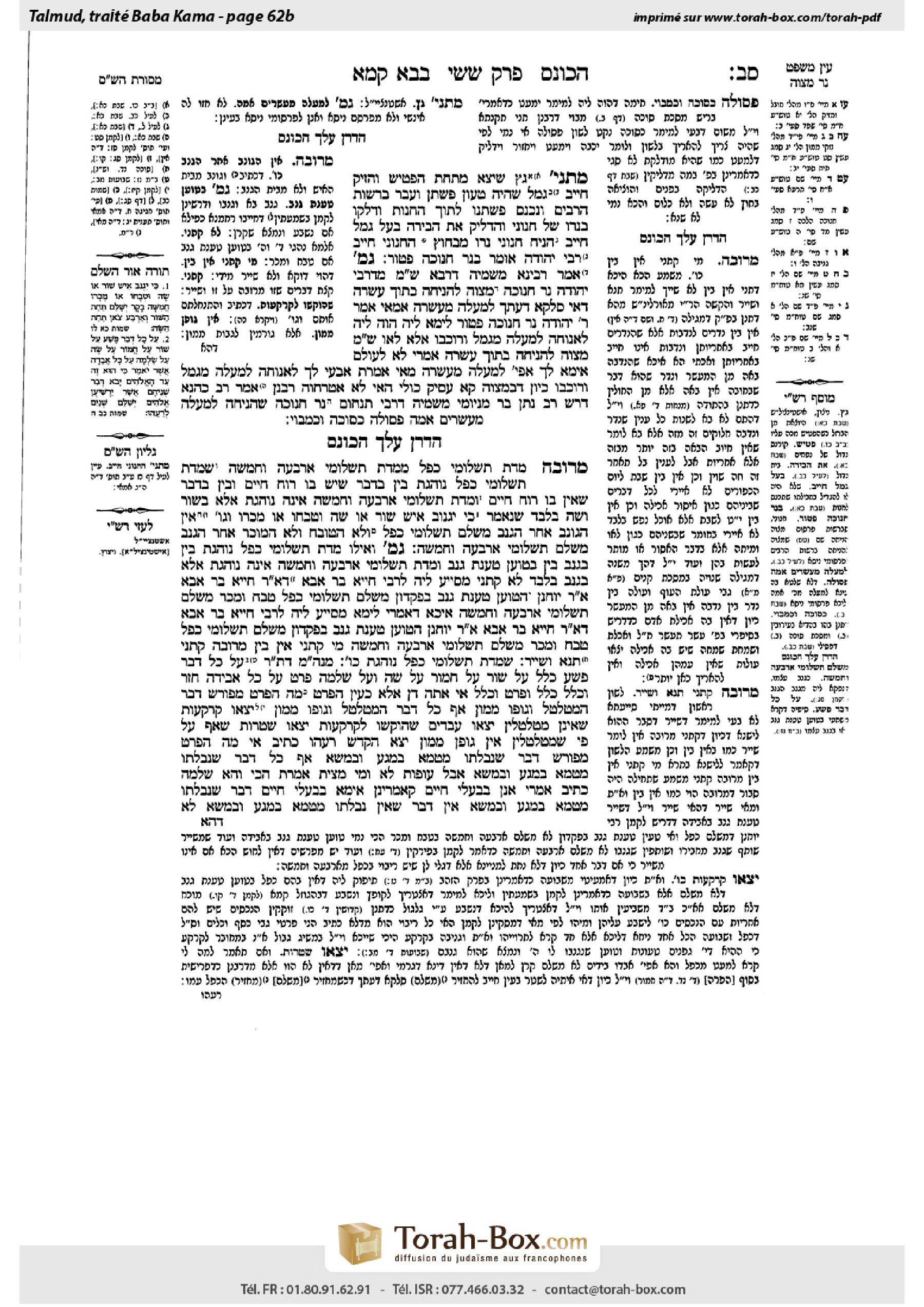
Bava Kamma 62b: Talmud study for Daf Yomi
Study the Talmud for Daf Yomi with scanned pages, Hebrew text, English translations from Sefaria and AI-generated French translations.
Passage selection and English or AI-generated French translation are available where the scan has annotations. Daf Study is independent of Torah-Box and Sefaria.
Browse Bava Kamma · בבא קמא · All tractatesBava Kamma 62b text and translations
This page of Bava Kamma includes the Aramaic text, an English translation and an AI-generated French translation, alongside the scan above.
בבא קמא ס״ב ב · Aramaic and Hebrew text
מַתְנִי׳ גֵּץ שֶׁיָּצָא מִתַּחַת הַפַּטִּישׁ וְהִזִּיק – חַיָּיב.
גָּמָל שֶׁהָיָה טָעוּן פִּשְׁתָּן, וְעָבַר בִּרְשׁוּת הָרַבִּים, וְנִכְנְסָה פִּשְׁתָּנוֹ לְתוֹךְ הַחֲנוּת וְדָלְקָה בְּנֵרוֹ שֶׁל חֶנְוָנִי, וְהִדְלִיק אֶת הַבִּירָה – בַּעַל גָּמָל חַיָּיב. הִנִּיחַ חֶנְוָנִי נֵרוֹ מִבַּחוּץ – הַחֶנְוָנִי חַיָּיב. רַבִּי יְהוּדָה אוֹמֵר: בְּנֵר חֲנוּכָּה – פָּטוּר.
גְּמָ׳ אָמַר רָבִינָא מִשְּׁמֵיהּ דְּרָבָא: שְׁמַע מִינַּהּ מִדְּרַבִּי יְהוּדָה, נֵר חֲנוּכָּה – מִצְוָה לְהַנִּיחָהּ בְּתוֹךְ עֲשָׂרָה. דְּאִי סָלְקָא דַּעְתָּךְ לְמַעְלָה מֵעֲשָׂרָה, אַמַּאי אָמַר רַבִּי יְהוּדָה: נֵר חֲנוּכָּה פָּטוּר? לֵימָא לֵיהּ: הֲוָה לֵיהּ לְאַנּוֹחַהּ לְמַעְלָה מִגָּמָל וְרוֹכְבוֹ! אֶלָּא לָאו שְׁמַע מִינַּהּ: מִצְוָה לְהַנִּיחָהּ בְּתוֹךְ עֲשָׂרָה?
אָמְרִי: לָא; לְעוֹלָם אֵימָא לָךְ אֲפִילּוּ לְמַעְלָה מֵעֲשָׂרָה, מַאי אָמְרַתְּ – אִבְּעִי לָךְ לְאַנּוֹחַהּ לְמַעְלָה מִגָּמָל וְרוֹכְבוֹ? כֵּיוָן דִּבְמִצְוָה קָא עָסֵיק, כּוּלֵּי הַאי לָא אַטְרְחוּהּ רַבָּנַן.
אָמַר רַב כָּהֲנָא, דָּרֵשׁ רַב נָתָן בַּר מִנְיוֹמֵי מִשְּׁמֵיהּ דְּרַבִּי תַּנְחוּם: נֵר חֲנוּכָּה שֶׁהִנִּיחָהּ לְמַעְלָה מֵעֶשְׂרִים אַמָּה – פְּסוּלָה, כְּסוּכָּה וּכְמָבוֹי.
הֲדַרַן עֲלָךְ הַכּוֹנֵס.
מַתְנִי׳ מְרוּבָּה מִדַּת תַּשְׁלוּמֵי כֶפֶל מִמִּדַּת תַּשְׁלוּמֵי אַרְבָּעָה וַחֲמִשָּׁה. שֶׁמִּדַּת תַּשְׁלוּמֵי כֶפֶל נוֹהֶגֶת בֵּין בְּדָבָר שֶׁיֵּשׁ בּוֹ רוּחַ חַיִּים וּבֵין בְּדָבָר שֶׁאֵין בּוֹ רוּחַ חַיִּים, וּמִדַּת תַּשְׁלוּמֵי אַרְבָּעָה וַחֲמִשָּׁה אֵינָהּ נוֹהֶגֶת אֶלָּא בְּשׁוֹר וָשֶׂה בִּלְבַד – שֶׁנֶּאֱמַר: ״כִּי יִגְנֹב אִישׁ שׁוֹר אוֹ שֶׂה וּטְבָחוֹ אוֹ מְכָרוֹ וְגוֹ׳״.
אֵין הַגּוֹנֵב אַחַר הַגַּנָּב מְשַׁלֵּם תַּשְׁלוּמֵי כֶפֶל, וְלֹא הַטּוֹבֵחַ וְלֹא הַמּוֹכֵר אַחַר הַגַּנָּב מְשַׁלֵּם תַּשְׁלוּמֵי אַרְבָּעָה וַחֲמִשָּׁה.
גְּמָ׳ וְאִילּוּ ״מִדַּת תַּשְׁלוּמֵי כֶפֶל נוֹהֶגֶת בֵּין בְּגַנָּב בֵּין בְּטוֹעֵן טַעֲנַת גַּנָּב, וּמִדַּת תַּשְׁלוּמֵי אַרְבָּעָה וַחֲמִשָּׁה אֵינָהּ נוֹהֶגֶת אֶלָּא בְּגַנָּב בִּלְבַד״ – לָא קָתָנֵי.
מְסַיַּיע לֵיהּ לְרַבִּי חִיָּיא בַּר אַבָּא, דְּאָמַר רַבִּי חִיָּיא בַּר אַבָּא אָמַר רַבִּי יוֹחָנָן: הַטּוֹעֵן טַעֲנַת גַּנָּב בְּפִקָּדוֹן – מְשַׁלֵּם תַּשְׁלוּמֵי כֶפֶל. טָבַח וּמָכַר – מְשַׁלֵּם תַּשְׁלוּמֵי אַרְבָּעָה וַחֲמִשָּׁה.
אִיכָּא דְאָמְרִי: לֵימָא מְסַיַּיע לֵיהּ לְרַבִּי חִיָּיא בַּר אַבָּא – דְּאָמַר רַבִּי חִיָּיא בַּר אַבָּא אָמַר רַבִּי יוֹחָנָן: הַטּוֹעֵן טַעֲנַת גַּנָּב בְּפִקָּדוֹן – מְשַׁלֵּם תַּשְׁלוּמֵי כֶפֶל. טָבַח וּמָכַר – מְשַׁלֵּם תַּשְׁלוּמֵי אַרְבָּעָה וַחֲמִשָּׁה?
מִי קָתָנֵי: ״אֵין בֵּין״?! ״מְרוּבָּה״ קָתָנֵי – תְּנָא וְשַׁיַּיר.
שֶׁמִּדַּת תַּשְׁלוּמֵי כֶפֶל נוֹהֶגֶת כּוּ׳. מְנָא הָנֵי מִילֵּי דְּתָנוּ רַבָּנַן: ״עַל כׇּל דְּבַר פֶּשַׁע״ – כָּלַל, ״עַל שׁוֹר, עַל חֲמוֹר, עַל שֶׂה וְעַל שַׂלְמָה״ – פָּרַט, ״עַל כׇּל אֲבֵדָה״ – חָזַר וְכָלַל;
כְּלָל וּפְרָט וּכְלָל – אִי אַתָּה דָן אֶלָּא כְּעֵין הַפְּרָט; מָה הַפְּרָט מְפוֹרָשׁ – דָּבָר הַמִּטַּלְטֵל וְגוּפוֹ מָמוֹן, אַף כֹּל דָּבָר הַמִּטַּלְטֵל וְגוּפוֹ מָמוֹן.
יָצְאוּ קַרְקָעוֹת – שֶׁאֵינָן מִטַּלְטְלִין; יָצְאוּ עֲבָדִים – שֶׁהוּקְּשׁוּ לְקַרְקָעוֹת; יָצְאוּ שְׁטָרוֹת – שֶׁאַף עַל פִּי שֶׁמִּטַּלְטְלִין, אֵין גּוּפָן מָמוֹן; יָצָא הֶקְדֵּשׁ – ״רֵעֵהוּ״ כְּתִיב.
אִי, מָה הַפְּרָט מְפוֹרָשׁ – דָּבָר שֶׁנִּבְלָתוֹ מְטַמְּאָ[ה] בְּמַגָּע וּבְמַשָּׂא, אַף כֹּל דָּבָר שֶׁנִּבְלָתוֹ מְטַמְּאָ[ה] בְּמַגָּע וּבְמַשָּׂא, אֲבָל עוֹפוֹת לָא!
וּמִי מָצֵית אָמְרַתְּ הָכִי? וְהָא ״שַׂלְמָה״ כְּתִיב! אָמְרִי: אֲנַן בְּבַעֲלֵי חַיִּים קָאָמְרִינַן; אֵימָא בְּבַעֲלֵי חַיִּים, דָּבָר שֶׁנִּבְלָתוֹ מְטַמְּאָ[ה] בְּמַגָּע וּבְמַשָּׂא – אִין, דָּבָר שֶׁאֵין נִבְלָתוֹ מְטַמְּאָ[ה] בְּמַגָּע וּבְמַשָּׂא – לָא,
Bava Kamma 62b · English translation
MISHNA: In the case of a spark that emerged from under the hammer of a blacksmith and started a fire, causing damage, the blacksmith is liable for the damage caused.
In the case of a camel that was laden with flax and was passing through the public domain, and its flax extended into a store and the flax caught fire from a lamp in the store belonging to the storekeeper, and as a result of the burning flax the camel set fire to the building together with all its contents, the owner of the camel is liable. But if the storekeeper placed his lamp outside, thereby causing the flax on the camel to catch fire, and consequently the building was set on fire, the storekeeper is liable. Rabbi Yehuda says: In a case where the lamp placed outside was a Hanukkah lamp, the storekeeper is exempt, since it is a mitzva for a Hanukkah lamp to be placed outside.
GEMARA: Ravina said in the name of Rava: Conclude from Rabbi Yehuda’s statement that the mitzva is to place the Hanukkah lamp within a height of ten handbreadths from the ground as, if it enters your mind to say that the mitzva can also be fulfilled by placing it above ten handbreadths, why did Rabbi Yehuda say that in the case of a Hanukkah lamp placed outside, the storekeeper is exempt? Let the owner of the camel say to the storekeeper: You should have placed the lamp above the height of a camel and its rider so that the flax would not catch fire. Rather, must one not conclude from here that Rabbi Yehuda’s opinion is that the mitzva is to place it within ten handbreadths of the ground and not higher?
The Sages say in response: No, there is no proof from here. Actually, I could say to you that one may place a Hanukkah lamp even above a height of ten handbreadths, and as for what you said, that the owner of the camel can claim: You should have placed the lamp above the height of a camel and its rider, in response to this one can say: Since the store owner is performing a mitzva by placing his Hanukkah lamp outside, the Sages did not trouble him to such an extent to have him place his lamp at a height that would be inconvenient for him to reach.
Further on the subject of the height of a Hanukkah lamp, Rav Kahana says that Rav Natan bar Minyumi taught in the name of Rabbi Tanḥum: A Hanukkah lamp that is placed higher than twenty cubits from the ground is unfit to be used for the mitzva, since people do not generally look up to such a height, and the main purpose of the Hanukkah lamp is for it to be seen by others. In this regard, the halakha of the height of a Hanukkah lamp is like the halakha of the height of a sukka and the halakha of the height of a cross beam at the entrance to an alleyway, which are unfit for their respective purposes if they are higher than twenty cubits.
MISHNA: The principle of double payment applies more broadly than the principle of fourfold or fivefold payment, as the principle of double payment applies both to the theft of something that is alive and to the theft of something that is not alive, but the principle of fourfold or fivefold payment applies only to the theft of an ox or a sheep, as it is stated: “If a man steal an ox or a sheep, and slaughter it or sell it, he shall pay five oxen for an ox and four sheep for a sheep” (Exodus 21:37).
Having stated a limitation to the halakha of fourfold and fivefold payment, the mishna mentions a further limitation, which applies to all three types of payments. One who steals an item after a thief has already stolen it, i.e., one who steals a stolen item, does not pay the double payment to the thief or to the prior owner, nor does one who slaughters or sells an ox or a sheep after a thief has already stolen it pay the fourfold or fivefold payment. Rather, he pays only the principal, i.e., the value of the item he stole.
GEMARA: The mishna teaches one particular difference between double payment and fourfold or fivefold payment, while it does not teach this difference between them: The principle of double payment applies both in the case of a thief and in the case of a bailee who falsely states the claim that a thief stole the deposit entrusted to him and who takes an oath to that effect. But the principle of fourfold or fivefold payment applies only in the case of a thief, not in the case of one who falsely claims that a deposit was stolen.
The fact that the mishna does not teach the latter distinction supports the opinion of Rabbi Ḥiyya bar Abba, as Rabbi Ḥiyya bar Abba says that Rabbi Yoḥanan says: In the case of one who falsely states the claim that a thief stole a deposit from him, and it is discovered that he himself is the thief, he pays double payment. And if the stolen item is an ox or sheep and he slaughtered or sold it, he pays the fourfold or fivefold payment. According to Rabbi Ḥiyya bar Abba, there is no difference between the applications of double payment and fourfold or fivefold payment in this case.
There are those who say a different version of this discussion: Let us say that the mishna supports the opinion of Rabbi Ḥiyya bar Abba, as Rabbi Ḥiyya bar Abba says that Rabbi Yoḥanan says: In the case of one who falsely states the claim that a thief stole a deposit from him, and it is discovered that he himself is the thief, he pays double payment. And if the stolen item is an ox or sheep, and he slaughtered or sold it, he pays the fourfold or fivefold payment.
The Gemara rejects the inference: Does the mishna teach that there is no difference between double payment and fourfold or fivefold payment except for the one mentioned in the mishna? It teaches merely that the principle of double payment applies more broadly than the principle of fourfold or fivefold payment, and it provides an example of this statement. This does not mean that this is the only difference, and it is possible that the tanna taught this one case and omitted others.
§ The mishna teaches that the principle of double payment applies both to the theft of something that is alive and to the theft of something that is not alive. The Gemara asks: From where are these matters derived? It is as the Sages taught in a baraita with regard to the verse that discusses double payment: “For any matter of trespass, whether it be for an ox, for a donkey, for a sheep, for a garment, or for any manner of lost thing about which one shall say: This is it, the claims of both of them shall come before the judges, the one whom the judges convict shall pay double to his neighbor” (Exodus 22:8). “For any matter of trespass” is a generalization; “whether it be for an ox, for a donkey, for a sheep, for a garment” is a detail. And when the verse states: “Or for any manner of lost thing,” it then generalizes again.
Consequently, this verse contains a generalization, and a detail, and a generalization, and one of the thirteen rules of exegesis states that in such a case you may deduce that the verse is referring only to items similar to the detail. Therefore, just as each of the items mentioned in the detail is clearly defined as an item that is movable property and has intrinsic monetary value, so too double payment is practiced with regard to any item that is movable property and has intrinsic monetary value.
Land is excluded, as it is not movable property. Canaanite slaves are excluded, as they are compared to land in many areas of halakha. Financial documents are excluded, as, although they are movable property, they do not have intrinsic monetary value. The value of the material on which the document is written is negligible; documents are valuable only because they serve as proof for monetary claims. Finally, consecrated property is excluded because it is written in the verse that the one found liable shall pay double to “his neighbor,” i.e., to another person, rather than to the Temple treasury.
The Gemara asks: If the halakha of double payment is limited to cases similar to the details mentioned in the verse, it should also be derived that just as each of the items mentioned in the detail is clearly defined as an item whose carcass transmits impurity through contact and carrying, so too any item whose carcass transmits impurity through contact and carrying it is subject to double payment. But birds, whose carcasses do not transmit impurity through contact or carrying, should not be subject to double payment.
The Gemara objects to the question: But how can you say this? But isn’t “garment” written in the list of specified items (Exodus 22:8)? It is impossible to speak of the impurity of carcasses with regard to clothing. The Gemara responds: Say, in response to this objection: We are speaking specifically of animals, and this is the question that was asked: Why not say that with regard to animals, an animal whose carcass transmits impurity through contact and carrying, yes, it is subject to double payment, whereas an animal whose carcass does not transmit impurity through contact and carrying, such as a bird, no, a thief would not pay double payment for stealing it?
Bava Kamma 62b · Traduction française (IA)
MICHNA: Dans le cas d'une étincelle provenant du marteau d'un forgeron et ayant provoqué un incendie, causant un préjudice, le forgeron est tenu responsable du préjudice causé.
Dans le cas d'un chameau chargé de lin passant par le domaine public, et dont le lin s'étendait dans un entrepôt, le lin s'embrasant à cause d'une lampe de l'entreprenant, et en conséquence du lin brûlant, le chameau a mis le bâtiment et tout son contenu à feu, le propriétaire du chameau est tenu responsable. Mais si l'entreprenant avait placé sa lampe à l'extérieur, provoquant ainsi l'embrasement du lin du chameau, et en conséquence le bâtiment a pris feu, l'entreprenant est tenu responsable. Rabbi Yéhuda dit : Dans le cas d'une lampe de Hanouka placée à l'extérieur, l'entreprenant est exempt, car il est un mitsva de placer une lampe de Hanouka à l'extérieur.
GUEMARA : Ravina a dit au nom de Rava : Concluez de la déclaration de Rabbi Yéhuda que la mitsva est de placer la lampe de Hanouka à une hauteur de dix paumes du sol, car si l'idée vous venait de dire que la mitsva peut être accomplie en la plaçant au-dessus de dix paumes, pourquoi Rabbi Yéhuda a-t-il dit que dans le cas d'une lampe de Hanouka placée à l'extérieur, l'entreprenant est exempt ? Laissez le propriétaire du chameau dire à l'entreprenant : Vous auriez dû placer la lampe au-dessus de la hauteur d'un chameau et de son cavalier afin que le lin ne s'embrase pas. Plutôt, ne doit-on pas conclure d'ici que l'opinion de Rabbi Yéhuda est que la mitsva est de la placer à dix paumes du sol et non plus haut ?
Les Sages répondent en disant : Non, il n'y a pas de preuve à partir de là. En réalité, je pourrais dire à vous que l'on peut placer une lampe de Hanouka même au-dessus d'une hauteur de dix paumes, et quant à ce que vous avez dit, que le propriétaire du chameau peut dire : Vous auriez dû placer la lampe au-dessus de la hauteur d'un chameau et de son cavalier, en réponse à cela, on peut dire : Puisque l'homme qui vend accomplit une mitsva en plaçant sa lampe de Hanouka à l'extérieur, les Sages ne l'ont pas gêné à ce point pour qu'il place sa lampe à une hauteur qui lui serait inconvenante.
En ce qui concerne la hauteur d'une lampe de Hanouka, Rav Kahana dit que Rav Natan bar Minyumi a enseigné au nom de Rabbi Tanḥum : Une lampe de Hanouka placée à une hauteur supérieure à vingt coudées du sol est inutilisable pour la mitsva, car les gens ne regardent généralement pas vers une telle hauteur, et le but principal d'une lampe de Hanouka est d'être vue par les autres. En ce sens, la halakha concernant la hauteur d'une lampe de Hanouka est semblable à celle concernant la hauteur d'une sukka et celle concernant la hauteur d'une poutre à l'entrée d'un passage, qui sont inutilisables pour leur usage respectif si elles sont supérieures à vingt coudées.
MICHNA : Le principe du double paiement s'applique plus largement que le principe du quadruple ou quintuple paiement, car le principe du double paiement s'applique à la fois au vol d'une chose vivante et au vol d'une chose non vivante, mais le principe du quadruple ou quintuple paiement s'applique uniquement au vol d'un bœuf ou d'une brebis, comme il est dit : « Si un homme vole un bœuf ou une brebis, et le tue ou le vend, il devra payer cinq bœufs pour un bœuf et quatre brebis pour une brebis » (Exode 21:37).
Ayant établi une limitation concernant la halakha du quadruple et quintuple paiement, la mishna mentionne une autre limitation qui s'applique à tous les trois types de paiements. Celui qui vole un objet après que quelqu'un d'autre ait déjà volé un objet, c'est-à-dire celui qui vole un objet volé, ne paie pas le double paiement au voleur ou à l'ancien propriétaire, ni celui qui tue ou vend un bœuf ou une brebis après que quelqu'un d'autre ait déjà volé un objet ne paie pas le quadruple ou quintuple paiement. Il paie seulement la valeur de l'objet qu'il a volé.
GUEMARA : La mishna enseigne une différence particulière entre le double paiement et le quadruple ou quintuple paiement, tout en ne mentionnant pas cette différence entre eux : Le principe du double paiement s'applique à la fois dans le cas d'un voleur et dans le cas d'un dépositaire qui affirme faussement que le dépôt confié à lui a été volé et qui prend un serment à cet égard. Mais le principe du quadruple ou quintuple paiement s'applique uniquement dans le cas d'un voleur, pas dans le cas d'une personne qui affirme faussement que le dépôt a été volé.
Le fait que la mishna ne mentionne pas cette différence secondaire soutient l'opinion de Rabbi Ḥiyya bar Abba, car Rabbi Ḥiyya bar Abba dit que Rabbi Yoḥanan dit : Dans le cas d'une personne qui affirme faussement que le dépôt a été volé par un voleur, et qu'il est découvert qu'il est lui-même le voleur, il paie le double paiement. Et si l'objet volé est un bœuf ou une brebis et qu'il l'a tué ou vendu, il paie le quadruple ou quintuple paiement. Selon Rabbi Ḥiyya bar Abba, il n'y a pas de différence entre l'application du double paiement et du quadruple ou quintuple paiement dans ce cas.
Certains disent une version différente de cette discussion : Disons que la Michna soutient l'opinion de Rabbi Ḥiyya bar Abba, car Rabbi Ḥiyya bar Abba dit que Rabbi Yoḥanan dit : Dans le cas d'une personne qui affirme faussement que le dépôt a été volé par un voleur, et qu'il est découvert qu'il est lui-même le voleur, il paie le double paiement. Et si l'objet volé est un bœuf ou une brebis, et qu'il l'a tué ou vendu, il paie le quadruple ou quintuple paiement.
La Guemara rejette cette déduction : La Michna enseigne-t-elle que la seule différence entre le double paiement et le quadruple ou quintuple paiement est celle mentionnée dans la Michna ? Elle enseigne simplement que le principe du double paiement s'applique plus largement que celui du quadruple ou quintuple paiement, et elle fournit un exemple de cette affirmation. Cela ne signifie pas que cette est la seule différence, et il est possible que le tanna ait enseigné ce cas-là et ait omis d'autres.
§ La Michna enseigne que le principe du double paiement s'applique à la fois au vol d'un objet vivant et au vol d'un objet non vivant. La Guemara pose la question : D'où sont dérivés ces enseignements ? C'est comme les Sages l'ont enseigné dans une baraïta concernant la parole qui parle du double paiement : « Pour toute affaire de vol, qu'il s'agisse d'un bœuf, d'un âne, d'une brebis, d'un vêtement, ou de toute chose perdue dont on dira : C'est cela, les revendications des deux parties viendront devant les juges, celui que les juges condamneront paiera double à son voisin » (Exode 22:8). « Pour toute affaire de vol » est une généralisation ; « qu'il s'agisse d'un bœuf, d'un âne, d'une brebis, d'un vêtement » est un détail. Et lorsque la parole dit : « Ou de toute chose perdue », elle généralise à nouveau.
Par conséquent, cette parole contient une généralisation, un détail, une généralisation, et l'une des treize règles d'exégèse stipule que dans un tel cas, on peut déduire que la parole fait référence uniquement aux objets semblables au détail. Ainsi, comme chaque objet mentionné dans le détail est clairement défini comme un objet mobile ayant une valeur monétaire intrinsèque, de même le double paiement s'applique à tout objet mobile ayant une valeur monétaire intrinsèque.
La terre est exclue, car elle n'est pas un objet mobile. Les esclaves cananéens sont exclus, car ils sont comparés à la terre dans de nombreux domaines de halakha. Les documents financiers sont exclus, car, bien qu'ils soient des objets mobiles, ils n'ont pas de valeur monétaire intrinsèque. La valeur du matériel sur lequel est écrit le document est négligeable ; les documents sont précieux uniquement parce qu'ils servent de preuve pour les revendications monétaires. Enfin, la propriété consacrée est exclue, car il est écrit dans la parole que celui qui est trouvé coupable paiera double à « son voisin », c'est-à-dire à une autre personne, et non au trésor du Temple.
La Guemara pose la question : Si la halakha du double paiement est limitée aux cas semblables aux détails mentionnés dans la parole, il devrait aussi être déduit que, comme chaque objet mentionné dans le détail est clairement défini comme un objet dont le cadavre transmet l'impureté par contact et par transport, de même tout objet dont le cadavre transmet l'impureté par contact et par transport est soumis au double paiement. Mais les oiseaux, dont les cadavres ne transmettent pas l'impureté par contact ou par transport, ne devraient pas être soumis au double paiement.
La Guemara s'oppose à cette question : Mais comment pouvez-vous dire cela ? Mais n'est-ce pas que « vêtement » est écrit dans la liste des objets spécifiés (Exode 22:8) ? Il est impossible de parler de l'impureté des cadavres concernant les vêtements. La Guemara répond : Dites, en réponse à cette objection : Nous parlons spécifiquement des animaux, et c'est cette question qui a été posée : Pourquoi ne pas dire que concernant les animaux, un animal dont le cadavre transmet l'impureté par contact et par transport, oui, il est soumis au double paiement, tandis qu'un animal dont le cadavre ne transmet pas l'impureté par contact et par transport, comme un oiseau, non, un voleur ne paiera pas double pour avoir volé ce dernier ?
Traduction française générée par IA à partir de l’édition anglaise de Sefaria. Vérifie toujours un passage avec le texte source.
Text from Sefaria: William Davidson Edition - Vocalized Aramaic (CC BY NC); William Davidson Edition - English (CC BY NC).