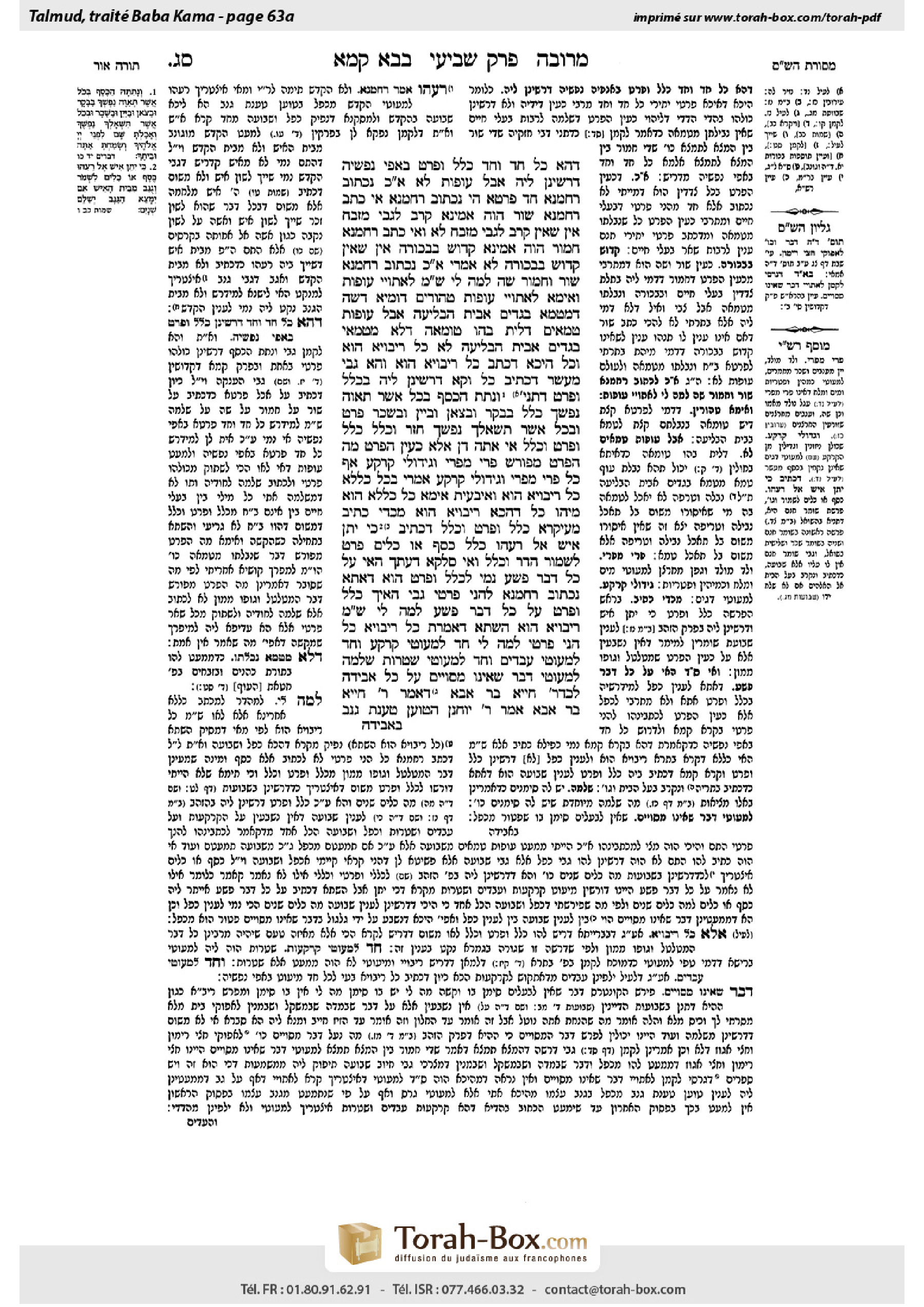
Bava Kamma 63a: Talmud study for Daf Yomi
Study the Talmud for Daf Yomi with scanned pages, Hebrew text, English translations from Sefaria and AI-generated French translations.
Passage selection and English or AI-generated French translation are available where the scan has annotations. Daf Study is independent of Torah-Box and Sefaria.
Browse Bava Kamma · בבא קמא · All tractatesBava Kamma 63a text and translations
This page of Bava Kamma includes the Aramaic text, an English translation and an AI-generated French translation, alongside the scan above.
בבא קמא ס״ג א · Aramaic and Hebrew text
דְּהָא כֹּל חַד וְחַד כְּלָל וּפְרָט בְּאַפֵּי נַפְשֵׁיהּ דָּרְשִׁינַן לֵיהּ; אֲבָל עוֹפוֹת – לָא!
אִם כֵּן, נִכְתּוֹב רַחֲמָנָא חַד פְּרָטָא!
הֵי נִכְתּוֹב רַחֲמָנָא? אִי כְּתַב רַחֲמָנָא ״שׁוֹר״, הֲוָה אָמֵינָא: קָרֵב לְגַבֵּי מִזְבֵּחַ – אִין, שֶׁאֵין קָרֵב לְגַבֵּי מִזְבֵּחַ – לָא. וְאִי כְּתַב רַחֲמָנָא ״חֲמוֹר״, הֲוָה אָמֵינָא קָדוֹשׁ בִּבְכוֹרָה – אִין, שֶׁאֵין קָדוֹשׁ בִּבְכוֹרָה – לָא!
אָמְרִי: אִם כֵּן, נִכְתּוֹב רַחֲמָנָא ״שׁוֹר וַחֲמוֹר״, ״שֶׂה״ לְמָה לִי? שְׁמַע מִינַּהּ לְאֵתוֹיֵי עוֹפוֹת.
וְאֵימָא לְאֵתוֹיֵי עוֹפוֹת טְהוֹרִים – דּוּמְיָא דְשֶׂה, דִּמְטַמֵּא בְּגָדִים אַבֵּית הַבְּלִיעָה; אֲבָל עוֹפוֹת טְמֵאִים – דְּלֵית בְּהוּ טוּמְאָה, דְּלָא מְטַמְּאִי בְּגָדִים אַבֵּית הַבְּלִיעָה, לָא! ״כֹּל״ – רִיבּוּיָא הוּא.
וְכֹל הֵיכָא דִּכְתַב ״כֹּל״ – רִיבּוּיָא הוּא? וְהָא גַּבֵּי מַעֲשֵׂר, דִּכְתִיב ״כֹּל״, וְקָא דָרְשִׁינַן לֵיהּ בִּכְלָל וּפְרָט!
דְּתַנְיָא: ״וְנָתַתָּ הַכֶּסֶף בְּכֹל אֲשֶׁר תְּאַוֶּה נַפְשְׁךָ״ – כָּלַל, ״בַּבָּקָר וּבַצֹּאן וּבַיַּיִן וּבַשֵּׁכָר״ – פָּרַט, ״וּבְכֹל אֲשֶׁר תִּשְׁאׇלְךָ נַפְשֶׁךָ״ – חָזַר וְכָלַל; כְּלָל וּפְרָט וּכְלָל – אִי אַתָּה דָן אֶלָּא כְּעֵין הַפְּרָט, מָה הַפְּרָט מְפוֹרָשׁ – פְּרִי מִפְּרִי וְגִידּוּלֵי קַרְקַע, אַף כֹּל פְּרִי מִפְּרִי וְגִידּוּלֵי קַרְקַע.
אָמְרִי: ״בַּכֹּל״ – כְּלָלָא, ״כֹּל״ – רִיבּוּיָא הוּא. וְאִיבָּעֵית אֵימָא: ״כֹּל״ – כְּלָלָא הוּא, מִיהוּ ״כֹּל״ דְּהָכָא – רִיבּוּיָא הוּא.
מִכְּדֵי כְּתִיב מֵעִיקָּרָא כְּלָל וּפְרָט וּכְלָל – דִּכְתִיב: ״כִּי יִתֵּן אִישׁ אֶל רֵעֵהוּ״ – כָּלַל, ״כֶּסֶף אוֹ כֵלִים״ – פָּרַט, ״לִשְׁמוֹר״ – (הֲדַר) [חָזַר] וְכָלַל;
וְאִי סָלְקָא דַעְתָּךְ הַאי ״עַל כׇּל דְּבַר פֶּשַׁע״ נָמֵי לִכְלָל וּפְרָט הוּא דַּאֲתָא, נִכְתּוֹב רַחֲמָנָא לְהָנֵי פְּרָטֵי גַּבֵּי הַאיְךְ כְּלָל וּפְרָט; ״עַל כׇּל דְּבַר פֶּשַׁע״ לְמָה לִי? שְׁמַע מִינַּהּ: רִיבּוּיָא הוּא.
הַשְׁתָּא דְּאָמְרַתְּ ״כֹּל״ – רִיבּוּיָא, כֹּל הָנֵי פְּרָטֵי לְמָה לִי? חַד לְמַעוֹטֵי קַרְקַע, וְחַד לְמַעוֹטֵי עֲבָדִים, וְחַד לְמַעוֹטֵי שְׁטָרוֹת. ״שַׂלְמָה״ – לְמַעוֹטֵי דָּבָר שֶׁאֵינוֹ מְסוּיָּים, ״עַל כׇּל אֲבֵדָה״ – לְכִדְרַבִּי חִיָּיא בַּר אַבָּא, דְּאָמַר רַבִּי חִיָּיא בַּר אַבָּא אָמַר רַבִּי יוֹחָנָן: הַטּוֹעֵן טַעֲנַת גַּנָּב
Bava Kamma 63a · English translation
This line of reasoning is correct, because we expound each one of the listed items in the generalization, and detail, and generalization by itself. Each item is treated individually as representing a category, but the different items are not grouped together into one broad category. Since several animals are listed, it is concluded that if the stolen item is an animal it must resemble the listed animals. But since birds do not transmit impurity through contact or carrying, they are not subject to double payment.
The Gemara rejects this: If so, let the Merciful One write just one detail, i.e., animal, and that would have been enough to teach that animals are subject to double payment only if they transmit impurity through contact and carrying, so birds are excluded. Since the Torah listed several animals, birds are included.
The Gemara questions this assertion: Which individual animal should the Merciful One have written? If the Merciful One had written only “ox,” I would say that only an animal that is similar to an ox, in that it is sacrificed on the altar, yes, it is subject to double payment. But an animal that is not sacrificed on the altar, no, it is not subject to double payment. And if the Merciful One had written only “donkey,” I would say that only an animal that is similar to a donkey, in that its firstborn male offspring is sacred with the sanctity of a firstborn, yes, it is subject to double payment. But an animal that is not sacred with the sanctity of a firstborn, no, it is not subject to double payment. The principle of double payment would then include cattle, sheep, goats, and donkeys, but not other animals (see Exodus 13:13 and Deuteronomy 15:19).
The Gemara responds: Say in answer to this question: If so, if the Torah had wished to limit double payment to cases where cattle, sheep, goats, or donkeys were stolen, let the Merciful One write just “ox” and “donkey”; why do I need the verse to mention “sheep”? Conclude from it that the Torah intends to include even animals that do not meet these criteria, e.g., birds.
The Gemara asks further: But say that the verse mentions sheep in order to include only kosher birds, which are similar to the sheep listed in the verse, in that a carcass of these birds renders both the one who eats it and his garments ritually impure when it passes through his esophagus, as the carcass of a sheep also transmits ritual impurity. But non-kosher birds, whose carcasses do not have ritual impurity at all, as they do not render either the one who eats them or his garments impure when they pass through his esophagus, no, they are not subject to double payment. The Gemara answers: The word “any [kol],” in the phrase “for any [kol] matter of trespass” is an amplification, and serves to include even non-kosher birds in the principle of double payment.
The Gemara asks: But is it so that anywhere that the Torah wrote the word kol it is an amplification? But isn’t it so that with regard to second tithe, the word kol is written in the verse: “And you shall bestow the money for whatever [bekhol] your soul desires, for oxen, or for sheep, or for wine, or for strong drink, or for whatever your soul asks of you” (Deuteronomy 14:26)? And yet we expound that verse as a generalization, and a detail, and a generalization.
As it is taught in a baraita: “And you shall bestow the money for whatever your soul desires,” is a generalization, as no particular type of food is specified. “For oxen, or for sheep, or for wine, or for strong drink,” is a detail, as specific types of food are mentioned. When the verse concludes with “or for whatever your soul asks of you,” it has generalized again. Since the verse is formulated as a generalization, and a detail, and a generalization, you may deduce that the verse is referring only to items similar to the detail. This indicates that just as each of the items mentioned in the detail is clearly defined as the produce of produce, i.e., they grow from a parent organism, e.g., agricultural produce or animals, and they are grown from the ground, i.e., their sustenance comes from the ground, so too the category of items one may purchase with second-tithe money includes all items that are the produce of produce and are grown from the ground.
The Gemara responds: Say in answer to this question that the term bekhol is a generalization, whereas the term kol is an amplification. And if you wish, say an alternate answer: The word kol is usually a generalization. But the word kol that is written here, in the verse concerning double payment (Exodus 22:8), is an exception. It is regarded as an amplification, as the Gemara will explain.
After all, there is another generalization, and a detail, and a generalization written at the beginning of this passage, as it is written: “If a man gives his neighbor money or vessels to safeguard and it was stolen from the house of the man, if the thief shall be found he shall pay double” (Exodus 22:6). “If a man gives his neighbor” is a generalization. “Money or vessels” is a detail. When the verse concludes “to safeguard,” it has generalized again.
And if it enters your mind to say that this later verse: “For any matter of trespass” (Exodus 22:8), is also coming to state a generalization, and a detail, and a generalization, let the Merciful One write these details, i.e., ox, donkey, sheep, and garment, which are cited in the later verse, together with that previous generalization, and detail, and generalization. Why do I need the latter verse beginning with “for any matter of trespass”? Conclude from it that the word kol is an amplification in this instance, and it includes all animals.
The Gemara asks: Now that you said that the word kol is an amplification, why do I need all these details listed in the verse, i.e., ox, donkey, sheep, and garment? The Gemara answers: As for the three animals listed, one is mentioned to exclude land, one to exclude Canaanite slaves, and one to exclude financial documents. The example of a garment is mentioned to exclude an item that is not clearly delineated in size or quantity. “Or for any manner of lost thing” is written to teach that which Rabbi Ḥiyya bar Abba says, as Rabbi Ḥiyya bar Abba says that Rabbi Yoḥanan says: With regard to one who falsely states the claim that a thief stole
Bava Kamma 63a · Traduction française (IA)
Cette ligne de raisonnement est correcte, car nous développons chaque élément des généralisations mentionnées, détaillons et la généralisation elle-même. Chaque élément est traité individuellement comme représentant une catégorie, mais les différents éléments ne sont pas regroupés dans une seule catégorie générale. Puisque plusieurs animaux sont mentionnés, on conclut que si l'objet volé est un animal, il doit ressembler aux animaux mentionnés. Cependant, puisque les oiseaux ne transmettent pas l'impureté par contact ou par transport, ils ne sont pas soumis à un paiement double.
La Guemara rejette cela : Si c'est ainsi, que le Bienveillant ait écrit simplement un détail, c'est-à-dire l'animal, ce serait suffisant pour enseigner que les animaux sont soumis à un paiement double uniquement s'ils transmettent l'impureté par contact et par transport, donc les oiseaux sont exclus. Puisque la Torah a mentionné plusieurs animaux, les oiseaux sont inclus.
La Guemara questionne cette affirmation : Quel animal individuel le Bienveillant aurait-il dû écrire ? Si le Bienveillant avait écrit seulement « bœuf », je dirais que seul un animal ressemblant au bœuf, celui qui est sacrifié sur l'autel, oui, est soumis à un paiement double. Mais un animal qui n'est pas sacrifié sur l'autel, non, n'est pas soumis à un paiement double. Et si le Bienveillant avait écrit seulement « âne », je dirais que seul un animal ressemblant à l'âne, celui dont le premier mâle est sacré avec la sanctité du premier-né, oui, est soumis à un paiement double. Mais un animal qui n'est pas sacré avec la sanctité du premier-né, non, n'est pas soumis à un paiement double. Le principe du paiement double inclurait alors les bovins, les moutons, les chèvres et les ânes, mais pas les autres animaux (voir Exode 13:13 et Deutéronome 15:19).
La Guemara répond : Dites en réponse à cette question : Si c'est ainsi, si la Torah avait souhaité limiter le paiement double aux cas où des bovins, des moutons, des chèvres ou des ânes étaient volés, pourquoi ne s'est-elle pas contentée d'écrire simplement « bœuf » et « âne » ? Pourquoi ai-je besoin de la mention « mouton » dans la parole ? Concluez-en qu'elle veut inclure même des animaux qui ne remplissent pas ces critères, par exemple les oiseaux.
La Guemara pose une question supplémentaire : Mais disons que la mention des moutons a lieu pour inclure uniquement les oiseaux kasher, qui sont semblables aux moutons mentionnés dans la parole, car la carcasse de ces oiseaux rend à la fois celui qui les mange et ses vêtements impurs lorsqu'ils passent par son œsophage, comme la carcasse du mouton transmet l'impureté rituelle. Les oiseaux non kasher, dont la carcasse ne transmet aucune impureté rituelle, car ils ne rendent ni celui qui les mange ni ses vêtements impurs lorsqu'ils passent par son œsophage, ne sont donc pas soumis à un paiement double. La Guemara répond : Le mot « tout [kol] », dans la phrase « pour toute chose de transgression », est une amplification, et sert à inclure même les oiseaux non kasher dans le principe du paiement double.
La Guemara pose une question : Mais est-ce que partout où la Torah a écrit le mot kol, c'est une amplification ? Mais n'est-ce pas aussi que, concernant la deuxième part, le mot kol est écrit dans la parole : « Et tu donneras l'argent pour toute chose que ton âme désire, pour des bœufs, ou pour des moutons, ou pour du vin, ou pour du vin fort, ou pour toute chose que ton âme demande de toi » (Deutéronome 14:26) ? Et pourtant, nous développons cette parole comme une généralisation, un détail, et une généralisation.
Comme il est enseigné dans une baraïta : « Et tu donneras l'argent pour toute chose que ton âme désire », est une généralisation, car aucun type particulier de nourriture n'est spécifié. « Pour des bœufs, ou pour des moutons, ou pour du vin, ou pour du vin fort », est un détail, car des types spécifiques de nourriture sont mentionnés. Lorsque la parole se termine par « ou pour toute chose que ton âme demande de toi », elle généralise à nouveau. Puisque la parole est formulée comme une généralisation, un détail, et une généralisation, vous pouvez déduire que la parole fait référence uniquement aux choses semblables au détail. Cela indique que tout comme chaque élément mentionné dans le détail est clairement défini comme le produit du produit, c'est-à-dire qu'ils croissent à partir d'un organisme parent, par exemple les produits agricoles ou les animaux, et qu'ils sont cultivés à partir du sol, c'est-à-dire que leur nourriture provient du sol, ainsi la catégorie des choses que l'on peut acheter avec l'argent de la deuxième part inclut toutes les choses qui sont le produit du produit et qui sont cultivées à partir du sol.
La Guemara répond : Dites en réponse à cette question que le terme bekhol est une généralisation, tandis que le terme kol est une amplification. Et si vous le souhaitez, dites une autre réponse : le mot kol est généralement une généralisation. Mais le mot kol qui est écrit ici, dans la parole concernant le paiement double (Exode 22:8), est une exception. Il est considéré comme une amplification, comme la Guemara l'expliquera.
En effet, il y a une autre généralisation, un détail, et une généralisation écrite au début de ce passage, car il est écrit : « Si un homme donne à son voisin de l'argent ou des objets pour les garder et qu'ils ont été volés de la maison de l'homme, si le voleur est trouvé, il paiera double » (Exode 22:6). « Si un homme donne à son voisin » est une généralisation. « De l'argent ou des objets » est un détail. Lorsque la parole se termine par « pour les garder », elle généralise à nouveau.
Et si vous pensez que cette dernière parole : « Pour toute chose de transgression » (Exode 22:8) vient aussi affirmer une généralisation, un détail, et une généralisation, que le Bienveillant écrive ces détails, c'est-à-dire les bœufs, les ânes, les moutons et les vêtements mentionnés dans la dernière parole, ensemble avec cette généralisation, ce détail, et cette généralisation précédente. Pourquoi ai-je besoin de cette dernière parole commençant par « pour toute chose de transgression » ? Concluez-en qu'il s'agit d'une amplification ici, et qu'elle inclut tous les animaux.
La Guemara pose la question : Maintenant que vous avez dit que le mot kol est une amplification, pourquoi ai-je besoin de tous ces détails énumérés dans la versette, c'est-à-dire bœuf, âne, mouton et vêtement ? La Guemara répond : En ce qui concerne les trois animaux mentionnés, l'un est cité pour exclure les terres, l'autre pour exclure les esclaves cananéens, et l'autre pour exclure les documents financiers. L'exemple du vêtement est mentionné pour exclure un objet qui n'est pas clairement défini en termes de dimension ou de quantité. « Ou pour toute chose perdue » est écrit afin d'enseigner ce que dit Rabbi Ḥiyya bar Abba, comme dit Rabbi Ḥiyya bar Abba que Rabbi Yoḥanan dit : En ce qui concerne celui qui affirme faussement la revendication que un voleur a volé
Traduction française générée par IA à partir de l’édition anglaise de Sefaria. Vérifie toujours un passage avec le texte source.
Text from Sefaria: William Davidson Edition - Vocalized Aramaic (CC BY NC); William Davidson Edition - English (CC BY NC).